Abbreviations: MN = Majjhima_Nikaya (Middle Length Discourses of the Buddha) SN = Saṃyutta Nikāya (Connected Discourses of the Buddha) AN = Aṅguttara Nikāya (Numerical Discourses of the Buddha) DN = Dīgha Nikāya (Long Discourses of the Buddha)
The following course on Buddhism is based on the text The Middle Length Discourses of the Buddha: A New Translation of the Majjhima Nikaya. This course was recently suggested to me by my old friend Chuck Beatty. I plan to subject clear this course and record my thoughts.
In doing this course, it is important to have the following references handy.
KHTK Factor # 16: As forms combine and get more complex, their motion also gets increasingly complex.
With the expansion and consolidation of viewpoints and dimension points, the forms start to get increasingly complex. With the complexity of forms, the motion that is generated, also gets increasingly complex.
We can see this in the motion of a galaxy as compared to the motion of a planet. Or, we may observe it in the motion of the human body, as compared to the motion of an ant.
.
Scientology
Compare the above to the following factor in Scientology.
Scientology Factor # 16. The viewpoint can combine dimension points into forms and the forms can be simple or complex and can be at different distances from the viewpoints and so there can be combinations of form. And the forms are capable of motion and the viewpoints are capable of motion and so there can be motion of forms.
This Scientology Factor simply states how the motion of forms comes about.
“The term ‘physics’ is derived from this Greek word [physis] and meant…, originally, the endeavour of seeing the essential nature of all things… The Milesians… saw no distinction between animate and inanimate, spirit and matter. In fact, they did not even have a word for matter, since they saw all forms of existence as manifestations of the ‘physis’, endowed with life and spirituality…
“Heraclitus [c. 535 – c. 475] believed in a world of perpetual change, of eternal ‘Becoming’. For him, all static Being was based on deception and his universal principle was fire, a symbol for the continuous flow and change of all things. Heraclitus taught that all changes in the world arise from the dynamic and cyclic interplay of opposites and he saw any pair of opposites as a unity. This unity, which contains and transcends all opposing forces, he called the Logos.
“The split of this unity began with the Eleatic school, which assumed a Divine Principle standing above all gods and men. This principle was first identified with the unity of the universe, but was later seen as an intelligent and personal God who stands above the world and directs it. Thus began a trend of thought which led, ultimately, to the separation of spirit and matter and to a dualism which became characteristic of Western philosophy.
“A drastic step in this direction was taken by Parmenides of Elea [c. 515/540 -c. 450] who was in strong opposition to Heraclitus. He called his basic principle the Being and held that it was unique and invariable. He considered change to be impossible and regarded the changes we seem to perceive in the world as mere illusions of the senses. The concept of an indestructible substance as the subject of varying properties grew out of this philosophy and became one of the fundamental concepts of Western thought.
“In the fifth century B.C., the Greek philosophers tried to overcome the sharp contrast between the views of Parmenides and Heraclitus. In order to reconcile the idea of unchangeable Being (of Parmenides) with that of eternal Becoming (of Heraclitus), they assumed that the Being is manifest in certain invariable substances, the mixture and separation of which gives rise to the changes in the world.”
.
Parallel to Buddha’s principle of anatta in the East, is Heraclitus’ theory of perpetual change in the West. This happened just about the same time. A departure from this view was championed by Parmenides, who came up with the principle of Being. This principle was first identified with the unity of the universe, but was later seen as an intelligent and personal God who stands above the world and directs it. This departure came about from the logic to have a stable reference point for the perpetual change.
But for Buddha, underlying the principle of anatta was the principle of “oneness of reality” from the Vedas. In other words, there is no permanent substance but all that impermanence has “oneness,” in the sense that it is continuous, consistent and harmonious. Any random change from this “oneness” is an aberration. That aberration, ultimately, settles itself out.
So we have the stable reference point of “oneness of reality” in the East. But the stable reference point in the West became an “intelligent and personal God.”
KHTK Factor # 15: As reality is simplified according to principles, it is reduced to classification based on scales.
The viewpoint and dimension points, together, form our reality. As they expand they become complex. As they are consolidated they reduce to principles and relationships that appear as classifications.
Such classes may be arranged further into subclasses for analysis and understanding. All such classes and subclasses remain consistent per the dimensional scale principle.
.
Scientology
Compare the above to the following factor in Scientology.
Scientology Factor # 15. The dimension point can be different from other dimension points and thus can possess an individual quality. And many dimension points can possess a similar quality, and others can possess a similar quality unto themselves. Thus comes about the quality of classes of matter.
The system of classification emerges based on similarities and differences and according to the principle of dimensional scales.
.
Logic
The concept of classification is vital to logical analysis.
DC CIRCUIT,R-C CIRCUIT, R-L CIRCUIT, L-C CIRCUIT, AC CIRCUIT, IN PHASE, OUT OF PHASE, RMS VALUE, CAPACITIVE REACTANCE, IMPEDANCE (R-C CIRCUIT), INDUCTIVE REACTANCE, IMPEDANCE (R-L CIRCUIT), R-L-C CIRCUIT
.
GLOSSARY
For details on the following concepts, please consult Chapter 11.
DC CIRCUIT A DC (direct current) circuit generally consists of a battery acting as the energy source, through its EMF, and causing a steady voltage to act across one or more resistors, capacitors or inductors. In the steady state, after all transient phenomena have stopped, there is no voltage across an inductor, since the current is no longer changing. There is a steady voltage across a capacitor, equal to Q/C, but there is no current flowing to or from the capacitor. The voltage across a resistor will equal V = IR.
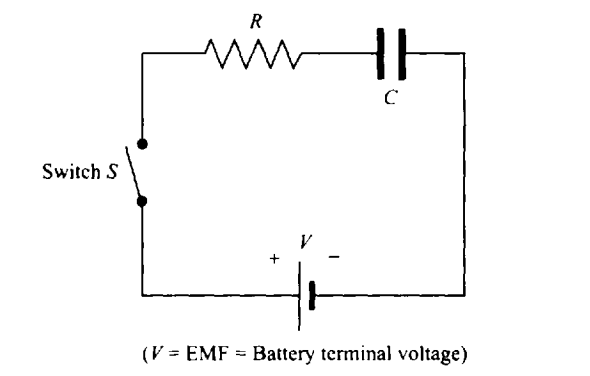
R-C CIRCUIT A DC circuit with a resistor R and a capacitor C shows a transient response when the switch is connected or disconnected.
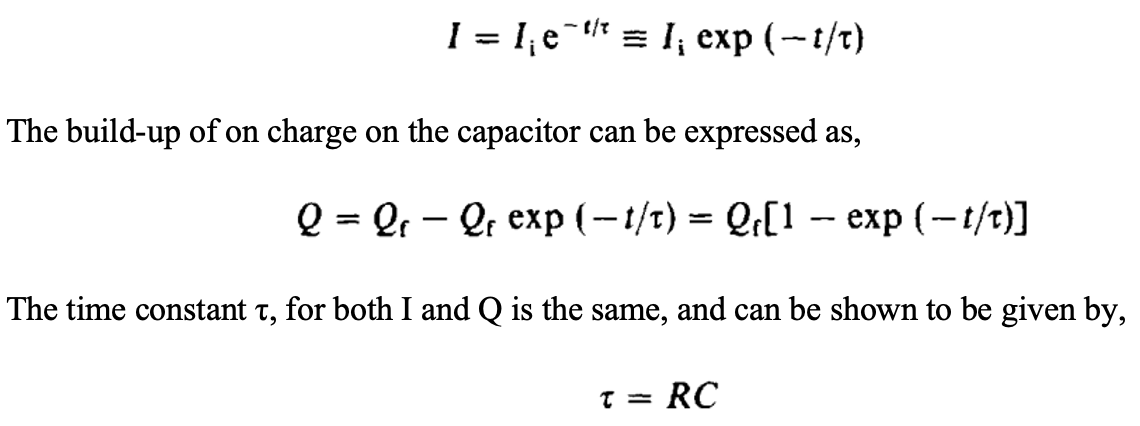
At the moment the switch is closed, there is current in the circuit but no charge on the capacitor, and when the capacitor is fully charged, there is no current in the circuit. The current decays exponentially, which can be expressed as,
The situation is very similar in the case of the discharge of a capacitor.
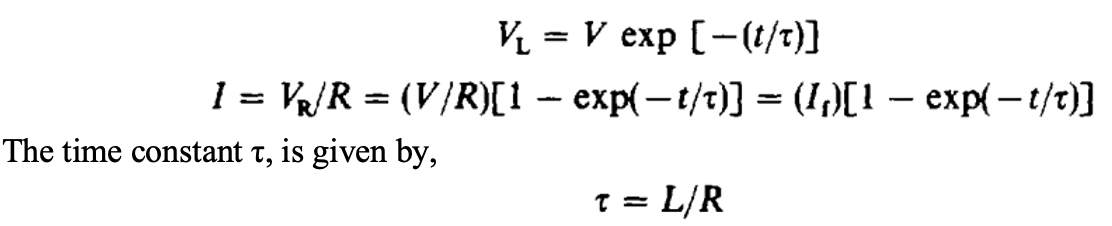
R-L CIRCUIT A DC circuit with a resistor R and an inductor L also shows a transient response when the switch is connected or disconnected.
In a similar manner, if current is decreasing in an L-R circuit, it will decay exponentially with a time constant L/R.
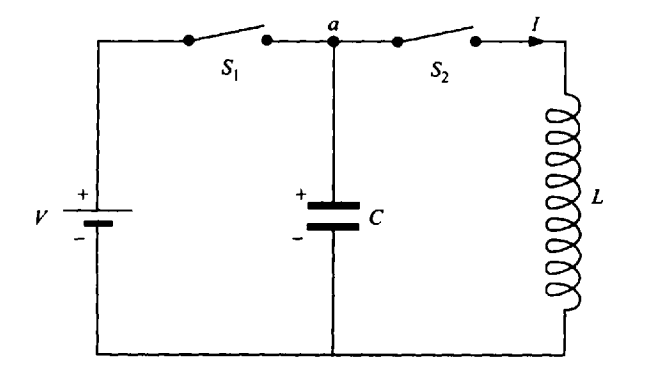
L-C CIRCUIT In this circuit there is no dissipation of energy because there is no resistor. The capacitor stores energy in the form of separated charges or electric fields. The inductor stores energy in the form of moving charges or magnetic fields. The total energy remains in the system.
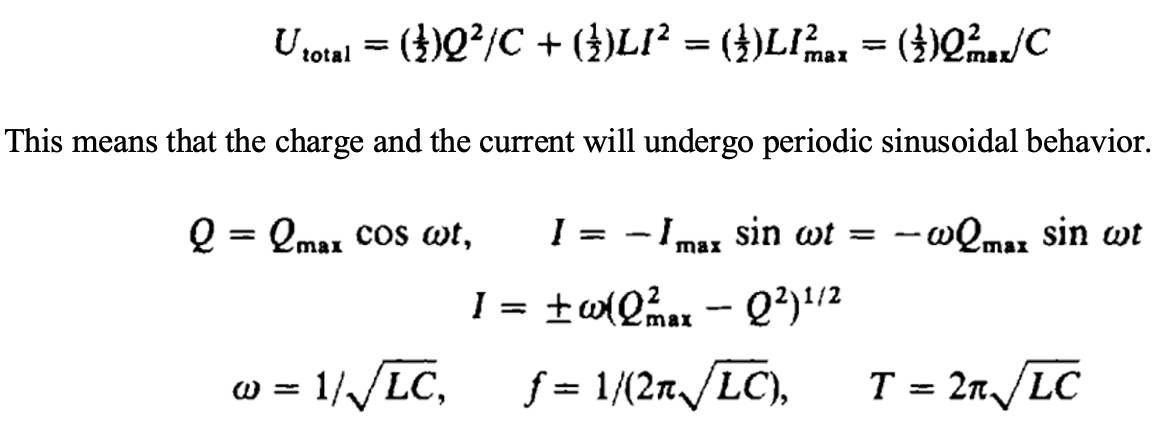
Therefore, the separated charges and the current interchange. This would bean oscillatory situation, with a repetitive interchange of energy between the capacitor and the inductor ad infinitum.
In the above circuit wefirst close switch S1 while S2 is open, and charge the capacitor to a voltage V, and charge Qmax. We then open S1 with the capacitor charged, and close S2 to permit the capacitor to discharge through the inductor. The capacitor discharges and then charges up again. This is similar to the case of simple harmonic motion (SHM).
This frequency, f, is called the resonance frequency of the circuit.
AC CIRCUIT An AC (alternate current) circuit generally consists of asource of voltage that is varying sinusoidally.In that case we expect that the variables of the circuit will also vary sinusoidally, after there has been sufficient time for the circuit to reach a steady state. This time is usually short enough that the effect of the transients can be neglected.
Whenever we have sinusoidal variation, we can express the variables as sine or cosine functions of time. The frequency f of the sinusoidal variation can be expressed in terms of an angular frequency ω, which simplifies the equations. Of course, the frequency can also be related to the period, T, by the relationship f= 1/T.
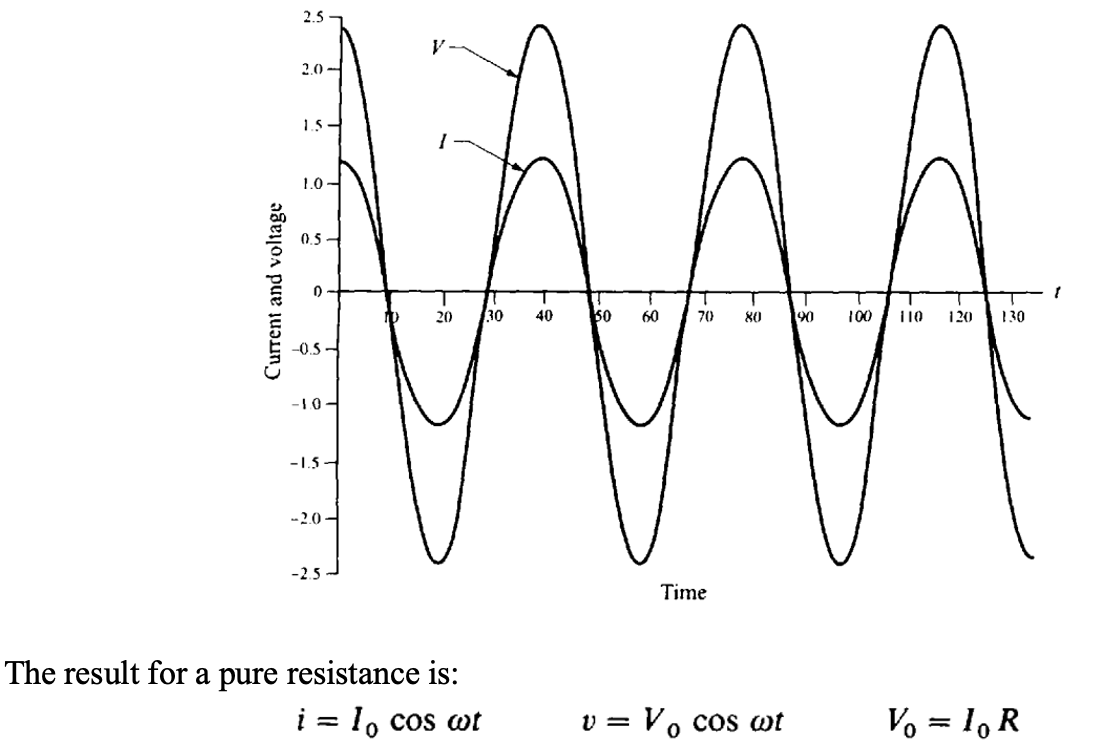
IN PHASE In AC circuit with a resistor,both current i and voltage v vary identically with time as cos ωt. We say that the two are “in phase”. This means that they both attain their maximum value at the same time, and both go through zero at the same time. We will see that this is true only for a resistor, while for capacitors and inductors, the voltage will not be in phase with the current.
The voltage at any time is just a fixed multiple of the current.
OUT OF PHASE When a generator causes a sinusoidal current to flow through the capacitor given by i = I0 cos ωt the capacitor is alternately charging each plate positively and negatively at a frequency: f = ω/2π. The voltage across the capacitor is defined to be from positive to negative plate and is always given as v = q/C. Both v and q will vary sinusoidally at the same frequency as the current. When the voltage reaches its peak, the current is zero. The current and voltage are said to be 90° or π/2 out of phase, and the current “leads” the voltage. We thus know that, for a capacitor, we can represent the voltage by v = VI0 sin ωt if the current is given by i = I0 cos ωt.
RMS VALUE In most formulas used in AC circuits, the quantity we use for the “magnitude” of currents and voltages will be the RMS value, and therefore when we write just I or V we will refer to the RMS values. The term RMS actually stands for “root-mean-square”, which refers to the method used to determine its value. To get the RMS value of a variable, we have to take the square root of the average (mean) of the square of the quantity. The current will vary as i = I0 cos ωt.I0 is the amplitude of the variation, and it represents the maximum value the current can have. We have the “RMS” value: IRMS = I0 √2.
CAPACITIVE REACTANCE We expect that if the maximum current is increased then the maximum charge on the capacitor will increase proportionally, and therefore also the maximum voltage. Consequently, we can write that V0 = χcI0, where the constant of proportionality χc is called the capacitive reactance of the capacitor. Similarly, VRMS = χcIRMS, or V = χcI. This capacitive reactance depends on the capacitance and on the frequency. Therefore, we have,
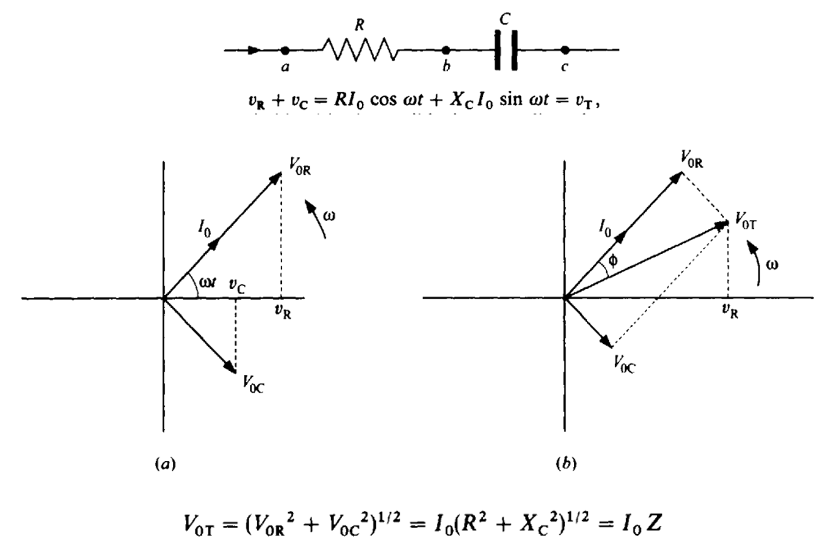
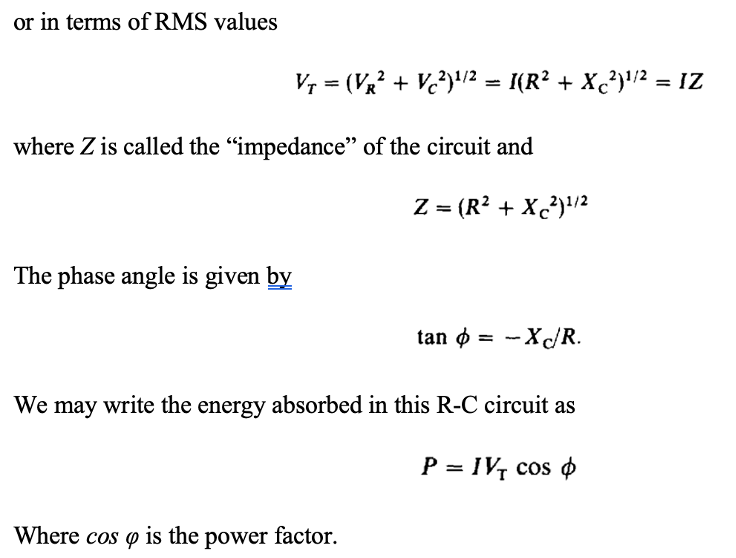
IMPEDANCE (R-C CIRCUIT) When theResistor and Capacitor are in Series, with the current given by as i = I0 cos ωt, the voltage across the entire circuit is
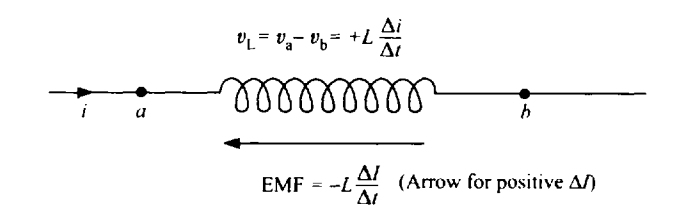
INDUCTIVE REACTANCE An AC generator produces a current I = I0 cos ωt in the inductor. The inductor produces a back EMF equal to (- L ∆I/∆t). This back EMF is balanced by the electrostatic voltage across the inductor, vL, as shown in the figure.
The voltage across the inductor is 90° out of phase with the current. The voltage leads the current,
IMPEDANCE (R-L CIRCUIT) When the Resistor and are in Series, with the current given by as i = I0 cos ωt, the voltage across the entire circuit and impedance is given by
We see that cos φ is again the power factor for an R-L circuit as it was for an R-C circuit. We can generally write that cos φ = X/R, where X is the reactance of the circuit, and equals XL for a circuit with inductance and -XC for a circuit with capacitance. Similarly, the impedance can then be written as Z = (R2 + X2)1/2, which will be valid for both R-C and R-L circuits. Additionally, we can write that the total voltage will vary with time as vT = V0T cos (ω t + φ), both for the case of the R-C and the R-L circuits, For the R-C circuit, φ is negative, and in the R-L circuit, φ is positive. We will find that we can extend these ideas to the last case, the R-L-C circuit also.
R-L-C CIRCUIT Here we have Resistor, Inductor and Capacitor in Series. We can write the equations giving these respective voltages as functions of time as:
From the phasor diagram we can deduce other relationships: