Author Archives: vinaire

I am originally from India. I am settled in United States since 1969. I love mathematics, philosophy and clarity in thinking.

Physics II: Chapter 15

Reference: Beginning Physics II

Chapter 15: INTERFERENCE. DIFFRACTION AND POLARIZATION

.

KEY WORD LIST

Phase, In Phase, Out of Phase, Interference, Constructive Interference, Destructive Interference, Interference versus Diffraction, Huygens’ Wavelets, Double Slit, Michelson Interferometer, Thin Film Interference, Non-Reflecting Coating, Wedge, Newton’s Rings, Diffraction, Single Slit, Single Hole, Diffraction Grating, Polarization Of Light, Absorption (Dichroism), Reflection, Birefringence, Scattering.

.

GLOSSARY

For details on the following concepts, please consult Chapter 15.

PHASE
Phase
is the fraction of a period that a point completes after last passing through the reference, or zero, position. Phase is the ratio of elapsed time t to the period T, or t/T—and is equal to the ratio of the phase angle to the angle of the complete cycle, 360°, or 2π radians.

IN PHASE
When comparing the phases of two or more periodic motions, such as waves, the motions are said to be in phase when corresponding points reach maximum or minimum displacements simultaneously. The actual displacement is given at any time by the sum of these two displacements, using the principle of superposition.
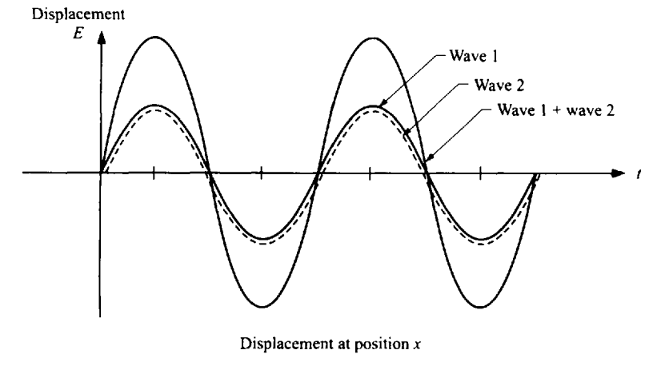
The two waves are in phase not only if they take the same time to reach the new point, but also if one of them takes exactly one period longer than the other (or any integral multiple of the period longer).

OUT OF PHASE
If the crest of one and the trough of the other pass at the same time, the phase angles differ by 180°, or π radians, and the waves are said to be out of phase.
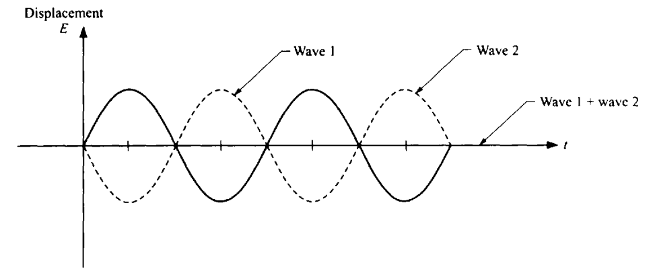
Here the time delay is of half a period, ∆t = T/2, or any half integral multiple of T, ∆t =
(m+ ½)T
, between the two waves. The two waves are said to be “180° out of phase”, or “out of phase by π (radians)” or simply “out of phase.”

INTERFERENCE
Interference is the net effect of the combination of two or more waves moving on intersecting or coincident paths. The effect is that of the addition of the amplitudes of the individual waves at each point affected by more than one wave.

CONSTRUCTIVE INTERFERENCE
If two of the components are of the same frequency and phase, the wave amplitudes are reinforced, producing constructive interference.

∆t = mT           or         ∆l = mλ → constructive interference with m integer

DESTRUCTIVE INTERFERENCE
If the two waves are out of phase by 1/2 period (i.e., one is minimum when the other is maximum), the result is destructive interference, producing complete annulment if they are of equal amplitude.

∆t = (m +½) T       or       ∆l = (m +½) λ → destructive interference with m integer

INTERFERENCE VERSUS DIFFRACTION
If we have more than two waves then we must add together all the waves to get the resultant wave. This will clearly result in a more complicated calculation in practice, although the underlying principle is still the same. Typically, when we consider waves traveling through openings in different barriers arriving at a common point, we use the term interference to characterize the results of their addition. This often involves the addition of a relatively small number of waves. If we add together waves coming from different parts of a single aperture and arriving at a common point, we usually refer to the effect as diffraction, and the addition can involve, in principle, large numbers of waves. Nonetheless, the basic principle for diffraction is the same as for interference.

HUYGEN’S WAVELETS
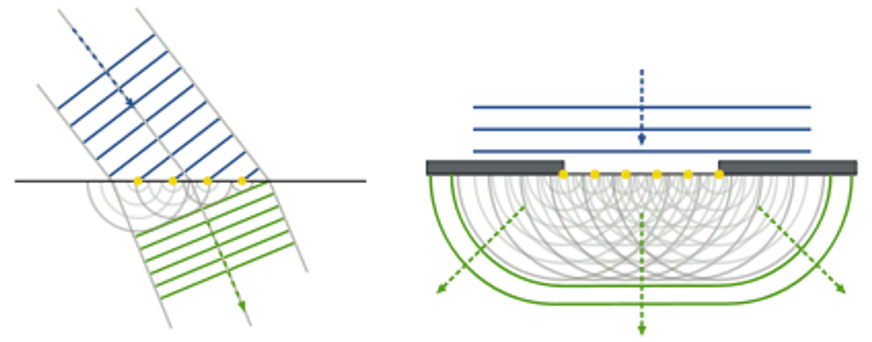
The Huygens–Fresnel principle states that every point on a wavefront is itself the source of spherical wavelets, and the secondary wavelets emanating from different points mutually interfere. The sum of these spherical wavelets forms a new wavefront.
DOUBLE SLIT
The double slit is an example of interference. From the geometry, the following result can be derived mathematically.
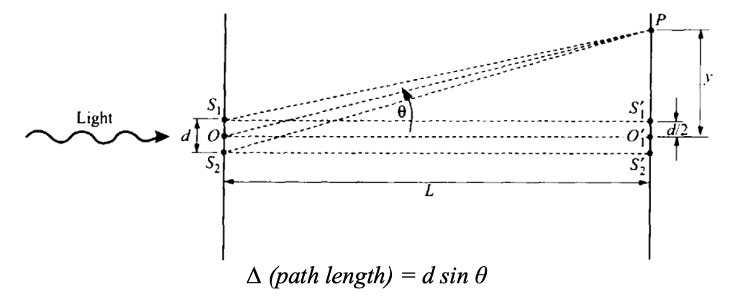
We can now determine the angles at which we have destructive and constructive interference by equating this difference in path length to the appropriate multiples of λ. The angle at which the first maximum occurs depends on λ/d. When λ/d is small, then sin θ is small, as is θ. If the ratio is not too small, one can see these interference effects. For wavelengths that are very short compared to the geometric dimensions of slits and apertures, there is little ability of the light to bend and there will be neither diffraction nor interference that is detectable. To see fringes, one needs this ratio to be much less than 1, but still not minuscule. One could use the double slit to measure the wavelength of some unknown radiation by measuring the angle at which interference occurs. In practice, one gets greater experimental accuracy if one uses a diffraction grating that contains thousands of slits rather than just two slits.

MICHELSON INTERFEROMETER
Here, light from a source, S, gets split and travels two different paths to reach the detector as shown.       The criterion for constructive interference remains that the difference in path length, 2∆D, equals an integral multiple of the wavelength.

As we change the distance to one of the mirrors, the detector will alternately record a large intensity and zero intensity as the interferometer changes from constructive to destructive interference and back again. This can be used to measure very small distances accurately.

THIN FILM INTERFERENCE
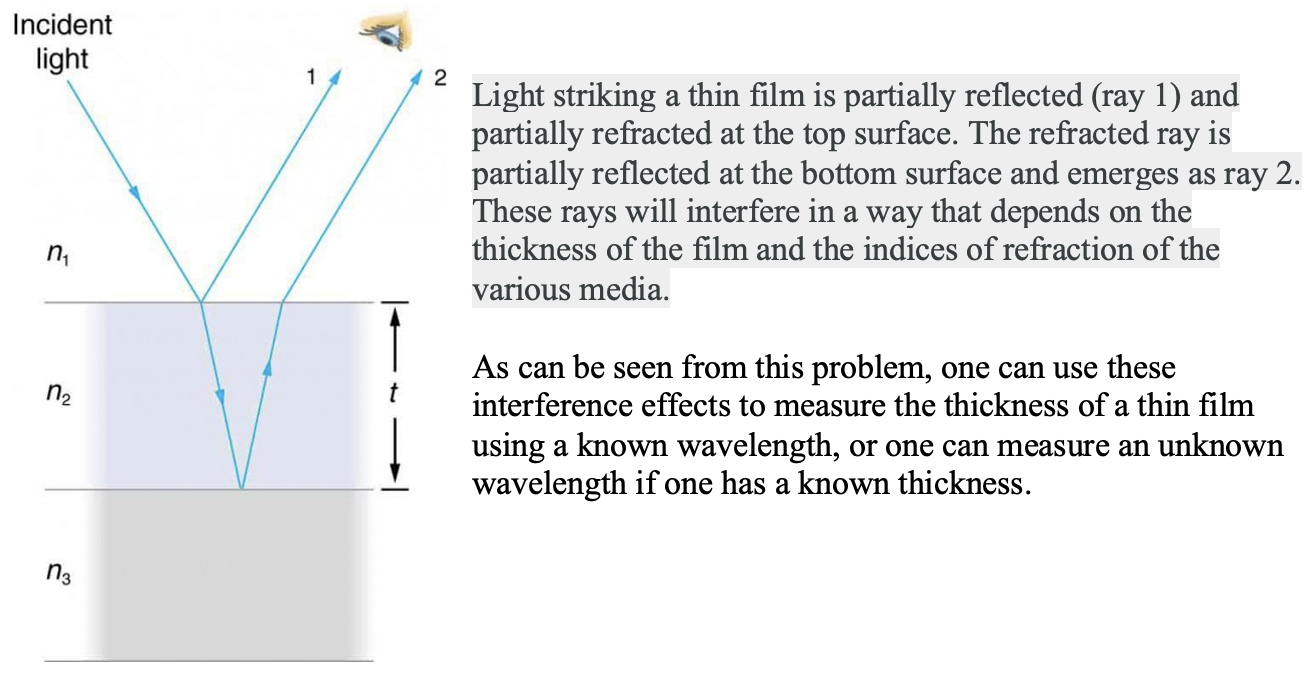
The bright colors seen in an oil slick floating on water or in a sunlit soap bubble are caused by interference. The brightest colors are those that interfere constructively. This interference is between light reflected from different surfaces of a thin film; thus, the effect is known as thin film interference.
NON-REFLECTING COATING
One can coat a surface with a specific thickness of film to produce destructive interference for a particular wavelength. In that case there will be no reflection from the surface at that wavelength. This is then called a non-reflecting coating.

WEDGE
A wedgeconsistsof two smooth glass plates that make a very small angle with each other. The air between the plates forms a “thin film” whose thickness increases as we move away from the corner. For the wavelength of the incident light there will be a point along the bottom plate where the thickness of the film is just right to give constructive interference. The result is a series of “fringes,” or alternating bright and dark fringes along the glass plate.
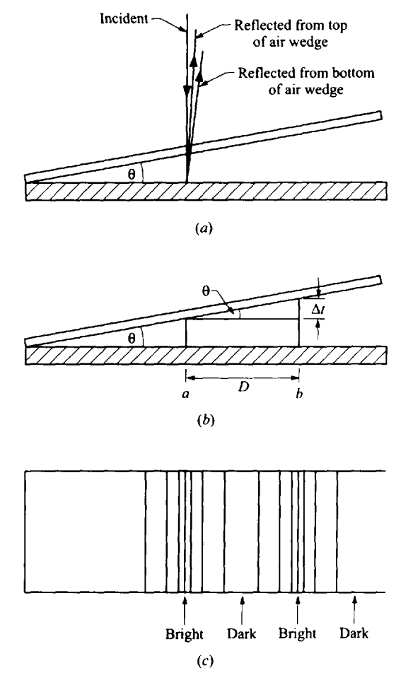
If the glass is not exactly smooth, the bright fringes will be somewhat distorted. The wavy line traces out points where the distance between the top and bottom plates is constant. This can be used to measure the smoothness of a plate. If the lines are distorted, one knows where one has to remove a small amount of glass and can grind the glass there to achieve better smoothness. Since these fringes are sensitive to distances of fractions of a wavelength, this can assure smoothness to that order of distance.

NEWTON’S RINGS
When a sector of a glass sphere is placed on a smooth glass plane, there is an air film between the lower surface of the sector and the plane. The height of this film increases as one moves out from the center. Points of equal height form circles around the center. Therefore, circular fringes appear because of the wedge principle above.

The circles seen are called Newton’s rings. This technique is used as standard procedure to test and adjust the smoothness and symmetry of spherical glass surfaces.

DIFFRACTION
Diffraction is the process by which a beam of light or other system of waves is spread out as a result of passing through a narrow aperture or across an edge, typically accompanied by interference between the wave forms produced.
SINGLE SLIT
For a single slit we get the following mathematical relationship.

w sin θ = mλ,              m = 1, 2, 3 . . . (destructive interference)

The intensities at these maxima decrease as θ increases. The intensity at the center is far greater than the intensity at any of the secondary maxima. Additionally, the central maximum is wider than any of the other maxima, and it has a width of

δcent = 2Lλ/w

The secondary fringes have width half as wide.

δ = Lλ/w

The angle of diffraction (the angle for the first minimum) increases with λ/w. The wave spreads out into a central bright fringe between (this angle). As w gets smaller, approaching λ, the central bright fringe gets bigger, and the light spreads out more widely. We therefore see that one cannot consider the light as moving in a straight line if there are apertures comparable to the wavelength of the light.

SINGLE HOLE
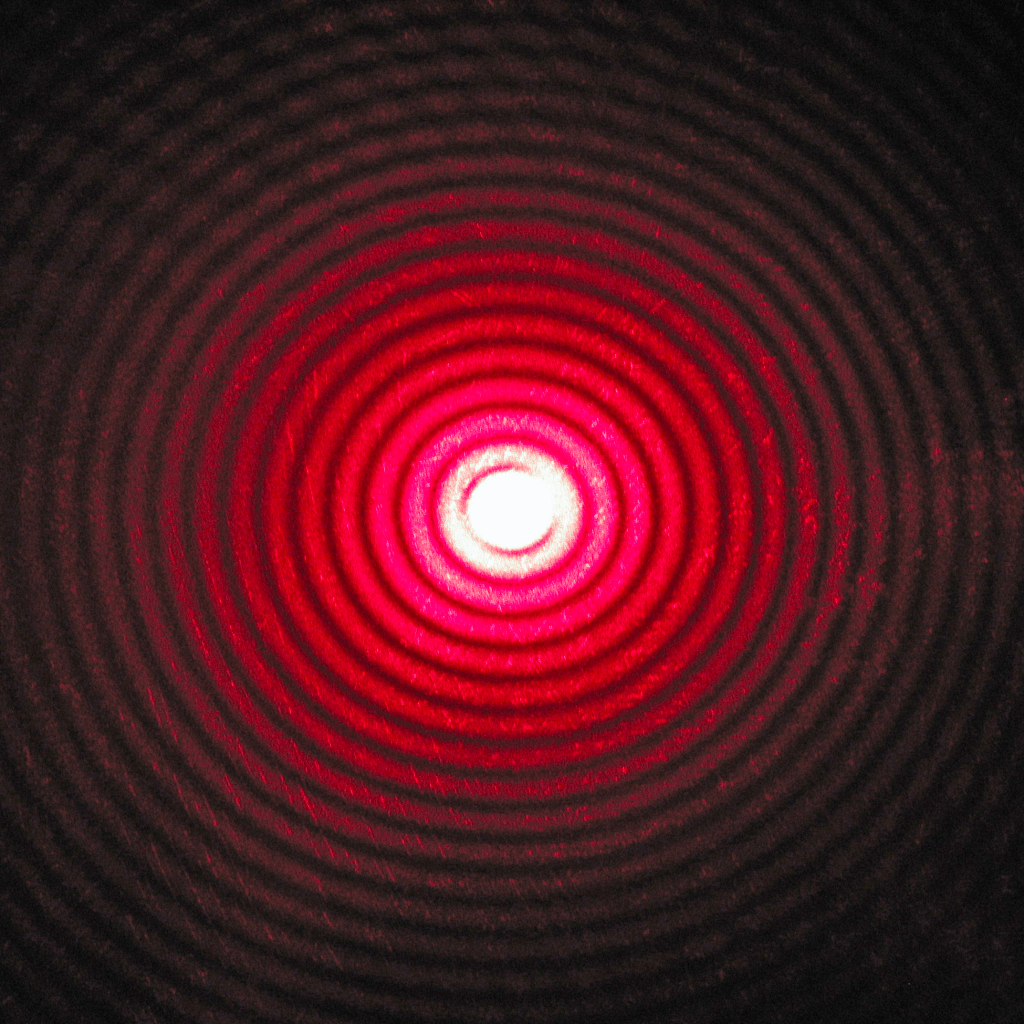
For a small circular aperture, the light would bend into a larger circle, with the angle of diffraction increasing as the diameter, D, of the hole decreases. The result is a bright central circular area (called the Airy disk), in which most of the energy of the light is concentrated, with secondary rings at larger angles containing smaller amounts of light energy. A small object viewed through a circular aperture expands into a larger circle, with the angle for the edge of the Airy disk given by:

sin θ = 1.22(λ/D)

As (λ/D) becomes larger, the image size increases. If we view two neighboring tiny objects through the hole, we can no longer “resolve” them from each other. Thus, diffraction imposes a limit on our ability to resolve closely spaced objects as through telescope. For the best resolution, we must have large aperture D and/or small wavelength λ. In order to increase our resolving power we must use waves of shorter wavelength, such as ultraviolet light or X-rays, or “electron waves.” Furthermore, this is one of the reasons that telescopes are built with the largest practical diameter objective lens or mirror.

DIFFRACTION GRATING
When there are very many, closely spaced slits on a plate, we call the arrangement a “diffraction grating.” Gratings can easily have 10,000 lines per cm, giving a spacing of d = 10-6 m. The angles at which we get multiple slit maxima (the angle through which the light is “diffracted”), is given by:

d sin θ = mλ

The angle at which maxima occur clearly depends on the wavelength, and for multi-frequency light, for each value of m, there will be a spectrum of colors, from blue to red, as the angle θ increases. We can use this multiple slit arrangement to measure wavelengths very accurately, and to separate out different wavelengths in the source of light.

POLARIZATION OF LIGHT
The electric field lies in the plane perpendicular to the direction of motion.  We call the direction of the electric field in this plane the direction of “polarization”. Most light that is produced by sources such as incandescent bulbs is unpolarized, meaning the electric field has no preferred direction. The simplest, and most common, case of polarization is one in which the electric field always points along one direction. This case is called linearly polarized light, or plane polarized light.

ABSORPTION (DICHROISM)
Dichroism is the property of some crystals and solutions of absorbing one of two plane-polarized components of transmitted light more strongly than the other. An example of such a material is a sheet of “polaroid”, which produces light polarized in one linear direction.

REFLECTION
Brewster’s angle is an angle of incidence at which light with a particular polarization is perfectly transmitted through a transparent dielectric surface, with no reflection. When unpolarized light is incident at this angle, the light that is reflected from the surface is therefore perfectly polarized.

BIREFRINGENCE
Birefringence is the phenomenon exhibited by certain materials in which an incident ray of light is split into two rays, called an ordinary ray and an extraordinary ray, which are plane-polarized in mutually orthogonal planes, or circular-polarized in opposite directions (left and right).

SCATTERING
Scattering offers another means of producing polarized light. In fact, the light from the sun scattered by the atmosphere (the light we see during the day if we don’t look at the sun), will be polarized, and we can selectively remove that light by using a polarizer that does not transmit that polarization.

.
The Definition of INCIDENT TWO

Please refer to Subject Clearing OT III

Reference: Subject: Scientology Fundamentals

This incident is akin to the description of “the fall of Man” in Abrahamic Religions.

.

Incident Two

The sequences in Incident II may be described briefly as follows. 

H-BOMB DROPPED ON VOLCANO
EXPLOSION
TERRIFIC WINDS
THETAN CARRIED OVER PEAK
ELECTRONIC RIBBON CAME UP
HE STUCK TO IT
IT WAS THEN PULLED DOWN AND HE WAS (AS PART OF A GROUP) IMPLANTED WITH R6
PICTURE OF PILOT SAYING HE IS MOCKING IT UP

Hubbard presents Incident II as something that occurred 75,000,000 years ago. It plays out like a science fiction story, “The head of the Galactic Federation (76 planets around larger stars visible from here) (founded 95,000,000 years ago, very space opera) solved overpopulation (250 billion or so per planet, 178 billion on average) by mass implanting.

.

“Calculated to Kill”

Hubbard says about the Incident II,

“The implant is calculated to kill (by pneumonia etc.) anyone who attempts to solve it… One can freewheel through the implant and die unless it is approached as precisely outlined. The “freewheel” (auto-running on and on) lasts too long, denies sleep etc and one dies. So be careful to do only Incidents I and II as given and not plow around and fail to complete one thetan at a time.”

The information about Incident II isn’t going to make you sick or kill you. You can read about it all you want; BUT DON’T START TO SOLVE THIS IMPLANT BY STRAIGHT MEMORY.

Things can go dangerously awry when you anxiously dig into your mind for answers. It can definitely send you to an insane asylum if not kill you. Therefore, do not ransack deep into your psyche in an effort to fix yourself. Please follow the The Discipline of Subject Clearing.

It takes a measured approach to handle the anomalies embedded deep in the psyche.

.

The Confidentiality of OT Levels

Hubbard declared the OT Levels to be confidential because he knew they needed a lot more work. His research had started to go deep into the psyche with the application of Listing and Nulling (L&N). Any slight error could have fatal repercussions. His upper level research no longer used the simple “straight memory,” and it required much greater skill on part of the auditors.

The reason for keeping the upper level materials confidential was to have much greater supervision, until their application was made safe.

.

Mental Sickness

The reason mental sickness is increasing in USA and the world over is because we do not really have solutions other than chewing over our memories and taking medication. The solution doesn’t lie either in the methods of psychology or in the medication of psychiatry. These are at best temporary holding actions. They do not bring about any cure.

In modern times we are facing a global epidemic of mental sickness; and there is a great need for effective solutions beyond psychology and psychiatry. Many esoteric practices have provided effective solutions in the past, but they require much greater supervision for the reasons given above. OT levels fall in that category. 

We need to examine such solutions and make them safer for application.

.

Therapy on OT Levels

Most therapy at this level of psyche involves the handling of deeply embedded misconceptions. Hubbard describes the handling as follows:

“One’s body is a mass of individual thetans stuck to oneself or to the body. One has to clean them off by running incident II and Incident I. It is a long job, requiring care, patience and good auditing. You are running beings. They respond like any preclear. Some large, some small. Thetans believed they were one. This is the primary error. Good luck.”

Hubbard refers to these anomalies as “body thetans.” They are akin to beings because they are complex in their structure, similar to the coding underlying artificial intelligence. They can communicate with you and respond to your questions. According to Hubbard, all beings have a permanent individuality, and this individuality needs to be freed up; for he says elsewhere, 

“Before the beginning of time, thetans existed, separate from one another (thetans were not created; they have existed for all time and indeed precede the creation of time).”

He says further,

“With the creation of energy and matter, thetans have gradually become trapped. The principal method of entrapment is through ‘implanting’, where the thetan is hypnotized and given positive suggestions which limit its powers.”

Hubbard codes the basic concepts to do with BEINGNESS as follows:

STATIC, THETA, MEST, THETA-MEST THEORY, POSTULATE, THETAN, EXTERIORIZATION, OPERATING THETAN, BODY THETAN, and INCIDENT ONE.

Hubbard’s definitions are available in Scientology Technical Dictionary and in OT materials. The process of subject clearing when applied to these concepts provides greater clarity. The clarified concepts are available at the following link.

Subject: Scientology Fundamentals

Any therapy on OT Levels starts with bringing clarity to the concepts listed above.

.

Therapy based on Incident Two

The last line of the description of Incident Two says.

PICTURE OF PILOT SAYING HE IS MOCKING IT UP

The pilot is most probably the euphemism for the Unknowable. And the idea of “mocking it up” is same as postulating. This requires the understanding of the following definitions:

UNKNOWABLE
Neither the cause nor the beginning of this universe is knowable. There is Inscrutable Power that keeps this universe running eternally; but, neither religion nor science has any clue to it. We make postulates to know the Unknowable, but we end up knowing the postulates only. We find that no matter how much we know, there is always something more to know. So, there is an unbridgeable division between the Unknowable and the Knowable.

POSTULATE
A postulate is is a self-created truth that gives form to the unknowable, and attempts to make it knowable. Based on postulates further reasoning is done. To be valid postulates and reasoning must adhere to the principle of oneness.

PRINCIPLE OF ONENESS
Oneness does not imply sameness. Oneness means that all that is known is continuous, consistent and harmonious. This principle of oneness underlies the very concept of the universe. It also underlies the Scientific method. This principle gives us the ideal scene for logic, because its violation gives us anomalies. 

ANOMALY
An anomaly is any violation of the principle of oneness, such as, discontinuity (missing data), inconsistency (contradictory data), or disharmony (arbitrary data).

From these definitions we understand that

Beingness, individuality and identity are the result of postulates. Any therapy involves the resolution of anomalies to do with these concepts. The ideal scene is the principle of oneness.

.

Handling of Implants

The Incident II is all about implanting.

IMPLANT
To implant is to put or fix firmly. It refers to a thought planted forcefully deep into the psyche of a person, which is not in harmony and generates anomalies. These implants are deep misconceptions.

Hubbard says, 

“The pictures contain God, the Devil, angels, space opera, theaters, helicopters, a constant spinning, a spinning dancer, trains and various scenes very like modern England. You name it, it’s in this implant we call in its entirety ‘R6’.”

Apparently, a lot of force is connected with this implanting. This indicates that when an anomaly deep in the psyche is resolved, it brings about a sudden release of energy, akin to an explosion. However, such anomalies cannot be resolved by simple recalls. They require a more sophisticated approach, such as, subject clearing on the subject of beingness.

SUBJECT CLEARING
Subject Clearing is listing the key concepts in a subject and then arranging them in a logical sequence. Then you start filling the holes in that sequence by finding the missing concepts. You focus on the earlier and earlier parts of that sequence, till you arrive at the original postulates. The key to Subject Clearing is the PRINCIPLE OF ONENESS.

.

Summary

Anything known is postulated into existence. Thetans are known to be individuals. So their individuality must have been postulated into existence. The source of postulates is Unknowable. 

What is postulated as individuality are goals and behavior characteristics. This forms the beingness of thetan, which is energized by theta (Unknowable).

Scientology seeks to return the thetan’s power by stripping away implants and using drills to heighten extrasensory perception and ability.

It is necessary to strip away implants (deep misconceptions) before any drills to heighten extrasensory perception and ability can be effective.

The tested and safe method of handling misconceptions is Subject Clearing.

.

The Definition of INCIDENT ONE

Please refer to Subject Clearing OT III

Reference: Subject: Scientology Fundamentals

The incident one is akin to the beginning of the universe as portrayed in the Abrahamic religions. It presents the imagery of a chariot pulled by Cherubs.

A cherub is one of the unearthly beings who directly attend to God, according to Abrahamic religions. The numerous depictions of cherubim assign to them many different roles, such as protecting the entrance of the Garden of Eden.

According to Hubbard, this is the very first incident that applies to all universes. When this incident is run on OT III, it appears to the pre-OT as follows:

.

Incident One

Occurs at start of track (4 quadrillion years ago).

LOUD SNAP
WAVES OF LIGHT
CHARIOT COMES OUT, TURNS RIGHT AND LEFT
CHERUB COMES OUT
BLOWS HORN, COMES CLOSE
SHATTERING SERIES OF SNAPS
CHERUB FADES BACK (RETREATS)
BLACKNESS DUMPED ON THETAN

This is probably the imagery of God and the universe emerging together. It may be referred to as the “Big Bang” of religion.

.

Definition

It is an interesting code to decipher. We have from The KHTK Factors:

KHTK Factor # 1: Before the beginning was the Unknowable and the entire purpose of the Unknowable was to know itself.

KHTK Factor # 1-1: In the beginning and forever is the ability to postulate and become aware.

According to the KHTK factors, here we have something knowable emerging from the Unknowable. The Incident One must be the code for the occurrence of the very first postulate. 

The whole universe exists as a seed in this incident. All possible beingness is emerging from this incident. This means, theta (ability to postulate) as well as the thetan (definite goals and behavior characteristics) are emerging here.

When this incident is erased, the thetan is erased also. Only the Unknowable is left. This may be the meaning of “blackness dumped on thetan.”

.

Vedic Hymn of Creation

The Incident One may be compared to the following:

The Creation Hymn of Rig Veda

The differences here indicate how the Eastern approach to knowledge differs from the Western approach.

.

The Definition of MEST

Reference: Subject: Scientology Fundamentals

Scientology provides the following definitions for MEST.

.

Scientology Technical Dictionary

“MEST, 1. a coined word, meaning matter, energy, space and time, the physical universe. All physical phenomena may be considered as energy operating in space and time. The movement of matter or energy in time is the measure of space. All things are mest except theta.” 

In Scientology, MEST refers to physical substance, physical space and physical time. In short, by MEST, Scientology refers to the material or physical universe that operates mechanically. Scientology differentiates MEST from Theta (thought substance).

“MEST, 2. the symbol for the physical universe in use hereafter is mest, from the first letters of the words matter, energy, space and time, or the Greek letter phi (ø).” 

See above.

“MEST, 3. simply a composite of energies and particles and spaces which are agreed upon and which are looked at.”

MEST is the outcome of postulates.

“MEST, 4. a solid object, and the space and energy and so forth which comprise such solid objects.”

In Scientology, MEST is identified with the solidity of matter.

“MEST, 5. any or all arrangements of energy, of whatever kind, whether in fluid or object form, in space or spaces.”

Thought is also a type of energy, but it is not included in MEST.

.

Subject Clearing

Anything manifested is knowable. Anything knowable has some substance. Thought, Energy and Matter are all knowable. They all have substance. Thought appears as pure space, energy has “energy space,” and matter has “material space.” From thought to energy to matter we have increasing condensation of substance. Time provides a measure of that condensation.

MEST is  an acronym formed from the initial letters matter, energy, space and time. MEST, therefore, represents the whole spectrum of substance from thought to energy to matter, that has the characteristics of space and time. Substance does not exclude thought.

Scientology makes the error of limiting the designation of “MEST” to the physical universe of energy and matter. But MEST equally describes the thought universe. In short, MEST is properly the designation for the “Knowable universe.”

.

Beingness: Key Definitions (old)

Please see Holding: Postulate Mechanics.

Reference: Scientology 8-8008
Reference: A Course on Hubbard’s Factors

The chapter SCN 8-8008: The Beingness of Man provides some very fundamental data on the subject of human beingness. Here are the definitions of some basic concepts in Scientology after subject clearing. They correct many misconceptions in Scientology.

.

Definitions

UNKNOWABLE
What religions generally refer to as “God” is actually unknowable, because neither the cause nor the beginning of this universe is knowable. Religions only make postulates in an effort to know the Unknowable, but we end up knowing the postulates only. We find that no matter how much we know, there is always something more to know. There is an unbridgeable division between the Unknowable and the Knowable. See The KHTK Factors.

KNOWABLE
Postulates are manifested and, therefore, they are knowable. From postulates evolves the whole universe, which is knowable.  Anything knowable must have substance. See POSTULATE, SUBSTANCE, UNIVERSE.

SELF
The SELF is the “ability to postulate and to become aware.” It pervades everything, and is considered to be infinite. It represents the ultimate beingness. It has no individuality.

STATIC
Scientology defines “Static” to be without mass, energy, space and time (making it Unknowable); but with the ability to postulate and become aware (this ability is knowable only when it is manifested). See UNKNOWABLE, SELF.

THETA 
Theta is the mathematical symbol assigned to Static. See STATIC.

POSTULATE
A postulate is a self-created truth that gives form to the unknowable, and attempts to make it knowable. Based on postulates further reasoning is done. To be valid postulates and reasoning must adhere to the Principle of Oneness. See KNOWABLE.

SUBSTANCE
A substance is anything substantial enough to be known or sensed. We know matter to be substance. But we can sense light; therefore light also is substance. We can know thought, so thought too is  substance. In general, all things knowable must have substance because they cannot be known otherwise. When a postulate is manifested we have substance. Origin: “That which stands under.”  

PRINCIPLE OF ONENESS
Oneness does not imply sameness. Oneness means that all that is known is continuous, consistent and harmonious in its substance. In other words, everything knowable is inherently connected according to this principle. This Principle of Oneness underlies the very concept of the universe. It also underlies the Scientific method. This principle gives us the ideal scene for logic, because its violation gives us anomalies. 

UNIVERSE
The universe is the outcome of postulates and the reasoning that follows from those postulates. The universe has substance. The universe consists of all that is knowable—physical, metaphysical, real, imaginary, postulated or speculated. The root meaning of the word UNIVERSE is “entire, all, literally, turned into one.” See SUBSTANCE, MEST.

SPIRIT
SPIRIT is a loose concept that includes SELF and the postulates that form the goals and basic characteristics of a person. Spirituality has to do with becoming aware of the situations in life and having the ability to resolve them. See SELF, POSTULATE.

THOUGHT
The substance of postulate is called thought. Thought then develops into considerations, concepts, etc. Pure thought has no resistance and its motion is infinite. It appears as space but as it condenses it takes on the characteristics of energy. The condensing thought has increasing resistance and a motion rapidly becoming finite. Condensing thought produces a spectrum. This spectrum is represented by a Tone Scale in Scientology on which 40.0 represents pure thought as “serenity of beingness”; and 0.0 represents a very condensed thought as “death of beingness.” Origin: “to know.” 

SPACE 
Space represents the dimensions of substance that we see as “extents.” Space of pure thought is infinite. Space condenses as thought condenses. Condensed space is seen as “energy space,” which represents the extents of the electromagnetic radiation. Extreme condensation of space appears as “material space,” which represents the extents of matter. Space to energy to matter we have increasing condensation of substance. Thus, the presence of space as “extents” implies the presence of substance. There is no empty space. Physics conceives of empty space as an abstraction of “material space” that we study in geometry. Einstein expanded the concept of space from rigid “material space” to increasingly malleable “energy space.”

ENERGY
Energy arises as thought condenses (see THOUGHT, and SPACE). Our experience does not differentiate “energy space” from “thought space” in terms of extents, or the electromagnetic radiation from thought in terms of substance. Therefore, much confusion exists regarding the concepts of ENERGY and SPACE. The electromagnetic radiation changes considerably as it condenses from radio waves to gamma rays. This is presented in detail as the electromagnetic spectrum of decreasing wavelengths and increasing frequency. When we talk about energy as activity, it is energy changing in its wavelength and frequency.

MATTER
Matter is condensed energy. This was the breakthrough discovery of Einstein which made atomic bombs and nuclear reactors possible. It explained how Sun produces its energy. Einstein also differentiated “material space” from “energy space.” These were the new scientific revolutions of the twentieth century. Matter is the most ubiquitous part of our experience as the solidity of substance, so much so that we have identified all substance as matter. Matter itself has a spectrum of density. The matter in collapsed stars and black holes have much higher density than what we normally experience.

TIME
Time is a measure of the condensation of substance as its “duration.” Thought has little duration; energy has greater duration; and matter has the most duration. We experience time, generally, as the changes occurring in our experience. We are generally conscious of the “material time” connected with the duration of matter. It is measured in terms of the passage of sun across the heavens due to earth’s rotation. This “material time,” however, is very different from the “thought time” connected with the duration of our thoughts. It is startling when we are confronted with both of them at once, such as, when waiting for something to happen in the “material universe” while thoughts are racing in our “thought universe.”

MEST
MEST is the mathematical symbol assigned to all substance that we are familiar with as space, energy and matter; along with time as the measure of condensation of substance. MEST refers not just to the material universe but also to the thought universe, because it is a designation for all that is knowable, as opposed to the Unknowable. MEST is an acronym formed from the initial letters matter, energy, space and time. Scientology makes the error of limiting the designation of “MEST” to the material universe only. See SUBSTANCE, SPACE, ENERGY, MATTER, and TIME.

THETA-MEST THEORY
The original idea of Hubbard was that life is a no-substance thing, up against a physical universe which is a substance thing. Here is nothingness up against a somethingness interacting where the nothingness or the no-substance thing is actually giving orders to and handling the all substance thing, the physical universe.

As the definition of “substance” is stated more accurately, the theory shifts toward becoming “Unknowable-Knowable theory.” There is the Unknowable, which is approximated and symbolized as Theta. There is knowable, which is approximated and symbolized as MEST. According to this theory, the MEST (knowable) is being postulated continually into existence by Theta (Unknowable).

BEING
The “being” is a package of postulates energized by Self. It consists of postulated goals and behavior characteristics. It carries the detailed blueprint for the body and the mind. The being, therefore, has an individuality, and it is finite with a beginning and an end.

BEINGNESS
Philosophically, the ancient Vedas divide the beingness of a person into Self and Being. The person is the BEING that is grounded in SELF. He is most happy and operates optimally when his postulates are not in violation of the principle of Oneness.

PERSON
When one addresses a person, a human being “in the flesh” one is not addressing a simple being. What you see as a human being, a person, is not a single unit being. A person can be himself or he can be under the belief that he is another person or thing entirely. Then there is the matter of being in a body. A body is a very complex contrivance, quite remarkable, quite complicated. And it is also quite subject to its own distortions. There are also the entities. These follow all the rules and laws and phenomena of single beings. And then there is the matter of influences of other people around this human being. 

THETAN
Thetan is the mathematical symbol assigned to individuality of a person, which is energized by theta. Thetan as an individuality is a package of postulates specifying definite goals and behavior characteristics, similar to the idea of Being. But Thetan does not include the idea of Genetic Entity, which is included in the Being.

In Scientology, the thetan is thought to be detachable from the body in a literal sense. This is in error because Thetan is not a thing that can be separated from the body. Such a “detachment” is essentially the resolving of fixation on the body.

In Scientology, thetan is also thought to be immortal. This is in error because thetan is made up of postulates, and postulates are not permanent. Hubbard is conflating thetan (individuality) with theta (ability without individuality). See STATIC, THETA, SELF, BEING, GENETIC ENTITY.

GENETIC ENTITY (GE)
Genetic Entity is the basic programming of the being, which is carried through the genetic line by the DNA molecule. The core genetic programming develops the body and maintains all its functions. It operates on feedback and is very sophisticated, but it has limited capacity to update itself. The higher end programming that allows self-awareness, which can update itself, operates as the thetan. The Genetic Entity + Thetan, together represent the whole gradient of programming, which results in the Being.

MENTAL MATRIX
The programming of the being is organized as a matrix of perceptual elements. We call it mental matrix. It is based on postulates, and it develops continually as it assimilates experience. The experience is made up of input to the physical senses of touch, sight, hearing smell and taste. This input proceeds as sensations, which breaks down into perceptual elements. These perceptual elements when assimilated into the mental matrix, produce perception.

PERCEPTUAL ELEMENT
The incoming sensation breaks down into its elements. We call them perceptual elements because they generate perception upon assimilation into the mental matrix. Each perceptual element is like a “pixel”, which is identified by its characteristics and the time when it were received. This time stamp helps recreate the memory form these perceptual elements later. Origin of perception: “a taking in.”

ASSIMILATION
Assimilation of perceptual elements allows perception to occur. Assimilation merges all perceptual elements with the elements of the mental matrix. This establishes associations among the perceptual elements, such that the Principle of Oneness is maintained as closely as possible. Duplication of perceptual elements is eliminated for efficient storage. Origin: “made similar”.

MEMORY
A memory is a duplication of a perception once received. It is routinely reconstructed, when required, from the associations among the perceptual elements based on similar “time stamps.” Memories are harder to reconstruct, when perceptual elements get associated with unassimilated impressions. Memories are not stored as “recordings” as assumed in Scientology. Only unassimilated impressions appear as recordings at the moment of their assimilation. 

IMAGINATION
Imagination, or visualization, is the result of creative associations among the perceptual elements according to some purpose. There may be gaps among the perceptual elements, but they are bridged over by rational projections. Over time, these rational projections may be replaced by actual experience.

CONSCIOUSNESS
Consciousness depends on the fineness of the perceptual elements. The finer are the perceptual elements the clearer is the perception and deeper is the understanding. These perceptual elements are much finer in humans compared to the animals. Origin: “to know together.”

UNASSIMILATED IMPRESSION
These impressions are made of compressed sensations, such as those from traumatic incidents. They do not breakdown into perceptual elements, and cannot be assimilated in the mental matrix. Therefore, they are sensed rather than perceived. They embed themselves in the mental matrix. When activated, these impressions play out like hidden recordings influencing the thinking and behavior of the person. They create irrational thinking and cause sickness in the body. The solution lies in discovering and assimilating such impressions.

FACSIMILES
The unassimilated impressions are called facsimiles because they are literal recordings of the experience. Facsimiles generate anomalies in the operation of the mind.

.

REASONING
Reasoning is the process of associating postulates and other data to come up with further considerations in the attempt to know the unknowable. Reasoning is subject to the constraint of continuity, consistency and harmony of data according to the principle of oneness.

EXTERIORIZATION
The whole idea, in Scientology, that the person, as the thetan, is detachable from the body is misconceived. When a part of the body is detached from rest of the body, certain functionality is lost. When the whole body is detached, it can only mean the loss of all functionality, or death. In reality, the phenomenon of exteriorization simply means letting go of the fixation on the body, mind, and self.

OPERATING THETAN
An operating thetan is a thetan that has resolved all anomalies to do with beingness. In spite of its complexity it is operating completely smoothly without friction or fixation. In other words, it is has become one with the universe. See PRINCIPLE OF ONENESS.

ABSOLUTE
Absolute means free from imperfection, restriction or limitation. This universe is postulated, where the postulates are subject to the principle of oneness. Therefore, everything is relative, conditioned and impermanent. There is no unchanging, everlasting, absolute substance like Self, Soul, or Ātman within or without. Origin of ABSOLUTE: “free, unrestricted, unconditioned.” 

LIFE
The postulates are manifested and become knowable; but the underlying potential to postulate and to become aware is hidden and unknowable. The knowable postulates (MEST) energized by unknowable potential (theta) results in all life and its activities.

REALITY
The reality of the universe comes from the principle of oneness. In other words, all that is real is continuous, consistent and harmonious. Conversely, all that is unreal has the element of discontinuity, inconsistency or disharmony in it.

BODY
The body is physical material arranged per the genetic blueprint. It operates per the electro-chemical-mechanical laws of substance.

VIEWPOINT
The postulates of beingness shape the view. This is the viewpoint of beingness. A thing to be “good” or “bad” would depend on the viewpoint of the observer. “Good” or “bad” do not exist as absolutes without a viewpoint. 

ANOMALY
An anomaly is any violation of the principle of oneness, such as, discontinuity (missing data), inconsistency (contradictory data), or disharmony (arbitrary data).

ABERRATION
In Dianetics, aberration is used  to refer to psychoses, neuroses, compulsions and repressions of all kinds and classifications. In Scientology, aberration is any deviation or departure from rationality. Origin of the word ABERRATION: “to wander, deviate.” All aberrations are anomalies.

HUMAN MIND
The task of the human mind is to keep the beingness and knowledge free of anomalies (See MENTAL MATRIX, ANOMALY). But Scientology conceives the human mind to be the recorder, computer and solver of problems relating to survival.

SURVIVAL
Mankind survives as well as it knows how to know, and has no illusions about its capabilities (See HUMAN MIND). But Scientology defines survival as an impulse to persist through time, in space, as matter and energy. 

DYNAMICS
Scientology divides the impulse to survive into eight sub-impulses called dynamics. Subject Clearing finds these dynamics to be more useful as categories of beingness in the sequence that beingness evolves: (8) Unknowable, (7) Oneness of postulates, (6) Substance, (5) Life, (4) Mankind, (3) Group, (2) Family, (1) Self. All these categories of beingness are interdependent.

OPTIMUM SOLUTION
An optimum solution is one that is free of all anomalies. But Scientology defines an optimum solution to any problem as “that solution which brought the greatest benefits to the greatest number of dynamics.” 

RIGHT ACTION
The right action would be spotting and resolving anomalies in the dynamics immediately concerned. But according to Scientology, right action would depend upon its assisting the survival of the dynamics immediately concerned.

ZERO AND INFINITY
Zero and infinity are best described relative to the scale of some value. Zero is the reference point on that scale that means “absence of that value.” Infinity is the undefined extreme of that scale in either direction. Zero and infinity exist only for the knowable. They do not exist for Unknowable.

.