Author Archives: vinaire

I am originally from India. I am settled in United States since 1969. I love mathematics, philosophy and clarity in thinking.

Concepts in Arithmetic (old 2)

negative

ARITHMETIC = Arithmos (number) + Techne (Skill) = Number skill

.

(1)  In counting, the previous number is one less.

1 less than 3       =     2

1 less than 2       =     1

1 less than 1       =     0 (zero, nothing)

.

(2)  Zero provides the reference point for all counting numbers.

1      =     0 + 1

5      =     0 + 5

9      =     0 + 9

If N is any number then,

N      =     0 + N

For measuring heights on earth, zero is the sea level.

.

(3)  Then numbers may be counted both forward and backward from zero.

Numbers counted forward from 0 are positive numbers:  +N   =   0 + N

Numbers counted backward from 0 are negative numbers:  –N   =   0 – N

The numbers go on forever in both forward and backward directions.

This we call the set of INTEGERS (untouched, hence, undivided)

.

(4)  The set of integers may be visualized as a number line.

Integer0

.

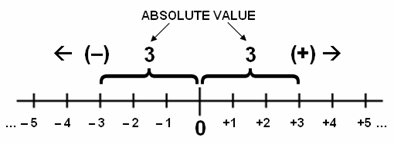
(5)    An integer is made up of a sign and an absolute value.
Integer2

Absolute value of +3   =    |+3|    =    3

Absolute value of –3   =    |–3|    =    3

.

(6)  POSITIVE affirms the existing characteristic.

Positive of a positive integer is that positive integer:    + (+1)   =   +1

Positive of a negative integer is the negative integer:  + (–1)   =   –1

.

(7)  NEGATIVE indicates the opposite characteristic.

Negative of a positive integer is the negative integer:   – (+1)   =   –1

Negative of a negative integer is the positive integer:   – (–1)   =   +1

.

(8)  A Rational number can be expressed as a ratio of two counting numbers.

Therefore, there is a definite unit on which a rational number is based.

This unit is the common factor of the two counting numbers.

.

(9) An Irrational number cannot be expressed as a ratio of two counting numbers.

Therefore, there is no unit, however small, on which an irrational number may be based.

Please see Going Beyond Counting.

Thus, the basic nature of number being discrete comes under question.

.

(10)  The following are considered as Real numbers:

Natural, whole, positive, negative, rational and irrational numbers.

Real numbers may be represented on a Number Line with a common reference point of zero.

The reference point of zero may be selected arbitrarily on the number line.

.

(11)  The square of an integer of either sign is always a positive integer.

A positive integer has two square roots: one positive and the other negative.

A negative integer has no square root in the real number system.

.

(12)  The square root of –1 is denoted as i (an imaginary unit)

Thus,      i2   =   −1

Therefore, the square root of 4 is written as 2i.

.

(13)  The Imaginary numbers may be represented on a different number line.

The imaginary and real numbers lines are independent of each other.

.

(14)  A complex number a + bi is made up of real and imaginary components.

The real component is a, and the imaginary component is bi

Here a and b are real numbers, and i is the imaginary unit satisfying i2 = −1

.

(16)  The Complex numbers may be represented on a complex plane.

A complex plane is determined by a real number line as the horizontal axis,

and an imaginary number line as the vertical axis.

The reference point of zero is shared by both number lines.

.

Space, Time, Dimensions, and Filter

unreality

“The Absolute Truth is that there is nothing absolute in the world, that everything is relative, conditioned and impermanent, and that there is no unchanging, everlasting, absolute substance like Self, Soul, or Ātman within or without.” ~ Buddha

.

How can we express the above mathematically?

We may say that the location (origin) used to refer to the locations of all other objects is not absolute. That origin may be selected arbitrarily. We may say that the duration (eternity) against which to measure the duration of all other objects is not absolute. That eternity may be selected arbitrarily. And then we select an arbitrary unit of measure, and fix it.  Now we have a consistent dimension on which all things relative may be placed.

This is what gives us three dimensions of space; and the dimension of time. These are the primary dimensions. Beyond these we have derived dimensions of mass, velocity, temperature, etc.

When we try to think beyond physical space-time, we run into mental speculation. We then find ourselves in a mental space-time. This is real to the degree that all associations have been kept consistent. We have simply shifted from concreteness to abstraction. This provides us with a super-dimension of abstraction that runs across the primary dimensions of space-time.

Thus, it is the relative nature of this universe which is perceived as space and time.

.

From Reality & Mindfulness

Space and time exist because manifestations are perceived as being relative to each other, both in their position as well as in their duration. If manifestations were absolute, or non-existent, there would be no space and time.

The location of an object is always relative to another location. As a minimum, the location of an object is referenced by the location of the observer. Similarly, the duration of an object is always relative to duration of another object, and, as a minimum, it is referenced by the duration of the observer. The absolute “location-in-itself” or “duration-in-itself” does not exist

Space and time depend on manifestation being perceived as relative.

A closer look, or overview, provides us with new information about objects. For example, the close-ups of insects, images through electron microscope, and views through Hubble Telescope are so striking that we are taken aback. Similarly, when we dilate or compress duration, we get new information about how phenomena transpire. This applies not only to physical but also to mental objects.

By controlling space and time we can obtain new insights into manifestations.

Was this “new” information always there as part of manifestation?

The answer is yes. People who are smart really know what they are looking at. They have a much finer sense of differentiation because they observe carefully. This gives them the ability to operate efficiently. Whether they are managing a company, or researching into a theoretical subject like mathematics, they perceive a lot more.

What does controlling space and time really means? It means positioning oneself to get a better look, or breaking down, or combining, sequences to see what is there. The idea is to scrutinize with mindfulness.

Anything that influences perception is part of filter by definition. Space and time influence our perception.

Space and time seems to be aspects of the filter that we all carry.

Even when objects are manifested in complete detail, space and time keep us from perceiving them for what they are. Knowing this we can start to get an idea of the nature of the elusive filter.

.

A wonderful example of consistency is mathematical associations. It is the consistency of space-time dimensions that comes across as reality.

This consistency breaks down as we observe life. Here we have an unknown filter that influences our perception of reality. Any inconsistency then appears as unreality.

This blog entry is offered as a place to discuss our observations and speculations about space, time, dimensions and filter. Have a go at it.

.

Two Favorites – Korzybski & Dunham

Korzybski Explains Abstracting with a Push Toy Fan

.

“Meet Achmed the Dead Terrorist” | Spark of Insanity | JEFF DUNHAM

.

The “Invalidation” Button

“Because one believes in oneself, one doesn’t try to convince others. Because one is content with oneself, one doesn’t need others’ approval. Because one accepts oneself, the whole world accepts him or her.” 
― Lao Tzu

.

criticism
Reference: Scientology

.

This process is for those who zealously try to convince others of their ideology, and get easily upset when people do not see things their way. They feel that they are being made wrong when inconsistencies are pointed out in their convictions. They cannot take any criticism. They cannot discuss calmly.

Scientologists use a special word at the first whiff of any criticism – INVALIDATION, as in, “You are invalidating me.” But words like WOGS and RAW MEAT are built into their vocabulary for those who are not scientologists.

Scientologists not only scream against being invalidated, but they also invalidate back immediately using convenient Scientology vocabulary like “suppressive,” “antago” or “1.1”. This button of “invalidation” tends to be very prominent among Scientologists both ways.

Recently, I was called “antago” in a Scientology groups on Facebook because I presented the Buddhist view that soul is impermanent. This view went against their cherished belief in an eternal “thetan.” In the upset that followed nothing that I could say made any difference. They were simply not willing to listen. They started to misinterpret anything I had to say, and make me wrong any way they could. No discussion was possible.

Those who often feel invalidated may find some relief from using the following process.

.

THE PROCESS

Scientologists use processes. So here is a process for those who very often feel invalidated. Contemplate on

“What is it that is getting invalidated?”

This process is done with KHTK approach (mindfulness), and not with Scientology approach (listing). Take the first item that comes at the top of the mental stack and mindfully contemplate over it. Then take the next, and the next, until no more items are coming up.

The 12 aspects of mindfulness are:

  1. Observe without expecting anything, or attempting to get an answer.

  2. Observe things as they really are, not as they seem to be.

  3. If something is missing do not imagine something else in its place.

  4. If something does not make sense then do not explain it away.

  5. Use physical senses as well as mental sense to observe.

  6. Let the mind un-stack itself.

  7. Experience fully what is there.

  8. Do not suppress anything.

  9. Associate data freely.

  10. Do not get hung up on name and form.

  11. Contemplate thoughtfully.

  12. Let it all be effortless.

.

One will find that it is always a consideration that one holds dear, which one feels is getting invalidated. Recognize that consideration. Then recognize your attachment to, or identification with that consideration.

One starts out being the sum total of one’s considerations.

Know thyself.

.

5 Minute University

Fr. Guido Sarducci (Don Novello) explains what the average college graduate remembers five years after graduation. From Gilda Live, 1980. Edit cuts out summary of religious studies…

.