Reference: The Scientific Frame of Reference
All motion and persistence in the universe is relative; nothing is at absolute rest except, maybe, the universe taken as a whole. There is no such thing as mass completely at rest. All objects naturally move at a uniform rate under their own inertia. Any departure from their uniform motion causes restorative force due to inertia.
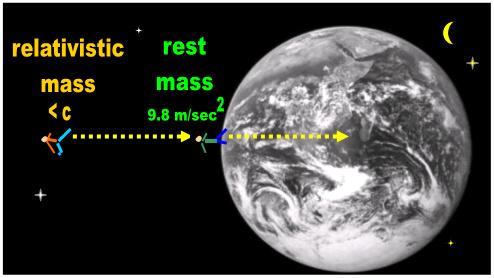
Uniform motion simply means “absence of acceleration.” It has nothing to do with the velocity of the object, which is relative anyway. It is the mass of an object that is moving uniformly under its own inertia, which may be defined as “rest mass.”
The “rest mass” is the mass of an object that is moving at uniform speed under its own inertia.
When the uniform motion of an object is disturbed by external force, a restorative force appears due to its inertia. This inertial force acts to eliminate acceleration and restore uniform motion. This restorative inertial force, very likely, is converted inertial mass.
Thus the inertial mass of an accelerating object is less than the “rest mass,” maybe by an imperceptible amount. When the acceleration stops, the original “rest mass” is restored.
Inertial mass converts into restorative force to oppose any change in uniform motion. Thus, the inertial mass of an object reduces with acceleration.
Once we understand the universal frame of reference of the Scientific Observer, no other frame of reference is needed to explain things. Changes in inertia in this frame of reference can explain all phenomena.
The Scientific Observer is simultaneously aware of the whole universe. This awareness is not limited by the speed of light. The Scientific Observer can observe light creeping among stars. He can see earth rotating. He can see motion at all different scales.
The Scientific Observer is aware that the velocity of light in space is limited by its inertia (permittivity and permeability). . The higher is the inertia, the lower is the uniform motion of any object under its own inertia. Maybe a mathematical relationship can be worked out between inertia and uniform motion.
In this frame of reference all inertia shall interact with all other inertia. Gravity shall be a natural outcome of this interaction. It may be possible from this universal frame of reference to derive all conclusions of the Theory of Relativity.
.