This is Chapter 6 of the Book: What the Buddha Taught by Walpola Rahula.
In color are the comments that have been added.
.
What in general is suggested by Soul, Self, Ego, or to use the Sanskrit expression Atman, is that in man there is a permanent, everlasting and absolute entity, which is the unchanging substance behind the changing phenomenal world.
According to some religions, each individual has such a separate soul which is created by God, and which, finally after death, lives eternally either in hell or heaven, its destiny depending on the judgment of its creator. According to others, it goes through many lives till it is completely purified and becomes finally united with God or Brahman, Universal Soul or Atman, from which it originally emanated. This soul or self in man is the thinker of thoughts, feeler of sensations, and receiver of rewards and punishments for all its actions good and bad. Such a conception is called the idea of self.
There is a persistent belief that there is something unchanging that underlies this changing phenomenal world. For example, in a person who is alive, there is a “self” that is aware. It thinks the thought, feels the sensations, and it is the effect of its karma. After death, it separates from the body and maintains a distinct identity eternally. It may exist without a body; it may take birth into another body; or, it may merge into a universal entity. The belief in an eternal entity exists in some form in every religion. Is there such an eternally unchanging substance, such as soul or God?
Buddhism stands unique in the history of human thought in denying the existence of such a Soul, Self, or Atman. According to the teaching of the Buddha, the idea of self is an imaginary, false belief which has no corresponding reality, and it produces harmful thoughts of ‘me’ and ‘mine’, selfish desire, craving, attachment, hatred, ill-will, conceit, pride, egoism, and other defilements, impurities and problems. It is the source of all the troubles in the world from personal conflicts to wars between nations. In short, to this false view can be traced all the evil in the world.
The human form may be seen as the body-mind-self. There is apparently a blueprint of human form that passes from one lifetime to the next through the DNA mechanism. Each lifetime may add certain impressions to the blueprint, but even the heaviest of these impressions ultimately get assimilated in four or five generations. The human blueprint may be the result of assimilation of impressions from more primitive blueprints. The human blueprint may ultimately evolve into some more efficient form. Any particular blueprint, therefore, has only relative endurance. None of its aspects have remained permanent. The only enduring aspect seems to be “evolution.”
Two ideas are psychologically deep-rooted in man: self-protection and self-preservation. For self-protection man has created God, on whom he depends for his own protection, safety and security, just as a child depends on its parent. For self-preservation man has conceived the idea of an immortal Soul or Atman, which will live eternally. In his ignorance, weakness, fear, and desire, man needs these two things to console himself. Hence he clings to them deeply and fanatically.
The Buddha’s teaching does not support this ignorance, weakness, fear, and desire, but aims at making man enlightened by removing and destroying them, striking at their very root. According to Buddhism, our ideas of God and Soul are false and empty. Though highly developed as theories, they are all the same extremely subtle mental projections, garbed in an intricate metaphysical and philosophical phraseology. These ideas are so deep-rooted in man, and so near and dear to him, that he does not wish to hear, nor does he want to understand, any teaching against them.
God and soul are human ideas. They did not exist until humans evolved. The idea of “God” serves to protect man for he is weak. The idea of “Soul” serves to preserve man for he is afraid. These ideas are very deep-rooted in man. He uses them to justify everything from personal conflicts to wars between nations. But all ideas are approximations of reality. To think they are the reality is ignorance. Buddha’s enlightenment is the overcoming of such weakness, fear, and ignorance.
The Buddha knew this quite well. In fact, he said that his teaching was ‘against the current’ (patisotagami), against man’s selfish desires. Just four weeks after his Enlightenment, seated under a banyan tree, he thought to himself: ‘I have realized this Truth which is deep, difficult to see, difficult to understand… comprehensible only by the wise… Men who are overpowered by passions and surrounded by a mass of darkness cannot see this Truth, which is against the current, which is lofty, deep, subtle and hard to comprehend.
With these thoughts in his mind, the Buddha hesitated for a moment, whether it would not be in vain if he tried to explain to the world the Truth he had just realized. Then he compared the world to a lotus pond: In a lotus pond there are some lotuses still under water; there are others which have risen only up to the water level; there are still others which stand above water and are untouched by it. In the same way in this world, there are men at different levels of development. Some would understand the Truth. So the Buddha decided to teach it.
Buddha knew that his teaching was ‘against the current’ (against man’s selfish desires); but he saw the possibility that some would understand the Truth. So he decided to teach it.
The doctrine of Anatta or No-Soul is the natural result of, or the corollary to, the analysis of the Five Aggregates and the teaching of Conditioned Genesis (Paticca-samuppada). We have seen earlier, in the discussion of the First Noble Truth (Dukkha), that what we call a being or an individual is composed of the Five Aggregates, and that when these are analysed and examined, there is nothing behind them which can be taken as ‘I’, Atman, or Self, or any unchanging abiding substance. That is the analytical method. The same result is arrived at through the doctrine of Conditioned Genesis which is the synthetical method, and according to this nothing in the world is absolute. Everything is conditioned, relative, and interdependent. This is the Buddhist theory of relativity.
According to Buddha’s teaching, the individual is composed of the Five Aggregates: matter, sensations, perceptions, mental formations and consciousness. None of these constitute unchanging abiding substance. Furthermore, the whole existence is relative, interdependent and interconnected, and nothing is absolute or independent. According to this principle the individual self is relative also.
Before we go into the question of Anatta proper, it is useful to have a brief idea of the Conditioned Genesis. The principle of this doctrine is given in a short formula of four lines:
When this is, that is (Imasmim sati idam hod);
This arising, that arises (Imassuppada idam uppajjati);
When this is not, that is not (Imasmim asati idam na boti);
This ceasing, that ceases (Imassa nirodha idam nirujjhati).
On this principle of conditionality, relativity and inter-dependence, the whole existence and continuity of life and its cessation are explained in a detailed formula which is called Paticca-samuppada ‘Conditioned Genesis’, consisting of twelve factors:
- Through ignorance are conditioned volitional actions or karma-formations (Avijjapaccaya samkhara).
- Through volitional actions is conditioned consciousness (Samkharapaccaja vinnanam).
- Through consciousness are conditioned mental and physical phenomena (Vinnanapaccaja namaruparti).
- Through mental and physical phenomena are conditioned the six faculties (i.e., five physical sense-organs and mind) (Namarupapaccayd salayatanam).
- Through the six faculties is conditioned (sensorial and mental) contact (Salayatanapaccaya phasso).
- Through (sensorial and mental) contact is conditioned sensation (Phassapaccaja vedana).
- Through sensation is conditioned desire, ‘thirst’ (Vedana-paccaja tanha).
- Through desire (‘thirst’) is conditioned clinging (Tanha-paccaja upadanam).
- Through clinging is conditioned the process of becoming (Upadatiapaccaya bhavo).
- Through the process of becoming is conditioned birth (Bhavapaccaya jati).
- Through birth are conditioned
- Decay, death, lamentation, pain, etc. (Jatipaccaya jaramaranam…).
This is how life arises, exists and continues. If we take this formula in its reverse order we come to the cessation of the process:
Through the complete cessation of ignorance, volitional activities or karma formations cease; through the cessation of volitional activities, consciousness ceases; … through the cessation of birth, decay, death, sorrow, etc., cease.
The word GENESIS means “an origin, creation, or beginning.” According to Buddhism “genesis” is conditioned. Nothing happens by itself. A happening is always dependent on something else happening. This obviously contradicts the Biblical concept of “genesis,” and correctly so. The Biblical God is not defined except in terms of what it has created. It is a circular definition.
It should be clearly remembered that each of these factors is conditioned (paticcasamuppanna) as well as conditioning (paticcasamuppada). Therefore they are all relative, interdependent and interconnected, and nothing is absolute or independent; hence no first cause is accepted by Buddhism as we have seen earlier. Conditioned Genesis should be considered as a circle, and not as a chain.
Conditioned Genesis should be considered as a circle, and not as a chain. Therefore, first cause is not accepted in Buddhism.
The question of Free Will has occupied an important place in Western thought and philosophy. But according to Conditioned Genesis, this question does not and cannot arise in Buddhist philosophy. If the whole of existence is relative, conditioned and interdependent, how can Will alone be free? Will, like any other thought, is conditioned. So-called ‘freedom’ itself is conditioned and relative. Such a conditioned and relative ‘Free Will’ is not denied. There can be nothing absolutely free, physical or mental, as everything is interdependent and relative. If Free Will implies a will independent of conditions, independent of cause and effect, such a thing does not exist. How can a will, or anything for that matter, arise without conditions, away from cause and effect, when the whole of existence is conditioned and relative, and is within the law of cause and effect? Here again, the idea of Free Will is basically connected with the ideas of God, Soul, justice, reward and punishment. Not only is so-called free will not free, but even the very idea of Free Will is not free from conditions.
If Free Will implies a will independent of conditions, independent of cause and effect, such a thing does not exist.
According to the doctrine of Conditioned Genesis, as well as according to the analysis of being into Five Aggregates, the idea of an abiding, immortal substance in man or outside, whether it is called Atman, ‘I’, Soul, Self, or Ego, is considered only a false belief, a mental projection. This is Buddhist doctrine of Anatta, No-Soul or No-Self.
The idea of an abiding, immortal substance in man or outside, is considered only a false belief, a mental projection.
In order to avoid a confusion it should be mentioned here that there are two kinds of truths: conventional truth (sammuti-sacca, Skt. Samvrti-satya) and ultimate truth (paramattha-sacca, Skt. paramartha-satya). When we use such expressions in our daily life as ‘I’, ‘you’, ‘being’, ‘individual’, etc., we do not lie because there is no self or being as such, but we speak a truth conforming to the convention of the world. But the ultimate truth is that there is no ‘I’ or ‘being’ in reality. As the Mahayana-sutralankara says: ‘A person (pudgala) should be mentioned as existing only in designation (prajnapit) (i.e., conventionally there is a being), but not in reality (or substance dravya)’.
According to Buddhism, the idea of self or being, is useful by convention only; but not in reality or substance.
‘The negation of an imperishable Atman is the common characteristic of all dogmatic systems of the Lesser as well as the Great Vehicle, and, there is, therefore, no reason to assume that Buddhist tradition which is in complete agreement on this point has deviated from the Buddha’s original teaching.’
It is therefore curious that recently there should have been a vain attempt by a few scholars to smuggle the idea of self into the teaching of the Buddha, quite contrary to the spirit of Buddhism. These scholars respect, admire, and venerate the Buddha and his teaching. They look up to Buddhism. But they cannot imagine that the Buddha, whom they consider the most clear and profound thinker, could have denied the existence of an Atman or self which they need so much. They unconsciously seek the support of the Buddha for this need for eternal existence–of course not in a petty individual self with small s, but in the big Self with a capital S.
It is better to say frankly that one believes in an Atman or self. Or one may even say that the Buddha was totally wrong in denying the existence of an Atman. But certainly it will not do for anyone to try to introduce into Buddhism an idea which the Buddha never accepted, as far as we can see from the extant original texts.
Religions which believe in God and Soul make no secret of these two ideas; on the contrary, they proclaim them, constantly and repeatedly, in the most eloquent terms. If the Buddha had accepted these two ideas, so important in all religions, he certainly would have declared them publicly, as he had spoken about other things, and would not have left them hidden to be discovered only 25 centuries after his death.
Religions which believe in God and Soul make no secret of these two ideas. Buddha never declared these two ideas publicly. He did not consider them to be real.
People become nervous at the idea that through the Buddha’s teaching of Anatta, the self they imagine they have is going to be destroyed. The Buddha was not unaware of this.
A bhikkhu once asked him: ‘Sir, is there a case where one is tormented when something permanent within oneself is not found?’
‘Yes, bhikkhu, there is,’ answered the Buddha.’ A man has the following view: “The universe is that Atman, I shall be that after death, permanent, abiding, ever-lasting, unchanging, and I shall exist as for eternity”. He hears the Tathagata or a disciple of his, preaching the doctrine aiming at the complete destruction of all speculative views… aiming at the extinction of “thirst”, aiming at detachment, cessation, Nirvana. Then that man thinks: “I will be annihilated, I will be destroyed, I will be no more.” So he mourns, worries himself, laments, weeps, beating his breast, and becomes bewildered. Thus, O bhikkhu, there is a case where one is tormented when something permanent within oneself is not found.’
Elsewhere the Buddha says: ‘O bhikkhus, this idea that I may not be, I may not have, is frightening to the uninstructed world-ling.’
Buddha was aware that people are frightened of the idea that nothing permanent within them will be found.
Those who want to find a ‘Self’ in Buddhism argue as follows: It is true that the Buddha analyses being into matter, sensation, perception, mental formations, and consciousness, and says that none of these things is self. But he does not say that there is no self at all in man or anywhere else, apart from these aggregates.
This position is untenable for two reasons:
One is that, according to the Buddha’s teaching, a being is composed only of these Five Aggregates, and nothing more. Nowhere has he said that there was anything more than these Five Aggregates in a being.
The second reason is that the Buddha denied categorically, in unequivocal terms, in more than one place, the existence of Atman, Soul, Self, or Ego within man or without, or anywhere else in the universe. Let us take some examples.
The effort to claim that Buddha never denied self, is the desire of that person for a permanent self.
In the Dhammapada there are three verses extremely important and essential in the Buddha’s teaching. They are nos. 5, 6 and 7 of Chapter 20 (or verses 277, 278, 279).
The first two verses say: ‘All conditioned things are impermanent'(Sabbe SAMKHARA anicca), and ‘All conditioned things are dukkha‘ (Sabbe SAMKHARA dukkha).
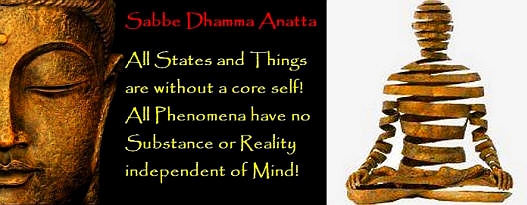
The third verse says: ‘All dhammas are without self’ (Sabbe DHAMMA anatta).
Here it should be carefully observed that in the first two verses the word samkhara ‘conditioned things’ is used. But in its place in the third verse the word dhamma is used. Why didn’t the third verse use the word samkhara ‘conditioned things’ as the previous two verses, and why did it use the term dhamma instead? Here lies the crux of the whole matter.
The term samkhara denotes the Five Aggregates, all conditioned, interdependent, relative thing and states, both physical and mental. If the third verse said : ‘All samkhara (conditioned things) are without self’, then one might think that, although conditioned things are without self, yet there may be a Self outside conditioned things, outside the Five Aggregates. It is in order to avoid misunderstanding that the term dhamma is used in the third verse.
The term dhamma is much wider than samkhara. There is no term in Buddhist terminology wider than dhamma. It includes not only the conditioned things and states, but also the non-conditioned, the Absolute, Nirvana. There is nothing in the universe or outside, good or bad, conditioned or non-conditioned, relative or absolute, which is not included in this term. Therefore, it is quite clear that, according to this statement: ‘ All dhammas are without Self’, there is no Self, no Atman, not only in the Five Aggregates, but nowhere else too outside them or apart from them.
This means, according to the Theravada teaching, that there is no self either in the individual (pudgala) or in dhammas. The Mahayana Buddhist philosophy maintains exactly the same position, without the slightest difference, on this point, putting emphasis on dharma-nairatmya as well as on pudgala-nairatmya.
Samkhara are mental impressions that give rise to conditioned response. When these impressions are fully assimilated, then they gives rise to rational response or dhamma. There is nothing permanent here: neither self nor universe.
In the Alagaddupama-sutta of the Majjhima-nikaya, addressing his disciples, the Buddha said: ‘O bhikkhus, accept a soul-theory (Attavada) in the acceptance of which there would not arise grief, lamentation, suffering, distress and tribulation. But, do you see, O bhikkhus, such a soul-theory in the acceptance of which there would not arise grief, lamentation, suffering, distress and tribulation?’
‘Certainly not, Sir.’
‘Good, O bhikkhus. I, too, O bhikkhus, do not see a soul-theory, in the acceptance of which there would not arise grief, lamentation, suffering, distress and tribulation.
If there had been any soul-theory which the Buddha had accepted, he would certainly have explained it here, because he asked the bhikkhus to accept that soul-theory which did not produce suffering. But in the Buddha’s view, there is no such soul-theory, and any soul-theory, whatever it may be, however subtle and sublime, is false and imaginary, creating all kind of problems, producing in its train grief, lamentation, suffering, distress, tribulation and trouble.
Continuing the discourse the Buddha said in the same sutta: ‘O bhikkhus, when neither self nor anything pertaining to self can truly and really be found, this speculative view: “The universe is that Atman (Soul); I shall be that after death, permanent, abiding, everlasting, unchanging, and I shall exist as such for eternity” – is it not wholly and completely foolish?’
Here the Buddha explicitly states that an Atman, or Soul, or Self, is nowhere to be found in reality, and it is foolish to believe that there is such a thing.
Death is the cessation of awareness and only impressions remain. But there is nothing permanent, abiding, everlasting, or unchanging about these impressions.
Those who seek a self in the Buddha’s teaching quote a few examples which they first translate wrongly, and then misinterpret. One of them is the well-known line Atta hi attano natho from the Dhammapada (XII , 4, or verse 160), which is translated as ‘Self is the lord of self’, and then interpreted to mean that the big Self is the lord of the small self.
First of all, this translation is incorrect. Atta here does not mean self in the sense of soul. In Pali the word atta is generally used as a reflexive or indefinite pronoun, except in a few cases where it specifically and philosophically refers to the soul-theory, as we have seen above. But in general usage, as in the chapter in the Dhammapada where this line occurs, and in many other places, it is used as a reflexive or indefinite pronoun meaning ‘myself’, ‘yourself’, ‘himself’, ‘one’, ‘oneself’, etc.
Next, the word natho does not mean ‘lord’, but ‘refuge’, ‘support’, ‘help’, ‘protection’. Therefore, Atta hi attano natho really means ‘One is one’s own refuge’ or ‘One is one’s own help’ or ‘support’. It has nothing to do with any metaphysical soul or self. It simply means that you have to rely on yourself, and not on others.
The phrase”Atta hi attano natho”means ‘One is one’s own refuge’. It has nothing to do with any metaphysical soul or self.
Another example of the attempt to introduce the idea of self into the Buddha’s teaching is in the well-known words Attadipa viharatha, attasarana anannasarana, which are taken out of context in the Mahaparinibbana-sutta. This phrase literally means: ‘Dwell making yourselves your island (support), making yourselves your refuge, and not anyone else as your refuge.’ Those who wish to see a self in Buddhism interpret the words attadipa and attasarana ‘taking self as a lamp’, ‘taking self as a refuge’.
We cannot understand the full meaning and significance of the advice of the Buddha to Ananda, unless we take into consideration the background and the context in which these words were spoken.
The Buddha was at the time staying at a village called Beluva. It was just three months before his death, Parinirvana. At this time he was eighty years old, and was suffering from a very serious illness, almost dying (maranantika). But he thought it was not proper for him to die without breaking it to his disciples who were near and dear to him. So with courage and determination he bore all his pains, got the better of his illness, and recovered. But his health was still poor.
After his recovery, he was seated one day in the shade outside his residence. Ananda, the most devoted attendant of the Buddha, went to his beloved Master, sat near him, and said: ‘Sir, I have looked after the health of the Blessed One, I have looked after him in his illness. But at the sight of the illness of the Blessed One the horizon became dim to me, and my faculties were no longer clear. Yet there was one little consolation: I thought that the Blessed One would not pass away until he had left instructions touching the Order of the Sangha.’
Then the Buddha, full of compassion and human feeling, gently spoke to his devoted and beloved attendant: ‘Ananda, what does the Order of the Sangha expect from me? I have taught the Dhamma (Truth) without making any distinction as exoteric and esoteric. With regard to the truth, the Tathagata has nothing like the closed fist of a teacher (acariya-mutthi). Surely, Ananda, if there is anyone who thinks that he will lead the Sangha, and that the Sangha should depend on him, let him set down his instructions. But the Tathagata has no such idea. Why should he then leave instructions concerning the Sangha? I am now old, Ananda, eighty years old. As a worn-out cart has to be kept going by repairs, so, it seems to me, the body of the Tathagata can only be kept going by repairs. Therefore, Ananda, dwell making yourselves your island (support), making yourselves, not anyone else, your refuge ; making the Dhamma your island (support), the Dhamma your refuge, nothing else your refuge.’
What the Buddha wanted to convey to Ananda is quite clear. The latter was sad and depressed. He thought that they would all be lonely, helpless, without a refuge, without a leader after their great Teacher’s death. So the Buddha gave him consolation, courage, and confidence, saying that they should depend on themselves, and on the Dhamma he taught, and not on anyone else, or on anything else. Here the question of a metaphysical Atman, or Self, is quite beside the point.
Buddha has laid down the path following which one could find one’s own answers. Buddha was willing to even have that path questioned. In spite of all help from others, one must ultimately find one’s own path. This doesn’t mean that there is a permanent self.
Further, the Buddha explained to Ananda how one could be one’s own island or refuge, how one could make the Dhamma one’s own island or refuge: through the cultivation of mindfulness or awareness of the body, sensations, mind and mind-objects (the four Satipatthanas). There is no talk at all here about an Atman or Self.
Another reference, oft-quoted, is used by those who try to find Atman in the Buddha’s teaching. The Buddha was once seated under a tree in a forest on the way to Uruvela from Benares. On that day, thirty friends all of them young princes, went out on a picnic with their young wives into the same forest. One of the princes who was unmarried brought a prostitute with him. While the others were amusing themselves, she purloined some objects of value and disappeared. In their search for her in the forest, they saw the Buddha seated under a tree and asked him whether he had seen a woman. He enquired what was the matter. When they explained, the Buddha asked them: ‘What do you think, young men? Which is better for you? To search after a woman, or to search after yourselves?’
Here again it is a simple and natural question, and there is no justification for introducing far-fetched ideas of a metaphysical Atman or Self into the business. They answered that it was better for them to search after themselves. The Buddha then asked them to sit down and explained the Dhamma to them. In the available account, in the original text of what he preached to them, not a word is mentioned about an Atman.
The subject of self-reliance is very different from the subject of Atman. The idea of self exists in conventional usage, but self does not exists as some absolute permanent reality.
Much has been written on the subject of the Buddha’s silence when a certain Parivrajaka (Wanderer) named Vacchagotta asked him whether there was an Atman or not. The story is as follows :
Vacchagotta comes to the Buddha and asks: ‘Venerable Gotama, is there an Atman?’
The Buddha is silent.
‘Then Venerable Gotama, is there no Atman?’
Again the Buddha is silent.
Vacchagotta gets up and goes away.
After the Parivrajaka had left, Ananda asks the Buddha why he did not answer Vacchagotta’s question. The Buddha explains his position:
‘Ananda, when asked by Vacchagotta the Wanderer: “Is there a self?”, if I had answered : “There is a self”, then, Ananda, that would be siding with those recluses and brahmanas who hold the eternalist theory (sassata-vada).
‘And, Ananda, when asked by the Wanderer; “Is there no self?” if I had answered: There is no self”, then that would be siding with those recluses and brahmanas who hold the annihilationist theory (ucchada-vada).
‘Again, Ananda, when asked by Vacchagotta: “Is there a self?”, if I had answered: “There is a self”, would that be in accordance with my knowledge that all dhammas are without self?’
‘Surely not, Sir,’
‘And again, Ananda, when asked by the Wanderer: “Is there no self?”, if I had answered: “There is no self”. Then that would have been a greater confusion to the already confused Vacchagotta. For he would have thought: Formerly indeed I had an Atman (self), but now I haven’t got one.’
It should now be quite clear why the Buddha was silent. But it will be still clearer if we take into consideration the whole background, and the way the Buddha treated questions and questioners – which is altogether ignored by those who discussed this problem.
The Buddha was not a computing machine giving answers to whatever questions were put to him by anyone at all, without any consideration. He was a practical teacher, full of compassion and wisdom. He did not answer questions to show his knowledge and intelligence, but to help the questioner on the way to realization. He always spoke to people bearing in mind their standard of development, their tendencies, their mental make-up, their character, their capacity to understand a particular question.
According to the Buddha, there are four ways of treating questions : (1) Some should be answered directly ; (2) others should be answered by way of analyzing them ; (3) yet others should be answered by counter-questions ; (4) and lastly, there are questions which should be put aside.
There may be several ways of putting aside a question. One is to say that a particular question is not answered or explained, as the Buddha had told this very same Vacchagotta on more than one occasion, when those famous questions whether the universe is eternal or not, etc., were put to him. In the same way he had replied to Malunkyaputta and others.
But he could not say the same thing with regard to the question whether there is an Atman (Self) or not, because he had always discussed and explained it. He could not say ‘there is self’, because it is contrary to his knowledge that ‘all dhammas are without self’. Then he did not want to say ‘there is no self’, because that would unnecessarily, without any purpose, have confused and disturbed poor Vacchagotta who was already confused on a similar question, as he had himself admitted earlier. He was not yet in a position to understand the idea of Anatta. Therefore, to put aside this question by silence was the wisest thing in this particular case.
Buddha’s responses were for the benefit of the questioner. If no answer could benefit the questioner he remained silent.
We must not forget too that the Buddha had known Vacchagotta quite well for a long time. This was not the first occasion on which this inquiring Wanderer had come to see him. The wise and compassionate Teacher gave much thought and showed great consideration for this confused seeker. There are many references in the Pali texts to this same Vacchagotta the Wanderer, his going round quite often to see the Buddha and his disciples and putting the same kind of question again and again, evidently very much worried, almost obsessed by these problems. The Buddha’s silence seems to have much more effect on Vacchagotta than any eloquent answer or discussion.
Some people take ‘self’ to mean what is generally known as ‘mind’ or ‘consciousness’. But the Buddha says that it is better for a man to take his physical body as self rather than mind, thought, or consciousness, because the former seems to be more solid than the latter, because mind, thought, or consciousness (citta, mano, vinnana) changes constantly day and night even faster than the body (kaya).
The body-mind system may be used as ‘self’; but it is not something permanent.
It is the vague feeling ‘I AM’ that creates the idea of self which has no corresponding reality, and to see this truth is to realize Nirvana, which is not very easy. In the Samjutta-nikaya there is an enlightening conversation on this point between a bhikkhu named Khemaka and a group of bhikkhus.
These bhikkhus ask Khemaka whether he sees in the Five Aggregates any self or anything pertaining to a self. Khemaka replies ‘No’. Then the bhikkhus say that, if so, he should be an Arahant free from all impurities. But Khemaka confesses that though he does not find in the Five Aggregates a self, or anything pertaining to a self, ‘I am not an Arahant free from all impurities. O friends, with regard to the Five Aggregates of Attachment, I have a feeling “I AM”, but I do not clearly see “This is I AM”.’
Then Khemaka explains that what he calls ‘I AM’ is neither matter, sensation, perception, mental formations, nor consciousness, nor anything without them. But he has the feeling ‘I AM’ with regard to the Five Aggregates, though he could not see clearly ‘This is I AM’.
He says it is like the smell of a flower: it is neither the smell of the petals, nor of the colour, nor of the pollen, but the smell of the flower.
Khemaka further explains that even a person who has attained the early stages of realization still retains this feeling ‘I AM’. But later on, when he progresses further, this feeling of ‘I AM’ altogether disappear, just as the chemical smell of a freshly washed cloth disappears after a time when it is kept in a box.
This discussion was so useful and enlightening to them that at the end of it, the text says, all of them, including Khemaka himself, became Arahants free from all impurities, thus finally getting rid of ‘I AM’.
When the understanding of ‘I AM’ takes place all fixed attention on ‘I AM’ simply disappears.
According to the Buddha’s teaching, it is as wrong to hold the opinion ‘I have no self’ (which is the annihilationist theory) as to hold the opinion ‘I have self’ (which is the eternalist theory), because both are fetters, both arising out of the false idea ‘I AM’. The correct position with regard to the question of Anatta is not to take hold of any opinions or views, but to try to see things objectively as they are without mental projections, to see that what we call ‘I’, or ‘being’, is only a combination of physical and mental aggregates, which are working together interdependently in flux of momentary change within the law of cause and effect, and that there is nothing permanent, everlasting, unchanging and eternal in the whole of existence.
What we call ‘I’, or ‘being’, is only a combination of physical and mental aggregates, which are working together interdependently in flux of momentary change within the law of cause and effect, and that there is nothing permanent, everlasting, unchanging and eternal in the whole of existence.
Here naturally a question arises: If there is no Atman or Self, who gets the results of karma (actions)? No one can answer this question better than the Buddha himself. When this question was raised by a bhikkhu the Buddha said: ‘I have taught you, O bhikkhus, to see conditionality everywhere in all things.’
The Buddha’s teaching on Anatta, No-Soul, or No-Self, should not be considered as negative or annihilistic. Like Nirvana, it is Truth, Reality; and Reality cannot be negative. It is the false belief in a non-existing imaginary self that is negative. The teaching on Anatta dispels the darkness of false beliefs, and produces the light of wisdom. It is not negative; as Asanga very aptly says: ‘There is the fact of No-selfness’ (nairatmyastita).
It simply boils down to freeing the fixed attention on the subject of ‘I’.
.