Author Archives: vinaire

I am originally from India. I am settled in United States since 1969. I love mathematics, philosophy and clarity in thinking.

KEX #2: Responsibility

Reference: KEX #1: Detachment

Introduction

The system of the body and the mind may be referred to as the “energy body.” The physical body forms the nucleus of this energy body. The energy body is much bigger than the physical body just like the atom is much bigger than its nucleus. It is true that you are neither your body, nor your mind; therefore, you are not this energy body either. But you are responsible for this energy body.

You come closest to being the “center” of this energy body. To establish yourself stably as the center, you must bring the energy body in complete harmony within itself.

This second exercise “KEX #2” is same as “KEX #1” except for the thoughts that you mentally say to yourself (see below). Therefore, “KEX #1,” (see the reference above), is the prerequisite to this exercise.

.

The Posture

Sit in a straight-backed chair with feet flat on the floor and arms resting comfortably in the lap. The knees are positioned parallel to the shoulders. This alternate posture allows the body to remain stably erect even in deep state of concentration. During this exercise, focus your attention mildly between the eyebrows.

.

The Exercise

In this exercise you simply BE there and face all perceptions, sensations, feelings and emotions without avoiding, resisting, suppressing, or denying them.

In addition you do the following.
… (1) Inhale and exhale gently, slowly.
… (2) With each inhalation, mentally say to yourself: “I am responsible for the body.” The inhalation should last the whole duration of that thought.
… (3) With each exhalation, mentally say to yourself: “I am responsible for the mind.” The exhalation should last the whole duration of that thought.

Do this exercise for at least 20 minutes at a stretch so that your energies get properly organized,

OPTIONAL: You may do this exercise while walking on a treadmill at a gentle pace. Make sure you have a safety cord attached to you, in case you stumble. Your body is generating more energy on a treadmill and that helps organize the energies better.

.

Please Note

This is an experimental exercise, which is a natural extension of KEX #1.

Do this exercise for 20 minutes, twice a day, for 1 week.  After that you may extend this exercise by one week at a time (twice a day) till you are satisfied with what this exercise may do.

You may then either go to a new exercise that is available, or go back to a previous exercise already completed, to consolidate the results.

When returning to a previous exercise always do it for at least one week, and then extend it by one week at a time (twice a day) till you are satisfied.

.

KEX #1: Detachment

Reference: TR0 and Mindfulness
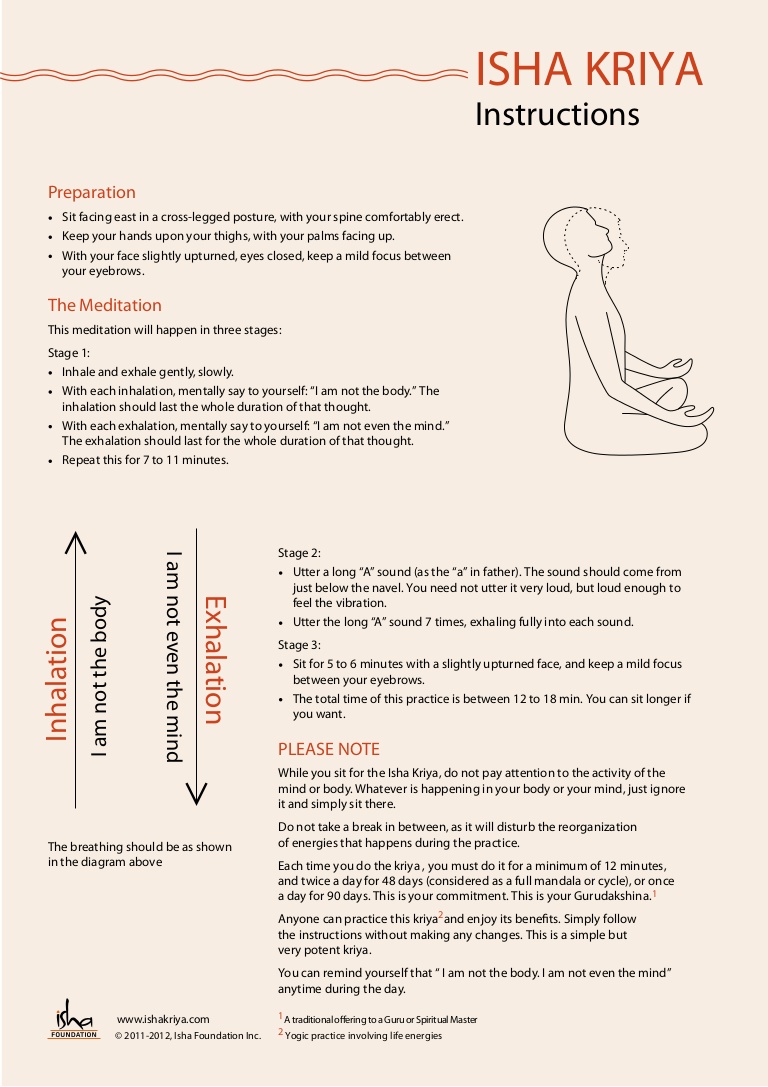
Reference: Sadhguru: Isha Kriya Instructions

Introduction

Neti, neti” is an ancient Vedic method to discover and get rid of unwitting identifications. People generally identify themselves with their body and mind, and identify others by their body and mind. The body is an accumulation of physical elements. The mind is an accumulation of impressions of such elements. So a person is neither the body nor the mind.

The purpose of this exercise is to help a person become aware of the primary misidentifications with body and mind, while seeing them for what they really are.

This is the first exercise of “KEX” series. “KEX #1” simply means “Knowledge Exercise #1.” Elements of this exercise are borrowed from Scientology exercise called TR0, and Sadhguru’s exercise on Kriya Yoga (see the two references above). It is important that you become reasonably familiar with these two references.

.

The Posture

The purpose of the posture in meditation is to keep the body stably erect in a natural and comfortable manner, even in deep meditation. The legs are crossed while sitting in meditation because it locks the body in a stable position. In many cultures, especially in European culture, people are not used to sitting with their legs crossed. Therefore, as in TR0, one may sit in a straight-backed chair with feet flat on the floor and arms resting comfortably in the lap. The knees are positioned parallel to the shoulders. This alternate posture allows the body to remain stably erect.

For KEX #1, we use the posture as used in TR0, while focusing the attention mildly between the eyebrows as in Isha Kriya.

.

The Exercise

In this exercise you simply BE there and face all perceptions, sensations, feelings and emotions without avoiding, resisting, suppressing, or denying them (see TR0 and The Discipline of Mindfulness).

In addition you do the following (see Isha Kriya).
… (1) Inhale and exhale gently, slowly.
… (2) With each inhalation, mentally say to yourself: “I am not the body.” The inhalation should last the whole duration of that thought.
… (3) With each exhalation, mentally say to yourself: “I am not even the mind.” The exhalation should last the whole duration of that thought.

Do this exercise for at least 20 minutes at a stretch so that your energies get properly organized,

OPTIONAL: You may do this exercise while walking on a treadmill at a gentle pace. Make sure you have a safety cord attached to you, in case you stumble. Your body is generating more energy on a treadmill and that helps organize the energies better.

.

Please Note

This is an experimental exercise derived from Hubbard’s and Sadhguru’s interpretations of ancient knowledge. Here we have a consolidation of those interpretations.

Do this exercise for 20 minutes, twice a day, for 48 days; or once a day for 90 days. This is your commitment as recommended for Isha Kriya.

In doing this exercise one may get into very deep concentration, in which the thought being repeated turns into visualizations. Simply BE with those visualizations without interfering with them.

If you want, you can do the sitting exercise for up to 2 hours at a stretch, safely, as was determined on TR0.

.

Isha Kriya of Sadhguru

Reference: Course on Subject Clearing

This exercise is taught at Sadhguru’s ISHA Foundation. Please do this exercise as instructed. If you cannot sit in a cross-legged posture comfortably then you may sit on a chair facing East (see Detachment).

This exercise requires a long commitment. During the 48 days that you would be doing Isha Kriya, find some time to study the documents under the section: The Discipline of Mindfulness.

Here is Sadhguru’s video on Isha Kriya.

.

The World of Atom (Part X)

Reference: Boorse 1966: The World of Atom

PART X – X-RAYS AND THEIR CONTRIBUTION TO THE RIDDLE OF MATTER

THE WORLD OF ATOM by Boorse

Chapter 51: Interference Phenomena (Max von Laue 1879 – 1960, Walter Friedrich 1883 – 1968, Paul Knipping 1883 – 1935)

After X-rays had been discovered by Roentgen in 1895, a considerable controversy arose as to their nature. They were unresponsive to electromagnetic forces. But X-rays were scattered from small particles in suspension the way light is scattered in a dusty medium. This and other observations convinced Max von Laue that X-Rays were electromagnetic waves. But X-rays could not be refracted or diffracted the way visible light is because of much shorter wavelength. Laue introduced a very ingenious idea: to use the regular array of atoms in the lattice structure of a crystal as the grating. Laue worked out the theory of this type of diffraction. He received the Nobel Prize for this work in 1914.

Chapter 52: Bragg’s Law (William Henry Bragg 1862 – 1942, William Lawrence Bragg 1890 – 1971)

W. L. Bragg examined the results of X-ray diffraction from Laue’s experiments done in 1812. He proceeded to show that the Laue pattern could be analyzed in a much simpler way. Bragg adopted the view that the incident X-rays consisted of a continuous spectrum extending over a wide range of wavelengths. He supposed that the atoms of the exposed crystal act as a diffraction center and radiate secondary waves, as if they are reflected from a plane made of a number of atoms. The intensity increased with the density of atoms in that plane. The research by the Braggs showed that the X-ray emission spectrum of an element is characteristic of that element, and that X-rays can be used as a powerful and precise means of crystal analysis. The 1915 Nobel Prize was awarded to the Braggs for their contribution to crystal analysis.

Chapter 53: Atomic Number (Antonius Van der Broek 1870 – 1926)

Antonius Van den Broek was the first to suggest that the number of charges in an element’s atomic nucleus is exactly equal to the element’s place on Mendeleev’s periodic table. The number of the place of an element in the periodic table at that time was not thought by most physicists to be a physical property. Simultaneous development of α-particle scattering theory and the X-ray scattering measurements suggested that the number of electrons per atom is equal to half the atomic weight of the atom. It was not until the work of Henry Moseley working with the Bohr model of the atom with the explicit idea of testing Van den Broek’s theory, that it was realized that atomic number was indeed a purely physical property (the charge of the nucleus) which could be measured, and that Van den Broek’s original guess had been correct. Henry Moseley, in his paper on atomic number and X-ray emission, mentions only the models of Rutherford and Van den Broek.

.

MAIN POINTS

  1. X-rays are not deflected by electrical or magnetic fields.
  2. X-rays are scattered from small particles in suspension the way light is scattered in a dusty medium.
  3. X-rays can excite atoms in a body to emit fluorescence radiation
  4. They are electromagnetic waves with much shorter wavelength.
  5. Ingenious idea of using the atoms forming the lattice structure of a crystal as a diffraction grating.
  6. Incident X-rays consist of a continuous spectrum extending over a wide range of wavelengths.
  7. X-ray emission spectrum of an element is characteristic of that element.
  8. X-rays can be used as a powerful and precise means of crystal analysis. 
  9. X-ray scattering measurements suggested that the number of electrons per atom is equal to half the atomic weight of the atom.
  10. To each possible intra-atomic charge corresponds a possible element.
  11. Mass deficit was accounted by protons neutralized by electrons in the nucleus.

THEORY
The number of charges in an element’s atomic nucleus is exactly equal to the element’s place on Mendeleev’s periodic table. 

.

Sadhguru: His Life

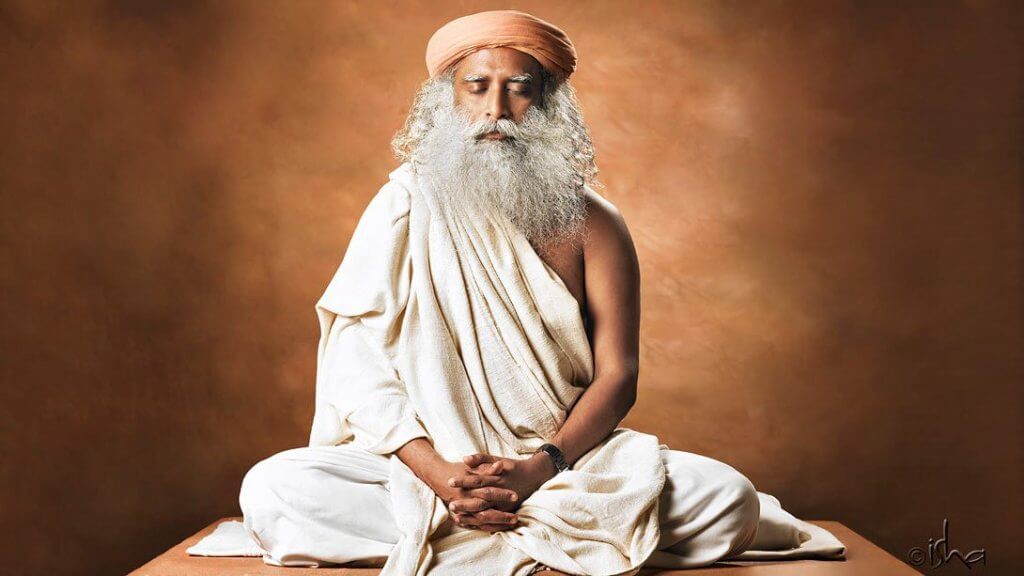
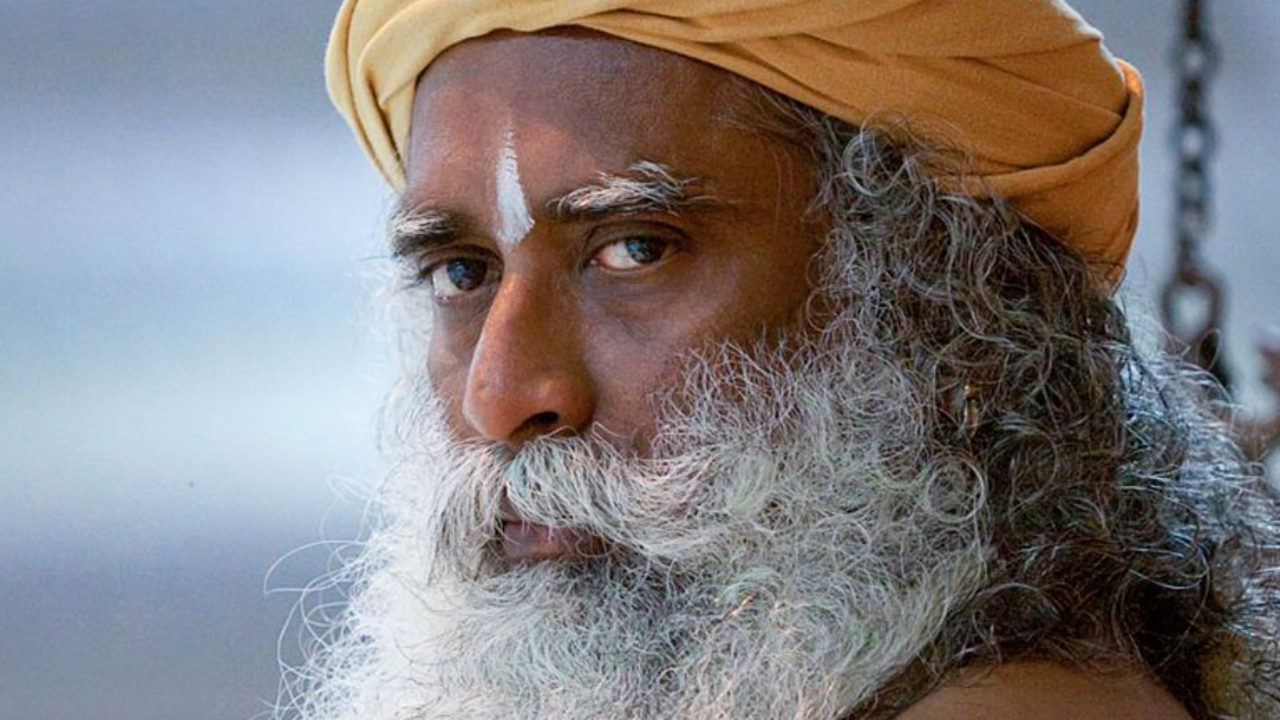
I started looking into Sadhguru only recently, since the end of August 2020. I have been researching on the interface between physics and metaphysics and I find Sadhguru’s responses in this area most insightful. Mostly I am impressed by the clarity of his responses to topics that range from common to  esoteric. I am, therefore, studying him in depth.

At first I looked him up on Wikipedia. Then I read the book Sadhguru More than a Life (2010, 242 pages) by Arundhathi Subramaniam. This is a very well-written and informative book. Here is quick time-line that may be corrected and expanded upon as I get feedback.

1957 – (September) Born as Jaggi Vasudev in Mysore in a Telugu speaking family
1970 – (Age 13) Took Yoga Lessons
1978 – Bachelor’s degree in English, Irreverent attitude to school, took to business
1982 – (Age 25) ’Spiritual experience’ on 23 Sept, then travelled extensively for a year
1983 – (Age 26) Yoga Teacher, taught his first yoga class
1984 – SSY teacher training under Guruji Rishi Prabhakar in Gommatagiiri near Mysore
1984 – (Age 27) Married Vijji
1985 – Started a center under the direction of Guruji Rishi Prabhakar in Hyderabad
1987 – Planned to start his own center in Coimbatore.
1989 – He conducted his first class in Coimbatore.
1990 – (March) Birth of daughter, Radhe
1991 – (May) Conducted a silence programme called Samyama (संयमः) for the first time
1992 – Incorporated Isha Foundation
1994 – (Age 37) Set up Isha Yoga Center and started Yoga programs
1994 – (August) Transformed from Jaggi into Sadhguru
1996 – Vijji resigned from her job in Bangalore and moved to Coimbatore.
1996 – (June) Sadhguru initiated Vijji and Bharathi into a process of intense practice
1996 – (June) Sadhguru and Vijji, along with their daughter, visited Swami Nirmalananda.
1996 – Course for the Indian Hockey Team
1996 – (Nov) the edifice of the lingam arrived in the ashram
1996 – (Dec) Sadhguru took Vijji to visit Swami Nirmalananda.
1996 – (Dec) Sadhguru took Vijji and Bharathi on a tour to places of past life.
1996 – Dhyanalinga Yogic Temple construction started
1997 – (Jan 23) Wife Vijji passed away in Mahasamadhi
1997 – Started conducting classes in USA
1998 – Dhyanalinga constructed
1998 – Conducting classes in Tamil Nadu prisons
1999 – (June 23) Dhyanalinga consecration completed
2000 – Addressed United Nation’s Millennium World Peace Summit
2007 – (Age 50) Spoke at World Economic Forum for the first time
2010 – Addressed British parliament’s House of Lords
2012 – Addressed MIT-India Conference
2012 – Addressed International Institute for Management Development, Switzerland
2015 – 21 ft statue of Adiyogi unveiled at Isha Foundation in Tennessee, USA
2017 – (Age 60) 112 ft bust of Adiyogi inaugurated at Isha Foundation in Coimbatore, India
2017 – (Age 60) Padma Vibhushan, India’s second highest civilian award
2024 – (March) Sadhguru underwent emergency brain surgery. He is recovering well.

So far my understanding of Sadhguru is as follows:

(1) From his childhood Sadhguru has never been religious. He was not even spiritual prior to having, at age 25, the mind-blowing experience where he could not tell the difference between his self and his surroundings.

(2) Prior to that point his modus operandi had simply been to give his full laser-sharp attention to things that interested him. He was quick in understanding the broad aspects of things and then he focused on details that didn’t make sense to him until he understood them.

(3) He was not interested in schooling. He just made sure that he had passing grades to move to the next class. He was interested in Yoga from age 12 but not from any spiritual perspective. Yoga simply helped him exercise his body and attention.

(4) He was fortunate to grow up in an environment where the food was nutritious and wholesome, the family was stable and caring, and he was allowed to be himself.

(5) His later spiritual approach is holistic in the sense that it focuses on practice of attention and not on thinking. This attention is to be put on both physical and mental health. It focuses on the step by step understanding of what brings about physical and mental health, and its practice.

(6) The major difference between Sadhguru’s ‘spiritual’ approach and Scientology is that Sadhguru’s entire emphasis is on attentive observation and not on messing around with one’s past memories and thoughts.

(7) In my opinion, Sadhguru’s approach may be summarized as follows: Start as broad as possible in your observation of life and situations. Grasp the details without missing anything. Practice on being “your” best in whatever you do.

I find that my practice of SUBJECT CLEARING is in tune with Sadhguru’s approach.

.