

Cover by Michael Allard
.
.
Contents
Preface
Chapter 1 — Introduction
Chapter 2 — How We Sense the Universe
Chapter 3 — Substance of the Universe
Chapter 4 — Properties of Substance
Chapter 5 — Where Science Falls Short
Chapter 6 — From Simple Motion to Life
Chapter 7 — The Science of Life
Chapter 8 — The Origin of Thought
Chapter 9 — The Anatomy of Reason
Chapter 10 — The Anatomy of Suffering
Chapter 11 — The Notion of “I”
Chapter 12 — The Truth about “I”
Chapter 13 — Infinity and Divinity
Chapter 14 — The Notion of God
Chapter 15 — Mind and Body
Chapter 16 — Learning to Look
Chapter 17 — Looking at a Postulate
Chapter 18 — The Mind and Logic
Chapter 19 — The Life and Self
Chapter 20 — The Factors
.
.
Preface
All my life, I wanted to clear up my confusions. There was so much I did not understand, and that troubled me. I had studied physical sciences, but quantum mechanics was always beyond my grasp. Life felt complex and overwhelming, and I often wondered if I would ever truly make sense of it.
When I retired in 2012, I finally had the time to look for answers. I decided to research the connection between physics and metaphysics — starting with the things that had puzzled me since childhood. I went back to the basics of mathematics, physics, Hinduism, Buddhism, and Scientology.
One practice that proved especially useful was word clearing — the habit of carefully understanding the definitions of words before moving on. I had used this in the Math Club I ran at the Safety Harbor Library from 1995 to 2010, and later through a blog I started in 2010, where I published The Book of Mathematics.
In 2015, I began working with high school dropouts preparing for their GED exams at a facility in New Port Richie, Florida. These young adults had real-life experience that I could only imagine, yet their basic gaps in learning held them back. Word clearing was supposed to help, but they were too overwhelmed to dig back and find where things had gone wrong.
Then something shifted. I organized a set of lectures that started from the very beginning — the most basic ideas in math — and built up step by step. I used an abacus. I showed them that all numbers are written using just ten digits, just as all English words are built from 26 letters. Their faces lit up. Questions started flowing. That is when Subject Clearing was born.
The lesson was clear: every subject has an inner logic. Understanding depends on a smooth, step-by-step path from simple to complex, with no gaps left behind. That is the only reliable way to learn anything.
As that insight sank in, a bold question arose: could the universe itself be treated as a subject? It seemed far-fetched, but no more so than searching for a bridge between physics and metaphysics. And I had the time. So I kept going — until I found the key I had been looking for: the correct definition of the word “substance.” That became the starting point for this book on Postulate Mechanics.
This book may only scratch the surface of what there is to understand. But more than its contents, I hope it points you toward Subject Clearing as a method. It has helped me grasp ideas that once seemed unreachable. I feel fortunate to have lived in an age when the knowledge of great minds is freely available to anyone who looks.
I hope this methodology serves you just as well.
.
.
Chapter 1 — Introduction

The Drive to Understand
At the heart of everything is a simple impulse: the desire to know. We always sense, somewhere inside us, the difference between understanding something and not understanding it. When we don’t understand something, we make our best guess and build a theory around it. A good theory has one essential quality — it is consistent all the way through, with no contradictions.
When there is no theory at all, no guesses, no explanations — that is the state described in the ancient creation hymn of Rig Veda :
Whence this creation has arisen
— perhaps it formed itself, or perhaps it did not —
the One who looks down on it,
in the highest heaven, only He knows —
or perhaps He does not know.
.
Starting with a Postulate
Every theory begins with a postulate — a starting assumption accepted as true, from which everything else follows. Einstein, for example, assumed that the speed of light is always the same everywhere. From that single assumption, he built the entire theory of relativity.
The purpose of any theory is to explain what we observe, bring separate facts together into one coherent picture, and help us predict and explore further.
.
From Sensation to Knowledge
Our knowledge is, at its core, our personal theory of the universe. It begins with sensation — what we feel, hear, see, touch, taste.
From raw sensations, we form perceptions (recognizing patterns). From perceptions, we form concepts (abstract ideas). From concepts, we build knowledge. Each step is a process of assimilation — taking in something new and fitting it into a larger picture.
.
What Postulate Mechanics Is
Postulate Mechanics is an attempt to bring all of our knowledge into one unified, consistent framework.
- Classical Mechanics deals with matter.
- Quantum Mechanics deals with energy.
- Postulate Mechanics deals with thought.
Just as physics seeks a unified theory of the physical world, Postulate Mechanics seeks a unified theory of how we know — and through that, a unified theory of everything.
.
.
Chapter 2 — How We Sense the Universe
Our Senses
We have five physical senses — sight, hearing, smell, taste, and touch. Beyond these, there is a sixth sense: thought. The job of thought is to make sense of everything the physical senses bring in.
When something new arrives through the senses and we have no ready explanation for it, the mind proposes a best guess — a postulate. As more sensations keep arriving, the mind slowly builds up a picture of the world. We call this complete picture the “universe” — one unified, harmonious, consistent whole.
.
Three Basic Postulates
The universe can be sensed and known. From this simple observation, three fundamental postulates follow:
1. Substantiality — “It’s real!”
The universe can be seen, heard, touched, and felt. That means it has substance — it is actually there. In ancient Sanskrit, this is called Sat (meaning “being” or “existence”).
2. Awareness — “It knows itself!”
The universe doesn’t just exist — it is aware. Think about it: you are part of the universe, and you are aware of yourself! In Sanskrit, this is called Chit (meaning “consciousness”).
3. Oneness — “It all fits together!”
Everything in the universe fits together like a giant puzzle. There are no loose pieces. In Sanskrit, this is called Ananda (often translated as “bliss” — the joy of everything being in harmony).
Together, these three are known as Substantiality-Awareness-Oneness (Sat-Chit-Ananda).
.
Three Grades of Substance
Substance comes in three forms, each with a different degree of “thickness” (density, firmness, viscosity or depth):
| Type | How thick/solid? | How we sense it |
|---|---|---|
| Matter | Most solid — has mass | You can see and touch it |
| Energy | Less solid — no mass | You feel it as movement or waves (like light or sound) |
| Thought | Least solid | You feel it mentally — as fixed ideas or open, free ones |
A cool example for thought: hate and bigotry feel very heavy and stuck, while love and tolerance feel light and free. Thoughts have a kind of “thickness” too!
.
How Awareness Grows
Awareness begins with raw sensation. It deepens in stages:
Sensation → Perception → Concepts → Knowledge
Each step takes what came before and blends it into something bigger and clearer.
.
How Oneness Arises
Oneness is what happens when sensations, perceptions, ideas, and knowledge all fit together seamlessly. It shows up as harmony, consistency, and continuity. When the observer and the observed are in complete accord, bliss, beauty, rationality, and health naturally arise. Oneness is the universe’s ultimate aim.
.
The Core Idea
Postulate Mechanics rests on the foundational postulate: Substantiality-Awareness-Oneness (Sat-Chit-Ananda). Everything we observe about the universe flows from this single starting point.
.
.
Chapter 3 — Substance of the Universe

Have you ever wondered what everything around you is made of? Not just rocks and water, but also sunlight, and even your own thoughts? It turns out the universe is made of three big things:
- Matter
- Energy
- Thought
.
Matter
Matter is all the stuff you can touch and hold — like a rock, a chair, or a glass of water. It has a set shape and it stays put unless something moves it. That’s called inertia — it’s like how a heavy backpack doesn’t just fly off your desk on its own.
If you break matter into smaller and smaller pieces, you eventually get to something called an atom. Atoms are so tiny you can’t see them, but everything solid around you is made of them. If you break an atom apart even further, it stops acting like regular matter.
Matter can be solid (like ice), liquid (like water), or gas (like steam), depending on how hot or cold it is.
.
Energy
Energy is the opposite of matter. Where matter stays still, energy is always moving. It spreads out as waves and has very little resistance to movement.
Energy exists in both the physical world (like light and heat) and the mental world. Different types of energy with different frequencies stay separate from each other, but energies of the same frequency blend together easily.
The smallest unit of energy is called a quantum — the tiniest possible “packet” of energy involved in any interaction.
.
Thought
This one might surprise you — thoughts are a kind of substance too! You can’t touch a thought, but you can sense it in your mind. It begins as a basic postulate (a foundational assumption or decision) and develops into bigger ideas, theories, and conclusions as you think things through.
Thoughts have their own kind of “space” and “time” — like how a really big idea can feel like it fills up your whole mind, or how you can get stuck on a thought and just can’t let it go. More complex mental phenomena like emotion and effort grow from thought as well.
.
Why This Matters
Conventional science recognizes matter as substance and grudgingly acknowledges energy. It ignores thought entirely. Postulate Mechanics takes a broader view: matter, energy, and thought are all equally real forms of substance, and a complete understanding of the universe — including the human being — requires all three.
.
.
Chapter 4 — Properties of Substance

All substance — whether matter, energy, or thought — shares five basic properties. These properties only exist where substance exists. They cannot exist without substance.
.
1. Space
Space is how much room things takes up.
- Matter is very compact — it occupies a small, dense space.
- Energy (like light or radio waves) spreads out over a huge space.
- Thought occupies a mental space, which is different from physical space altogether.
The key point: space is never truly “empty.” What we call empty space just means no matter is there. Energy or thought can still fill it. True nothingness — with no substance at all — does not exist.
.
2. Time
Time is how long things last.
- Matter: a mountain lasts millions of years — it has a lot of time.
- Energy: a flash of light zips by super fast — it has much less time.
- Thought: sometimes a minute feels like forever (like waiting for summer vacation), and sometimes an hour feels like five minutes (like playing video games). That’s mental time!
The key point: time only makes sense when something is there to have a duration. Without substance, time has no meaning.
.
3. Inertia
Inertia means things don’t like to change when they are settled in a routine. It maintains that natural routine.
- Matter has the highest inertia — it is hard to move and hard to stop.
- Energy (like light) has very little inertia — it travels freely.
- Thought can be either fixed (like a stubborn belief) or free-flowing.
Think of a spinning top: it stays in a position because it is “centered.” Inertia only shows up as a force when you try to disturb a settled position. A billiard ball sitting still shows no inertial force — push it, and the resistance you feel is inertia.
.
4. Motion
Motion is how freely a substance moves on its own.
- Matter moves slowly and within a limited range.
- Energy moves extremely fast — light travels at 300,000 km/s.
- Thought can move instantaneously across mental space.
Inertia and motion are connected: inertia is what keeps something moving at its natural speed. The constant speed of light, for example, is maintained by its (very small but real) inertia.
.
5. Gravity
Gravity does for a system of bodies what inertia does for a single body — it maintains the natural, balanced motion of the whole group.
- The planets, moons, and the sun form one system. Gravity keeps them all moving in their natural orbits.
- Gravity only produces a noticeable force when that balance is disturbed. Once disturbed, gravity acts to restore the balance.
Think of it as inertia operating at the scale of an entire solar system.
.
How This Differs from Standard Science
| Topic | Standard Science | Postulate Mechanics |
|---|---|---|
| Space & Time | Independent backdrop for events | Properties of substance itself |
| Inertia | Resistance to changes in motion | Centeredness that also sets intrinsic motion |
| Inertia & Motion | No direct relationship | Inertia maintains natural motion |
| Gravity | A force between masses (still mysterious) | The inertia of a whole system of bodies |
The core difference: science treats space and time as the stage on which things happen. Postulate Mechanics treats them as qualities of the things themselves — just like color or temperature. Remove the substance, and space, time, inertia, motion, and gravity all vanish with it.
.
.
Chapter 5 — Where Science Falls Short
What Science Currently Assumes
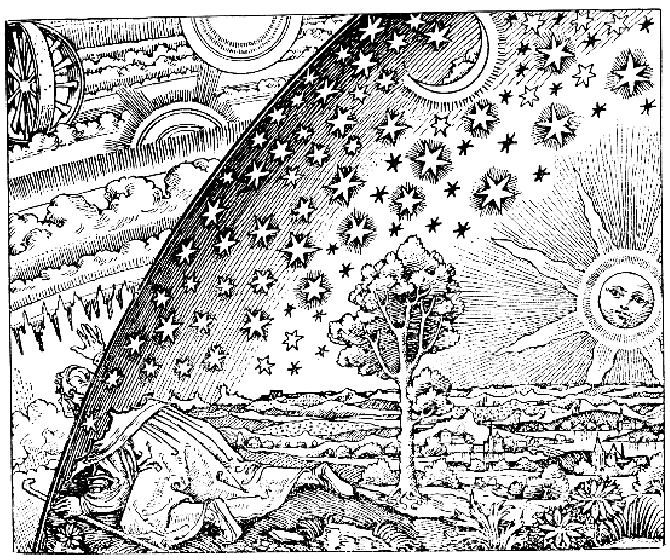
Modern science is built on a few core assumptions:
- The universe looks roughly the same no matter where you are or which direction you look.
- The laws of physics work the same for anyone moving at a constant speed — there is no special “motionless” point in the universe.
- Light always travels at the same speed, no matter how fast the observer or the source is moving.
- Mass (matter) causes space and time to bend around it.
- That bending of space and time is what we experience as gravity — it guides how matter moves.
.
What Postulate Mechanics Assumes Instead
Postulate Mechanics starts from a different set of ideas:
- The universe can be sensed, so it must be made of substance — and substance comes in three forms: matter, energy, and thought.
- Every substance has five basic properties: space, time, inertia, motion, and gravity.
- Space and time give substance its shape and persistence — where it is and how long it lasts.
- Inertia and motion govern how substance moves — inertia is the tendency to hold a center, and motion is how fast it moves.
- Gravity is essentially inertia acting across a group of bodies, keeping the whole system balanced and stable.
.
Where Science Falls Short
From the Postulate Mechanics point of view, science has several blind spots:
- Science does not recognize energy and thought as forms of substance, because it never ties substance to sensation in its definitions.
- Science treats space and time as a backdrop or container, rather than as properties that belong to substance itself.
- Science misunderstands inertia — it is not just resistance to change, but an inner “centeredness” that arises from spin within a configuration.
- The massive black holes at the centers of galaxies have such enormous inertia that they effectively serve as the absolute reference points for all motion — but science does not see this.
- Because the speed of light is determined by its inertia, it is constant — not mysteriously so, but for a clear physical reason science overlooks.
- Inertia keeps a single body moving in equilibrium, and restores that equilibrium after any disturbance — science does not frame it this way.
- Gravity does the same thing, but for whole systems of bodies — it is the equilibrium-keeper at the larger scale, parallel to what inertia does for a single body.
The core disagreement between science and Postulate Mechanics comes down to this: science treats space, time, and motion as the stage on which matter acts, while Postulate Mechanics sees them as properties that belong to substance itself — inseparable from it.
.
.
Chapter 6 — From Simple Motion to Life

The Big Idea
Life is not a mystery added on top of matter. It grows naturally out of motion — motion that becomes more and more organized and controlled.
.
A Ladder of Increasing Complexity
Think of nature as a ladder, where each rung has more organization than the one below it:
Light — Light moves at a constant speed. It has no variation, no flexibility. It is as simple as motion gets.
Atoms — Electrons orbit a nucleus. The motion is more varied than light. Things can change and respond. There is a tiny hint of something “lively.”
Molecules — In an organic molecule (made of carbon, hydrogen, oxygen), electrons are shared across many atoms. The motion is even richer — more ways to move, more ways to interact.
Viruses — A virus is a highly organized arrangement of molecules. It has so many interlocking moving parts that it behaves almost like a tiny robot running its own program.
Living cells — One step beyond the virus, and you have a true living organism.
.
What Makes Something “Alive”?
A living organism is matter that has become extraordinarily well-organized. It:
- Moves and regulates its own motion from within
- Takes in material and energy from its environment
- Expresses or reflects the nature of the universe through itself
Life is not some external force plugged into matter. Motion and inertia are already built into substance. Life is simply what emerges when that built-in motion reaches a high enough level of organization and control.
There is no separate “spirit” needed to explain it.
.
The Core Principle
So here’s the journey from simple to alive:
| Step | Example | What’s special about its motion |
|---|---|---|
| 1 | Light | Constant, never changes |
| 2 | Atom | Electrons move and can vary |
| 3 | Molecule | Many atoms dancing together |
| 4 | Virus | Incredibly complex, almost robotic |
| 5 | Living Cell | Fully self-controlling — it’s alive! |
Life is organized motion, nothing more and nothing less. But “nothing more” is still breathtaking in its complexity.
.
.
Chapter 7 — The Science of Life
Life Starts with Chemistry
Before we can understand life, we need to understand chemistry. Life is built on chemical reactions.
The simplest living things are viruses and cells. They follow instructions written in their genetic material — the biological “code” that tells them what to do.
That code is stored in molecules called DNA and RNA. Scientists can now build these molecules in a lab — but lab-made versions tend to have more errors. This is likely because the lab environment is different from the natural environment where these molecules originally formed.
.
What Happens in Chemical Reactions
When atoms bond together, they form molecules. Each new molecule can have properties that its individual atoms did not have on their own — but the atoms themselves do not disappear or change; their cores stay intact. Only the outer electron regions merge and interact.
One key point: the environment matters. Even if two reactions produce chemically identical results, there are subtle differences depending on where and how the reaction took place. A lab is not the same as nature, and those differences show up.
.
How Life’s Molecules First Appeared
Early Earth had no life, but it had energy — ultraviolet light, lightning, volcanic heat. These drove reactions between simple inorganic compounds, producing the first organic (carbon-based) molecules. Some of these molecules also arrived from space on meteorites and comets.
Over time, small molecules joined together into larger ones. A major turning point was the appearance of RNA — a molecule that could both store information and help drive chemical reactions on its own.
Eventually, some of these self-copying molecules became enclosed inside a membrane, forming a contained system. That was the beginning of the cell — with its own energy supply, protein-building machinery, and chemical regulation.
.
What Genetic Material Does
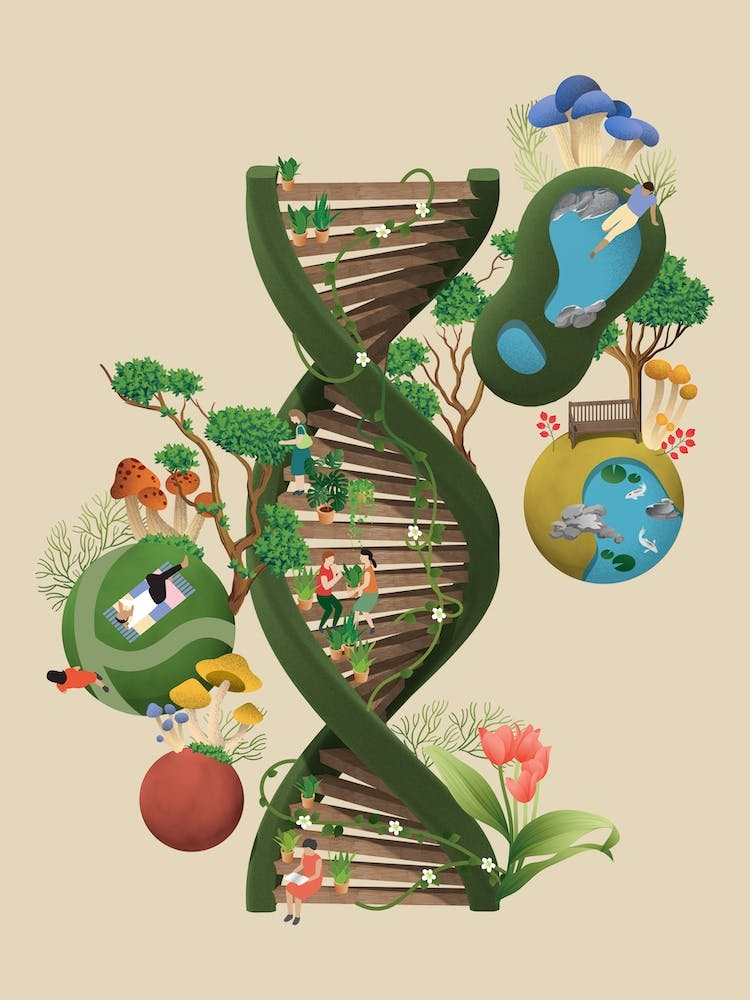
DNA (and RNA in some viruses) is the molecule that carries all the hereditary information of a living thing. It controls how an organism grows, develops, and functions. DNA is shaped like a twisted ladder (a double helix) and is made of repeating units called nucleotides.
“Hereditary” simply means what is passed from parents to offspring — traits like eye color, but also, importantly, the impressions left by trauma or unprocessed experiences. These can be impressed upon genes and carried forward through generations until they are resolved.
Scientists can now synthesize DNA in a lab from scratch. But as with other synthetic genetic material, error rates increase as the molecule gets longer and more complex.
.
What All Living Things Have in Common
Every living organism, no matter how simple or complex, shares these basic features:
- Made of cells — the basic unit of life
- Uses energy — through chemical reactions, organisms break down food to power movement, growth, and other processes
- Maintains balance — living things regulate their internal temperature, acidity, and water levels despite changes in the outside world
- Grows — organisms increase in size and complexity according to their genetic instructions
- Reproduces — all living things can produce offspring, passing life on to the next generation
- Responds — organisms detect and react to changes in their environment, such as light, heat, or chemicals
- Evolves — over many generations, populations change in response to their environment
.
The Bigger Picture: Environment Is Everything
The core insight of Postulate Mechanics is that the environment is never separate from the organism. This is true at every level — from a simple chemical reaction to the most complex living being.
The environment is not just physical matter and energy. It also includes thought. Interactions happen at all three levels — matter, energy, and thought — and none of these can be ignored or treated as isolated from the others.
The main idea is that life didn’t appear by magic — it grew step by step from simple chemistry, shaped by the environment at every stage.
.
.
.
Chapter 8 — The Origin of Thought
The Core Idea
The mind exists to guide and regulate thought. Just as nature keeps physical things in balance through inertia, the mind keeps mental activity in balance. This balancing act is the very origin of thought itself.
.
It Starts in the DNA
Every living organism carries a genetic blueprint in its DNA. This blueprint doesn’t just build the body — it also lays the foundation for the mind. Think of it as the “factory settings” of mental life, installed before you were born. You don’t choose it; it comes pre-programmed.
On top of this base layer, higher mental functions develop — like sensing, perceiving, forming ideas, and building knowledge.
.
The Mind and Its Environment
An organism lives inside an environment that is messy and unpredictable. The organism itself, by contrast, is well-organized. Everything that comes in from the outside — sensations, experiences, shocks — needs to be processed and absorbed.
When experiences are easy and calm, the mind absorbs them smoothly. When they are violent or traumatic, they are harder to absorb. Those unresolved impressions get carried forward in time. Some are so deep they may even pass to the next generation through DNA. When they finally get resolved, they can feel like memories from a past life.
.
What “Assimilation” Means
Assimilation simply means making something fit in. A good analogy: pour hot water and cold water into the same container. They gradually mix until both reach the same temperature. Balance is restored.
The mind does the same thing with experience. When you pay close attention to something confusing or troubling, all the conflicting thoughts and feelings around it gradually settle into clarity and consistency.
- Raw sensations, when assimilated, provide clearer perceptions.
- Perceptions, when assimilated, provide clearer concepts.
- Concepts, when assimilated, provide clearer knowledge.
- Knowledge, fully assimilated, becomes wisdom.
.
The Physics Behind It
At the deepest level, thought arises from the interplay between inertia (resistance to change) and motion. This same tension shows up in physics — it’s why the speed of light is constant, and why atoms have fixed energy levels.
As atoms combine into complex molecules like DNA, the number of possible energy states becomes enormous — almost like the keys of a vast piano. The mind “plays” these states to generate signals and impulses, which is how it runs the organism.
.
The Takeaway
Thought, energy, and matter are always moving toward balance. The universe — and life within it — is a continuous process of seeking harmony, consistency, and wholeness. The mind is nature’s instrument for that process.
.
.
Chapter 9 — The Anatomy of Reason

The Big Idea
The universe is constantly moving toward greater unity and harmony. Life — especially human life — is the highest expression of that harmony. But we suffer. And suffering means something is wrong. The tool for fixing what’s wrong is reason.
.
Harmony
Harmony is the natural state of things when everything is working as it should. Motion is smooth, clarity is present, and there are no contradictions. When life feels right — no confusion, no emotional turmoil — that’s harmony.
Any departure from that state is an anomaly.
.
Anomaly
An anomaly is anything that disrupts clarity or causes wrong emotions (anger, fear, anxiety, etc.). Anomalies come in three forms:
- Arbitrary data — assumptions that are disconnected from reality. Example: “My religion is the only true one” — a claim not grounded in careful examination.
- Contradictory data — inconsistencies that don’t add up. Example: a leader says the economy is great, but people’s lives are getting worse.
- Missing data — gaps in understanding. Example: a case is “closed” but key questions are never answered.
.
Reason
Reason is the process of tracking down and resolving anomalies. You do it by:
- Spotting where the arbitrary, contradictory, or missing data is
- Following the trail back to the root cause
- Continuing until total clarity is reached — when all doubt disappears
The prerequisite for reason is seeing things as they are — without filtering reality through assumptions or emotional reactions. This is where mindfulness practice comes in. Please see The 12 Aspects of Mindfulness.
.
Postulate Mechanics
The broader project (Postulate Mechanics) is an effort to clear up the most fundamental misconceptions about the universe and life. By resolving confusion at the deepest level, it sharpens the ability to reason and restore harmony.
In one sentence: Reason is the practice of finding and fixing the root cause of confusion — and when done fully, harmony returns.
.
.
Chapter 10 — The Anatomy of Suffering

The Four Noble Truths
Buddha taught four core truths about suffering:
- Suffering exists
- Suffering has a cause
- Suffering can end
- There is a path to end it
.
What Is Suffering?
Suffering — called Dukkha in Buddhism — means that life is often unsatisfying, painful, and unstable. Getting old, getting sick, dying, and not getting what you want are all forms of it. This is not pessimism; it is just an honest look at life.
Postulate Mechanics reframes suffering as a loss of harmony. Think of life as naturally flowing smoothly. Suffering happens when that flow is disrupted — by specific problems, distortions, or imbalances. This framing is useful because you can then tackle one disruption at a time, rather than feeling overwhelmed by “suffering” as a vague whole.
.
Why Does Suffering Arise?
Buddhism says suffering comes from craving — wanting pleasurable experiences, wanting to keep existing, or wanting experiences to stop. The problem is inside the mind, not outside in the world.
Postulate Mechanics agrees that the cause is internal, but asks: what exactly triggers these cravings? In the modern world, “stop wanting things” is too general to be helpful. The desire to learn and grow is natural and healthy. Suffering arises only when that desire gets twisted, misdirected, or distorted in some way.
.
Can Suffering End?
Buddhism says yes — by letting go of attachments, greed, and delusion, you can reach a state of peace and freedom called Nirvana.
Postulate Mechanics says this goal is right but hard to reach, because there are so many triggers — countless attachments, countless moments of greed or confusion. However, there is likely one root factor that, once addressed, makes all the others much easier to handle. Finding and resolving that single root factor requires focused, sustained effort — and most people find that difficult.
.
The Path
Buddhism prescribes the “Middle Way” — a balanced life combining ethical behavior, mindfulness, and wisdom. Neither extreme indulgence nor extreme deprivation.
Postulate Mechanics says this path is hard to follow mainly because of deep misconceptions — about the nature of the universe, about matter and motion, and about how thought and life evolved. Earlier chapters in this book work through many of those misconceptions.
.
The Big Question
The universe has evolved to a level of complexity where it produced self-awareness and reasoning. With that came the ideas of “I” and suffering — ideas that did not exist before humans.
Postulate Mechanics defines suffering as a lack of harmony. But this raises a deeper question:
Who or what exactly is the “I” that is suffering?
Do we really understand what the self is — or is that itself a misconception we have not yet examined?
.
.
Chapter 11 — The Notion of “I”

The Big Picture
Buddhism says life is inherently full of suffering and instability. But that is only true from a narrow human perspective. At the scale of the universe, suffering and instability are simply things that have gone out of balance — problems waiting to be solved.
Life itself is the universe’s way of solving problems. Life is not the problem.
Throughout most of life’s history, organisms existed without any sense of self-awareness. The word “I” only appeared with humans, and even then, it is mostly just a useful label. The trouble starts when religions treat this “I” as something permanent and real.
.
Three Ideas of a Permanent Self
Soul (Abrahamic religions)
Most people in the West are raised to believe they have a soul — a non-physical entity that survives death and faces judgment in heaven or hell. The soul is thought to be separate from the body and to last forever.
Thetan (Scientology)
Scientology teaches something similar: you are an eternal spiritual being called a thetan. The slight difference is that you don’t have a thetan — you are one. You are the being who lives inside and operates the body.
Atman (Eastern religions)
In Hindu thought, Atman is pure consciousness that takes on individuality by getting caught up in the physical world. It moves from body to body across lifetimes. Eventually, through awareness, it recognizes the entanglement and becomes free, returning to pure consciousness.
A common mistake here: people assume that because consciousness exists, it must be permanent. But consciousness is always changing. Permanence is an illusion projected onto it.
.
The Core Mistake
All three concepts above share a common assumption: that somewhere at the center of your experience, there is a fixed, permanent “I.”
That assumption is the mistake.
.
How to Undo It
Eastern traditions offer a direct method called Neti, neti — Sanskrit for “not this, not that.” You systematically ask of everything you identify with: Is this really me?
The process goes like this: pick anything — a physical object, a thought, an emotion, a belief — and ask yourself:
- “Am I this _____?”
- “What even is this _____?”
- “Do I truly understand what this _____ is?”
You can only honestly say “I am not this” after you genuinely understand what it is. You peel away layer by layer — body, energy, thoughts, assumptions — until you reach the bare underlying assumption (the postulate) at the root of it, and ask again: Is this me?
.
What Postulate Mechanics Says
The observer and the observed are neither completely separate nor the same. There is a living relationship — a harmony — between them.
Recognizing that harmony is the realization.
.
.
Chapter 12 — The Truth about “I”
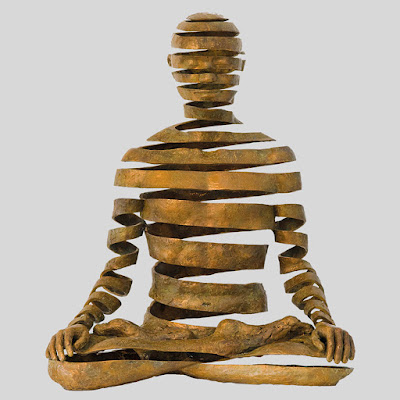
The Problem with a Permanent “I”
Many spiritual traditions — such as those using words like soul, thetan, or atman — assume there is a part of you that never changes and lives forever. They suggest that the “I” from a past life is the same “I” as you are now.
But this may not be true. A more likely explanation is that memories or emotional impressions from our ancestors get passed down through our DNA. When those old impressions surface in us, we mistakenly feel they belong to our own “I.”
Buddha’s teaching of Anatta (No-Soul) directly challenges the idea that any part of “I” is permanent.
.
What Is the Sense of “I”?
The sense of “I” is the feeling that you are the one thinking your thoughts, feeling your feelings, and being responsible for what happens to you. It seems to arise with the body and gives you a sense of being a separate individual.
This sense of “I” is real — it clearly exists. But it also causes a lot of harm: selfishness, craving, hatred, pride, conflict. All the troubles of the world — from personal arguments to wars — trace back to it. Yet there is no solid evidence that this sense of individuality survives after the body dies.
A newborn baby already has its own “I.” Some of this comes from inherited DNA, some from upbringing and culture. Patterns of dysfunction can pass from one generation to the next — but that does not prove a single, permanent “I” is being carried forward.
.
DNA and Inherited Patterns
A parent’s experiences can actually change how genes are expressed in their children, without changing the DNA itself. This affects things like stress responses, fear, anxiety, and emotional patterns — and can carry across several generations. Much of what we call “inherited trauma” comes through this biological pathway, as well as through culture and behavior.
Dianetics explores this territory, suggesting that traumatic impressions can even be formed in the womb. These impressions shape the sense of “I” — but they do not prove that the “I” is eternal. They are more like echoes that fade over generations.
.
Is a Permanent “I” Just a Postulate?
According to Buddha, the belief in an immortal soul is deeply rooted in psychology. When people feel fear, weakness, or uncertainty about death, the idea of a soul that lives forever is deeply comforting.
But when you rigorously examine your experience — asking “Is this really me? Is this really mine?” (the neti, neti process) — it becomes clear that the notion of an eternal soul, thetan, or Atman is simply a belief we hold. It is a postulate, not a discovered fact.
.
The Nirvana
Buddha taught that a person is made up of five components: the physical body, sensations, perceptions, mental formations, and consciousness. There is nothing behind or beneath these five that you can point to and call “I” or “Self” — no permanent, unchanging substance.
Everything is conditioned, interconnected, and relative. The idea of a separate self is useful as a practical convention, but it has no ultimate reality.
Here is a helpful way to see it: when you are aware of something, there is a subject (awareness) and an object (what is being observed). The object exists in the dimension of substance — matter, energy, thought. But awareness itself is a different dimension entirely. Awareness is not a thing being observed; it is the looking itself.
The sense of “I” arises only when awareness identifies with something in the material dimension — when the looker thinks it is the thing being looked at.
Enlightenment is the moment you clearly see that identification happening. You realize you have been constructing or “postulating” the “I” all along — it was never a fixed, inherent reality.
This is the beginning of Nirvana.
As you continue to see through more and more of these false identifications — clearing up misconceptions about yourself and the universe — Nirvana deepens and expands.
The core insight: the “I” is not a permanent entity but a habit of awareness identifying with passing phenomena. When that habit is seen clearly, it loosens — and that loosening is liberation.
.
.
Chapter 13 — Infinity and Divinity
What This Chapter Is About
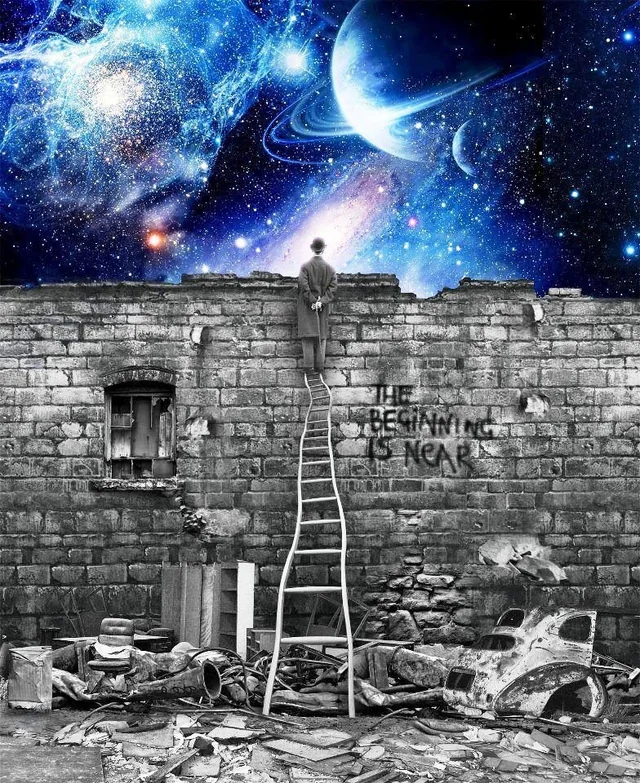
Divinity — whether we call it God, the universe, or ultimate reality — has always been described as infinite. This chapter explores what “infinity” really means when applied to substance, space, and existence itself.
.
Infinite Substance
Philosophers have long wrestled with what the universe is fundamentally made of.
- Anaximander (600s BCE) said everything comes from a single, boundless primal substance and eventually returns to it.
- Descartes said only God is truly self-sufficient — everything else depends on something else to exist.
- Spinoza simply equated God, the universe, and the one infinite substance — God is Nature.
- Leibniz said created things depend on God the way light depends on the sun — continuously produced by a kind of emanation.
Postulate Mechanics takes a practical view: substance as anything substantial enough to be sensed. We sense the universe as matter, energy, and thought. At the deepest level of thought, we arrive at postulates — foundational assumptions from which all reasoning and experienced reality flows. That level of postulates is what we call the divine.
In other words, when we speak of God or the divine, we are really speaking about the deepest layer of thought — the level of first principles.
.
Infinite Space
Space is where infinity hits us most directly — it just seems to go on forever with no wall or edge.
- Archytas (300s BCE) argued: if the universe had a boundary, you could stick your hand past it — so there can be no boundary.
- Aristotle shifted the idea of infinity away from substance and toward measurable things like space, time, and numbers.
- Newton pictured space as flat, absolute, and infinite in all directions — the stage on which everything happens.
Postulate Mechanics sees space differently: space is not a separate container. It is simply the extent, or reach, of substance itself. As substance changes — from matter to energy to thought — so does the nature of the space it fills. No substance means no extent, and no space.
What about empty void? Even void, to be thought about, must be “filled” with at least the thought of void. The limits of void are the limits of thought. And at those outermost limits of thought — that is where we find divinity, gods, and the deepest Self.
.
Infinity Itself
Infinity simply means something without end — boundless, limitless, going on forever. It is represented by the symbol ∞, invented by mathematician John Wallis.
In Postulate Mechanics, infinity is a postulate — a foundational assumption we apply to the universe and its key dimensions:
- Substantiality — substance, space, time
- Awareness — divinity, God, Self
- Oneness — nature, natural law, knowledge, wisdom
Infinity, divinity, and the universe are three ways of pointing at the same thing.
The core insight: what we call God or infinity is not something “out there” beyond the universe. It is the universe itself, understood at its deepest level — the level of foundational postulates from which everything else arises.
.
.
Chapter 14 — The Notion of God

Where the Idea Begins
The universe is vast and infinite, and humans have always found this overwhelming. Out of that sense of vastness, people developed the idea of God — something infinite and all-encompassing. Because the universe also seems to work as one interconnected whole, God was seen as having a quality of Oneness. That is the seed of every notion of God.
.
The Vedic Gods
The oldest Indian tradition did not begin with one God. It began with many gods — called devas— who were seen as different expressions of a single underlying reality. A famous ancient saying captures this: “The Truth is one; the wise call it by many names.”
So the Vedic idea of God is more like a poetic insight — one truth shining through many forms — rather than a fixed religious doctrine.
.
God in Buddhism
Buddhism inherited the idea of devas from the Vedas, but shifted the focus. The Buddha was more interested in solving human suffering than in debating theology.
His view was blunt: people invented God out of fear and weakness. We want protection, so we imagine a protector. We fear death, so we imagine an immortal soul. Buddhism rejects the idea of an all-powerful creator God because it conflicts with two of its core teachings — that everything arises through causes and conditions, and that there is no permanent self.
.
The Monotheistic God
The belief in one single God — and only one — did not appear all at once. It developed gradually in the ancient Middle East over roughly a thousand years.
Early on, people in the region worshipped one God as the most important while accepting that other gods existed. Over time, this became stricter: the other gods were denied entirely.
The clearest shift happened after the Babylonian exile, around the 6th–5th centuries BCE. When Jewish elites returned from exile, they shaped a religion centered on one God of the entire universe — not just a tribal deity. This strict monotheism is what Christianity and Islam later inherited.
.
What Postulate Mechanics Says
Postulate Mechanics is built on the idea of SUBSTANTIALITY-AWARENESS-ONENESS, drawn from the Vedic concept of Sat-chit-ananda. It tries to describe reality in a rigorous way, like a science of existence.
From this perspective, the monotheistic God is an oversimplification. The universe is wonderfully complex, and its apparent unity is a dynamic balance among countless interacting forces. Reducing all of that to a single personal God misses the real picture.
There may also be a social and political dimension to strict monotheism. A single God, tied to a single scripture and law, is a powerful tool for unifying large populations, creating shared identity, and drawing sharp lines between “true” and “false” belief.
Postulate Mechanics sees the “one true God” as an arbitrary concept that actually gets in the way of genuinely understanding the Oneness that runs through all of reality.
.
.
Chapter 15 — Mind and Body

Dualism of Mind and Body
Dualism is the idea that the mind and body are two completely separate, unrelated things — like oil and water. They are so different, some philosophers argue, that they cannot even affect each other.
Monism disagrees. It says everything is made of one underlying reality, and mind and body are just two faces of the same coin.
.
The Problem With Dualism
If mind and body are totally different substances with nothing in common, how can they interact? When you decide to raise your arm, your mind causes your body to move. That interaction is a fact of experience. So they cannot be completely separate.
Postulate Mechanics takes the monist view: the universe is fundamentally one. If dualism seems to make sense, it is only because we are missing something — a connecting bridge between mind and body.
.
The Gradient of Substance
Think of temperature. Hot and cold are not two separate, unrelated things — they are opposite ends of the same scale, with a smooth gradient between them.
The same is true for mind and body. Between pure thought (mental) and solid matter (physical), there is a gradient:
Thought → Energy → Matter
All three can be sensed, and all three are therefore “substance.” They are different in degree, not in kind. This gradient is what allows mind and body to influence each other.
.
What Is “Real”?
Reality can mean two things:
- What lies behind appearances — the ultimate foundation
- Everything that exists, taken together
In Postulate Mechanics, the ultimate foundation is a postulate — a basic assumption from which everything else follows. For something to be truly real, it must be consistent and continuous with that foundation. Contradictions and gaps signal that something is being misunderstood.
Dualism introduces such a gap. That gap is the anomaly.
.
Mind and Body — The Simple Truth
- The mind is made of thought.
- The body is made of energy and matter.
- Both can be sensed, so both are made of substance.
- Because they share this common nature, they can interact.
What we experience as consciousness (in the mind) and physical agility (in the body) both arise from the same source: complexity of motion within substance.
Calling mind and body completely different things is simply a mistake born of incomplete understanding.
.
Summary
Mind and body are distinct phenomena, yes — but not alien to each other. They are different points on the same spectrum of substance. Mind cannot exist independently of body. Dualism, in its strict form, is an anomaly that dissolves once the gradient between thought, energy, and matter is properly understood.
.
.
Chapter 16 — Learning to Look

What Is Looking?
The mind’s first job is simply to notice what is there. This is different from thinking about it.
You don’t need words or labels to know something. When you truly look at something, you are just observing it directly — no analysis, no commentary.
.
Looking vs. Thinking
When you look at something, thoughts will naturally arise. That’s fine. The key is: don’t fight them, and don’t get caught up in them. Just notice that a thought appeared, and keep looking.
Many meditation techniques teach you to blank out your mind or focus on one thought while blocking others. This actually gets in the way of pure looking. Real looking doesn’t require suppressing anything.
The rule is simple: look without judging, without expecting, and without trying to reach any conclusion.
When you do this, you see things as they actually are.
.
Exercises in Looking
Each exercise below has the same structure: look around the room, notice what your mind does, and simply observe that activity without stopping it.
Exercise 1 — Notice labeling
Look at objects around you. Your mind may say “that’s a lamp.” Don’t stop it. Just notice that it’s labeling.
Exercise 2 — Notice evaluating
Look at objects around you. Your mind may say “that’s an expensive lamp.” Don’t stop it. Just notice that it’s evaluating.
Exercise 3 — Notice conclusions
Your mind may jump to “I would never buy that lamp.” Don’t stop it. Just notice that it’s drawing conclusions.
Exercise 4 — Notice thoughts in general
Look at objects while simply watching whatever thoughts arise. Don’t suppress any of them. Just keep looking and noticing.
.
Connection to Postulate Mechanics
Every object has an underlying “thought” that the mind uses to model it — this is called a postulate. When you look at an object, you can also look at that underlying postulate. Acknowledge the postulate and any other stray thoughts that appear, then move on. This is the starting point for all of Postulate Mechanics.
.
.
Chapter 17 — Looking at a Postulate

The Main Idea
Whenever you face a problem, a situation, or an event, the most useful thing you can do is find the core belief — the postulate — behind it. A postulate is simply the basic thought or assumption that shapes what you are looking at.
Once you find that core belief, you have already made the situation much simpler. You can then ask: does anything about this belief seem off, contradictory, or incomplete?
For example, take the conflict between Iran and Israel. The driving belief underneath it seems to be Israel’s fear for its own survival. That one belief explains a great deal of the situation. Once you see it, things start to become clearer.
.
Where Does a Postulate Come From?
The honest answer is: we do not know. Just as we cannot fully trace where the universe itself came from, we cannot trace where a basic belief ultimately originates.
We often assume there is a “self” that creates beliefs. But that self is itself just another belief. So chasing after the ultimate origin of a belief is a dead end — it is not where the useful work happens.
The useful work is this: find the belief, find where it breaks down, and follow those breakdowns until the whole picture becomes clear.
.
How to Trace the Breakdowns
You know something is off when you notice:
- Disharmony — things are not fitting together
- Inconsistency — things contradict each other
- Gaps — something is simply missing
These are your clues. Follow them. Look closely at the areas where things feel the most tangled or confused. The most important clues are things that seem arbitrary — data or actions that do not make sense given the stated belief.
Keep looking, keep tracing, and at some point the whole thing suddenly snaps into focus. You will know exactly what is going on and what to do about it.
.
Exercises
These exercises help you practice spotting postulates — the basic assumptions that give shape to what you observe.
Exercise 1 — Physical objects:
- Look around the room and pick an object.
- Ask yourself: what basic assumption or idea gives this object its form and meaning?
- Repeat until this becomes easy.
Exercise 2 — Situations in your mind:
- Call to mind any situation you are dealing with.
- Ask yourself: what is the core belief or assumption that is shaping this situation?
- Repeat until this becomes easy.
The core skill here is simple: find the belief, find where it cracks, and follow the cracks. That is how a confusing situation becomes clear.
.
.
Chapter 18 — The Mind and Logic
What the Mind Does
The mind is a structure made of thoughts. It is always in motion. In humans, this structure becomes very refined — so refined that it gives rise to what we call awareness, will, and creativity.
At its core, the mind holds a matrix of data, anchored by basic assumptions called postulates. New information continuously flows into this matrix. The brain supports this by storing and retrieving memories.
The mind uses logic to solve problems — both in the outside world and within itself.
.
What Logic Is For
The goal of logic is oneness. Not a dull sameness, but a harmonious whole — like a painting where all colors and forms fit together beautifully.
Logic works by taking in data and making it consistent. Think of mixing cold water and hot water in a single container: they eventually reach the same temperature. In the mind, logic does the same thing — it brings scattered or conflicting data into harmony. This harmony is called oneness.
As data becomes more harmonious:
- Raw sensations sharpen into clear perceptions
- Clear perceptions form stable concepts
- Stable concepts become knowledge
- Integrated knowledge becomes wisdom
.
What Are Anomalies?
An anomaly is anything that breaks oneness — a disharmony, inconsistency, or gap in understanding.
Anomalies show up as:
- Arbitrary data — something that doesn’t fit and has no clear reason
- Contradictory data — two things that cancel each other out
- Missing data — a gap where something should be but isn’t
When you notice anomalies, you follow them like a trail — zooming in on wherever they cluster most densely. At some point, you find the root cause, and suddenly everything makes sense. This is the moment of understanding.
.
How to Resolve Anomalies
Anomalies are resolved by looking, not by thinking harder. Thinking only tells you where to look. The actual resolution happens when you see clearly.
Start with definitions. A poorly defined term carries hidden anomalies. Look for the underlying postulate — the foundational assumption — behind any concept you’re struggling with.
The pattern of resolution follows three tracks:
| Sign of trouble | What to look for | Underlying cause |
|---|---|---|
| Disharmony | Arbitrary data | Lack of clear distinction |
| Inconsistency | Contradictory data | Lack of gradation |
| Discontinuity | Missing data | Missing postulate |
If anomalies keep piling up without resolution, the problem may lie in the viewpoint itself — the lens through which you are looking.
.
Postulate Mechanics
A postulate is a foundational assumption. Its value is measured by how well it:
- Explains what is already known
- Predicts what can then be found to be true
- Does not require inventing things that don’t actually exist
All knowledge is interconnected — no single datum stands alone. When outside authority replaces direct observation, anomalies multiply. Fields that rely most on authoritative opinion tend to have the most unresolved confusion.
Mathematics is a good example of mechanical logic — it starts from postulates and builds consistent patterns that mirror patterns in the universe.
One careless assumption (an arbitrary) opens the door to more. Logic closes that door by returning to honest observation.
.
.
Chapter 19 — The Life and Self

What Is Life?
Life is movement — and as it evolves, that movement becomes more complex and coordinated. There is no separate spirit “driving” a living body from outside. The body itself is the source of its own motion and inertia. A living organism is simply a very sophisticated, self-reproducing system.
Evolution
Life evolves in stages: from non-living matter, to single cells, to multicellular organisms, to plants, animals, and finally humans. As the form grows more complex, so does its behavior.
The Genetic Blueprint
Every living body carries a built-in program — encoded in DNA — that guides its development and keeps all its functions running. This blueprint is inherited and passed down through reproduction. It is very capable, but it cannot easily update itself.
Body, Mind, and Spirit
A living organism has three aspects that are really one thing viewed from different angles:
- The body — its physical form and substance
- The mind — the complex abilities and functions that flow through that form
- The spirit — the underlying motion and energy that makes it all possible
Humans are at the top of this evolutionary chain.
How Life Moves Itself
Living things — from viruses to humans — can direct their own motion. Because even tiny changes in a body’s inertia can produce large visible effects, life can control its movement through thought. This is why thoughts can influence physical action.
What Makes You “You” (Beingness)
Your individual essence is the entire history of your genetic and evolutionary development, expressed as a unified body-mind-spirit system.
Death
Death is simply the permanent stopping of all vital functions. When it happens, the body-mind-spirit system breaks down. The sense of “I” is the first thing to go. There is no eternal soul that survives. Birth and death are natural parts of how life evolves.
What Is the Self?
The Self is not a person — it is the core of awareness itself. It is pure, conscious engagement with the world, always working to resolve contradictions and move toward greater wholeness.
Identity
The Self picks up identities through experience — when it identifies strongly with a sensation, role, or idea, it becomes that identity. A person can carry many identities and switch between them without realizing it. As understanding deepens, these identities gradually dissolve.
Individuality
The Self has a sense of being unique. Even an identified self (one caught up in a particular role or persona) can feel individual. So individuality and identity overlap.
Ego
Ego is what happens when individuality turns inward and becomes self-absorbed. The more it closes in on itself, the more irrational it becomes. Extreme fixation leads to irrationality or even mental instability.
The Individual
An individual is a human being who experiences life as if controlled from a single center — who feels unique and separate from others.
Viewpoint
Your viewpoint is the frame through which you see everything — your location in the world, your sense of self, your reality. It can become fixed, but it can always be shifted.
Self-Determination
Self-determination is the ability to make choices based purely on your own viewpoint, without being driven by outside pressure.
Free Will
Free will is the ability to make genuine choices. However, it does not mean you can do anything you want — your choices still operate within the natural laws of how things work (what the author calls “Postulate Mechanics”).
Spirit
At its root, “spirit” simply means breath or wind — the animating energy of a living being. It covers the mind, emotions, and will. The word is also used more loosely to refer to non-physical beings like ghosts or deities.
Soul
“Soul” refers to the non-physical essence of a person. In philosophy, it often just means the mind. In religion, it is imagined as an eternal part of the person that survives death. This chapter treats that eternal survival as a theory, not a fact.
.
.
Chapter 20 — The Factors

The Beginning
- Everything starts when substance comes into existence.
- Wherever there is substance, there is also awareness — the two always appear together.
- Awareness means there is a viewpoint (something that sees).
- And that something is being viewed.
- So from the very start, there is substance that can be perceived and responded to.
The Oneness of Life
- Substance naturally moves and resists change.
- Over time, these movements diversify and blend back together.
- This interplay produces harmony.
- Harmony persists as consistency and continuity.
- And that is what we call the oneness of life.
Oneness as a Goal
- Many viewpoints exist, each with its own perspective, and they exchange views with one another.
- Viewpoints can adjust and adapt to each other, creating a shared, common reality.
- And that reality feels solid and real.
- This shared reality grows into larger structures of thought, energy, and matter. However, when admiration (open, appreciative attention) is lacking, oneness breaks down.
- And reality fragments into increasingly complex individual objects with their own separate characteristics.
Individuality and Free Will
- As viewpoints come together, the forms they produce become finer and more complex.
- Whether something appears beautiful or ugly depends entirely on how a viewpoint perceives its harmony — this is the essence of art.
- When a viewpoint becomes attached to a particular form, concern about survival arises.
- Yet no form and no viewpoint lasts forever.
- When viewpoints accept forms without fully examining them, they become dependent on those forms.
The Universe
- All change must be harmonious, consistent, and continuous — this is dynamic oneness, and when regulated, it becomes what we call Time.
- This is the essence of the universe, which rests on three inseparable foundations: substantiality, awareness, and oneness.
- Ideally, all viewpoints are absorbed into this oneness.
- Whenever a viewpoint tries to hold itself fixed and unchanging, it violates dynamic oneness — and that is the root of all anomalies.
- Unresolved anomalies are what keep the cycles of life and death going.
Anomalies and Their Resolution
- Anomalies are breaks in the oneness of the universe, and they show up as suffering.
- The root cause of suffering is attachment to a fixed viewpoint — a fixation.
- Freedom from suffering comes from spotting these fixations and dissolving them.
- The best viewpoint is one that supports the dynamic oneness of everything.
- Rather than prescribing solutions, the most useful thing we can do is give people tools to resolve their own deepest concerns. Thus, building a culture where people solve problems for themselves.
.

Comments
Here is a PDF version of this book.
https://vinaire.me/wp-content/uploads/2026/06/postulate-mechanics.pdf