
Reference: Postulate Mechanics
What Comes Before Life?
Before we can understand living things, we need to understand chemistry — the science of how tiny things called atoms stick together and break apart. Viruses and cells are the smallest living things. They follow instructions written in something called genetic material, like a recipe book inside every living thing.
.
Chemical Reactions
Imagine atoms as tiny LEGO bricks. In chemical reactions, these bricks snap together or pull apart to make brand-new things called molecules. When atoms team up, they don’t disappear — they just share their “outer edges” and create something new with new abilities.
Here’s something cool: the environment around a reaction matters just as much as the atoms themselves. Think of it like baking a cake. The same ingredients can turn out differently depending on your oven, the altitude, or even the mood in the kitchen. That’s why molecules made in a lab can be slightly different from ones made in nature, even if they look the same on paper.
.
Where Did the First Life Molecules Come From?
A long, long time ago on early Earth, simple chemicals got zapped by lightning, heated by volcanoes, and blasted by sunlight. These energy sources caused simple chemicals to combine into more complex ones called organic molecules — the building blocks of life.
Some of these molecules even hitched rides to Earth on meteors and comets from outer space! Over time, these molecules clumped together in warm, wet pools and started forming bigger and bigger structures. Eventually, one very special molecule called RNA appeared. RNA could do two jobs at once: store information AND help build things. That was a huge deal.
Over millions of years, these clumps got more organized, developed their own energy systems, and became the first true cells.
.
What Is Genetic Material?
Genetic material is like the instruction manual inside every living cell. The most famous type is called DNA, which stands for deoxyribonucleic acid (try saying that five times fast!). DNA tells your body how to grow, what color your eyes should be, and how to stay alive.
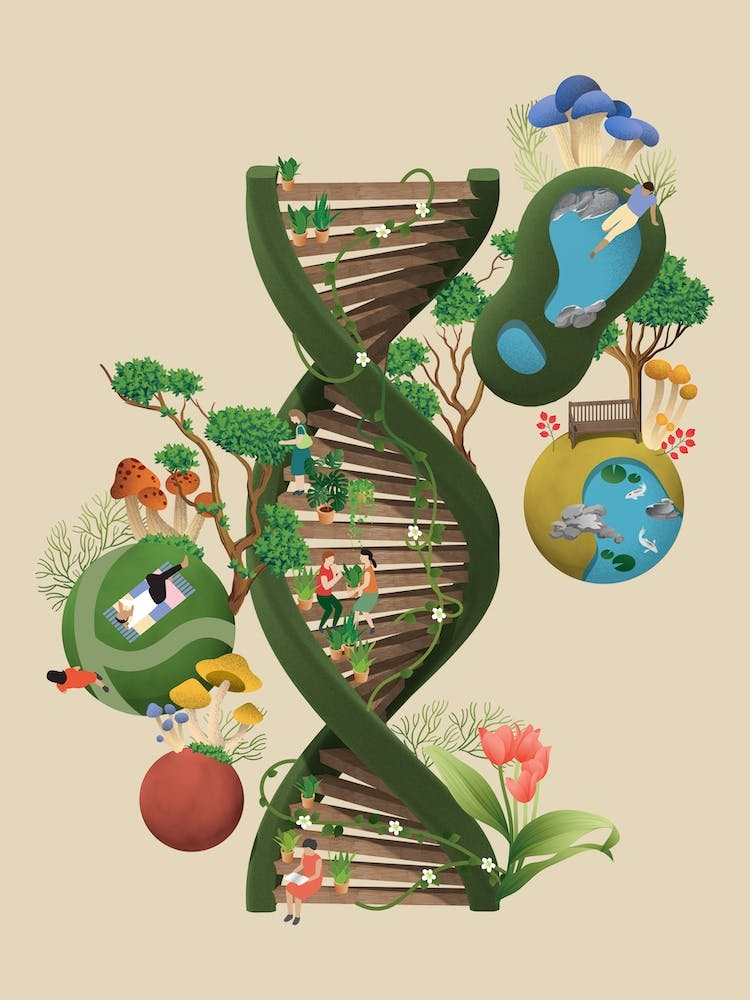
DNA is shaped like a twisted ladder, called a double helix. The “rungs” of the ladder are made of smaller pieces called nucleotides.
The traits your parents pass on to you — like your height, eye color, or even some health conditions — are called hereditary traits. Scientists can now actually build DNA from scratch in a lab. But the longer and more complicated the DNA they try to make, the more mistakes happen — kind of like how copying a really long sentence by hand leads to more typos.
.
What Makes Something Alive?
All living things share a few important features:
- Cells: Every living thing is made of at least one cell. Cells are like tiny rooms that do all the work of life.
- Energy: Living things eat or absorb energy to keep going, kind of like how your phone needs charging.
- Balance: Living things keep their insides stable — the right temperature, the right amount of water — even when the outside world changes. This is called homeostasis.
- Growth: Living things grow and change following instructions in their DNA.
- Reproduction: Living things can make copies of themselves, so life keeps going from one generation to the next.
- Response: Living things react to their surroundings. A plant turns toward sunlight. You pull your hand away from something hot.
- Adaptation: Over many, many generations, living things slowly change to better fit their environment. This is called evolution.
.
The Big Idea: Environment Matters
Here’s the key takeaway from this chapter: everything is connected to its environment. A tiny chemical reaction and a huge living creature both depend on what’s around them — not just physical stuff like air and water, but energy and even something like thought or awareness.
You can’t understand life by looking at a living thing in isolation. The world around it is part of what makes it alive.
The main idea is that life didn’t appear by magic — it grew step by step from simple chemistry, shaped by the environment at every stage.
.
