
Reference: Essays on Substance
Quantum Mechanics and Reality
Quantum Mechanics may be mathematically consistent, but it is not consistent with the reality that we observe. The Scientific Method requires consistency with both the mathematical logic and the live logic.
Here are couple of specifics:
(1) Wave-Particle Duality:
Wave-particle duality is a fundamental concept in quantum mechanics that describes the dual nature of quantum objects exhibiting both wave-like and particle-like properties depending on the experimental circumstances. But this quantum object is described mathematically only. There is no equivalent object described in the real sense. This has created an anomaly with respect to the double-slit experiment, which is still not resolved.
This quantum object can be described in reality, but that would require some new postulates as done in the Theory of Substance. The Substance theory views the quantum object as a “fluid particle” that can split and coalesce back together. The photon or electron can appear as a point on the photographic plate in the double-slit experiment. But, being a fluid-particle, it has real dimensions that extend in spacetime, such that it can also coalesce with the next photon when it comes along. So there is a fluid-like aspect to light and electrons that seems to make all the difference. This representation adds a dimension to quantum particles, which has been missed by the mathematical model.
(2) Superposition:
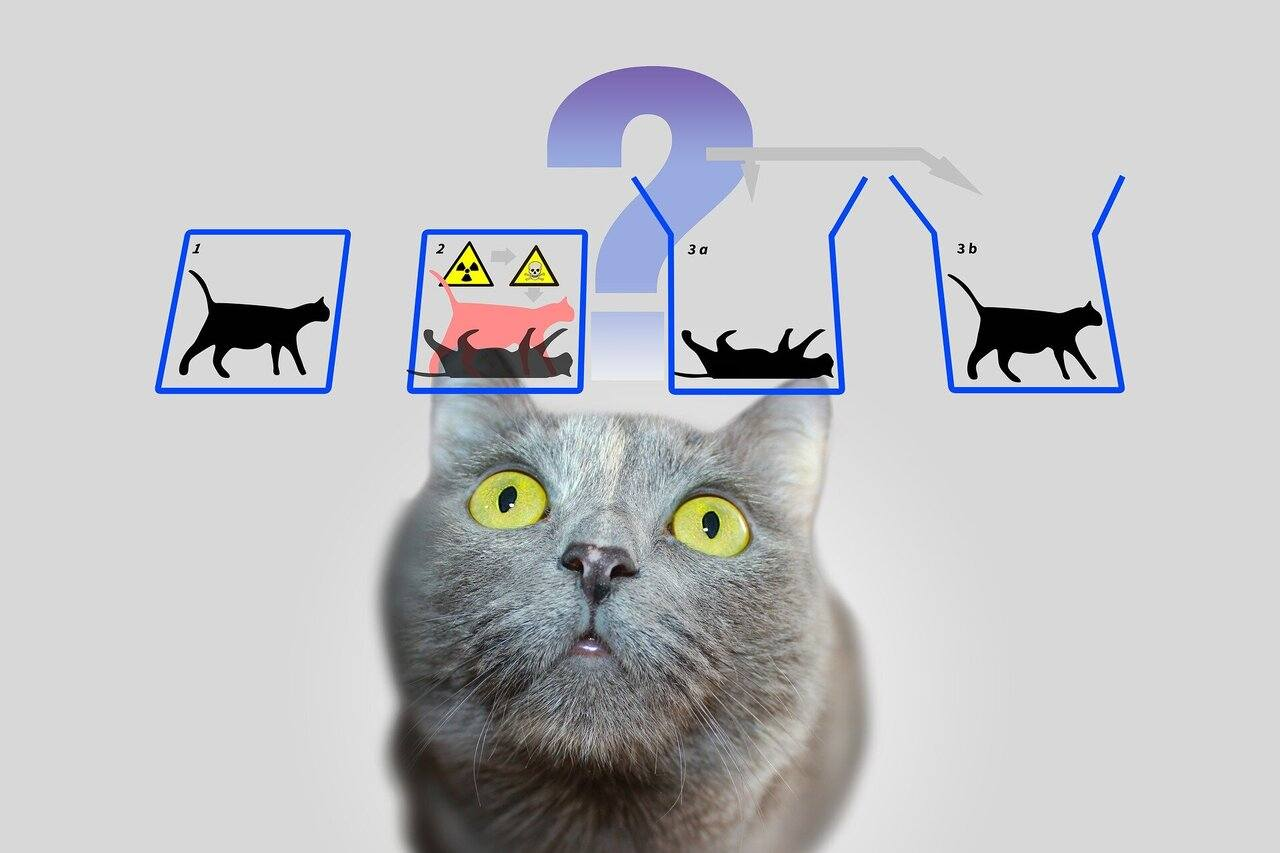
Superposition is a fundamental concept in quantum mechanics that describes the ability of quantum systems to exist in multiple states simultaneously until it is measured. It is mathematically represented as a linear combination of all possible states of a system. This principle is a direct consequence of the linear nature of the Schrödinger equation, which allows for linear combinations of solutions to represent valid quantum states. This created the famous paradox of Schrodinger’s cat being both dead and alive until actually observed. It highlights the apparent conflict between quantum superposition and our everyday experience of reality. The conflict arises due to QM assuming point locations for quantum objects, and then ends up relying on probabilities. But quantum objects have dimensions as represented by their wavelengths, and do not really have point locations.
The Substance theory proposes a spectrum of substance based on their wavelengths (or corresponding frequency) that is consistent with reality.
This opens the door to using Schrödinger equation without the use of probabilities.
.
