
Reference: Essays on Substance
Proton, Electron and Photon
A particle implies a point-like center and a fixed identity that is moving. But the quantum “particles” inside the atom are not like material particles. They are like drops that could be dissolving and forming within a fluid-like field.
According to the Theory of Substance there are no material-like particles inside the atom. There are only fluid-like fields of different consistencies. These fields are continuous with each other despite sharply varying consistencies.
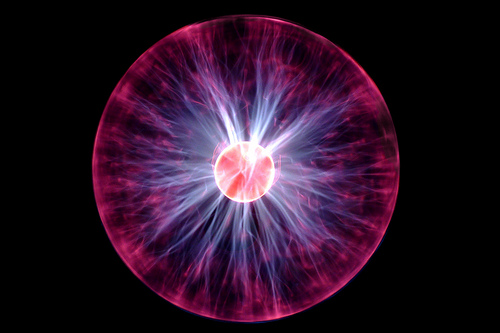
In a hydrogen atom, the only proton of very high consistency is the very small nucleus at the center, but the only electron of 1836 times lesser consistency fills the rest of the atom. This electron is like a huge field of very diluted mass. It is not like a point-like condensed particle orbiting the nucleus. This makes the electron tens of thousands of times larger than the proton.
There seems to be a relationship between consistency and size of substance: The lower is the consistency, the greater is the size.
Even when the atoms are packed tightly within matter, they have very large spaces among them. These spaces are filled with photons of negligible consistency. From the relationship between consistency and size, we may estimate the size of a photon to be tens of thousands of times larger than the electron.
We may not have the exact sizes of Proton, Electron and Photon, but we can say with certainty that the size of the electron is humongous compared to the size of the proton; and the size of the photon is humongous compared to the size of the electron.
The mathematical interpretation of quantum mechanics may disagree with the above conclusion but the mathematics of quantum mechanics assumes quantum entities to be point-like particles that have probabilistic locations.
.
