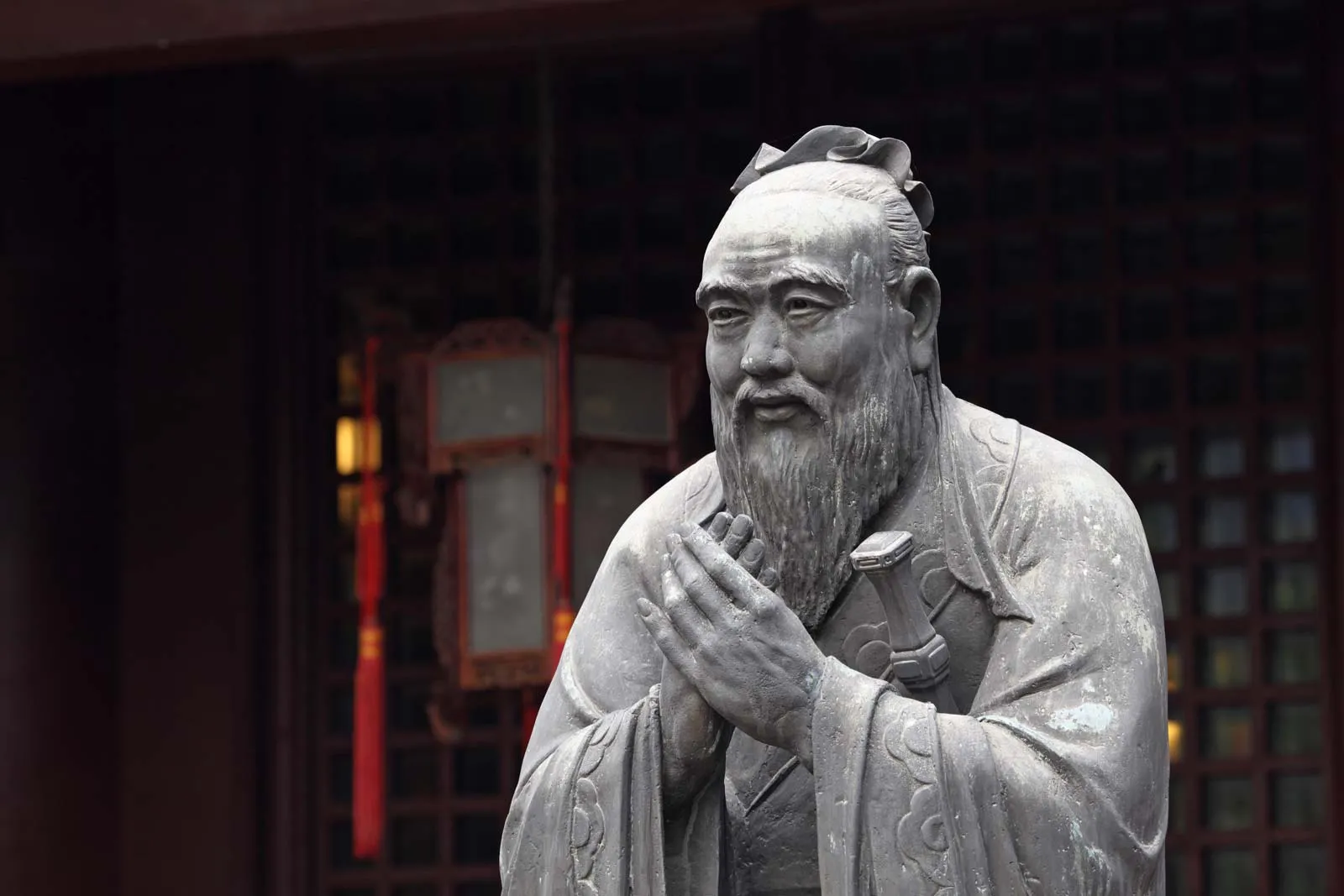
Reference: Confucianism
[NOTE: In color are Vinaire’s comments.]
A failure as a politician, Confucius was undoubtedly one of the world’s greatest teachers. He was, in the manner of Socrates, a one-man university. His method of teaching was likewise Socratic.
If there is one name with which Chinese culture has been associated it is Confucius’—Kung Fu-tzu or Kung the Master. Chinese reverently speak of him as the First Teacher—not that there were no teachers before him, but because he stands first in rank. No one claims that he crafted Chinese culture singlehandedly, and he himself played down his originality by claiming to be no more than “a lover of the ancients.” This designation, however, gives him less than his due; it stands as an example of the modesty and reticence he advocated. For though Confucius did not author Chinese culture, he was its supreme editor. Winnowing the past, underscoring here, playing down or discarding there, reordering and annotating throughout, he brought his culture to a focus that has remained remarkably distinct for twenty-five centuries.
Confucius brought Chinese culture to a focus that has remained remarkably distinct for twenty-five centuries.
The reader who supposes that such an achievement could come only from a dramatic life will be disappointed. Confucius was born around 551 B.C. in the principality of Lu in what is now Shantung province. We know nothing for certain about his ancestors, but it is clear that his early home life was modest. “When young, I was without rank and in humble circumstances.” His father died before Confucius was three, leaving his upbringing to a loving but impoverished mother. Financially, therefore, he was forced to make his own way, at first through menial tasks. The hardship and poverty of these early years gave him a tie with the common people, which was to be reflected in the democratic tenor of his entire philosophy.
The hardship and poverty of his early years gave Confucius a tie with the common people, which was to be reflected in the democratic tenor of his entire philosophy.
Though reminiscences of his boyhood contain nostalgic references to hunting, fishing, and archery, thereby suggesting that he was anything but a bookworm, he took early to his studies and did well in them. “On reaching the age of fifteen, I bent my mind to learning.” In his early twenties, having held several insignificant government posts and contracted a not too successful marriage, he established himself as a tutor. This was obviously his vocation. The reputation of his personal qualities and practical wisdom spread rapidly, attracting a circle of ardent disciples.
In his early twenties, Confucius established himself as a tutor. The reputation of his personal qualities and practical wisdom spread rapidly, attracting a circle of ardent disciples.
Despite these disciples’ conviction that “since the beginning of the human race there has never been a man like our Master,” Confucius’ career was, in terms of his own ambitions, a failure. His goal was public office, for he believed—how wrongly we shall see—that his theories would not take hold unless he showed that they worked. He had supreme confidence in his ability to reorder society if given a chance. Being told of the growth of population in the state of Wei and asked what should be done, he answered, “Enrich them.” And after that? “Educate them,” was his famous reply, adding with a sigh, “Were a prince to employ me, in a year something could be done, and in three years the work could be completed!” Doting biographers, unable to conceive that a man so gifted could remain permanently blocked in his life’s ambition, credit him with five years of brilliant administration in his early fifties, years in which he is pictured as advancing rapidly from Minister of Public Works through Minister of Justice to Prime Minister, during which Lu became a model state. Dissoluteness and dishonesty hid their heads, the romanticized account continues. “A thing dropped in the streets was not picked up,” and loyalty and good faith became the order of the day. The truth is that contemporary rulers were much too afraid of Confucius’ candor and integrity to appoint him to any position involving power. When his reputation rose to the point where the ruler of his own state, who had gained his power through usurpation, felt obliged to ask him perfunctorily for advice on how to rule, Confucius replied, tartly, that he had better learn to govern himself before trying to govern others. The ruler did not have him cut into pieces, as he might have done save for Confucius’ reputation, but neither did he appoint him prime minister. Instead he tossed him an honorific post with an exalted title but no authority, hoping thus to keep him quiet. Needless to say, once Confucius discovered the ploy he resigned in disgust.
Contemporary rulers were much too afraid of Confucius’ candor and integrity to appoint him to any position involving power.
Prompted as if by call—“At fifty I perceived the divine mission”—he gave his next thirteen years, with many a backward look and resisting footstep, to “the long trek,” in which he wandered from state to state proffering unsolicited advice to rulers on how to improve their governing and seeking a real opportunity to put his ideas into practice. The opportunity never came; a bystander’s prediction as he set out that “Heaven is going to use the Master as a bell to rouse the people” turned to mockery as the years slipped by. Once he was offered an official position in the state of Chen, but finding that the official who issued the invitation was in rebellion against his chief, he refused to become a party to the intrigue. The dignity and saving humor with which he carried himself during these difficult years does great credit to his person. Taunted once by a bystander: “Great indeed is Confucius! He knows about everything and has made no name in anything,” Confucius responded to his disciples in mock dismay: “Now what shall I take up? Charioteering? Archery?” As state after state disregarded his counsels of peace and concern for the people, recluses and hermits sneered at his efforts to reform society and advised him to join their quest for a self-mastery sufficient to offset the ills of a society beyond redemption. Even peasants criticized him as “a man who knows he cannot succeed but keeps on trying.” Only a small band of faithful disciples stood by him through rebuff, discouragement, and near starvation. Once the records give us a picture of them together, Confucius’ heart swelling with happiness and pride as he looked at them—Ming Tzu so calm in reserved strength, Tzu Lu so full of energy, Jan Ch’iu and Tzu Kung so frank and fearless.
Confucius wandered from state to state proffering unsolicited advice to rulers on how to improve their governing and seeking a real opportunity to put his ideas into practice; but, the opportunity never came.
In time, with a change of administration in his own state, he was invited to return. There, recognizing that he was now too old for office anyway, he spent his last five years quietly teaching and editing the classics of China’s past. In 479 B.C., at the age of seventy-two, he died.
Confucius spent his last five years quietly teaching and editing the classics of China’s past.
A failure as a politician, Confucius was undoubtedly one of the world’s greatest teachers. Prepared to instruct in history, poetry, government, propriety, mathematics, music, divination, and sports, he was, in the manner of Socrates, a one-man university. His method of teaching was likewise Socratic. Always informal, he seems not to have lectured but instead to have conversed on problems his students posed, citing readings and asking questions. He was particularly skilled at the latter: “The Master’s way of asking—how different it is from that of others!” The openness with which he interacted with his students was likewise striking. Not for a moment assuming that he was a sage himself, sagehood being for him not a stock of knowledge but quality in comportment, he presented himself to his students as their fellow traveler, committed to the task of becoming fully human but modest in how far he had gotten with that task.
There are four things in the Way of the profound person, none of which I have been able to do. To serve my father as I would expect my son to serve me. To serve my ruler as I would expect my ministers to serve me. To serve my elder brother as I would expect my younger brothers to serve me. To be the first to treat friends as I would expect them to treat me. These I have not been able to do.
A failure as a politician, Confucius was undoubtedly one of the world’s greatest teachers. He was, in the manner of Socrates, a one-man university. His method of teaching was likewise Socratic.
At the same time, on the importance of the task on which he was embarked, he was uncompromising. This led him to expect much from his students, for he saw the cause in which he was enrolling them as nothing less than the redressing of the entire social order. This conviction made him a zealot, but humor and a sense of proportion preserved him from being a fanatic. When the skeptic Tsai Wo proposed derisively, “If someone said there is a man in the well, the altruist, I suppose, would go after him,” Confucius remarked that “even an altruist would first make certain there really was a man down the well!” When someone was recommended to him as “thinking thrice before he took action,” Confucius replied dryly, “Twice is sufficient.” Confident as he was, he was always ready to admit that he might be wrong, and, when it was the case, that he had been mistaken.
On the importance of the task on which he was embarked, he was uncompromising. Confident as he was, he was always ready to admit that he might be wrong, and, when it was the case, that he had been mistaken.
There was nothing other-worldly about him. He loved to be with people, to dine out, to join in the chorus of a good song, and to drink, though not in excess. His disciples reported that “When at leisure the Master’s manner was informal and cheerful. He was affable, yet firm; dignified yet pleasant.” His democratic attitudes have already been remarked upon. Not only was he always ready to champion the cause of common people against the oppressive nobility of his day; in his personal relations he cut “scandalously” across class lines and never slighted his poorer students even when they could pay him nothing. He was kind, though capable of sarcasm when he thought it deserved. Of one who had taken to criticizing his companions, Confucius observed, “Obviously Tzu Kung must have become quite perfect himself to have time for this sort of thing. I do not have this much leisure.”
There was nothing other-worldly about him. He loved to be with people, to dine out, to join in the chorus of a good song, and to drink, though not in excess.
It was true, for he remained to the end more exacting of himself than he was of others. “How dare I allow myself to be taken as sage and humane!” he said. “It may rather be said of me that I strive to become such without satiety.” He remained faithful to the quest. Power and wealth could have been his for the asking if he had been willing to compromise with those in authority. He preferred, instead, his integrity. He never regretted the choice. “With coarse food to eat, water to drink, and my bended arm for a pillow, I still have joy in the midst of these things. Riches and honors acquired by unrighteousness mean no more to me than the floating clouds.”
Confucius remained to the end more exacting of himself than he was of others. Power and wealth could have been his for the asking if he had been willing to compromise with those in authority. He preferred, instead, his integrity.
With his death began his glorification. Among his disciples the move was immediate. Said Tzu Kung, “He is the sun, the moon, which there is no way of climbing over. The impossibility of equalling our Master is like the impossibility of reaching the sky by scaling a ladder.” Others came to agree. Within a few generations he was regarded throughout China as “the mentor and model of ten thousand generations.” What would have pleased him more was the attention given to his ideas. Until this century, every Chinese school child for two thousand years raised his clasped hands each morning toward a table in the schoolroom that bore a plaque bearing Confucius’ name. Virtually every Chinese student has pored over his sayings for hours, with the result that they have become a part of the Chinese mind and trickled down to the illiterate in spoken proverbs. Chinese government, too, has been influenced by him, more deeply than by any other figure. Since the start of the Christian era a large number of governmental offices, including some of the highest, have required of their occupants a knowledge of the Confucian classics. There have been a number of attempts, some of them quasi-official, to elevate him to the stature of divinity.
With his death began his glorification. Within a few generations he was regarded throughout China as “the mentor and model of ten thousand generations.” His sayings have become a part of the Chinese mind.
What produced this influence?—so great that until the Communist takeover observers were still regarding Confucianism as “the greatest single intellectual force” among one-quarter of the world’s population. It could hardly have been his personality. Exemplary as this was, it was too undramatic to explain his historical impact. If we turn instead to his teachings, our puzzle only deepens. As edifying anecdotes and moral maxims, they are thoroughly commendable. But how a collection of sayings so patently didactic, so pedestrian that they often appear commonplace, could have molded a civilization, appears at first glance to be one of history’s enigmas. Here are some samples:
Is not he a true philosopher who, though he be unrecognized, cherishes no resentment?
What you do not wish done to yourself, do not do to others.
I will not grieve that others do not know me. I will grieve that I do not know others.
Do not wish for quick results, nor look for small advantages. If you seek quick results, you will not attain the ultimate goal. If you are led astray by small advantages, you will never accomplish great things.
Nobler persons first practice what they preach and afterwards preach according to their practice. If, when you look into your own heart, you find nothing wrong there, what is there to worry about. What is there to fear?
When you know a thing, to recognize that you know it; and when you do not, to know that you do not know—that is knowledge.
To go too far is as bad as to fall short.
When you see someone of worth, think of how you may emulate. When you see someone unworthy, examine your own character.
Wealth and rank are what people desire, but unless they be obtained in the right way they may not be possessed.
Feel kindly toward everyone, but be intimate only with the virtuous.
There is certainly nothing to take exception to in such observations. But where is their power?
It is difficult to explain the historical impact of Confucius by his personality. If we turn instead to his teachings, our puzzle only deepens. Where is their power?
.