

Reference: Course on The Bhagavad Gita
This glossary is an attempt to provide scientifically precise definitions of the key terminology related to HINDUISM. The tool for generating these definitions is Subject Clearing. These definitions shall be regularly updated with clarity in mind.
For more definitions, please see https://www.yogapedia.com/dictionary
This is a work in progress.
.
GLOSSARY

—A—
ABSOLUTE
Please see BRAHMAN.
ABSOLUTE TRUTH
The Absolute Truth is that there is nothing absolute in the world, that everything is relative, conditioned and impermanent, and that there is no unchanging, everlasting, absolute substance like Self, Soul, or Ātman within or without.
Absolute truth will be the deepest common denominator of all existence. But like an irrational number this depth keeps on going deeper and deeper. There is no end to it.
ACTION
Action is the outcome of the qualities inherent in Nature. It is only the ignorant man who, misled by personal ego, says: I am the doer. But he, who understands correctly the relation of the qualities to action, is not attached to the act for he perceives that it is merely the action and reaction of the qualities among themselves. See BG Verses 3.27-3:28
ADVAITA AND DVAITA
Please see Glossary: Hinduism.
AGNI
The Vedas start with homage to Agni. Agni implies substance in all its forms. It is animated by an innate impulse. Everything physical, spiritual, real, imaginary, postulated or considered, is made of substance.
Please consult PM: Glossary for SUBSTANCE.
Agni represents divine illumination. It is the excitement of discovery, and the key to all knowledge. Agni is the active power of looking and attaining insight through meditation. (agni)
AHAMKĀRA (अहंकार )
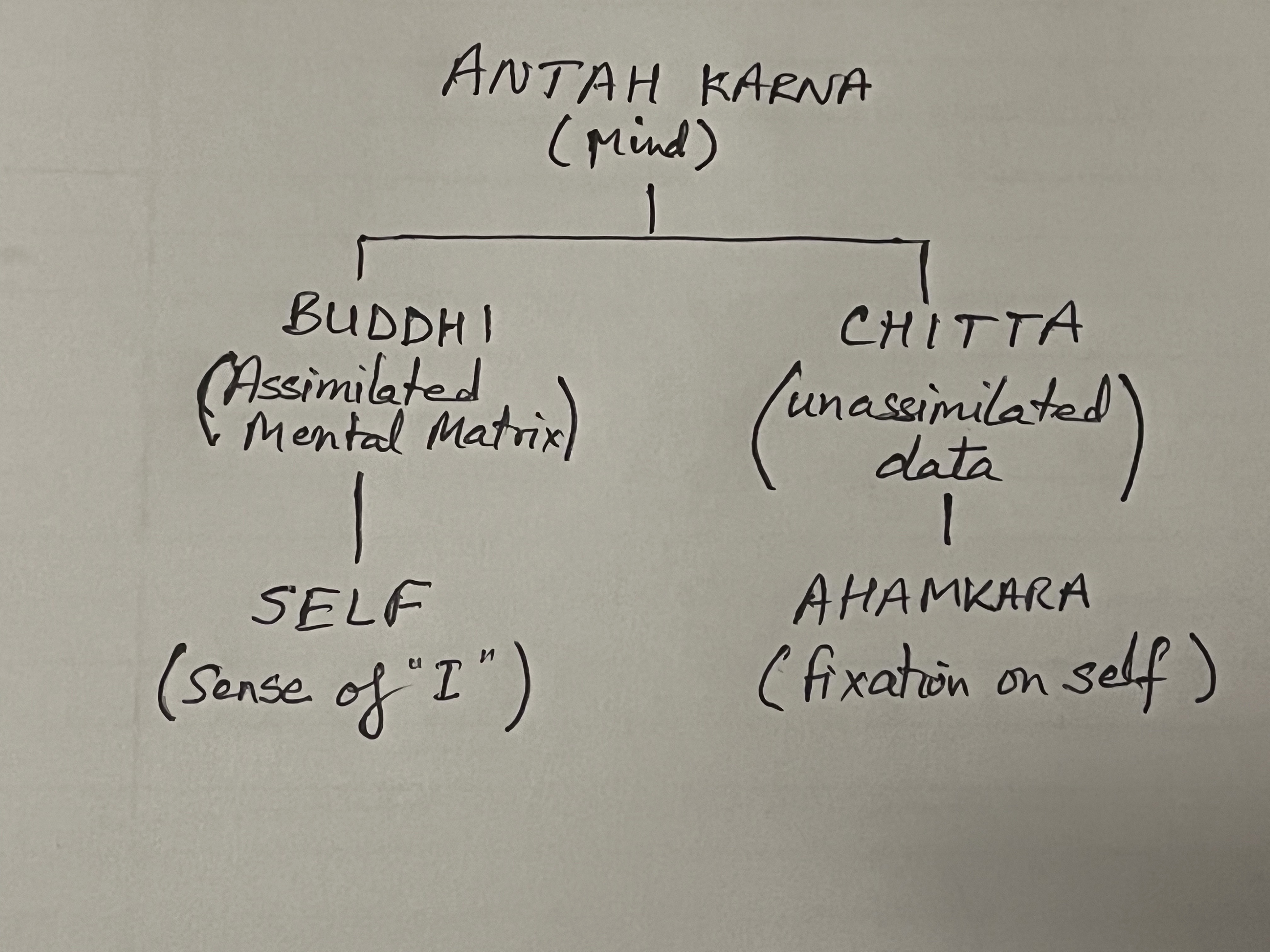
Ahamkāra is the fixation on personal self.
Ahamkāra is the conception of “I” (ego) of the identity (body-mind system). The identity functions according to laws that are inherent in nature, which makes “I” naturally fluid. In plants the identity is very simple and the “I” hardly stands out. But, in man, the identity is very sophisticated and the “I” acquires an individuality. This idea is expressed in BG 3:27. The “I” can be naturally fluid or it can become attached and solid. The latter condition is known as Ahamkāra.
AKASHA
(Vedas) Energy on a universal scale that forms the environment

ANOMALY
Please see Glossary: Hinduism.
ANTAHKARANA (अन्तःकरण)
Antahkarana literally translates as the “internal organ.” It consists of four parts: Manas, Buddhi, Chitta and Ahamkara.
ASHVINS
In meditation, when past traumas are confronted fully, and the person fully realizes that which did happen, then remarkable alleviation of ailments and sickness occur. This phenomena is symbolized by Ashvins in the Vedas. (Aśvins)
ĀSTIKA (THEIST)
Astika (आस्तिक; from Sanskrit: asti, ‘there is, there exists’, the original doctrine) means one who views deities existing as supernatural beings. He is looking at Sākār Brahman.
ASTRAL BODIES
Astral bodies are the result of visualization or belief that the person has, but he is unaware of it. Astral bodies do not exist independently of the person.
ĀTMAN (Self)
Please see Glossary: Hinduism.
ATTACHMENT
Attachment starts with dwelling on the objects of sense. This creates an attraction for them; attraction develops into desire, and desire breeds anger. From anger comes delusion; from delusion loss of memory; from loss of memory he cannot concentrate, Without concentration, there cannot be meditation. He who cannot meditate must not expect peace. With the mind not at peace, discrimination is destroyed. From the destruction of discrimination he perishes. See Verses 2:62-2:63, 2:66-2:67.
The holding on to something has been expressed as ‘attachment’. It has also been expressed as ‘fixation of attention.’ Attention always seems to go to that aspect of life that needs to be fully assimilated. Therefore, “holding on to” may come about when some thought (sensation, perception, memory, experience, or knowledge) is not assimilated. When all thoughts are assimilated attention becomes free. All fixations and attachments go away, and the person is continually in an ecstatic state of liberation.
Attachment starts with the consideration that one’s identity is above the laws of nature. This fixation on identity then translates to fixation on worldly affairs. Such a person is calm only when he is within his worldly zone of comfort.
AVATĀR
Avatār literally means, “to make one’s appearance.” From its usage in Hinduism, an avatar appears to be a major step forward in evolution. Some of the avatars are: Matsya (fish), Kurma (tortoise), Varaha (boar), Narasimha (animal-man), Vamana (dwarf), Parshuram (warrior-sage), Rama (model of ethics), Krishna (model of love), Buddha (model of wisdom), Kalki (prophesied to end evil). NOTE: An Avatar is a symbol for a major step toward evolution.
—B—
BECOMING ONE
To “become one” is to know something so intimately that there is no distance left. For example, when you are expert in riding a bicycle, you have become one with that bicycle. You push pedals and apply brakes without putting attention on them. But you are fully aware of those actions, and you can change them whenever you want. To “become one with God” is to know the universal laws so well that you operate according to them without having attention on them. When one says, “the seer and scenery has become one,” it implies knowingness. See KNOWINGNESS.
BHAGAVĀN
Bhagavān literally means “fortunate”, “blessed”, and hence “illustrious”, “divine”, “venerable”, and “holy”. It refers to one who understands the creation and dissolution, the appearance and disappearance of beings, the wisdom and ignorance. In Bhāgavad Gīta, Krishna is referred to as bhagavān.
BHAKTA
A bhakta is a devotee who is seeking moksha by acquiring spiritual attributes through devotion to gods, and then moving beyond those attributes to a state of oneness.
BHAKTI AND JNANA
Please see Glossary: Hinduism.
BHAKTI MOVEMENT
The Bhakti movement refers to the trend in medieval Hinduism. It was inspired by many poet-saints, who championed a wide range of philosophical positions ranging from theistic dualism of Dvaita to absolute monism of Advaita Vedanta. It was a revival, reworking and recontextualisation of ancient Vedic traditions. Bhakti refers to passionate devotion (to a deity) to achieve salvation. It provided an individual-focused alternative path to spirituality regardless of one’s birth or gender. The Bhakti movement preached using the local languages so that the message reached the masses. NOTE: Bhakti movement has been a great effort to bring Vedic knowledge broadly to the uneducated masses. It has inspired much progress in arts and culture. However, the diverse symbolism has created much confusion and it requires careful deciphering.
BHAKTI YOGA
Focus on a personal god or a divine principle. Unfortunately, Bhakti Yoga has become all about symbols. One may keep on using symbols, but one’s understanding must transcend symbols. Before any spirituality will work, the person must be given hope that he can improve. This is done by participating in festivals and satsangs; singing bhajans and chanting; and practicing rituals. He must believe that there is a better future ahead. That if he does good deeds, his next life will be much better. That there is an external deity that bestows love and grace upon him. That God can bestow heaven on him. Thus, Bhakti is there to give a person hope. It intensify a person’s focus on God with the belief that God saves.
BRAHMAN
Please see Glossary: Hinduism.
BUDDHI (बुद्धि)
Buddhi is derived from the Vedic Sanskrit root Budh (बुध् ), which literally means “to wake, to know, be conscious again”. The same root is the basis for the more familiar masculine form Buddha and the abstract noun bodhi. Buddhi means the intellectual faculty and the ability to “discern, judge, comprehend, understand” something.
—C—
CHAKRA
Chakras are centers of energy within the human body. The seven main chakras are thought to influence physical, emotional, and spiritual well-being, and are often associated with specific colors, locations on the body, and areas of life. Here’s a breakdown of the seven chakras:
- Root Chakra (Muladhara): Located at the base of the spine, it represents grounding, security, and survival instincts.
- Sacral Chakra (Svadhisthana): Situated in the lower abdomen, it governs creativity, emotions, and sexuality.
- Solar Plexus Chakra (Manipura): Found in the upper abdomen, it relates to personal power, confidence, and self-esteem.
- Heart Chakra (Anahata): Located in the center of the chest, it embodies love, compassion, and emotional balance.
- Throat Chakra (Vishuddha): Found in the throat area, it governs communication, self-expression, and truth.
- Third Eye Chakra (Ajna): Situated between the eyebrows, it represents intuition, insight, and spiritual awareness.
- Crown Chakra (Sahasrara): Located at the top of the head, it is associated with spiritual connection, enlightenment, and higher consciousness.
In chakra meditation and other practices, the goal is often to balance and harmonize these energy centers, which is believed to promote overall well-being.
CHANGE & CHANGELESS
Ātman that carries mental impressions never perishes, but the mental impressions carried by ātman are forever changing. (Verse 2:12-14).
CHANTING
Please see Glossary: Hinduism.
CHAOS AND ORDER
It is true that chaos gradually evolves into order. This is the story of evolution. Physics deals with that initial chaotic state through the concept of Quantum field. From total chaos to total order may be regarded as the scale of evolution. The divine underlies this whole scale. To say, “Beneath chaos lies divine order” gives us an altered picture.
CHIT (चित्)
Chit meaning consciousness or awareness. Chit is associated with Jivatman, Atman and Paramatman meaning that there are different levels of consciousness associated with these viewpoints.
CHITTA (चित्त)
Chitta is the term used to refer to the quality of mental processes as a whole. One’s state of mind at any given time affects one’s actions, speech, and thoughts. The chitta is said to go off with a will of its own if not properly controlled. Generally speaking, a person will operate with a collection of changing mindsets, and some will occur regularly. While these mindsets determine the personality, they are not in control of themselves, but fluctuate and alternate.
CLIMAX OF ACTION
The climax of action is always Realization. So engage in the action that brings realization and wisdom. See Verses 4:33-4:34.
CONSORT PRACTICES
Consort practices involve a spiritual partner (or a symbolic representation) engaged in tantric yogic practices aimed at enlightenment by integrating wisdom (female consort) and method (male aspect). This is not a romantic relationship but a sacred, esoteric practice focusing on energetic or mental union to cultivate spiritual energy and develop wisdom, though the meaning and necessity of physical consorts can vary among teachers and traditions.
Creation Myth = sacred, plot, characters, set in a dim and nonspecific past, the framework for the self-identity of the culture and individual in a universal context, central worldview.
—D—
DARSHANA
In spiritual terms, darshan is a deeply fulfilling experience, regarded as a form of worship and a moment for spiritual advancement. While most temple visits are considered acts of darshan, the practice can also extend to viewing sacred images at home, or even recognizing holiness in natural phenomena or spiritual teachers. The significance lies in the intent and reverence brought to the act, not just the physical location. Darshan is central to Hindu devotional life, symbolizing both the blessed vision of the divine and the inward spiritual connection formed through acts of seeing and being seen.
DEATH AND BIRTH CYCLE
Please see Glossary: Hinduism.
DEITY
Please see Glossary: Hinduism.
“Deity” refers to a god or goddess, a supernatural being considered divine and worthy of worship. It can also refer to the divine nature itself or anything considered supremely good or powerful. The term is often used in the context of religious beliefs and practices where deities are worshipped as having control or influence over aspects of the world. NOTE: Deity refers to external influences that need to be harmonized.
Brahma = the creator in Hindu Trinity
Brahman = Unknowable
Kali = the ultimate liberator
Prakriti = cosmic energy, substance
Purusha = pure awareness
Shakti = Prakriti (motion inherent in substance)
Shiva = Purusha (substance)
Shiva = the destroyer in Hindu Trinity
Vishnu = the preserver in Hindu Trinity
DEITY YOGA
A meditative practice where one visualizes oneself as a deity embodying enlightened qualities to transform one’s perception of reality.
DESIRE
All desires have deep roots in innate impulse, and they are shaped by the self. (Verse 2:42).
DHARMA
Dharma literally means, “the Law of Being.” Dharma is that which is established or firm, steadfast decree, statute, ordinance, law.” For example, the “Dharma” of the sun is to shine and give warmth. Dharma (DHAMMA in Pali) is virtue, morality, religion, religious merit, good works. It is the law, doctrine and the ethical precepts of Buddhism.
DHYANI BUDDHAS
The Five Dhyani Buddhas, also known as the Five Wisdom Buddhas, are a group of celestial Buddhas who are believed to have always existed and represent different aspects of enlightened consciousness. These Buddhas are often depicted in mandalas and are meditated upon to aid in spiritual transformation.
- Vairochana: Represents the wisdom of all-encompassing reality, often associated with the center of the mandala and the color white.
- Akshobhya: Represents the wisdom of the mirror-like, embodying clarity and equanimity, often associated with the east and the color blue.
- Ratnasambhava: Represents the wisdom of equanimity and the enriching qualities, often associated with the south and the color yellow or gold.
- Amitabha: Represents the wisdom of discernment and infinite light, often associated with the west and the color red.
- Amoghasiddhi: Represents the wisdom of all-accomplishing action, often associated with the north and the color green.
These Buddhas are not historical figures but rather symbolic representations of different aspects of enlightenment and are used as objects of meditation and contemplation.
DISCIPLINE OF ACTION
There is a discipline in the practice of one’s dharma (sacrifice). Some fix their attention on Gods while performing their actions. Others fix their attention on Brahma (Unknowable). Some concentrate on controlling their physical senses and limiting their exposure to objects. Others restrain all their activities and vitality through asceticism. Some engage in charity, austerity, and meditation. Others engage in acquiring knowledge through the study of scriptures. Some are solely absorbed in the restraint of the breath in various ways. Others are absorbed in the control of their diet. There are many other disciplines employed to reach the state of immortality, but they all depend on action. Knowing this you will be free. See Verses 4:25-4:32.
DIVINE
Please see Glossary: Hinduism.
DVAITA
Please see Glossary: Hinduism.
DZOGCHEN (Ati Yoga)
Dzogchen, also known as Atiyoga, is a profound teaching within Tibetan Buddhism, particularly in the Nyingma and Bon traditions, emphasizing the direct realization of one’s inherent Buddha-nature. It’s considered the highest and most direct path to enlightenment, focusing on recognizing and resting in rigpa, the primordial awareness that is the mind’s true nature.
—E—
ENLIGHTENED ACTION
When one engages in an action simply to restore the truth of the natural order, then it is an enlightened action. (Verse 2:47).
ENLIGHTENED PERSON
A person who is established in the truth of natural order; who is always seeing things as they are. (Verse 2:46).
EVOLUTION
Please see Glossary: Hinduism.
—F—
—G—
GOD
Please see Glossary: Hinduism.
GODS
The unknowable and unseen powers.
GRADES (HINDUISM)
BHAKTI YOGA—Focus on a personal god or a divine principle.
KARMA YOGA—Understand and practice the divine wisdom in your life.
JNANA YOGA—Meditate and resolve the suffering (anomalies) in your life.
GUNA
Guṇas are “modes of existence” (tendencies, qualities, attributes). It is a philosophical and psychological concept developed by the Samkhya school of Hindu philosophy. There are three gunas: sattva (goodness, constructive, harmonious), rajas (passion, active, confused), and tamas (darkness, destructive, chaotic). All of these three gunas are present in everyone and everything, it is the proportion that is different. The interplay of these gunas defines the character of someone or something, of nature and determines the progress of life. (Verse 2:45).
—H—
HINDUISM
Hinduism is an organization of spiritual thought that started with the Vedic period and has continued till today. The Vedic period (c. 1500 -500 BCE) was a period of rapid development of thought with little organization. This is the period during which Krishna, very likely, existed as a yogi and had such a great impact that his name became synonymous with Hinduism.
At the end of the Vedic period (500 BCE) there was organization of spiritual thought in the form of Jnana Yoga. Jnana Yoga separated all ritualism, and focused primarily on meditation. It clarified the concept of self, and the goal of meditation became accessing and assimilating the samskāras (unassimilated impressions) in one’s Chitta (mental processes). This meditation brings up unknown sensations, emotions and thoughts that have been buried for a long time. This is followed by the process of assimilation, during which many realizations occur. This phase of spiritual organization became synonymous with Buddha. However, Jnana Yoga just happens to be very cerebral and was successfully followed by relatively few people.
During the next phase of the organization (400-200 BCE) Patanjali and Ved Vyas expanded Jnana to Karma Yoga of detached action. Karma Yoga required giving up the fixation on worldly affairs. There was a fine line here. One engaged in the worldly affairs to the degree that the actions were in line with the natural laws. One’s disposition suited one to follow a certain class of activity in the society. It was mandatory for the person to perform his assigned duty to the best of his ability. This allowed the person to focus on developing his abilities in a detached manner. Karma Yoga is the main subject of the Bhagavad Gita (BG). It has less focus on the mind and more on detached action. In writing BG, Vyasa used the legendary character of Krishna to popularize Karma Yoga. BG introduces Jnana Yoga briefly in Chapter 2, with the concept of Atman, and then focuses on Karma Yoga as a step preliminary to Jnana Yoga. However, Karma Yoga ended up alienating people from their emotions. Like Jnana Yoga, it was successfully followed by relatively few people.
In the centuries following the Bhagavad Gita, the emotional dimension of spiritual thought was explored. This led to Bhakti Yoga. Unlike Jnana and Karma, Bhakti was able to win the hearts and minds of people in large numbers. This makes Bhakti Yoga a fascinating subject.
HINDUISM AND KARMA
Please see Glossary: Hinduism.
—I—
IMMORTALITY
Immortality is not identifying with perishable mental impressions of sense-objects. It is the freedom from fixations due to samskaras (karmic impressions). (Verse 2:15).
INDRA
A deeply embedded trauma is not easy to confront; but, when finally confronted, the painful core of that trauma explodes like a thunder bolt. There is a shift in one’s beingness, and a great relief follows. Certain abilities may be strengthened, but more at the physical level. (Indra)
ĪŚVARÁ (ईश्वर)
Īśvará means, “one who is capable of”, It is used for master, lord, prince, king, mistress, and queen.
The composite word, Ishvara literally means “owner of best, beautiful”, “ruler of choices, blessings, boons”, or “chief of suitor, lover”. As a concept, Ishvara in ancient and medieval Sanskrit texts, variously means God, Supreme Being, Supreme Soul, lord, king or ruler, rich or wealthy man, god of love, deity Vishnu… [in Vedas,] the contextual meaning, however as the ancient Indian grammarian Pāṇini explains, is neither god nor supreme being. Please see Etymology.
—J—
JIVA (जीव)
Jiva means ‘to breathe or to live’. It is the human self that is made of deha, antahkarana and jivātman.
JIVĀTMAN (जीवात्मन्)
Please see Glossary: Hinduism.
JNANA YOGA
Jnana means ‘knowledge’. It refers to knowledge that has been assimilated. Jnana yoga (Yoga of Knowledge) is one of the three main paths in Hinduism that lead a person towards moksha. The subject of Atman belongs to Jnana Yoga. See Verse 2:39.
Jnana yoga is about meditating to resolve the sufferings in life. God is seen as a postulate that can be invoked from deep within.
—K—
KALI
Kālī (काली) is the power (SHAKTI) that emerges from SHIVA. It destroys all ignorance and leads one to the understanding of the ultimate reality (BRAHMA). Kali, as deity, is portrayed standing on Lord Shiva, with one foot forward. Her skin color appears to be dark, and she is wearing a garland of 51 skulls, denoting 51 letters of sanskrit alphabet. She is four armed, holding a Kharag, in her top left arm, denoting strength of divine knowledge. In her lower hand, she is holding a severed head denoting ego. Both of her right hands are in the abhaya (fearlessness) and varada (blessing) mudras. She is often depicted naked which symbolizes her being beyond the covering of Maya since she is far above Prakriti. NOTE: Kali symbolizes the concentrated effort to overcome the very source of ignorance.
KALPA
One day of Brahma equal to 1000 Yugas, equal to 4320 million years. See Hindu units of time.
KARMA
Please see Glossary: Hinduism.
Karma is essentially the influence on us from past lives. It is also the consequence of our actions in this life. Structurally, Karma is made up of unassimilated impressions in our mind.
In Dianetics, we have mental impressions in the form of locks, secondaries and engrams. In Scientology, we have identification of thoughts (A=A=A) that messes up our thinking. At OT Levels, we have misconceptions that go deep into our postulates. These misconceptions lie at the root of all our aberrations. All these are included in the definition of Karma.
KARMA MUDRA
In Tibetan Buddhism, karmamudra refers to practices that may involve sexual union with a partner, either physical or visualized, as a means to achieve non-dual awareness and bliss. Tantra has been popularized in the West, particularly through the Neo-Tantra movement, with a strong emphasis on sexual practices, which is a limited and potentially misleading interpretation.
KARMA YOGA
Karma means ‘action’. It refers to action guided by a resolute intellect that reflects svadharma. It helps one break through all bondage of action. On this Path, endeavor is never wasted, nor can it ever be repressed. By its means, the straying intellect becomes steadied in the contemplation of one object only.
Thus, a karma yogi rises above the three constituents of life (sattva, rajas and tamas), and above all the pairs of opposing sensations. He is always involved in action but without desire for personal gain. Renouncing all attachments, he focuses his mind on moksha only. He looks upon success and failure with an equal eye. He engages only in right action. His reason crosses the entanglements of illusion and becomes indifferent to all philosophies. See Verses 2:39-2:53.
Karma Yoga is essentially the surrender of the arrogant egotism and letting it reduce to the humble ego by going along with the laws of nature in one’s action.
It is necessary to consider what is right action, what is wrong action, and what is inaction. He who can see inaction in action, and action in inaction, is the wisest among men. The wise takes action that is free from personal motive or desire. He is guided by deep thought that does not generate anomaly. He lets the results take care of themselves. In reality he does nothing, even though he is apparently acting. He has become an instrument through whom the nature is operating.
Thus he remains untainted by those actions. He has transcended the pair of opposites. He is free from envy. And his mind is balanced both in success and failure. He is not bound by any consequences. He leaves no trace behind. He has become one with nature. In modern language, the beingness, doingness and havingness has become one. See Verses 4:16-4:24.
KENSHO (lit., “seeing into one’s own nature”)
Semantically, kensho and satori have virtually the same meaning, and they are often used interchangeably. In describing the enlightenment of the Buddha and the Patriarchs, however, it is customary to use the word satori rather than kensho, the term satori implying a deeper experience.
KIRTAN
Kirtan is a Bhakti Yoga technique in which attention is diverted away from mental fixations, so that mind is temporarily free to resolve anomalies in a natural fashion. Kirtan includes singing of bhajans and chanting. Bhajan refers to any devotional song with a religious theme or spiritual ideas. The term bhajanam means reverence and originates from the root word bhaj, which means to revere, as in ‘Bhaja Govindam’. NOTE: A technique to more deeply free the mind of fixations is meditation. Of course, one needs to resolve fixations themselves to keep the mind permanently free. Subject Clearing helps in resolving the fixations themselves.
KRISHNA
In Bhagavata Purana, Krishna is considered an avatar that did not undergo a human birth. NOTE: As an avatar Krishna has become a symbol for a major step toward evolution. This means that, at one time, Krishna must have been an actual person who became a great yogi and attained moksha through his efforts.
KSHATRIYA
Kshatriya is one who protects from hurt or wound. A Kshatriya is a member of the second of the four great Hindu castes, the military caste. The traditional function of the Kshatriyas is to protect society by fighting in wartime and governing in peacetime. (Verse 2:32).
KUNDALINI
This is the life-force energy, likened to a coiled serpent, believed to reside at the base of the spine. When activated, it travels up the central channels (chakras) towards the head, leading to spiritual awakening and liberation.
KURU
Kuru (कुरु) was the name of a Vedic Indo-Aryan tribal union in northern Iron Age India, encompassing the modern-day states of Delhi, Haryana, Punjab and some parts of western part of Uttar Pradesh, which appeared in the Middle Vedic period (c. 1200 – c. 900 BCE) and developed into the first recorded state-level society in the Indian subcontinent.
—L—
LAMA
Spiritual teacher
LIBATION
A libation is a ritual pouring of a drink, typically wine or water, as an offering to a deity or as a symbolic gesture to honor ancestors.
LONGDE (space series)
Longdé offers a unique path to liberation through the awareness of the subtle body and its interplay with the boundless spaciousness of reality. It highlights the vastness and boundless nature of awareness (rigpa) and the exploration of physical sensations within that space.
—M—
MAHABHARATA
Mahabharata describes the first civil war among the Kurus. It seems to have been composed about 800 to 1000 years later after the actual event. Krishna and Arjuna seems to be characters created by the author based on legends.
MANAS (मनस्))
Manas translates as mind (in its widest sense as applied to all the mental powers). The embodied ātman is aware. It has the natural capacity to recognize what is there and what is not. This is its mind. (Verse 2:16).
MANDALA PROCESSING
The term “mandala” originates from Sanskrit and means “circle” or “center”. A mandala is a geometric design or pattern, often circular, that is used to represent the universe, the structure of the world, and the path to enlightenment. They can symbolize various concepts like the five elements, the five aggregates, and the five inner negativities in Buddhist philosophy. They serve as a tool for meditation, focusing the mind, and connecting with a higher power.
MANTRA RECITATION
The term “mantra” is derived from the Sanskrit root “man” (mind) and “tra” (instrument). Mantras are words and syllables recited over and over again to help us to generate and stay focused on beneficial states of mind, like compassion for others, or clarity of thought. They are an aid to concentration. They protect the mind from negative states.
MĀYĀ
Please see Glossary: Hinduism.
MEDITATION
Please see Glossary: Hinduism.
Meditation, as practiced in the non-theistic religion of Buddhism, is the practice of focusing the mind on the ultimate reality of Oneness, and letting all mental impressions, emotions and thoughts flow unresisted through oneself. This requires the ability to confront. Meditation has the effect of assimilating the activated contents of the mind.
To meditate is to engage in deep and serious looking. It suggests focusing the attention on a subject from every point of view, to understand all its sides and relations. Thus, the process of meditation involves viewing something thoroughly. The end product of meditation is to perceive something for what it truly is.
Meditation is the process of looking, not thinking. Thinking is often used to avoid looking at things to such a degree that it degenerates into a never-ending “figure-figure.” In meditation one simply looks. If there is any thinking at all, it is to find out where to look.
Meditation is looking and not thinking. In meditation you simply observe the mind. You do not ransack the mind through thinking. You just face whatever comes up. You do not avoid, suppress, deny or resist what is there. Unless you confront, you are not going to make spiritual progress. Meditation is not just sitting in a lotus position. Meditating is perceiving correctly by being there and doing nothing else. If you are not simply being there then your social conditioning is making you do something.
A practice of separating from your thoughts so that you can observe them rather than being caught up in them. Meditation is going to help you notice the thoughts and stories arise and not get caught up in them as irrefutable truth to which you react. (Youngblood)
BREATH PRACTICES: Breathing takes center stage in meditation — it helps you break the monopoly of your thoughts by giving you a physical sensation on which to focus. You intentionally breathe in and out slowly, fully filling and emptying the lungs, and have all of your attention on the breath itself. You breathe through the nose (mouth closed) but slightly constricting the back of the throat so that you create an audible sound, similar to what you do when you whisper. Feel the fluid qualities of air as it slides across the inner part of your nostrils. Feel the rising of your chest and filling of your lungs as you inhale. Feel all of the physical sensations. Along with the breathing, you include a full body scan to notice those places that are held tight. A systematic unclenching of your body can go a long way in reducing anxiety. Deep, conscious Ujjayi breathing is your secret weapon for settling your body chemistry. You can do it anytime — alone, in line at the grocery store, or in front of your upset partner. Use it liberally.
The second breath exercise is “lung expander.” Take in a full breath and hold it. Then take two more sips of breath into the lungs to bring them to their maximum absolute capacity. Hold for five seconds and then release. Add a squeeze of the perineum during the five second hold. Perform this ten times in the morning, and again at night. (Youngblood)
MENGAKDE (secret or pith instruction series)
The Mengakdé series provides a direct approach to Dzogchen realization through detailed instructions and practices, guided by the insights of masters and intended for individuals at different levels of capacity, with the Nyingthig teachings representing the pinnacle of this path.
Mimamsa = reflection, consideration, profound thought, investigation, examination, discussion, examination of the Vedic text
MITRA
Mitra represents vigor in spotting things in meditation for what they really are. (Mitra)
MOKSHA AND NIRVANA
Please see Glossary: Hinduism.
MOKSHA (Enlightenment)
Moksha, also known as mukti, is a concept central to Indian religions like Hinduism, Buddhism, Jainism, and Sikhism. It signifies liberation from the cycle of death and rebirth, known as samsara. Achieving moksha is often considered the ultimate goal in these traditions, representing freedom from suffering and the merging with a higher state of consciousness or the divine. NOTE: In practical terms, moksha amounts to freedom from all possible conditioning.
MUDRA
The term “mudra” originates from Sanskrit and primarily means “seal,” “mark,” or “gesture”. Mudras are deeply symbolic hand gestures that play a crucial role in practice, often combined with mantras and yantras (visualizations). They are used to evoke specific states of mind, represent deities, and facilitate spiritual connection. Different mudras are associated with different Buddhas and their enlightened qualities.
MYSTERY
Please see Glossary: Hinduism.
MYTH
Myth, a story of the gods, a religious account of the beginning of the world, the creation, fundamental events, the exemplary deeds of the gods as a result of which the world, nature, and culture were created together with all parts thereof and given their order, which still obtains. A myth expresses and confirms society’s religious values and norms, it provides a pattern of behavior to be imitated, testifies to the efficacy of ritual with its practical ends and establishes the sanctity of cult. NOTE: God is a mythological explanation for an unknown cosmic influence that does not have a face or personality. Ultimate authority resides in universal principles.
—N—
NADIS
Nadis refer to the energy channels through which vital energy, or prana, flows throughout the body. There are said to be 72,000 nadis, with 108 being particularly important, and three of these being the most significant: Ida, Pingala, and Sushumna. These nadis are not physical structures like veins or arteries but rather subtle energy pathways in the astral body.
NĀSTIKA (ATHEIST)
Nāstika (from Sanskrit: na, ‘not’ + āstika,
negating the doctrine of original) means one who views deities to be the symbolization of elements of nature.
NEO-TANTRA
Neo-Tantra is a modern, Westernized interpretation of ancient tantric practices, often associated with the New Age movement. It diverges from traditional tantra by incorporating unorthodox techniques and focusing on spiritual and sexual awakening, often with an emphasis on harnessing sexual energy for healing, creativity, and emotional release. While traditional tantra is a complex system rooted in ancient Hindu, Buddhist, and Jain traditions, Neo-Tantra presents a more accessible and personalized approach, sometimes drawing from various spiritual and philosophical viewpoints.
NETI NETI
“Neti neti” is a Vedic process to locate THAT which is not an outcome of your postulate or consideration.
NIRVĀNA (निर्वाण)
Nirvāṇa literally means, “blown out”, as in an oil lamp. It represents the blowing out of Self, as in the realization that even Self is a product of maya, or postulate. Nirvana is the ultimate release from dukkha and saṃsāra. Also see MOKSHA AND NIRVANA.
Please see Postulate Mechanics: Glossary.
Nyaya = rules, method or judgment, systematic development of the theory of logic, methodology, and treatises on epistemology.
—O—
OBLATIONS
A thing presented or offered to God or a god. The efforts extended in meditation.
ONENESS
Please see Glossary: Hinduism.
—P—
PARAMĀTMAN (परमात्मन्)
Please see Glossary: Hinduism.
Paramātman is the ultimate consciousness to which all jivātmans converge upon expansion. Selflessness is the attribute of Paramatman, because all personality/individuality vanishes at this level. Broad concept: “supreme atman or consciousness.” Definition: “the Supreme Spirit.”
Paramātman is the infinite viewpoint that is unattached and static. See The Static Viewpoint.
PASSION
Desire and aversion born out of passion consume and corrupt the knowledge and discernment in man. This is an insatiable enemy that even the wisest is faced with. It works through the senses, the mind and the reason; and with their help destroys wisdom and confounds the soul. It is said that the senses are powerful. But beyond the senses is the mind, beyond the mind is the intellect, and beyond and greater than intellect is atman. It is difficult but you can overcome this enemy by controlling the senses. See BG Verses 3.37-3:43.
PAST LIVES
- A ‘past life’ is an assumption by a person that he must have lived before this life. This assumption is based on his discovery of impressions in his mind, which could have been made only before the current life started.
- Such an impression has charge (tension) when it is first encountered. Upon the encounter, the charge releases and the impression reduces to the person’s knowledge. It is the presence of that charge that authenticates that impression as being from a ‘past life’.
- Such an impression could have traveled from the ‘remote’ past only through the DNA, just like the programming of the body, and other personal characteristics. The alternative is to resort to some esoteric theory of a ’soul’. We do not know if a ‘soul’ is something factual.
- The ’soul’ is supposed to separate from the body upon death. The ‘soul’ is synonymous to the ‘mind’ and viewed as the person without the body.
- This assumes that, even in a live person, the mind (soul) is separate from the body. But mind is the programming. Mind is like the ‘software’, where brain and body are the ‘hardware’. They can’t be separated like two different objects.
- Death can only mean the death of the whole organism—body mind and spirit—everything is gone. Only impressions are left that appear as a hauntings in old locations in space.
- But impressions from a person’s life can pass through to his progeny like the physical and personality characteristics.
- It is more likely that the ‘past live’ are a part of a person’s ancestry.The past life “memories” are old ancestral impressions getting assimilated in your mental matrix in the present. These are unassimilated experiences of your ancestors and predecessors that are carried forward as impressions on the genetic line.
- It may be your ancestor’s impression, but when you resolve it it becomes your experience.
- 10. Once an impression is assimilated it no longer carries forward on the genetic line.
PAST LIFE “MEMORIES”
The past life “memories” are old ancestral impressions getting assimilated in your mental matrix in the present. These are unassimilated experiences of your ancestors and predecessors that are carried forward as impressions on the genetic line. They were recognized by Buddha as “samskaras.” These “memories” share some characteristics with dreams in the sense that a narrative is constructed at the moment of assimilation. The older is the impression, the less likely it is that its original context is reproduced exactly. So distortions are present while some recognizable landmarks and patterns may still be there. Despite any distortions, the assimilation of these past impressions is very therapeutic as it reduces tensions in the mental matrix. Yes, there are past life memories. These are unassimilated sensations coming down through the ancestral line. Sensations get their meaning only during the process of assimilation in meditation. The meaning is given by postulates and past experience existing in the matrix of the mind. The MEST universe does not pre-determine the meaning.
PERSONAL GOD (Bhakti)
The personal god refers to a specific deity to whom a devotee offers heartfelt devotion and love. A devotee often chooses his own personal god based on his spiritual inclination, family tradition, or regional culture.
PHILOSOPHY OF ACTION
It is necessary to consider what is right action, what is wrong action, and what is inaction. He who can see inaction in action, and action in inaction, is the wisest among men. The wise takes action that is free from personal motive or desire. He is guided by deep thought that does not generate anomaly. He lets the results take care of themselves. In reality he does nothing, even though he is apparently acting. He has become an instrument through whom the nature is operating.
Thus he remains untainted by those actions. He has transcended the pair of opposites. He is free from envy. And his mind is balanced both in success and failure. He is not bound by any consequences. He leaves no trace behind. He has become one with nature. In modern language, the beingness, doingness and havingness has become one. See Verses 4:16-4:24.
POSTULATE
Please see Glossary: Hinduism.
POWER OF WISDOM
The power of wisdom is that there is no longer any confusion. By that power you shall see all other people as if they were your own self. You will understand everyone’s nature. With this wisdom you shall overcome all sins, and resolve all the consequences of your actions. That wisdom lies ultimately in you. With wisdom you shall attain Supreme peace. If there are doubts they must be resolved. See Verses 4:35-4:42.
PRAKRITI
Prakriti (प्रकृति) is “the original or natural form or condition of anything” and connotes “nature, body, matter, phenomenal universe”. It is a key concept in Hinduism, where it includes all the cognitive, moral, psychological, emotional, sensorial and physical aspects of reality. Prakriti has three different innate qualities (guṇas): sattva (goodness, calmness, harmonious), rajas (passion, activity, movement), and tamas (ignorance, inertia, laziness). The equilibrium of these qualities is the basis of all observed empirical reality. Prakriti refers to the feminine aspect of all life forms. It contrasts with the male aspect, Purusha, which is pure awareness and metaphysical consciousness.
Prakriti = making or placing before or at first, the original or natural form or condition of anything, original or primary substance.
PRANA
Prana refers to subtle life force energy, often translated as “wind” or “vital energy,” that is believed to flow through the body’s subtle channels. Vajrayana practices, particularly those involving the subtle body, utilize this prana to enhance awareness, facilitate meditative states, and ultimately, to attain enlightenment.
PURĀNA
Purāna (पुराण) literally means “ancient, old”. It is a vast genre of Indian literature woven with the Bhakti movement. It includes diverse topics such as cosmogony, cosmology, genealogies of gods, goddesses, kings, heroes, sages, and demigods, folk tales, pilgrimages, temples, medicine, astronomy, grammar, mineralogy, humor, love stories, as well as theology and philosophy. Several of these texts are named after major Hindu deities such as Vishnu, Shiva, Brahma and Shakti. The Puranas are known for the intricate layers of symbolism depicted within their stories. They present a form of religion, wherein bhakti ultimately leads to self-knowledge, salvation (moksha) and bliss. They have been influential in the Hindu culture, inspiring major national and regional annual festivals of Hinduism.
PURUŚA (पुरुष)
Purusha means the cosmic being or self, consciousness, and universal principle. It is atman working toward the state of parmātama. Brahma combines Prakriti (nature, matter) and Purusha (spirit, soul) to create a dazzling variety of living creatures, and tempest of causal nexus. NOTE: It is the universal viewpoint that still suffers from some fixations as it works its way towards becoming the static viewpoint.
Puruśa is abstract essence of the Self, Spirit and the Universal Principle that is eternal, indestructible, without form and is all pervasive.
Purusha = cosmic being (Self), consciousness, universal principle, part of creation myth, abstract essence of the Self, Spirit and the Universal Principle that is eternal, indestructible, without form and is all pervasive.
—Q—
—R—
REBIRTH
Please see Glossary: Hinduism.
The idea of rebirth comes from variations in the characteristics that one is born with, along with the continuation of certain characteristics from one life cycle to the next. Both these factors may be explained through the phenomenon of genes and the programming they carry. However, it still remains to be explained what this genetic programming is and how it comes about. The genetic programming is the blue print that shapes the identity (body-mind system) of the organism. Its content comes from impressions of the life cycles that have already occurred. Most of this programming is evolutionary; but some of it contains anomalies that needs to be resolved. It is the resolution of these anomalies that drives the evolution of the self.
REINCARNATION
New configuration of atoms and monads.
Reincarnation is the precipitation of physical and spiritual elements in a new configuration. It is never the same body or identity.
From a scientific perspective REINCARNATION is due to persistence of unassimilated sensations. These are sensations from traumatic events that could not be assigned meaning until they loosened enough over several lifetimes. The mechanism is same as that underlies KARMA. This traumatic event must have occurred in the lifetime of one of the ancestors whose DNA programming we have inherited. See BEINGNESS.
RIGPA
The fundamental nature of mind, characterized by purity, spontaneity, and compassion. It’s the ultimate ground of being, the source of all experience.
RITUAL
A ritual is a repeated, structured sequence of actions or behaviors that alters the internal or external state of an individual, group, or environment, regardless of conscious understanding, emotional context, or symbolic meaning. NOTE: A ritual replaces a part of person’s conditioning by a ritualistic practice; but it does not remove that conditioning permanently.
—S—
Sacred = that which inspires awe and reverence
SACRIFICE (YAJNA)
Please see Glossary: Hinduism.
An action that is carried out according to the laws of nature for the welfare of all.
SAMĀDHI (समाधि)
Samādhi means concentration of the thoughts, profound or abstract meditation, intense contemplation of any particular object (so as to identify the contemplator with the object meditated upon); this is the eighth and last stage of yoga; with Buddhists samādhi is the fourth and last stage of dhyāna or intense abstract meditation. The deep sleep like state of samadhi is the period of assimilation in which you completely reset your system. But you don’t live in that state. Samadhi leads you toward the universal viewpoint. Being “established in God” would means being established in the universal viewpoint.
SAMKHYA
(“to reckon, count, enumerate, calculate, deliberate, reason, reasoning by numeric enumeration, relating to number, rational”) Samkhya is one of the six āstika schools of Hindu philosophy. It refers to the philosophical school in Hinduism based on systematic enumeration and rational examination. It ‘enumerates’ twenty-five Tattvas or true principles; and its chief object is to effect the final emancipation of the twenty-fifth Tattva, i.e. the puruṣa or Self. (Verse 2:39). Samkhya is considered āstika; Buddhism is considered nāstika.
SAMSKARA (SAMKHARA in Pali)
Samskara are mental impressions that give rise to conditioned response. When these impressions are fully assimilated, then they gives rise to rational response or dharma (dhamma).
Samskara are the residual tendencies of a being. Samskara are mental impressions that give rise to conditioned response. When these impressions are fully assimilated, then they gives rise to rational response or dharma (dhamma).
SARASVATI
Sarasvati represents the knowledge and learning that is attained during meditation. It is the delight in truth of self-realizations. It inspires and enlightens. (Sarasvatī)
SAT-CHIT-ANAND
The bliss of pure thought energy
SEMDE (mind series)
In Semdé, the core principle is to grasp the nature of mind, which is considered primordial and uncreated. This involves understanding the mind’s inherent purity and its capacity for direct insight, known as rigpa.
SENSUAL PLEASURE
Sensual pleasure includes spiritual pleasure also that becomes an obstruction to Moksha or Nirvana.
SHATAKRATU
A name of Indra. (Śatakratu)
SHIVA
Shiva (शिव) means “auspicious, propitious, gracious, benign, kind, benevolent, friendly”. The term Shiva also connotes “liberation, final emancipation” and “the auspicious one”. It is the supreme power that recognizes the true nature of reality and destroys all illusion. Shiva is one of the principal deities of Hinduism. As a deity, Shiva is identified as the creator of the cosmos and liberator of Selfs from the birth-rebirth cycle. NOTE: The Static Viewpoint comes closest to describing Shiva.
SMRTI (स्मृति)
Smrti means “remembrance, reminiscence, thinking of or upon, calling to mind”, or simply “memory”. The word is found in ancient Vedic literature. In later usage, the term refers to tradition, memory, as well as “tradition that is remembered”. Please see MEMORY in the Other Glossary.
SOCIETY
The society is organized by the natural order of four main functions: acquisition of knowledge, protection from danger, equitable commerce, and adequate labor. These universal principles of action are simply there. Actions according to these principles flow in nature without binding anyone. Our ancestors acted in the light of this wisdom. We should too. See Verses 4:13-4:15.
SOMA
Soma refers to an intoxicating drink prepared by pressing the stalks of a plant. Under its influence one could rise above the obstacles of the mind. Soma was primarily used in sacrifices and hence was considered sacred. (Soma)
STHULA SHARIRA (GROSS BODY)
The Sthula Sharira is a synonym for Jiva (identity).
SUBTLE BODY
The subtle body refers to an energetic and psychospiritual framework within the human being, distinct from the physical body. It’s believed to be the conduit for spiritual growth and realization, composed of energy channels (nadis) and energy centers (chakras). Practices like yoga and meditation aim to awaken and balance the energies within this subtle body, leading to spiritual transformation.
SUKSHMA SHARIRA (SUBTLE BODY)
The Sukshma Sharira is a synonym for Jivātman (viewpoint).
SURRENDER (TO GOD)
To surrender to God means to let the laws of nature take over. You do not avoid, suppress, deny, or resist your tendencies but face them for what they are. This will make you become aware of your conditioning in depth and the laws of nature. This will help you become free of your conditioning and be able to navigate successfully with your basic nature. People suppress their tendencies and think they have surrendered. They have not.
Surrendering is “not avoiding, not denying, not resisting, and not suppressing.” It is experiencing fully what is there. You free yourself from an unwanted condition only by becoming fully aware of it. Suppressing is not the same thing as surrendering. If a person is suppressing bad habits to become good, he has not surrendered yet. After you have surrendered, only your basic nature is left. The basic nature operates according to the universal laws
SVADHARMA
Svadharma is “one’s own duty”. These are the goals that follow naturally from one’s being. In other words, these are the postulates that comprise the being. Everyone’s svadharma is aligned per the oneness of overall dharma. So it is vital to carry out one’s svadharma and not ignore or deviate from it. You do so while looking upon pleasure and pain, victory and defeat, with an equal eye. See Verses 2:31-2:38.
—T—
TANTRA
Please see Glossary: Hinduism.
TANTRIC KUNDALINI
Tantric Kundalini refers to spiritual practices that combine the philosophies and techniques of Tantra and Kundalini Yoga, using methods like meditation, breathwork, and mindful sensory experiences to awaken and raise the dormant coiled energy, known as Kundalini, from the base of the spine to the head, leading to expanded consciousness and spiritual realization. While Kundalini Yoga focuses on physical postures and breath, Tantra adds a broader approach, incorporating rituals and sensual practices to channel spiritual energy for transformation and bliss.
THOUGHT
Please see Glossary: Hinduism.
TRIMURTI
Trimurti is the embodiment of the universe’s three fundamental cosmic functions: creation, preservation, and destruction, personified as Brahma (the creator), Vishnu (the preserver), and Shiva (the destroyer). This trinity conveys the essential cyclical nature of existence.
—U—
UNIVERSAL GODS
Universal gods appear to symbolize the deep realizations that occur during meditation.
—V—
Vaisheshika = insights in naturalism… form of atomism in natural philosophy… all objects in the physical universe are reducible to paramāṇu (atoms)… Everything was composed of atoms, qualities emerged from aggregates of atoms, but the aggregation and nature of these atoms was predetermined by cosmic forces.
VAJRA
A vajra (Sanskrit for “thunderbolt” and “diamond”) is a sacred ritual tool in Buddhism and Hinduism symbolizing indestructibility and irresistible force, and can also refer to the Vajrayana branch of Buddhism. It is a handheld scepter, often paired with a bell, representing wisdom and skillful means.
VAJRAYANA (Tibetan Buddhism)
Vajrayana Buddhism, also known as Tantric Buddhism or Esoteric Buddhism, is a branch of Buddhism that emphasizes accelerated paths to enlightenment through esoteric practices and rituals. It’s often considered a more advanced and transformative path within the broader Mahayana tradition. It incorporates tantric techniques and rituals, such as mantras (sacred sounds), mudras (hand gestures), mandalas (spiritual diagrams), and deity visualization, to transform ordinary experiences into paths toward moksha (enlightenment).
VAJRYANA INITIATION CEREMONY
- It bring about a new viewpoint that transcends self.
- It brings certainty about the Vajrayan path (all doubts are removed).
- It establishes a strong bond with the teacher.
- It preserves the purity of teachings.
VARUNA
Varuṇa is referred as the devourer of foes. In meditation, when one sees things as they are, all doubts and confusions associated with them disappear. (Varuṇa)
VAYU
Vayu represents the cosmic life breath. It is the impeller of life and the living, and the essence of speech. It is the postulate that explains the phenomenal nature of the universe. (Vāyu)
Vedanta = the end of the Vedas and originally referred to the Upanishads.
VIDHATA
Vidhata means “inherent principles of existence.” Duality is a natural consequence of these principles. Any imbalance straightens out by itself.
VISHNU
Vishnu (विष्णु) literally means the pervader. It is the all pervasive cosmic order that maintains cosmic equilibrium. It forms into universal principles. Vishnu, along with Brahma and Shiva, is one of the principal deities of Hinduism. Brahma, Vishnu and Shiva are part of extensive Hindu mythology. NOTE: Vishnu seems to be the description of the innate impulse that energizes every atom of this universe, and, therefore, our very beingness. Obviously, it is formless and the very root of everything. It generates the very sense organs that perceive. It manifests as space, time, knowledge and all characteristics. It is the ultimate realization that one can have.
Vishnu is the preserver and protector of the universe. He ensures the maintenance of cosmic order and the triumph of righteousness over chaos.
VISUALIZATION
- Underlying the processing of Mandala is visualization.
- Visualization is a powerful technique next to actual experience.
- A person visualizes a phenomenon that he has not actually experienced.
- He visualizes that phenomenon by stitching together what he has actually experienced.
- Such a visualization done right can be very vivid.
- Mandalas is basically an aid to visualization.
- Such a visualization should start with a broad but very simple concept.
- Then narrower concepts should be visualized within that broad concept.
- This can result in a complex visualization, but you visualize only one concept at a time.
- You relate that concept to the concepts already visualized.
- This way this doesn’t overload your faculty to visualize.
- This way you can experience phenomenon that you haven’t experienced before.
- The way you can experience abstract realities such as love, compassion, etc.
- This way you can experience the various other concepts in Buddhism.
- This way you may experience any part of this universe.
- The whole idea is to experience whatever your attention goes on.
- But you experience the broad simplicity first, and then the multiplicity of narrow complexities, one at a time.
- At no time time you do bypass anything that you have difficulty visualizing.
- Difficulty simply means that the visualization is too complex and you must break it down into simpler parts.
- Visualization of deities is a complex visualization—you must break it down into simpler parts.
- Any empowerment comes from correct and complete visualization.
VRITRA
Vritra represents drought and enemy of Indra. (Vṛtras)
—W—
WISDOM
The wise person acts for the welfare of the world without attachment. He does not perturb the minds of the ignorant, who are attached to things, and react in their ignorance. He simply lets his actions inspire them to do the same. See Verses BG 3.25-3.26.
Wisdom = Knowing how to know one’s self to resolve the mystery of life.
Please see Postulate Mechanics: Glossary.
WORSHIP
All paths of worship lead to the universal awareness and the ability to postulate. Then one’s action in this world are immediately successful. See Verses 4:11-4:12.
—X—
—Y—
YAJNA
Please see Glossary: Hinduism.
YĀNA
Vehicle
YANTRA
The word “Yantra” (Sanskrit for “instrument”) refers to geometric designs that are composed of intricate geometric shapes like triangles, squares, circles, and lotus patterns. Each element within a yantra carries symbolic meaning, representing deities, cosmic energies, or aspects of the universe. It serves as a symbolic representation of cosmic unity, a focus for channeling energies, and a tool for concentration and visualization.
YOGA
Yoga means ’yoke or union’. It presents universal principles. It is the practice of uniting atman with the absolute from which develops the detached ‘witness-consciousness’. Discrimination, resolute intellect and devotion is present in all yoga. In Jnana Yoga there is predominance of discrimination, in Karma Yoga there is predominance of resolute intellect and action, and in Bhakti Yoga there is predominance of devotion.
Yoga = the practice aspect sankhya theory
—Z—
.

Comments
Totally agree with you