
Reference: The Story of Philosophy
Note: The original Text is provided below.
Previous / Next
.
Summary
Well, then, what is to be done? The first turn on our road is universal education. For the first ten years of life, education shall be predominantly physical. Steps must be taken to minimize conditioning of the children by their parents and elders. We must give to every child full equality of educational opportunity. Every school is to have a gymnasium and a playground; play and sport are to be the entire curriculum; and in this first decade such health will be stored up as will make all medicine unnecessary.
But mere athletics and gymnastics would make a man too one-sided. Therefore, music must be added to the curriculum. Music is valuable not only because it brings refinement of feeling and character, but also because it preserves and restores health. A healthy and refined character influences positively in determining social and political issues. Our political psychology is perplexed because we have.not adequately studied the various appetites or instincts of man. Dreams may give us a clue to some of the subtle and more elusive of these dispositions.
The must be a balance between athletics and music. After sixteen the individual practice of music must be abandoned, though it must be used to provide attractive forms for the sometimes unappetizing contents of mathematics, history and science. Even then these studies are not to be forced upon an unwilling mind. A libertarian spirit must prevail within limits.
With minds so freely growing, and bodies made strong by sport and outdoor life, our ideal state would have a firm psychological and physiological base. But a moral basis must be provided as well, so the members of the community make a unity. Such moral requirement of the community must have sanction of supernatural authority to make men behave themselves. We must have a religion.
A belief in living God and personal immortality can comfort man and help control base passions. Granted that none of the beliefs can be demonstrated; yet surelyit will do us no harm to believe, and it may do us and our children immeasurable good. For we are likely to have trouble if we undertake to explain and justify everything to their simple minds.
When they arrive at the age of twenty, they will face the first scrutiny and test of what they have learned. Those who fail will be assigned to the economic work of the nation; they will be business men, and clerks, and factory workers, and farmers. The selection will be more democratic than democracy. Those who pass this first test will receive ten more years of education and training, in body and mind and character.
Those who fail the second test at age thirty will become the auxiliaries, or executive aides and military officers of the state. Myths should be used to persuade them to accept their fate. Those who pass are taught philosophy. Philosophy means: to think clearly, which is metaphysics; and to rule wisely, which is politics. To think clearly they shall study the doctrine of Ideas for the next five years.
According to this doctrine, we sense what is there. The sensations develop into general ideas. From general ideas develop particular ideas through reason and thought. There come about laws and ideals. The ideas become more permanent the more they fit together and form an overall consistent picture. The essence of a higher education is the search for Ideas that fit together forming a complete picture of whatever subject that is being considered.
At the age of thirty-five, these students now enter the concrete world with no favor shown them. In this mart of strife they shall learn from the book of life itself. They shall earn their bread and butter by the sweat of their high brows. And this last and sharpest test shall go on ruthlessly for fifteen long years. Those that survive, scarred and fifty, sobered and self-reliant, shorn of scholastic vanity by the merciless friction of life, and armed now with all the wisdom that tradition and experience, culture and conflict, can cooperate to give—these men at last shall automatically become the rulers of the state.
.
Comments
In general Plato is right in proposing full equality of educational opportunity from a young age as the solution to all the ills in the society. But education is not just acquiring knowledge. A large part of education is to get rid of existing conditioning.
Plato recommends taking children away from their parents to prevent conditioning by them; but, then, he recommends indoctrination through religious beliefs to secure compliance.
Plato recommends a uniform curriculum; and the success of children in this curriculum will determine their position in the society. However, the society simply needs to provide equal opportunity of advancement to all. Life itself will take care of who acquires what position.
An ability to think clearly should work as an antidote to the conditioning arising from family and religion. It should lead to a fine character. Life itself will teach the person as long as his confusion are being resolved in a timely fashion.
.
Original Text
Well, then, what is to be done?
We must begin by “sending out into the country all the inhabitants of the city who are more than ten years old, and by taking possession of the children, who will thus be protected from the habits of their parents” (540). We cannot build Utopia with young people corrupted at every turn by the example of their elders. We must start, so far as we can, with a clean slate. It is quite possible that some enlightened ruler will empower us to make such a beginning with some part or colony of his realm. (One ruler did, as we shall see.) In any case we must give to every child, and from the outset, full equality of educational opportunity; there is no telling where the light of talent or genius will break out; we must seek it impartially everywhere, in every rank and race. The first turn on our road is universal education.
For the first ten years of life, education shall be predominantly physical; every school is to have a gymnasium and a playground; play and sport are to be the entire curriculum; and in this first decade such health will be stored up as will make all medicine unnecessary. “To require the help of medicine because by lives of indolence and luxury men have filled themselves like pools with waters and winds. … flatulence and catarrh—is not this a disgrace? … Our present system of medicine may be said to educate diseases,” to draw them out into a long existence, rather than to cure them. But this is an absurdity of the idle rich. “When a carpenter is ill he asks the physician for a rough and ready remedy—an emetic, or a purge, or cautery, or the knife. And if anyone tells him that he must go through a course of dietetics, and swathe and swaddle his head, and all that sort of thing, he replies at once that he has no time to be ill, and that he sees no good in a life that is spent in nursing his disease to the neglect of his ordinary calling; and therefore, saying good-bye to this sort of physicians, he resumes his customary diet, and either gets well and lives and does his business, or, if his constitution fails, he dies and has done with it” (405-6). We cannot afford to have a nation of malingerers and invalids; Utopia must begin in the body of man.
But mere athletics and gymnastics would make a man too one-sided. “How shall we find a gentle nature which has also. great courage?—for they seem to be inconsistent with each other” (375). We do not want a nation of prize-fighters and weight-lifters. Perhaps music will solve our problem: through music the soul learns harmony and rhythm, and even a disposition to justice; for “can he who is harmoniously constituted ever be unjust? Is not this, Glaucon, why musical training is so powerful, because rhythm and harmony find their way into the secret places of the soul, bearing grace in their movements and making the soul graceful?” (401; Protagoras, 326). Music moulds character, and therefore shares in determining social and political issues. “Damon tells me—and I can quite believe it—that when modes of music change, the fundamental laws of the state change with them.”*
*[Cf. Daniel O’Connell: ”Let me write the songs of a nation, and I care not who makes its laws.”]
Music is valuable not only because it brings refinement of feeling and character, but also because it preserves and restores health. There are some diseases which can be treated only through the mind. (Charmides, 157): so the Corybantic priest treated hysterical women with wild pipe music, which excited them to dance and dance till they fell to the ground exhausted, and went to.sleep; when they awoke they were cured. The unconscious sources of human thought are touched and soothed by such methods;. and it is in these substrata of behavior and feeling that genius sinks its roots. “No man when conscious attains to true or inspired intuition, but rather when the power of intellect is fettered in sleep or by disease or dementia”; the prophet (mantike) or genius is akin to the madman (manike) (Phredrus, 244).
Plato passes on to a remarkable anticipation of “psychoanalysis.” Our political psychology is perplexed, he argues, because we have.not adequately studied the various appetites or instincts of man. Dreams may give us a clue to some of the subtle and more elusive of these dispositions.
Certain of the unnecessary pleasures and instincts are deemed to be unlawful; every man appears to have them, but in some persons they are subjected to the control of law and reason [“sublimated”], and the better desires prevailing over them, they are either wholly suppressed, or reduced in strength and number; while in other persons these desires are stronger and more abundant. I mean particularly those desires which are awake when the reasoning and taming and ruling power [“censor”] of the personality is asleep; the wild beast in our nature, gorged with meat and drink, starts up and walks about naked, and surfeits at his will; and there is no conceivable folly or crime, however shameless or unnatural—not excepting incest or parricide [“Oedipus complex”]—of which such a nature may not be guilty. … But when a man’s pulse is healthy and temperate, and he goes to sleep cool and rational, … having indulged his appetites neither too much nor too little, but just enough to lay them to sleep, … he is then least likely to be the sport of fanciful and lawless visions. … In all of us, even in good men, there is such a latent wild beast nature, which peers out in sleep (571-2).
Music and measure lend grace and health to the soul and to the body; but again, too much music is as dangerous as too much athletics. To be merely an athlete is to be nearly a savage; and to be merely a musician is to be “melted and softened beyond what is good” (410). The two must be combined; and after sixteen the individual practice of music must be abandoned, though choral singing, like communal games, will go on throughout life. Nor is music to be merely music; it must be used to provide attractive forms for the sometimes unappetizing contents of mathematics, history and science; there is no reason why for the young these difficult studies should not be smoothed into verse and beautified with song. Even then these studies are not to be forced upon an unwilling mind; within limits a libertarian spirit must prevail.
The elements of instruction … should be presented to the mind in childhood, but not with any compulsion; for a freeman should be a freeman too in the acquisition of knowledge. … Knowledge which is acquired under compulsion has no hold on the mind. Therefore do not use compulsion, but let early education be rather a sort of amusement; this will better enable you to find out the natural bent of the child (536).
With minds so freely growing, and bodies made strong by sport and outdoor life of every kind, our ideal state would have a firm psychological and physiological base broad enough for every possibility and every development. But a moral basis must be provided as well; the members of the community must make a unity; they must learn that they are members of one another; that they owe to one another certain amenities and obligations. Now since men are by nature acquisitive, jealous, combative, and erotic, how shall we persuade them to behave themselves? By the policeman’s omnipresent club? It is a brutal method, costly and irritating. There is a better way, and that is by lending to the moral requirements of the community the sanction of supernatural authority. We must have a religion.
Plato believes that a nation cannot be strong unless it believes in God. A mere cosmic force, or first cause, or elan vital,. that was not a person, could hardly inspire hope, or devotion, or sacrifice; if could not offer comfort to the hearts of the distressed, nor courage to embattled souls. But a living God can do all this, and can stir or frighten the self-seeking individualist into some moderation of his greed, some control of his passion. All the more so if to belief in God is added belief in personal immortality: the hope of another life gives us courage to meet our own death, and to bear with the death of our loved ones; we are twice armed if we fight with faith. Granted that none of the beliefs can be demonstrated; that God may be after all only the personified ideal of our love and our hope, and that the soul is like the music of the lyre, and dies with the instrument that gave it form: yet surely (so runs the argument, Pascal-like, of the Phaedo) it will do us no harm to believe, and it may do us and our children immeasurable good.
For we are likely to have trouble with these children of ours if we undertake to explain and justify everything to their simple minds. We shall have an especially hard time when they arrive at the age of twenty, and face the first scrutiny and test of what they have learned in all their years of equal education. Then will come a ruthless weeding out; the Great Elimination, we might call it. That test will be no mere academic examination; it will be practical as well as theoretical: “there shall also be toils and pains and conflicts prescribed for them” (413). Every kind of ability will have a chance to show itself, and every sort of stupidity will be hunted out into the light. Those who fail will be assigned to the economic work of the nation; they will be business men, and clerks, and factory workers, and farmers. The test will be impartial and impersonal; whether one is to be a farmer or a philosopher will be determined not by monopolized opportunity or nepotic favoritism; the selection will be more democratic than democracy.
Those who pass this first test will receive ten more years of education and training, in body and mind and character. And then they will face a second test, far severer than the first. Those who fail will become the auxiliaries, or executive aides and military officers of the state. Now it is just in these great eliminations that we shall need every resource of persuasion to get the eliminated to accept their fate with urbanity and peace. For what is to prevent that great unselected majority, in the first test, and that lesser but more vigorous and capable second group of Eliminees, from shouldering arms and smashing this Utopia of ours into a mouldering reminiscence? What is to prevent them from establishing there and then a world in which again mere number or mere force will rule, and the sickly comedy of a sham democracy will reenact itself da capo ad nauseam? Then religion and faith will be our only salvation: we shall tell these young people that the divisions into which they have fallen are God-decreed and irrevocable—not all their tears shall wipe out one word of it. We shall tell them the myth of the metals :
“Citizens, you are brothers, yet God has framed you differently. Some of you have the power of command; and these he has made of gold, wherefore they have the greatest honor; others of silver, to be auxiliaries; others again, who are to be husbandmen and craftsmen, he has made of brass and iron; and the species will generally be preserved in the children. But as you are of the same original family, a golden parent will sometimes have a silver son, or a silver parent a golden son. And God proclaims … that if the son of a golden or a silver parent has an admixture of brass or iron, then nature requires a transposition of ranks; and the eye of the ruler must not be pitiful towards his child because he has to descend in the scale to become a husbandman or an artisan, just as there may be others sprung from the artisan class who are raised to honor, and become guardians and auxiliaries. For an oracle says that when a man of brass or iron guards the state, it will be destroyed” (415).
Perhaps with this “royal fable” we shall secure a fairly general consent to the furtherance of our plan.
But now what of the lucky remnant that ride these successive waves of selection?
They are taught philosophy. They have now reached the age of thirty; it would not have been wise to let them “taste the dear delight too early; … for young men, when they first get the taste of philosophy in their mouths, argue for amusement, and are always contradicting and refuting, … like puppy-dogs who delight to tear and pull at all who come near them” (539). This dear delight, philosophy, means two things chiefly: to think clearly, which is metaphysics; and to rule wisely, which is politics. First then, our young Elite must learn to think clearly. For that purpose they shall study the doctrine of Ideas.
But this famous doctrine of Ideas, embellished and obscured by the fancy and poetry of Plato, is a discouraging maze to the modern student, and must have offered another severe test to the survivors of many siftings. The Idea of a thing might be the “general idea” of the class to which it belongs (the Idea of John, or Dick, or Harry, is Man); or it might be the law or laws according to which the thing operates (the Idea of John would be the reduction of all his behavior to “natural laws”); or it might be the perfect purpose and ideal towards which the thing and its class may develop (the Idea of John is the John of Utopia). Very probably the Idea is all of these—idea, law and ideal. Behind the surface phenomena and particulars which greet our senses, are generalizations, regularities, and directions of development, unperceived by sensation but conceived by reason and thought. These ideas, laws and ideals are more permanent—and therefore more “real”—than the sense-perceived particular things through which we conceive and deduce them: Man is more permanent than Tom, or Dick, or Harry; this circle is born with the movement of my pencil and dies under the attrition of my eraser, but the conception Circle goes on forever. This tree stands, and that tree falls; but the laws which determine what bodies shall fall, and when, and how, were without beginning, are now, and ever shall be, without end. There is, as the gentle Spinoza would say, a world of things perceived by sense, and a world of laws inferred by thought; we do not see the law of inverse squares but it is there, and everywhere; it was before anything began, and will survive when all the world of things is a finished tale. Here is a bridge: the sense perceives concrete and iron to a hundred million tons; but the mathematician sees, with the mind’s eye, the daring and delicate adjustment of all this mass of material to the laws of mechanics and mathematics and engineering, those laws according to which all good bridges that are made must be made; if the mathematician be also a poet, he will see these laws upholding the bridge; if the laws were violated the bridge wouId collapse into the stream beneath; the laws are the God that holds up the bridge in the hollow of his hand. Aristotle hints something of this when he says that by Ideas Plato meant what Pythagoras meant by ”number” when he taught that this is a world of numbers (meaning presumably that the world is ruled by mathematical constancies and regularities). Plutarch tells us that according to Plato “God always geometrizes”; or, as Spinoza puts the same thought, God and the universal laws of structure and operation are one and the same reality. To Plato, as to Bertrand Russell, mathematics is therefore the indispensable prelude to philosophy, and its highest form; over the doors of his Academy Plato placed, Dantesquely, these words, “Let no man ignorant of geometry enter here.”*
*[The details of the argument for the interpretation here given of the doctrine of Ideas may be followed in D. G. Ritchie’s Plato, Edinburgh, 1902, especially pp. 49 and 85]
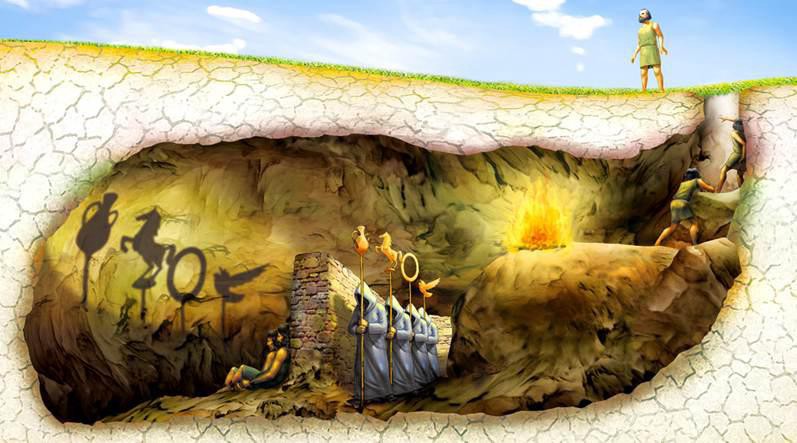
Without these Ideas—these generalization, regularities and ideals—the world would be to us as it must seem to the first-opened eyes of the child, a mass of unclassified and un-meaning particulars of sensation; for meaning can be given to things only by classifying and generalizing them, by finding the laws of their beings, and the purposes and goals of their activity. Or the world without Ideas would be a heap of book-titles fallen haphazard out of the catalogue, as compared to the same titles arranged in order according to their classes, their sequences and their purposes; it would be the shadows in a cave as compared with the sunlit realities without, which cast those fantastic and deceptive shadows within (514). Therefore the essence of a higher education is the search for Ideas: for generalizations, laws of sequence, and ideals of development; behind things we must discover their relation and meaning, their mode and law of operation, the function and ideal they serve or adumbrate; we must classify and coordinate our sense experience in terms of law and purpose; only for lack of this does the mind of the imbecile differ from the mind of Caesar.
Well, after five years of training in this recondite doctrine of Ideas, this art of perceiving significant forms and causal sequences and ideal potentialities amid the welter and hazard of sensation; after five years of training in the application of this principle to the behavior of men and the conduct of states; after this long preparation from childhood through youth and into the maturity of thirty-five; surely now these perfect products are ready to assume the royal purple and the highest functions of public life?—surely they are at last the philosopher-kings who are to rule and to free the human race?
Alas! not yet. Their education is still unfinished. For after all it has been, in the main, a theoretical education: something else is needed. Let these Ph.D.’s pass down now from the heights of philosophy into the “cave” of the world: of men and things; generalizations and abstractions are worthless except they be tested by this concrete world; let our students enter that world with no favor shown them; they shall compete with men of business, with hard-headed grasping individualists, with men of brawn and men of cunning; in this mart of strife they shall learn from the book of life itself; they shall hurt their fingers and scratch their philosophic shins on the crude realities of the world; they shall earn their bread and butter by the sweat of their high brows. And this last and sharpest test shall go on ruthlessly for fifteen long years. Some of our perfect products will break under the pressure, and be submerged by this last great wave of elimination. Those that survive, scarred and fifty, sobered and self-reliant, shorn of scholastic vanity by the merciless friction of life, and armed now with all the wisdom that tradition and experience, culture and conflict, can cooperate to give—these men at last shall automatically become the rulers of the state.
.

Comments
Excellent post. Both Plato’s and Durant’s plans ignore (as they must) the Nature of Man. Christianity teaches that man’s basic nature is evil until transformed by God. This good and evil is not a helpful description, because it is too simplistic. Even if true, it does not move Man forward in a positive way.
I agree that good and evil are not only too simplistic but they also can be very deceptive.
For the sake of the future, I do not agree that the children must be left with their parents, nor that they must be removed from their parents. Durant is correct that every point of contact for a child is conditioning and that parents corrupt the thinking of their children with old ways.
The problem is that these views do not embrace the immense diversity of the human genome and no wonder! Knowledge of the human genome is both new and embryonic. There is a lot there to discover.
Plato’s solution also conditions the child. Christianity was made to order to Plato’s solution. Conditioning is inevitably a part of growing up. The solution is to make the child aware that such a thing as conditioning exists, and that it can be overcome with the use of observation and critical thinking.
Mankind is caught in several social conundrums.
For instance, legally he must behave and require accountability as though there truly is free will. A society cannot exist without this premise.
Likewise, we must raise our children as though they will understand and assume our values, regardless of the probability of them doing as we teach.
Having had much cognitive dissonance with the teachings that I received as a child, both at home and at school, I determined to offer forks in the road for my children to consider. I am routinely frustrated when they “fail” to follow my ideas, but then I must remember that my dreams are not my children’s dreams.
Free will can be applied only as skillfully as one understands the natural laws. Science has demonstrated this already. Man has good understanding of physical laws, but much progress is needed in the discovery and understanding of the metaphysical laws.
Thank you for reminding me and reposting this on my FB wall.
In 2021, I wrote, “The problem is that these views do not embrace the immense diversity of the human genome and no wonder! Knowledge of the human genome is both new and embryonic. There is a lot there to discover.”
Because my own knowledge, experience, and opinions have changed so dramatically over the years in which we’ve known each other, I find it pleasing to read something I’ve written in the past (even if only 4 years past) with which I can still agree! I interpret this means that my opinion stabilized on this item which I interpret as an equilibrium was reached (not an ossification, but an equilibrium). This is how I judge whether understanding is being reached.
Time seems to flow at the speed of light, and because we do not, it rushes past us leaving all manner of effects such as gravity and inertia in its wake.
This past year of 2024 has been another year of study for me on climate, physics, and political philosophies including the US Constitution. I have the feeling that mankind was fashioned from earlier, already existing DNA strands and then seeded around the world using geography to isolate each experimental petri’ dish.
I do not have a sense of whether I believe this human experiment will succeed or fail. Probably that is too black and white. Possibly the current mankind will give way to an evolutionary model which is no longer homo sapiens but some better version. Possibly that better version will have a modified ego which is better emotionally balanced and less R6 reactive.
The genetic survival strength of homo sapiens seems to also contain its weakness. The diversity which allows for any of innumerable changes to appear, also is the weakness that does not allow for the exclusion our more unsavory traits.
How was your past year?
My past year was very good. I feel somewhat healthier, which matters a lot at the age of 78.
My ideas have been changing too, and for the better, I hope. Currently, I am developing a Theory of Substance and testing it on a NUCLEAR PHYSICS site on Facebook. I am getting lots of responses because they have a worldwide membership of over 273,000 members.
I am also developing the subject of Postulate Mechanics. So, I am quite active mentally. For physical activity, I walk daily in a park behind my house. I also take several short walks, additionally, around the neighborhood, because, otherwise, I am sitting in front of my computer.
Life is good. There is a lot to be done. 🙂
You wrote, “Man has good understanding of physical laws, but much progress is needed in the discovery and understanding of the metaphysical laws.”
I agree with the second half of that statement; however, I have been concluding that learning the physical laws is a first gradient which we have not yet accomplished. Perhaps we can successfully study “metaphysical laws” at the same time as physical laws, perhaps not. The older definition of metaphysical included those things which were outside human senses, and modern physics already depends on this for studying celestial bodies, seeking foreign bodies within our bodies, and studying and experimenting on small substances and invisible fields. It is my opinion that we currently live in and enjoy technology which is already only possible because of metaphysics. I also believe that future iterations of mankind may evolve to live in a thicker slice of reality than we currently do.
I recently wrote the following on the Scientific Method. I believe that the scientific method can be applied to both physics and metaphysics.
The curiosity to know has progressed from religious speculations about life to extroverted philosophical inquiry of the universe. This inquiry then gave birth to the systematic approach of science.
The modern scientific approach is based on observing more closely to formulate a hypothesis, and then using that hypothesis to arrive at some new conclusions. The next step is to verify those conclusions through further observations.
Consistency is extremely important in such verifications. If the new conclusions cannot be shown to be consistent with life experiences, then one has to go back and work more on improving the hypothesis. If the conclusions are consistent with life experiences, then the hypothesis is accepted as a new theory. However, such acceptance is provisional because the verification can never be absolute. For the future may present observations that are not entirely consistent with the theory.
In today’s science, mathematics has become an important part of formulating and verifying a hypothesis. The scientist makes a mathematical model of the hypothesis. He, then, checks that model for mathematical consistency. This has become an important step in the scientific development. But, the mathematical consistency is not the same as consistency with life experiences.
In the past, consistency of a hypothesis was tested in the live environment of the laboratory. The scientist devised experiments that could be conducted using lab equipment. This was closer to life than mathematics and provided live verification. However, science has advanced to a point that such lab experimentation is not always possible, especially in the case of sub-atomic and cosmic phenomena. Einstein’s theory of relativity could not be verified until the Solar eclipse of 1920. Still many doubts exist regarding this theory. In fact, the theory of relativity was not even considered when the Nobel Prize was awarded to Einstein.
But Einstein also advanced a novel idea of conducting thought experiments to verify a hypothesis beyond the mathematical logic. Such thought experiments were closer to the live logic of life. They only need to be devised carefully.
Once again the criterion of thought experiments had to be consistency; only that consistency was in terms of ideas. In addition, it was expected that the logical train of ideas would have no gaps. Also, there would be no arbitrary ideas that do not fit the overall picture. In short, the criterion of a thought experiment would be continuity, consistency and overall harmony of ideas.
But, if we look carefully, the criterion of continuity, consistency and harmony applies to all experimentation, whether it is mathematical or lab oriented, and it even defines the Scientific Method itself.
PS: My 87 year old father in law is currently studying the Durant’s THE STORY OF PHILOSOPHY. 🙂
Here is THE STORY OF PHILOSOPHY with my comments. I am going over this book again, converting the previous comments into a summary and an overall comment.
The Book of Philosophy