
Reference: The Book of Scientology
The Emotional Scale and Sub-Zero Tone-Scale
Please see the original section at the link above.
.
Summary
The Tone scale was first discovered by Hubbard by observing the changes in emotional levels of an individual as he improved during auditing.
Hubbard say’s, “Below zero on the tone-scale is applicable only to a thetan.” This is because Hubbard assigns tone level zero to body death. He assumes that the individual “exteriorizes” from the body upon death and survives as a thetan. But thetan is the sense of beingness. It is not something physical that separates from the body.
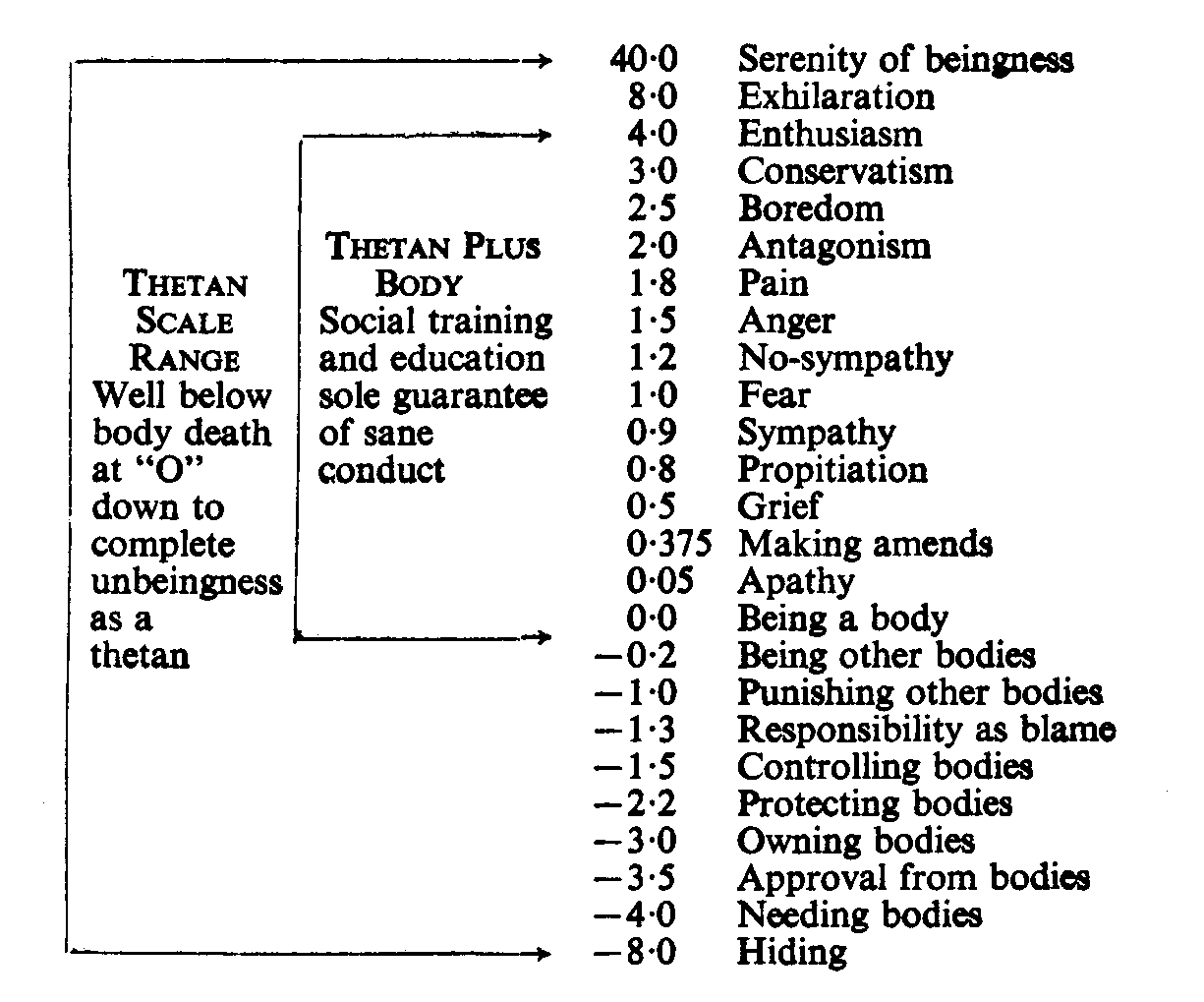
The tone level of zero is not body death, but being a body. The person’s attention is totally fixated on the body, but he is not aware of it. The experience of “exteriorization” actually makes a person aware that he is not the body. But this is not what is happening at Tone zero. At zero and below the person is totally convinced that he is a body.
Hubbard says, “It has been quite commonly observed that there are two positions for any individual on the tone scale.” This may be because when a person is being a body, the emotions he experiences are plotted as negative tone levels. But when he is somewhat aware of his fixation, the same emotions are plotted as positive tone levels. This may give the false impression of an individual having two positions on the tone scale.
Hubbard says, “This sub-zero tone-scale shows that the thetan is several hands below knowingness as a body, and so he will be found in the majority of cases.” This would be the case when social machinery has taken over. Therefore, the sub-zero tone-scale also applies to a thetan with a body; the only difference is that he is not even aware that he is being a body. The reactive mind is the complete fixation of attention on the body to the point that the person has no awareness beyond the body.
The levels of sub-zero tone scale simply illustrate the attitudes of the person when he is being a body. For example, “being other bodies” is the level when a person is in another’s valence and living the life continuum of another person. Such a person treats others as bodies only. His “attitudes” toward bodies may be processed through auditing until he becomes aware of having such attitudes.
Hubbard says, “The sub-zero to 40.0 scale is the range of the thetan.” Actually, this whole tone scale applies to the person being audited, and he very much has a body. This idea of thetan without a body is completely theoretical. One is still auditing a mind that is housed in a body. The fixation is not only on the body but it covers all misconceptions and identifications that ultimately lead to the idea of body. The first realization a person gets through auditing is that he is being a body, and that there is awareness beyond the body. This is only a beginning of the person becoming aware of his fixations. As he resolves those fixations, he rises up the tone scale.
.
Comments
A person descends the Tone scale because of identifications in his thinking. Such identifications start as misconceptions at the top of tone scale. These misconceptions condense down the tone scale as increasing identifications. At the bottom of the tone scale, these identifications condense into reactive attachments to the body, which bring about valences, life continua, etc. These identifications produce anomalies in one’s perception of reality; such as, confusions, illusions, and hallucinations. These things may be summed up as “suppositional reality.” The anomalies are manifested in the person’s behavior as aberrations; but the person is largely unaware of them.
Nobody ever audits a mind that is not housed in a body. Hubbard implies that one can audit a thetan without a body, but that simply means that one is auditing fixations above and beyond the fixation on the body.
.
