Monthly Archives: June 2015

The Logic of Spirituality

Walking on water at sunset

Reference:  The Logic of God

This is a universe of continuous change. This change seems to be part of a harmonic disturbance that is going back and forth like the swinging of a pendulum. The pendulum keeps on oscillating under the constant influence of gravity. Similarly, the universe seems to be changing continuously under some fundamental influence. Ancient Vedas have referred to that influence as Brahma.

The concept of Brahma is supposedly arrived at by contemplating on ‘neti, neti’—not this, not that. In other words, one cannot know anything about Brahma through projections of knowledge gained in this universe. However, one may arrive at an intuitive understanding of Brahma as one sets out to resolve all inconsistencies in one’s understanding of this universe.

According to the ancient Vedas, the continuous change of this universe seems to run in cycles much like a circle with no beginning or end. This describes a harmonic motion.

This universe is a harmonic disturbance on a cosmic scale with no beginning or end. The underlying driver is some unknown constant influence.

A harmonic motion has extremes of static and kinetic states. Between these states there is a whole range of motion. Therefore, this cosmic disturbance must go through from no disturbance to extremely complex disturbance. All the levels of disturbance may lie between these extremes.

We may plot the cosmic disturbance on a scale from static to kinetic in increasing levels of complexity.

Each level of cosmic disturbance contributes to the form of the universe. The attributes of these forms range from concrete to abstract. The five physical senses perceive the concrete attribute of the form. The mental sense perceives the underlying abstract patterns that can go quite deep.

The disturbance levels manifest into forms with attributes ranging from concrete to abstract.

We associate “physical” with the concrete attributes of the universe, and “spiritual” often with the attributes that go deep into abstraction. Thus, we associate spirituality with the attributes of the universe that are abstract.

Spirituality is a consideration applied to the abstract aspects of the universe.

At the static end of the disturbance scale there is little disturbance. The physical attribute of the universe at this level appears as space, and the corresponding spiritual attribute appears as primitive and broad awareness.  Probably there is not much of an abstraction scale between space and broad awareness. Space is a very light disturbance corresponding to which the awareness is very primitive.

Primitive broad awareness corresponds to space.

As the disturbance levels increase, the change becomes more strident, and so does its reaction. Action and reaction appear as a frequency that increases with disturbance levels. There is a whole spectrum of it. The physical form of this spectrum appears as electromagnetic radiation. The spiritual form appears as perceptive awareness.

Perceptive awareness corresponds to electromagnetic spectrum.

At the upper end of frequency spectrum the disturbance starts to converge and condense. On the physical side, the condensation appears as atoms of a variety described by the periodic table. On the spiritual side, the condensation appears as concepts of a variety described by the words of a language.

Concepts and ideas correspond to atomic configurations.

Beyond the level of condensation of disturbance, we have elemental forms, combining into more complex forms. A whole “spectrum” of increasing complexity of forms now ensues. On the physical side we have evolving inanimate and animate solid forms. On the spiritual side, we have evolving automatic and self-determined systems.

Complex awareness corresponds to the complex structure of the body.

There is no soul separable from the body. The body and soul are simply the physical and spiritual attributes of a very complex disturbance.

.

The Logic of God

Golden pendulum swinging

Golden pendulum swinging

Reference: The Logic of Non-Duality

According to the reference above, duality appears when we focus only on the extreme states of a varying characteristic. So, when we look at the idea of a spiritual entity called God having created a physical universe, we may ask, “Is that just looking at the extremes and not considering the gradients in between?”

Are God and Physical Universe the extreme states of some continuously varying characteristic?

We look at God as infinite cause, the effect of that is the physical universe. God and physical universe are essentially Cause and Effect. The continuously varying gradient from cause to effect shall consist of cause-effect elements, each contributing to the overall change in a consistent manner. We may compare this to the domino effect, but the time between successive “falling of dominoes” shall be infinitely small indeed. We can say that from cause to effect there is a continuously varying change.

The fundamental unit of cause and effect is CHANGE.

When we look at the two extreme ends of a scale of change as Cause and Effect with an infinite gap between them, we see them as infinite. So we call them an invisible God and a visible universe.

This change is occurring in a myriad of ways. It is visible in the changing of the seasons, in the blowing of wind, in temperature fluctuating, and birds chirping. It is visible throughout this wonderful universe. Everything in this universe seems to be participating in a cosmic dance of change.

The scale that lies between the Creator God and the created Universe is the scale of change, and that change is still going on in the infinite number of dimensions that make up this universe.

We see a continuously changing universe, but we do not see the source of that change. We do not know how the universe was in the beginning, or how it is going to end up. We don’t even know if the universe has a beginning or an end.

The universe appears to be a disturbance arising from some undisturbed state. It is now trying to return to that undisturbed state. But in that attempt at restoration, it tends to overshoot the undisturbed state and then tries to restore itself again. It seems to be a cosmic oscillation much like a swinging pendulum.  The harmonic motion of a pendulum occurs under the constant pull of gravity. This means that there is a constant all-pervading influence, which is driving the change in the universe.

We may refer to that fundamental attribute, which lies in the background of this universe, as God; but it is not so concrete that it is comparable to the image of man.

The concept of BRAHMA in Hinduism is this infinitely abstract cosmic influence that underlies the continuous change.

There is a kind of inevitability associated with the cosmic oscillations. This shows up in the laws of this universe, such as, “conservation of mass and energy”. But it is more like “conservation of cosmic oscillations”. The idea of INERTIA points to this inevitable oscillatory movement. And from this inevitability also comes the idea of KARMA.

Karma is essentially a very complex cycle of action that is moving forward towards its completion in slow motion. There is a sense of inevitability associated with it. Any hindrance to that cycle results in all kind of repercussions. But these repercussions once again force that complex cycle toward its completion.

So karma and inertia are closely related to each other. Karma is simply a more complex view of inertia.

The logic of God consists of complex ideas, such as, Change, Brahma, Karma and Inertia.

This essay describes these ideas in detail.

.

The Logic of Duality

images

Reference: The Logic of Truth

In this essay we are going to look at the logical structure of the universe. A logical universe shall be a universe that is consistent throughout. It shall have a ring of truth to it simply because it is consistent.

In the process of looking at the universe logically we are bound to run into inconsistencies. We shall look at each inconsistency more closely and see where they would lead us to if we resolve them.

The very first inconsistency that comes up about the nature of the universe is. “Is this universe basically an expression of duality or non-duality?”

Everywhere we see opposing concepts—such as, ‘night and day’, ‘good and evil’, ‘man and woman’, etc. Actually, the question above itself is an expression of duality. Any concept seems to brings about an opposite concept. Can we then conclude that this universe is an expression of duality?

“Not so fast,” says the non-dualist, “Non-duality points to the idea that the universe and all its multiplicity are ultimately expressions or appearances of one essential reality.” It is asserted that there is a reality that transcends the opposites.

How can we grasp that reality conjured up by the non-dualist?

A logically consistent universe shall be made up of states that proceed from one state to the next in a consistent manner leaving no gaps.

On a number line, the value of a number changes from one point to the next in a consistent manner without any gaps.  The number line extends in a consistent manner from negative infinity to positive infinity.

Is the concept of number the “one essential reality,” which expresses itself in the duality of negative and positive infinities?

Let us consider the duality of ‘night and day’ of the real universe. We find that night is changing into day, and day is changing into night with the steady rotation of earth. We notice the continuously varying characteristic of illumination, which expresses itself in the extremes of night and day.

Is illumination that “one essential reality,” which expresses itself in the duality of night and day?

We shall see a duality when we focus on the extremes and do not take into account the continuously varying nature of some attribute of the universe. The bigger is the gap between two points on the scale of that attribute, the more is the likelihood that those points shall appear as opposites.

So, duality appears when we focus only on the extreme states of a varying characteristic. Duality disappears when we recognize the characteristic that is varying continuously.

Thus we settle the argument about the essential nature of the universe by taking a mindful approach to looking at the “opposites” more closely.

.

The Logic of Truth

Logic of Universe

Truth, as perceived, is never absolute. Truth is perceived from one logical state to the next logical state in a relative manner only. The smooth transition of truth from one step to the next is the harmony that qualifies the truth.

The harmony of truth reflects in the consistency of observations from one moment to the next. When the consistency is missing in observation then there is probably some truth hidden somewhere.

One may have no idea of what the absolute truth is; but one can definitely spot inconsistency when it is present. There is a built-in sense within us that flags inconsistencies.

When we are searching for truth it does not really matter whether that truth is absolute or relative. We just want to discover the missing step, which is causing the inconsistency in one’s observation. When we find that missing piece of truth, the consistency in observation is restored.

Looking for absolute truth may be an impossible task. But looking for consistency in observation is feasible.

Maybe if we start seeking consistency in everything, we may ultimately reach the absolute truth. That is a hope and not certainty.

There may be many levels of consistency in what we observe. Once we have achieved a certain level of consistency, we may know intuitively that there must also be consistency at a deeper level of abstraction. We may now become aware of new inconsistencies at deeper levels. And so we look for deeper truth to attain deeper harmony within ourselves.

Thus, truth is not just one-dimensional affair. Truth is probably two-dimensional, or even multi-dimensional. This may point to the universe having a multi-dimensional logical structure as we see in the subjects of mathematics and philosophy.

The whole logical structure of the universe may be looked upon as one single truth. That truth may be absolute, or maybe not, but it can definitely provide a context in which the relativity and interconnection of all other truth could be seen.

Knowing this overall logical structure of the universe may lead us to the absolute truth.

The absolute truth may be a moving target, but the strategy outlined here, at least, gives us a workable approach toward it.

Also See: The Quest for Certainty

.

Disturbance, Inertia, Matter and Gravity


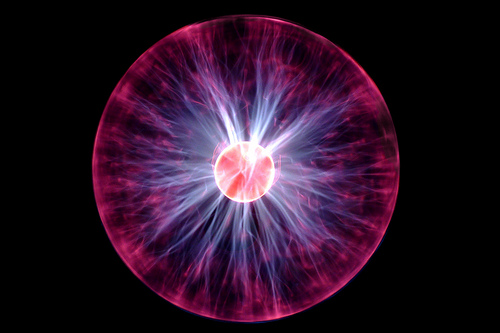
Electron

 [NOTE: I am celebrating my 5th anniversary of blogging at WordPress.com with this article.]

To have the awareness of velocity there should be at least two objects. In a one dimensional space the two objects will either be approaching each other or moving away from each other. If the objects have mass then there will also be gravitational attraction between them, and therefore, there will be acceleration. There will be velocity but it will not be constant.

Let’s consider a 3D-space, which is made up of at least four non-planar objects with mass. The objects are moving in this space. There has to be gravitational attraction among them. They all will be accelerating one way or another, if not linearly then in terms of changing direction. There shall always be acceleration no matter how imperceptible it is. It seems that constant velocity will be a rare phenomenon in this universe.

We observe that as long as objects have mass they can never be free of acceleration. That means there is always some force acting on an object in this universe. If it is not direct push or pull it will be some sort of reaction due to gravitational force, friction, etc.

Mass is a form of inertia that generates gravitational force. And the force generates acceleration. There is no constant velocity.

Inertia, force and acceleration seem to be different stages of the same thing.

Constant velocity may exist only for inertia-less particle. A photon is massless and it may come closest to being inertia-less depending on its frequency.

“Inertia-less-ness” acquires inertia by acquiring frequency. This gives us a photon. As the photon increases in frequency, its inertia increases also. This is evidenced by light bending near heavy cosmic objects.

The frequency is basically a disturbance. When frequency of the photon reaches the region of gamma rays, the photon becomes unstable under the influence of its own inertia. The high frequency photon, instead of propagating linearly, seems to converge on itself when shocked in some way.

An electron has a “mass” that corresponds to the frequency of gamma rays per Einstein equations: E = mc^2 = hf. An electron may be described as the stable state resulting from the shocked convergence of gamma photons. The surface of the electron shall consist of something similar to a shock wave. The frequency within an electron is likely to increase along its radius. The maximum frequency shall appear at the center of the electron.

Mass may be a phenomenon resulting from shocked convergence of high frequency photons.

The next stable particle that we get after an electron is a hydrogen atom. Here a lot more has converged because of some cosmic reaction. The outer shell is still like an electron, but in addition, there is an inner solid core. The high frequency center seems to have undergone another shocked convergence. The surface of the nucleus shall also consist of something similar to a shock wave.

A hydrogen atom is very likely to be a single particle that breaks into an electron and a proton during atomic reactions. There is a succession of stable particles beyond the hydrogen atom that gives us the periodic table. They happen to have near integral multiples of the atomic mass of the hydrogen atom. They also break into electrons, protons, and other particles during atomic reactions.

We assume that these integer values of atomic mass mean that a number of electrons, protons and other particles exist within an atom, but that may not necessarily be the case. Each atom could just be a single particle, and the integral values may appear due to resonances observed due to wave mechanics.

Once we have “mass” in the nucleus, we have particles of large inertia. And so we have matter, material objects, gravity, force and acceleration, which we are most familiar with.

Inertia (frequency and mass), force (gravity) and acceleration are simply the different stages of cosmic disturbance.

This is a simple model of how the universe logically may be at its core.

.