Monthly Archives: February 2013

Scientology’s Fixation on Self

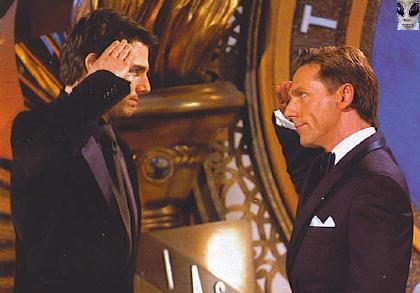
cruise-salute

The key concept in Scientology is that of a “bank” or “reactive mind.” Let’s take a closer look at it. I shall be using definitions from the Technical Dictionary of Scientology.

BANK: (definition #2) A colloquial name for the reactive mind. This is what the procedures of Scn are devoted to disposing of, for it is only a burden to an individual and he is much better off without it.

REACTIVE MIND: (definition #1) a portion of a person’s mind which works on a totally stimulus-response basis, which is not under his volitional control, and which exerts force and the power of command over his awareness, purposes, thoughts, body and actions. Stored in the reactive mind are engrams, and here we find the single source of aberrations and psychosomatic ills.

So, the problem boils down to rigid association among thoughts that channels action only in certain pre-selected manner. There is no flexibility or little room to maneuver. This inflexibility is the Reactive Mind. The solution is to remove this inflexibility.

.

Hubbard ascertained this “inflexibility” to exist at the perceptual level. This became Dianetics. Hubbard reasoned that too much perception coming in at a rapid rate, as in an accident or in a forceful event, would jam up the reasoning faculty of the mind. One would then end up with a jumble of perception waiting to be processed.

Hubbard called this jumble of perception an “engram.” This proved out to be correct. However, after clearing of a few engrams on a case, no more engrams could be found, but case problems still existed. Dianetics hit a brick wall. Per Hubbard’s theory there were supposed to be more engrams, and so it was assumed that the problem was with inaccessibility of these engrams. There was something wrong with the theory, “Stored in the reactive mind are engrams, and here we find the single source of aberrations and psychosomatic ills.” Actually, there were no more engrams. So it was not the engram that was the single source of aberration.

It was the principle of inflexibility that was the source of aberrations and psychosomatic ills.

An engram was only one type of inflexibility. There were other types of inflexibility.

Data gets processed in the mind in the form of following layers (see Perception & Knowledge).

  1. Perception
  2. Experience
  3. Information
  4. Hypothesis
  5. Theory
  6. Principles
  7. Axioms
  8. Self

Inflexibility may generate inconsistencies on each of these layers as follows (see Knowledge & Inconsistency).

  1. Inconsistency in Perception: Engram 
  2. Inconsistency in Experience: Unwanted feeling or emotion 
  3. Inconsistency in Information: Indoctrination
  4. Inconsistency in Hypothesis: Belief
  5. Inconsistency in Theory: Doctrine
  6. Inconsistency in Principles: Fixed ideas
  7. Inconsistency in Axioms: Fixed viewpoints
  8. Inconsistency in Self: Fixed identity 

Thus, engram was one of many type of inconsistencies generated by the general principle of inflexibility. But Hubbard assumed engram to underlie all other type of inconsistencies.  Hubbard brought e-meter to his aid and created hundreds of processes to overcome that assumed lack of accessibility to engrams.

Hubbard made self, or individuality, the foundation of his theory of Scientology. (see Scientology Axiom # 1). His goal became the strengthening of self by searching for and eliminating engrams.

This goal of Hubbard also gave birth to the OT levels. This was same as the age-old search for siddhis that Buddha examined and discarded.

The analysis of inconsistencies above shows that engrams are only at the surface of inconsistencies, which go a lot deeper.  At the deepest level we find the inconsistency of a fixation on self, just as Buddha had preached 2600 years ago. Thus the theory of Scientology seems to look at inconsistencies in the reverse order.

The single source of aberrations and psychosomatic ills is not the engram but a fixation on self. Scientology promotes this fixation on self through its OT Levels.

Until one realizes that looking at self as “something fixed” is the basic inconsistency there is no spiritual freedom.
.

The above is the culmination of the search, for me, of what is wrong with Scientology. Now I can focus on those aspects of Scientology that are beneficial.

The beneficial aspects of Scientology shall be preserved in KHTK.

.
Knowledge & Inconsistency

contradiction2

As detailed in Perception & Knowledge, the most accurate knowledge is made up of the perceptions obtained within a span of few hundred milliseconds. Rest of the knowledge is extrapolated from data indexed among:

  1. Perception
  2. Experience
  3. Information
  4. Hypothesis
  5. Theory
  6. Principles
  7. Axioms
  8. Self

.

INCONSISTENCY

However such data is subject to inconsistencies. An inconsistency is something that doesn’t seem to make sense. There is some sort of disharmony, even when one can’t put one’s finger on it.

A physicist looks at the outer space. There is no physical medium there, yet the speed of light is constant. He is puzzled by this and makes it the subject of his research, because it is an inconsistency to him.

A person says that he has a happy married life, yet his wife is often seen crying. This is an inconsistency.

You postpone your trip to Spain because that country is torn by riots. Yet there are no riots in Spain. This is inconsistency.

One resolves repeatedly to stop smoking, yet he continues to smoke. This is an inconsistency.

A man finds life to be without purpose, yet he never had thoughts like this when he was young. This is also an inconsistency.


Such inconsistencies may be categorized as follows:

  1. Engram (Inconsistency in Perception)
  2. Unwanted feeling or emotion (Inconsistency in Experience)
  3. Indoctrination (Inconsistency in Information)
  4. Belief (Inconsistency in Hypothesis)
  5. Doctrine (Inconsistency in Theory)
  6. Fixed ideas (Inconsistency in Principles)
  7. Fixed viewpoints (Inconsistency in Axioms)
  8. Fixed identity (Inconsistency in Self)

Inconsistencies add inaccuracies to extrapolated knowledge. All the situations in life are the result of such inconsistencies.

.

THE ROUTE TO KNOWLEDGE

It is difficult to perceive inconsistencies when justifications are present. For example, we say that God created this universe, but God could not have created evil in this universe because God is good.

Fixation on self (shame, blame, egotism, etc.) provides a wonderful array of justifications. A person may say, “I am a failure because I do not have the abilities that make one succeed.”

But “self” is an altered view of a “tightly interrelated system of considerations” that exist in relative isolation. Instead of focusing on self (overall personal characteristics), if one focuses on the related system of consideration, and non-judgmentally spots  inconsistencies therein, then the situations in life resolve swiftly.

Mindfulness helps one perceive inconsistencies and reduce them. It also brings about rapid spiritual progress.

  1. Practice mindfulness until it becomes effortless as a second nature.

  2. Recognize inconsistencies as they arise. Do not ignore them.

  3. Immediately look at the inconsistency more closely.

  4. Draw upon data as needed. It is quite easy to research in the Information Age of today.

  5. Simply track down the inconsistency and keep looking at it more closely until it dissolves.

  6. When the inconsistency is dissolved, then that’s it… let it go.

  7. Focus on the next inconsistency as it arises.

Situations resolve much more swiftly in a group where everybody is applying mindfulness in discussions.

.

Perception & Knowledge

Reference: Philosophy Project

A Matter of Perception1

We look and perceive. Therefore, there is perception. Perception is generated by a desire to know.

For perception to occur there must be a separation between the perception point and whatever is being perceived. Thus, perception occurs across space.

Perception brings about instantaneous knowledge. However, perception retains its exact form for not more than few hundred milliseconds before it transforms into experience.

Experience allows indexing of current information with earlier information, and thus reducing the requirement for storage space. Thus, from perception to experience there is some condensation of knowledge. The directness of perception is replaced by indexing of data, which allows reconstruction of details on as-needed basis. This allows more knowledge to be stored in the same space.

Over time, experience transforms into information. Information then leads to hypotheses. Hypothesis generates theory. From theory are derived principles. And principles are consolidated into axioms. Each of these transformations allows increasing condensation of knowledge. Thus, more knowledge is stored in the same space. The storage algorithms allow for a reconstruction of knowledge from the cross-indexing of data to the desired degree of accuracy on an as-needed basis. The coordination-point of all this knowledge may then appear as the “self”.

The results of this successive condensation of knowledge may be listed as follows.

  1. Perception
  2. Experience
  3. Information
  4. Hypothesis
  5. Theory
  6. Principles
  7. Axioms
  8. Self

Points 1 to 7 above may describe a unique system of tightly interrelated considerations. Self in point 8 may be defined by this system of consideration much like a “doughnut’s hole” is defined by the doughnut.

The self may appear as a “causative individuality” but it is no more capable than what the system of consideration is capable of. The individuality would disappear with the disappearance of the system of consideration.

This system of consideration determines how the “universe” appears to the “self”.

.

VISUALIZATION & RECALL

This indexed knowledge may be played upon in infinite number of ways. This gives us visualization. Such visualization may be demonstrated by the following experiment:

Close your eyes. Think of a cat, or your favorite small pet animal. Have that pet come to you and jump in your lap. Pick it up and caress it. Feel its weight and the texture of its fur. Now let that pet jump and run away from you. Open your eyes and look in the direction in which your pet ran away.

A recall of some past memory would be a similar play, except that it is allowed to take place by itself without interference. Thus, a recall of past memory uses the same mechanism as visualization. The only difference is that visualization is actively manipulated, whereas recall is allowed to take place by itself.

Accuracy of recall would then depend on the lack of interference in the reconstruction of the memory. Thus, a proper recall shall require mindfulness.

.