Tag Archives: 800000

Eddington 1927: The Principle of Indeterminacy

Indeterminacy

Reference: The Nature of the Physical World

This paper presents Chapter XIV (section 5) from the book THE NATURE OF THE PHYSICAL WORLD by A. S. EDDINGTON. The contents of this book are based on the lectures that Eddington delivered at the University of Edinburgh in January to March 1927.

The paragraphs of original material are accompanied by brief comments in color, based on the present understanding.  Feedback on these comments is appreciated.

The heading below links to the original materials.

.

The Principle of Indeterminacy

Thus far we have shown that modern physics is drifting away from the postulate that the future is predetermined, ignoring it rather than deliberately rejecting it. With the discovery of the Principle of Indeterminacy (p. 220) its attitude has become more definitely hostile.

Let us take the simplest case in which we think we can predict the future. Suppose that we have a particle with known position and velocity at the present instant. Assuming that nothing interferes with it we can predict the position at a subsequent instant. (Strictly the non- interference would be a subject for another prediction, but to simplify matters we shall concede it.) It is just this simple prediction which the principle of indeterminacy expressly forbids. It states that we cannot know accurately both the velocity and position of a particle at the present instant.

The principle of indeterminacy does not take quantization into account.

At first sight there seems to be an inconsistency. There is no limit to the accuracy with which we may know the position, provided that we do not want to know the velocity also. Very well; let us make a highly accurate determination of position now, and after waiting a moment make another highly accurate determination of position. Comparing the two accurate positions we compute the accurate velocity—and snap our fingers at the principle of indeterminacy. This velocity, however, is of no use for prediction, because in making the second accurate determination of position we have rough-handled the particle so much that it no longer has the velocity we calculated. It is a purely retrospective velocity. The velocity does not exist in the present tense but in the future perfect; it never exists, it never will exist, but a time may come when it will have existed. There is no room for it in Fig. 4 which contains an Absolute Future and an Absolute Past but not an Absolute Future Perfect.

The velocity which we attribute to a particle now can be regarded as an anticipation of its future positions. To say that it is unknowable (except with a certain degree of inaccuracy) is to say that the future cannot be anticipated. Immediately the future is accomplished, so that it is no longer an anticipation, the velocity becomes knowable.

The classical view that a particle necessarily has a definite (but not necessarily knowable) velocity now, amounts to disguising a piece of the unknown future as an unknowable element of the present. Classical physics foists a deterministic scheme on us by a trick; it smuggles the unknown future into the present, trusting that we shall not press an inquiry as to whether it has become any more knowable that way.

The same principle extends to every kind of phenomenon that we attempt to predict, so long as the need for accuracy is not buried under a mass of averages. To every co-ordinate there corresponds a momentum, and by the principle of indeterminacy the more accurately the co-ordinate is known the less accurately the momentum is known. Nature thus provides that knowledge of one-half of the world will ensure ignorance of the other half—ignorance which, we have seen, may be remedied later when the same part of the world is contemplated retrospectively. We can scarcely rest content with a picture of the world which includes so much that cannot be known. We have been trying to get rid of unknowable things, i.e. all conceptions which have no causal connection with our experience. We have eliminated velocity through aether, “right” frames of space, etc., for this reason. This vast new unknowable element must likewise be swept out of the Present. Its proper place is in the Future because then it will no longer be unknowable. It has been put in prematurely as an anticipation of that which cannot be anticipated.

In assessing whether the symbols which the physicist has scattered through the external world are adequate to predetermine the future, we must be on our guard against retrospective symbols. It is easy to prophesy after the event.

.

Eddington 1927: The New Epistemological Outlook

meet12

Reference: The Nature of the Physical World

This paper presents Chapter XIV (section 4) from the book THE NATURE OF THE PHYSICAL WORLD by A. S. EDDINGTON. The contents of this book are based on the lectures that Eddington delivered at the University of Edinburgh in January to March 1927.

The paragraphs of original material are accompanied by brief comments in color, based on the present understanding.  Feedback on these comments is appreciated.

The heading below links to the original materials.

.

The New Epistemological Outlook

Scientific investigation does not lead to knowledge of the intrinsic nature of things. “Whenever we state the properties of a body in terms of physical quantities we are imparting knowledge of the response of various metrical indicators to its presence and nothing more” (p. 257). But if a body is not acting according to strict causality, if there is an element of uncertainty as to the response of the indicators, we seem to have cut away the ground for this kind of knowledge. It is not predetermined what will be the reading of the weighing-machine if the body is placed on it, therefore the body has no definite mass; nor where it will be found an instant hence, therefore it has no definite velocity; nor where the rays now being reflected from it will converge in the microscope, therefore it has no definite position; and so on. It is no use answering that the body really has a definite mass, velocity, position, etc., which we are unaware of; that statement, if it means anything, refers to an intrinsic nature of things outside the scope of scientific knowledge. We cannot infer these properties with precision from anything that we can be aware of, because the breach of causality has broken the chain of inference. Thus our knowledge of the response of indicators to the presence of the body is non-existent; therefore we cannot assert knowledge of it at all. So what is the use of talking about it? The body which was to be the abstraction of all these (as yet unsettled) pointer readings has become superfluous in the physical world. That is the dilemma into which the old epistemology leads us as soon as we begin to doubt strict causality.

Substance is what we become aware of underlying all the properties. The substance is intuitively grasped by its substantialness, which is governed by the law of quantization. This law of quantization is yet to be determined by science. There is no reason why this law cannot be determined with certainty.

In phenomena on a gross scale this difficulty can be got round. A body may have no definite position but yet have within close limits an extremely probable position. When the probabilities are large the substitution of probability for certainty makes little difference; it adds only a negligible haziness to the world. But though the practical change is unimportant there are fundamental theoretical consequences. All probabilities rest on a basis of a priori probability, and we cannot say whether probabilities are large or small without having assumed such a basis. In agreeing to accept those of our calculated probabilities which are very high as virtually equivalent to certainties on the old scheme, we are as it were making our adopted basis of a priori probability a constituent of the world-structure—adding to the world a kind of symbolic texture that cannot be expressed on the old scheme.

Classical physics has no concept of field-substance or quantization. Quantum physics uses probability to account for the effects of quantization.

On the atomic scale of phenomena the probabilities are in general well-balanced, and there are no “naps” for the scientific punter to put his shirt on. If a body is still defined as a bundle of pointer readings (or highly probable pointer readings) there are no “bodies” on the atomic scale. All that we can extract is a bundle of probabilities. That is in fact just how Schrodinger tries to picture the atom—as a wave centre of his probability entity ψ.

The atom is made of layers of quantization of field-substance.

We commonly have had to deal with probabilities which arise through ignorance. With fuller knowledge we should sweep away the references to probability and substitute the exact facts. But it appears to be a fundamental point in Schrodinger’s theory that his probabilities are not to be replaced in that way. When his ψ is sufficiently concentrated it indicates the point where the electron is; when it is diffused it gives only a vague indication of the position. But this vague indication is not something which ideally ought to be replaced by exact knowledge; it is ψ itself which acts as the source of the light emitted from the atom, the period of the light being that of the beats of ψ. I think this means that the spread of ψ is not a symbol for uncertainty arising through lack of information; it is a symbol for causal failure—an indeterminacy of behaviour which is part of the character of the atom.

Schrodinger’s wave-function ψ may indicate the degree of quantization.

We have two chief ways of learning about the interior of the atom. We can observe electrons entering or leaving, and we can observe light entering or leaving. Bohr has assumed a structure connected by strictly causal law with the first phenomenon, Heisenberg and his followers with the second. If the two structures were identifiable then the atom would involve a complete causal connection of the two types of phenomena. But apparently no such causal linkage exists. Therefore we have to be content with a correlation in which the entities of the one model represent probabilities in the second model. There are perhaps details in the two theories which do not quite square with this; but it seems to express the ideal to be aimed at in describing the laws of an incompletely causal world, viz. that the causal source of one phenomenon shall represent the probability of causal source of another phenomenon. Schrodinger’s theory has given at least a strong hint that the actual world is controlled on this plan.

The electron and light may get transformed into quantized field-substance after entering the atom. Bohr’s atom maintains the electron inside the atom, which is very unlikely. How the light quanta configures itself inside the atom is not quite known.

.

Eddington 1927: Predictability of Events

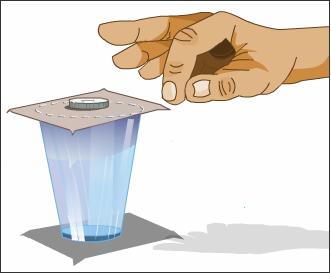
inertia-coin-tumbler-experiment

Reference: The Nature of the Physical World

This paper presents Chapter XIV (section 3) from the book THE NATURE OF THE PHYSICAL WORLD by A. S. EDDINGTON. The contents of this book are based on the lectures that Eddington delivered at the University of Edinburgh in January to March 1927.

The paragraphs of original material are accompanied by brief comments in color, based on the present understanding.  Feedback on these comments is appreciated.

The heading below links to the original materials.

.

Predictability of Events

Let us examine a typical case of successful scientific prediction. A total eclipse of the sun visible in Cornwall is prophesied for 11 August 1999. It is generally supposed that this eclipse is already predetermined by the present configuration of the sun, earth and moon. I do not wish to arouse unnecessary misgiving as to whether the eclipse will come off. I expect it will; but let us examine the grounds of expectation. It is predicted as a consequence of the law of gravitation—a law which we found in chapter VII to be a mere truism. That does not diminish the value of the prediction; but it does suggest that we may not be able to pose as such marvellous prophets when we come up against laws which are not mere truisms. I might venture to predict that 2 + 2 will be equal to 4 even in 1999; but if this should prove correct it will not help to convince anyone that the universe (or, if you like, the human mind) is governed by laws of deterministic type. I suppose that in the most erratically governed world something can be predicted if truisms are not excluded.

But we have to look deeper than this. The law of gravitation is only a truism when regarded from a macroscopic point of view. It presupposes space, and measurement with gross material or optical arrangements. It cannot be refined to an accuracy beyond the limits of these gross appliances; so that it is a truism with a probable error—small, but not infinitely small. The classical laws hold good in the limit when exceedingly large quantum numbers are involved. The system comprising the sun, earth and moon has exceedingly high state-number (p. 198); and the predictability of its configurations is not characteristic of natural phenomena in general but of those involving great numbers of atoms of action—such that we are concerned not with individual but with average behaviour.

Causality applies to the domain of material-substance. It ensures predictability.

Human life is proverbially uncertain; few things are more certain than the solvency of a life-insurance company. The average law is so trustworthy that it may be considered predestined that half the children now born will survive the age of x years. But that does not tell us whether the span of life of young A. McB. is already written in the book of fate, or whether there is still time to alter it by teaching him not to run in front of motorbuses. The eclipse in 1999 is as safe as the balance of a life-insurance company; the next quantum jump of an atom is as uncertain as your life and mine.

Certain patterns may be predicted on the basis of average behavior. Thus we may use statistical methods to predict behavior where large numbers are concerned. Uncertainty lies in singular events at atomic level.

We are thus in a position to answer the main argument for a predetermination of the future, viz. that observation shows the laws of Nature to be of a type which leads to definite predictions of the future, and it is reasonable to expect that any laws which remain undiscovered will conform to the same type. For when we ask what is the characteristic of the phenomena that have been successfully predicted, the answer is that they are effects depending on the average configurations of vast numbers of individual entities. But averages are predictable because they are averages, irrespective of the type of government of the phenomena underlying them.

Averages are predictable because they are averages, irrespective of the type of government of the phenomena underlying them.

Considering an atom alone in the world in State 3, the classical theory would have asked, and hoped to answer, the question, What will it do next? The quantum theory substitutes the question, Which will it do next? Because it admits only two lower states for the atom to go to. Further, it makes no attempt to find a definite answer, but contents itself with calculating the respective odds on the jumps to State 1 and State 2. The quantum physicist does not fill the atom with gadgets for directing its future behaviour, as the classical physicist would have done; he fills it with gadgets determining the odds on its future behaviour. He studies the art of the bookmaker not of the trainer.

Quantum mechanics deals not with certainties but with probabilities of certain behaviors.

Thus in the structure of the world as formulated in the new quantum theory it is predetermined that of 500 atoms now in State 3, approximately 400 will go on to State 1 and 100 to State 2—in so far as anything subject to chance fluctuations can be said to be predetermined. The odds of 4 to 1 find their appropriate representation in the picture of the atom; that is to say, something symbolic of a 4 : 1 ratio is present in each of the 500 atoms. But there are no marks distinguishing the atoms belonging to the group of 100 from the 400. Probably most physicists would take the view that although the marks are not yet shown in the picture, they are nevertheless present in Nature; they belong to an elaboration of the theory which will come in good time. The marks, of course, need not be in the atom itself; they may be in the environment which will interact with it. For example, we may load dice in such a way that the odds are 4 to 1 on throwing a 6. Both those dice which turn up 6 and those which do not have these odds written in their constitution—by a displaced position of the centre of gravity. The result of a particular throw is not marked in the dice; nevertheless it is strictly causal (apart perhaps from the human element involved in throwing the dice) being determined by the external influences which are concerned. Our own position at this stage is that future developments of physics may reveal such causal marks (either in the atom or in the influences outside it) or it may not. Hitherto whenever we have thought we have detected causal marks in natural phenomena they have always proved spurious, the apparent determinism having come about in another way. Therefore we are inclined to regard favourably the possibility that there may be no causal marks anywhere.

But, it will be said, it is inconceivable that an atom can be so evenly balanced between two alternative courses that nowhere in the world as yet is there any trace of the ultimately deciding factor. This is an appeal to intuition and it may fairly be countered with another appeal to intuition. I have an intuition much more immediate than any relating to the objects of the physical world; this tells me that nowhere in the world as yet is there any trace of a deciding factor as to whether I am going to lift my right hand or my left. It depends on an unfettered act of volition not yet made or foreshadowed.* My intuition is that the future is able to bring forth deciding factors which are not secretly hidden in the past.

* It is fair to assume the trustworthiness of this intuition in answering an argument which appeals to intuition; the assumption would beg the question if we were urging the argument independently.

Looking at the behavior of electrons in a double-slit experiment, we may say that the odds being definite in terms of behavior are determined by the underlying continuum.

The position is that the laws governing the microscopic elements of the physical world—individual atoms, electrons, quanta—do not make definite predictions as to what the individual will do next. I am here speaking of the laws that have been actually discovered and formulated on the old quantum theory and the new. These laws indicate several possibilities in the future and state the odds on each. In general the odds are moderately balanced and are not tempting to an aspiring prophet. But short odds on the behaviour of individuals combine into very long odds on suitably selected statistics of a number of individuals; and the wary prophet can find predictions of this kind on which to stake his credit—without serious risk. All the successful predictions hitherto attributed to causality are traceable to this. It is quite true that the quantum laws for individuals are not incompatible with causality; they merely ignore it. But if we take advantage of this indifference to reintroduce determinism at the basis of world structure it is because our philosophy predisposes us that way, not because we know of any experimental evidence in its favour.

We might for illustration make a comparison with the doctrine of predestination. That theological doctrine, whatever may be said against it, has hitherto seemed to blend harmoniously with the predetermination of the material universe. But if we were to appeal to the new conception of physical law to settle this question by analogy the answer would be :—The individual is not predestined to arrive at either of the two states, which perhaps may here be sufficiently discriminated as State 1 and State 2; the most that can be considered already settled is the respective odds on his reaching these states.

.

Eddington 1927: Causation and Time’s Arrow

mirror_by_shewolf294-d7aet38

Reference: The Nature of the Physical World

This paper presents Chapter XIV (section 2) from the book THE NATURE OF THE PHYSICAL WORLD by A. S. EDDINGTON. The contents of this book are based on the lectures that Eddington delivered at the University of Edinburgh in January to March 1927.

The paragraphs of original material are accompanied by brief comments in color, based on the present understanding.  Feedback on these comments is appreciated.

The heading below links to the original materials.

.

Causation and Time’s Arrow

Cause and effect are closely bound up with time’s arrow; the cause must precede the effect. The relativity of time has not obliterated this order. An event Here-Now can only cause events in the cone of absolute future; it can be caused by events in the cone of absolute past; it can neither cause nor be caused by events in the neutral wedge, since the necessary influence would in that case have to be transmitted with a speed faster than light. But curiously enough this elementary notion of cause and effect is quite inconsistent with a strictly causal scheme. How can I cause an event in the absolute future, if the future was predetermined before I was born? The notion evidently implies that something may be born into the world at the instant Here-Now, which has an influence extending throughout the future cone but no corresponding linkage to the cone of absolute past. The primary laws of physics do not provide for any such one-way linkage; any alteration in a prescribed state of the world implies alterations in its past state symmetrical with the alterations in its future state. Thus in primary physics, which knows nothing of time’s arrow, there is no discrimination of cause and effect; but events are connected by a symmetrical causal relation which is the same viewed from either end.

What is born into the world at this instant must have corresponding linkage in the absolute past.

Primary physics postulates a strictly causal scheme, but the causality is a symmetrical relation and not the one-way relation of cause and effect. Secondary physics can distinguish cause and effect but its foundation does not rest on a causal scheme and it is indifferent as to whether or not strict causality prevails.

The lever in a signal box is moved and the signal drops. We can point out the relation of constraint which associates the positions of lever and signal; we can also find that the movements are not synchronous, and calculate the time-difference. But the laws of mechanics do not ascribe an absolute sign to this time-difference; so far as they are concerned we may quite well suppose that the drop of the signal causes the motion of the lever. To settle which is the cause, we have two options. We can appeal to the signalman who is confident that he made the mental decision to pull the lever; but this criterion will only be valid if we agree that there was a genuine decision between two possible courses and not a mere mental registration of what was already predetermined. Or we can appeal to secondary law

which takes note of the fact that there was more of the random element in the world when the signal dropped than when the lever moved. But the feature of secondary law is that it ignores strict causation; it concerns itself not with what must happen but with what is likely to happen. Thus distinction of cause and effect has no meaning in the closed system of primary laws of physics; to get at it we have to break into the scheme, introducing considerations of volition or of probability which are foreign to it. This is rather analogous to the ten vanishing coefficients of curvature which could only be recognised if the closed system of the world were broken into by standards foreign to it.

For convenience I shall call the relation of effect to cause causation, and the symmetrical relation which does not distinguish between cause and effect causality. In primary physics causality has completely replaced causation. Ideally the whole world past and future is connected into a deterministic scheme by relations of causality. Up till very recently it was universally held that such a determinate scheme must exist (possibly subject to suspension by supernatural agencies outside the scope of physics) ; we may therefore call this the “orthodox” view. It was, of course, recognised that we were only acquainted with part of the structure of this causal scheme, but it was the settled aim of theoretical physics to discover the whole.

More appropriate view seems to be that of complete causality (symmetrical relation which does not distinguish between cause and effect).

This replacement in orthodox science of causation by causality is important in one respect. We must not let causality borrow an intuitive sanction which really belongs only to causation. We may think we have an intuition that the same cause cannot have two alternative effects; but we do not claim any intuition that the same effect may not spring from two alternative causes. For this reason the assumption of a rigid determinateness enforced by relations of causality cannot be said to be insisted on by intuition.

What is the ground for so much ardent faith in the orthodox hypothesis that physical phenomena rest ultimately on a scheme of completely deterministic laws? I think there are two reasons—

(1) The principal laws of Nature which have been discovered are apparently of this deterministic type, and these have furnished the great triumphs of physical prediction. It is natural to trust to a line of progress which has served us well in the past. Indeed it is a healthy attitude to assume that nothing is beyond the scope of scientific prediction until the limits of prediction actually declare themselves.

(2) The current epistemology of science presupposes a deterministic scheme of this type. To modify it involves a much deeper change in our attitude to natural knowledge than the mere abandonment of an untenable hypothesis.

In explanation of the second point we must recall that knowledge of the physical world has to be inferred from the nerve-messages which reach our brains, and the current epistemology assumes that there exists a determinate scheme of inference (lying before us as an ideal and gradually being unravelled). But, as has already been pointed out, the chains of inference are simply the converse of the chains of physical causality by which distant events are connected to the nerve-messages. If the scheme of transmission of these messages through the external world is not deterministic then the scheme of inference as to their source cannot be deterministic, and our epistemology has been based on an impossible ideal. In that case our attitude to the whole scheme of natural knowledge must be profoundly modified.

These reasons will be considered at length, but it is convenient to state here our answers to them in equally summary form.

(1) In recent times some of the greatest triumphs of physical prediction have been furnished by admittedly statistical laws which do not rest on a basis of causality. Moreover the great laws hitherto accepted as causal appear on minuter examination to be of statistical character.

(2) Whether or not there is a causal scheme at the base of atomic phenomena, modern atomic theory is not now attempting to find it; and it is making rapid progress because it no longer sets this up as a practical aim. We are in the position of holding an epistemological theory of natural knowledge which does not correspond to actual aim of current scientific investigation.

.

Eddington 1927: Causation

karma

Reference: The Nature of the Physical World

This paper presents Chapter XIV (section 1) from the book THE NATURE OF THE PHYSICAL WORLD by A. S. EDDINGTON. The contents of this book are based on the lectures that Eddington delivered at the University of Edinburgh in January to March 1927.

The paragraphs of original material are accompanied by brief comments in color, based on the present understanding.  Feedback on these comments is appreciated.

The heading below links to the original materials.

.

Causation

In the old conflict between freewill and predestination it has seemed hitherto that physics comes down heavily on the side of predestination. Without making extravagant claims for the scope of natural law, its moral sympathy has been with the view that whatever the future may bring forth is already foretold in the configurations of the past—

Yea, the first Morning of Creation wrote
What the Last Dawn of Reckoning shall read.

Free will exists in formulating the postulates at the beginning of a theory, but as the theory develops, the free will is constrained by the logic of consistency, harmony and continuity.

I am not so rash as to invade Scotland with a solution of a problem which has rent her from the synod to the cottage. Like most other people, I suppose, I think it incredible that the wider scheme of Nature which includes life and consciousness can be completely predetermined; yet I have not been able to form a satisfactory conception of any kind of law or causal sequence which shall be other than deterministic. It seems contrary to our feeling of the dignity of the mind to suppose that it merely registers a dictated sequence of thoughts and emotions; but it seems equally contrary to its dignity to put it at the mercy of impulses with no causal antecedents. I shall not deal with this dilemma. Here I have to set forth the position of physical science on this matter so far as it comes into her territory. It does come into her territory, because that which we call human will cannot be entirely dissociated from the consequent motions of the muscles and disturbance of the material world. On the scientific side a new situation has arisen. It is a consequence of the advent of the quantum theory that physics is no longer pledged to a scheme of deterministic law. Determinism has dropped out altogether in the latest formulations of theoretical physics and it is at least open to doubt whether it will ever be brought back.

Free will is constrained by the laws it creates to bring order. The first such law is the LAW OF CONTINUUM, which demands consistency, harmony and continuity of all reality. We have yet to determine the laws for the new quantum theory.

The foregoing paragraph is from the manuscript of the original lecture delivered in Edinburgh. The attitude of physics at that time was one of indifference to determinism. If there existed a scheme of strictly causal law at the base of phenomena the search for it was not at present practical politics, and meanwhile another ideal was being pursued. The fact that a causal basis had been lost sight of in the new theories was fairly well known; many regretted it, and held that its restoration was imperative.*

* A few days after the course of lectures was completed, Einstein wrote in his message on the Newton Centenary, “It is only in the quantum theory that Newton’s differential method becomes inadequate, and indeed strict causality fails us. But the last word has not yet been said. May the spirit of Newton’s method give us the power to restore unison between physical reality and the profoundest characteristic of Newton’s teaching—strict causality.” (Nature, 1927, March 26, p. 467.)

We have yet to determine proper laws of quantization for the new quantum theory.

In rewriting this chapter a year later I have had to mingle with this attitude of indifference an attitude more definitely hostile to determinism which has arisen from the acceptance of the Principle of Indeterminacy (p. 220). There has been no time for more than a hurried examination of the far-reaching consequences of this principle; and I should have been reluctant to include “stop-press” ideas were it not that they appear to clinch the conception towards which the earlier developments were leading. The future is a combination of the causal influences of the past together with unpredictable elements

—unpredictable not merely because it is impracticable to obtain the data of prediction, but because no data connected causally with our experience exist. It will be necessary to defend so remarkable a change of opinion at some length. Meanwhile we may note that science thereby withdraws its moral opposition to freewill. Those who maintain a deterministic theory of mental activity must do so as the outcome of their study of the mind itself and not with the idea that they are thereby making it more conformable with our experimental knowledge of the laws of inorganic nature.

Science by its very nature is deterministic. The principle of Indeterminacy exists because we lack the law of quantization.

.