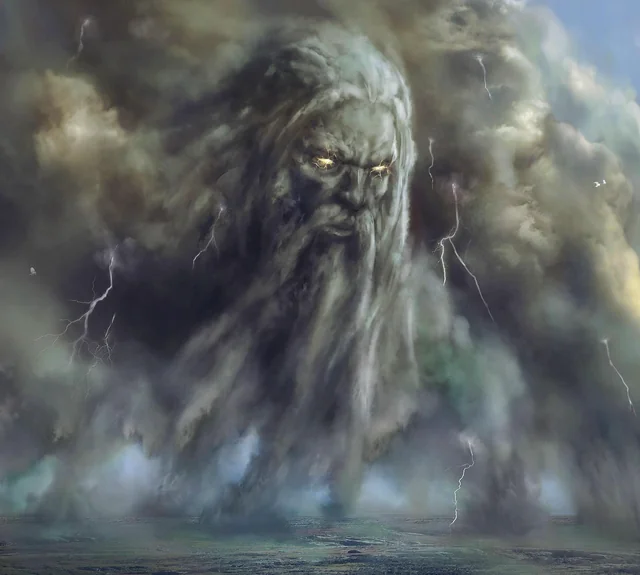
The Big Being GPM

Reference: The Level of OT II
Previous/Next

The Big Being GPM addresses space, form and its survival. The big being suggests the expansiveness of space an form.

LRH Instructions for Big Being GPM

.

Subject Clearing Prerequisites

Study and understand the following concepts:

  1. The Space
  2. The Spectrum of Substance

.

The Big Being GPM

This GPM is made up of 15 pairs of items (a total of 30 items) as follows.

Explosion
Appearance of a huge Being in sky.

  1. (a) You must survive.
    (b) You mustn’t survive.
  2. (a) You should survive.
    (b) You shouldn’t survive.
  3. (a) You can survive.
    (b) You can’t survive.

  1. (a) He must survive.
    (b) He mustn’t survive.
  2. (a) He should survive.
    (b) He shouldn’t survive.
  3. (a) He can survive.
    (b) He can’t survive.

  1. (a) They must survive.
    (b) They mustn’t survive.
  2. (a) They should survive.
    (b) They shouldn’t survive.
  3. (a) They can survive.
    (b) They can’t survive.

  1. (a) We must survive.
    (b) We mustn’t survive.
  2. (a) We should survive.
    (b) We shouldn’t survive.
  3. (a) We can survive.
    (b) We can’t survive.

  1. (a) All must survive.
    (b) All mustn’t survive.
  2. (a) All should survive.
    (b) All shouldn’t survive.
  3. (a) All can survive.
    (b) All can’t survive.

Explosion.

The Big Being GPM starts with an explosion and also ends with an explosion. In between we have the postulate regarding different aspects of survival of all existence.

.

Running the Big Being GPM

There are 15 pairs of opposite postulates. One contemplates on these pairs as in the earlier GPMs. Looking at the pair of opposites exteriorizes one from any identification with thoughts.

Thoughts are as expansive as space. Survival means continuation of the expansive postulates. One is unconsciously postulating the survival of all that one has ever postulated and the reasoning proceeding from those postulates. The idea here is to become aware of that automaticity.

On this GPM one is handling fixation on survival.

.

Definitions

SURVIVE
When “survive” becomes concerned with the continuation of a certain form only, it is a fixation that generates this GPM.

.

The Confusion of Past Lives

Reference: Course on Subject Clearing

When you have a computer program, you can run it with different inputs and get different results. An individual is a “human program” running with certain “set of postulates”. Another individual is the same program running with a different “set of postulates”. If there are 8 billion people currently on Earth, then the same “human program” is running with 8 billion different “set of postulates”.

.

Individuality

What makes an individual different from another individual is the “set of postulates” the “human program” is running on. There are also “animal programs,” “plant programs,” and “mineral programs.”

When you are talking about past lives of a person, you are saying that the human program was running in the past with exactly the same set of postulates as it is running on today. The individual is, therefore, defined by the “set of postulates” the human program is running on. Postulates go very deep. They define the goals and very basic characteristics of the individual. If these postulates change then the individual also changes. He is then a different individual.

.

The Self

When Lord Krishna in the Bhagavad Gita refers to himself as unborn and imperishable, he is referring to something without individuality that is the basis of all individualities. It is that, which generates the individual set of postulates and energizes it.

.

The Individual

The individual is a “human program” running on a “set of postulates.”

A person in an insane asylum is as much an individual as a normal person in the society. They are different only in terms of the “postulates” they are operating on. Each individual is essentially a “system of postulates.” A person has a right to his sanity. A person is as sane as his postulates are consistent with the postulates underlying this universe according to the Principle of Oneness.

.

Body & Past Lives

We measure lives in terms of the life lived by the body. The body is organized according to the blueprint carried by the “human program.” This blueprint is forwarded from one life to the next. From the viewpoint of this blueprint there are past lives when it was manifested as a body.

Such bodies, in different lives, have similarities and differences, just like, in one life, there are similarities and differences in the body from childhood to youth to adulthood and old age. It is those similarities that are thought of as characterizing the individual.

.

The Mental Matrix

The “human program” and the blueprints it carries can be thought of as the mental matrix (see Subject Clearing the Mind). The mental matrix has several layers. The deepest layer is, obviously, the layer of the postulates. It has the greatest durability.

The next layer is the blueprint according to which the body is formed, and its various functions occur. These functions include how the various parts of the body operate and coordinate with each other. This layer contains the evolutionary history of the body also.

The next layer forms the higher functions known as consciousness and thinking. These functions have to be continuous, consistent and harmonious with the earlier layers of the postulates and the blueprint. However, in this layer, facsimiles are formed that influence the individual’s thinking and behavior most directly. The influence is adverse to the degree these facsimiles are not assimilated in the mental matrix. In other words, the facsimiles that are in violation of the Principle of Oneness, affect the individual most severely.

.

Past Karma

Karma is made of facsimiles that needs to be assimilated with rest of the mental matrix. Usually they exists on the top layer of thinking, but they can go deeper into the layer of blueprint and the layer of postulates. These karmas come forward from one life to the next as part of the mental matrix.

When a person recognizes certain facsimiles from the past as intimate to him, he thinks that those impressions were produced by him. Hence he surmises that he has lived before. 

.

Summary

A body goes through a certain cycle. Some karma (facsimiles) go through a larger cycle. The blueprint goes through a still larger cycle. The individual “set of postulates” goes through the largest cycle. And the ultimate Self (ability to postulate and to become aware) appears to be eternal in comparison.

The key point here is that the individual is a SET OF POSTULATES, which forms the basis of the mental matrix of a person. The confusion of past lives may be resolved when the person understands which layer of the mental matrix, or the facsimile, he is identifying himself with.

.

The Tocky GPM

Reference: The Level of OT II
Previous/Next

The Tocky GPM deals with time. The end word used here is “Sun swing” which suggests TIME. Time suggests the tick-tock of a clock, which gives this GPM its name “Tocky GPM.” Time refers to a regular, cyclic occurrence.

LRH Instructions for Tocky GPM

Hubbard says, “That’s what you get for making this universe.” “Get out.” He seems to be referring to one’s fixation on the physical universe. The whole idea is to get rid of this fixation, and not necessarily the universe.

.

Subject Clearing Prerequisites

Study and understand the following concepts:

  1. The Substance
  2. The Time

.

The Tocky GPM

There are 24 items in Tocky GPM as follows:

  1. Create Sun swing
  2. Create no Sun swing
  3. Abide Sun swing
  4. Abide no Sun swing
  5. Enjoy Sun swing
  6. Enjoy no Sun swing
  7. Welcome Sun swing
  8. Welcome no Sun swing
  9. Share Sun swing
  10. Share no Sun swing
  11. Keep Sun swing
  12. Keep no Sun swing
  13. Hold Sun swing
  14. Hold no Sun swing
  15. Exploit Sun swing
  16. Exploit no Sun swing
  17. Deplore Sun swing
  18. Deplore no Sun swing
  19. Skip Sun swing
  20. Skip no Sun swing
  21. Continue Sun swing
  22. Continue no Sun swing
  23. Forget Sun swing
  24. Forget no Sun swing

The key characteristic of this universe is that it is enduring. The endurance manifests as cycles. The cycle of attention is to reach and withdraw.

.

Running the Tocky GPM

The 24 items of this GPM present 12 pairs of opposite postulates. One contemplates on these pairs as in the Electrical GPM. Looking at the pair of opposites exteriorizes one from any identification with the postulates.

The “sun swing” is a symbol for endurance as a regularly repeating cycle. The universe may be described as one large cycle, that contains smaller cycles within it. Those smaller cycles contain within them still smaller cycles and so on. Here we are looking at the attention becoming increasingly condensed as it identifies more and more with the substance of the universe.

On this GPM one is addressing the mechanism of fixation.

.

Definitions

TOCKY
The word “tocky”comes from “tick tock” of a clock. It refers to a regular, cyclic occurrence.

SUN SWING
The sun swings across front left to right as you face South. This is visualized as the “end word” on the items of this GPM. It suggests the cyclic but arbitrary nature of TIME.

UNIVERSE
The key characteristic of this universe, and of everything in it, is CYCLIC. Nothing in this universe is permanent or eternal.

.

The Electrical GPM

Reference: The Level of OT II
Previous/Next

The Electrical GPM is the first of the set of GPMs, which is run on the Scientology upper level of OT II. That means that it is the earliest GPM on the whole track as far as Hubbard could determine from his research.

LRH Instructions on Electrical GPM

Hubbard says, “It is an oddity as it has an electrical shock as its end word rather than a word. This was to convince a thetan he should think of himself as an electrical being.”

Hubbard defines shock as, “an electrical impact and flow.”

.

Subject Clearing Prerequisites

Study and understand the following concepts:

  1. The Unknowable-Knowable
  2. The Postulate
  3. The Reality
  4. The Anomaly

.

The Electrical GPM

There are 20 items in Electrical GPM as follows.

  1. Create (shock)
  2. Create no (shock)
  3. Destroy (shock)
  4. Destroy no (shock)
  5. Love (shock)
  6. Love no (shock)
  7. Hate (shock)
  8. Hate no (shock)
  9. Be (shock)
  10. Be no (shock)
  11. Disown (shock)
  12. Disown no (shock)
  13. Use (shock)
  14. Use no (shock)
  15. Condemn (shock)
  16. Condemn no (shock)
  17. Seize (shock)
  18. Seize no (shock)
  19. Escape (shock)
  20. Escape no (shock)

This list apparently refers to the occurrence of the earliest postulate. The sudden manifestation of a postulate may appear as a shock. 

.

Running the Electrical GPM

These 20 items of the GPM describe 10 pairs of opposite postulates. One contemplates on the first element, then on the second element, and then both elements of the pair. The pair of opposites help one develop a viewpoint that is exterior to both items of the pair.

Handle the next two items in a similar manner, and so on down the line.

Make sure you follow the The 12 Aspects of Mindfulness as you contemplate and visualize.

On this GPM one is addressing the mechanism of postulating and remaining exterior to what one postulates.

.

Definitions

END WORD
End Word is the word used at the end of statement for a goal, which is always a noun. If the statement for a goal is “To know the Unknowable” then the end word is “Unknowable.” 

GOAL
Goal is a postulate stating the aim towards which the effort is directed. For example, a goal would be, “To know the Unknowable.”

SHOCK
The shock is a discontinuity that may be felt as an electrical impact and flow.

.

The Level of OT II

Reference: Scientology OT Levels

According to Postulate Mechanics

  1. DIANETICS handles Engrams, Secondaries and Locks.
  2. SCIENTOLOGY handles Misjudgments and their consequences on the Grades. 
  3. OT LEVELS handle the underlying Postulates and Misconceptions.
  4. The OT Level I handles Beingness in general.
  5. The OT Level II handles GPMs starting from the earliest.

A GPM is a complexity arising from misconceptions. It is addressed by running a list of items that are designed to bring misconceptions to light. Here are Hubbard’s instructions for OT II:

LRH OT II Instructions

“There are 10 complete whole track tables. But only 1 of each kind of GPM in each table. This is a complete “Run” (1 of each kind). The sets belong to different entities. One finds the earliest set and runs it with care to stay in that set. Then one finds the next earliest set and so on for 10 sets. Just as in running the CC GPMs. The Electrical is the earliest in the run.

The CC Supervisor must recompile (?) the table on the above, 1 of each type in that order, Electrical, the first to be run. When all ten runs have been run, the pc has completed the Sect II Course unless I add another series to it.”

The GPMs are arranged on a Whole Track Table from the earliest to the latest.

.

Whole Track Table

The Whole Track Table is as follows:

The Electrical GPM
The Tocky GPM
The Big Being GPM
The House GPM
The Psycho GPM
The Banky GPM
OT II Incidents
The Basic-Basic GPM
The Basic GPM
The Command GPM
The Lower LP GPM
The LP GPM
The Body GPM
The Lower BANK

.

The Subject Clearing Approach

These GPMs are run using Subject Clearing approach. The E-meter is not used. Instead, one contemplates on the items using The 12 Aspects of Mindfulness. When a confusion arises on an item, one looks at it more closely until the underlying misconception is spotted and resolved.

The genesis of GPM lies in awareness. Awareness begins with sensations. Once sensation are received, they acquire meaning through postulates. So the GPMs have to do with sensations and POSTULATES.

The postulates must be consistent among themselves to make sense. When we look at consistency very closely it appears continuous. And, in a large context, that consistency appears harmonious. So, for the GPM to come about there must be violations of continuity, consistency and harmony.

This is covered under the following basics of Subject Clearing:

  1. The Unknowable-Knowable
  2. The Postulate
  3. The Reality
  4. The Anomaly

According to Subject Clearing, GPMs are about clearing up the basic concepts and underlying postulates collectively and individually, such that there are no anomalies about them in one’s understanding.

Therefore, in order to resolve the GPMs, one must be able to spot anomalies. Most likely, one would have to run the set of the GPMs in the Whole Track Table several times, because the resolution of anomalies in the first run will make it possible to spot and resolve more anomalies in the second run, and so on. One runs the items in the given sequence of the GPM.

The earliest GPM is the Electrical GPM. One should now contemplate on each item of this GPM by opening one’s mind and letting the thoughts arise by themselves. As one finds something that does not make sense, one would also find an anomaly. As one looks at that anomaly more closely, it would produce a realization and resolve.

If nothing comes up on an item, one moves quickly to the next item. With this Subject Clearing approach one should be able to move through these GPMs at a good clip.

.