
Truth cannot be declared.
All one may express is one’s own opinion, for truth is relative and never absolute.
The degree of truth depends on the consistency among the considerations that one holds.
.
 Vinaire's Blog
Truth cannot be declared.
All one may express is one’s own opinion, for truth is relative and never absolute.
The degree of truth depends on the consistency among the considerations that one holds.
.
Andrew Solomon (2013)
.

The whole theory of relativity is based on the premise that there is an upper limit ‘c’ to the speed of light. At this limit the relativity of space and time becomes quite evident. The Newtonian model of absolute space and absolute time no longer works as this speed is approached.
The question that has been there in my mind for some time is ‘What makes the upper limit of the speed of light such an absolute quantity?’ The answer seems to be ‘the physicality of this universe.’
What is ‘physicality’? How does one define it? Physicality would be defined by perception through our physical senses. All physical perceptions are consistent with each other. They are consistent with the measurements made through the use of physical instruments, such as, those used to measure the speed of light.
What is not physicality? The abstraction that we perceive through the mind would be a departure from physicality. This mental perception is different from the physical perception through eye, ear, nose, tongue, and body. Mind is first and foremost a sense organ. It perceives mental objects and the interactions among them. The mental objects are the abstractions that underlie physical objects. For example, three cups, three plates and three spoons are physical objects. But the underlying pattern of three is a mental object.
Such abstraction may go deeper in the form of patterns underlying patterns. We see that in mathematics. The whole subject of mathematics is abstract. There are numbers, but underlying those numbers is the number theory. Thus, we may say that there is a basic dimension of abstraction. The deeper one goes in this dimension, the more abstract things are.
The upper limit of the dimension of abstraction is the perception through the physical sense organs of eye, ear, nose, tongue, and body. This is the physicality defined by space-time of Einstein. Space-time has four components: three of space and one of time. The concrete forms are conjectured to be derived from space-time as follows
(1) Energy is a ripple that travels through the fabric of space.
(2) Matter is the condensation of energy.
This physicality is simply the upper limit of abstraction. Underlying this physicality are layers of subtle to subtler forms generating the dimension of abstraction. This dimension of abstraction has been there all this time. We know that the physical perception soon converts into experience, and then to information, hypothesis, theory, principles, axioms, etc. These subtler layers are then perceived by the mind.
The progress of mankind is measured in this dimension of abstraction. It has long been recognized as such in the eastern philosophy of the Vedas. Now it is time to look at this fundamental dimension scientifically.
Science recognizes the physicality consisting of three components of SPACE, and the one component of TIME. SPACE can be felt as concrete as well as abstract. TIME can be felt as concrete as well as abstract. This makes the dimension of abstraction as the most basic dimension that underlies even space-time.
Science has not delved into the abstraction of space-time even when these subtler forms exist.
Science should recognize and investigate ABSTRACTION as a fundamental dimension underlying even space and time.
Physicality of space-time is just a surface phenomenon. There is a whole ocean of abstraction that underlies it. It seems that there are general laws yet to be discovered that connect physicality to underlying abstraction.
.
.
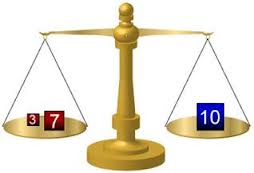
(1) An equation has two sides that are equal.
For example, 3 + 4 = 7
The left hand side (LHS) of the equation is 3 + 4. The right hand side (RHS) of the equation is 7
Let A, B, and C stand for numbers, where A + B equals C. Then we write the equation as,
A + B = C
.
(2) When the same quantity is added to, or subtracted from, the two sides, the equation is maintained.
For example, (3 + 4) + 8 = (7) + 8
Let N be a number added to both sides of the earlier equation, then
(A + B) + N = (C) + N
Similarly, (A + B) – N = (C) – N
.
(3) When the two sides of an equation are multiplied or divided by the same quantity, the equation is maintained.
For example, (3 + 4) x 8 = (7) x 8
Let both sides of the earlier equation be multiplied by the number N, then
(A + B) x N = (C) x N
Similarly, (A + B) ÷ N = (C) ÷ N
The above is taught in American schools. But the same thing can be done mentally as explained in the next section.
.
(4) When the equation is made up of two equal expressions, and a term is moved from one side to the other side, its sign changes to the opposite. That is, + becomes –, and – becomes +.
EXAMPLE:
If A + B = C
then A = C – B
and B = C – A
EXAMPLE:
If A – B = C
then A = C + B
and A – C = B or B = A – C
.
(5) When the equation is made up of two equal terms, and a factor is moved from one side to the other side, then multipication becomes division, and division becomes multiplication.
EXAMPLE:
If A x B = C
then A = C / B
and B = C / A
EXAMPLE:
If A / B = C
then A = C x B
and A / C = B or B = A / C
.
When working with word problems, we first translate the word problem into an equation, using a letter to represent the unknowm.
We then bring the unknown to one side of the equation, and all the knowns to the other side of the equation using the rules of transposition.
.
EXAMPLE: 3 more than 5 times a number is 13. What is that number?
Suppose the unknown number is N. The problem translates to the equation,
5N + 3 = 13
We first transpose the term 3 to the right. Addition becomes subtraction.
5N = 13 – 3 = 10
Then we transpose the factor 5 to the right. Multiplication becomes division.
N = 10 / 5 = 2
The answer is N = 2. We verify the answer by substituting it in the equation.
5 (2) + 3 = 13
The answer N = 2 is correct.
.
EXAMPLE: If 5A – 6 = 14, what is the value of A ?
We get, 5A = 14 + 6 = 20 (Transpose 6)
Therefore, A = 20 / 5 = 4 (Transpose 5)
Verify by substituting 4 for A in the original relation.
We get, 5 (4) – 6 = 14 (Verified correct)
.
EXAMPLE: Determine the value of A if 7A / 3 + 4 = 18.
We get, 7A / 3 = 18 – 4 = 14 (Transpose 4)
Therefore, 7A = 14 x 3 = 42 (Transpose 3)
Therefore, A = 42 / 7 = 6 (Transpose 7)
Verify by substituting 6 for A in the original relation.
We get, (7)(6) / 3 + 4 = 18 (Verified correct)
EXAMPLE: Determine the value of X if 4X – 2 = X + 7.
By transposition, you can bring all X‘s to the left and all number to the right in one step as follows.
We get, 4X – X = 7 + 2
or, 3X = 9
or, X = 3
Such transposition can easily be done mentally. The alternate method of repeatedly adding, subtracting, multiplying or dividing equal quantities from both sides takes longer.
.

There is relativity of motion. Relative motion of two trains side by side is a good example of it. When you are sitting in one train, it is hard to determine which train is moving unless one looks at the “stationary” ground, or feels the vibration of motion.
But we find that there is relativity of location also. We may measure distances from a particular reference point. We may then refer that reference point from another reference point. We may keep doing that but we will never find some absolute reference point.
Similarly, we may find that there is relativity of duration. How long something endures may be measured relative to how long something else endures. We may keep doing that but we will never find some absolute duration.
.
