Addition = Counting together
Multiplication = Repeated addition
Exponentiation = Repeated Multiplication
.
Subtraction = Opposite of addition
Division = Opposite of multiplication
.
 Vinaire's Blog
.
.
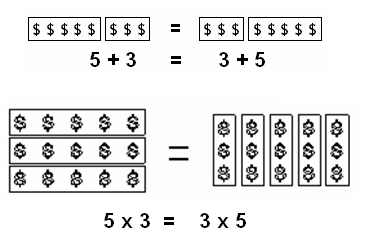
The Commutative Property applies to addition as follows:
Note that 0 (zero) is the neutral element for addition. The operation of plus appears for 5 when 0 is placed in front of it. It does not change the meaning. The commutative property is applied by rearranging the number with its operation. We note that plus for addition is also omitted when 0 is omitted.
.
The Commutative Property applies to subtraction as follows:
Note that 0 (zero) is the neutral element for subtraction as well, because addition and subtraction are opposite of each other. The commutative property is applied by rearranging the number with its operation. Therefore, 3 is moved with its minus operation. When 0 is removed, the ‘minus’ becomes a ‘negative’ sign.
.
The Commutative Property applies to multiplication as follows:
Note that 1 (one) is the neutral element for multiplication. The operation of multiplication appears for 6 when 1 is placed in front of it. It does not change the meaning. The commutative property is applied by rearranging the number with its operation. We note that multiplication sign is also omitted when 1 is omitted.
.
The Commutative Property applies to division as follows:
Note that 1 (one) is the neutral element for division as well, because multiplication and division are opposite of each other. The commutative property is applied by rearranging the number with its operation. Therefore, 2 is moved with its division operation. 1 divided by 2 becomes the fraction half.
.

.
Recently I discovered that my thought process, unbeknownst to me, has wandered into the realms of the philosophy of cosmology – a new field that was established within the philosophy of Physics just recently in December 2011.
This article from The Atlantic What Happened Before the Big Bang? The New Philosophy of Cosmology provides a nice introduction to this latest venture in philosophy.
“This is a branch of the philosophy of physics, in which you happen to be treating the entire universe –which is one huge physical object– as a subject of study, rather than say studying just electrons by themselves, or studying only the solar system. There are particular physical problems, problems of explanation, which arise in thinking about the entire universe, which don’t arise when you consider only its smaller systems. I see this as trying to articulate what those particular problems are, and what the avenues are for solving them, rather than trying to translate from physics into some other language. This is all within the purview of a scientific attempt to come to grips with the physical world.”
This philosophy has started with a bang by questioning the Big Bang theory. “The state of Big Bang,” it says, “has to be a highly ordered state of low entropy. How can the universe begin in this highly improbable state?”
Current scientific observations show that the universe is expanding. The idea of “Big Bang” came from extrapolating this expansion of universe backwards in time using general relativity. This yields an infinite density and temperature at a finite time in the past. However, this poses the inconsistency identified above in the philosophy of cosmology.
There can be many other scenarios that may be postulated to explain the present condition of an expanding universe. One such scenario could be a resonating field that may start out in a very subtle state. But all such scenarios may contradict the postulates underlying general relativity and later developments.
Here is an interesting criticism of Quantum Mechanics forwarded by this new philosophy.
“Physics has definitely avoided what were traditionally considered to be foundational physical questions, but the reason for that goes back to the foundation of quantum mechanics. The problem is that quantum mechanics was developed as a mathematical tool. Physicists understood how to use it as a tool for making predictions, but without an agreement or understanding about what it was telling us about the physical world. And that’s very clear when you look at any of the foundational discussions. This is what Einstein was upset about; this is what Schrodinger was upset about. Quantum mechanics was merely a calculational technique that was not well understood as a physical theory. Bohr and Heisenberg tried to argue that asking for a clear physical theory was something you shouldn’t do anymore. That it was something outmoded. And they were wrong, Bohr and Heisenberg were wrong about that. But the effect of it was to shut down perfectly legitimate physics questions within the physics community for about half a century. And now we’re coming out of that, fortunately.”
The philosophy of cosmology allows us to look at the big picture outside the constraints of general relativity or quantum mechanics. This leads to interesting conjectures such as the following:
The space and time associated with this primeval field may be postulated to be infinite. At this level there is no disturbance or frequency. This is marked by the parameter of “Disturbance = 0.”
The first level of spacetime may be identified as “Disturbance = 1″. The nth level of spacetime may be identified as “Disturbance = n″. As disturbance increases the spread of spacetime becomes finite and lesser. There are frequencies and physical constant associated with spacetime. The frequency increaseses with disturbance. Physical constants change too in some harmonic relationship.
If the electromagnetic radiation is identified with these disturbances than higher than “speed of light” velocities are predicted at the lower frequencies and lower than “speed of light” velocities are predicted at higher frequencies of the electromagnetic spectrum.
.
.
From Wikipedia:
Physics (from Greek φυσική (ἐπιστήμη), i.e. “knowledge of nature”, from φύσις, physis, i.e. “nature”) is the natural science that involves the study of matter and its motion through space and time, along with related concepts such as energy and force. More broadly, it is the general analysis of nature, conducted in order to understand how the universe behaves.
This is an open thread where the fundamentals of physics shall be discussed. This post shall be added to with meaningful ideas as the discussion develops.
The fundamental concepts seems be the following (Note: we shall be using SI units):
From these we derive the following concepts in mechanics:
In Mechanics, two fascinating concepts are Motion and Inertia.
.
In Electricity, I am looking at the following concepts:
The most fascinating concept is that of Charge.
.
A more fascinating concept is that of field from Wikipedia:
Maxwell, at first, did not adopt the modern concept of a field as fundamental entity that could independently exist. Instead, he supposed that the electromagnetic field expressed the deformation of some underlying medium—the luminiferous aether—much like the tension in a rubber membrane. If that were the case, the observed velocity of the electromagnetic waves should depend upon the velocity of the observer with respect to the aether. Despite much effort, no experimental evidence of such an effect was ever found; the situation was resolved by the introduction of the theory of special relativity by Albert Einstein in 1905. This theory changed the way the viewpoints of moving observers should be related to each other in such a way that velocity of electromagnetic waves in Maxwell’s theory would be the same for all observers. By doing away with the need for a background medium, this development opened the way for physicists to start thinking about fields as truly independent entities.
A charge produces a field. A brief acceleration of the charge produces a disturbance in the field that propagates at the speed of light. The animation provided at the preceding link is insightful.
When we look at this animation, the viewpoint is covering the whole extent of motion without moving itself. This may be considered the “viewpoint of the universe” with respect to actual propagation of light in cosmic space. The “velocity of the observer” does not enter the picture.
We run into problem when the viewpoint is reduced to that of the “body of the observer” and much smaller than the size of the universe. Now the “velocity of the observer” enters the picture.
Einstein assumes that the viewpoint is limited to the body of the observer and, therefore, the viewpoint has a velocity. But when we expand the viewpoint to the size of the universe then no “velocity of the observer” is necessary.
The special theory of relativity seems to depend on the assumption that viewpoint can have a velocity.
.
In mindfulness, there is no viewpoint separate from what is being observed. So, the “velocity” of the viewpoint is the same as the velocity of what is being observed.
Science is observing the universe. So, the correct viewpoint is that of the universe. A universe is all that exists.
The net velocity of the universe shall be indeterminate because there is nothing else to compare it to. The net velocity of the universe relative to itself shall be zero.
So, the velocity of a scientific viewpoint shall be zero.
In other words, the velocity of the scientific observer shall be zero relative to the resultant velocity of the universe. From the viewpoint of the scientific observer, the maximum velocity of light shall always be c.
.
The velocity of a wave on the surface of the pond depends on the properties of water filling that pond.
The velocity of sound wave depends on the properties of the medium, such as, air, in which it is travelling.
The velocity of the light wave also depends on the properties of the medium, such as, glass, in which it is traveling. The problem has been that light can travel in space where, apparently, there is no medium.
The medium in outer space is not made up of atoms and molecules. It is made up of the “field” that also exists within an atom, but much concentrated.
The vacuum of space seems to be a field similar to the field existing within the atoms of matter.
.
Albert Einstein stated in 1920: ”We may say that according to the general theory of relativity space is endowed with physical qualities; in this sense, therefore, there exists an Aether. According to the general theory of relativity space without Aether is unthinkable; for in such space there not only would be no propagation of light, but also no possibility of existence for standards of space and time (measuring-rods and clocks), nor therefore any space-time intervals in the physical sense. But this Aether may not be thought of as endowed with the quality characteristic of ponderable media, as consisting of parts which may be tracked through time. The idea of motion may not be applied to it.”
To me, this medium is a universal field. This field has indeterminate motion because there is nothing else to compare its motion to. Its motion is zero relative to the universe as a whole. Therefore, this field also acts as the universal frame of reference for all the velocities within the universe.
It requires some primitive form of energy to disturb this field. A disturbance of this field gives birth to space and time with the manifestations of electromagnetic radiation. This disturbance has a frequency. This frequency increases as more energy is pumped in.
At some point frequency causes discreteness (wave packets, photons) to appear. These photons may not have mass, but they have inertia (resistance to motion). This inertia occurs because the speed of the disturbance cannot be increased beyond that allowed by the physical properties (permittivity and permeability) of the field.
As more energy is pumped in, this inertia acquires the appearance of mass. Thus, the following evolution seems to take place:
Thus, expansion of this space-time universe occurs as energy of some primitive form gets pumped into this field.
.
Here is how this conjecture is developing:
This model explains why Michelson-Morley’s experiment shall detect no “aether wind.”
.
Conjecture #5 above postulates, “Increasing frequency generates increasing inertia.” Thus the speed of the electromagnetic radiation shall be slower at higher end of the frequency spectrum compared to the lower end. This seems to be confirmed by the following article.
High Energy Gamma Rays Go Slower Than the Speed of Light?
And also by Wikipedia entry: Markarian 501
.
Conjectures #3 and #4 above may be expressed further as follows:
The universal field may be viewed as “Disturbance = 0″. The frequency is 0. The space (wavelength) and time (period) associated with this field are infinite. This is like a theoretical absolute for space and time.
The next level of disturbance is “Disturbance = 1″. The frequency is 1 (20) Hz. The space (wavelength) and time (period) associated with this disturbance has finite value yet to be determined. These would supply some constant units of space and time.
The next level of disturbance is “Disturbance = 2″. The frequency is 2 (21) Hz. The space (wavelength) and time (period) associated with this disturbance would be half of the constants determined above.
The next level of disturbance is “Disturbance = 3″. The frequency is 4 (22) Hz. The space (wavelength) and time (period) associated with this disturbance would be quarter of the constants determined above.
…
The nth level of disturbance is “Disturbance = n″. The frequency is 2n-1 Hz. The space (wavelength) and time (period) associated with this disturbance would be 1/2n-1 of the constants determined above.
And so on.
.
The “disturbance” parameter for visible light of frequency 4 x 10¹⁴ to 8 x 10¹⁴ shall be approximately 49 to 50 compared to the “disturbance” parameter of 1 for a 1 Hz electromagnetic wave. The “disturbance” parameter at the upper end of the electromagnetic spectrum would be about 66-67.
The velocity of light is 3 x 10⁵ km/sec. The velocity of electromagnetic radiation of low level “disturbance” shall be greater than the velocity of light because it has much lower inertia (resistance to motion). The opposite shall be the case for high level “disturbances.”
The “disturbance” levels beyond 70 shall be those of particles with mass variety.
The layer of “Disturbance = 0″ shall have infinite velocity. This would be the layer of fundamental spacetime, which would gradually transition to electromagnetic type disturbance.
Electromagnetism may start from “Disturbance = 1″ but the velocity at this low level shall be much higher than the velocity of light.
Beyond “Disturbance = 67” electromagnetism may gradually transition to disturbances of particles with mass variety such as the electron. Here the velocity shall be much lower than the velocity of light.
Thus the universe seems to be made up of layered “disturbances” that are expanding at different rates. The lower level “disturbances” are expanding at much higher rates than the high level “disturbances.”
.

It is much easier to recognize physical objects than the subjective thoughts and ideas. So the person should gradually be brought up to a point that he can recognize physical objects in his present environment. The person’s memory is very fragile so no demands should be made to recall things from the past. All conversation must be limited to simple things in the present.
Get the person to recognize large, simple physical objects first by looking, touching and feeling them. Then give him smaller and more complex objects. Do not ask him to recall or recognize things out of his memory.
.
.
