Inertia and Mass

2004_stellar_quake_full

Reference:

Ether and Motion

.

As we go to higher disturbance levels, the changes in the electric/magnetic phases of disturbance are much more rapid, but the forward advance is much slower.

Thus, inertia has to do with the rapidity of changes within the disturbance. This rapidity of changes gives the disturbance its form of mass.

The form of mass may appear to be static but that form itself is made up of changes that are occurring incredibly rapidly.

Thus, in a particle, such as a neutron, there are incredibly rapid changes going inside.

.

There has always been a question in my mind about what makes the boundary between a particle and its surrounding space. I am now convinced that this boundary is due to a sudden change in motion by several orders of magitude.

Space seems to be very close to DL0. The first appreciable boundary seems to exist between space and the electromagnetic level at DL50. This is the boundary between space and the atom, molecule, or matter.

The next boundary seems to be within the atom between the electromagnetic level at DL50 and the nucleus at DL100. There may be additional boundaries within the nucleus itself but that is a matter of future research.

.

Ether and Motion

Albert Einstein (SUBMITTED PHOTO)

References:

Mindful Subject Clearing – Physics

The Disturbance Hypothesis of Light

KHTK Postulates for Physics

Evolution of Physics by Einstein

.

From THE EVOLUTION OF PHYSICS by Einstein and Infeld (Chapter III, Section “Ether and Motion”):

We are sitting in a closed room so isolated from the external world that no air can enter or escape. If we sit still and talk we are, from the physical point of view, creating sound waves, which spread from their resting source with the velocity of sound in air. If there were no air or other material medium between the mouth and the ear, we could not detect a sound. Experiment has shown that the velocity of sound in air is the same in all directions, if there is no wind and the air is at rest in the chosen c.s. [coordinate system.]

Let us now imagine that our room moves uniformly through space. A man outside sees, through the glass walls of the moving room (or train if you prefer), everything which is going on inside. From the measurements of the inside observer he can deduce the velocity of sound relative to his c.s. connected with his surroundings, relative to which the room moves. Here again is the old, much discussed, problem of determining the velocity in one c.s. if it is already known in another.

The observer in the room claims: the velocity of sound is, for me, the same in all directions.

The outside observer claims : the velocity of sound, spreading in the moving room and determined in my c.s., is not the same in all directions. It is greater than the standard velocity of sound in the direction of the motion of the room and smaller in the opposite direction… In the case of the sound wave in the room moving uniformly, relative to the outside observer, the following intermediate steps are very essential for our conclusion:

The moving room carries the air in which the sound wave is propagated.

The velocities observed in two c.s. moving uniformly, relative to each other, are connected by the classical transformation.

The corresponding problem for light must be formulated a little differently. The observers in the room are no longer talking, but are sending light signals, or light waves in every direction. Let us further assume that the sources emitting the light signals are permanently resting in the room. The light waves move through the ether just as the sound waves moved through the air.

Is the ether carried with the room as the air was? Since we have no mechanical picture of the ether, it is extremely difficult to answer this question. If the room is closed, the air inside is forced to move with it. There is obviously no sense in thinking of ether in this way, since all matter is immersed in it and it penetrates everywhere. No doors are closed to ether… There is not the slightest doubt as to the clarity of this verdict, although it is obtained through rather indirect experiments in view of the great technical difficulties caused by the enormous value of the velocity of light. The velocity of light is always the same in all c.s. independent of whether or not the emitting source moves, or how it moves.

.

In case of sound, the vibration of the object creates displacement in the medium that is at the same macro level.

In case of light, the “vibration” is occurring at a subatomic level, and so is the “displacement” of the “medium”. It is a whole different level.

Motion at macro level may be compared to another motion at macro level in a meaningful way. Similarly, motion at subatomic level may be compared to another motion at subatomic level in a meaningful way. But we lose the relative significance when we try to compare motion at macro level to the motion at subatomic level. This is a problem of scales.

We may be able to express this problem better in terms of disturbance levels. The macro level may be approximated as DL100, where the frequency of electromagnetic disturbance is so high, and variations so rapid, that it looks “solid”. The subatomic level may be approximated as DL50 where the frequency of the electromagnetic disturbance is less “dense” by a factor of 250. The motion of a wavelength at one level shall appear to be shrunk by a factor of 250 at another level. This comparison is hardly significant to the senses.

The factor of 250 is likely to be inaccurate being a rough estimation, but it provides an explanation in terms of the orders of magnitude involved. The motion of the source of light at DL100 will hardly contribute to the motion of light at DL50.

The speed of light shall appear to be constant in all coordinate systems from the perspective of DL100.

.

Let’s imagine a drum inside another drum. They both are rotaing about the same axis. The outer drum is rotating at the speed of light of DL50. The inner drum is rotating at the ordinary speed of DL100. Let us also suppose that we are looking at a certain characteristic through a narrow slit.

If we are at the inner drum looking at that characteristic in the outer drum, our c.s.(coordinate system) shall be the inner drum, and we shall see that characteristic in the outer drum changing very rapidly.

But if we are at the outer drum looking at that characteristic in the inner drum, our c.s.shall be the outer drum, and we shall see that characteristic in the inner drum changing very slowly.

In fact, when the c.s. is at DL100, and the background is DL50, the background shall appear to be full of light rays bouncing around at incredible speeds, as is the case in our experience.

But if the c.s. is at DL50 and the background is at DL100, the background shall appear to be dark and solid with a feeling of being totally closed in.

Einstein considers all c.s. to be at DL100 only. From that c.s. the differences in the surrounding speed of light shall not be appreciable because of the order of magnitude involved, and the speed of light shall appear to be constant.

The limitation in Einstein’s Theory of Relativity is that Einstein does not consider the coordinate system at any level other than the material level of DL100.
.

The 4th and 5th Dimensions

hqdefault

A location has no dimensions. A location continually extended in a direction forms a line. A line continually extended in another direction forms a surface. A surface continually extended in still another direction forms a solid. A solid is a 3-dimensional object.

Now we have run out of new directions in what we know as space, but directions should not be limited to space. We can now extend a solid in a new direction known as time. This forms a history. A history of something would be a 4-dimensional object. We trace the history of a person from his birth to death. This will give us a 4-dimensional object.

What new direction can we think of now? We can take any object and conceptualize it and apply that concept in a much wider domain of abstraction. Mathematics and philosophy have been doing that for a long time. So, when we look at the existence of the object in the dimension of abstraction it gives us a 5-dimensional object.

When we consider the universe, it not only has an existence in physical space with a long history, but it also extends in the dimension of abstraction as well. The ultimate abstraction of the universe may be called God.

Thus God belongs to the dimension of abstraction.

.

Do Schools Kill Creativity


Reference: Subject: Education

You may read the transcript here.

Here are the main points from this talk (Jun 2006):

(1) There is increasing display of creativity in the society. No idea how this may play out.

(2) Education is one of those things that goes deep with people. We have a huge vested interest in it, partly because it’s education that’s meant to take us into this future that we can’t grasp.

(3) Children have extraordinary capacities for innovation. We squander them pretty ruthlessly. Creativity now is as important in education as literacy, and we should treat it with the same status.

(4) If one is not prepared to be wrong, one will never come up with anything original. Kids are not frightened of being wrong. They will take a chance. If they don’t know, they’ll have a go. But, by the time they get to be adults, most kids have lost that capacity.

(5) We stigmatize mistakes. And we’re now running national education systems where mistakes are the worst thing you can make. And the result is that we are educating people out of their creative capacities. It need not be this way.

(6) Every education system seems to have the same hierarchy of subjects. At the top are mathematics and languages, then the humanities, and the bottom are the arts. There’s a hierarchy within the arts. Art and music are normally given a higher status in schools than drama and dance. As children grow up, we start to educate them progressively from the waist up. And then we focus on their heads, and slightly to one side. It need not be this way.

(7) The whole purpose of public education throughout the world seems to be to produce people who live in their head, and slightly to one side. We shouldn’t hold them up as the high-water mark of all human achievement.

(8) Our education system is predicated on the idea of academic ability. The whole system was invented to meet the needs of industrialism. So the hierarchy is rooted on two ideas.

  • The most useful subjects are those that provide us with a job.
  • Academic ability is the measure of intelligence.

(9) Today, due to technology and its transformation effect on work, degrees aren’t worth anything. You need an MA where the previous job required a BA, and now you need a PhD for the other. The whole structure of education is shifting beneath our feet. We need to radically rethink our view of intelligence.

(10) We know three things about intelligence:

  • Intelligence is diverse. We think about the world in all the ways that we experience it.
  • Intelligence is dynamic and interactive. Creativity comes about through the interaction of different disciplinary ways of seeing things.
  • Intelligence is distinct.

(11) Our only hope for the future is to adopt a new conception of the richness of human capacity. Our education system has mined our minds in the way that we strip-mine the earth: for a particular commodity. And for the future, it won’t serve us. We have to rethink the fundamental principles on which we’re educating our children.

(12) The only way we’ll avert some of the dreadful scenarios of future is by seeing our creative capacities for the richness they are and seeing our children for the hope that they are. Our task is to educate our children’s whole being, so they can face this future. We may not see this future, but they will. And our job is to help them make something of it.

.

KHTK Postulates for Metaphysics – Part 1 (old)

alone-on-a-boat-fishing

Please see Course on Subject Clearing

I shall start these postulates with what Buddha declared.

KHTK Postulate M-0: The Absolute Truth is that there is nothing absolute in the world, that everything is relative, conditioned and impermanent, and that there is no unchanging, everlasting, absolute substance like Self, Soul, or Ātman within or without.

DEFINITION: Absolute means, “Viewed independently; not comparative or relative; ultimate; intrinsic.”

This postulate may appear self-contradictory to some, but it essentially says, “There are no absolute certainties.” This is reflected in one of the most ancient hymns, The Creation Hymn of Rig Veda.

All certainties are relative. This statement does not degrade any certainty we have. It simply means that one can always come up with a better certainty.

That is how science makes progress. Einstein declared the speed of light to be a universal constant. This is a certainty for now, but there may possibly be a wider context in which the speed of light is a special case.

Similarly, in the field of spirituality, we cannot be absolutely certain that self or soul is permanent. The phenomenon that is described as self or soul must be open to further investigation.

There is no progress possible for a person who believes his certainties to be absolute.

Reference: The Quest for Certainty

.

KHTK Postulate M-1: Awareness is primordial disturbance.

Awareness is known to arise, change and disappear. It may be likened to a disturbance that arises, changes and disappears. We may assume some ground state, which when disturbed gives rise to awareness.

However, the ground state shall forever be unknowable and shall remain only theoretical because there is no awareness to go with it. Awareness arises only when this ground state is disturbed. Therefore, awareness is something relative and not absolute.

Reference: The Ultimate Reality

.

KHTK Postulate M-2: Consciousness (self-awareness) is primordial light.

Awareness is aware by its very nature. This self-awareness is called consciousness.

Since awareness seems to be disturbance, and science recognizes light (electromagnetic wave) as the most basic form of disturbance in nature, there is some justification in associating consciousness with light. It appears that this association of consciousness with light has been made on an intuitive basis since ancient times.

Consciousness may be regarded as something spiritual as opposed to physical. But spiritual and physical states are neither absolute nor independent. This is similar to the case with space and time which are found by the scientific investigation to be neither absolute nor independent.

For a long time space and time were regarded as absolute concepts in themselves. Newtonian mechanics built on that consideration is still very successful but in a limited scope on earth. Einstein’s Theory of Relativity, when considering a cosmic scale, finds space and time to be relative. Similarly, Abrahamic religions have long regarded spiritual and physical states to be absolute in themselves. This has been adequate for a limited understanding of human consciousness. But to understand consciousness on cosmic scale we need to consider spiritual and physical states to be relative. A spiritual state will have physical form, no matter how subtle. And a physical state will have some spiritual characteristics, no matter how subdued.

Thus, we may say with some confidence that self-awareness, or consciousness, has the basic form of light, which represents a disturbance of nearly infinite wave-length of practically zero frequency. Being timeless, its velocity is infinite. Since awareness is relative, consciousness is also relative.

This is a very raw level of consciousness. Soul, self, energy, matter, etc., come later.

Reference: Awareness and Light

.

KHTK Postulate M-3: Awareness, as a disturbance, is a back and forth conversion between perception and knowledge.

As disturbance occurs, there is perception. Perception then acquires meaning. This is knowledge. Knowledge then prompts perception, which then acquires meaning, and so on.

When I am looking at a tiled floor, I perceive a tiled floor because I know it is a tiled floor. It is almost like a tautology. It is a back and forth conversion of perception and knowledge of a tiled floor.

This is the form awareness as a disturbance – a back and forth conversion between perception and knowledge. This parallels light as a disturbance – a back and forth conversion between electric and magnetic fields.

.

KHTK Postulate M-4: Awareness expands and consciousness grows as the frequency of perception/knowledge interchange increases.

Knowledge gives meaning to incoming perception, whereas perception strengthens the knowledge with meaningful patterns. There is a finite frequency, wavelength and period to this interchange. As the frequency of this disturbance increases, more complex awareness comes about, and all that meaning molds consciousness.

The most fundamental level of consciousness (self-awareness) is the primordial light. As frequency increases, the light acquires new characteristics, and capabilities for new interactions. These characteristics express the inherent knowledge, and the interactions express the inherent perceptions.

The answers to questions like, “How this disturbance does come about?” or “How does its frequency increase?” shall have to wait. But we know that awareness seems to grow with intuition, and this intuition is somehow linked to the frequency of perception/knowledge interchange. That is why mindfulness is effective. Mindfulness is essentially seeing things as they are. As one perceives things continually without interfering with them, intuitions come about.

.

KHTK Postulate M-5: The range of frequencies of perception/knowledge interchange generates a spectrum of consciousness.

The increasing frequency of perception/knowledge interchange may be characterized by Disturbance levels. The basic level of disturbance may be defined as having a frequency of 1 (20). At this level the wavelength of the disturbance is practically infinite and the period is non-existent. The basic consciousness would appear as primordial light without characteristics. We may refer to this level as DL0 (Disturbance Level 0).

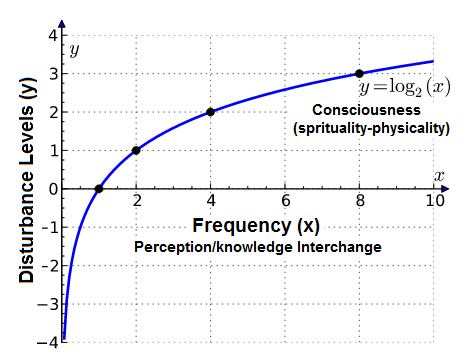
The subsequent disturbance levels, DL1, DL2, DL3, etc., may be defined in terms of doubling of frequency, such as, 2 (21), 4 (22), 8 (23), etc. Disturbance Level ‘n’ (DLn) will have a frequency of 2n. As disturbance levels increase, the wave-length of light shrinks to create the dimensions of space. The period is manifested to create the dimension of time. These dimensions become manifested with the formation of finite forms.

Please note that Consciousness consists of both spiritual and physical characteristics througout this spectrum.

Disturbance Levels

The graph above presents the disturbance levels as a function of frequency of perception/knowledge interchange. The frequencies are plotted along the x-axis, and the disturbance levels are plotted along the y-axis. It can be seen from this graph that negative disturbance levels may be postulated with the halving of frequency. The frequency never reaches the zero of the theoretical ground level.

The disturbance level of zero occurs at the frequency of 1. The disturbance is manifested as consciousness that has both spiritual and physical characteristics.

.

Next: 

KHTK Postulates for Metaphysics – Part 2

KHTK Postulates for Physics

.