.
.
.
.
.
.
 Vinaire's Blog
.
.
.
.
.
.
Please see The Book of Subject Clearing
When studying a subject one should be able to detect the hidden assumptions and distortions present in it. This is especially necessary when one is studying the fundamentals of a subject. Such distortions can be very pervasive. They may even enter the definitions of words provided in dictionaries.
The following procedure may help one detect and clear assumptions and distortions present in a subject being studied.
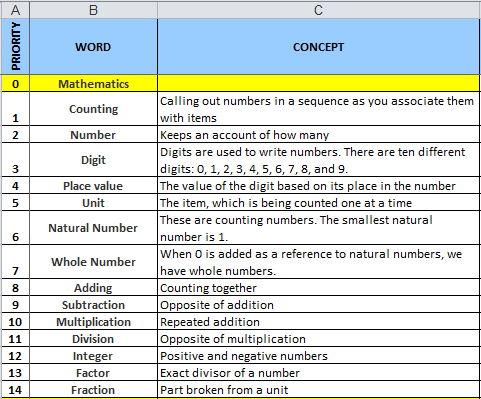
Skim through the chapter that you are going to study, and make a list of key words that introduce new concepts in that chapter. Put that list on an Excel worksheet, so you can rearrange their order as necessary. You may add key words from previous chapters, or from other books, that you have studied. This list may grow as your studies get deeper into the subject.
In a dictionary you may find the broad concept listed under ‘history’, ‘origin’, or ‘derivation’ of the word. This may appear either before, or after the definitions. For example, when you look up ARITHMETIC, you may find the underlying concept expressed as “skill with numbers.”
Look for broad concept only. Sometimes you may have to piece together the concept from the derivations given. Ignore most other details. Once you have grasped the broad concept note it down next to the word on your Excel worksheet.
Study the materials in the chapter one paragraph at a time. Summarize and reduce each paragraph to its main thought before proceeding to the next. This may provide you with additional conceptual understanding. If so, then note it down next to the appropriate word on your Excel worksheet.
If the paragraph is difficult to reduce to its main thought then look for words in that paragraph that may not have been understood fully. If the difficulty with a paragraph still persists then note down the confusion on your worksheet with the location. It may get clarified by something you read later.
Since the required information may easily be accessed these days, the purpose of study is not to memorize but to sort out relevant data.
The true purpose of study is to resolve inconsistencies (things that do not make sense) as you come across them. This develops a clarity of mind and the ability to think fast on your feet.
The key words should be listed starting with those that express the fundamental concepts. These are followed by those key words, which express derived concepts.
Start by arranging the key words in the sequence they appear in the chapter. As you gain familiarity, rearrange the key words in the sequence that concepts seem to have evolved. Move the words expressing more fundamental concepts toward the top. Move the words expressing derived concepts toward the bottom.
A “Priority” column may be added to your Excel worksheet. You may place numbers in that column to readjust the sequence, and then simply sort the list by that column.
As the study of the subject progresses and better understanding comes about, the list of key words may be continually rearranged to achieve consistency among the concepts.
If you notice any inconsistencies then this motivates research deeper into the subject. First review your materials to clarify any inconsistency. If it does not clarify easily then note it down on the worksheet and research through other materials in the library or on Internet.
The fundamentals concepts of a subject must be consistent. Any inconsistency at the fundamental level must be handled as a priority, since on this depends the consistency of later concepts in that subject.
Look closely at the inconsistencies starting from the top. If an inconsistency does not resolve then look for underlying assumptions. Arbitrary assumptions may reveal gaps in the subject itself.
There are likely to be many contributors to a subject. For example, many different cultures have contributed to the broad subject of religious knowledge. You may find similar concepts referred to by different words in different languages. Note down all those words and differences among the concepts. Seek consistency among these concepts and develop your own understanding.
There are many examples in the subject of religion where gaps in knowledge are hidden under assumptions and dubious explanations. This may be the case with any subject where inconsistencies abound.
When such assumptions and dubious explanations are ferreted out, then the gaps in knowledge become obvious.Real progress becomes possible now.
Fill gaps in the subject with wider research. Make the subject as complete and consistent as possible through experimentation and direct experience.
.
Thus, subject clearing may occur.
.

Many people have “out-of-body” experiences, which they fondly remember for the rest of their lives. Such experiences are never under one’s control. They cannot be consciously repeated. Usually they do not repeat on their own either. A big deal is made out of “out-of-body” experiences in Scientology. In fact, Scientology has made itself a big $$$ “church” by exploiting this phenomenon.
.
.

.
.
Reference: Subject: Education
You may read the transcript here.
Here are the main points from this talk (August 2008):
(1) I wanted to build an argument for primary education in a very specific context. What happens to education as it gets remote from urban centers and resources?
(2) Studies show that test results drop with the remoteness of schools from urban centers. Most teachers in remote areas are not very motivated. Educational technology would have much greater positive impact in these remote areas than in urban areas.
(3) An alternative primary education is required where schools don’t exist, where schools are not good enough, where teachers are not available or where teachers are not good enough, for whatever reason.
(4) A possible alternate system is SOLE (self-organizing learning environment) that was observed in a set of “hole-in-the wall” experiments. It was discovered that a child could self-learn to browse on Internet within 8 minutes. They could even self-learn English by locating an English teaching site on the web.
(5) We found younger children teaching the older one. Six to 13-year-olds could self-instruct in a connected environment (group), irrespective of anything that we could measure. We got a clean learning curve, almost exactly the same as what you would get in a school. They seem to be learning as much by watching as by doing.
(6) The conclusion was that primary education, or parts of it, can happen on its own. It does not have to be imposed from the top downwards. It could perhaps be a self-organizing system. All natural systems are self-organizing.
(7) So, the conclusions are:
(8) it gives us a goal, a vision, for an educational technology pedagogy that is digital, automatic, fault-tolerant, minimally invasive, connected and self-organized. We can call this educational technology “out-doctrination,” It could be a goal for the future.
.
