Reference: Speed of Light Essays
I can understand that velocity of light is a universal constant. I can see that from a constant “wavelength to period” ratio even when the frequency of light changes. But I do not understand why the relative velocity of light should also be constant and not exceed the velocity of light.
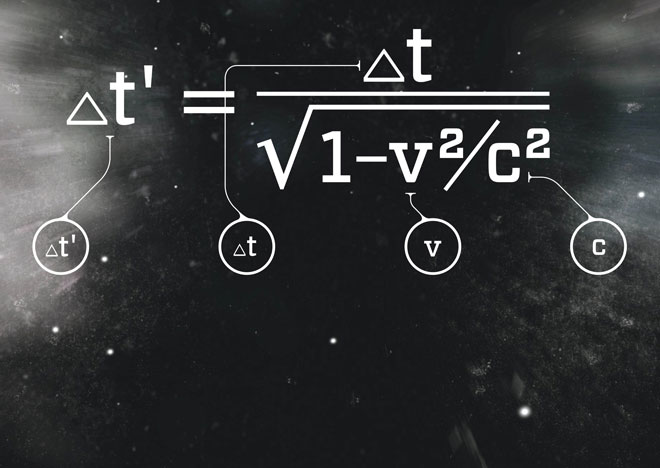
Isn’t that an assumption by Einstein? What is the logic underlying Einstein’s conclusion?
The Dutch astronomer De Sitter showed that the velocity of light does not depend on the velocity of the source of light. This is similar to the fact that the velocity of sound does not depend on the velocity of the source of sound.
Sound is a disturbance in a physical medium. Similarly, we may look at light as a disturbance in a physical medium. That physical medium is not aether, but space itself. Space has definite physical properties, such as, permittivity and permeability. The only difference is that space does not consist of mass. Instead space consists of a more fundamental substance called “field”.
When there is no sound, its medium of air may be considered to have a frequency of zero. Similarly, when there is no light (electromagnetic wave), the medium of space may be considered to have a frequency of zero. It is the postulate of Disturbance Theory that
Space is the theoretical state of electromagnetic field at zero frequency.
We cannot compare the velocity of the disturbance in a physical medium (sound) to the velocity of the physical medium (air) itself. This is like comparing apples to oranges. When a plane is moving at supersonic speed in air and sound is moving as a disturbance in air, that does not mean that air itself is moving at supersonic speed.
Air as a medium is flexible. That is how it allows sound wave to move through it. Similarly, space has to be flexible to allow light wave to move through it. We cannot assume space to be rigid, just like we cannot assume air to be rigid.
When a source of sound is moving relative to air, it only changes the frequency of sound and not the speed of sound. Similarly, when a source of light is moving relative to space, it only changes the frequency of light and not the speed of light.
What happens when the source of sound is moving at the speed of sound? The frequency of sound would increase until it collapses into rigidity because sound cannot advance any faster. The medium of air would appear inflexible and rigid to the source of sound. Similarly, when a source of light moves in space at the speed of light, the medium of space would appear inflexible and rigid to the source of light.
We recognize this rigid condition of space as the Euclidean space.
So, when we assume space to be totally rigid as Euclid does, it is as if we are looking at it relative to a source of light moving at the speed of light. However we don’t observe that directly. We only know that we become aware of objects when light reflects or scatters off them.
Could it be that high frequency electromagnetic waves collapse into mass that makes up the objects?
This conjecture is in line with the Disturbance Theory, but it is yet to be demonstrated.
.
This article establishes an uncanny parallel between sound and light waves. We know that the velocity of sound can be exceeded both in relative and actual sense. So, what made Einstein assert that the velocity of light could not be exceeded even in a relative sense?
To answer this question we look at Section V of Einstein’s Book “Relativity: The Special and General Theory”. In this section Einstein establishes the Principle of Relativity (in the restricted sense).
Einstein takes up the case where a railway carriage is undergoing uniform translation without rotation. Using this example Einstein shows that the mechanical laws hold good for uniform translatory motion of Galilean co-ordinate system. This co-ordinate system applies to bodies with mass changing their position in space with time. It is valid for Newtonian mechanics.
Einstein then makes the assumption that all natural laws shall hold good for uniform translatory motion of Galilean co-ordinate system. But the natural laws of electrodynamic and optics move beyond classical mechanics.
We know now that light is a disturbance in electromagnetic field. The electromagnetic field is more basic than mass and it is devoid of inertia. It is the concept of frequency that is more applicable to electromagnetic field than the concept of velocity because we cannot use the concept of rigid space for light. The Galilean co-ordinate system assumes space to be rigid.
Therefore, Einstein’s principle of relativity when restricted to uniform translatory motion of Galilean co-ordinate system, does not apply to light.
Therefore, the conclusion that the velocity of light cannot be exceeded, even relatively, comes under question.
The theory of relativity needs to be reviewed thoroughly because the assumption that Einstein made has now come under question.
.