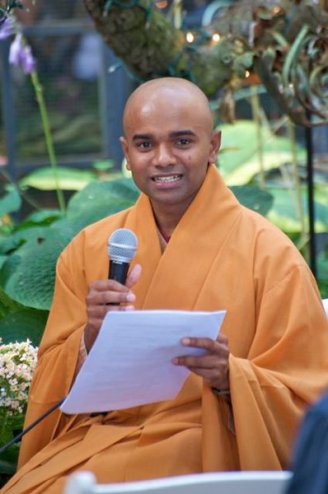
Mindfulness 02: Desires, Expectations and Speculations

Desires

Reference: Mindfulness Exercises


Mindfulness is “seeing things as they are.”

One wants answers; but answers do not come from desiring, expecting and speculating. Only when you know what is there, can you truly know what is to come.

Uncontrolled thinking comes about when desires, expectations and speculations rule your mind.

.

MINDFULNESS # 02: Observe without desires, expectations and speculations.

In a class of students, first call out “Mindfulness 0” instructions to start mindfulness meditation. Next, explain this exercise as follows.

“In this exercise we meditate on desires, expectations, and speculations.

“Desires can act as filters and prevent you from recognizing what is actually there. For example, you desire your team to win. You look only at strong points of your team, and weak points of the other team. You do not look objectively at the strong and weak points of both the teams.

“Expectations also act as filters and prevent one from recognizing what is actually there. For example, you may see a person in priestly robes and trust him implicitly because you expect him to be a man of God. But he may be a crook who can take you for a ride.

“Speculations do not reflect what is actually there. For example, you may speculate on what you need to be for others to like and admire you. But that may hide your natural talents and attractiveness from yourself, and you fail to recognize yourself.”

Call out the following instructions slowly and clearly. Pause for 15 to 20 seconds after each instruction to let the student settle down with it.

  1. Become aware of the desires that are there.

  2. Observe nonjudgmentally. It is neither good nor bad. It is what it is.

  3. Do not resist anything. Do not suppress anything. Do not interfere with what is there.

  4. Simply become aware of the desire and move on.

  5. When it is difficult to move on, simply observe the desire more closely. Let further details appear as they may.

  6. Let the realizations come as they may and move on.

  7. Become aware of expectations. Trace them back to the underlying desire. Simply become aware and move on.

  8. Become aware of speculations. Trace them back to the underlying desire. Simply become aware and move on.

  9. Expand your span of attention to your whole life as far back as possible. Let the perceptions pour in.

  10. Become aware of the desires, expectations, and speculations as they were during various stage of your life.

  11. Expand your span of attention to others that you have come across during your life. Let the perceptions pour in.

  12. Become aware of the desires, expectations, and speculations as you saw them in others.

  13. Observe nonjudgmentally. It is neither good nor bad. It is what it is.

  14. Do not resist anything. Do not suppress anything. Do not interfere with what is there.

  15. Simply become aware of the underlying desires and move on.

  16. When it is difficult to move on, simply observe the desire more closely. Let further details appear as they may.

  17. Let the realizations come as they may and move on.

  18. Continue meditating on desires, expectations, and speculations till the end of the meditation session.

.

 

Mindfulness C: Continuity, Harmony & Consistency

stacked-stones-by-river

Reference: The 4th and 5th Dimensions

We all are familiar with the four dimensions that are acknowledged by science or, more specifically, by physics. These are the three dimensions of space and one dimension of time. Is there a fifth dimension?

Maybe abstraction is the fifth dimension. Science reduces physical observations to relationships in the form of equations.  That would be a step towards abstraction. Mathematics reduces three cups, three plates and three spoons to a pattern of three. That is also abstraction. If we look closely, religion reduces a living person to an abstract soul after his death. So, the dimension from physical to mental to spiritual may be looked upon as the dimension of abstraction.

Let’s look at the fundamental principle of this universe. We may explain it in terms of dimensions as follows.

  • In case of space, that fundamental principle is continuity. If there is a discontinuity in space, then that would be something out of place.

  • In the dimension of time, it is harmony that is the basic principle. If there is a disharmony then there is something missing.

  • Finally, in the dimension of abstraction, it is consistency, which is the basic principle. From physical to mental to spiritual there should be a consistency. If there is inconsistency then some basic truth is missing.

In this mindfulness exercise, we listen to music and perceive the harmony that it conveys. The idea is to recognize the contrast of any discontinuity, disharmony and inconsistency. This exercise should be effortless. Do not strain to perceive the contrast. Let it appear in your consciousness.

.

MINDFULNESS C: Recognize the contrast to Continuity, Harmony & Consistency.

Play classical music in the background during mindfulness meditation. It may be the sitar music of Ravi Shankar, or the orchestral music of Mozart.

The student is given “Mindfulness 0” instructions while the music is playing. The idea is to make the mindfulness meditation harmonious with the help of music, so that the contrast of any discontinuity, disharmony or inconsistency stands out.

The student simply recognizes the discontinuity, disharmony and inconsistency in the practice of meditation, and moves on.

.

.

Mindfulness 01: Something and Nothing

Nothing

Reference: Mindfulness 0: See Things as They are

Mindfulness is “seeing things as they are”. At the basis of mindfulness is the recognition of something or nothing.

Of course, something and nothing are relative to the background of unbroken uniformity. So, we define something and nothing as follows.

“Something” = a manifestation,

“Nothing” = absence of manifestation.

It is as important to recognize “nothing” as it is to recognize “something”.

.

MINDFULNESS #01: Recognize something and nothing.

In a class of students, call out “Mindfulness 0” instructions to establish students in mindfulness meditation. Then proceed by explaining to the students,.

“I shall call out some items from a list. Your task is to recognize if some memory comes up automatically or not. It is as important to recognize ‘nothing’ as it is to recognize ‘something’.”

Call out items from the following list, 5 seconds apart. Only enough items needs to be called out to get the point of this exercise across.

Then let the class continue with the mindfulness meditation in silence.

.

 Spot a moment in your life when…

  1. You were happy.
  2. You climbed a tree.
  3. You ate something good.
  4. You received a present.
  5. You enjoyed a laugh.
  6. You helped somebody.
  7. You threw a ball.
  8. Something important happened to you.
  9. You played a game.
  10. You jumped down from a tree.
  11. You won a contest.
  12. You laughed loudly.
  13. You met someone you liked.
  14. You flew on a plane.
  15. You were at a beautiful place.
  16. You jumped into a pool.
  17. You enjoyed a beautiful morning.
  18. You went for a walk.
  19. Somebody teased you.
  20. You sat in a coffee shop.
  21. You danced with joy.
  22. You raced with someone.
  23. You completed something important.
  24. You were pleasantly surprised.
  25. You met somebody after a long time.
  26. You were caught in a rain.
  27. You heard a thunder.
  28. Someone smiled at you.
  29. You played with a pet.
  30. You held someone’s hand.
  31. Someone picked you up.
  32. You were spinning around.
  33. You read a good book.
  34. You felt breeze on your face.
  35. You saw a beautiful flower.
  36. You smelled a rose.
  37. Somebody called you.
  38. You were in a play on the stage.
  39. You sang aloud.
  40. You watched a movie.
  41. Your team won.
  42. You rode with friends.
  43. You visited a beautiful garden.
  44. You played in water.
  45. The weather was stormy.
  46. Somebody gave you a hug.
  47. You liked somebody.
  48. You slid down a slide.
  49. You ran toward someone you liked.
  50. You enjoyed a beautiful weather.

.

Exercise Part 1

Exercise Part 2

.

Velocity of Light versus Mass

Mass

Reference: Reality of Relativity (Part I)
  1. A single reference point cannot have distance, velocity, or acceleration.

  2. Distance, velocity, or acceleration requires at least two reference points.

  3. A reference point, by definition, must be relatively static.

  4. Therefore, a reference point must have inertial resistance.

  5. A reference point must be a particle with mass.

  6. Mass means “stored inertial resistance”.

  7. Separation is easier to increase when mass is less.

  8. Greater velocity would mean lesser inertia in the system of particles.

  9. The limiting velocity of light would mean zero inertia in the system.

  10. Zero inertia would mean that there are no reference points.

  11. No reference points would mean that there is no velocity

  12. Therefore,  “velocity of light” is a theoretical concept like “no disturbance”.

  13. Nothing really moves at velocity of light, not even light itself.

.

Instructions for Mindfulness Meditation

Instructions

A person, when he starts out on mindfulness meditation, does not always have an easy time. Even when he maintains a comfortable meditation posture, he finds it difficult to continue with meditation for an hour. Other classes in meditation take a break from straight meditation every 30 minutes or so.

People who have learned to meditate can sit in meditation for hours quite comfortably. So this problem seems to arise when one is still learning. Maybe the person feels overwhelmed with what the mind unloads on him.

The instructions for meditation are there. These instructions can even be very precise as documented in Mindfulness Exercises. But the problem seems to lie in accessing the instructions when needed during meditation. The instructions can be simple but incomplete, or they can be complete but voluminous. A neophyte can easily get overwhelmed by a lack of instructions, or having too many instructions to digest.

In mindfulness meditation one is simply instructed to see things as they are. These simple instructions are then reinforced by giving precise instructions during meditation itself. This allows the person to adjust to one small aspect of meditation at a time, until he is fully established in mindfulness meditation.

Here are the steps:

  1. The student starts with a posture that he can maintain comfortably for an hour or more.

  2. The student then settles down in meditation with simple breathing exercises.

  3. After a few minutes the instructor calls out the first instruction of Mindfulness 0: See Things as they are.

  4. The instructor waits for 2 to 3 minutes and then gives out the next instruction. This gives the student enough time to get comfortably established with the first instruction.

  5. The instructor thus gives out rest of the instructions of Mindfulness 0, spacing them apart by 2 to 3 minutes as above. This gives the student time to digest each instruction and execute it in real time.

  6. The spacing may be reduced to a minute in subsequent sessions as the student gets more familiar with the instructions.

  7. Once the student is established in mindfulness meditation, the instructor may assist him further by calling out the instructions for mindfulness exercises 1 to 12.

Subsequent mindfulness exercises address specific filters of the mind, such as, desires, expectations, bias, prejudice, assumptions, etc. As the student progresses with these exercises he needs less and less external assistance. He may then simply do them by himself until he is fully established in mindfulness.