This is a video of the first lecture of an introductory course on QM at Yale university. Here are thelecture notes from this video.
This lecture discusses the wave-particle duality. The results of the famous double slit experiment cannot be explained with either the wave or the classical particle model of light. The math shows a photon to be massless.
The photon does not follow the classical wave model because it has its own substance, and it does not require a medium. The photon does not follow the classical particle model either because it can split between the slits, and it does not always leave a point impression. Yet it does appear to have a discrete existence.
The Theory of Substance sees light to be a fluid substance that flows. It has a continuous medium, that can be reduced to discrete “drops” similar to water. These “drops” or “fluid-particles” have dimensions and they have the ability to split and coalesce back. The classical point-particles do not have such properties.
The analogy of light and water ends when we notice that, when divided, water ends up with hard core molecules that cannot coalesce with each other. However, light has no such limitations.
The photon being, a fluid-particle, can appear as a point on the photographic plate in the experiment. But it extends in spacetime, such that it can coalesce with the next photon when it comes along. So there is a fluid-like aspect to light that seems to make all the difference. This has not been examined in physics so far.
A quantum particle is, therefore, a fluid-particle that can split and coalesce and remain a continuous fluid medium.
Here is AI summarization of the Internet data available on Einstein-Bohr Debate. The Theory of Substance now provides the deterministic element Einstein was looking for (see the link above).
The Einstein-Bohr debate of 1927 was a pivotal moment in the history of quantum mechanics, taking place at the fifth Solvay Conference in Brussels. This debate centered on the interpretation of quantum theory and its implications for our understanding of reality.
Key Points of the Debate
Niels Bohr presented the Copenhagen interpretation, which proposed that quantum entities like electrons don’t have a definite existence until observed. This interpretation suggested that the act of observation causes the existence of particles.
Albert Einstein strongly disagreed with Bohr’s view, arguing for a more deterministic universe. He famously stated, “God does not play dice with the universe,” to which Bohr replied, “Stop telling God what to do”.
The debate focused on whether quantum mechanics provided a complete description of reality. Einstein believed that there must be an underlying deterministic reality, while Bohr argued for the probabilistic nature of quantum mechanics.
Einstein proposed various thought experiments to challenge Bohr’s interpretation, attempting to show that it was possible to measure complementary properties simultaneously, which would violate the uncertainty principle.
Significance
This debate marked the beginning of a long-standing disagreement between two of the most influential physicists of the 20th century. It continued for decades, shaping the development of quantum theory and our understanding of the nature of reality at the subatomic level. The debate also led to important concepts in quantum mechanics, such as quantum entanglement, which emerged from later stages of their discussions.
NOTE: The position of a particle in space is determined by its wavelength. Therefore, the position of quantum particles at subatomic levels cannot be approximated by dimensionless mathematical “points.” The position of quantum particles have dimensions. The Uncertainty principle arises from the assumption of “point” position of particles. As Einstein argued, it is possible to measure complementary properties simultaneously if the total position of a quantum particle is taken into account.
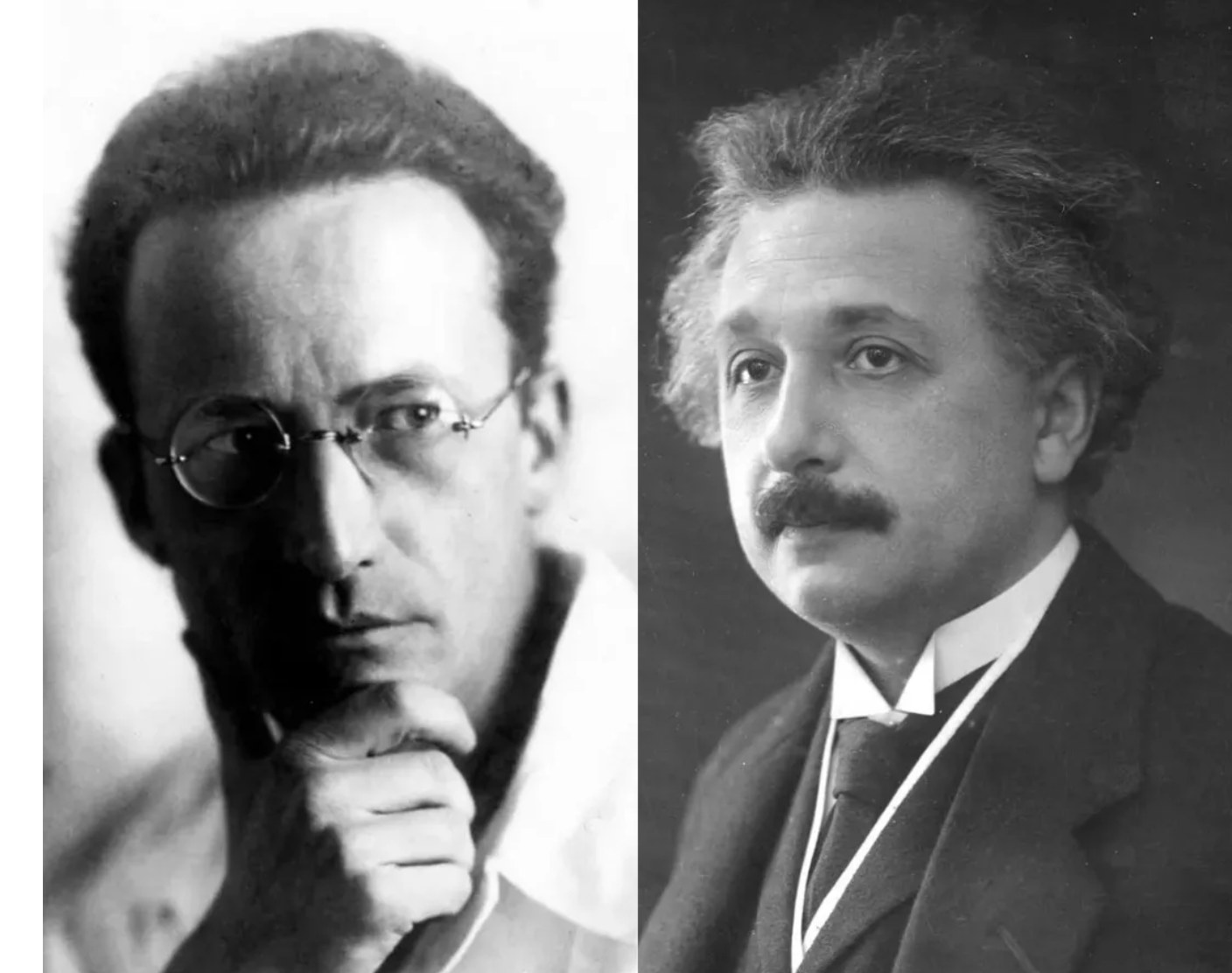
In a letter dated April 23, 1950 to Schrödinger, Einstein expressed his dissatisfaction with the prevailing interpretation of quantum mechanics and praised Schrödinger for his famous thought experiment involving a cat in a box.
According to Einstein quantum mechanics was incomplete and inconsistent with the notion of reality.
Einstein praised Schrödinger for this famous thought experiment, which illustrated the paradoxical nature of quantum superposition. He argued that the cat’s existence should not depend on the act of observation and that there must be a more complete description of reality.
The new theory of Substance reinterprets the same data that quantum mechanics is based on. It replaces the discontinuous picture of reality presented by quantum mechanics by a continuous picture. This does not change the positive results of quantum mechanics. However, it may simplify its mathematical model.
The unreality of quantum mechanics comes from its “point particle” assumption. This assumption is a good approximation for atoms and larger particles. But it is no longer appropriate at subatomic levels as explained in the essay The Uncertainty Principle.
The Superposition principle of quantum mechanics tries to explain the continuous nature of substance at subatomic level through a linear combination of many discrete states. This introduces the unreality of discontinuity. This is explained in the essay Quantum Superposition.
The Theory of Substance may initially be validated through very simple math presented in the essay The Rigidity of Mass.
The math of fluid mechanics may be used in a modified form for quantum mechanics.
A material body has mass. The free motion of a body manifests as a constant velocity. When this constant velocity is disturbed, inertia is manifested. Inertia is resistance. Inertia is manifested because the body has mass. The mass exists whether inertia is manifested or not. The whole purpose of inertia is to restore the free velocity of the body.
The above logic applies to light also. Light has a constant speed. If the constant speed of light is disturbed then inertia will be manifested. Inertia is manifested because light has consistency. Inertia of light restores the free velocity of light.
This principle may be applied not just to a single object, but to a whole system of bodies or substance.
Brainwashing occurs when a person cannot see what is there. He only sees what agrees with his mental state.
At one time people believed that the sun revolves around the earth. The Catholic Church pushed that as a fact on the population. It even punished Galileo for saying that it was earth that revolved around the sun.
The above is an example of a brainwashed state of mind, that could not see the inconsistency that Copernicus revealed with his brilliant observation and math. Similar problem was faced by Einstein about his brilliant ideas.
Today all kind of inconsistencies are simply swallowed by gullible people and even by scientists who cannot see inconsistency because of their mental fixations. It is so bad that they would rather change their view of reality instead.
This is happening today with respect to strange interpretations of the mathematics of General Relativity and Quantum Mechanics. Until such inconsistencies are confronted head on as demanded by The Scientific Method, the scientific progress will remain at a standstill.
Yes, there is mind-blowing progress in Technology, but let’s not confuse that with scientific progress.