Physics Materials

CircumhorizonArcAcon

The Physics Classroom

Gamow: One, Two, Three… Infinity

Asimov: Understanding Physics Volume 1

Asimov: Understanding Physics Volume 2

Asimov: Understanding Physics Volume 3

Schaum Beginning Physics I

Schaum beginning Physics II

Schaum Modern Physics

The Physics Hypertextbook

Newton’s Principia

.

Subject Clearing (old-4)

Math

Please see The Book of Subject Clearing

Subject Clearing, along with Word Clearing, is the most powerful tool currently available to bring clarity to mind.

When one is studying the basic postulates and fundamental concepts of a subject it is very important to be able to detect hidden assumptions and subjective opinions. Such erroneous ideas can be very pervasive, and may even enter the definitions of words provided in dictionaries.

The true purpose of study is to resolve inconsistencies (things that do not make sense) as you come across them in a subject or in life. This develops clarity of mind and the ability to think fast on your feet.

Since additional information on a subject may easily be accessed through Internet these days, the purpose of study is not to memorize but to improve one’s critical thinking.

The following procedure helps one become aware of hidden assumptions and subjective opinions related to a subject or any area of life.

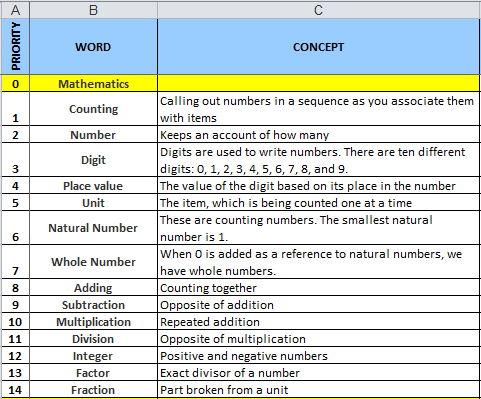
1.    Make a list of key words in that subject.

Skim through the chapter that you are going to study, and make a list of key words. Put that list on an Excel worksheet. This list may grow as your studies get deeper into the subject.

Look up the broad concept and definitions for each key word, as described in Word Clearing, and note it down on the Excel worksheet.

2.    Gradually build upon each concept for that subject.

Study the materials of the subject one paragraph at a time. Reduce a paragraph to its main thought and note it down in an editable document on computer. Do this before proceeding to the next paragraph.

When it is difficult to reduce the paragraph then look for words that may not be clear in that context. If the difficulty persists then note down the confusion with the “main thought” in that paragraph. It may get clarified by something you read later.

Note down any additional conceptual understanding and questions next to the appropriate word on the Excel worksheet.

3.    Arrange the key words with their concepts in proper sequence.

The concepts in a subject always evolve in a sequence. This can easily be seen in Mathematics and Science.

In Excel, you may separate the key words on two different worksheets categorized as “fundamental concepts” and “derived concepts”. Then arrange the concepts in each worksheet in the order they evolved.

This sequence of the evolution of these concepts may not be linear but multi-dimensional . So, to look at the key words in different sequences, you may create “priority columns” in the worksheet with a number assigned to each key word. The whole idea is to arrange these words in different ways to examine the connections among them.

4.    Note any inconsistencies among the concepts and clarify them.

As the study of the subject progresses and better understanding comes about, rearrange the list of key words to examine consistency among the various concepts. You are looking for things that appear inconsistent and do not make sense. There may be holes among these concepts that need to be filled.

Deeper research may be required to discover such holes and fill them. First review your materials to clarify any inconsistency. If it does not clarify easily then note it down on the worksheet and research through other materials in the library or on Internet.

5.    Clarify the fundamentals of the subject as a priority.

The consistency of the fundamentals determines the consistency of the whole subject. Any inconsistency at the fundamental level must be handled as a priority. For example, a unified theory is desperately being looked for in the subject of Physics, which could bring the fundamentals of Newtonian Physics, the Theory of Relativity, and Quantum Mechanics in line.

There are likely to be many contributors to a subject who may use different words for the same concept. This is the case with religious knowledge from different cultures. Group such words together to discover inconsistencies among concepts.

Study of inconsistencies may lead to discovery of arbitrary assumptions that were made in the absence of knowledge, or you may find erroneous observation, or simply some ideas that are taken for granted. This may reveal gaps in the subject itself. Develop your own understanding by seeking consistency among these concepts.

6.    Make the subject as complete as possible.

There are many examples in the subject of religion where gaps in knowledge are hidden under assumptions and dubious explanations. This may be the case with any subject where inconsistencies abound. Follow up on inconsistencies, which may then reveal gaps in the subject. Real progress then becomes possible.

Fill gaps in the subject with wider research. Make the subject as complete as possible through direct experience and experimentation.

.

Word Clearing (old)

words3

Please see Word Clearing.

When there is confusion in the study materials, the first thing to do is to isolate the area of confusion and check the understanding of the words used to explain that area. Hopefully that would handle the confusion or, at least, narrow it down. This is because

Words and symbols form our basic understanding.

A word can have different definitions and many shades of them. The cause of the confusion is obvious when the definition of a word is not known. The cause, however, is difficult to trace when you know the definition but you don’t know that it is the wrong one. The context of the word may be such that it requires a definition, or a shade of definition, which is different from the one you are using.

It is the tendency of the mind to fill the missing definition by some preconceived projection. Therefore, it is very important to examine the standard definitions of the word. The following procedure helps determine the correct definitions for words in study materials.

1.    Determine the broad concept of the word.

See how the broad concept of the word fits in the present context. You may find the broad concept listed under ‘history’, ‘origin’, or ‘derivation’ of the word in a dictionary. The following broad concepts for some words are taken from “Dictionary of Word Origins” by John Ayto

The word STUDY comes from a Latin word meaning “eagerness, intense application”.

The word MATHEMATICS comes from a Greek word meaning “something learned”.

The word ARITHMETIC comes from Greek, ARITHMOS number + TECHNE skill, which means “number skill”.

2.    Look up the definitions of the word.

Look up the standard definitions provided for that word in a good but simple dictionary. Visualize the definitions as you look them up. You may sketch diagrams on paper, or make models with bits and pieces, or even make detailed models with clay.

To get a better idea you may bring up the images for that word on the Internet. Make examples of different definitions to understand the differences, and demonstrate them to obtain clarity.

Use the word in your own sentences to get further clarity on a definition. Relate the different definitions to your experiences to make them real.

4.    Look up words in definitions as necessary.

If a definition contains a word that is not quite clear then look it up per this procedure. This may sometime get you in a chain of words. List the words as you look them up, and cross them out as they are cleared up. It is okay to look up the same word many times. Each time you look it up you may pick up a new dimension to its meaning.

5.    Determine the definition that fits the context.

Once you have understood the basic concept and have adequately examined all the definitions of the word, determine the definition that fits the context the best. Then review that area to see if the confusion has cleared up.

Keep examining the definition of words in that area until the confusion clears up fully. Continue with the next step of subject clearing.

.

Einstein’s 1905 Paper on Relativity (Part 2)

OLYMPUS DIGITAL CAMERA

This version is obsolete.

ReferenceDisturbance Theory

.

This is continuation of the examination of Einstein’s postulates underlying his theory of Relativity, specifically, how these postulates were translated into his mathematics.

Einstein’s 1905 paper: http://www.fourmilab.ch/etexts/einstein/specrel/www/#tex2html1

.

I. KINEMATICAL PART – § 1. Definition of Simultaneity

“Let us take a system of co-ordinates in which the equations of Newtonian mechanics hold good. In order to render our presentation more precise and to distinguish this system of co-ordinates verbally from others which will be introduced hereafter, we call it the ‘stationary system’.” 

Einstein takes up a system of co­ordinates in which equations of Newtonian mechanics hold well. These he calls inertial frames in which a body remains at rest or moves with constant linear velocity unless acted upon by forces. This property of a body is called inertia.

Inertia represents the resistance to change in motion of a body in space. When this resistance is overcome there is acceleration. We have assumed all along that space is completely permeable to matter. This is not so as evidenced by inertia.

Therefore, matter is ‘stationary’ relative to space when there is no acceleration. All inertial frames in “uniform motion” are actually stationary relative to space. This we identified earlier as the space reference frame (SRF).

“If a material point is at rest relatively to this system of co-ordinates, its position can be defined relatively thereto by the employment of rigid standards of measurement and the methods of Euclidean geometry, and can be expressed in Cartesian co-ordinates.”

A particle is essentially a disturbance propagating through space. This particle of disturbance has a configuration. As the complexity of this configuration increases, the inertia of the particle also increases, and its speed of propagation decreases. A light particle has the simplest configuration and its speed of propagation is ‘c’. An electron is a particle of complex configuration, whose speed is less than 1% of the speed of light. A neutron is a still more complex particle whose speed is thousand times still less.

Einstein’s “material point” refers to a matter particle that has a configuration more complex than that of a neutron. In its most complex configuration a matter particle shall have a speed that is infinitesimal compared to ‘c’. Euclidean geometry and Cartesian co-ordinates apply only to this extreme case of a matter particle. They do not apply to light particles.

All motion considered by Einstein is in reference to matter. This we identified earlier as the material reference frame (MRF). MRF represents a limiting case of a more general SRF that addresses a much wider range of particle configurations.

“If we wish to describe the motion of a material point, we give the values of its co-ordinates as functions of the time. Now we must bear carefully in mind that a mathematical description of this kind has no physical meaning unless we are quite clear as to what we understand by ‘time.’ We have to take into account that all our judgments in which time plays a part are always judgments of simultaneous events. If, for instance, I say, ‘That train arrives here at 7 o’clock,’ I mean something like this: ‘The pointing of the small hand of my watch to 7 and the arrival of the train are simultaneous events’.”

The natural speed of propagation in space then depends on the complexity of configuration of a disturbance as particle. This we perceive as motion that is balanced by the inertia of the particle. Any change in this balance is perceived as acceleration. Acceleration implies presence of force.

Motion is described by the property of TIME. Time essentially describes the sequence of change. A change is referred back to the previous step in the sequence. Thus, time lies in the continuity of a sequence, and it is unique to the configuration of that sequence.

To compare two time sequences in terms of simultaneity they must have comparable configurations. This is reflected in comparability in terms of inertia of the particles. The property of time shall then be a function of inertia. The “time” that we are used to is tied with the material level of inertia. In other words, our experience of time depends on the inertial characteristic of MRF (material reference frame).

The “time” associated with light shall depend on the configuration of the light particle or its inertia. To consider simultaneity of time for matter and light particles, their relative inertia shall have to be taken into account.

“It might appear possible to overcome all the difficulties attending the definition of ‘time’ by substituting ‘the position of the small hand of my watch’ for ‘time.’ And in fact such a definition is satisfactory when we are concerned with defining a time exclusively for the place where the watch is located; but it is no longer satisfactory when we have to connect in time series of events occurring at different places, or—what comes to the same thing—to evaluate the times of events occurring at places remote from the watch.”

The “time characteristics” of particles of different inertia shall be measurable from a “particle” that has no inertia.  Such a particle may be postulated as “undisturbed space”. We can then assess the “simultaneity” of two particles by determining their “time characteristics” in terms of their inertia.

The complexity of configuration, and thus the inertia of a particle may be measured in terms of “disturbance levels” as described earlier in The Disturbance Theory. On this scale the disturbance level of zero is a frequency of 1. The disturbance level of 77.6 represents a neutron. All higher disturbance levels represent matter. Earth has a disturbance level of about 235.

At the disturbance levels of matter the wavelength, period and speed become infinitesimal; and the sinusoidal variations in time and space become imperceptible. Time and space then acquire an appearance of constancy that does not exist at electrodynamic and quantum levels.

“We might, of course, content ourselves with time values determined by an observer stationed together with the watch at the origin of the co-ordinates, and co-ordinating the corresponding positions of the hands with light signals, given out by every event to be timed, and reaching him through empty space. But this co-ordination has the disadvantage that it is not independent of the standpoint of the observer with the watch or clock, as we know from experience. We arrive at a much more practical determination along the following line of thought.”

The idea of observer basically represents the characteristics of the reference frame that is being used to interpret motion. The time measured by Einstein’s clocks follows the inertial characteristics of matter. To combine the velocity of light with material velocity would be equivalent to assuming light to have same inertial characteristics as matter. Any mathematics that combines the velocity of light with material velocity using simple addition or subtraction shall lead to erroneous results. It would be like adding a penny to a dollar and calling it two coins of same magnitude.

Unfortunately, Einstein’s mathematics does just that in the rest of this section. We shall skip this mathematics and focus on those aspects of Einstein’s theory that make correct predictions of physical phenomena. Hopefully, a closer look at such aspects will provide better insight into Einstein’s thinking.

[To be continued…]

.

Einstein’s 1905 Paper on Relativity (Part 1)

17992213_10101196502121958_5555825604982154806_n

This version is obsolete.

Reference: Disturbance Theory

.

This examination of Einstein’s 1905 paper on relativity (see the link below) is being carried out to see if Einstein’s original postulates can be modified to bring better consistency among the Theory of Relativity and Newtonian Mechanics.

Einstein’s 1905 paper: http://www.fourmilab.ch/etexts/einstein/specrel/www/#tex2html1

Please note that the indented text below is from Einstein’s paper.

.

INTRODUCTION

“It is known that Maxwell’s electrodynamics—as usually understood at the present time—when applied to moving bodies, leads to asymmetries which do not appear to be inherent in the phenomena. Take, for example, the reciprocal electrodynamic action of a magnet and a conductor. The observable phenomenon here depends only on the relative motion of the conductor and the magnet, whereas the customary view draws a sharp distinction between the two cases in which either the one or the other of these bodies is in motion. For if the magnet is in motion and the conductor at rest, there arises in the neighbourhood of the magnet an electric field with a certain definite energy, producing a current at the places where parts of the conductor are situated. But if the magnet is stationary and the conductor in motion, no electric field arises in the neighbourhood of the magnet. In the conductor, however, we find an electromotive force, to which in itself there is no corresponding energy, but which gives rise—assuming equality of relative motion in the two cases discussed—to electric currents of the same path and intensity as those produced by the electric forces in the former case.”

This introductory paragraph from the paper mentions asymmetry observed in the relative motion between a magnet and a conductor. This asymmetry occurs in the reference frame of the lab, which results in different interpretation of the same phenomenon.

This “asymmetry” disappears when we use the magnetic lines of force, which are attached to the magnet, as the reference frame. The conductor moves relative to these lines of force the same way in either case producing the same result.

“Examples of this sort, together with the unsuccessful attempts to discover any motion of the earth relatively to the “light medium,” suggest that the phenomena of electrodynamics as well as of mechanics possess no properties corresponding to the idea of absolute rest. They suggest rather that, as has already been shown to the first order of small quantities, the same laws of electrodynamics and optics will be valid for all frames of reference for which the equations of mechanics hold good. We will raise this conjecture (the purport of which will hereafter be called the “Principle of Relativity”) to the status of a postulate, and also introduce another postulate, which is only apparently irreconcilable with the former, namely, that light is always propagated in empty space with a definite velocity c which is independent of the state of motion of the emitting body. These two postulates suffice for the attainment of a simple and consistent theory of the electrodynamics of moving bodies based on Maxwell’s theory for stationary bodies. The introduction of a “luminiferous ether” will prove to be superfluous inasmuch as the view here to be developed will not require an “absolutely stationary space” provided with special properties, nor assign a velocity-vector to a point of the empty space in which electromagnetic processes take place.”

This paragraph states that no motion of the earth relatively to the “light medium” has been discovered. This is incorrect because the very fact of radial acceleration due to inertia is a proof of motion relatively to the “light medium”.

This “light medium” is the space itself as established by Maxwell’s equations. The very fact that the speed of light is determined exclusively by the permeability and permittivity of space establishes space as the “light medium”. Light is a disturbance in space.

It was assumed that space could not be a medium because it could not be rigid to electromagnetic waves, while being completely permeable to matter. It was not realized that space puts up resistance to motion relative to it in the form of inertia. Thus space is not completely permeable to matter. Space resists the motion of matter. This resistance shows up as inertia.

Any motion relative to space requires force and it is accompanied by acceleration. Moons are always accelerating toward their planets.  Planets are always accelerating toward their stars. Stars are always accelerating toward the center of their galaxies and so on. There may appear to be no acceleration in the direction tangential to an orbit. But there is always a radial acceleration toward some center. When there is no force or acceleration, there is no motion relative to space.

There is no uniform motion without acceleration that travels in straight line. All Newtonian or Einstenian inertial frames are actually a single frame, which is at rest relative to space. This nicely explains the Principle of Relativity.

Any motion in this single frame is resisted by inertia. A fixed velocity in this frame shall result from a balance between acceleration and inertia. The velocity of light is finite and constant because there is a balance between an electromagnetic push of disturbance and the inertia of disturbed space.

If a Michelson-Morley experiment is conducted to compare the speed of light in the direction tangential to earth’s orbit and also normal to it, it is likely to observe a difference due to the centripetal acceleration of earth. Einstein’s assumption that there is no motion of the earth relative to the “light medium” is not fully justified.

An absence of inertia may be used as an absolute rest point from which to measure motion. This would also be an absence of electromagnetic frequency. Any motion relative to space will manifest some force due to inertia as acceleration.

The phenomena of electrodynamics as well as of mechanics, has inertia as a property common between them that can be referenced from the idea of undisturbed space.

Einstein postulates as the Principle of Relativity: “The same laws of electrodynamics and optics will be valid for all frames of reference for which the equations of mechanics hold good.”

This postulate assumes that light has same magnitude of inertial characteristics as matter. This assumption is not justified.

Einstein makes another postulate: “Light is always propagated in empty space with a definite velocity c which is independent of the state of motion of the emitting body.”

This postulate assumes that there is no property shared by light with the body that emits it, which control their respective velocities. This assumption is also not justified because the velocities of light and the emitting body are related by their respective inertia relative to inertialess space.

“The theory to be developed is based—like all electrodynamics—on the kinematics of the rigid body, since the assertions of any such theory have to do with the relationships between rigid bodies (systems of co-ordinates), clocks, and electromagnetic processes. Insufficient consideration of this circumstance lies at the root of the difficulties which the electrodynamics of moving bodies at present encounters.”

Essentially, Einstein uses RIGID MATTER as its reference frame. We may call it the Material Reference Frame or MRF. This reference frame does not properly account for the inertia associated with light and sub-atomic particles. It actually considers inertia of light particle (photon) to be zero.

The proper reference frame would however be SPACE. We may call it the Space Reference Frame or SRF. This reference frame shall account for the inertia associated with light and sub-atomic particles. It would not represent space by rigid coordinates. The SRF coordinate system shall take into account the varying characteristics of inertia of the particles being considered.

[To be continued…]

.