The Electromagnetic Spectrum (Old)

electromagnetic-spectrum

Reference: Disturbance Theory

.

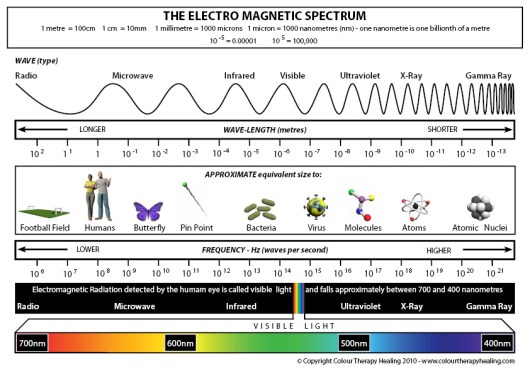
The variations in the frequency of field cover the whole electromagnetic spectrum. At the bottom of this spectrum lies the EMPTINESS of zero frequency. At the top is the mass as seen in the nucleus of an atom. The layers of this spectrum build up in the following sequence.

  1. Emptiness (theoretical)
  2. Radio waves
  3. Microwave radiation
  4. Terahertz radiation
  5. Infrared radiation
  6. Visible radiation
  7. Ultraviolet radiation
  8. X-ray radiation
  9. Gamma radiation
  10. Mass

This whole spectrum of field may be seen in an atom from its outermost boundary to its center. The gamma rays are seen to be emitted by the nucleus, and X-rays from inner electrons.

The substance of field appears in emptiness in the form of disturbance at the beginning of this spectrum. The disturbance has a frequency. The frequency maintains itself and does not disappear. This property is recognized as inertia. In general, inertia is the resistance of physical substance to any change in its state of motion. Any effort to change frequency activates the restoring force of inertia. Thus, inertia “pins down” a phenomenon made up of frequencies, against the backdrop of emptiness.

As we move up the spectrum, the frequency increases and the field become denser in terms of its cycles. Each cycle has constant energy equal to the Planck’s constant ‘h‘. Therefore, energy of the field increases at a location in proportion to the frequency and becomes more focused in character. This leads to quantization at higher frequencies.

The wavelength to period ratio is also constant as represented by ‘c‘. Therefore, both wavelength and period shrink together inversely proportional to frequency. This is like extensions of the field consolidating themselves and gaining in endurance with increase in frequency. We see the extensions of the field as SPACE and their endurance as TIME.

The constants described above ensure the continuity of different regions of the field that are at different frequencies. These regions are bounded by smooth gradients of frequency. These gradients manifest as tension or force. These forces then become part of the field. We recognize these forces as gravitational, electromagnetic, nuclear, etc. These forces differ in their nature depending on the sharpness of the gradient as well as on their relative position on the spectrum.

As energy increases with frequency and forces become stronger, inertia also increases to balance them. If forces are represented by acceleration (increased motion relative to itself) then inertia is represented by “negative” acceleration (quantization). Basic inertia appears as permeability and permittivity. It balances the dynamic of conversion between electric (kinetic) and magnetic (potential) aspects of a cycle. This shows up in the constant rate of propagation of electromagnetic disturbance within the field.

With increasing frequency, inertia seems to develop into a structure of disturbance, which we may refer to as “quantization into mass”. Actual mass appears to be made up of high frequency of infinitesimal cycles that border into forming a continuum. The quantization into mass seems to start out like “eddies are forming in a flow”. We may identify these “eddies” as the multitudes of quantum particles. Thus the primary characteristic of quantization into mass appears to be rotational.

The rotational nature of mass tends to pin it down and reduce its linear motion. This also increases inertia. We may relate this inertia to natural speeds of quantum particles as we do so for the speed of light. The natural tendency for disturbance is to spread at infinite speed, but that tendency gets checked by inertia into a balanced finite speed. As inertia increases the “free speed” of the phenomenon reduces.

External force when impressed on a field increases its frequency, and thus becomes internalized as inertia. This may describe the conservation of force of Faraday.

The Newton’s Laws of motion apply to inertia at the level of matter at the top of the electromagnetic spectrum. At this level force manifests as acceleration of the “quantized” physical object, while inertia acts as “resistance to acceleration”. The balance of the two determines the “free speed” of the object.

Where the levels of inertia are far apart by many orders of magnitude, the vector addition is replaced by relativistic addition. A more exact algorithm needs to be developed to find the resultant motion of phenomena of different inertia interacting together.

.

SUMMARY

The Electromagnetic spectrum reduces to the emptiness of background as frequency goes to zero. Emptiness has no substance, which is represented by zero inertia. We may use it as the absolute reference point.

Substance seems to enter the picture with the disturbance of emptiness. We may look at the electromagnetic phenomenon whose substance is “disturbance”. The electromagnetic spectrum is a spectrum of this substance represented by inertia.

As the disturbance increases in frequency, its complexity increases. This is manifested as increase in inertia. Toward the upper end of the spectrum, where the frequency is very high, the inertia starts to manifest itself as particles of mass.

This spectrum is visible from the outer boundary of the atom to the nucleus at the center of the atom, as increasing substance and inertia.

.

Time and Period

Time

Reference: Disturbance Theory

.

Time is the property of endurance of a substance. In the absence of substance there is no endurance or time. The EMPTINESS (referenced earlier) is devoid of substance, and, therefore, it is also devoid of time.

Time is essentially the manifestation of change, which could be ephemeral or enduring. It could be a change in physical extensions perceived objectively; or it could be a change in mental abstractions experienced subjectively. The former is represented by the clock time; and the latter is simply felt inwardly.

We limit our considerations of time to changes in physical extensions perceived objectively.

We now consider physical substance broadly to be field, with matter as a special instance. The field is made up of cycles. The changes in frequencies of these cycles provide varying endurance or time. The duration of a single cycle is called a PERIOD.

The duration of field is made up of period of its cycles.

The period and wavelength of a cycle are closely related. If cycle is represented by a turn of a screw then period is the duration of that turn and wavelength is the advance made by the screw during that turn. The wavelength and period are proportional to each other.

The period is proportional to the wavelength of the cycle.

The ratio of wavelength to period is now considered a universal constant. This constant is ‘c’, known popularly as the speed of light. Like the Planck’s constant ‘h’, the ratio ‘c’ also remains constant for a cycle regardless of its frequency. Therefore, as frequency increase and cycles become denser, and both wavelength and period shrink as one.

As the period shrinks with increasing frequency the endurance of cycles increases.

Like the wavelength, period is also infinitesimal for matter and appears to be unchanging and absolute. It determines the character of time as absolute in relation to material objects. This is the clock time of Newton.

The infinitely enduring characteristic of matter represents the absolute time of Newton.

Space and time appear to be absolute and independent at the level of matter because their characteristics do not appear to vary. They do not appear to be related to each other by the universal constant ‘c’. We associate ‘c’ with the speed of light, which is unaffected by the usual speed of matter.

Newtonian mechanics works perfectly well at the level of matter, where cycles of field are infinitesimal in wavelength and period.

But when we consider “speeds closer to the speed of light”, we are actually considering phenomena that are closer to much smaller frequency and inertia of light. In this domain the cycles of field are finite in wavelength and period. They can be seen as dependent on each other by the proportionality constant ‘c’.

Relativistic mechanics comes into play for the field where cycles are not dense enough to have infinitesimal wavelength and period.

Relativistic addition replaces the vector addition of Newtonian mechanics where quantities being added are far apart in their velocity or frequency by many orders of magnitude. Einstein’s mathematical derivation of time dilation can now be understood better in terms of varying period of the field.

Einstein’s “time dilation” relates to the period of cycle increasing.

The cycles repeat in continuous sequence. This sequence is also a characteristic of time. The continuity of sequence is maintained despite changes in frequency. The frequency changes show up as gradients in the field. The gradient of frequency may reverse but time is not seen as reversing because, relative to perception, the change is always occurring in a “forward” sequence.

We perceive the flow of time in the “forward” sequence only.

It must be emphasized that space and time exist as properties of field and matter. They do not exist in the absence of field and matter.

Matter does not “move in space”; instead, it moves in the field and inertia represents the resistance to this motion.

Field is not a “condition in space”; instead it determies the varying conditions of space and time.

.

Space and Wavelength (old)

Space

Reference: Disturbance Theory

Space is the property of the extensions of a substance. In the absence of substance there are no extensions, and therefore, there is no space. The EMPTINESS (referenced earlier) is devoid of substance, and, therefore, it is also devoid of space.

Matter is the only substance we have known until recent past. We consider “space” to be those regions of the universe that are not by filled by matter. The nature of space has been a mystery.

“Empty space” is the region of the universe not filled by matter.

We see space occupied by matter to be three-dimensional, so we consider “empty space” to be three-dimensional. We see the space occupied by matter to be rigid, so we measure “empty space” as if it were rigid. But this has not been satisfactory.

There have been considerations since ancient times that “empty space” is filled by invisible matter called aether. Aether is no longer considered to be matter, but its actual nature is still disputed. At present, “empty space” seems to be defined mathematically only.

We consider “empty space” as if it is filled by some unknown substance.

It is true that “empty space” cannot exist in the absence of extensions defined by some substance. In mid-19th century Michael Faraday, the great experimental researcher, proposed the idea of field to replace the notion of materialistic aether. This idea was supported by James Clerk Maxwell who went on to show mathematically that light was an example of this substance called field.

Faraday was the first to suggest that the “empty space” is actually the electromagnetic field.

However, the idea of field was opposed by scientists who believed in “action at a distance” because of the work done earlier by Newton. But as Faraday pointed out, Newton himself was not comfortable with the notion of “action at a distance” even though his mathematics seem to explain it.  However, this opposition persisted because the nature of gravitational attraction was not understood. In the early part of 20th century, Einstein came up with the mathematics to explain gravity but its connection with the mathematics of electromagnetic field is still lacking.

The opposition to the idea of “field replacing aether” came from its lack of explanation for gravitational attraction.

However, it is pretty much established that “empty space” is a field, but the exact nature of that field is yet to be determined. The field is a more basic substance than matter. It has spatial dimensions. These spatial dimensions may be understood in terms of the extensions of its cycles.  The extension of a single cycle is called a WAVELENGTH.

The extensions of field are made up of wavelength of its cycles.

As frequency increases, more cycles occur within a measured interval. Thus cycles become denser and wavelengths shrink with increasing frequency. We may say that the extensions of field shrink and become increasingly “substantial” in areas where frequency is greater.

The wavelength of a cycle shrinks with increasing frequency.

We associate material characteristics with the characteristics of atom. An atom is made up of high frequency field that is rapidly increasing in frequency toward its center. The nucleus at the center of the atom has the highest frequency and the smallest wavelength. It has the characteristics of material.

The characteristic of matter is approached with increasing frequency and shrinking wavelength.

On the whole the wavelength of an atom is infinitesimal. It is so small that any fluctuations in its value are insignificant. Thus, it appears to be unchanging and absolute. it determines the character of the “space occupied” by matter. Thus it also seems to have absolute characteristics as “space”. This is the space of Newton.

The absolute space of Newton is essentially the field of infinitesimal wavelength that makes up matter.

The empty space right next to a material surface may carry a gradient of decreasing frequency and increasing wavelength because the way atoms are structured.  The wavelengths of field within an empty box may add up to the dimensions of the box, but they wouldn’t be distributed evenly within that box. Einstein’s theory of relativity talks about length contraction as an object approaches the velocity of light. This can now be better understood in terms of varying wavelength of the field.

The characteristic of “empty space” varies with wavelengths of field .

Field does not “occupy space”, as thought by many. Field’s extensions appear as space. Field is not a “condition in space”, as thought. Field is a disturbance in emptiness.

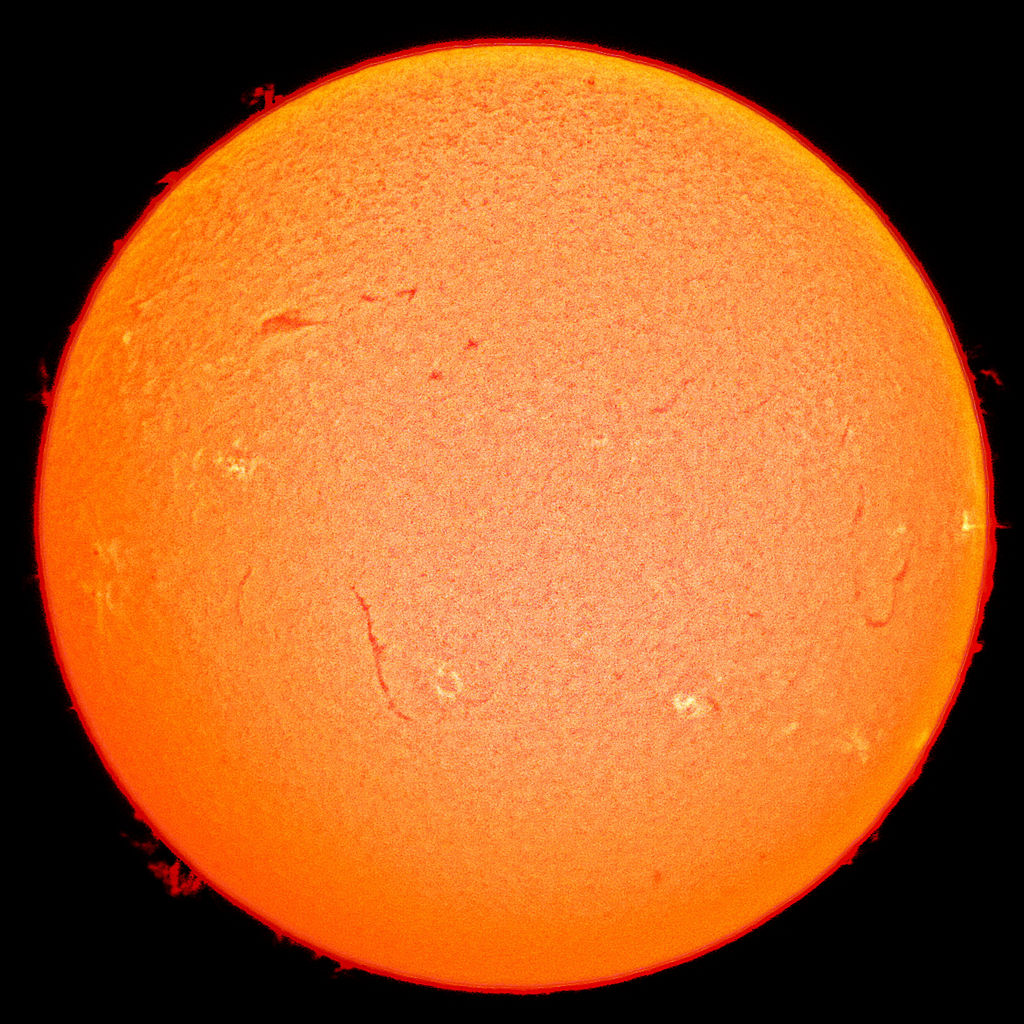
The background of sun, moon and stars should more properly be called field though we see it as “space”. The heavenly bodies are extremely dense regions of this field. They are not “matter in space”.

This universe is, therefore, made up of FIELD; and the background of this universe is EMPTINESS.

When we look at heavens, we are looking at the extensions of field among the stars and beyond.

.

Electromagnetic Spectrum (Wikipedia)


EM_Spectrum_Properties_edit.svg

Reference: Disturbance Theory

.

Parts from Wikipedia article are quoted in black. My comments follow in bold color italics.

Electromagnetic Spectrum – Wikipedia

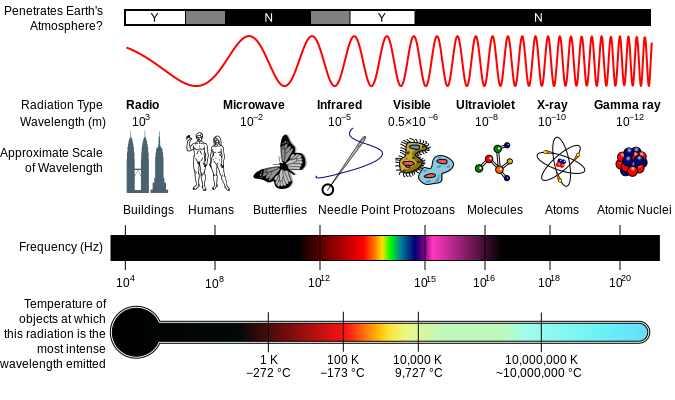
The electromagnetic spectrum is the entire range and scope (spectrum) of frequencies of electromagnetic radiation and their respective wavelengths and photon energies.

The Electromagnetic Spectrum of frequencies applies not only to the radiation but also to the fabric of the three-dimensional field. In this field the Faraday’s lines of force appear as frequency gradients.

The electromagnetic spectrum extends from below the low frequencies used for modern radio communication to gamma radiation at the short-wavelength (high-frequency) end, thereby covering wavelengths from thousands of kilometers down to a fraction of the size of an atom. Visible light lies toward the shorter end, with wavelengths from 400 to 700 nanometers. The limit for long wavelengths is the size of the universe itself, while it is thought that the short wavelength limit is in the vicinity of the Planck length. Until the middle of the 20th century it was believed by most physicists that this spectrum was infinite and continuous.

The lowest frequency on the electromagnetic spectrum shall theoretically be zero. At zero frequency there is no cycle, inertia, energy, extension or duration. In short, there is no substance, and therefore, no space or time. We may refer to this state as “absence of all phenomena”, or EMPTINESS. It shall act as a reference point for the universe, much like zero is the reference point for the scale.

As we move up from this point on the electromagnetic spectrum we have cycles appearing with increasing frequency. As a result, the field becomes denser, and the energy becomes more focused. This makes the substance of the field acquire more inertia. The extensions of the field become increasingly enduring, meaning both space and time become more apparent.

Nearly all types of electromagnetic radiation can be used for spectroscopy, to study and characterize matter. Other technological uses are described under electromagnetic radiation.

As the frequency increases different properties appear in interaction of field with matter. Field appears to condense into mass particles in the gamma range.

.

Comments on Energy

Sun energy

Reference: Disturbance Theory

.

Energy – Wikipedia

In physics, energy is the quantitative property that must be transferred to an object in order to perform work on, or to heat, the object. Energy is a conserved quantity; the law of conservation of energy states that energy can be converted in form, but not created or destroyed. The SI unit of energy is the joule, which is the energy transferred to an object by the work of moving it a distance of 1 metre against a force of 1 newton.

The fundamental unit of energy is the Planck’s constant ‘h’ that maps one cycle of back and forth conversion of electric and magnetic fields. Work is performed with the organization of these cycles into desired configurations. It appears that the number of these cycles does not increase or decrease; but they organize themselves in different ways. (See “Energy is not the ability to do work”)

Common forms of energy include the kinetic energy of a moving object, the potential energy stored by an object’s position in a force field (gravitational, electric or magnetic), the elastic energy stored by stretching solid objects, the chemical energy released when a fuel burns, the radiant energy carried by light, and the thermal energy due to an object’s temperature.

A uniformly moving (non-accelerating) body has fictitious motion only, which depends on an external frame of reference. By choosing an appropriate frame of reference, that velocity can be shown as zero. Therefore the kinetic energy is not because of “uniform motion”. The “kinetic energy” appears only at the moment of impact due to change in velocity.

Potential energy does not exist when a body is under equilibrium of forces. The potential energy appears only when the equilibrium of forces is disturbed, and a background force comes into play. In all instances when energy appears, active forces are present.

Mass and energy are closely related. Due to mass–energy equivalence, any object that has mass when stationary (called rest mass) also has an equivalent amount of energy whose form is called rest energy (in that frame of reference), and any additional energy (of any form) acquired by the object above that rest energy will increase the object’s total mass just as it increases its total energy. For example, after heating an object, its increase in energy could be measured as a small increase in mass, with a sensitive enough scale.

Both matter and field are physical substances. Matter has mass; similarly field has energy. Each cycle of field has energy equal to Planck’s constant ‘h’. Mass may be looked upon as resulting from a condensation of such cycles.

Living organisms require available energy to stay alive, such as the energy humans get from food. Human civilization requires energy to function, which it gets from energy resources such as fossil fuels, nuclear fuel, or renewable energy. The processes of Earth’s climate and ecosystem are driven by the radiant energy Earth receives from the sun and the geothermal energy contained within the earth.

All different forms of energies are configured from the basic cycle of the field of energy ‘h’.

.