Eddington 1927: Nature’s Plan of Structure

Nature-Plan

Reference: The Book of Physics

Note: The original text is provided below.
Previous / Next

Summary

.

Comments

.

Original Text

Let us now return to the observer who was so anxious to pick out a “right” frame of space. I suppose that what he had in mind was to find Nature’s own frame—the frame on which Nature based her calculations when she poised the planets under the law of gravity, or the reckoning of symmetry which she used when she turned the electrons on her lathe. But Nature has been too subtle for him; she has not left anything to betray the frame which she used. Or perhaps the concealment is not any particular subtlety; she may have done her work without employing a frame of space. Let me tell you a parable.

There was once an archaeologist who used to compute the dates of ancient temples from their orientation. He found that they were aligned with respect to the rising of particular stars. Owing to precession the star no longer rises in the original line, but the date when it was rising in the line of the temple can be calculated, and hence the epoch of construction of the temple is discovered. But there was one tribe for which this method would not work; they had built only circular temples. To the archaeologist this seemed a manifestation of extraordinary subtlety on their part; they had hit on a device which would conceal entirely the date when their temples were constructed. One critic, however, made the ribald suggestion that perhaps this particular tribe was not enthusiastic about astronomy.

Like the critic I do not think Nature has been particularly subtle in concealing which frame she prefers. It is just that she is not enthusiastic about frames of space. They are a method of partition which we have found useful for reckoning, but they play no part in the architecture of the universe. Surely it is absurd to suppose that the universe is planned in such a way as to conceal its plan. It is like the schemes of the White Knight—

But I was thinking of a plan
To dye one’s whiskers green,
And always use so large a fan
That they could not be seen.

If this is so we shall have to sweep away the frames of space before we can see Nature’s plan in its real significance. She herself has paid no attention to them, and they can only obscure the simplicity of her scheme. I do not mean to suggest that we should entirely rewrite physics, eliminating all reference to frames of space or any quantities referred to them; science has many tasks to perform, besides that of apprehending the ultimate plan of structure of the world. But if we do wish to have insight on this latter point, then the first step is to make an escape from the irrelevant space-frames.

This will involve a great change from classical conceptions, and important developments will follow from our change of attitude. For example, it is known that both gravitation and electric force follow approximately the law of inverse-square of the distance. This law appeals strongly to us by its simplicity; not only is it mathematically simple but it corresponds very naturally with the weakening of an effect by spreading out in three dimensions. We suspect therefore that it is likely to be the exact law of gravitational and electric fields. But although it is simple for us it is far from simple for Nature. Distance refers to a space-frame; it is different according to the frame chosen. We cannot make sense of the law of inverse-square of the distance unless we have first fixed on a frame of space; but Nature has not fixed on any one frame. Even if by some self-compensation the law worked out so as to give the same observable consequences whatever space-frame we might happen to choose (which it does not) we should still be misapprehending its real mode of operation. In chapter VI we shall try to gain a new insight into the law (which for most practical applications is so nearly expressed by the inverse-square) and obtain a picture of its working which does not drag in an irrelevant frame of space. The recognition of relativity leads us to seek a new way of unravelling the complexity of natural phenomena.

.

Eddington 1927: Einstein’s Principle of Relativity

Einstein

Reference: The Book of Physics

Note: The original text is provided below.
Previous / Next

Summary

.

Comments

.

Original Text

The modest observer mentioned in the first chapter was faced with the task of choosing between a number of frames of space with nothing to guide his choice. They are different in the sense that they frame the material objects of the world, including the observer himself, differently; but they are indistinguishable in the sense that the world as framed in one space conducts itself according to precisely the same laws as the world framed in another space. Owing to the accident of having been born on a particular planet our observer has hitherto unthinkingly adopted one of the frames; but he realizes that this is no ground for obstinately asserting that it must be the right frame. Which is the right frame?

At this juncture Einstein comes forward with a suggestion—”You are seeking a frame of space which you call the right frame. In what does its rightness consist?”

You are standing with a label in your hand before a row of packages all precisely similar. You are worried because there is nothing to help you decide which of the packages it should be attached to. Look at the label and see what is written on it. Nothing.

“Right” as applied to frames of space is a blank label. It implies that there is something distinguishing a right frame from a wrong frame; but when we ask what is this distinguishing property, the only answer we receive is “Rightness”, which does not make the meaning clearer or convince us that there is a meaning.

I am prepared to admit that frames of space in spite of their present resemblance may in the future turn out to be not entirely indistinguishable. (I deem it unlikely, but I do not exclude it.) The future physicist might find that the frame belonging to Arcturus, say, is unique as regards some property not yet known to science. Then no doubt our friend with the label will hasten to affix it. “I told you so. I knew I meant something when I talked about a right frame.” But it does not seem a profitable procedure to make odd noises on the off-chance that posterity will find a significance to attribute to them. To those who now harp on a right frame of space we may reply in the words of Bottom the weaver— “Who would set his wit to so foolish a bird? Who would give a bird the lie, though he cry ‘cuckoo’ never so?”

And so the position of Einstein’s theory is that the question of a unique right frame of space does not arise. There is a frame of space relative to a terrestrial observer, another frame relative to the nebular observers, others relative to other stars. Frames of space are relative. Distances, lengths, volumes—all quantities of space-reckoning which belong to the frames—are likewise relative. A distance as reckoned by an observer on one star is as good as the distance reckoned by an observer on another star. We must not expect them to agree; the one is a distance relative, to one frame, the other is a distance relative to another frame. Absolute distance, not relative to some special frame, is meaningless.

The next point to notice is that the other quantities of physics go along with the frame of space, so that they also are relative. You may have seen one of those tables of “dimensions” of physical quantities showing how they are all related to the reckoning of length, time and mass. If you alter the reckoning of length you alter the reckoning of other physical quantities.

Consider an electrically charged body at rest on the earth. Since it is at rest it gives an electric field but no magnetic field. But for the nebular physicist it is a charged body moving at 1000 miles a second. A moving charge constitutes an electric current which in accordance with the laws of electromagnetism gives rise to a magnetic field. How can the same body both give and not give a magnetic field? On the classical theory we should have had to explain one of these results as an illusion. (There is no difficulty in doing that; only there is nothing to indicate which of the two results is the one to be explained away.) On the relativity theory both results are accepted. Magnetic fields are relative. There is no magnetic field relative to the terrestrial frame of space; there is a magnetic field relative to the nebular frame of space. The nebular physicist will duly detect the magnetic field with his instruments although our instruments show no magnetic field. That is because he uses instruments at rest on his planet and we use instruments at rest on ours; or at least we correct our observations to accord with the indications of instruments at rest in our respective frames of space.

Is there really a magnetic field or not? This is like the previous problem of the square and the oblong. There is one specification of the field relative to one planet, another relative to another. There is no absolute specification.

It is not quite true to say that all the physical quantities are relative to frames of space. We can construct new physical quantities by multiplying, dividing, etc.; thus we multiply mass and velocity to give momentum, divide energy by time to give horse-power. We can set ourselves the mathematical problem of constructing in this way quantities which shall be invariant, that is to say, shall have the same measure whatever frame of space may be used. One or two of these invariants turn out to be quantities already recognised in pre-relativity physics; “action” and “entropy” are the best known. Relativity physics is especially interested in invariants, and it has discovered and named a few more. It is a common mistake to suppose that Einstein’s theory of relativity asserts that everything is relative. Actually it says, “There are absolute things in the world but you must look deeply for them. The things that first present themselves to your notice are for the most part relative.”

Eddington 1927: “Common Sense” Objections

Argument

Reference: The Book of Physics

Note: The original text is provided below.
Previous / Next

Summary

.

Comments

.

Original Text

Before going further I must answer the critic who objects in the name of common sense. Space—his space—is so vivid to him. “This object is obviously here; that object is just there. I know it; and I am not going to be shaken by any amount of scientific obscurantism about contraction of measuring rods.”

We have certain preconceived ideas (about location in space) which have come down to us from ape-like ancestors. They are deeply rooted in our mode of thought, so that it is very difficult to criticize them impartially and to realise the very insecure foundation on which they rest. We commonly suppose that each of the objects surrounding us has a definite location in space and that we are aware of the right location. The objects in my study are actually in the positions where I am “aware” that they are; and if an observer (on another star) surveying the room with measuring rods, etc., makes out a different arrangement of location, he is merely spinning a scientific paradox which does not shake the real facts of location obvious to any man of common sense. This attitude rejects with contempt the question, “How am I aware of the location?” If the location is determined by scientific measurements with elaborate precautions, we are ready enough to suggest all sorts of ways in which the apparatus might have misbehaved; but if the knowledge of location is obtained with no precautions, if it just comes into our heads unsought, then it is obviously true and to doubt it would be flying in the face of common sense! We have a sort of impression (although we do not like to acknowledge it) that the mind puts out a feeler into space to ascertain directly where each familiar object is. That is nonsense; our common sense knowledge of location is not obtained that way. Strictly it is sense knowledge, not common sense knowledge. It is partly obtained by touch and locomotion; such and such an object is at arm’s length or a few steps away. Is there any essential difference (other than its crudity) between this method and scientific measurements with a scale? It is partly obtained by vision—a crude version of scientific measurement with a theodolite. Our common knowledge of “where things are” is not a miraculous revelation of unquestionable authority; it is inference from observations of the same kind as, but cruder than, those made in a scientific survey. Within its own limits of accuracy the scheme of location of objects that I am instinctively “aware” of is the same as my scientific scheme of location, or frame of space.

When we use a carefully made telescope lens and a sensitized plate instead of the crystalline lens and retina of the eye we increase the accuracy but do not alter the character of our survey of space. It is by this increase of refinement that we have become “aware” of certain characteristics of space which were not known to our ape-like ancestor when he instituted the common ideas that have come down to us. His scheme of location works consistently so long as there is no important change in his motion (a few miles a second makes no appreciable difference); but a large change involves a transition to a different system of location which is likewise self-consistent, although it is inconsistent with the original one. Having any number of these systems of location, or frames of space, we can no longer pretend that each of them indicates “just where things are”. Location is not something supernaturally revealed to the mind; it is a kind of conventional summary of those properties or relations of objects which condition certain visual and tactual sensations.

Does not this show that “right” location in space cannot be nearly so important and fundamental as it is made out to be in the Newtonian scheme of things? The different observers are able to play fast and loose with it without ill effects.

Suppose that location is, I will not say, entirely a myth, but not quite the definite thing it is made out to be in classical physics; that the Newtonian idea of location contains some truth and some padding, and it is not the truth but the padding that our observers are quarrelling over. That would explain a great deal. It would explain, for instance, why all the forces of Nature seem to have entered into a conspiracy to prevent our discovering the definite location of any object (its position in the “right” frame of space); naturally they cannot reveal it, if it does not exist.

.

Eddington 1927: Frames of Space

Relativity

Reference: The Book of Physics

Note: The original text is provided below.
Previous / Next

Summary

.

Comments

.

Original Text

We can now return to the quarrel between the nebular physicists and ourselves. One of us has a large velocity and his scientific measurements are seriously affected by the contraction of his scales. Each has hitherto taken it for granted that it is the other fellow who is making the mistake. We cannot settle the dispute by appeal to experiment because in every experiment the mistake introduces two errors which just compensate one another.

It is a curious sort of mistake which always carries with it its own compensation. But remember that the compensation only applies to phenomena actually observed or capable of observation. The compensation does not apply to the intermediate part of our deduction—that system of inference from observation which forms the classical physical theory of the universe.

Suppose that we and the nebular physicists survey the world, that is to say we allocate the surrounding objects to their respective positions in space. One party, say the nebular physicists, has a large velocity; their yard-measures will contract and become less than a yard when they measure distances in a certain direction; consequently they will reckon distances in that direction too great. It does not matter whether they use a yard-measure, or a theodolite, or merely judge distances with the eye; all methods of measurement must agree. If motion caused a disagreement of any kind, we should be able to determine the motion by observing the amount of disagreement; but, as we have already seen, both theory and observation indicate that there is complete compensation. If the nebular physicists try to construct a square they will construct an oblong. No test can ever reveal to them that it is not a square; the greatest advance they can make is to recognise that there are people in another world who have got it into their heads that it is an oblong, and they may be broadminded enough to admit that this point of view, absurd as it seems, is really as defensible as their own. It is clear that their whole conception of space is distorted as compared with ours, and ours is distorted as compared with theirs. We are regarding the same universe, but we have arranged it in different spaces. The original quarrel as to whether they or we are moving with the speed of 1000 miles a second has made so deep a cleavage between us that we cannot even use the same space.

Space and time are words conveying more than one meaning. Space is an empty void; or it is such and such a number of inches, acres, pints. Time is an ever-rolling stream; or it is something signaled to us by wireless. The physicist has no use for vague conceptions; he often has them, alas! But he cannot make real use of them. So when he speaks of space it is always the inches or pints that he should have in mind. It is from this point of view that our space and the space of the nebular physicists are different spaces; the reckoning of inches and pints is different. To avoid possible misunderstanding it is perhaps better to say that we have different frames of space—different frames to which we refer the location of objects. Do not, however, think of a frame of space as something consciously artificial; the frame of space comes into our minds with our first perception of space. Consider, for example, the more extreme case when the FitzGerald contraction is one-half. If a man takes a rectangle 2” x 1” to be a square it is clear that space must have dawned on his intelligence in a way very different from that in which we have apprehended it.

The frame of space used by an observer depends only on his motion. Observers on different planets with the same velocity (i.e. having zero relative velocity) will agree as to the location of the objects of the universe; but observers on planets with different velocities have different frames of location. You may ask, “How can I be so confident as to the way in which these imaginary beings will interpret their observations?” If that objection is pressed I shall not defend myself; but those who dislike my imaginary beings must face the alternative of following the argument with mathematical symbols. Our purpose has been to express in a conveniently apprehensible form certain results which follow from terrestrial experiments and calculations as to the effect of motion on electrical, optical and metrical phenomena. So much careful work has been done on this subject that science is in a position to state what will be the consequence of making measurements with instruments travelling at high speed—whether instruments of a technical kind or, for example, a human retina. In only one respect do I treat my nebular observer as more than a piece of registering apparatus; I assume that he is subject to a common failing of human nature, viz. he takes it for granted that it was his planet that God chiefly had in mind when the universe was created. Hence he is (like my reader perhaps?) disinclined to take seriously the views of location of those people who are so misguided as to move at 1000 miles a second relatively to his parish pump.

An exceptionally modest observer might take some other planet than his own as the standard of rest. Then he would have to correct all his measurements for the FitzGerald contraction due to his own motion with respect to the standard, and the corrected measures would give the space-frame belonging to the standard planet as the original measures gave the space-frame of his own planet. For him the dilemma is even more pressing, for there is nothing to guide him as to the planet to be selected for the standard of rest. Once he gives up the naive assumption that his own frame is the one and only right frame the question arises, “Which then of the innumerable other frames is right?” There is no answer, and so far as we can see no possibility of an answer. Meanwhile all his experimental measurements are waiting unreduced, because the corrections to be applied to them depend on the answer. I am afraid our modest observer will get rather left behind by his less humble colleagues.

The trouble that arises is not that we have found anything necessarily wrong with the frame of location that has been employed in our system of physics; it has not led to experimental contradictions. The only thing known to be “wrong” with it is that it is not unique. If we had found that our frame was unsatisfactory and another frame was preferable, that would not have caused a great revolution of thought; but to discover that ours is one of many frames, all of which are equally satisfactory, leads to a change of interpretation of the significance of a frame of location.

.

Eddington 1927: FitzGerald Contraction

Contraction

Reference: The Book of Physics

Note: The original text is provided below.
Previous / Next

Summary

.

Comments

.

Original Text

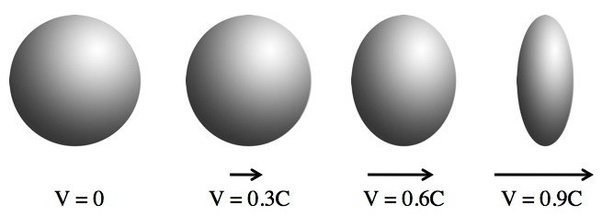
We can best start from the following fact. Suppose that you have a rod moving at very high speed. Let it first be pointing transverse to its line of motion. Now turn it through a right angle so that it is along the line of motion. The rod contracts.  It is shorter when it is along the line of motion than when it is across the line of motion.

This contraction, known as the FitzGerald contraction, is exceedingly small in all ordinary circumstances.  It does not depend at all on the material of the rod but only on the speed. For example, if the speed is 19 miles a second—the speed of the earth round the sun—the contraction of length is 1 part in 200,000,000, or 2 ½ inches in the diameter of the earth.

This is demonstrated by a number of experiments of different kinds of which the earliest and best known is the Michelson-Morley experiment first performed in 1887, repeated more accurately by Morley and Miller in 1905, and again by several observers within the last year or two. I am not going to describe these experiments except to mention that the convenient way of giving your rod a large velocity is to carry it on the earth which moves at high speed round the sun. Nor shall I discuss here how complete is the proof afforded by these experiments. It is much more important that you should realise that the contraction is just what would be expected from our current knowledge of a material rod.

You are surprised that the dimensions of a moving, rod can be altered merely by pointing it different ways.  You expect them to remain unchanged. But which rod are you thinking of? (You remember my two tables.)  If you are thinking of continuous substance, extending in space because it is the nature of substance to occupy space, then there seems to be no valid cause for a change of dimensions. But the scientific rod is a swarm of electrical particles rushing about and widely separated from one another. The marvel is that such a swarm should tend to preserve any definite extension. The particles, however, keep a certain average spacing so that the whole volume remains practically steady; they exert electrical forces on one another, and the volume which they fill corresponds to a balance between the forces drawing them together and the diverse motions tending to spread them apart. When the rod is set in motion these electrical forces change. Electricity in motion constitutes an electric current. But electric currents give rise to forces of a different type from those due to electricity at rest, viz. magnetic forces. Moreover these forces arising from the motion of electric charges will naturally be of different intensity in the directions along and across the line of motion.

By setting in motion the rod with all the little electric charges contained in it we introduce new magnetic forces between the particles. Clearly the original balance is upset, and the average spacing between the particles must alter until a new balance is found. And so the extension of the swarm of particles—the length of the rod—alters.

There is really nothing mysterious about the FitzGerald contraction. It would be an unnatural property of a rod pictured in the old way as continuous substance occupying space in virtue of its substantiality; but it is an entirely natural property of a swarm of particles held in delicate balance by electromagnetic forces, and occupying space by buffeting away anything that tries to enter. Or you may look at it this way: your expectation that the rod will keep its original length presupposes, of course, that it receives fair treatment and is not subjected to any new stresses. But a rod in motion is subjected to a new magnetic stress, arising not from unfair outside tampering but as a necessary consequence of its own electrical constitution; and under this stress the contraction occurs. Perhaps you will think that if the rod were rigid enough it might be able to resist the compressing force. That is not so; the FitzGerald contraction is the same for a rod of steel and for a rod of  india-rubber; the rigidity and the compressing stress are  bound up with the constitution in such a way that if one is large so also is the other. It is necessary to rid our minds of the idea that this failure to keep a constant length is an imperfection of the rod; it is only imperfect as compared with an imaginary “something” which has not this electrical constitution—and therefore is not material at all. The FitzGerald contraction is not an imperfection but a fixed and characteristic property of matter, like inertia.

We have here drawn a qualitative inference from the electrical structure of matter; we must leave it to the mathematician to calculate the quantitative effect. The problem was worked out by Lorentz and Larmor about 1900. They calculated the change in the average spacing of the particles required to restore the balance after it had been upset by the new forces due to the change of motion of the charges. This calculation was found to give precisely the FitzGerald contraction, i.e. the amount already inferred from the experiments above mentioned. Thus we have two legs to stand on. Some will prefer to  trust the results because they seem to be well established  by experiment; others will be more easily persuaded by  the knowledge that the FitzGerald contraction is a  necessary consequence of the scheme of electromagnetic laws universally accepted since the time of Maxwell. Both experiments and theories sometimes go wrong; so it is just as well to have both alternatives.

.