Eddington 1927: FitzGerald Contraction

Contraction

Reference: The Book of Physics

Note: The original text is provided below.
Previous / Next

Summary

.

Comments

.

Original Text

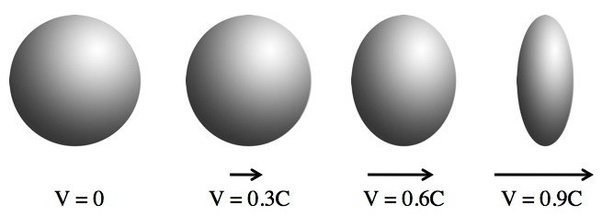
We can best start from the following fact. Suppose that you have a rod moving at very high speed. Let it first be pointing transverse to its line of motion. Now turn it through a right angle so that it is along the line of motion. The rod contracts.  It is shorter when it is along the line of motion than when it is across the line of motion.

This contraction, known as the FitzGerald contraction, is exceedingly small in all ordinary circumstances.  It does not depend at all on the material of the rod but only on the speed. For example, if the speed is 19 miles a second—the speed of the earth round the sun—the contraction of length is 1 part in 200,000,000, or 2 ½ inches in the diameter of the earth.

This is demonstrated by a number of experiments of different kinds of which the earliest and best known is the Michelson-Morley experiment first performed in 1887, repeated more accurately by Morley and Miller in 1905, and again by several observers within the last year or two. I am not going to describe these experiments except to mention that the convenient way of giving your rod a large velocity is to carry it on the earth which moves at high speed round the sun. Nor shall I discuss here how complete is the proof afforded by these experiments. It is much more important that you should realise that the contraction is just what would be expected from our current knowledge of a material rod.

You are surprised that the dimensions of a moving, rod can be altered merely by pointing it different ways.  You expect them to remain unchanged. But which rod are you thinking of? (You remember my two tables.)  If you are thinking of continuous substance, extending in space because it is the nature of substance to occupy space, then there seems to be no valid cause for a change of dimensions. But the scientific rod is a swarm of electrical particles rushing about and widely separated from one another. The marvel is that such a swarm should tend to preserve any definite extension. The particles, however, keep a certain average spacing so that the whole volume remains practically steady; they exert electrical forces on one another, and the volume which they fill corresponds to a balance between the forces drawing them together and the diverse motions tending to spread them apart. When the rod is set in motion these electrical forces change. Electricity in motion constitutes an electric current. But electric currents give rise to forces of a different type from those due to electricity at rest, viz. magnetic forces. Moreover these forces arising from the motion of electric charges will naturally be of different intensity in the directions along and across the line of motion.

By setting in motion the rod with all the little electric charges contained in it we introduce new magnetic forces between the particles. Clearly the original balance is upset, and the average spacing between the particles must alter until a new balance is found. And so the extension of the swarm of particles—the length of the rod—alters.

There is really nothing mysterious about the FitzGerald contraction. It would be an unnatural property of a rod pictured in the old way as continuous substance occupying space in virtue of its substantiality; but it is an entirely natural property of a swarm of particles held in delicate balance by electromagnetic forces, and occupying space by buffeting away anything that tries to enter. Or you may look at it this way: your expectation that the rod will keep its original length presupposes, of course, that it receives fair treatment and is not subjected to any new stresses. But a rod in motion is subjected to a new magnetic stress, arising not from unfair outside tampering but as a necessary consequence of its own electrical constitution; and under this stress the contraction occurs. Perhaps you will think that if the rod were rigid enough it might be able to resist the compressing force. That is not so; the FitzGerald contraction is the same for a rod of steel and for a rod of  india-rubber; the rigidity and the compressing stress are  bound up with the constitution in such a way that if one is large so also is the other. It is necessary to rid our minds of the idea that this failure to keep a constant length is an imperfection of the rod; it is only imperfect as compared with an imaginary “something” which has not this electrical constitution—and therefore is not material at all. The FitzGerald contraction is not an imperfection but a fixed and characteristic property of matter, like inertia.

We have here drawn a qualitative inference from the electrical structure of matter; we must leave it to the mathematician to calculate the quantitative effect. The problem was worked out by Lorentz and Larmor about 1900. They calculated the change in the average spacing of the particles required to restore the balance after it had been upset by the new forces due to the change of motion of the charges. This calculation was found to give precisely the FitzGerald contraction, i.e. the amount already inferred from the experiments above mentioned. Thus we have two legs to stand on. Some will prefer to  trust the results because they seem to be well established  by experiment; others will be more easily persuaded by  the knowledge that the FitzGerald contraction is a  necessary consequence of the scheme of electromagnetic laws universally accepted since the time of Maxwell. Both experiments and theories sometimes go wrong; so it is just as well to have both alternatives.

.

Eddington 1927: Structure of Atom

whirlpool

Reference: The Book of Physics

Note: The original text is provided below.
Previous / Next

Summary

.

Final Comments

.

Original Text

Between 1905 and 1908 Einstein and Minkowski introduced fundamental changes in our ideas of time and space. In 1911 Rutherford introduced the greatest change in our idea of matter since the time of Democritus. The reception of these two changes was curiously different. The new ideas of space and time were regarded on all sides as revolutionary; they were received with the greatest enthusiasm by some and the keenest opposition by others. The new idea of matter underwent the ordinary experience of scientific discovery; it gradually proved its worth, and when the evidence became overwhelmingly convincing it quietly supplanted previous theories. No great shock was felt.  And yet when I hear today protests against the Bolshevism of modern science and regrets for the old-established order, I am inclined to think that Rutherford, not Einstein, is the real villain of the piece. When we compare the universe as it is now supposed to be with the universe as we had ordinarily preconceived it, the most arresting change is not the rearrangement of space and time by Einstein but the dissolution of all that we regard as most solid into tiny specks floating in void. That gives an abrupt jar to those who think that things are more or less what they seem. The revelation by modern physics of the void within the atom is more disturbing than the revelation by astronomy of the immense void of interstellar space.

The atom is as porous as the solar system. If we eliminated all the unfilled space in a man’s body and collected his protons and electrons into one mass, the man would be reduced to a speck just visible with a magnifying glass.

This porosity of matter was not foreshadowed in the atomic theory. Certainly it was known that in a gas  like air the atoms are far separated, leaving a great deal  of empty space; but it was only to be expected that material with the characteristics of air should have relatively little substance in it, and “airy nothing” is a common phrase for the insubstantial. In solids the atoms are packed tightly in contact, so that the old atomic theory agreed with our preconceptions in regarding solid bodies as mainly substantial without much interstice.

The electrical theory of matter which arose towards the end of the nineteenth century did not at first alter this view. It was known that the negative electricity was concentrated into unit charges of very small bulk; but the other constituent of matter, the positive electricity, was pictured as a sphere of jelly of the same dimensions as the atom and having the tiny negative charges embedded in it. Thus the space inside a solid was still for the most part well filled.

But in 1911 Rutherford showed that the positive electricity was also concentrated into tiny specks. His scattering experiments proved that the atom was able to exert large electrical forces which would be impossible unless the positive charge acted as a highly concentrated source of attraction; it must be contained in a nucleus minute in comparison with the dimensions of the atom.  Thus for the first time the main volume of the atom was entirely evacuated, and a “solar system” type of atom was substituted for a substantial “billiard-ball”. Two years later Niels Bohr developed his famous theory on the basis of the Rutherford atom and since then rapid progress has been made. Whatever further changes of view are in prospect, a reversion to the old substantial atoms is unthinkable.

The accepted conclusion at the present day is that all varieties of matter are ultimately composed of two elementary constituents—protons and electrons. Electrically these are the exact opposites of one another, the proton being a charge of positive electricity and the electron a charge of negative electricity. But in other respects their properties are very different. The proton has 1840 times the mass of the electron, so that nearly all the mass of matter is due to its constituent protons.  The proton is not found unadulterated except in hydrogen, which seems to be the most primitive form of matter, its atom consisting of one proton and one electron. In other atoms a number of protons and a lesser number of electrons are cemented together to form  a nucleus; the electrons required to make up the balance are scattered like remote satellites of the nucleus,  and can even escape from the atom and wander freely  through the material. The diameter of an electron is about 1/50,000 of the diameter of an atom; that of the nucleus is not very much larger; an isolated proton is supposed to be much smaller still.

Thirty years ago there was much debate over the question of aether-drag—whether the earth moving round the sun drags the aether with it. At that time the solidity of the atom was unquestioned, and it was difficult to believe that matter could push its way through the aether without disturbing it. It was surprising and perplexing to find as the result of experiments that no convection of the aether occurred. But we now realise that the aether can slip through the atoms as easily as through the solar system, and our expectation is all the other way.

We shall return to the “solar system” atom in later chapters. For the present the two things which concern us are (i) its extreme emptiness, and (2) the fact that it is made up of electrical charges.

Rutherford’s nuclear theory of the atom is not usually counted as one of the scientific revolutions of the present century. It was a far-reaching discovery, but a discovery falling within the classical scheme of physics. The nature and significance of the discovery could be stated in plain terms, i.e. in terms of conceptions already current in science. The epithet “revolutionary” is usually reserved for two great modern developments—the Relativity Theory and the Quantum Theory. These are not merely new discoveries as to the content of the world; they involve changes in our mode of thought about the world. They cannot be stated immediately in plain terms because we have first to grasp new conceptions undreamt of in the classical scheme of physics.

I am not sure that the phrase “classical physics” has ever been closely defined. But the general idea is that the scheme of natural law developed by Newton in the Principia provided a pattern which all subsequent developments might be expected to follow. Within the four corners of the scheme great changes of outlook were possible; the wave-theory of light supplanted the corpuscular theory; heat was changed from substance (caloric) to energy of motion; electricity from continuous  fluid to nuclei of strain in the aether. But this was all allowed for in the elasticity of the original scheme.  Waves, kinetic energy, and strain already had their place in the scheme; and the application of the same conceptions to account for a wider range of phenomena was a tribute to the comprehensiveness of Newton’s original outlook.

We have now to see how the classical scheme broke down.

.

Eddington 1927: Introduction

Eddington
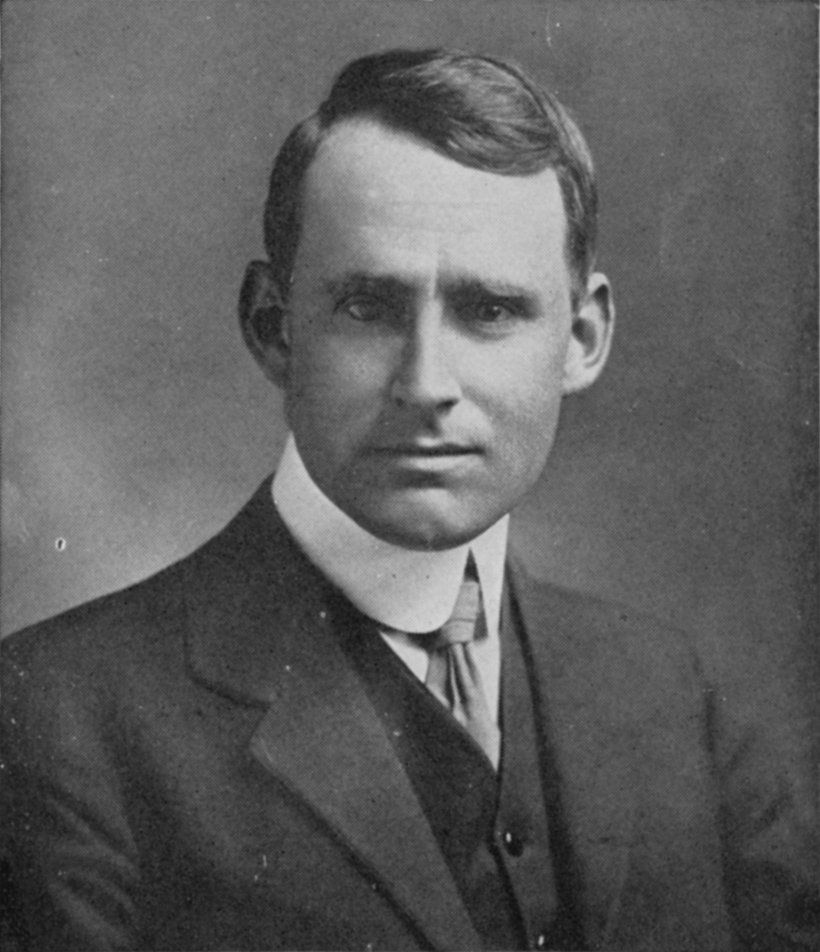
Professor A. S. Eddinton, one of the British observers of the total solar eclipse of May 29, 1919.

Reference: The Book of Physics

Note: The original text is provided below.
Previous / Next

Summary

.

Comments

.

Original Text

I have settled down to the task of writing these lectures and have drawn up my chairs to my two tables. Two tables! Yes; there are duplicates of every object about me—two tables, two chairs, two pens.

This is not a very profound beginning to a course which ought to reach transcendent levels of scientific philosophy. But we cannot touch bedrock immediately; we must scratch a bit at the surface of things first. And whenever I begin to scratch the first thing I strike is—my two tables.

One of them has been familiar to me from earliest years. It is a commonplace object of that environment which I call the world. How shall I describe it? It has extension; it is comparatively permanent; it is coloured; above all it is substantial. By substantial I do not merely mean that it does not collapse when I lean upon it; I mean that it is constituted of “substance” and by that word I am trying to convey to you some conception of its intrinsic nature. It is a thing; not like space, which is a mere negation; nor like time, which is—Heaven knows what! But that will not help you to my meaning because it is the distinctive characteristic of a “thing” to have this substantiality, and I do not think substantiality can be described better than by saying that it is the kind of nature exemplified by an ordinary table. And so we go round in circles. After all if you are a plain commonsense man, not too much worried with scientific scruples, you will be confident that you understand the nature of an ordinary table. I have even heard of plain men who had the idea that they could better understand the mystery of their own nature if scientists would discover a way of explaining it in terms of the easily comprehensible nature of a table.

Table No. 2 is my scientific table. It is a more recent acquaintance and I do not feel so familiar with it. It does not belong to the world previously mentioned— that world which spontaneously appears around me when I open my eyes, though how much of it is objective and how much subjective I do not here consider. It is part of a world which in more devious ways has forced itself on my attention. My scientific table is mostly emptiness. Sparsely scattered in that emptiness are ! numerous electric charges rushing about with great speed; but their combined bulk amounts to less than a billionth of the bulk of the table itself. Notwithstanding its strange construction it turns out to be an entirely efficient table. It supports my writing paper as satisfactorily as table No. 1 ; for when I lay the paper on it the little electric particles with their headlong speed keep on hitting the underside, so that the paper is maintained in shuttlecock fashion at a nearly steady level. If I lean upon this table I shall not go through; or, to be strictly accurate, the chance of my scientific elbow going through my scientific table is so excessively small that it can be neglected in practical life. Reviewing their properties one by one, there seems to be nothing to choose between the two tables for ordinary purposes; but when abnormal circumstances befall, then my scientific table shows to advantage. If the house catches fire my scientific table will dissolve quite naturally into scientific smoke, whereas my familiar table undergoes a metamorphosis of its substantial nature which I can only regard as miraculous.

There is nothing substantial about my second table. It is nearly all empty space—space pervaded, it is true, by fields of force, but these are assigned to the category of “influences”, not of “things”. Even in the minute part which is not empty we must not transfer the old notion of substance. In dissecting matter into electric charges we have travelled far from that picture of it which first gave rise to the conception of substance, and the meaning of that conception—if it ever had any— has been lost by the way. The whole trend of modern scientific views is to break down the separate categories of “things”, “influences”, “forms”, etc., and to substitute a common background of all experience. Whether we are studying a material object, a magnetic field, a geometrical figure, or a duration of time, our scientific information is summed up in measures; neither the apparatus of measurement nor the mode of using it suggests that there is anything essentially different in these problems. The measures themselves afford no ground for a classification by categories. We feel it necessary to concede some background to the measures—an external world; but the attributes of this world, except in so far as they are reflected in the measures, are outside scientific scrutiny. Science has at last revolted against attaching the exact knowledge contained in these measurements to a traditional picture-gallery of conceptions which convey no authentic information of the background and obtrude irrelevancies into the scheme of knowledge.

I will not here stress further the non-substantiality of electrons, since it is scarcely necessary to the present line of thought. Conceive them as substantially as you will, there is a vast difference between my scientific table with its substance (if any) thinly scattered in specks in a region mostly empty and the table of everyday conception which we regard as the type of solid reality —an incarnate protest against Berkleian subjectivism. It makes all the difference in the world whether the paper before me is poised as it were on a swarm of flies and sustained in shuttlecock fashion by a series of tiny blows from the swarm underneath, or whether it is supported because there is substance below it, it being the intrinsic nature of substance to occupy space to the exclusion of other substance; all the difference in conception at least, but no difference to my practical task of writing on the paper.

I need not tell you that modern physics has by delicate test and remorseless logic assured me that my second scientific table is the only one which is really there— wherever “there” may be. On the other hand I need not tell you that modern physics will never succeed in exorcising that first table—strange compound of external nature, mental imagery and inherited prejudice—which lies visible to my eyes and tangible to my grasp. We must bid good-bye to it for the present for we are about to turn from the familiar world to the scientific world revealed by physics. This is, or is intended to be, a wholly external world.

“You speak paradoxically of two worlds. Are they not really two aspects or two interpretations of one and the same world?”

Yes, no doubt they are ultimately to be identified after some fashion. But the process by which the external world of physics is transformed into a world of familiar acquaintance in human consciousness is outside the scope of physics. And so the world studied according to the methods of physics remains detached from the world familiar to consciousness, until after the physicist has finished his labours upon it. Provisionally, therefore, we regard the table which is the subject of physical research as altogether separate from the familiar table, without prejudging the question of their ultimate identification. It is true that the whole scientific inquiry starts from the familiar world and in the end it must return to the familiar world; but the part of the journey over which the physicist has charge is in foreign territory.

Until recently there was a much closer linkage; the physicist used to borrow the raw material of his world from the familiar world, but he does so no longer. His raw materials are aether, electrons, quanta, potentials, Hamiltonian functions, etc., and he is nowadays scrupulously careful to guard these from contamination by conceptions borrowed from the other world. There is a familiar table parallel to the scientific table, but there is no familiar electron, quantum or potential parallel to the scientific electron, quantum or potential. We do not even desire to manufacture a familiar counterpart to these things or, as we should commonly say, to “explain” the electron. After the physicist has quite finished his world-building a linkage or identification is allowed; but premature attempts at linkage have been found to be entirely mischievous.

Science aims at constructing a world which shall be symbolic of the world of commonplace experience. It is not at all necessary that every individual symbol that is used should represent something in common experience or even something explicable in terms of common experience. The man in the street is always making this demand for concrete explanation of the things referred to in science; but of necessity he must be disappointed. It is like our experience in learning to read. That which is written in a book is symbolic of a story in real life. The whole intention of the book is that ultimately a reader will identify some symbol, say BREAD, with one of the conceptions of familiar life. But it is mischievous to attempt such identifications prematurely, before the letters are strung into words and the words into sentences. The symbol A is not the counterpart of anything in familiar life. To the child the letter A would seem horribly abstract; so we give him a familiar conception along with it. “A was an Archer who shot at a frog.” This tides over his immediate difficulty; but he cannot make serious progress with word-building so long as Archers, Butchers, Captains, dance round the letters. The letters are abstract, and sooner or later he has to realise it. In physics we have outgrown archer and apple-pie definitions of the fundamental symbols. To a request to explain what an electron really is supposed to be we can only answer, “It is part of the A B C of physics.”

The external world of physics has thus become a world of shadows. In removing our illusions we have removed the substance, for indeed we have seen that substance is one of the greatest of our illusions. Later perhaps we may inquire whether in our zeal to cut out all that is unreal we may not have used the knife too ruthlessly. Perhaps, indeed, reality is a child which cannot survive without its nurse illusion. But if so, that is of little concern to the scientist, who has good and sufficient reasons for pursuing his investigations in the world of shadows and is content to leave to the philosopher the determination of its exact status in regard to reality. In the world of physics we watch a shadowgraph performance of the drama of familiar life. The shadow of my elbow rests on the shadow table as the shadow ink flows over the shadow paper. It is all symbolic, and as a symbol the physicist leaves it. Then comes the alchemist Mind who transmutes the symbols. The sparsely spread nuclei of electric force become a tangible solid; their restless agitation becomes the warmth of summer; the octave of aethereal vibrations becomes a gorgeous rainbow. Nor does the alchemy stop here. In the transmuted world new significances arise which are scarcely to be traced in the world of symbols; so that it becomes a world of beauty and purpose—and, alas, suffering and evil.

The frank realization that physical science is concerned with a world of shadows is one of the most significant of recent advances. I do not mean that physicists are to any extent preoccupied with the philosophical implications of this. From their point of view it is not so much a withdrawal of untenable claims as an assertion of freedom for autonomous development. At the moment I am not insisting on the shadowy and symbolic character of the world of physics because of its bearing on philosophy, but because the aloofness from familiar conceptions will be apparent in the scientific theories I have to describe. If you are not prepared for this aloofness you are likely to be out of sympathy with modern scientific theories, and may even think them ridiculous—as, I daresay, many people do.

It is difficult to school ourselves to treat the physical world as purely symbolic. We are always relapsing and mixing with the symbols incongruous conceptions taken from the world of consciousness. Untaught by long experience we stretch a hand to grasp the shadow, instead of accepting its shadowy nature. Indeed, unless we confine ourselves altogether to mathematical symbolism it is hard to avoid dressing our symbols in deceitful clothing. When I think of an electron there rises to my mind a hard, red, tiny ball; the proton similarly is neutral grey. Of course the colour is absurd—perhaps not more absurd than the rest of the conception—but I am incorrigible. I can well understand that the younger minds are finding these pictures too concrete and are striving to construct the world out of Hamiltonian functions and symbols so far removed from human preconception that they do not even obey the laws of orthodox arithmetic. For myself I find some difficulty in rising to that plane of thought; but I am convinced that it has got to come.

In these lectures I propose to discuss some of the results of modern study of the physical world which give most food for philosophic thought. This will include new conceptions in science and also new knowledge. In both respects we are led to think of the material universe in a way very different from that prevailing at the end of the last century. I shall not leave out of sight the ulterior object which must be in the mind of a Gifford Lecturer, the problem of relating these purely physical discoveries to the wider aspects and interests of our human nature. These relations cannot but have undergone change, since our whole conception of the physical world has radically changed. I am convinced that a just appreciation of the physical world as it is understood today carries with it a feeling of open-mindedness towards a wider significance transcending scientific measurement, which might have seemed illogical a generation ago; and in the later lectures I shall try to focus that feeling and make inexpert efforts to find where it leads. But I should be untrue to science if I did not insist that its study is an end in itself. The path of science must be pursued for its own sake, irrespective of the views it may afford of a wider landscape; in this spirit we must follow the path whether it leads to the hill of vision or the tunnel of obscurity. Therefore till the last stage of the course is reached you must be content to follow with me the beaten track of science, nor scold me too severely for loitering among its wayside flowers. That is to be the understanding between us. Shall we set forth?

.

Interpretation of Quantum Phenomena

Quantum Phenomena

Reference: Disturbance Theory

.

This paper summarizes a new interpretation of Quantum mechanics that was introduced in an earlier paper, Quantization & the Atom.

.

Postulates

The following postulates form the basis of the interpretation of quantum phenomena being presented here:

  1. The reference point that allows ultimate objectivity in viewing the universe is EMPTINESS.

  2. The UNIVERSE is intrinsically consistent, harmonious and continuous.

These two postulates are derived from the HEART SUTRA of Buddha. They support the perspective of “continuum of substance”.

.

Substance

The substance of this universe may be divided into two major categories:

(1) MATERIAL-SUBSTANCE – This is the structured aspect of substance. The smallest material-particle having the simplest structure is the hydrogen atom.  Atoms acquire greater substantial-ness by growing in size. They acquire more complex structures by combining in various ways as molecules and aggregates. The substantial-ness of material-substance is measured in terms of INERTIA.

(2) FIELD-SUBSTANCE – This is the non-structured aspect of substance that starts as a wave of disturbance. This wave congeals into greater substantial-ness as it follows paths of smaller and smaller radius. This leads to a pattern similar to a “whirlpool”. The substantial-ness increases as one approaches the center of this whirlpool formation.  The electromagnetic spectrum provides the progression of substantial-ness of field-substance. The substantial-ness of field-substance is measured in terms of QUANTIZATION.

.

Quantization

It may be pure speculation to say that substance starts with disturbance in emptiness; but it is valid to associate basic substance with disturbance; because, at lower quantization, the wave characteristics dominate. The particle characteristics come into picture with increasing quantization, which parallels the increasing frequency of electromagnetic spectrum.

Quantization increases as the disturbance follows a curved path of decreasing radius. Here we have the scenario of galaxy-like whirlpool formation, where quantization is increasing from periphery towards the center. Such a formation may apply to the atom, where maximum quantization at the center converges to form a “solid” nucleus. The ultimate quantization of field-particle thus leads to the formation of a material-particle. For material-particles, increasing quantization appears as increasing inertia.

Any particle with a quantization less than that of the simplest atom is a field-particle. Thus, electrons, protons and neutrons are all field-particles. The stand-alone electron may be regarded as having a whirlpool formation that has yet to form a solid nucleus at the center to give birth to an atom.

.

The Force Characteristics

Charge has the same significance for field-substance, as mass has for material-substance. The difference is that charge is animated and dynamic, whereas, mass is structured. The field and material substances exist in equilibrium with each other. Here charge provides animation to the structure of mass.

The force characteristic, such as,  electromagnetic and nuclear forces, originate at the level of field-substance. Their range is limited. But the force characteristic of gravitation appears at the level of material-substance. The range of gravitation is unlimited.

There seems to an inverse relationship between quantization/inertia and natural velocity of a particle. The higher is the inertia, the lesser is the natural velocity. The lower is the quantization, the greater is the natural velocity. The black hole at the center of a galaxy has so much inertia that it anchors the whole galaxy. Its natural velocity may be considered almost zero on an absolute scale. Light, on the other hand, has such a low level of quantization that it’s velocity is almost infinite.

.

Gravitation

The electrical lines of force were postulated by Faraday to originate and terminate at “centers” called charges. Such charges could be light years apart, and yet be connected by a line of force. [See Faraday: Thoughts on Ray Vibrations].

Each point on the electrical line of force, however, is surrounded by a circular magnetic lines of force. This is like the whirlpool formation mentioned earlier. Here the whirlpool is described by the magnetic lines of force, and the center line of the whirlpool is described by the electrical lines of force. The two ends of the electrical line of force ends at two charges. The quantization at each point of electrical line of force is provided by the radius of the magnetic line of force surrounding it. Thus there is a gradient of quantization along the line of force from one end to the other.

The gravitational lines of force between two material particles also carry a gradient of quantization. This force characteristic of this quantization pertains to the whole atom and not to parts within it as do electromagnetic and nuclear force characteristics. The lines of force representing whirlpool formation of the two material particles bend away from each other. But they interact with each other by aligning with each other. This results in material particles as centers of force being dragged toward each other. This is gravitation.

.

Uncertainty in Measurements

A decreasing gradient of quantization means that the field-substance is gradually becoming less substantial. Therefore, it’s characteristics of space and time are simultaneously becoming less substantial. A consolidated point location at a higher quantization may expand into a flimsy region at a lower quantization.

This explanation seems to underlie the Heisenberg principle of uncertainty. Heisenberg is basically saying that a point location no longer remains a point at lower quantization; instead it spreads out producing uncertainty.

But this uncertainty arises in reference to material-point. The lower quantization has its own point location as a field-point. In other words, the uncertainty disappears in reference to the field-point. Thus, we may account for uncertainty when we look within the atom by accounting for the decrease in quantization.

Quantization & the Atom


dl10c

Reference: Disturbance Theory

.
Quantization was the subject of Einstein’s very first paper in 1905, On a Heuristic Point of View about the Creatidn and Conversion of Light for which he was awarded Nobel Prize. Einstein wrote:

The energy of a ponderable body cannot be split into arbitrarily many, arbitrarily small parts, while the energy of a light ray, emitted by a point source of light is according to Maxwell’s theory (or in general according to any wave theory) of light distributed continuously over an ever increasing volume.”
“In fact, it seems to me that the observations on “black-body radiation”, photoluminescence, the production of cathode rays by ultraviolet light and other phenomena involving the emission or conversion of light can be better understood on the assumption that the energy of light is distributed discontinuously in space.”

Basically, according to Einstein, there appears to be a limit to which an electromagnetic cycle could be divided into smaller bits of energy. Per the relationship, E = hv, an electromagnetic cycle cannot have energy less than h. This limits the “size” of light quanta. Therefore, light or electromagnetic energy is not a continuous function in space as postulated by Maxwell. The size of this light quantum increases with the frequency of light.

.

Field and Material Substances

This paper of Einstein has another deep significance. Just like there is a limit to which matter could be subdivided in terms of “mass”, there is also a limit to which electromagnetic phenomena could be subdivided in terms of “energy”. In some respect, the “pure energy” of the electromagnetic phenomena is equivalent to the “mass” of matter. In fact, Einstein derived this equivalence of energy and mass, as E= mc2 in his fifth paper, “Does the inertia of a body depend on its energy context” that he published in 1905.

This equivalence of energy and mass puts the electromagnetic phenomena in the same general category as matter. We may define this general category as “substance”. We may refer to the electromagnetic phenomena as “field-substance” and matter as “material-substance”. This categorization also helps us differentiate the “pure energy” aspect of electromagnetic phenomena from the kinetic and potential energy associated with matter.

The smallest particle of material-substance exists as an atom. When the atom is subdivided into smaller particles we enter into the realm of field-substance. The atom forms the interface between material and field substances. The study of this interface is the subject of Quantum Mechanics.

.

Substance, Emptiness and Space

Newtonian mechanics, as well as the Quantum mechanics, is based on a belief in “particles in void”. According to this viewpoint, space and time exist seperate and independent of substance.

Based purely on extensive experimentation with electricity and magnetism, Faraday favored the alternate belief of “continuum of substance”. According to this viewpoint, space and time are integral characteristics of substance. When there is no substance, there is no space, and no time either. There is only emptiness..

The current interpretation of quantum mechanics is mostly from the viewpoint of “particles in void”. This essay on quantization takes the viewpoint of “continuum of substance”.

The universe thus consists of field-substance, material-substance, and their characteristic space and time. Space is thus part of the universe. This universe is then surrounded by emptiness. This emptiness is not only devoid of all substance but it is also devoid of space and time.

.

The Wave-particle Duality

Since we define electromagnetic phenomena as field-substance, we may refer to the light-quantum, introduced by Einstein, as a “field-particle”. A particle is characterized by how discrete it is as opposed to being continuous.

According to “continuum of substance”, the background is made up of the same field-substance that makes up the field-particle. The field-particle, therefore, appears like a pulse in the background. This imparts wave characteristics to the field-particle. But the increasing frequency differential between the field-particle and the background then also imparts particle characteristic of “discrete-ness”.

Thus, the wave properties dominate at lower frequencies; whereas, the particle properties dominate at higher frequencies. In any case, the field-particle is imbued with both wave and particle characteristics. This wave-particle duality is supported better from the perspective of “continuum of substance.”

.

The Meaning of Quantization

At lower frequencies the field-substance is very flimsy. But as it increases in frequency it becomes increasingly substantial. This process may be called “quantization”. Besides increased substantial-ness of the field-substance, quantization also refers to increased discrete-ness of the field-particle.

The spectrum of quantization parallels the electromagnetic spectrum. At the upper end of this spectrum we have material-particles. The lower end of this spectrum gradually approaches pure emptiness that is devoid of field-substance.

Thus, not only the substantial-ness, but also the very existence of the field-substance depends on its frequency. If there is no frequency there is no field-substance, and consequently no space and time. There is only emptiness.

Emptiness is not arrived at right below the frequency of “one”. Since the unit of time on which the frequency is based is arbitrary, this frequency can be given any number with a smaller unit of time and reduced further. An infinite series of reduced cycles thus exists before emptiness can be arrived at.

.

Particle Physics

The smallest material-particle is the atom. It forms the interface between material and field substances. The moment we break the atom we get particles that are less substantial than the atom. The sub-atomic particles belong to the category of field particles. They exist in the gamma range of the electromagnetic spectrum as obvious from their de Broglie wave-lengths.

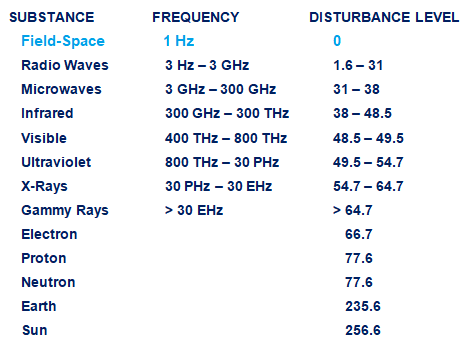
The following table is provided at The Disturbance Levels:

Disturbance Levels

The disturbance level expresses the frequency of electromagnetic radiation as a power of 2. It is calculated per the following formula.

Disturbance level,           D = (log f) / (log 2) = 138.4 + 3.322 log p

Where f is frequency in hertz
And p is momentum of material particles in S.I. Units.

The gamma range starts at the disturbance level of 64.7 (30 EHz). Electron appears at the beginning of the gamma range at a disturbance level of 66.7. The nucleons appear well into the gamma range at a disturbance level of 77.6.

The minimum disturbance level that applies to material particles is then 138.4. Below this level we are dealing with field-particles. Particle physics is then dealing with field-particles and not with material-particles. The mass associated with electrons and nucleons is not due to matter. It represents quantized field-substance.

. 

Charge, Mass and Gravitation

Charge is a field property, whereas, mass is a material property. Both comply with the inverse square law. When we do a dimensional analysis, we find that both charge and mass have the same dimensions (L3 T -2). Thus, charge and mass belong to the same category, which we may identify as the force characteristic of substance Per Faraday. Mass as a force characteristic may be described as the “inertia” of the material particle. On the other hand, charge as a force characteristic may be described as the “quantization” of the field-particle.

The nuclear force among nucleons is much greater than the electromagnetic force among electrons around the nucleus because the quantization In the nucleus is much greater. At quantization lower than that for electromagnetic force the charge is much smaller and not obvious.

From its periphery to its nucleus, the atom consists of all levels of quantizations. The gravitational force represents the weighted average of all such quantization for the whole atom, as compared to the electromagnetic and nuclear forces that are limited to “local” parts within the atom. Therefore, the gravitational force is weaker in strength than the electromagnetic and nuclear forces, but it can act over a much greater range.

.

Quantization, Inertia and Velocity

Quantization of field-particles ends up with the formation of the atoms of the periodic table. Atoms are the beginning of the formation of material-particles. As these atoms combine and collect to form larger material-particles, their quantization is represented by “inertia” as defined by Newton.

If the inertia of a material-particle is infinite it would appear to be still because any attempt to move it will be resisted. But if the inertia is not infinite, the material particle shall exhibit a natural velocity that is the result of its motion balanced exactly by its inertia.

Thus, the lesser is the inertia or quantization of a particle, the greater would be its velocity. This explains why the speed of light is greater by many degrees of magnitude compared to a material body. The quantization associated with the photons of light is infinitesimal compared to the inertia of a material body, such as, earth.

Between two particles of different quantization and/or inertia there will naturally be a relative velocity between them. Two such particles shall attract each other as a result of the gravitational attraction between them, but their relative velocity shall keep them apart. They are then likely to form a system where they will revolve around each other.

Such is the behavior of material bodies that we observe in our cosmos. This confirms the model we have built so far based on the concept of quantization/inertia.

.

The Gravitational Force

As presented above, substance has force characteristics that we perceive as gravitational, electromagnetic and nuclear forces. Faraday looked at force to be synonymous with substance. Please see Faraday: On the Conservation of Force.

Faraday visualized lines of forces extending out from centers of force. The center of force is the electronic region within the atom, when we look at the electromagnetic field. It is the nuclear region within the atom, when we look at the nuclear field. These forces have short ranges as they originate from within the atom.

But when it comes to the gravitational field, the center of force is the whole atom and not some part within it. Thus, the gravitational force applies more to the material-substance; and its range extends without limit.

These force fields interact through their lines of force. These lines of force are curved around their respective center of force. When they interact they try to line up with each other. This results in the centers of forces moving towards or away from each other.

In case of gravitation the lines of forces are around atoms or larger material-particles. Since these particles are clearly discrete, their lines of force always curve away from each other. When they interact, they try to curve toward each other. This generates a force of attraction between the material-particles.

By drawing the gravitational lines of force for two discrete material-particles, it is easy to see why the force of gravitation is always attractive.

.

Field-particle Spin

Beyond this universe of substance there is emptiness of no-substance. Due to the overall symmetry, the surface of the universe must be closed and curved. Any particle in this universe must follow a curved path to remain within the universe.

The lower is the quantization the lesser is the density of the field-substance, and larger is the radius of the curved path that a field-particle may follow. The higher is the quantization, the denser is the field-substance, and smaller is the radius of the curved path that a field-particle follows. We may liken these paths to those in a “whirlpool”. These paths are decreasing in radius and increasing in quantization as the center is approached. Ultimately, the path completely closes upon itself to produce a spinning particle at the center of the “whirlpool”.

All field-particles must have a spin to be able to exist in stand-alone form. A complex particle, such as, an atom, is likely to consist of increasing levels of quantization from its periphery to the center following the whirlpool model. The “electrons” near the nucleus shall have much higher quantization compared to the “electrons” near the periphery. This tells us that “electrons” within the atom are not the same as they appear in their stand-alone form.

The nucleus in an atom shall have a spin. This spin is likely to be discrete, just as the quantization is discrete. The higher is the average quantization, the greater shall be the spin of the nucleus, or a stand-alone field -particle.

.

A New Atomic Model

The “whirlpool” likeness seem to provide a new atomic model for the atom. This same likeness seems to apply to a galaxy. We may compare the spinning black hole at the center of the galaxy to the nucleus of the atom. The rest of the rotating galaxy may be compared to the rotating field-substance around the nucleus.

The field-substance thickens gradually from the periphery of the atom toward its center with decreasing radius and increasing rotation.

As the field-substance thickens, it starts to acquire a structure. This structure first appears as the nucleus. This essentially forms the atom. More complex structures come about with combining of atoms as molecules, and then with increasing number of atoms and molecules combining into gases, liquids, solids, crystals, etc.

This structure is the forming characteristic of the material-substance! which starts with atom. Inside the atom lies the field-substance of layered quantization. The peripheries of the atoms, molecules, etc., eventually extend up to the background and merge into it. Thus, the background of the structured material substance is formed of unstructured field-substance.

The field and material substances exist in equilibrium with each other. It is the flows and ebbs among the quantization and inertial levels of these substances that cause all phenomena.

.