Reference: Einstein’s 1920 Book
Section XV (Part 1)
General Results of the Theory
Please see Section XV at the link above.
.
ith the velocity of light always takes the place of instantaneous action at a distance or of action at a distance with an infinite velocity of transmission.
Summary
The origins of the special theory of relativity lie in electrodynamics and optics. In its turn, the special theory of relativity has considerably simplified the theoretical structure of electrodynamics and optics.
Classical mechanics required to be modified, mainly in regards to rapid motions, before it could come into line with the demands of the special theory of relativity.
The special theory of relativity points to the equivalence of matter and energy by conserving them together. In other words, it looks at energy as a form of substance.
The conclusion that matter and energy are equivalent is an important one. [NOTE: This prediction of energy converting into inertial mass, and vice versa, was prophetic. It led to the development of atomic bomb and nuclear reactor.]
According to the theory of relativity, action at a distance with the velocity of light always takes the place of instantaneous action at a distance or of action at a distance with an infinite velocity of transmission.
.
Comments
Electrodynamics and optics basically introduced the idea of lines of force replacing the idea of empty space. These lines of force form the basis of light in the special theory of relativity. According to Faraday, these lines of force flow in space as light, and they become concentrated in atoms to form mass. This provides the basis for the equivalence of energy and matter. This also provides a bridge between classical mechanics, electrodynamics and optics.
The degree of concentration of the lines of force may be called the “consistency of substance.” Light has very low consistency but very high velocity. On the other hand, matter has very high consistency but very low velocity. Thus, consistency seems to have an inverse relationship to motion. It is the change in consistency that manifests as the change in the velocity of a material body. However, this change denotes the mass that is being converted into energy (and vice versa), which is so small that it is imperceptible. The magnitude of this change in consistency may be assessed from the third term in the mathematical series above. It is of the order of 10-8, which is obtained by substituting v by the velocity of the earth.
The Lorentz transformation uses the extrapolation of consistency between light and matter to determine the relativity of motion of material bodies. This extrapolation works in the range of matter only. It takes into account the imperceptible change in consistency that contributes to motion of material bodies. This is how the special theory of relativity modifies classical mechanics.
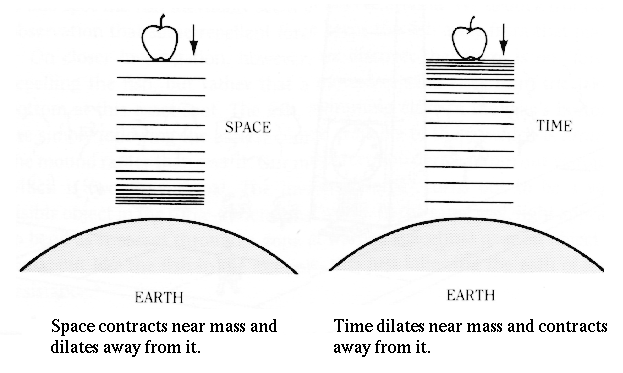
The lines of force provide substantiality to space in the form of a “fabric.” The word “space” then defines the extents of this fabric. The word “time” then defines the durability of this fabric at any location in space. Both space and time shall vary in their characteristics as the “fabric” varies in its consistency.
A totally rigid coordinate system represents a “fabric” of space that is rigid like matter. Any body attached to this coordinate system shall exhibit infinite inertia and a state of no motion. As the coordinate system becomes less rigid, the body attached to it shall display a decrease in inertia and an increase in motion. The amount of motion gained shall depend on the reduction in inertia.
The law of addition of velocities applies when the reduction in inertia is infinitesimal and can be ignored. When the change in inertia cannot be ignored the Lorentz transformation replaces the Galilean transformation. However, when the change in inertia becomes large even the Lorentz transformation becomes inapplicable because it is also an approximation.
The electromagnetic spectrum may be now expanded into a spectrum of substance. This spectrum shall extend from energy of lowest frequency to matter of highest density. It will show decreasing motion with increasing consistency.
This means that the orbits of planets in the solar system purely are the result of a balance among their inherent consistencies or motion. We see this balance as gravity. It defines gravity as being more than merely a force.
.