A Critique of Einstein’s Relativity

Reference: A Logical Approach to Theoretical Physics

In his 1905 paper on Relativity1, Einstein starts out by pointing out the asymmetries that originate from Maxwell’s electrodynamics.  He says,

It is known that Maxwell’s electrodynamics—as usually understood at the present time—when applied to moving bodies, leads to asymmetries which do not appear to be inherent in the phenomena. Take, for example, the reciprocal electrodynamic action of a magnet and a conductor. The observable phenomenon here depends only on the relative motion of the conductor and the magnet, whereas the customary view draws a sharp distinction between the two cases in which either the one or the other of these bodies is in motion. For if the magnet is in motion and the conductor at rest, there arises in the neighbourhood of the magnet an electric field with a certain definite energy, producing a current at the places where parts of the conductor are situated. But if the magnet is stationary and the conductor in motion, no electric field arises in the neighbourhood of the magnet. In the conductor, however, we find an electromotive force, to which in itself there is no corresponding energy, but which gives rise—assuming equality of relative motion in the two cases discussed—to electric currents of the same path and intensity as those produced by the electric forces in the former case.

The following must be noted here:

(1) This problem arises because Maxwell’s electrodynamics has not identified the frame of reference associated with absolute rest.

Einstein then considers a solution to this problem that would not require an “absolutely stationary space”. He says,

Examples of this sort, together with the unsuccessful attempts to discover any motion of the earth relatively to the “light medium,” suggest that the phenomena of electrodynamics as well as of mechanics possess no properties corresponding to the idea of absolute rest. They suggest rather that, as has already been shown to the first order of small quantities, the same laws of electrodynamics and optics will be valid for all frames of reference for which the equations of mechanics hold good. We will raise this conjecture (the purport of which will hereafter be called the “Principle of Relativity”) to the status of a postulate, and also introduce another postulate, which is only apparently irreconcilable with the former, namely, that light is always propagated in empty space with a definite velocity c which is independent of the state of motion of the emitting body. These two postulates suffice for the attainment of a simple and consistent theory of the electrodynamics of moving bodies based on Maxwell’s theory for stationary bodies. The introduction of a “luminiferous ether” will prove to be superfluous inasmuch as the view here to be developed will not require an “absolutely stationary space” provided with special properties, nor assign a velocity-vector to a point of the empty space in which electromagnetic processes take place.

The following must be noted here:

(2) The “light medium” was supposed to be the “absolutely stationary space” but no motion of earth was detected relative to it. Yet earth moved around the sun. This produced an anomaly. It suggested to Einstein that the idea of absolute rest could not be justified. Thus he rejected the idea of aether.

(3) According to the laws of mechanics, however, in a system of rotating bodies, the more massive body is closer to the common center of mass and rotates more slowly. Therefore, the speed of Sun is much slower than the speed of Earth. In short, the greater is the mass of a body, the slower is its free speed in space.

(4) A body’s natural speed, therefore, depends on its inertia. It is inherent to the body. A body with infinite inertia will be at absolute rest. As inertia decreases the natural speed increases. The speed of light is very large but finite because light has a very small amount of inertia (quantization).

(5) This is consistent with “continuum of substance” perspective. Space is the basic substance of zero quantization. The natural tendency for a pulse in space is to spread at infinite speed. All quantized radiation and material bodies are like pulses in space. This tendency to move rapidly gets resisted by inertia, and a finite natural speed results from that balance. This natural speed is absolute in nature.

(6) Einstein’s first postulate that “the same laws of electrodynamics and optics will be valid for all frames of reference for which the equations of mechanics hold good” is logical because this universe is naturally continuous, harmonious and consistent. Otherwise, there will be no laws of science. All laws are consistent to the degree that they contain no unwarranted and unverified assumptions.

(7) Einstein’s second postulate that “light is always propagated in empty space with a definite velocity c which is independent of the state of motion of the emitting body” is logical because inertia (quantization) of light is insignificant compared to the inertia of matter, and it can be used as the reference point of “zero”. This postulate, however, runs into difficulty with quantum mechanics only because the inertia of light is not insignificant compared to the inertia of quantum “particles”. The quantum particles are also radiation except little more quantized than light.

Einstein defines a “stationary system” in which the equations of Newtonian mechanics hold good. He then defines time objectively as “simultaneity of events” with information moving at speed of light between two events far from each other. Einstein postulates the speed of light to be constant in all systems regardless of their motions. This allows Einstein to compare relative speeds of the systems accurately as long as they are insignificant compared to the speed of light. This is true for all speeds in the material domain.

Einstein’s stipulations may be understood more clearly as follows: A completely “stationary system” shall correspond to infinite inertia. A moving system shall correspond to lesser inertia. The greater is the motion the lesser is the corresponding inertia. Einstein can measure the relative inertia of systems accurately as long as the inertia of light is so insignificant that it can act as the reference point of “zero” inertia.

Einstein considers the motion of coordinate systems attached to bodies. The inertia, space and time of the bodies depend on this motion. To keep this version of the theory simple Einstein does not consider any acceleration. That means that motion and inertia of the bodies remain constant.

Einstein imagines the following:

Let there be given a stationary rigid rod; and let its length be l as measured by a measuring-rod which is also stationary. We now imagine the axis of the rod lying along the axis of x of the stationary system of co-ordinates, and that a uniform motion of parallel translation with velocity v along the axis of x in the direction of increasing x is then imparted to the rod.

The following must be noted here:

(8) Motion cannot be imparted to an absolutely stationary system because its inertia is infinite. Therefore, Einstein’s “stationary system” is only relatively so.

(9) To impart motion, Einstein must accelerate the system somehow so it is now moving at a different velocity. Einstein is not accelerating the system overtly. So, he is adding inertia to the system in this thought experiment. This is similar to increasing the quantization of radiation.

Application of mathematics then leads Einstein to the same relationships that Lorenz had come up with earlier with a different model but with the constant speed of light.
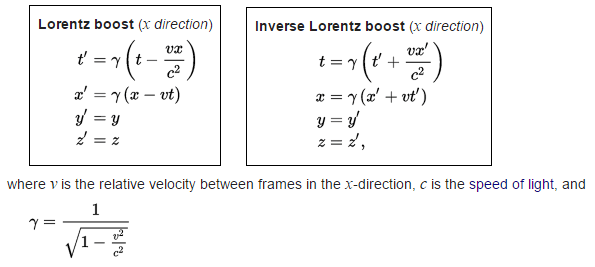
(10) The equations obtained above essentially predict that length of the rod would shrink and its duration would increase (time delay) with increased inertia or quantization. But the math does not reveal this unless the thought experiment is evaluated properly as above.

Einstein interprets his mathematical results about length as follows.

… i.e. the greater the value of v, the greater the shortening. For v=c all moving objects—viewed from the “stationary” system—shrivel up into plane figures. For velocities greater than that of light our deliberations become meaningless; we shall, however, find in what follows, that the velocity of light in our theory plays the part, physically, of an infinitely great velocity.

It is clear that the same results hold good of bodies at rest in the “stationary” system, viewed from a system in uniform motion.

The following must be noted here:

(11) As inertia of a body increases, its natural speed decreases. So the parameter v in the equation is deceptive. It actually represents a negative velocity.

(12) Einstein is looking at matter to be stationary from the viewpoint of the speed of light. He is only considering a velocity differential from the “stationary condition of matter”. But that cannot lead to length always shrinking with velocity. Therefore, Einstein’s statement in the second paragraph above is incorrect.

Einstein interprets his mathematical results about time as follows.

If one of two synchronous clocks at A is moved in a closed curve with constant velocity until it returns to A, the journey lasting t seconds, then by the clock which has remained at rest the travelled clock on its arrival at A will be ½tv2/c2 second slow.

The following must be noted here:

(13) The clock must increase in inertia to move away and decrease in inertia to move toward. So the movement in a closed curve should cancel out the effect of motion on time. Therefore, Einstein’s conclusion above is incorrect.

(14) The theory of relativity becomes incompatible with Newtonian mechanics by not relating motion with inertia.

In the composition of velocities section, Einstein says,

It follows from this equation that from a composition of two velocities which are less than c, there always results a velocity less than c… It follows, further, that the velocity of light c cannot be altered by composition with a velocity less than that of light. 

The following must be noted here:

(15) These conclusions are correct only if the speed of light is infinite. Since that is not the case, these conclusions by Einstein are incorrect. Thus, we see that math can be fallible when the assumptions are ignored.

In the subsequent portion of his relativity paper, Einstein is applying his new theory to several different situations in Physics. However, he is not always careful of his assumptions as in the cases cited above.

The success of the theory of relativity primarily shows up in astronomical situations where the assumption underlying this theory are justified, as explained above.

.

1On the Electrodynamics of Moving Bodies”, by A. Einstein, June 30, 1905

.
Quantization and Atom

Reference: A Logical Approach to Theoretical Physics

The spectrum of quantization describes a gradual coagulation of vis insita, Newton’s innate force of substance, which, ultimately, congeals into the solidity of matter. An atom consists of this entire spectrum. It is a compact structure that forms the smallest unit of matter.

The modern atom is visualized as a highly quantized nucleus surrounded by a barely quantized electronic region. The nucleus is extremely small in size compared to the region surrounding it. The vibrations are so dense in the nucleus that they have the appearance of solidity. The wavelength of vibrations has become so small that the solidity itself forms a continuum. This condition is identified as “mass”.

The atomic unit of mass is the mass of the nucleus of the hydrogen atom. The mass of the nuclei of other atoms are very close to being integer multiples of this unit. This has led to the assumption that the nuclei of atoms are made of particles called “nucleons” that are bound by nuclear force. This assumption is reinforced by nuclear reactions in which nucleons are absorbed or emitted.

This, however, does not exclude the alternate view that all nuclei are single entities in which nucleons get absorbed and emitted. When we say that the nucleus consists of nucleons, it simply means that there are localized regions in the nucleus of still higher frequency that are indistinguishable from one another. There is continuity of substance from one nucleon to another.

Individual nucleons may not exist as separate particles inside the nucleus.

Compared to the substantiality of the mass in nucleus, the substantiality of the surrounding electronic region is almost insignificant. A similar situation exists in the macroscopic view of matter and space, where we overlook the significance of space. This is the basis of “particles in void” framework. This framework is applicable only to the material domain where the substance is made up of atoms; it cannot be applied to radiation. This is the perspective of Newtonian mechanics.

The substantiality of the electronic region in atom is insignificant compared to the mass in the nucleus, but it cannot be ignored in quantum mechanical studies of the interface between the nucleus and electronic region. It is conjectured here that the charge between these two regions exist only because of the extremely high gradient of substantiality between them. An electron expelled from the atom is still bound to a positive nucleus. Hopefully, I shall be able to prove this conjecture soon.

In current physics, the electronic region is assumed to be made up of particles called “electrons” because mathematical calculations yield integral relationships, and also because this region absorbs and emit electrons. The electronic region being continuous cannot consist of discrete electron particles. This continuity is acknowledged by Schrödinger in his study of the electronic region.

Electrons are “particles” in the sense that they are radiation of high substantiality in the gamma region of the spectrum.

The Schrödinger’s equation1 was successfully solved for the emission of light from a hydrogen atom. The solution agreed with Bohr’s quantized energy levels. It even provided the energy levels observed, which could not be predicted from the Bohr’s model. It was a considerable advance to have determined these energies by a wave-theory instead of by an inexplicable mathematical rule. The Schrödinger’s model defines the point location of the subatomic particle by a probability distribution function. The concept of “probability” may be given a more realistic meaning using the “continuum of substance” framework. Hopefully, this will improve the workability of this equation for more complex atoms.

The success of Schrödinger’s wave-theory, however, puts the particle model of atom in doubt.

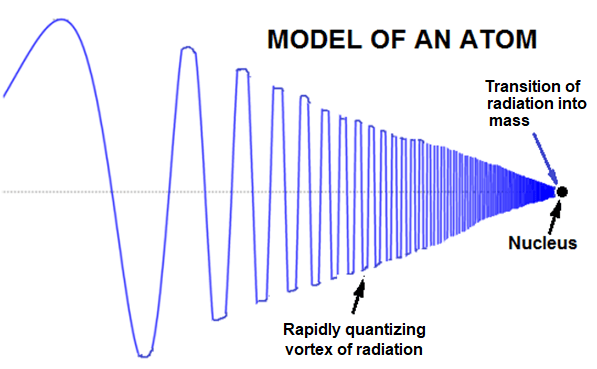
It is very likely that an atom is a homogeneous entity with no discrete particles existing inside it. The interactions with the atom may suffice to generate electrons, protons and neutrons. If we do not assume subatomic particles to reside within an atom, we can express the atomic structure in terms of rapidly quantizing whirlpool of radiation.

The atom may be modeled as a “sink” for quantizing radiation. This means that the atom provides a location where radiation may condense and terminate as mass. There are threshold frequencies at which radiation converges into the atom and then forms the nucleus at the center of the atom.

This model may be identified as the “whirlpool” model of the atom.

The Bohr’s model of atom has helped provide insight into the Periodic Table; but, it soon becomes very complex when describing the atomic structure beyond the simplest hydrogen atom. Hopefully, the “whirlpool” model of atom shall provide deeper insight into the structure of the atom with simpler math.

In a blackbody, the atomic configurations consist of “oscillators” over the whole range of frequency spectrum. When a blackbody is heated, it emits radiation at all frequencies. Oscillators of higher frequencies require increasing energy to be activated.

We may assume “oscillators” in the electronic region of the atom that, when irradiated, become activated and emit characteristic radiation.

Atoms are stable configurations of extremely high quantization levels in space. A free electron is a ray of highly substantial radiation.

Schrödinger’s wave-theory may be improved doing away with the particle model of the atom.

.

1The Nature of The Physical World” by A. S. Eddington, Chapter X (section 4)

.

Quantum & Consistency

Reference: A Logical Approach to Theoretical Physics

The word QUANTA is plural of QUANTUM which comes from Latin quantus how much.

In physics, quantum means a discrete quantity of energy proportional in magnitude to the frequency of the radiation it represents. The quantum theory and quantum mechanics are concerned with the behavior of atomic particles.

But the above definition is from the macroscopic perspective of “particles in void”. From the microscopic perspective of “continuum of substance” we get a different picture. Radiation is not a vibrating aether, because there is no aether. Radiation is a vibrating substance in its own right. These vibrations are part of its makeup. They determine its substantial-ness or substantiality (see A Critique of Einstein’s Light Quanta).

QUANTUM is the measure of substantiality of radiation just like inertia is a measure of substantiality of matter.

Therefore, the quantum (substantiality) of radiation is proportional to its frequency.

Q = hf ……..… where Q is quantum, h is Plank’s constant, and f is frequency.

Quantum is not discrete energy localized in space. Quantum is a continuous ray of radiation that is substantial. With increased substantiality radiation gains “ability to maintain form”. It does not necessarily acquire a “discrete shape in space”.

A quantum should be understood to mean “that which has ability to maintain form,” or consistency, and not “that which has a discrete shape,” or a particle.

A quantum is perceived to have properties both as a wave and as a particle, but it is essentially a continuum that has consistency. This is explained by a continuous ray of radiation that has acquired substantiality. In three-dimensions it would a force field that is continuous at every point, but contains areas of high substantiality. A “particle” could be a long “ray” of substantiality. The length of this “ray” may decrease with increasing substantiality, until it becomes globular.

Heavenly bodies of very high substantiality are surrounded by space that has almost no substantiality. These bodies are continuous with the space around them because they are part of the same force field. Because of this continuity, very high gradients of consistency exist at the interface between matter and space at atomic scales.

Between matter and space there is continuity of substance.

At lower frequencies the radiation is very flimsy. But as it increases in frequency it becomes increasingly substantial. This process may be called “quantization”. Wikipedia states,

One also speaks of field quantization, as in the “quantization of the electromagnetic field”, where one refers to photons as field “quanta” (for instance as light quanta). This procedure is basic to theories of particle physics, nuclear physics, condensed matter physics, and quantum optics.

But this definition emphasizes discreteness rather than the ability to maintain form. In fact radiation becomes more substantial while maintaining continuity with its surroundings.

QUANTIZATION is the phenomena of increasing consistency of radiation with frequency, where consistency means the ability to maintain form.

Wikipedia also states,

In physics, a quantum (plural: quanta) is the minimum amount of any physical entity involved in an interaction. The fundamental notion that a physical property may be “quantized” is referred to as “the hypothesis of quantization”. This means that the magnitude of the physical property can take on only discrete values consisting of integer multiples of one quantum.

For example, a photon is a single quantum of light (or of any other form of electromagnetic radiation), and can be referred to as a “light quantum”. Similarly, the energy of an electron bound within an atom is also quantized, and thus can only exist in certain discrete values. The fact that electrons can only exist at discrete energy levels in an atom causes atoms to be stable, and hence matter in general is stable.

But the hypothesis of quantization is a mathematical one. It refers to amounts involved in a reaction, or those, which are in equilibrium in a dynamic system, such as, an atom. Mathematical units are obviously discrete but they do not imply “discrete in shape”.

In the macroscopic perspective of “particles in void” the void is represented mathematically. This leads to mathematical discreteness to be confused with spatial discreteness.

The smallest particle of material-substance is an atom. When the atom is subdivided into smaller “particles” we enter into the realm of quantized radiation. Within the atom we have the interface between the “material” nucleus and the surrounding “electronic” radiation. The substances of nucleus and radiation interact and maintain equilibrium. The study of this interface is the truly the subject of Quantum Mechanics.

QUANTUM MECHANICS is the study of the interface between the material nucleus and the surrounding radiation and its quantization.

The spectrum of quantum, or consistency, parallels the spectrum of frequency. This spectrum forms the continuum of substance between space and matter.

For sake of simplicity, we define quantization levels, or consistency, arbitrarily as the doubling of frequency. A consistency is then the number of times frequency has doubled. Inertia may then be expressed as a function of the consistency in the material domain. This may be expressed mathematically as follows.

Consistency (Q) = log f / log 2 ………………. where f is the frequency

Frequency (f) = 2Q …………………………………… where Q is consistency

Inertia (I) = function (Q)

The following table describes the consistency of radiation and matter.

Space is the lowest level on this spectrum, which we use as our reference point of zero consistency. Space extends into infinity but as frequency increases these extents reduce and becomes more compact.  Mass begins to form in the gamma range where the frequency is greater than 3 x 10¹⁹. Using de Broglie’s hypothesis for mass-frequency equivalence we find that electrons appear at the beginning of the gamma range, and protons and neutrons in the nucleus of an atom appear at the upper end of the gamma range.

We may calculate the consistency of material bodies from their momentum as follows.

De Broglie Equation,       λ = h/p,

where h is Planck’s constant, and p is momentum

Frequency,                       f = c/λ = (c/h) p = 4.528 x 1041 p

Consistency,          Q = (log f) / (log 2) = 138.4 + 3.322 log p

Thus, given the mass and velocity of Earth, we may calculate its quantization level as follows,

ME = 5.972 x 1024 kg, VE = 3 x 10⁴ m/s, and  p = ME V= 1.79 x 1029

Q (earth) = 138.4 + 3.322 log (1.79 x 1029) = 235.6

NOTE: The physical definitions of QUANTA, QUANTUM, QUANTIZATION and QUANTUM MECHANICS provided here are based on the microsopic “continuum of substance” perspective. They are different from their traditional mathematical definitions based on macroscopic “particles in void” framework.

The mathematics of Newton, Maxwell, Einstein and Quantum Mechanics is hiding the reality of continuum of substance.

.

A Critique of Einstein’s Light Quanta

Reference: A Logical Approach to Theoretical Physics

In his 1905 paper on light quanta, Einstein starts out by comparing material substance to Maxwell’s “electromagnetic state in space”. He says,

There exists an essential formal difference between the theoretical pictures physicists have drawn of gases and other ponderable bodies and Maxwell’s theory of electromagnetic processes in so-called empty space. Whereas we assume the state of a body to be completely determined by the positions and velocities of an, albeit very large, still finite number of atoms and electrons, we use for the determination of the electromagnetic state in space continuous spatial functions, so that a finite number of variables cannot be considered to be sufficient to fix completely the electromagnetic state in space. According to Maxwell’s theory, the energy must be considered to be a continuous function in space for all purely electromagnetic phenomena, thus also for light, while according to the present-day ideas of physicists the energy of a ponderable body can be written as a sum over the atoms and electrons. The energy of a ponderable body cannot be split into arbitrarily many, arbitrarily small parts, while the energy of a light ray, emitted by a point source of light is according to Maxwell’s theory (or in general according to any wave theory) of light distributed continuously over an ever increasing volume.

The following must be noted here:

(1) The statement “the energy of a ponderable body cannot be split into arbitrarily many, arbitrarily small parts” is from “particles in void” perspective. This is an unverified assumption.

(2) The idea of being ponderable, or substantial, comes from the force that is inherent to the substance. Newton referred to it as vis insita or innate force of matter. Faraday expressed it through lines of force.

(3) Radiation is generally in equilibrium with matter as in the case of black-body radiation. Therefore, we may look at matter and radiation as two substances with different substantial-ness.

(4) The radiation in space, such as light, has momentum and force. Therefore, it qualifies as a substance.

(5) Radiation is not viewed as substance in the particles in void framework. It is viewed as vibrations in a postulated substance called aether.

According to Einstein the Planck’s postulate of “energy is proportional to the frequency of radiation” is not just a mathematical device. It actually refers to the substantial-ness of radiation. He sets up the following model to demonstrate this.

Let there be in a volume completely surrounded by reflecting walls, a number of gas molecules and electrons moving freely and exerting upon one another conservative forces when they approach each other that is, colliding with one another as gas molecules according to the kinetic theory of gases. Let there further be a number of electrons which are bound to points in space, which are far from one another, by forces proportional to the distance from those points and in the direction towards those points. These electrons are also assumed to be interacting conservatively with the free molecules and electrons as soon as the latter come close to them. We call the electrons bound to points in space “resonators”; they emit and absorb electromagnetic waves with definite periods…

This relation, which we found as the condition for dynamic equilibrium does not only lack agreement with experiment, but it also shows that in our picture there can be no question of a definite distribution of energy between aether and matter…

We thus reach the conclusion : the higher the energy density and the longer the wavelengths of radiation, the more usable is the theoretical basis used by us; for short wavelengths and low radiation densities, however, the basis fails completely.

Einstein thus shows that the energy of radiation is a continuous function in space at low frequencies only. As frequency increases the energy distribution becomes more discontinuous in space.

The following must be noted here:

(6) In his model, Einstein is assuming radiation to be vibrations in aether. Aether is postulated to have fixed substantial-ness.

(7) Einstein’s discovery of quanta required aether to have varying substantial-ness. Therefore, Einstein had to drop the idea of aether the way it was postulated. No evidence for aether was ever found anyway.

(8) Einstein then dealt with the requirement of varying substantial-ness by treating energy vibrations (without aether) mathematically.

(9) Radiation itself, however, may be treated as substance and assigned varying substantial-ness.

In explaining the photoelectric effect Einstein says,

According to the idea that the incident light consists of energy quanta with an energy Rßv/N, one can picture the production of cathode rays by light as follows. Energy quanta penetrate into a surface layer of the body, and their energy is at least partly transformed into electron kinetic energy…

An electron obtaining kinetic energy inside the body will have lost part of its kinetic energy when it has reached the surface….

If every energy quantum of the incident light transfers its energy to electrons independently of all other quanta, the velocity distribution of the electrons, that is, the quality of the resulting cathode radiation, will be independent of the intensity of the incident light; on the other hand, ceteris paribus, the number of electrons leaving the body should be proportional to the intensity of the incident light.

These observations are consistent with experimental results and prove that energy transferred to electrons is proportional to the frequency of incident light and not its intensity. The concept of quanta is thus real. It is not just a mathematical device as was assumed by Planck.

Einstein, therefore, concludes:

According to the assumption considered here, when a light ray starting from a point is propagated, the energy is not continuously distributed over an ever increasing volume, but it consists of a finite number of energy quanta, localised in space, which move without being divided and which can be absorbed or emitted only as a whole.

The following must be noted here.

(10) Einstein is using the Newtonian “particles in void” framework to assume quanta to be a series of discrete energy particles “localized in space” that are following each other in a line.

(11) From Faraday’s “continuum of substance” perspective, however, quanta are more particle-like only because their substantial-ness has increased. They can be represented by thicker lines of force that are continuous.

(12) Therefore, quanta do not necessarily have to be viewed as discrete particles “localized in space”. Radiation may still distribute continuously over an ever increasing volume. That will affect only its intensity and not the substantial-ness.

(13) The spectrum of increasing frequency provides a spectrum of increasing substantial-ness. This results in the “continuum of substance” from space to matter. We see this occurring inside the atom along the radius from space at its surface to matter as the nucleus at the center.

(14) On the other hand the “particles in void” means only space and matter with no gradient in between. So it applies only to the macroscopic view of matter. The “particles in void” framework is simply a limiting case of the broad “continuum of substance” framework.

.

Summary

The current science is based on the logic that there is either particles or void (nothing). Matter (substance) is looked upon as made up of particles. Space is looked upon as made up of nothing. Quantum mechanics is stuck with thinking that particles are made up of smaller particles to which there is a limit. But they can’t define the material, which the smallest particle is made up of.

In his 1905 paper on light quanta Einstein makes the following assumption: “the energy of a ponderable body cannot be split into arbitrarily many, arbitrarily small parts”. Per Newtonian mechanics, energy is the activity occurring in substance. If there is no substance then there cannot be energy.

The idea that energy cannot be split indefinitely means that substance cannot be split indefinitely either. This is where quantum mechanics stops theoretically.

This makes light a vibration that requires a substantial medium (aether) to propagate in. Einstein’s discovery of light quanta requires aether of variable substantiality, because the substantial-ness of quantum changes with frequency. No such aether has ever been found, and so Einstein dropped the idea of aether.

The dropping the idea of aether has left light to be a vibration in the void (pure energy without substantial basis).

Earlier Newton had handled the void with mathematics in his theory of gravity. That led to the problem of “action at a distance”, which is not yet resolved. So, Einstein handled vibrations in the void with some more mathematics, which has given us the general theory of relativity.

NOTE: The problem of “action at a distance” was resolved by Faraday but it was ignored by other scientists who continued with Newtonian mathematical approach. That is what Maxwell did. Einstein did the same.

What is coming in the way of reconciliation between quantum mechainics and general theory of relativity is the original assumption by Einstein: “the energy of a ponderable body cannot be split into arbitrarily many, arbitrarily small parts”.

The answer is that light and other radiation is not just “pure energy” but it is a vibrating substance in its own right. This substance coagulates as the frequency increases. This is the process of quantization. Therefore, the smallest particle of quantum mechanics is made up of quantized radiation.

But this logic, unfortunately, in spite of brilliant explanations of Faraday, has been unacceptable to science.

Quanta is coagulated radiation and not a train of discrete energy particles as Einstein postulated.

.

.

“Lines of Force” & Maxwell

Reference: A Logical Approach to Theoretical Physics

Michael Faraday (1791 – 1867) came up with a brilliant solution to the problem of “action at a distance” (action across the void) by modeling the space between atoms as lines of force. These lines, when concentrated, formed a center of force that could not be distinguished from the atom. Furthermore, Faraday postulated that these lines of force, extended from the atoms of a material body to the atoms of another material body forming the space between them. These lines of force that formed the space then carried the vibrations of radiative phenomena. Thus, matter and space were but a manifestation of a varying force field. To Faraday, the lines of force replaced the very idea of aether, which was assumed to be of material origin and filling the space.

Maxwell (1831 – 1879) constructed his theory of Electromagnetism based on the inspiration he got from the experimental research of Faraday. He writes in the preface of his major work “A Treatise on Electricity & Magnetism.”1

Faraday, in his mind’s eye, saw lines of force traversing all space where the mathematicians saw centres of force attracting at a distance: Faraday saw a medium where they saw nothing but distance: Faraday sought the seat of the phenomena in real actions going on in the medium, they were satisfied that they had found it in a power of action at a distance impressed on the electric fluids.

In his correspondence with Faraday, however, Maxwell disagreed with Faraday’s ideas on the conservation of Force, because Faraday’s perspective on force did not agree with Newton’s definition of “force”.  Maxwell wrote2:

Now, first, I am sorry that we do not keep our words for distinct things more distinct, and speak of the “Conservation of Work or of Energy” as applied to the relations between the amount of “vis viva” and of “tension” in the world; and of the “Duality of Force” as referring to the equality of action and reaction.

Energy is the power a thing has of doing work arising either from its own motion or from the “tension” subsisting between it and other things.

Force is the tendency of a body to pass from one place to another, and depends upon the amount of change of “tension” which that passage would produce.

Maxwell seems to have tried his best to unlock the mystery of action going on in the medium that Faraday sought, but he did not quite understand what Faraday meant by “force of nature”. Faraday had modeled his lines of forces such that they included the inherent force of substance (inertia) as well the energy due to its activity. He was quite clear in saying that his ideas were an alternative to the aether theory. But Maxwell couldn’t move beyond the view of nature as presented by Newton’s mechanics and the aether theory.

In this excellent article Kevin Brown points out where Maxwell was influenced by the aether theory and diverged from the ideas of Faraday3.

Maxwell’s understanding of the electrical force that exists between charged particles was based on the idea that even the ‘empty space’ of the vacuum is actually permeated with some kind of substance, called the ether, which consists of individual parts that can act as dielectrics… In simple terms, he pictured ordinary empty space, when devoid of any electric field, as consisting of many small pairs of positive and negative charge elements, and in the absence of an electric field the two opposite charges in each pair are essentially co-located, so there is no net change or electric potential observable at any point. If an electric potential is established across some region of this medium (e.g., empty space), it tends to pull the components of each pair apart slightly. Maxwell termed this an electric displacement in the medium. Of course, the constituent parts of the dielectric pairs attract each other, so the electric displacement is somewhat like stretching a little spring at each point in space.

The article goes on to say3,

It’s interesting that this theory, which supposedly denies the intelligibility of distant action, nevertheless ends up invoking (albeit on a very small scale) what appears to be elementary attraction between distinct and separate entities.

According to Maxwell himself3,

The theory I propose may therefore be called a theory of the Electromagnetic Field, because it has to do with the space in the neighbourhood of the electric or magnetic bodies, and it may be called a Dynamical Theory, because it assumes that in that space there is matter in motion, by which the observed electromagnetic phenomena are produced…

Maxwell’s modeled the lines of force along the lines of incompressible fluid4. These mathematical lines of force bunched up and spread out in space, but they could not model the substance of space thinning out and thickening up as Faraday’s lines could. It gave the electromagnetic field a mechanical character that maintained its identity rigidly separate from space.

Maxwell’s mathematical model of lines of force did not thicken to coincide with matter or thinned to coincide with space as Faraday had visualized from his extensive and painstaking experimentation.

Maxwell then admitted5

If, in order to get rid of the idea of action at a distance, we imagine a material medium through which the action is transmitted, all that we have done is to substitute for a single action at a great distance a series of actions at smaller distances between the parts of the medium, so that we cannot even thus get rid of action at a distance.

Maxwell’s field existed between two oppositely charged material surfaces, or between the positive nucleus and the surrounding electrons in an atom. Maxwell’s electromagnetic field was a special case that depended on the concept of discrete electrical charge. It could not be extended to fill the whole space as Faraday’s lines of force could.

Maxwell was unable to unlock the mystery of action at a distance because he assumed his electromagnetic field to be based on discrete electrical charges. Discreteness implies separation and, thus, action at a distance.

Discrete charge and electromagnetic field may exist in the gamma range of the spectrum where electron’s frequency is found, but we may not assume it to exist throughout the spectrum of light. Visible light does not have charge but it has momentum. It may be possible that momentum (or inertia) has some relation to charge.

Interestingly enough, charge has same dimensions as mass per the dimensional analysis provided by Maxwell6.

[M] = [Q] = [L3-2] = Area x acceleration

Charge and mass may be related by the property of inertia. This requires that we should look at the characteristics of inertia more closely.

Thus Faraday’s idea of continuum of substance was never implemented by Maxwell. Maxwell’s electromagnetic field was not the same as Faraday’s field of force. The theory of electromagnetism did not provide a viable solution to the problem of action at a distance.

Faraday’s solution to the problem of “action at a distance” got sidetracked; and the mystery of aether continued.

.

1A Treatise on Electricity & Magnetism”, Vol I, James Clerk Maxwell, p. 51, 416
2Maxwell’s response to Faraday’s concept of Force”, The Life of James Clerk Maxwell (published 1884), p. 202
3Why Maxwell Couldn’t Explain Gravity” by Kevin Brown
4A Treatise on Electricity & Magnetism”, Vol I, James Clerk Maxwell, p. 51, 416
5Maxwell in an article on Attraction written for the 9th edition of the Encyclopedia Britannica in 1875
6A Treatise on Electricity & Magnetism”, Vol I, James Clerk Maxwell, p. 3 – 6

.