PM Chapter 3: Awareness, Postulate, Self

Reference: Postulate Mechanics (PM)

Both awareness and postulate must be present together for postulate to even appear. The appearance of postulate implies that awareness is present. Even when awareness and postulate manifest together, they are two different phenomena. Only when we identify awareness with postulate that the idea of self comes about. 

.

Awareness

Awareness is present while postulates appear and disappear. Awareness is not any of those postulates that it is aware of. The moment awareness wonders what it is, it is looking to identify itself. And, the moment awareness gets an idea of what it is, it has  identified itself with some postulate.

.

Postulate

A postulate is a statement assumed to be true without proof, serving as a foundational premise for further reasoning. Einstein postulated the speed of light to be a universal constant to derive his theory of relativity. Postulate has been described in detail in PM Chapter 1: Introduction. All postulates and the considerations derived from it describe to us the reality of the universe.

.

Self

The moment awareness introverts into looking at what it is, it identifies itself with some postulate. In that moment it becomes a self. If the introversion continues the identification continues to occur and the self comes to acquire various colors and attributes.

At first, the self is in total harmony within itself, and it operates as a single entity. But as the attribute of individuality comes about, it breaks into many individual selves. All the earlier experience is shared by the individualities. That experience of total harmony within oneself becomes the idea of God. It extends to harmony within the society. It extends, ultimately, to harmony of humanity, and of all life.

God then comes to be regarded as the symbol of oneness. God is looked upon as the original form of self as a harmonious single whole.

.

PM Chapter 2: Unknowable, Knowable, Awareness

Reference: Postulate Mechanics (PM)

There is a fundamental impulse to know because there are things that are unknown. We are surrounded by a universe that we would like to know about. We know it by postulating about what we are observing. So we postulate that there are things to become aware of.

From that it follows that there is awareness that starts with postulates. If we are becoming aware of the universe then that awareness must be present within us. The most fundamental postulate that we can make about ourselves is that we are that awareness.

.

Unknowable

The highest echelon concept is UNKNOWABLE. This has been mentioned in The Creation Hymn of Rig Veda.

Whence this creation has arisen
– perhaps it formed itself, or perhaps it did not –
the One who looks down on it,
in the highest heaven, only He knows
or perhaps He does not know.

We may say that there is always something more to know.

.

Knowable

We come to know by postulating about what we are observing. A postulate is something taken for granted. It is a creative thought that is claimed to be true. A postulate then forms the basis of all reasoning that follows. It may result in further considerations. There may be assumptions, that are verified later or simply get dropped. 

We may say that all that is knowable, proceeds from our own postulates and considerations.

.

Awareness

Thus, there is awareness of what is known. There is also a general awareness that many things are unknown. We associate ourselves closely with this awareness. Maybe this awareness is basically what we are. But all this is just a string of postulates.

Thus, our consideration of self, proceeds from a string of postulates. It makes us aware of ourselves and the universe.

When self is considered something to be aware of, it is no less a part of the universe. Then “that” which looks at self and the universe is just “awareness.”

Individuality is an aspect of self, and not of awareness.

.

PM Chapter 1: Introduction

Reference: Postulate Mechanics (PM)

Postulate Mechanics is an effort to understand the fundamentals of this universe. Its basic postulates are:

  1. The fundamental impulse is to know.
  2. Effort to know starts with a postulate.
  3. Assimilation of postulates brings enlightenment.

.

Postulate

A postulate is a basic assumption, taken as true, which is then used to derive the rest of the theory. For example, Einstein postulated that the speed of light is a universal constant. He used this postulate (and others) to derive his theory of relativity. The purpose of generating a theory is to explain and organize what we observe, to unify many separate facts into a coherent model, and to guide prediction, research, and action. 

Postulate serves as a foundational premise for further reasoning. It is through postulates, which follow observations, that knowledge develops. The postulates must be harmonious, consistent and continuous among themselves for sensible knowledge to develop. Ordinary assumptions are lower harmonics of postulates. Such assumptions either get revised upwards into postulates, or simply get dropped, as knowledge comes to be assimilated over time.

Assimilation means bringing harmony to knowledge by removing all inconsistencies. It also means researching and making discoveries in those areas where gaps exist in knowledge.

.

Oneness, Anomalies & Misconceptions

The ideal scene of knowledge is ONENESS of all postulates, reasoning, and theories. Departures from this ideal scene appears in the form of disharmony (arbitrary data), inconsistency (contradictory data), or discontinuity (missing data). We refer to such departures as anomalies.

The basic form of anomalies are misconceptions. Misconceptions at the level of postulates corrupt the logic of reasoning, and the workability of theories. Resolution of misconceptions at the level of postulates is an important part of the assimilation of knowledge. The resolution of misconceptions and other anomalies lies at the core of Postulate Mechanics.

A very basic misconception is about the nature of self. “Who am I?” is a genuine concern for every person as he develops his understanding. He looks for answers in the universe and derives his identity from the things in it. Enlightenment occurs when he realizes his true nature. Further enlightenment occurs as he realizes the true nature of the universe.

.

Postulate Mechanics

The purpose of Postulate Mechanics is to investigate the nature of self and the universe, and to assimilate all knowledge. It attempts to do that by going back to the original postulates and resolving anomalies at that level.

Postulate Mechanics attempts to reveal the mechanics of “thought,” just like Classical Mechanics reveals the mechanics of “matter,” and Quantum Mechanics reveals the mechanics of “energy.”

.

High Energy Gamma Rays

This post is written to preserve the following news article.

High Energy Gamma Rays Go Slower than the Speed of Light?

This is a demonstration of the The Fourth Law of Motion.

High Energy Gamma Rays Go Slower Than the Speed of Light?

By Fraser Cain – October 03, 2007 04:36 PM UTC | Physics

The speed of light is the speed of light, and that’s that. Right? Well, maybe not. Try and figure this out. Astronomers studying radiation coming from a distant galaxy found that the high energy gamma rays arrived a few minutes after the lower-energy photons, even though they were emitted at the same time. If true, this result would overturn Einstein’s theory of relativity, which says that all photons should move at the speed of light. Uh oh Einstein.

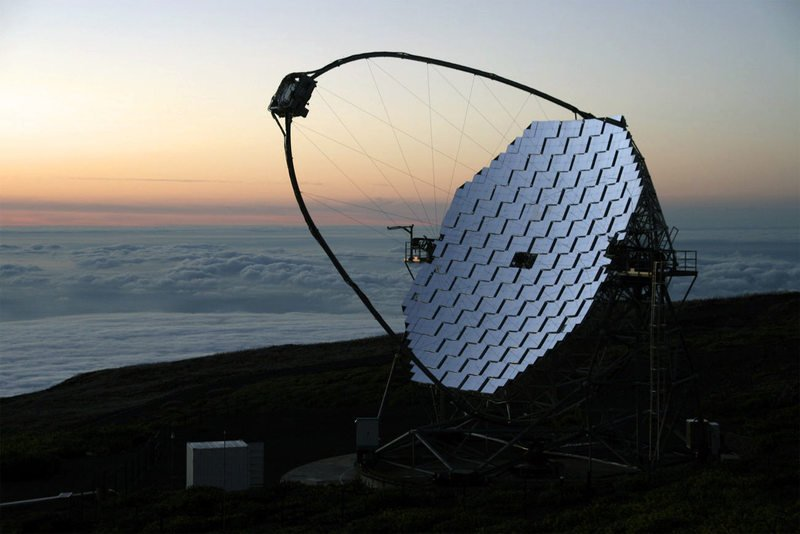
The discovery was made using the new MAGIC (Major Atmospheric Gamma-ray Imaging Cherenkov) telescope, located on a mountain top on the Canary island of La Palma. Since gamma rays are blocked by the Earth’s atmosphere, astronomers have figured out a clever trick to see them from the ground. When the gamma rays strike the atmosphere, they release a cascade of particles and radiation. The Cherenkov technique detects this cascade, and then works backwards to calculate the direction and energy level of the gamma rays. With a 17-metre detector, MAGIC is the largest telescope of its type.

The international team of researchers pointed the telescope at Markarian 501, a galaxy 500 million light-years away that contains a blazar – a supermassive black hole that periodically releases bursts of gamma rays. More material is falling into the black hole than it can consume, and so it gets squeezed into jets that fire off from the poles of the black hole at close to the speed of light. What astronomers call a “blazar” is when the jets of a supermassive black hole are pointed directly at the Earth.

Researchers sorted high- and low-energy gamma ray photons coming from the blazar with each flareup. Since all the radiation was emitted at the same time, and the speed of light is the speed of light, you would expect the high-energy photons to arrive at the same time. But nope, the high-energy photons showed up around 4 minutes later.

So what’s happening? Nobody knows, and this could turn into an entirely new field of physics. The researchers are proposing that maybe the radiation is interacting with “quantum foam”. This is a theoretical property of space itself, and predicted by quantum gravity theory – a competitor to string theory.

UC Davis News Release

.

Remedy of Laughter

When a person finds himself in an environment that makes it difficult for him to reject what he doesn’t like, he is likely to feel very uncomfortable. When this continues, he may become serious, and even neurotic. Getting a person to laugh is always a good remedy because, besides surprise, laughter is rejection. Laughter surprises the person into rejecting, and that is very therapeutic.

The Remedy of Laughter could be entered simply by having the individual predict that a wall would be there in ten seconds, count off ten seconds on his watch, and then ascertain with thoroughness that the wall is still there.

A direct mock up process can be applied to the Remedy of Laughter by having the person mock up alternately himself and others laughing.

The person can also be made simply to stand up and start laughing. He at first will demand to have something to laugh at, but at length will be able to laugh without reason. 

The goal of the process is to regain the ability to laugh without reason. One may run this process simply by using the following two commands.

Start laughing.’
‘Keep on laughing.’

.

The Excerpt

Here is the full excerpt of this Scientology process from the Book, The Creation of Human Ability by L. Ron Hubbard.

R2-26: REMEDY OF LAUGHTER 

The earliest known psychotherapy consisted of getting a patient to laugh. Laughter is rejection. A preclear being continually inflowed upon by the physical universe at length may find it difficult to reject anything. Getting him to reject something could be made an auditing goal. The best manifestation of this is laughter. Laughter includes both surprise and rejection. The individual is surprised into rejecting. 

In order to laugh, he must have laid aside some of his ability to predict. An individual who is serious has laid aside so much of his ability to predict that he now cannot be surprised into rejection. The anatomy of mystery consists of, in this order, unpredictability, confusion, and chaos covered up because it cannot be tolerated. Therefore, this is also the anatomy of problems. Problems always begin with an unpredictability, deteriorate into a confusion, and then if still unsolved become a mystery which is massed confusion. It will be observed that as a person falls further and further away from the ability to laugh he becomes more and more confused until at last he sees no points in any jokes, he sees only embarrassment when confronted by laughter, and the whole action of laughter itself escapes him. The ability to laugh is rehabilitated in general by Scientology as it advances the ability of the preclear to know – which is to say, predict. 

The Remedy of Laughter could be entered simply by having the individual predict that a wall would be there in ten seconds, count off ten seconds on his watch, and then ascertain with thoroughness that the wall is still there, to establish if the wall is there, then to predict that it will be there in ten seconds, then to count off ten seconds on his watch and ascertain if the wall is still there. By thus bringing solid objects into the realm of prediction, an individual at length comes to a point where he can predict very slowly moving objects. A cheap train and track could be set up for this purpose and the preclear could be led to predict with accuracy the position of engines on the small circular track. However, the preclear can be made to watch automobiles on the street – a process which serves just as well with no such equipment. 

The preclear would then be led to predict the positions of his own body, first by predicting that it was going to be in a certain spot, then moving it there and seeing whether or not it had arrived at that spot. He would then be brought to swing his arm in a circle, predict that it would swing faster, and swing it faster. And thus being led to predict the motion of his body with these simplicities, he could be exercised in making his body go tense and go limp by his command until he was thoroughly certain that he could both predict the tension or relaxation by doing it. Then he could be led to predict the positions of people walking on the street until he felt some security in predicting without exercising physical control. By thus remedying his ability to predict, one brings the preclear up into a tolerance of motion. He is then led to put his attention on one moving object, then on two moving objects at once, and so forth using the processes of spanning attention on moving objects.

A direct mock up process can be applied to the Remedy of Laughter by having the preclear mock up alternately himself and others laughing or by having him mock up an acceptable level of amusement and remedy his havingness with it until he can have people laughing very broadly in his mock-ups. The preclear can also be made simply to stand up and start laughing. He at first will demand to have something to laugh at, but at length will be able to laugh without reason. The goal of the process is contained in the last line – to regain the ability to laugh without reason. 

In this Intensive Procedure only two steps are employed to remedy laughter. The first consists of these commands, ‘Be completely certain that the wall is there’. And when the preclear has become with considerable conversation completely certain that the wall is there, touching it, pushing against it, and so forth, the auditor then says, ‘Sit down, take this (your) watch’, ‘Now predict that the wall will be there ten seconds from now’, ‘Have you done so?’ ‘All right wait ten seconds by your watch’. And when this is done, ‘Is the wall still there?’ And when the preclear has answered, ‘Now make absolutely certain the wall is there’ and the preclear does so by touching it, pushing at it, kicking it. ‘Now make very sure that the wall is there’. And when the preclear very vigorously has done so, ‘Now predict that it will be there in ten seconds’. And when the preclear has done so, the remainder of the commands are given and this is repeated over and over. 

Then the second part of lntensive Procedure’s process of laughter, but only after the preclear has experienced considerable relief and is absolutely sure that he can predict that all parts of the room will be there, not only in ten seconds, but in an hour – although no such timing is used, and only ten seconds of time is employed – ‘Start laughing’. And no matter what the preclear says thereafter, or what arguments he advances, or how many things he asks about, or how many reasons he wants or gives, the auditor merely says (adding words that urge the preclear), ‘Start laughing’. And when the preclear at length does so, no matter how half heartedly, ‘Keep on laughing’. The two commands which are used in addition to words necessary to urge the preclear without giving the preclear any reason whatsoever are, ‘Start laughing’ and ‘Keep on laughing’. 

This process is then done until the preclear can actually enjoy a laugh without any reason whatsoever, without believing that laughing without reason is insane, without feeling self-conscious about laughing, and without needing any boost from the auditor. The auditor in this second part need take no pains to agree with the preclear by laughing. He need not chuckle or smile nor need he even particularly act seriously, his laughter is not needed or used in the process. An auditor can be as serious as he pleases, and indeed, if he wishes to do so, can be even more serious than is usual when running this second step of R2-26. 

In earlier Scientology it was learned that serious preclears would often recover considerable ground simply when they were made to do things without any reason whatsoever. This achievement is much greater when they are made to laugh without any reason.

.