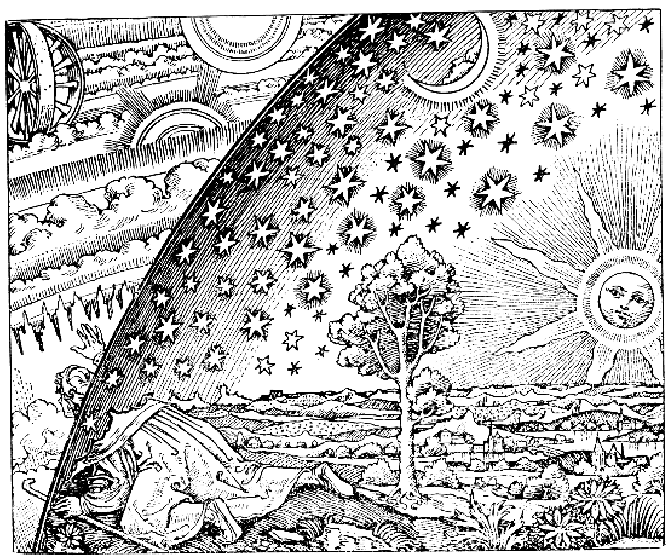
Tertium Organum, Chapter 14 (Sensation)

Reference: Tertium Organum

.

Chapter 14: Sensation

The voices of stones. The wall of a church and the wall of a prison. The mast of a ship and a gallows. The shadow of a hangman and of an ascetic. The soul of a hangman and of an ascetic. The different combinations of known phenomena in higher space. The relationship of phenomena which appear unrelated, and the difference between phenomena which appear similar. How shall we approach the noumenal world? The understanding of things outside the categories of space and time. The reality of many “figures of speech.” The occult understanding of energy. The letter of a Hindu occultist. Art as the knowledge of the noumenal world. What we see and what we do not see. Plato’s dialogue about the cavern.

.

It seems to us that we see something and understand something. But in reality all that proceeds around us we sense only very confusedly, just as a snail senses confusedly the sunlight, the darkness, and the rain. 

Sometimes in things we sense confusedly their difference in function, i.e., their real difference. 

On one occasion I was crossing the Neva with one of my friends. A, with whom I happened to have had many conversations upon the themes touched on in this book. We had been talking, but both fell silent as we approached the fortress, gazing up at its walls and making probably the same reflection. ”Right there are also factory chimneys!” said A. Behind the walls of the fortress indeed appeared some brick chimneys blackened by smoke. 

On his saying this, I too sensed the difference between the chimneys and the prison walls with unusual clearness and like an electric shock. I realized the difference between the very bricks themselves, and it seemed to me that A realized this difference also. 

Later in conversation with A, I recalled this episode, and he told me that not only then, but always, he sensed these differences and was deeply convinced of their reality. “Positivism assures itself that a stone is a stone and nothing more,” he said, “but any simple woman or child knows perfectly that a stone from the wall of a church and one from a prison wall are different things.” 

It seems to me also, that in considering a given phenomenon in connection with all the chains of sequences of which it is a link, we shall see that the subjective sensation of the difference between two physically similar objects — which we are accustomed to think of only as poetic expression, metaphor, and the reality of which we deny — is entirely real; we shall see that these objects are really different, just as different as the candle and the coin which appear as similar circles (moving lines) in the two-dimensional world of the plane-man. We shall see that things of the same material constitution but different in their functions are really different, and that this difference goes so deep as to make different the very material which is physically the same. There are differences in stone, in wood, in iron, in paper, which no chemistry will ever detect: but these differences exist, and there are men who feel and understand them. 

The mast of a ship, a gallows, a crucifix at a cross-roads on the steppes — these may be made of the same kind of wood, but in reality they are different objects made of different material. That which we see, touch, investigate, is nothing more than “the circles on the plane” made by the coin and the candle. They are only the shadows of real things, the substance of which is contained in their function. The shadow of a sailor, of a hangman, and of an ascetic may be quite similar — it is impossible to distinguish them by their shadows, just as it is impossible to find any difference between the wood of a mast, of a gallows and of a cross by chemical analysis. But they are different men and different objects — their shadows only are equal and similar. 

And if we take men as we know them — the sailor, the hangman, the ascetic: men who seem to us similar and equal — and consider them from the standpoint of their differences in function, we shall see that in reality they are entirely different and that there is nothing in common between them. They are quite different beings, belonging to different categories, to different planes of the world between which there are no bridges, no avenues at all. These men seem to us equal and similar because in most cases we see only the shadows of real facts. The “souls” of these men are actually quite different, different not only in their quality, their magnitude, their “age,” as some people like now to put it, but as different in the very nature, origin and purpose of their existence as things belonging to entirely different categories can be. 

When we shall begin to understand this, the general concept man will take on a different meaning. 

And this relation holds in the observation of all phenomena. The mast, the gallows, the cross — these are things belonging to such different categories, the atoms of such different objects (known only by their functions), that there cannot be a question of any similarity at all. Our misfortune consists in the fact that we regard the chemical constitution of a thing as its most real attribute, while as a matter of fact its true attributes must be sought for in its functions. Could we broaden and deepen our vision of the chains of causation the links of which are forged by our action and our conduct; could we learn to see them not only in their narrow relation to the life of man — to our personal life — but in their broad cosmical meaning; could we succeed in finding and establishing a connection between the simple phenomena of our life and the life of the cosmos; then without doubt in these “simplest” phenomena would be unveiled for us an infinity of the new and the unexpected. 

For example, in this way we may come to know something entirely new about those simple physical phenomena which we are accustomed to regard as natural and obvious and about which we think we know something. Then, unexpectedly, we may find that we know nothing, that everything heretofore known about them is only an incorrect deduction from incorrect premises. There may be revealed to us something infinitely great and immeasurably important in such phenomena as the expansion and contraction of solids, electrical phenomena, heat, light, sound, the movements of the planets, the coming of day and of night, the change of seasons, a thunderstorm, heat-lightning, etc., etc. Generally speaking, we may find explained in the most unexpected manner the properties of phenomena which we used to accept as given things, as not containing anything within themselves that we could not see and understand. 

The constancy, the time, the periodicity or unperiodicity of phenomena may take on quite a new meaning and significance for us. The new and the unexpected may reveal itself in the transition of some phenomena into others. Birth, death, the life of a man, his relations with other men; love, enmity, sympathies, antipathies, desires, passions — these may unexpectedly receive illumination by an entirely new light. It is impossible now to imagine the nature of this newness which we shall sense in familiar things, and once felt it will be difficult to understand. 

But it is really only our inaptitude to feel and understand this “newness” which divides us from it, because we are living in it and amidst it. Our senses, however, are too primitive, our concepts are too crude, for that fine differentiation of phenomena which must unfold itself to us in higher space. Our minds, our powers of correlation and association are sufficiently elastic for the grasping of new relations. Therefore, the first emotion at the rising of the curtain on “that world” — i.e., this our world, but free of those limitations under which we usually regard it — must be of wonderment, and this wonderment must grow greater and greater according to our better acquaintance with it. And the better we know a certain thing or a certain relation of things — the nearer, the more familiar they are to us — the greater will be our wonder at the new and the unexpected therein revealed. 

Desiring to understand the noumenal world we must search for the hidden meaning in everything. At present we are too heavily enchained by the habit of the positivistic method of searching always for the visible cause and the visible effect. Under this weight of positivistic habit it is extremely difficult for us to comprehend certain ideas. Among other things we have difficulty in understanding the reality of the difference in the noumenal world between objects of our world which are similar, but different in function. 

But if we desire to approach to an understanding of the noumenal world, we must try with all our might to notice all those seeming, “subjective” differences between objects which astonish us sometimes, of which we are often painfully aware — those differences expressed in the symbols and metaphors of art which are often revelations of the world of reality. Such differences are the realities of the noumenal world, far more real than all maya (illusion) of our phenomena. 

We should endeavor to notice these realities and to develop within ourselves the ability to feel them, because exactly in this manner and only by such a method do we put ourselves in contact with the noumenal world or the world of causes.

.

I find an interesting example of the understanding of the hidden meaning of phenomena contained in The Occult World in the letter of a Hindu occultist to the author of the book, A. P. Sinnett. 

We see a vast difference between the two qualities of two equal amounts of energy expended by two men, of whom one, let us suppose, is on his way to his daily quiet work, and another on his way to denounce a fellow creature at the police station, while the men of science see none; and we — not they — see a specific difference between the energy in the motion of the wind and that of a revolving wheel. 

Every thought of man upon being evolved passes into the inner world, and becomes an active entity by associating itself, coalescing, we might term it, with an elemental — that is to say, with one of the semi-intelligent forces of the kingdom.

If we ignore the last part of this quotation for the moment, and consider only the first part, we shall easily see that the “man of science” does not recognize the difference in the quality of the energy spent by two men going, one to his work, and another to denounce someone. For the man of science this difference is negligible: science does not sense it and does not recognize it. But perhaps the difference is much deeper and consists not in the difference between modes of energy but in the difference between men, one of whom is able to develop energy of one sort and another that of a different sort. Now we have a form of knowledge which senses this difference perfectly, knows and understands it. I am speaking of art. The musician, the painter, the sculptor well understand that it is possible to walk differently — and even impossible not to walk differently: a workman and a spy cannot walk alike. 

Better than all the actor understands this, or at least he should understand it better. 

The poet understands that the mast of a ship, the gallows, and the cross are made of different wood. He understands the difference between the stone from a church wall and the stone from a prison wall. He hears “the voices of stones,” understands the whisperings of ancient walls, of tumuli, of mountains, rivers, woods and plains. He hears “the voice of the silence,” understands the psychological difference between silences, knows that one silence can differ from another. And this poetical understanding of the world should be developed, strengthened and fortified, because only by its aid do we come in contact with the true world of reality. In the real world, behind phenomena which appear to us similar, often stand noumena so different that only by our blindness is it possible to account for our idea of the similarity of those phenomena. 

Through such a false idea the current belief in the similarity and equality of men must have arisen. In reality the difference between a “hangman,” a “sailor,” and an “ascetic” is not an accidental difference of position, state and heredity, as materialism tries to assure us; nor is it a difference between the stages of one and the same evolution, as theosophy affirms; but it is a deep and IMPASSABLE difference — such as exists between murder, work and prayer —- involving entirely different worlds. The representatives of these worlds may seem to us to be similar MEN, only because we see, not them, but their shadows only. 

It is necessary to accustom oneself to the thought that this difference is not metaphysical but entirely real, more real than many visible differences between things and between phenomena. 

All art, in essence, consists of the understanding and representation of these elusive differences. The phenomenal world is merely a means for the artist — just as colors are for the painter, and sounds for the musician — a means for the understanding of the noumenal world and for the expression of that understanding. At the present stage of our development we possess nothing so powerful, as an instrument of knowledge of the world of causes, as art. The mystery of life dwells in the fact that the noumenon, i.e., the hidden meaning and the hidden function of a thing, is reflected in its phenomenon. A phenomenon is merely the reflection of a noumenon in our sphere. THE PHENOMENON IS THE IMAGE OF THE NOUMENON. It is possible to know the noumenon by the phenomenon. But in this field the chemical reagents and spectroscopes can accomplish nothing. Only that fine apparatus which is called the soul of an artist can understand and feel the reflection of the noumenon in the phenomenon. In art it is necessary to study “occultism” — the hidden side of life. The artist must be a clairvoyant: he must see that which others do not see; he must be a magician: must possess the power to make others see that which they do not themselves see, but which he does see. 

Art sees more and farther than we do. As was said before, we usually see nothing, we merely feel our way; therefore we do not notice those differences between things which cannot be expressed in terms of chemistry or physics. But art is the beginning of vision; it sees vastly more than the most perfect apparatus can discover; and it senses the infinite invisible facets of that crystal, one facet of which we call man. 

The truth is that this earth is the scene of a drama of which we only perceive scattered portions, and in which the greater number of the actors are invisible to us. 

Thus says the theosophical writer, Mabel Collins, the author of Light on the Path, in a little book, Illusions. And this is very true: we see only a little. 

But art sees farther than merely human sight, and therefore concerning certain sides of life art alone can speak, and has the right to speak. 

.

A remarkable attempt to portray our relation to the “noumenal world” — to that “great life” — is found in Book VII of Plato’s Republic.

Behold! human beings living in a sort of underground den; they have been there from their childhood, and have their legs and necks chained — the chains are arranged in such a manner as to prevent them from turning round their heads. At a distance above and behind them the light of a fire is blazing, and between the fire and the prisoners there is a raised way; and you will see, if you look, a low wall built along the way, like the screen which marionette players have before them, over which they show the puppets. Imagine men passing along the wall carrying vessels, which appear over the wall; also figures of men and animals, made of wood and stone and various materials; and some of the passengers, as you would expect, are talking, and some of them are silent! 

That is a strange image, he said, and they are strange prisoners. 

Like ourselves, I replied; and they see only their own shadows, or the shadows of one another, which the fire throws on the opposite wall of the cave? 

True, he said; how could they see anything but the shadows if they were never allowed to move their heads? 

And of the objects which are being carried in like manner they would only see the shadows? 

Yes, he said. 

And if they were able to talk with one another, would they not suppose that they were naming what was actually before them? 

Very true. 

And suppose further that the prison had an echo which came from the other side, would they not be sure to fancy that the voice which they heard was that of a passing shadow? 

No question, he replied. 

There can be no question, I said, that the truth would be to them just nothing but the shadows of the images. 

That is certain. 

And now look again and see how they are released and cured of their folly. At first, when any one of them is liberated and compelled suddenly to go up and turn his neck around and walk and look at the light, he will suffer sharp pains; the glare will distress him and he will be unable to see the realities of which in his former state he had seen the shadows; and then imagine someone saying to him, that what he saw before was an illusion, but that now he is approaching real being and has a truer sight and vision of more real things, — what will be his reply? And you may further imagine that his instructor is pointing to the objects as they pass and requiring him to name them, — will he not be in a difficulty? Will he not fancy that the shadows which he formerly saw are truer than the objects which are now shown to him? 

Far truer.

And if he is compelled to look at the light, will he not have a pain in his eyes which will make him turn away to take refuge in the object of vision which he can see, and which he will conceive to be clearer than the things which are now being shown to him? 

True, he said. 

And suppose once more, that he is reluctantly dragged up a steep and rugged ascent, and held fast and forced into the presence of the sun himself, do you not think that he will be pained and irritated, and when he approaches the light he will have his eyes dazzled, and will not be able to see any of the realities which are now affirmed to be the truth? 

Not all in a moment, he said. 

He will require to get accustomed to the sight of the upper world. And first he will see the shadows best, next the reflections of men and other objects in the water, and then the objects themselves; next he will gaze upon the light of the moon and the stars; and he will see the sky and the stars by night, better than the sun, or the light of the sun, by day? 

Certainly. 

And at last he will be able to see the sun, and not mere reflections of him in the water, but he will see him as he is in his own proper place, and not in another, and he will contemplate his nature. 

Certainly. 

And after this he will reason that the sun is he who gives the seasons and the years, and is the guardian of all that is in the visible world, and in a certain way the cause of all things which he and his fellows have been accustomed to behold? 

Clearly, he said, he would come to the other first and to this afterwards. 

And when he remembered his old habitation, and the wisdom of the den and his fellow-prisoners, do you not suppose that he would felicitate himself on the change, and pity them? 

Certainly, he would. 

And if they were in the habit of conferring honors on those who were quickest to observe and remember and foretell which of the shadows went before, and which followed after, and which were together, do you think that he would care for such honors and glories, or envy the possessors of them? 

Would he not say with Homer, — 

“Better to be a poor man, and have a poor master,” and endure anything, than to think and live after their manner? 

Yes, he said, I think that he would rather suffer anything than live after their manner. 

Imagine once more, I said, that such an one coming suddenly out of the sun were to be replaced in his old situation, is he not certain to have his eyes full of darkness? 

Very true, he said.

And if there were a contest, and he had to compete in measuring the shadows with the prisoners who have never moved out of the den, during the time that his sight is weak, and before his eyes are steady (and the time which would be needed to acquire this new habit of sight might be very considerable), would he not be ridiculous? Men would say of him that up he went and down he comes without his eyes; and that there was no use in even thinking of ascending: and if anyone tried to loose another and lead him up to the light, let them only catch the offender in the act, and they would put him to death. 

No question, he said. 

This allegory, I said, you may now append to the previous argument; the prison is the world of sight, the light of the fire is the sun, the ascent and vision of the things above you may truly regard as the upward progress of the soul into the intellectual world. 

And you will understand that those who attain to this beatific vision are unwilling to descend to human affairs; but their souls are ever hastening into the upper world in which they desire to dwell. And is there anything surprising in one who passes from divine contemplations to human things, misbehaving himself in a ridiculous manner. 

There is nothing surprising in that, he replied. 

Any one who has common sense will remember that the bewilderments of the eyes are of two kinds, and arise from two causes, either from coming out of the light or from going into the light, which is true of the mind’s eye, quite as much as of the bodily eye; and he who remembers this when he sees the soul of any one whose vision is perplexed and weak, will not be too ready to laugh; he will first ask whether that soul has come out of the brighter life, and is unable to see because unaccustomed to the dark, or having turned from darkness to the day is dazzled by excess of light. And then he will count one happy in his condition and state of being.

.

Tertium Organum, Chapter 13 (Life)

Reference: Tertium Organum

.

Chapter 13: Life

The apparent and hidden side of life. Positivism as the study of the phenomenal side of life. Of what does the “two-dimensionality” of positive philosophy consist? The regarding of everything upon a single plane, in one physical sequence. The streams which flow underneath the earth. What can the study of life, as a phenomenon, yield? The artificial world which science erects for itself. The unreality of finished and isolated phenomena. The new apprehension of the world.

.

There exist visible and hidden causes of phenomena; there exist also visible and hidden effects. 

Let us consider some one example. 

In all textbooks on the history of literature we are told that in its time Goethe’s Werther provoked an epidemic of suicides. 

What did provoke these suicides? 

Let us imagine that some “scientist” appears, who, being interested in the fact of the increase of suicides, begins to study the first edition of Werther according to the method of exact, positive science. He weighs the book, measures it by the most precise instruments, notes the number of its pages, makes a chemical analysis of the paper and the ink, counts the number of lines on every page, the number of letters, and even how many times the letter A is repeated, how many times the letter B, and how many times the interrogation mark is used, and so on. In other words he does everything that the pious Mohammedan performs with relation to the Koran of Mohammed, and on the basis of his investigations writes a treatise on the relation of the letter A of the German alphabet to suicide. 

Or let us imagine another scientist who studies the history of painting, and deciding to put it on a scientific basis, starts a lengthy series of analyses of the pigment used in the pictures of famous painters in order to discover the causes of the different impressions produced upon the beholder by different pictures. 

Imagine a savage studying a watch. Let us admit that he is a wise and crafty savage. He takes the watch apart and counts all its wheels and screws, counts the number of teeth in each gear, finds out its size and thickness. The only thing that he does not know is what all these things are for. He does not know that the hand completes the circuit of the dial in half of twenty-four hours, i.e., that it is possible to tell time by means of a watch.

All this is “positivism.” 

We are too familiar with “positivistic” methods, and so fail to realize that they end in absurdities and that if we are seeking to explain the meaning of anything, they do not lead to the goal at all. 

The difficulty is that for the explanation of the meaning positivism is of no use. For it, nature is a closed book of which it studies the appearance only. 

In the matter of the study of the operations of nature, the positive methods have achieved much, as is proven by the innumerable successes of modern technics, including the conquest of the air. But everything in the world has its own definite sphere of action. Positivism is very good when it seeks an answer to the question of how something operates under given conditions; but when it makes the attempt to get outside of its definite conditions (space, time, causation), or presumes to affirm that nothing exists outside of these given conditions, then it is transcending its own proper sphere. 

It is true that the more serious positive thinkers deny the possibility of including in “positive investigation” the question of why and what for. But as a matter of fact the positive standpoint is not the only possible one. The usual mistake of positivism consists in its not seeing anything except itself — it either considers everything as possible to it, or considers as generally impossible much that is entirely possible, but not for positive inquiry. 

Humanity will never cease to search, however, for answer to the questions why, and wherefore

The positivistic scientist finds himself in the presence of nature almost in the position of a savage in a library of rare and valuable books. For a savage a book is a thing of definite size and weight. However long he may ask himself what purpose this strange thing serves, he will never discover the truth from its appearance; and the contents of the book will remain for him the incomprehensible noumenon. In like manner the contents of nature are incomprehensible to the positivistic scientist. 

But if a man knows of the existence of the contents of the book — the noumenon of life — if he knows that a mysterious meaning is hidden under visible phenomena, there is the possibility that in the long run he will discover the contents. 

For success in this it is necessary to grasp the idea of the inner contents, i.e, the meaning of the thing in itself.

The scientist who discovers little tablets with hieroglyphics, or wedgeshaped inscriptions in an unknown language, deciphers and reads them after great labor. And in order to accomplish this he needs only one thing: it is necessary for him to know that these little signs represent an inscription. As long as he regards them simply as an ornament, as the outside embellishment of little tablets, or as an accidental tracing without meaning — up to that time their meaning and significance will be closed to him absolutely. But let him only assume the existence of that meaning and the possibility of its comprehension will be already within sight. 

No secret cipher exists which cannot be solved without the aid of any key. But it is necessary to know that it is a cipher. This is the first and necessary condition. Lacking this it is impossible to accomplish anything.

.

The idea of the existence of the visible and the hidden sides of life was known to philosophy long ago. Phenomena were regarded as only one aspect of the world, and as being infinitely small compared to the hidden aspect — seeming, not existing really, arising in consciousness at the moment of its contact with the real world. Another side, noumena, was recognized as really existing in itself, but inaccessible for our receptivity. 

But there is no greater error than to regard the world as divided into phenomena and noumena — to conceive of phenomena and noumena apart from one another, and susceptible of being separately known. This is philosophic illiteracy, which shows itself most clearly in the dualistic spiritistic theories. The division into phenomena and noumena exists only in our minds. The “phenomenal world” is simply our incorrect perception of the world. 

As Carl DuPrel has said, “The world beyond is this world, only perceived strangely.” It would be more accurate to say, that this world is the world beyond perceived strangely. 

Kant’s idea is quite correct, that the study of the phenomenal side of the world will not bring us any nearer to the understanding of “things-in-themselves.” The “thing-in-itself” — that is the thing as it exists in itself, independently of us. The “phenomenon of the thing” — that is the thing in such semblance as we perceive it. 

The example of a book in the hands of an illiterate savage shows us quite clearly that it is sufficient not to know about the existence of the noumenon of a thing (the contents of the book in this case) in order that it shall not manifest itself in phenomena. On the other hand, the knowledge of its existence is sufficient to make possible its discovery with the aid of the very phenomena which, without the knowledge of the noumenon, would be perfectly useless.

Just as it is impossible for a savage to attain to an understanding of the nature of a watch by a study of its phenomenal side — the number of wheels, and the number of teeth in each gear — so also for the positivistic scientist, studying the external, manifesting side of life, its secret raison d’etre and the aim of separate manifestations will be forever hidden. 

To the savage the watch will be an extremely interesting, complicated, but entirely useless toy. Somewhat after this manner a man appears to the scientist-materialist — a mechanism infinitely more complex, but equally unknown as regards the purpose for which it exists and the manner of its creation. 

We pictured to ourselves how incomprehensible the functions of a candle and of a coin would be for a plane-man, studying two similar circles on his plane. In like manner the functions of a man are incomprehensible to the scientist, studying him as a mechanism. The reason for this is clear. It is because the coin and the candle are not two similar circles, but two different objects, having an entirely different use and meaning in that world which is relatively higher than the plane — and man is not a mechanism, but something having an aim and meaning in the world relatively higher than the visible one. 

The functions of a candle and of a coin in our world are for the imaginary plane-man an inaccessible noumenon. It is evident that the phenomenon of a circle cannot give any understanding of the function of a candle, and its difference from the function of a coin. But two-dimensional knowledge exists not alone on the plane. Materialistic thought tries to apply it to real life. A curious result follows, the true meaning of which is, unhappily, incomprehensible to many people. One of such applications is “the economic man” — this is quite clearly the two-dimensional and flat being moving in two directions — those of production and consumption — i.e., living upon the plane of production-consumption. How is it possible to imagine man in general as such an obviously artificial being? And how is it possible to hope to understand the laws of the life of man, with his complex spiritual aspirations and his great impulse to know, to understand everything around about him and within himself — by studying the imaginary laws of the imaginary being upon an imaginary plane? The inventors of this theory alone possess the secret of the answer to this question. But the economic theory of human life attracts men as do all simple theories giving a short answer to a series of complicated questions. And we are ourselves too entangled in materialistic theories to see anything beyond them.

.

Positivistic science does not really deny the theory of phenomena and noumena, it only affirms, in opposition to Kant, that in studying phenomena we are gradually approaching to noumena. The noumena of phenomena science considers to be the motion of atoms and the ether, or the vibrations of electrons; it conceives of the universe as a whirl of mechanical motion or the field of manifestation of electro-magnetic energy taking on the “phenomenal tint” for us on their reception by the organs of sense. 

“Positivism” affirms that the phenomena of life and psychic phenomena are simply the functions of physical phenomena, that without physical phenomena the phenomena of life, thought and emotion cannot exist and that they represent only certain complex combinations of the foregoing; and furthermore that all these three kinds of phenomena are one and the same thing in substance — and the higher, i.e., the phenomena of life and of consciousness, are only different expressions of the lower, i.e., of one and the same physico-mechanical or electro-magnetic energy. 

But to all this it is possible to answer one thing. If it were true it would have been proven long ago. Nothing is easier than to prove the energetic hypothesis of life and the psyche. Just create life and thought by the mechanical method. Materialism and energetics are those “obvious” theories which cannot be true without proofs, because they cannot not have proofs if they contain even a little grain of truth. 

But there are no proofs at the disposition of these theories; quite the reverse: the infinitely greater potentiality of the phenomena of life and the psyche compared with physical phenomena assures us of the exact opposite. 

The simple fact, above shown, of the enormous liberating, unbinding force of psychic phenomena is sufficient to establish quite really and firmly the problem of the world of the hidden. 

And the world of the hidden cannot be the world of unconscious mechanical motion, of unconscious development of electro-magnetic forces. The positivistic theory admits the possibility of explaining the higher through the lower, the invisible through the visible. But it has been shown at the very beginning that this is the explanation of one unknown by another unknown. There is still less justification for explaining the known through the unknown. Yet that “lower” (matter and motion) through which the positivists strive to explain the “higher” (life and thought) is itself unknown. Consequently it is impossible to explain and define anything else in terms of it, while the higher, i.e., the thought, this is our sole known: it is this alone that we do know, that we are conscious of in ourselves, that we can neither mistake nor doubt. And if thought can evoke or unbind physical energy, and motion can never create or unbind thought (out of a revolving wheel no thought ever arose) so of course we shall strive to define, not the higher in terms of the lower, but the lower in terms of the higher. If the invisible, like the contents of a book or the purpose of a watch, defines by itself the visible, so also we shall endeavor to understand not the visible, but the invisible.

Starting from a false assumption concerning the mechanicality of the noumenal side of nature, positive science, upon which the view of the world of the intelligent majority of contemporary humanity is founded, makes still another mistake in regard to cause and effect, or the law of functions — that is, it mistakes what is cause, and what is effect.

.

Just as the two-dimensional plane-man thinks of all phenomena touching his consciousness as lying on one plane, so the positivistic method strives to interpret upon one plane all phenomena of different orders, i.e., to interpret all visible phenomena as the effects of antecedent visible phenomena, and as the inevitable cause of subsequent visible phenomena. In other words, it sees in causal and functional interdependence merely phenomena proceeding upon the surface, and studies the visible world, or the phenomena of the visible world, not admitting that causes can enter into this world which are not contained in it or that the phenomena of this world can possess functions extending beyond it. 

But this could be true only in case there were no phenomena of life and of thought in the world, or if the phenomena of life and thought were really derivatives from physical phenomena, and did not possess infinitely greater latent force than they. Then only should we have the right to consider the chains of phenomena in their physical or visible sequence alone, as positivistic philosophy does. But taking into consideration the phenomena of life and thought we shall inevitably recognize that the chain of phenomena often translates itself from a sequence purely physical to a biological sequence, i.e., one in which there is much of the hidden and invisible to us — or to a psychical sequence where there is even more of the hidden; but during reverse translations from biological and psychical spheres into physical sequences actions proceed often, if not always, from regions which are hidden from us; i.e., the cause of the visible is the invisible. In consequence of this we must admit that it is impossible to consider the chains of sequences in the world of physical phenomena only. When such a sequence touches the life of a man or that of a human society, we perceive clearly that it escapes from the “physical sphere” and returns into it. Regarding the matter from this standpoint we see that, just as in the life of one man and in the life of a society there are many streams, at times appearing on the surface and spouting up in boisterous torrents, and at other times disappearing deep underground, hidden from view, but only waiting for their moment to appear again on the surface, so do we observe in the world continuous chains of phenomena and we perceive how these chains shift from one order of phenomena to another without a break. We observe how the phenomena of consciousness — thoughts, feelings, desires — are accompanied by physiological phenomena — creating them perhaps —- and inaugurate a series of purely physical phenomena; and we see how physical phenomena, becoming the object of sensations of sight, hearing, touch, smell and the like, induce physiological phenomena, and then psychological. But looking at life from that side, we see only physical phenomena, and having assured ourselves that it is the only reality we may not notice the others at all. Herein appears the enormous power of suggestion in current ideas. To a sincere positivist any metaphysical argument proving the unreality of matter or energy seems sophistry. It strikes him as a thing unnecessary, disagreeable, hindering a logical train of thought, an assault without aim or meaning on that which in his opinion is firmly established, alone immutable, lying at the foundation of everything. He vexedly fans away from himself all “idealistic” or “mystical” theories as he would a buzzing mosquito.

But the fact is that thought and energy are different in substance and cannot be one and the same thing, because they are different sides of one and the same thing. For if we open the cranium of a living man in order to observe all the vibrations of the cells of the gray matter of the brain, and all the quivering white fibres, in spite of everything there will be merely motion, i.e., the manifestation of energy, and thought will remain somewhere beyond the limits of investigation, retreating like a shadow at every approach. The “positivist,” when he begins to realize this, feels that the ground is quaking underneath his feet, feels that by his method he will never approach to the thought. Then he sees clearly the necessity for a new method. As soon as he begins to think about it he begins quite unexpectedly to notice things around him which he did not see before. His eyes begin to open to that which he did not wish to see before. The walls which he had erected around himself begin to fall one after another, and behind the falling walls infinite horizons of possible knowledge, hitherto undreamed of, unroll before him.

Thereupon he completely alters his view of everything surrounding him. He understands that the visible is produced by the invisible; and that without understanding the invisible it is impossible to understand the visible. His “positivism” begins to totter and, if he is a man with a bold thought, then in some splendid moment he will perceive those things which he was wont to regard as real and true to be unreal and false, and those things regarded as false to be real and true. 

First of all he will see that manifested physical phenomena often hide themselves, like a stream that has gone underground. Yet they do not disappear altogether, but continue to exist in latent form in some minds, in someone’s memory, in the words or books of someone, just as the future harvest is latent in the seeds. And thereafter they again burst into light; out of this latent state they come into an apparent one, making a roar, reverberation, motion. 

We observe such transitions of the invisible into the visible in the personal life of man, in the life of peoples, and in the history of humanity. These chains of events go on continuously, interweaving among themselves, entering one into another, sometimes hidden from our eyes, and sometimes visible. 

I find an admirable description of this idea in the chapter on “Karma” in Light on the Path by Mabel Collins.

Consider with me that the individual existence is a rope which stretches from the infinite to the infinite, and has no end and no commencement, neither is it capable of being broken. This rope is formed of innumerable fine threads, which, lying closely together, form its thickness . . . and remember that the threads are living — are like electric wires; more, are like quivering nerves. . . . 

But eventually the long strands, the living threads which in their unbroken continuity form the individual, pass out of the shadow into the shine. . . . 

This illustration presents but a small portion — a single side of the truth: it is less than a fragment. Yet dwell on it; by its aid you may be led to perceive more. What it is necessary first to understand is not that the future is formed by any separate acts of the present, but that the whole of the future is in unbroken continuity with the present, as the present is with the past. In the plane, from one point of view, the illustration of the rope is correct.

The passages quoted show us that the idea of karma, developed in remote antiquity by Hindu philosophy, embodies the idea of the unbroken consecutiveness of phenomena. Each phenomenon, no matter how insignificant, is a link of an infinite and unbroken chain, extending from the past into the future, passing from one sphere into another, sometimes manifesting as physical phenomena, sometimes hiding in the phenomena of consciousness. 

If we regard karma from the standpoint of our theory of time and space of many dimensions, then the connection between distant events will cease to be wonderful and incomprehensible. If events most distant from one another in relation to time touch one another in the fourth dimension, this means that they are proceeding simultaneously as cause and effect, and the walls dividing them are just an illusion which our weak intellect cannot conquer. Things are united, not by time, but by an inner connection, an inner correlation. And time cannot separate those things which are inwardly near, following one from another. Certain other properties of these things force us to think of them as being separated by the ocean of time. But we know that this ocean does not exist in reality and we begin to understand how and why the events of one millennium can directly influence the events of another millennium. 

The hidden activity of events becomes comprehensible to us. We understand that the events must become hidden in order to preserve for us the illusion of time. 

We know this — know that the events of today were the ideas and feelings of yesterday — and that the events of tomorrow are lying in someone’s irritation, in someone’s hunger, in someone’s suffering, and possibly still more in someone’s imagination, in someone’s fantasy, in someone’s dreams. 

We know all this, yet nevertheless our “positive” science obstinately seeks to establish correlations between visible phenomena only, i.e., to regard each visible or physical phenomenon as the effect of some other physical phenomenon only, which is also visible. 

This tendency to regard everything upon one plane, the unwillingness to recognize anything outside of that plane, horribly narrows our view of life, prevents our grasping it in its entirety and taken in conjunction with the materialistic attempts to account for the higher as a function of the lower, appears as the principal impediment to the development of our knowledge, the chief cause of the dissatisfaction with science, the complaints about the bankruptcy of science, and its actual bankruptcy in many of its relations. 

The dissatisfaction with science is perfectly well grounded, and the complaints about its insolvency are entirely just, because science has really entered a cul de sac out of which there is no escape, and the official recognition of the fact that the direction it has taken is entirely the wrong one, is only a question of time.

.

We may say — not as an assumption, but as an affirmation — that the world of physical phenomena in itself represents the section, as it were, of another world, existing right here, and the events of which are proceeding right here, but invisibly to us. There is nothing more miraculous or supernatural than life. Consider the street of a great city, in all its details. An enormous diversity of facts will result. But how much is hidden underneath these facts of that which it is impossible to see at all! What desires, passions, thoughts, greed, covetousness; how much of suffering both petty and great; how much of deceit, falsity; how much of lying; how many invisible threads — sympathies, antipathies, interests — bind this street with the entire world, with all the past and with all the future. If we realize this imaginatively, then it will become clear that it is impossible to study the street by that which is visible alone. It is necessary to plunge into the depths. The complex and enormous phenomena of the street will not reveal its infinite noumenon, which is bound up both with eternity and with time, with the past and with the future, and with the entire world. 

Therefore we have a full right to regard the visible phenomenal world as a section of some other infinitely more complex world, manifesting itself at a given moment in the first one. 

And this world of noumena is infinite and incomprehensible for us, just as the three-dimensional world, in all its manifoldness of function, is incomprehensible to the two-dimensional being. The nearest approach to “truth” which is possible for a man is contained in the saying: everything has an infinite variety of meanings, and to know them all is impossible. In other words, “truth,” as we understand it, i.e., the finite definition, is possible only in a finite series of phenomena. In an infinite series it will certainly become its own opposite. 

Hegel has given utterance to this last thought: “Every idea, extended into infinity, becomes its own opposite.”

In this change of meaning is contained the cause of the incomprehensibility to man of the noumenal world. The substance of a thing, i.e., the thing-in-itself, contains an infinite quantity of meanings and functions of something which it is impossible to grasp with our mind. And in addition to this it involves a change of meaning of one and the same thing. In one meaning it represents an enormous whole, including within itself a great number of things; in another meaning it is an insignificant part of a great whole. Our mind cannot bind all this into one; therefore, the substance of a thing recedes from us according to the measure of our knowledge, just as a shadow flees before us. Light on the Path says: 

“You will enter the light, but you will never touch the flame.” 

This means, that all knowledge is relative. We can never grasp all the meanings of any one thing, because in order to grasp them all, it is necessary for us to grasp the whole world, with all the variety of meanings contained in it. 

The principal difference between the phenomenal and noumenal aspects of the world is contained in the fact that the first one is always limited, always finite; it includes those properties of a given thing which we can generally know as phenomena: the second, or noumenal aspect, is always unlimited, always infinite. And we can never say where the hidden functions and the hidden meanings of a given thing end. Properly speaking, they end nowhere. They may vary infinitely, i.e., may seem various, ever new from some new standpoint, but they cannot utterly vanish, any more than they can cease, come to an end. 

All that is highest to which we shall come in the understanding of the meaning, the significance, of the soul of any phenomenon, will again have another meaning, from another, still higher standpoint, in still broader generalization — and there is no end to it! In this is the majesty and the horror of infinity.

.

Let us also remember that the world as we know it does not represent anything stable. It must change with the slightest change in the forms of our knowledge. Phenomena which appear to us as unrelated can be seen by some other more inclusive consciousness as parts of a single whole. Phenomena which appear to us as similar may reveal themselves as entirely different. Phenomena which appear to us as complete and indivisible, may be in reality exceedingly complex, may include within themselves different elements, having nothing in common. And all these together may be one whole in a category quite incomprehensible to us. Therefore, beyond our view of things another view is possible — a view, as it were, from another world, from “over there” from “the other side ”

Now “over there” does not mean some other place, but a new method of knowledge, a new understanding. And should we regard phenomena not as isolated, but bound together with inter-crossing chains of things and events, we would begin to regard them not from over here, but from over there.

.

Tertium Organum, Chapter 12 (Phenomena)

Reference: Tertium Organum

.

Chapter 12: Phenomena


Analysis of phenomena. What defines different orders of phenomena for us? Methods and forms of the transition of one order of phenomena into another. Phenomena of motion. Phenomena of life. Phenomena of consciousness. The central question of our knowledge of the world: what mode of phenomena is generic and produces the others? Can the origin of everything lie in motion? The laws of transformation of energy. Simple transformation and liberation of latent energy. Different liberating forces of different orders of phenomena. The force of mechanical energy, the force of a living cell, the force of an idea. Phenomena and noumena of our world.

.

The order of phenomena is defined for us, first, by our method of apprehending them, and second, by the form of the transition of one order of phenomena into another. 

According to our method of apprehending them and by the form of their transition into one another we discern three orders of phenomena. 

Physical phenomena (i.e., all phenomena studied by physics and chemistry). Phenomena of life (all phenomena studied by biology and its subdivisions). Phenomena of consciousness (psychic and spiritual phenomena). 

We know physical phenomena by means of our sense organs or by the aid of apparatus. Many recognized physical phenomena are not observed directly; they are merely projections of the assumed causes of our sensations, or those of the causes of other phenomena. Physics recognizes the existence of many phenomena which have never been observed either by the sense organs or by means of apparatus (the temperature of absolute zero, for example etc.). 

The phenomena of life, as such, are not observed directly. We cannot project them as the cause of definite sensations. But certain groups of sensations force us to assume in certain groups of physical phenomena the presence of the phenomena of life. It may be said that a certain grouping of physical phenomena forces us to assume the presence of the phenomena of life. We define the cause of the phenomena of life as a something not capable of being grasped by the senses nor by apparatus, and incommensurable with the causes of physical sensations. The sign of the presence of the phenomena of life consists in the power of organisms to reproduce themselves, i.e., the multiplication of them in the same forms.

The phenomena of consciousness are the feelings and the thoughts that we know in ourselves by direct sensation subjectively. We assume their existence in others (1) from analogy with ourselves; (2) from their manifestation in actions and (3) from that which we gather by the aid of speech. But, as has been shown by certain philosophical theories, it is impossible to establish strictly objectively, the presence of consciousnesses other than our own. A man establishes this usually because of his inner assurance of its truth. 

Physical phenomena transform themselves into one another completely. It is possible to transform heat into light, pressure into motion, etc. It is possible to produce any physical phenomenon from other physical phenomena; to produce any chemical combination by the synthetic method, combining the composite parts in proper proportions and under proper physical conditions. Modern physics assumes electro-magnetic phenomena as the basis of all physical phenomena. But physical phenomena do not transform themselves into the phenomena of life. By no combination of physical conditions can science create life, just as by chemical synthesis it cannot create living matter—protoplasm. We can tell what amount of coal is necessary to generate the certain amount of heat necessary to transform a given quantity of ice into water; but we cannot tell what amount of coal is necessary to create the vital energy with which one living cell forms another living cell. In similar manner physical, chemical and mechanical phenomena cannot themselves produce the phenomena of consciousness, i.e., of thought. Were it otherwise, a rotating wheel, after the expenditure of a certain amount of energy, or after the lapse of a certain time, could generate an idea. Yet we know perfectly well that the wheel can go on rotating for millions of years, and no single idea will be produced by it at all. Thus we see that the phenomena of motion differ in a fundamental way from the phenomena of life and of consciousness.

The phenomena of life change into other phenomena of life, multiply infinitely, and transform themselves unto physical phenomena, generating whole series of mechanical and chemical combinations. The phenomena of life manifest themselves to us in physical phenomena, and in the existence of such phenomena. 

The phenomena of consciousness are sensed subjectively, and possessing enormous potential force, transform themselves into physical phenomena and into manifestations of life. We know that at the basis of our procreative force lies desire—that is, a psychical state, or a phenomenon of consciousness. Desire is possessed of enormous potential force. Out of the united desire of a man and of a woman, a whole nation may come into being. At the root of the active, constructive, creative force of man, that can change the course of rivers, unite oceans, cut through mountains, lies the will, i.e., again a psychical state, or a phenomenon of consciousness. Thus the phenomena of consciousness possess even greater unifying force with relation to physical phenomena than do the phenomena of life. 

Positive philosophy affirms that all three orders of phenomena proceed from one cause lying within the sphere of the study of physics. This cause is called by different names at different times, but it is assumed to be identical with physical energy in general. 

Seriously analyzing such an affirmation, it is easily seen to be absolutely arbitrary, and not founded upon anything. Physical phenomena of themselves, inside the limits of our existence and observation, never create the phenomena of life and the phenomena of consciousness. Consequently we may with greater right assume that in the phenomena of life and in the phenomena of consciousness there is something which does not exist in physical phenomena.

.

Moreover, we cannot measure physical, biological, and psychic (or spiritual) phenomena by the same unit of measurement. Or more correctly, we cannot measure the phenomena of life and the phenomena of consciousness at all. It is only the phenomena first mentioned, i.e., the physical, that we fancy we can measure, though this is very doubtful, too. 

In any case we undoubtedly know that we can expect neither the phenomena of life nor the phenomena of consciousness in the formulae of physical phenomena; and generally speaking we have for them no formulae at all.

In order to clarify the relation between phenomena of different kinds, let us examine in detail the laws of their transformation one into another. 

First of all it is necessary to consider physical phenomena, and make a detailed study of the conditions and properties of their transformation one into another. 

In an essay on Wundt (The Northern Messenger, 1888) A. L. Volinsky, elucidating the principles of Wundt’s physiological psychology, says: 

The actions of sensation are provoked by the actions of irritation. But both these actions need not be at all equal. It is possible to burn a whole city by a spark from a cigarette. It is necessary to understand why this is possible. Place a board upon the edge of some object scalewise, so that it will balance. On both ends of the board put now an equal amount of weight. The weights will not fall : although both of them will tend to fall, they balance one another. If we lift the least weight from one end of the board, then the other end will overbalance, and the board will fall—i.e., the force of gravity which existed before as an invisible tendency, will have become a visible motive force. If we put the board and weights on the earth, the force of gravity will not produce any action, but it will not be eliminated: it will only transform itself into other forces. 

Those forces which are only striving to produce motion are called constrained, or dead, forces. The forces which are actually manifesting themselves in certain definite actions are called free, or live forces; but as regards free forces it is necessary to differentiate those forces which are liberating, setting free, from the forces which are liberated, or set free. 

An enormous difference exists between the liberation of force and its transformation into another. 

When one kind of motion transforms itself into another kind, the amount of free force remains the same; and contrariwise, when one force liberates another, the amount of free force changes. The free force of an irritation liberates the tied-up forces of a nerve. And this liberation of tied-up forces is proceeding at each point of the nerve. The first motion increases like a fire, like a snow-slide carrying along with it new and ever new snow drifts. It is for this reason that the action (phenomenon) of sensation need not be exactly equal to the action of irritation. 

Let us look more broadly at the relation between liberated and liberating forces in the different kinds of phenomena. 

We shall discover that sometimes an almost negligible amount of physical force may liberate an enormous, a colossal quantity of physical energy. But all that we can ever assemble of physical force is powerless to liberate a single iota of that vital energy necessary for the independent existence of a single microscopic living organism.

The force contained in living organisms, the vital force, is capable of liberating infinitely greater amounts of vital and also of physical energy than the force of motion. 

The microscopic living cell is capable of infinite dissemination, to evolve new species, to cover continents with vegetation, to fill the oceans with seaweed, to build islands out of coral, to deposit powerful layers of coal, etc., etc. 

Concerning the latent energy contained in the phenomena of consciousness, i.e., in thoughts, feelings, desires, and in will, we discover that its potentiality is even more immeasurable, more boundless. From personal experience, from observation, from history, we know that ideas, feelings, will, manifesting themselves, can liberate enormous quantities of energy, and create infinite series of phenomena. An idea can act for centuries and millenniums and only grow and deepen, evoking ever new series of phenomena, liberating ever fresh energy. We know that thoughts continue to live and act when even the very name of the man who created them has been converted into a myth, like the names of the founders of ancient religions, the creators of the immortal poetical works of antiquity—heroes, leaders, prophets. Their words are repeated by innumerable lips, their ideas are studied and commented upon. Their preserved works are translated, printed, read, studied, staged, illustrated. And this is done not only with the masterpieces of men of genius, but some single little verse may live millenniums, making hundreds of men work for it, serve it, in order to transmit it further. 

Observe how much of potential energy there is in some little verse of Pushkin or Lermontoff: This energy acts not only upon the feelings of men, but by reason of its very existence it acts upon their will. See how vital and immortal are the words, thoughts and feelings of half-mythical Homer—how much of “motion” each word of his, during the time of its existence, has evoked. 

Undoubtedly each thought of a poet contains enormous potential force, like the power confined in a piece of coal or in a living cell, but infinitely more subtle, imponderable and potent.

This remarkable correlation of phenomena may be expressed in the following terms: the farther a given phenomenon is from the visible and sensed—from the physical—the farther it is from matter, the more there is in it of hidden force, the greater the quantity of phenomena it can produce, can leave in its wake, the greater amount of energy it can liberate, and so the less it is dependent upon time.

.

If we would correlate all of the above with the principle of physics that the amount of energy is constant, then we must state more exactly that in the preceding discussion nothing has been said of the creation of new energy, but of the liberation of latent force. And we have found that the liberating force of life and thought is infinitely greater than the liberating force of mechanical motion and of chemical reactions. The microscopic living cell is more powerful than a volcano—the idea is more powerful than the geological cataclysm. 

Having established these differences between phenomena, let us endeavor to discover what phenomena themselves represent, taken by themselves, independently of our receptivity and sensation of them. 

We at once discover that we know nothing about them. 

We know a phenomenon just as much and just as far as it is irritation, i.e., to the extent that it provokes sensation. 

The positivistic philosophy sees mechanical motion or electromagnetic energy as the basis of all phenomena. But the hypothesis of vibrating atoms or of units of energy—electrons and cycles of motion, combinations of which create different “phenomena”—is only an hypothesis, built upon a perfectly arbitrary and artificial assumption concerning the existence of the world in time and space. Just as soon as we discover that the conditions of time and space are merely the properties of our sensuous receptivity, we absolutely destroy the validity of the hypothesis of “energy” as the foundation of everything; because time and space are necessary for energy, i.e., it is necessary for time and space to be properties of the world and not properties of consciousness. 

Thus in reality we know nothing about the causes of phenomena. 

We do know that some combinations of causes, acting through the organism upon our consciousness, produce the series of sensations which we recognize as a green tree. But we do not know if this perception of a tree corresponds to the real substance of the causes which evoked this sensation. 

The question concerning the relation of the phenomenon to the thing-in-itself, i.e., to the indwelling reality, has been from far back the chief and most difficult concern of philosophy. Can we, studying phenomena, get at the very cause of them, at the very substance of things? Kant has said definitely: No!—by studying phenomena we do not even approach to the understanding of things in themselves. Recognizing the correctness of Kant’s view, if we desire to approach to an understanding of things in themselves, we must seek an entirely different method, an utterly different path from that which positive science is treading, which studies phenomena.

.

Tertium Organum, Chapter 11 (Science)

Reference: Tertium Organum

.

Chapter 11: Science

Science and the problem of the fourth dimension. The address of Prof N. A. Oumoff before the Mendeleevsky Convention m 1911—”The Characteristic Traits and Problems of Contemporary Science Thought.” The new physics. The electro-magnetic theory. The principle of relativity! The works of Einstein and Minkowsky. Simultaneous existence of the past and the future. The Eternal Now. Van Manen’s book about occult experiences. The drawing of a four-dimensional figure.

.

Speaking generally with regard to the problems propounded in the foregoing chapters—those of time, space, and the higher dimensions—it is impossible not to dwell once more upon the relation of science to these problems. To many persons the relation of “exact science” to these questions which undoubtedly constitute the most important problem now engaging human thought appears highly enigmatical. 

If it is important why does not science deal with it? And why, on the contrary, does science repeat the old, contradictory affirmations, pretending not to know or not to notice an entire series of theories and hypotheses advanced? 

Science should be the investigation of the unknown. Why, therefore, is it not anxious to investigate this unknown, which has been in process of revelation for a long time—which soon will cease to be the unknown? 

It is possible to answer this question only by acknowledging that unfortunately official, academic science is doing but a small part of what it should be doing in regard to the investigation of the new and unknown. For the most part, it is only teaching that which has already become the commonplace of the independent thinker, or, still worse, has already become antiquated and rejected as valueless. 

So it is the more pleasant to remark that even in science may sometimes be discerned an aspiration toward the search of new horizons of thought; or, to put it differently, not always and not in all the academic routine, with its obligatory repetition of an endless number of commonplaces, has the love of knowledge and the power of independent thinking been crowded out.

Although timidly and tentatively, science, through its boldest representatives, in the last few years has after all been touching upon the problems of higher dimensions, and in such cases has arrived at results almost identical with those propounded in the preceding chapters. 

In December, 1911, the second Mendeleevsky Convention [a convention of Russian scientists, named in honor of the famous Russian chemist, Prof. Mendeleeff] was opened by the address of Prof. N. A. Oumoff, dedicated to the problems of time and the higher dimensions under the title, “The Characteristic Traits and Problems of Contemporary Natural-Scientific Thought.” 

The address of Prof. Oumoff, though not altogether outspoken, was nevertheless an event of great importance in the history of the development of exact science, and some time it will doubtless be recognized as an unusually bold and brilliant attempt to come forward and proclaim absolutely new ideas which practically renounce all positivism: and in the very citadel of positivism which the Mendeleevsky Convention represents. 

But inertia and routine of course did their work. Prof. Oumoff’s address was heard along with the other addresses, was printed in the Proceedings of the Convention, and there rested, without producing at all the impression of an exploded bomb which it should have produced had the listeners been more in a position to appreciate its true meaning and significance, and—more important—had they had the desire to do so. 

In this diminution of its significance the reserves and limitations which Prof. Oumoff himself made in his address assisted to a degree, as did the title, in failing to express its substance and general tendency, which was to show that science goes now in a new direction, and one which is not in reality—i.e., that the new direction goes against science. 

Professor Oumoff died several months ago, and I am unwilling to impose upon him thoughts which he did not share. I talked with him in January, 1912, and from our conversation I saw that he was stopping half way, as it were, between the ideas of the fourth dimension approximating those expressed by me in the first edition of Tertium Organum and those physical theories which still admit motion as an independent fact. What I wish to convey is that Prof. Oumoff, admitting time as being the fourth dimension of space, did not regard motion as the illusion of our consciousness, but recognized the reality of motion in the world, as a fact independent of us and our psyche.

I speak of this, because later I shall quote extracts from Prof. Oumoff’s paper, choosing generally those places containing the ideas almost identical with the thoughts expressed in the preceding chapters. 

That part of the address which pictures the evolution of modern physics from the atom to the electron I shall omit, because this seems to me somewhat artificially united to those ideas upon which I wish to dwell, and is not inwardly connected with them at all. 

From my standpoint it is immaterial whether we make the foundation of matter the atom or the electron. I believe that at the foundation of matter lies illusion. And the consistent development of those ideas of higher space which Prof. Oumoff made the basis of his address leads, in my opinion, to the negation of motion; just as the consistent development of the ideas of mathematical physics has led to the negation of matter as substance

Having mentioned electrons, I may add that there is a method whereby modern scientific ideas and the data of the psychological method may be reconciled; namely, by the aid of the very ancient systems of the Kabala, Alchemy and so forth, which establish the foundation of the material world in four principles or elements, of which the first two—fire and water—correspond to the positive and negative electrons of modern physics. 

But in such case the electrons must be regarded, not as electro-magnetic units, but as principles only, i.e., as two opposite aspects, phases of the world, or in other words, as metaphysical units. The transition of physics into metaphysics is inevitable if the physicists desire to be simply logical. 

Prof. Oumoff’s address is interesting and remarkable in that it steps already on the very threshold of metaphysics, and he is perhaps hindered only by a lingering faith in the value of the positivistic method, which dies when the new watch-words of science are declared. 

The introductory word to our forthcoming labors [says Prof. Oumoff] it will be most proper to dedicate to the excursions of scientific thought in its search for the image of the world. The necessity for scientific research along this path will become clear if we will turn to the covenants of our high priests of science. These covenants convey the deep motives of active service to natural science and to men. It is useful to express them in our time, wherein thought is pre-eminently directed to the questions of the organization of life. Let us remember the credo of the natural scientist:

To establish the authority of man over energy, time and space: 

To know the architecture of the universe, and in this knowledge to find a basis of creative foresight: This foresight inspires confidence that natural science continuing the great and responsible work of creation in the fields of nature which it has already made its own, will not fail to enter a new field adapted to the enlarged necessities of mankind. 

This new nature has become a vital necessity of personal and public activity. But its grandeur and power summon the mind as it were to tranquillity. 

The demand for stability in the household and the brevity of the personal experience in comparison with the evolution of the earth lead men to faith, and create in them an image of the durability of the surrounding order of things not for the present only, but for the future. The pioneers of natural science do not enjoy such a serene point of view, and to this circumstance the natural sciences are indebted for their continuous development. I venture to lift the brilliant and familiar veil and throw open the sanctuaries of scientific thought, now poised upon the summit of two contrasted contemplations of the world. 

The steersman of science shall be ceaselessly vigilant, despite the felicity of his voyage; above him shall invariably shine the stars by which he finds his way upon the ocean of the unknown. 

At the time in which we are living now the constellations in the skies of our science have changed, and a new star has flashed out, having no equal to itself in brightness. 

Persistent scientific investigation has expanded the volume of the knowable to dimensions which could scarcely be imagined only a short time—fifteen or twenty years—ago. Number remains, as before, the lawmaker of nature, but, being capable of representation, it has escaped from that mode of contemplating the world which regarded as possible its representation by mechanical models. 

This augmentation of knowledge gives a sufficient number of images for the construction of the world, but they destroy its architecture as that is known to us, and create as it were a new order, extending far, in its free lines, beyond the limits not only of the old visible world, but even beyond the fundamental forms of our thinking. 

I have now to lead you to the summits from which open the perspectives that are re-forming the very basis of our understanding of the world. 

The ascent to them amid the ruins of classical physics is attended with no small difficulty, and I ask in advance your indulgence and shall exercise all my efforts to simplify and shorten our path as far as possible.

Prof. Oumoff proceeds to picture the evolution of form “from the atom to the electron,” from materialistic and mechanistic ideas about the universe to the electro-magnetic theory. 

The axioms of mechanics are only fragments, and their application may be compared to the judgment concerning the contents of an entire chapter by means of a single sentence. 

Therefore it is not strange that the attempt of the mechanistic explanation of the properties of the electro-magnetic ether by the aid of axioms in which these properties were either denied or one-sidedly pre-determined was doomed to failure. . .

The mechanistic contemplation of the world appeared as one-sided . . . In the image of the world, unity was not in evidence. The electro-magnetic world could not remain as something quite alien, unrelated to matter. The material mode of contemplating the world, with its fixed formulae, had no sufficient flexibility to bring about unification through it and its principles. There remained only one way out—to sacrifice one of the worlds—the material, the mechanistic, or the electro-magnetic. It was necessary to find sufficient foundations for decision on the one side or on the other. These were not slow to appear. 

The consequent development of physics is a process against matter, which ended with its expulsion. But along with this negative activity has gone the creative work of the reformation of electro-magnetic symbolics; it was forced to become adequate to express the properties of the material world, its atomic structure, inertia, radiation and absorption of energy, electro-magnetic phenomena. . . 

. . . On the horizon of scientific thought was arising the electronic theory of matter. 

Through electrical corpuscles was opening the connection between matter and vacuum. . . 

. . . The idea of a special substratum filling the vacuum—ether became superfluous.

. . . Light and heat are born by the motion of electrons. They are the suns of microcosms. 

. . . The universe consists of positive and negative corpuscles, bound by electro-magnetic fields. 

Matter disappeared; its variety was replaced by a system of mutually related electric corpuscles and instead of the accustomed material world one deeply different—the electro-magnetic world—is envisaging itself to us. . . 

But the recognition of the electro-magnetic world did not annihilate many unsolved problems and difficulties, and the necessity for a generalizing system was felt. 

In our difficult ascent we have reached the point, according to Prof. Oumoff, at which the road divides. One stretches horizontally to that plane which has been pictured, another goes to the high summit which is already visible, and the grade is not steep. 

Let us look about us at the point which we have reached. It is very dangerous; not one theory only has suffered wreck there. It is the more dangerous that its subtlety is covered by the mask of simplicity. Its basis is the experimental attempts which gave a negative answer to the researches of careful and skilled experimenters.

Prof. Oumoff shows the contradictions which were the outcome of certain experiments. The necessity to explain these contradictions served as the incentive to the discovery of the unifying principle: this was the principle of relativity. 

The deductions of Lorentz, which were made in 1909, and which in general had in view electro-optical phenomena only, gave the impetus to the promulgation by Albert Einstein of a new principle and to its remarkable generalization by the recently deceased Hermann Minkowsky. 

We are approaching the summit of modern physics. It is occupied by the principle of relativity, the expression of which is so simple that it is difficult to discern its all-important significance. It asserts that the laws of phenomena in the system of bodies for the observer who is connected with it, will be the same, whether this system is at rest, or is moving uniformly and rectilinearly. 

Hence it follows that the observer cannot detect by the aid of the phenomena which are proceeding in the system of bodies with which he is connected, whether this system has a uniform translational motion or not. 

Thus we cannot detect from any phenomena proceeding on the earth, its translational motion in space. 

The principle of relativity includes the observing intellect within itself which is a circumstance of extraordinary significance. The intellect is connected with a complex physical instrument—the nervous system. This principle therefore gives directions concerning things proceeding in moving bodies, not only in relation to physical and chemical phenomena, but also in relation to the phenomena of life and therefore to the quests of man. It is remarkable as an example of a thesis, founded upon strictly scientific experiment, in a purely physical region, which erects a bridge between two worlds usually regarded as quite distinct. 

Prof. Oumoff gives examples of the explanation of complex phenomena by the aid of the principle of relativity. 

He shows further how the most enigmatical problems of life are explained from the standpoint of the electro-magnetic theory and the principle of relativity, and he comes at last to that which is the most interesting to us. 

Time is involved in all spatial measurements. We cannot define the geometrical form of a solid moving in relation to us; we are always defining its kinematical form. Therefore our spatial measurements are in reality proceeding not in a three-dimensional manifold , i.e., having three dimensions, of height, length and width, like this hall, but in a four-dimensional manifold: the first three dimensions we can represent by the divisions of a tape-measure upon which are marked feel, yards, or some other measure of length; the fourth dimension we will represent by the film of a cinematograph upon which each point corresponds to a new phase of the world’s phenomena. The distances between the points of this film are measured by a clock going indifferently with this or that velocity. One observer will measure the distance between two points by a year—another by a hundred years. The transition from one point to another of this film corresponds to our concept of the flow of time. This fourth dimension we will call, therefore, time. The film of a cinematograph can replace the reel of any tape-measure, and contrariwise. The ingenious mathematician, Minkowsky, who died too young, proved that all these four dimensions are equivalent. How shall we comprehend this? Persons who arrive in St. Petersburg from Moscow have passed through Tver. They are not at this station (Tver) any longer, but nevertheless it continues to exist. In the same manner, that moment of time corresponding to some event which has already passed—the beginning of life on earth, for example—has not disappeared, it exists still. It is not outlived by the universe, but only by the earth. The place of this event is defined by a certain point in the four-dimensional universe and this point existed, is existing, and will exist; now through it, through this station passed by the earth, passes another wanderer. Time does not flow, any more than space flows. It is we who are flowing, wanderers in a four-dimensional universe. Time is just the same measurement of space as is length, breadth and height. Having changed them in the expression of some law of nature we are returning to the identical law.

These new concepts are embodied by Minkowsky in an elegant mathematical theory; we shall not enter the magnificent temple erected by his genius, from which proceeds this voice: 

In nature all is given: for her the past and future do not exist; she is the eternal present; she has no limits, either of space or of time. Changes are proceeding in individuals and correspond to their displacements upon world-ways in a four-dimensional eternal and limitless manifold. These concepts in the region of philosophical thought will produce a revolution considerably greater than that caused by the displacement of the earth from the center of the universe by Copernicus. From the times of Newton to those of natural science, more brilliant perspectives have never opened up. Is not the power of natural science proclaimed in the transition from the undoubted experimental fact—the impossibility of the absolute motion of the earth—to a problem of the soul! A contemporary philosopher exclaimed in his confusion, “beyond truth and falsehood.” 

When the cult of a new God is born his word is not perfectly understood; the true meaning only becomes clear after the lapse of time. I think that this is true also as regards the principle of relativity. The elimination of anthropomorphism from scientific conceptions was of enormous service to science. On the same path stands the principle of relativity showing the dependence of our observations on general conditions of phenomena. 

The electro-magnetic theory of the world (and the principle of relativity) explains only those phenomena the place of which is defined by that part of the universe which is occupied by matter; the rest of it, which presents itself to our senses as a vacuum remains as yet beyond the reach of science. But at the shores of the material world is changelessly dashing the surf of new energy from that deep ocean empty for our senses, but not for our reason.

Is not this dualism of matter and vacuum the anthropomorphism of science, and the last one? Let us put the fundamental question: What part of the universe is filled by matter? Let us surround our planetary system with a sphere the radius of which is equal to half of the distance from the sun to the nearest stars: the length of this radius is traversed by a light-ray in one and a half years. The volume of this sphere let us take as the volume of our world. Let us now describe, with the sun as a center, another, lesser sphere with a radius equal to the distance of our sun to the outermost planet. I admit that the matter of our world, collected in one place, will not take more than one-tenth of the volume of the planetary sphere: I think that this figure is considerably exaggerated. After calculations of volume it will appear that in our world the volume occupied by the matter will be related to the volume of the vacuum as the figure 1 to the number represented by the figure 3 with 13 zeros. This relation is equivalent to the relation of one second to one million years. 

According to the calculations of Lord Kelvin, the density of matter corresponding to such a relation would be less than the density of water by ten thousand million times, i.e., it would be in an extreme degree of rarification. . .

Prof. Oumoff gives the example of such a number of balls as correspond to the number of seconds in one million years. Upon one of these balls (corresponding to the matter in the universe) is written all that we know, because all that we know is related to matter. And matter is only one ball among millions and millions of ” balls of vacuum.” 

Hence the conclusion, says he: 

Matter represents a highly improbable event in the universe. This event came into existence because small probability does not mean impossibility. But where, and in what manner, are realized more probable events? Is it not in the domain of radiant energy? 

The theory of probability includes the immense part of the universe the vacuum—in the world of becoming. We know that radiant energy possesses the preponderating mass. Among the different phenomena in the world of inter-crossing rays, out of elements attracting each other, are not the tiny fragments born which by their congregation compose our material world? Is not the vacuum the laboratory of matter? The material world corresponds to that limited horizon which is open to a man who has come out into a field. To his senses life is teeming only within the limits of this horizon; outside of it for the senses of man there is only a vacuum. 

I do not desire to start a polemic about those thoughts in Prof. Oumoff’s address with which I do not agree. Yet I shall mention and enumerate the questions which in my opinion are raised by the incompatibility of certain principles.

The contrast between the vacuum and the material world sounds almost naive after the just quoted words of Minkowsky concerning the necessity of a transfer of attention, on the part of science, from purely physical problems to questions of consciousness. Moreover I do not see any fundamental difference between the material, the mechanical, and the electro-magnetic universe. All this is three-dimensional. In the electro-magnetic universe there is yet no true transition to the fourth dimension. And Prof. Oumoff makes only one clear attempt to bind the electro-magnetic world with the higher dimensions. He says 

That sheet of paper, written in electro-magnetic symbols, with which we covered the vacuum, it is possible to regard as billions of separate superimposed sheets, but of which each one represents the field of one small electric quantity or charge. 

But this is all. The rest is just as three-dimensional as the theory of atoms and the ether. 

“We are present at the funeral of the old physics,” says Prof. Oumoff, and this is true. But the old physics is losing itself and disappears not in the electro-magnetic theory, but in the idea of a new dimension of space which up to the present has been called time and motion

Truly, the new physics will be that in which there will be no motion, i.e., there will be no dualism of rest and motion, nor any dualism of matter and vacuum. 

Understanding the universe as thought and consciousness we completely divorce ourselves from the idea of a vacuum. And from this standpoint is explained the small probability of matter to which Prof. Oumoff referred. Matter, i.e., everything finite, is an illusion in an infinite world. 

Among many attempts at the investigation of the fourth dimension I shall note one in the book by Johan Van Manen, “Some Occult Experiences.” 

In this book is a remarkable drawing of a four-dimensional figure which the author “saw” by means of his inner vision. This interesting experience Van Manen describes in the following way:

When residing and touring in the North of England, several years ago, I talked and lectured several times on the fourth dimension. One day after having retired to bed, I lay fully awake, thinking out some problems connected with this subject. I tried to visualize or think out the shape of a four-dimensional cube, which I imagined to be the simplest four-dimensional shape. To my great astonishment I saw plainly before me first a four-dimensional globe and afterwards a four-dimensional cube, and learned only then from this object-lesson that the globe is the simplest body, and not the cube, as the third dimensional analogy ought to have told me beforehand. The remarkable thing was that the definite endeavor to see the one thing made me see the other. I saw the forms as before me in the air (though the room was dark), and behind the forms I saw clearly a rift in the curtains through which a glimmer of light filtered into the room. This was a case in which I can clearly fix the impression that the objects seen were outside my head. In most of the other cases I could not say so definitely, as they partake of a dual character, being almost equally felt as outside and inside the brain.

I forego the attempt to describe the fourth-dimensional cube as to its form. Mathematical description would be possible, but would at the same time disintegrate the real impression in its totality. The fourth-dimensional globe can be better described. It was an ordinary three-dimensional globe, out of which, on each side, beginning at its vertical circumference, bent, tapering horns proceeded, which, with a circular bend, united their points above the globe from which they started. The effect is best indicated by circumscribing the numeral 8 by a circle. So three circles are formed, the lower one representing the initial globe, the upper one representing empty space, and the greater circle circumscribing the whole. If it be now understood that the upper circle does not exist and the lower (small) circle is identical with the outer (large) circle, the impression will have been conveyed, at least to some extent. 

I have always been easily able to recall this globe; to recall the cube is far more difficult, and I have to concentrate to get it back. 

I have in a like manner had rare visions of fifth and sixth-dimensional figures. At least I have felt as if the figures I saw were fifth and sixth- dimensional. In these matters the greatest caution is necessary. I am aware that I have come into contact with these things as far as the physical brain allows it, without denying that beyond what the brain has caught there was something further, felt at the time which was not handed on. The sixth-dimensional figure I cannot describe. All I remember of it is that it gave me at the time an impression in form of what we might call diversity in unity, or synthesis in differentiation. The fifth dimensional vision is best described, or rather hinted at, by saying that it looked like an Alpine relief map, with the singularity that all mountain peaks and the whole landscape represented in the map were one mountain, or again in other words as if all the mountains had one single base. This was the difference between the fifth and the sixth, that in the fifth the excrescences were in one sense exteriorized and yet rooted in the same unit; but in the sixth they were differentiated but not exteriorized; they were only in different ways identical with the same base, which was their whole.

C. W. Leadbeater on a note to these remarkable pages says: 

Striking as this drawing is, its value lies chiefly in its suggestiveness to those who have once seen that which it represents. One can hardly hope that it will convey a clear idea of the reality to those who have never seen it. It is difficult to get an animal to understand a picture—apparently because he is incapable of grasping the idea that perspective on a flat surface is intended to represent objects which he knows only as solid. The average man is in exactly the same position with regard to any drawing or model which is intended to suggest to him the idea of the fourth dimension; and so, clever and suggestive as this is, I doubt whether it will be of much help to the average reader. 

The man who has seen the reality might well be helped by this to bring into his ordinary life a flash of that higher consciousness; and in that case he might perhaps be able to supply, in his thought, what must necessarily be lacking in the physical-plane drawing. 

For my part, I may say that the true meaning of Van Manen’s “vision” is difficult even to appreciate with the means at our disposal. After seeing the drawing in his book I at once felt and understood all that it means, but I disagree somewhat with the author in the interpretation of his drawing. He says, 

“We may also call the total impression that of a ring. I think it was then that I understood for the first time that so-called fourth-dimensional sight is sight with reference to a space-conception arising from the visual perception of density.” 

This remark though very cautious seems to me dangerous, because it creates the possibility of the same mistake which stopped Hinton in many things and which I partly repeated in the first edition of the book “The Fourth Dimension.” This mistake consists in the possibility of the construction of some pseudo fourth dimension, which lies in substance completely in three dimensions. In my opinion there is very much of motion in the figure. The entire figure appears to me as a moving one, continuously generating itself, as though it were at the point of contact of the acute ends, coming from there and involving back there. But I shall not analyze and comment upon Van Manen’s experience now, leaving it to readers who have had similar experiences. 

So far as Van Manen’s descriptions of his observations of the “fifth” and “sixth” dimensions are concerned, it seems to me that nothing in them warrants the supposition that they are related to any region higher or more complex than the four-dimensional world. In my opinion all these are just observations of the region of the fourth dimension. But the similarity to the experience of certain mystics is very remarkable in them, especially those of Jacob Boehme. Moreover the method of object lesson is very interesting—i.e., those two images which Van Manen saw and from the comparison of which he deduced his conclusions. To the psychology of this “object lesson” method which comes from the depths of consciousness, I hope to return in the book “The Wisdom of the Gods” in a chapter on experimental mysticism.

.

Tertium Organum, Chapter 10 (Motion)

Reference: Tertium Organum

.

Chapter 10: Motion

The spatial understanding of time. The angles and curves of the fourth dimension in our life. Does motion exist in the world or not? Mechanical motion and “life.” Biological phenomena as the manifestation of motions going on in the higher dimension. Evolution of the space-sense. The growth of the space-sense and the diminution of the time-sense. The transformation of the time-sense into the space-sense. The difficulties of our language and of our concepts. The necessity for seeking a method of spatial expression for temporal concepts. Science in relation to the fourth dimension. The solid of four dimensions. The four-dimensional sphere.

.

Now, from the basis of those conclusions already made, let us seek to define how we may discover the real four-dimensional world obscured for us by the illusory three-dimensional world. “See” it we may by two methods—either by sensing it directly, by developing the “space-sense” and other higher faculties, which will be discussed later; or by understanding it mentally by a perception of its possible properties through the exercise of the reason. 

By abstract reasoning, we have already come to the conclusions that the fourth dimension of space must lie in time, i.e., that time is the fourth dimension of space. We have discovered psychological proofs of this thesis. Comparing the receptivity of the world by living beings of different grades of consciousness snail, dog and man—we have seen how different for them are the properties of one and the same world; namely, those properties which are expressed for us in the concepts of time and space. We have seen that time and space are sensed by each in a different manner: that what for the lower being (the snail) is time, for the being standing one degree higher (the dog) becomes space, and that the time of this being becomes space to a being standing still higher—man. 

This is a confirmation of the supposition previously expressed, that our idea of time is complex in its substance, and that in it are properly included two ideas—that of a certain space and that of motion upon this space. Or to put the matter more exactly, the contact with a certain space of which we are not clearly conscious calls forth in us the sensation of motion upon that space; and all this taken together, i.e., the unclear consciousness of a certain space and the sensation of motion upon that space, we call time.

This last confirms the conception that the idea of time has not arisen from the observation of motion existing in nature, but that the very sensation and idea of motion has arisen from a “time-sense” existing in ourselves, which is an imperfect sense of space: the fringe, or limit of our space-sense. 

The snail feels the line as space, i.e., as something constant. It feels the rest of the world as time, i.e., as something eternally moving. The horse feels the plane as space. It feels the rest of the world as time. 

We feel an infinite sphere as space; the rest of the world, that which was yesterday and that which will be tomorrow, we feel as time. 

In other words, every being feels as space that which is grasped by his space-sense: the rest he refers to time; i.e., the imperfectly felt is referred to time. Or it is possible to formulate the matter thus every being feels as space that which, by the aid of his space-sense he is able to represent to himself in form, outside of himself; and that which he is not able thus to represent he feels as time, i.e., eternally moving, impermanent, so unstable that it is impossible to imagine it in terms of form. 

THE SENSE OF SPACE (SPACE-SENSE) IS THE POWER OF REPRESENTATION BY MEANS OF FORM.

.

The “infinite sphere” by which we represent the universe to ourselves is constantly and continuously changing: in every consecutive moment it is not that which it was before. A constant change of pictures, images, relations, is going on therein. It is for us as it were the screen of a cinematograph upon which the swiftly running images of pictures appear and disappear. 

But where are the pictures themselves? Where is the light throwing the image upon the screen? Whence do the pictures come, and where do they go? 

If the “infinite sphere” is the screen of the cinematograph so our consciousness is the light, penetrating through our psyche: i.e., through the stores of our impressions (pictures) it (the light) throws upon the screen their images which we call life.

But where do the impressions come to us from? 

From the same screen. 

And herein dwells the most incomprehensible mystery of life as we see it. We are creating it and we are receiving everything from it. 

Imagine a man sitting in the ordinary moving picture theatre. Imagine that he knows nothing of the construction of the cinematograph, nothing of the existence of the lantern behind his back, nor of the small transparent picture on the moving film. Let us imagine that he wants to study the cinematograph, and begins to study that which proceeds on the screen, to make notes, to take pictures, to observe the order, to calculate, to construct hypotheses, and so forth. 

At what will he arrive? 

Evidently at nothing at all, unless he will turn his back to the screen, and will begin to study the cause of the appearance of the pictures upon the screen. The cause is confined in the lantern (i.e., in consciousness) and in the moving films of pictures (in the psyche) . These it is necessary to study, desiring to understand the “cinematograph.” 

Positive philosophy studies only the screen and the pictures passing upon it. For this reason for it remains the eternal enigma wherefrom are the pictures coming and where are they going, and why are they coming and going instead of remaining eternally the same? 

But it is necessary to study the cinematograph beginning with the source of light, i.e., with consciousness, then to pass on to the pictures on the moving film, and only after that to study the projected image

.

We have established that the animal (the horse, the cat, the dog) must perceive the immobile angles and curves of the third dimension as motion, i.e., as temporal phenomena. 

The question arises: do not we perceive as motion, i.e., as temporal phenomena, the immobile angles and curves of the fourth dimension? We ordinarily say that our sensations are the moments of the apprehension of certain changes proceeding outside of us; such are sound, light, etc., all “vibrations of the ether.” But what are these “changes?” Perhaps in reality there are no changes at all. Perhaps the immobile sides and angles of certain things which exist outside of us—of certain things which we know nothing about—only appear to us as motions, i.e., as changes.

It may be that our consciousness, not being able to embrace these things with the aid of the organs of sense, and to represent them to itself in their entirety, just as they are, and grasping only the separate moments of its contact with them, is constructing the illusion of motion, and conceives that something is moving outside of it (of consciousness), i.e., that the “things” are themselves moving. 

If such is the case, then “motion” must be in reality something only “derived,” arising in our intellect during its contact with things which it does not grasp in their totality. Let us imagine that we are approaching an unknown city, and that it is slowly “growing up” before us as we approach. It appears to us as though it is really growing up, i.e., as though it did not exist before. There disappeared the river, which was visible for so long a time; there appeared the bell-tower, which was invisible before. . . Such, exactly, is our relation to time, which is a continual coming—arising, as it were, from nothing and going into naught. 

Every thing lies for us in time, and only the section of the thing lies in space. Transferring our consciousness from the section of the thing to those parts of it which lie in time, we receive the illusion of motion on the part of the thing itself. 

It is possible to formulate the matter thus: the sensation of motion is the consciousness of the transition from space to time, i.e., from a clear space-sense to one which is unclear. With this in mind it is not difficult to realize that we are receiving as sensations, and projecting into the outside world as phenomena, the immobile angles and curves of the fourth dimension. 

On this account is it not necessary and possible to recognize that the world is immobile and constant, and that it seems to us to be moving and evolving simply because we are looking at it through the narrow slit of our sensuous receptivity? 

We are returning again to the question, what is the world and what is consciousness? But now the question concerning the relation of our consciousness to the world is beginning to be formulated for us.

If the world is a Great Something, possessing the consciousness of itself, so are we rays of that consciousness, self-conscious, but unconscious of the whole.

.

If there be no motion, if it be an illusion, then we must search further—whence could this illusion have arisen? 

The phenomena of life—biological phenomena—much resemble the transition through our space of certain four-dimensional circles, the circles being extremely complicated, every one consisting of a great number of interlaced lines. 

The life of a man or of any other living being suggests a complicated circle. It begins always at one point (birth) and ends always at one point (death) . We have complete justification for supposing that it is one and the same point. The circles are large and small, but they begin and end similarly, and they end at the same point where they began, i.e., at the point of non-existence, from the physico-biological standpoint, or of some existence other than the psychological one. 

What is the biological phenomenon, the phenomenon of life? Our science does not answer this question. This is the enigma. In the living organism, in the living cell, in the living protoplasm there is something indefinable, differentiating living matter from dead matter. We recognize this something only by its functions. The chief of these functions is the power of self-reproduction—absent in the dead organism, the dead cell, dead matter. 

The living organism multiplies infinitely, incorporating and assimilating dead matter into itself. This ability to reproduce itself and to absorb dead matter with its mechanical laws is the inexplicable function of “life,” showing that life is not simply a complex of mechanical forces, as the positivist philosophy attempts to prove. 

This thesis, that life is not a complex of mechanical forces, is corroborated also by the incommensurability of the phenomena of mechanical motion with the phenomena of life. Life phenomena cannot be expressed in terms of mechanical energy, calories of heat or units of horse power, Nor can the phenomena of life be artificially created by the physico-chemical method. 

If we shall regard every separate life as a circle of the fourth dimension, this will make clear to us why every circle is inevitably escaping from our space. This happens because the circle inevitably ends in the same point at which it began, and the “life” of the separate being, beginning with birth, must end in death, which is the return to the point of departure. But during its transit through our space, the circle puts forth from itself certain lines, which, uniting with others, yield new circles.

In reality of course all this proceeds quite otherwise: nothing is born and nothing dies ; it only so represents itself to us, because we see but the sections of things. In reality, the circle of life is only the section of something, and that something undoubtedly exists before birth, i.e., before the appearance of the circle in our space, and continues to exist after death, i.e., after the disappearance of the circle from the field of our vision. 

To our observation the phenomena of life are similar to the phenomena of motion as these appear to the two-dimensional being; and therefore it may be that this is “the motion in the fourth dimension.” 

We have seen that the two-dimensional being is bound to regard the properties of the three-dimensionality of solids as motions, and the real motions of solids, going on in the higher space as the phenomena of life. 

In other words, that motion which remains a motion in the higher space appears to the lower being as a phenomenon of life, and that which disappears in the higher space, transforming itsself into the property of an immobile solid, appears to the lower being as mechanical motion. 

The phenomena of “life” and the phenomena of “motion” are just as incommensurable for us as are the two kinds of motion in its world for the two-dimensional being; one of these motions being real and the other illusory. 

Hinton says of this incommensurability: “There is something in life not included in our conceptions of mechanical movement. Is this something a four-dimensional movement? 

If we look at it from the broadest point of view there is something striking in the fact that where life comes in there arises an entirely different set of phenomena from those of the inorganic world.”

Upon this basis it is justifiable to assume that those phenomena which we call the phenomena of life are movements in higher space. Those phenomena which we call mechanical motion become in turn the phenomena of life in a space lower relatively to ours, and in one higher—simply the properties of immobile solids. This means that if we consider three kinds of existence—the two-dimensional, ours, and the higher dimensional—then it will appear that the “motion” which is observed by the two dimensional being in two-dimensional space, is for us a property of immobile solids; “life” as it is apprehended in two-dimensional space, is “motion”as we observe it in our space. Moreover, motions in three-dimensional space, i.e., all our mechanical motions and the manifestations of physico-chemical forces—light, sound, heat, etc.,—are only our sensations of some to us incomprehensible properties of four-dimensional solids; and our “phenomena of life” are the motions of solids of higher space which appear to us as the birth, growth, and life of living beings. But if we presuppose a space not of four, but of five dimensions, then in it the “phenomena of life” would probably appear as the properties of immobile solids—genus, species, families, peoples, races, and so forth and motions would seem perhaps, only the phenomena of thought.

.

We know that the phenomena of motion or the manifestations of energy are involved with the expenditure of time, and we see how, with the gradual transcendence of the lower space by the higher, motion disappears, being converted into the properties of immobile solids; i.e., the expenditure of time disappears—and the necessity for time. To the two-dimensional being time is necessary for the understanding of the most simple phenomena an angle, a hill, a ditch. For us time is not necessary for the understanding of such phenomena, but it is necessary for the explanation of the phenomena of motion and physical phenomena. In a space still higher, our phenomena of motion and physical phenomena would probably be regarded independently of time, as properties of immobile solids; and biological phenomena—birth, growth, reproduction, death—would be regarded as phenomena of motion. 

Thus we see how the idea of time recedes with the expansion of consciousness. 

We see its complete conditionality. 

We see that by time are designated the characteristics of a space relatively higher than a given space—i.e., the characteristics of the perceptions of a consciousness relatively higher than a given consciousness. 

For the one-dimensional being all the indices of two, three, four-dimensional space and beyond, lie in time—all this is time. For the two-dimensional being time embraces within itself the indices of three-dimensional space, four-dimensional space, and all spaces beyond. For man, i.e., the three-dimensional being, time contains the indices of four-dimensional space and all spaces beyond. 

Therefore, according to the degree of expansion and elevation of the consciousness and the forms of its receptivity the indices of space are augmented and the indices of time are diminished. 

In other words, the growth of the space sense is proceeding at the expense of the time-sense. Or one may say that the time-sense is an imperfect space-sense (i.e., an imperfect power of representation which, being perfected, translates itself into the space-sense, i.e., into the power of representation in forms. 

If, taking as a foundation the principles elucidated here, we attempt to represent to ourselves the universe very abstractly, it is clear that this will be quite other than the universe which we are accustomed to imagine to ourselves. Everything will exist in it always

This will be the universe of the Eternal Now of Hindu philosophy a universe in which will be neither before nor after, in which will be just one present, known or unknown

Hinton feels that with the expansion of the space-sense our vision of the world will change completely, and he tells about this in his book, “A New Era of Thought.” (p. 66.) 

The conception which we shall form of the universe will undoubtedly be as different from our present one, as the Copernican view differs from the more pleasant view of a wide, immovable earth beneath a vast vault. Indeed, any conception of our place in the universe will be more agreeable than the thought of being on a spinning ball, kicked into space without any means of communication with any other inhabitants of the universe.

.

But what does the world of many dimensions represent in itself—what are these solids of many dimensions the lines and boundaries of which we perceive as motion? 

A great power of imagination is necessary to transcend the limits of our perceptions and to mentally visualize the world in other categories even for a moment.

Let us imagine some object, say a book outside of time and space What will this last mean? Were we to take the book out of time and space it would mean that all books which have existed, exist now, and will exist, exist together, i.e., occupy one and the same place and exist simultaneously, forming as it were one book which includes within itself the properties, characteristics and peculiarities of all books possible in the world. When we say simply, a book, we have in mind something possessing the common characteristics of all books—this is a concept. But that book about which we are talking now, possesses not only these common characteristics but the individual characteristics of all separate books. 

Let us take other things—a table, a house, a tree, a man. Let us imagine them out of time and space. The mind will have to open its doors to objects each possessing such an enormous, such an infinite number of signs and characteristics that to comprehend them by means of the reason is absolutely impossible. And if one wants to comprehend them by his reason he will certainly be forced to dismember these objects somehow, to take them at first in some one sense, from one side, in one section of their being. What is “man” out of space and time? He is all humanity, man as the “species “—Homo Sapiens, but at the same time possessing the characteristics, peculiarities and individual ear-marks of all separate men. This is you, and I, and Julius Caesar and the conspirators who killed him, and the newsboy I pass every day—all kings, all slaves, all saints, all sinners—all taken together, fused into one indivisible being of a man, like a great living tree in which are bark, wood, and dry twigs; green leaves, flowers and fruit. Is it possible to conceive of and understand such a being by our reason? 

The idea of such a “great being” inspired the artist or artists who created the Sphinx

When I saw the great Sphinx adjacent to the pyramids tor the first time, not in a picture, but in reality, I felt that it represented “humanity,” or the “human race” or “Man’ in general—that being with the body of an animal and the face of a superman.

.

But what is motion? Why do we feel it if it does not exist? About this last, Mabel Collins, a theosophical writer of the first period of modern theosophy, writes very beautifully in her poetical “Story of the Year.”

. . . The entire true meaning of the earthly life consists only in the mutual contact between personalities and in the efforts of growth. Those things which are called events and circumstances and which are regarded as the real contents of life—are in reality only the conditions which make these contacts and this growth possible.

In these words there sounds already quite a new understanding of the real. And truly the illusion of motion cannot arise out of nothing. When we are travelling by train, and the trees are running, overtaking one another, we know that this motion is an illusory one, that the trees are immobile, and that the illusion of their motion is created by our own. 

As in these particular cases, so also in general as regards all motion in the material world, the foundation of which the “positivists” consider to be motion in the finest particles of matter, we, recognizing this motion as an illusory one, shall ask: Is not an illusion of this motion created by some motion inside our consciousness. 

So it shall be. 

And having established this, we shall endeavor to define what kind of motion is going on inside our consciousness, i.e., what is moving relatively to what? 

H. P. Blavatsky, in her first book, “Isis Unveiled”, touched upon the same question concerning the relation of life to time and motion. She writes: 

As our planet revolves every year around the sun and at the same time turns once in every twenty-four hours upon its own axis, thus traversing minor cycles within a larger one, so is the work of the smaller cyclic periods accomplished and recommenced. 

The revolution of the physical world, according to the ancient doctrine, is attended by a like revolution in the world of intellect—the spiritual evolution of the world proceeding in cycles, like the physical one.

Thus we see in history a regular alternation of ebb and flow in the tide of human progress. The great kingdoms and empires of the world, after reaching the culmination of their greatness, descend again in accordance with the same law by which they ascended; till, having reached the lowest point, humanity reasserts itself and mounts up once more, the height of its attainment being, by this law of ascending progression by cycles, somewhat higher than the point from which it had before descended.

The division of the history of mankind into Golden, Silver, Copper and Iron Ages, is not a fiction. We see the same thing in the literature of peoples. An age of great inspiration and unconscious productiveness is invariably followed by an age of criticism and consciousness. The one affords material for the analyzing and critical intellect of the other. 

Thus all those great characters who tower like giants in the history of mankind, like Buddha-Siddartha, and Jesus, in the realm of spiritual, and Alexander the Macedonian and Napoleon the Great, in the realm of physical conquests, were but reflexed images of human types which had existed ten thousand years before, in the preceding decimillennium, reproduced by the mysterious powers controlling the destinies of our world. There is no prominent character in all the annals of sacred or profane history whose prototype we cannot find in the half-fictitious and half-real traditions of bygone religions and mythologies. As the star, glimmering at an immeasurable distance above our heads, in the boundless immensity of the sky, reflects itself in the smooth waters of a lake, so does the imagery of men of the antediluvian ages reflect itself in the periods we can embrace in an historical retrospect. 

As above, so below. That which has been will return again. As in heaven, so on earth. 

Anything that can be said about the understanding of temporal relations is inevitably extremely vague. This is because our language is absolutely inadequate to the spatial expression of temporal relations. We lack the necessary words for it, we have no verbal forms, strictly speaking, for the expression of these relations which are new to us, and some other quite new forms—not verbal—are indispensable. The language for the transmission of the new temporal relations must be a language without verbs. New parts of speech are necessary, an infinite number of new words. At present, in our human language, we can speak about “time” by hints only. Its true essence is inexpressible for us. 

We should never forget about this inexpressibility. This is the sign of the truth, the sign of reality. That which can be expressed, cannot be true. 

All systems dealing with the relation of the human soul to time—all ideas of post-mortem existence, the theory of re-incarnation, that of the transmigration of souls, that of karma all these are symbols, trying to transmit relations which cannot be expressed directly because of the poverty and the weakness of our language. They should not be understood literally any more than it is possible to understand the symbols and allegories of art literally. It is necessary to search for their hidden meanings, that which cannot be expressed in words.

The literal understanding of these symbolical forms in the latest theosophical literature, and the union with them of ideas of “evolution” and “morals” taken in the most narrow, dualistic meaning, completely disfigures the inner content of these forms, and deprives them of their value and meaning.

.