This paper presents Chapter
II, section 2 from the book THE EVOLUTION
OF PHYSICS by A. EINSTEIN and L. INFELD. The contents are from the original
publication of this book by Simon and Schuster, New York (1942).
The paragraphs of the original
material (in black) are accompanied by brief comments (in color) based on the present
understanding. Feedback on these comments is appreciated.
The heading below is linked to
the original materials.
We shall proceed here in the same manner as before, starting with very simple facts and then seeking their theoretical explanation.
1.
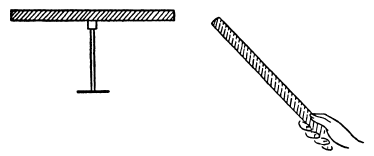
We have two long bar magnets, one suspended freely at its centre, the other
held in the hand. The ends of the two magnets are brought together in such a
way that a strong attraction is noticed between them. This can always be done.
If no attraction results, we must turn the magnet and try the other end.
Something will happen if the bars are magnetized at all. The ends of the
magnets are called their poles. To
continue with the experiment we move the pole of the magnet held in the hand
along the other magnet. A decrease in the attraction is noticed and when the
pole reaches the middle of the suspended magnet there is no evidence of any
force at all. If the pole is moved farther in the same direction a repulsion is
observed, attaining its greatest strength at the second pole of the hanging magnet.
2. The above experiment suggests another. Each magnet has two poles. Can we not isolate one of them? The idea is very simple: just break a magnet into two equal parts. We have seen that there is no force between the pole of one magnet and the middle of the other. But the result of actually breaking a magnet is surprising and unexpected. If we repeat the experiment described under 1, with only half a magnet suspended, the results are exactly the same as before! Where there was no trace of magnetic force previously, there is now a strong pole.
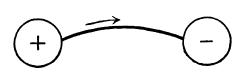
How are these facts to be explained? We can attempt to pattern a theory of magnetism after the theory of electric fluids. This is suggested by the fact that here, as in electrostatic phenomena, we have attraction and repulsion. Imagine two spherical conductors possessing equal charges, one positive and the other negative. Here “equal” means having the same absolute value; + 5 and 5, for example, have the same absolute value. Let us assume that these spheres are connected by means of an insulator such as a glass rod. Schematically this arrangement can be represented by an arrow directed from the negatively charged conductor to the positive one. We shall call the whole thing an electric dipole. It is clear that two such dipoles would behave exactly like the bar magnets in experiment 1. If we think of our invention as a model for a real magnet, we may say, assuming the existence of magnetic fluids, that a magnet is nothing but a magnet dipole, having at its ends two fluids of different kinds. This simple theory, imitating the theory of electricity, is adequate for an explanation of the first experiment. There would be attraction at one end, repulsion at the other, and a balancing of equal and opposite forces in the middle. But what of the second experiment? By breaking the glass rod in the case of the electric dipole we get two isolated poles. The same ought to hold good for the iron bar of the magnetic dipole, contrary to the results of the second experiment. Thus this contradiction forces us to introduce a somewhat more subtle theory. Instead of our previous model we may imagine that the magnet consists of very small elementary magnetic dipoles which cannot be broken into separate poles. Order reigns in the magnet as a whole, for all the elementary dipoles are directed in the same way. We see immediately why cutting a magnet causes two new poles to appear on the new ends, and why this more refined theory explains the facts of experiment 1 as well as 2.
Each magnet has two poles. Similar to the electrostatic phenomena, opposite poles attract; and like poles repel each other; but the magnetic poles cannot be isolated. Cutting a magnet causes two new poles to appear on the new ends. We theorize that the magnet consists of very small elementary magnetic dipoles directed in the same way. The elementary magnetic dipoles cannot be broken into separate poles.
For
many facts, the simpler theory gives an explanation and the refinement seems
unnecessary. Let us take an example: We know that a magnet attracts pieces of iron.
Why? In a piece of ordinary iron the two magnetic fluids are mixed, so that no
net effect results. Bringing a positive pole near acts as a “command of division”
to the fluids, attracting the negative fluid of the iron and repelling the
positive. The attraction between iron and magnet follows. If the magnet is removed,
the fluids go back to more or less their original state, depending on the
extent to which they remember the commanding voice of the external force.
The magnetic dipoles are mixed in the iron, but they manage to order themselves in the presence of a magnet.
Little
need be said about the quantitative side of the problem. With two very long
magnetized rods we could investigate the attraction (or repulsion) of their
poles when brought near one another. The effect of the other ends of the rods
is negligible if the rods are long enough. How does the attraction or repulsion
depend on the distance between the poles? The answer given by Coulomb’s
experiment is that this dependence on distance is the same as in Newton’s law
of gravitation and Coulomb’s law of electrostatics.
The dependence on distance in magnetic attraction (or repulsion)
is the same as in Newton’s law of gravitation and Coulomb’s law of
electrostatics.
We
see again in this theory the application of a general point of view: the
tendency to describe all phenomena by means of attractive and repulsive forces depending
only on distance and acting between unchangeable particles.
All phenomena may be described by means of attractive and repulsive forces depending only on distance.
One
well-known fact should be mentioned, for later we shall make use of it. The
earth is a great magnetic dipole. There is not the slightest trace of an
explanation as to why this is true. The North Pole is approximately the minus
(-) and the South Pole the plus (+) magnetic pole of the earth. The names plus
and minus are only a matter of convention, but when once fixed, enable us to
designate poles in any other case. A magnetic needle supported on a vertical
axis obeys the command of the magnetic force of the earth. It directs its (+) pole
toward the North Pole, that is, toward the (-) magnetic pole of the earth.
The earth is a great magnetic dipole.
Although
we can consistently carry out the mechanical view in the domain of electric and
magnetic phenomena introduced here, there is no reason to be particularly proud
or pleased about it. Some features of the theory are certainly unsatisfactory
if not discouraging. New kinds of substances had to be invented: two electric fluids
and the elementary magnetic dipoles. The wealth of substances begins to be overwhelming!
Here we are inventing new substances (heat, electric charges, magnetic dipoles).
The
forces are simple. They are expressible in a similar way for gravitational,
electric, and magnetic forces. But the price paid for this simplicity is high: the
introduction of new weightless substances. These are rather artificial
concepts, and quite unrelated to the fundamental substance, mass.
These weightless substances are rather artificial concepts, and quite unrelated to the fundamental substance, mass.
.
Final Comment
In this mechanical view, there are new weightless substances (heat, electric charges, magnetic dipoles) that involve forces that seem to behave very similar to the gravitational force. But gravitational force involves mass as substance.
This paper presents Chapter
II, section 1 from the book THE EVOLUTION
OF PHYSICS by A. EINSTEIN and L. INFELD. The contents are from the original
publication of this book by Simon and Schuster, New York (1942).
The paragraphs of the original
material (in black) are accompanied by brief comments (in color) based on the present
understanding. Feedback on these comments is appreciated.
The heading below is linked to
the original materials.
The
following pages contain a dull report of some very simple experiments. The
account will be boring not only because the description of experiments is
uninteresting in comparison with their actual performance, but also because the
meaning of the experiments does not become apparent until theory makes it so.
Our purpose is to furnish a striking example of the role of theory in physics.
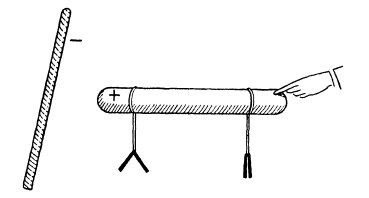
1. A metal bar is supported on a glass base, and each end of the bar is connected by means of a wire to an electroscope. What is an electroscope? It is a simple apparatus consisting essentially of two leaves of gold foil hanging from the end of a short piece of metal. This is enclosed in a glass jar or flask and the metal is in contact only with non-metallic bodies, called insulators. In addition to the electroscope and metal bar we are equipped with a hard rubber rod and a piece of flannel.
The
experiment is performed as follows: we look to see whether the leaves hang
close together, for this is their normal position. If by chance they do not, a touch
of the finger on the metal rod will bring them together. These preliminary
steps being taken, the rubber rod is rubbed vigorously with the flannel and brought
into contact with the metal. The leaves separate at once! They remain apart
even after the rod is removed.
2.
We perform another experiment, using the same apparatus as before, again
starting with the gold leaves hanging close together. This time we do not bring
the rubbed rod into actual contact with the metal, but only near it. Again the
leaves separate. But there is a difference! When the rod is taken away without
having touched the metal, the leaves immediately fall back to their normal
position instead of remaining separated.
3. Let us change the apparatus slightly for a third experiment. Suppose that the metal bar consists of two pieces, joined together. We rub the rubber rod with flannel and again bring it near the metal. The same phenomenon occurs, the leaves separate. But now let us divide the metal rod into its two separate parts and then take away the rubber rod. We notice that in this case the leaves remain apart, instead of falling back to their normal position as in the second experiment.
It
is difficult to evince enthusiastic interest in these simple and naive
experiments. In the Middle Ages their performer would probably have been
condemned; to us they seem both dull and illogical. It would be very difficult
to repeat them, after reading the account only once, without becoming confused.
Some notion of the theory makes them understandable. We could say more: it is
hardly possible to imagine such experiments performed as accidental play,
without the pre-existence of more or less definite ideas about their meaning.
We
shall now point out the underlying ideas of a very simple and naive theory
which explains all the facts described.
There exist two electric fluids, one called positive (+) and the other negative (-). They are somewhat like substance in the sense already explained, in that the amount can be enlarged or diminished, but the total in any isolated system is preserved. There is, however, an essential difference between this case and that of heat, matter or energy. We have two electrical substances. It is impossible here to use the previous analogy of money unless it is somehow generalized. A body is electrically neutral if the positive and negative electric fluids exactly cancel each other. A man has nothing, either because he really has nothing, or because the amount of money put aside in his safe is exactly equal to the sum of his debts. We can compare the debit and credit entries in his ledger to the two kinds of electric fluids.
A property of substance is that its amount can be enlarged or diminished, but the total in any isolated system is preserved. In the case of electricity there exist two electric fluids that neutralize each other.
The next assumption of the theory is that two electric fluids of the same kind repel each other, while two of the opposite kind attract. This can be represented graphically in the following way:
Two electric fluids of the same kind repel each other, while two of the opposite kind attract.
A
final theoretical assumption is necessary: There are two kinds of bodies, those
in which the fluids can move freely, called conductors,
and those in which they cannot, called insulators.
As is always true in such cases, this division is not to be taken too
seriously. The ideal conductor or insulator is a fiction which can never be
realized. Metals, the earth, the human body, are all examples of conductors,
although not equally good. Glass, rubber, china, and the like are insulators. Air
is only partially an insulator, as everyone who has seen the described
experiments knows. It is always a good excuse to ascribe the bad results of
electrostatic experiments to the humidity of the air, which increases its
conductivity.
There are two kinds of bodies, those in which the fluids can move freely, called conductors, and those in which they cannot, called insulators.
These
theoretical assumptions are sufficient to explain the three experiments
described. We shall discuss them once more, in the same order as before, but in
the light of the theory of electric fluids.
1.
The rubber rod, like all other bodies under normal conditions, is electrically
neutral. It contains the two fluids, positive and negative, in equal amounts.
By rubbing with flannel we separate them. This statement is pure convention,
for it is the application of the terminology created by the theory to the
description of the process of rubbing. The kind of electricity that the rod has
in excess afterwards is called negative, a name which is certainly only a
matter of convention. If the experiments had been performed with a glass rod rubbed
with cat’s fur we should have had to call the excess positive, to conform with
the accepted convention. To proceed with the experiment, we bring electric fluid
to the metal conductor by touching it with the rubber. Here it moves freely,
spreading over the whole metal including the gold leaves. Since the action of negative
on negative is repulsion, the two leaves try to get as far from each other as
possible and the result is the observed separation. The metal rests on glass or
some other insulator so that the fluid remains on the conductor, as long as the
conductivity of the air permits. We understand now why we have to touch the metal
before beginning the experiment. In this case the metal, the human body, and
the earth form one vast conductor, with the electric fluid so diluted that
practically nothing remains on the electroscope.
2.
This experiment begins just in the same way as the previous one. But instead of
being allowed to touch the metal the rubber is now only brought near it. The two
fluids in the conductor, being free to move, are separated, one attracted and
the other repelled. They mix again when the rubber rod is removed, as fluids of
opposite kinds attract each other.
3.
Now we separate the metal into two parts and afterwards remove the rod. In this
case the two fluids cannot mix, so that the gold leaves retain an excess of one
electric fluid and remain apart.
In the light of this simple theory all the facts mentioned here seem comprehensible. The same theory does more, enabling us to understand not only these, but many other facts in the realm of “electrostatics”. The aim of every theory is to guide us to new facts, suggest new experiments, and lead to the discovery of new phenomena and new laws. An example will make this clear. Imagine a change in the second experiment. Suppose I keep the rubber rod near the metal and at the same time touch the conductor with my finger. What will happen now? Theory answers: the repelled fluid (-) can now make its escape through my body, with the result that only one fluid remains, the positive. Only the leaves of the electroscope near the rubber rod will remain apart. An actual experiment confirms this prediction.
The
theory with which we are dealing is certainly naive and inadequate from the
point of view of modern physics. Nevertheless it is a good example showing the characteristic
features of every physical theory.
The above theory of electricity explains the experimental
observations.
There
are no eternal theories in science. It always happens that some of the facts
predicted by a theory are disproved by experiment. Every theory has its period
of gradual development and triumph, after which it may experience a rapid
decline. The rise and fall of the substance theory of heat, already discussed here,
is one of many possible examples. Others, more profound and important, will be
discussed later. Nearly every great advance in science arises from a crisis in
the old theory, through an endeavour to find a way out of the difficulties
created. We must examine old ideas, old theories, although they belong to the
past, for this is the only way to understand the importance of the new ones and
the extent of their validity.
Older theories are superseded by later theories based on new
observations.
In
the first pages of our book we compared the role of an investigator to that of
a detective who, after gathering the requisite facts, finds the right solution by
pure thinking. In one essential this comparison must be regarded as highly
superficial. Both in life and in detective novels the crime is given. The
detective must look for letters, fingerprints, bullets, guns, but at least he
knows that a murder has been committed. This is not so for a scientist. It
should not be difficult to imagine someone who knows absolutely nothing about electricity,
since all the ancients lived happily enough without any knowledge of it. Let
this man be given metal, gold foil, bottles, hard-rubber rod, flannel, in short,
all the material required for performing our three experiments. He may be a
very cultured person, but he will probably put wine into the bottles, use the flannel
for cleaning, and never once entertain the idea of doing the things we have
described. For the detective the crime is given, the problem formulated: who killed
Cock Robin? The scientist must, at least in part, commit his own crime, as well
as carry out the investigation. Moreover, his task is not to explain just one case,
but all phenomena which have happened or may still happen.
Scientific investigations proceed on the basis of pure
curiosity.
In
the introduction of the concept of fluids we see the influence of those
mechanical ideas which attempt to explain everything by substances and simple
forces acting between them. To see whether the mechanical point of view can be
applied to the description of electrical phenomena, we must consider the
following problem. Two small spheres are given, both with an electric charge,
that is, both carrying an excess of one electric fluid. We know that the
spheres will either attract or repel each other. But does the force depend only
on the distance, and if so, how? The simplest guess seems to be that this force
depends on the distance in the same way as gravitational force, which diminishes,
say, to one-ninth of its former strength if the distance is made three times as
great. The experiments performed by Coulomb showed that this law is really valid.
A hundred years after Newton discovered the law of gravitation, Coulomb found a
similar dependence of electrical force on distance. The two major differences between
Newton’s law and Coulomb’s law are: gravitational attraction is always present,
while electric forces exist only if the bodies possess electric charges. In the
gravitational case there is only attraction, but electric forces may either
attract or repel.
There is similarity between the laws that govern gravitational
and electrical force. Gravitational attraction is always present, while
electric forces exist only if the bodies possess electric charges. In the
gravitational case there is only attraction, but electric forces may either
attract or repel.
There
arises here the same question which we considered in connection with heat. Are
the electrical fluids weightless substances or not? In other words, is the
weight of a piece of metal the same whether neutral or charged? Our scales show
no difference. We conclude that the electric fluids are also members of the
family of weightless substances.
The electric fluids are also members of the family of weightless
substances.
Further progress in the theory of electricity requires the introduction of two new concepts. Again we shall avoid rigorous definitions, using instead analogies with concepts already familiar. We remember how essential it was for an understanding of the phenomena of heat to distinguish between heat itself and temperature. It is equally important here to distinguish between electric potential and electric charge. The difference between the two concepts is made clear by the analogy:
Two conductors, for example two spheres of different size, may have the same electric charge, that is the same excess of one electric fluid, but the potential will be different in the two cases, being higher for the smaller and lower for the larger sphere. The electric fluid will have greater density and thus be more compressed on the small conductor. Since the repulsive forces must increase with the density, the tendency of the charge to escape will be greater in the case of the smaller sphere than in that of the larger. This tendency of charge to escape from a conductor is a direct measure of its potentials. In order to show clearly the difference between charge and potential we shall formulate a few sentences describing the behaviour of heated bodies, and the corresponding sentences concerning charged conductors.
But
this analogy must not be pushed too far. An example shows the differences as
well as the similarities. If a hot body is brought into contact with a cold
one, the heat flows from the hotter to the colder. On the other hand, suppose
that we have two insulated conductors having equal but opposite charges, one
positive and the other negative. The two are at different potentials. By
convention we regard the potential corresponding to a negative charge as lower
than that corresponding to a positive charge. If the two conductors are brought
together or connected by a wire, it follows from the theory of electric fluids
that they will show no charge and thus no difference of electric potential at
all. We must imagine a “flow” of electric charge from one conductor
to the other during the short time in which the potential difference is
equalized. But how? Does the positive fluid flow to the negative body, or the negative
fluid to the positive body?
Hot and cold temperatures can be put on the same scale, but this is not so with positive and negative electricity.
In
the material presented here we have no basis for deciding between these two
alternatives. We can assume either of the two possibilities, or that the flow
is simultaneous in both directions. It is only a matter of adopting a convention,
and no significance can be attached to the choice, for we know no method of deciding
the question experimentally. Further development leading to a much more
profound theory of electricity gave an answer to this problem, which is quite
meaningless when formulated in terms of the simple and primitive theory of
electric fluids. Here we shall simply adopt the following mode of expression. The
electric fluid flows from the conductor having the higher potential to that
having the lower. In the case of our two conductors, the electricity thus flows
from positive to negative. This expression is only a matter of convention and
is at this point quite arbitrary. The whole difficulty indicates that the
analogy between heat and electricity is by no means complete.
The positive and negative potentials are arbitrarily assigned under the two fluids theory.
We
have seen the possibility of adapting the mechanical view to a description of
the elementary facts of electrostatics. The same is possible in the case of magnetic
phenomena.
.
Final Comment
Postive and negative charges represent two opposite conditions of tension that can exist in matter. When a positive charge arises in one place then an equivalent negative charge must arise at another place. Opposite charges attract each other. Like charges repel each other. When positive and negative charges come together, they neutralize each other. The amount of charge in a system can be enlarged or diminished. The total charge in any isolated system is preserved.
According to Postulate Mechanics, gravity depends on the balance of inertia and motion among a system of bodies. In this theory, the bodies follow their balanced path. Two bodies when pushed closer shall repel each other. Two bodies when pulled apart shall attract each other. There is neutralization in terms of traveling the balanced path.
Thus, there are parallels between electrical and gravitational forces, but their nature is very different.
This paper presents Chapter
I, section 10 from the book THE EVOLUTION
OF PHYSICS by A. EINSTEIN and L. INFELD. The contents are from the original
publication of this book by Simon and Schuster, New York (1942).
The paragraphs of the original
material (in black) are accompanied by brief comments (in color) based on the present
understanding. Feedback on these comments is appreciated.
The heading below is linked to
the original materials.
Is
it possible to explain the phenomena of heat in terms of the motions of
particles interacting through simple forces? A closed vessel contains a certain
mass of gas air, for example at a certain temperature. By heating we raise the
temperature, and thus increase the energy. But how is this heat connected with
motion? The possibility of such a connection is suggested both by our
tentatively accepted philosophical point of view and by the way in which heat
is generated by motion. Heat must be mechanical energy if every problem is a
mechanical one. The object of the kinetic
theory is to present the concept of matter just in this way. According to
this theory a gas is a congregation of an enormous number of particles, or molecules, moving in all directions,
colliding with each other and changing in direction of motion with each
collision. There must exist an average speed of molecules, just as in a large
human community there exists an average age, or an average wealth. There will
therefore be an average kinetic energy per particle. More heat in the vessel
means a greater average kinetic energy. Thus heat, according to this picture,
is not a special form of energy different from the mechanical one but is just the
kinetic energy of molecular motion. To any definite temperature there
corresponds a definite average kinetic energy per molecule. This is, in fact,
not an arbitrary assumption. We are forced to regard the kinetic energy of a
molecule as a measure of the temperature of the gas if we wish to form a
consistent mechanical picture of matter.
Heat, according to this picture, is not a special form of energy
different from the mechanical one but is just the kinetic energy of molecular
motion. To any definite temperature there corresponds a definite average
kinetic energy per molecule.
This
theory is more than a play of the imagination. It can be shown that the kinetic
theory of gases is not only in agreement with experiment, but actually leads to
a more profound understanding of the facts. This may be illustrated by a few
examples.
We
have a vessel closed by a piston which can move freely. The vessel contains a
certain amount of gas to be kept at a constant temperature. If the piston is
initially at rest in some position, it can be moved upward by removing and
downward by adding weight. To push the piston down force must be used acting
against the inner pressure of the gas. What is the mechanism of this inner
pressure according to the kinetic theory? A tremendous number of particles
constituting the gas are moving in all directions. They bombard the walls and
the piston, bouncing back like balls thrown against a wall. This continual
bombardment by a great number of particles keeps the piston at a certain height
by opposing the force of gravity acting downward on the piston and the weights.
In one direction there is a constant gravitational force, in the other very
many irregular blows from the molecules. The net effect on the piston of all
these small irregular forces must be equal to that of the force of gravity if
there is to be equilibrium.
The continual bombardment by a great number of particles keeps
the piston at a certain height by opposing the force of gravity acting downward
on the piston and the weights.
Suppose
the piston were pushed down so as to compress the gas to a fraction of its former
volume, say one-half, its temperature being kept unchanged. What, according to
the kinetic theory, can we expect to happen? Will the force due to the
bombardment be more or less effective than before? The particles are now packed
more closely. Although the average kinetic energy is still the same, the
collisions of the particles with the piston will now occur more frequently and thus
the total force will be greater. It is clear from this picture presented by the
kinetic theory that to keep the piston in this lower position more weight is
required. This simple experimental fact is well known, but its prediction
follows logically from the kinetic view of matter.
To keep the piston in a lower position more weight is required. This
prediction follows logically from the kinetic view of matter.
Consider
another experimental arrangement. Take two vessels containing equal volumes of
different gases, say hydrogen and nitrogen, both at the same temperature. Assume
the two vessels are closed with identical pistons, on which are equal weights.
This means, briefly, that both gases have the same volume, temperature, and
pressure. Since the temperature is the same, so, according to the theory, is
the average kinetic energy per particle. Since the pressures are equal, the two
pistons are bombarded with the same total force. On the average every particle
carries the same energy and both vessels have the same volume. Therefore, the number of molecules in each must be the
same, although the gases are chemically different. This result is very
important for the understanding of many chemical phenomena. It means that the
number of molecules in a given volume, at a certain temperature and pressure, is
something which is characteristic, not of a particular gas, but of all gases.
It is most astonishing that the kinetic theory not only predicts the existence
of such a universal number, but enables us to determine it. To this point we
shall return very soon.
The kinetic theory predicts the number of molecules in a given
volume, at a certain temperature and pressure as a characteristic, not of a
particular gas, but of all gases.
The
kinetic theory of matter explains quantitatively as well as qualitatively the
laws of gases as determined by experiment. Furthermore, the theory is not
restricted to gases, although its greatest successes have been in this domain.
A
gas can be liquefied by means of a decrease of temperature. A fall in the
temperature of matter means a decrease in the average kinetic energy of its
particles. It is therefore clear that the average kinetic energy of a liquid
particle is smaller than that of a corresponding gas particle.
A
striking manifestation of the motion of particles in liquids was given for the
first time by the so-called Brownian
movement, a remarkable phenomenon which would remain quite mysterious and
incomprehensible without the kinetic theory of matter. It was first observed by
the botanist Brown, and was explained eighty years later, at the beginning of
this century. The only apparatus necessary for observing Brownian motion is a
microscope, which need not even be a particularly good one.
Brown
was working with grains of pollen of certain plants, that is:
particles or granules of unusually large size varying from one four-thousandth to about five-thousandth of an inch in length.
He
reports further:
While examining the form of these particles immersed in water, I observed many of them evidently in motion…. These motions were such as to satisfy me, after frequently repeated observation, that they arose neither from current in the fluid nor from its gradual evaporation, but belonged to the particle itself.
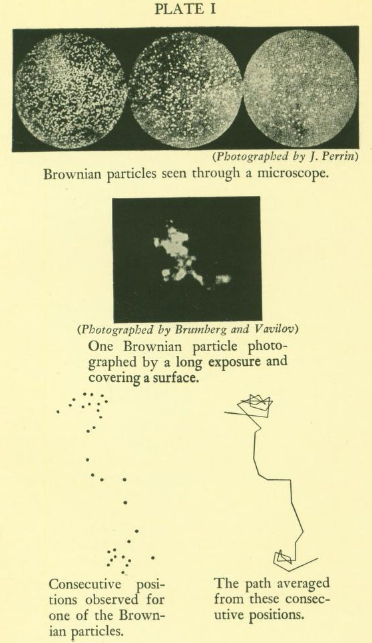
What
Brown observed was the unceasing agitation of the granules when suspended in
water and visible through the microscope. It is an impressive sight!
A similar phenomenon of unceasing agitation is the Brownian
movement.
Is
the choice of particular plants essential for the phenomenon? Brown answered
this question by repeating the experiment with many different plants, and found
that all the granules, if sufficiently small, showed such motion when suspended
in water. Furthermore, he found the same kind of restless, irregular motion in
very small particles of inorganic as well as organic substances. Even with a
pulverized fragment of a sphinx he observed the same phenomenon!
How
is this motion to be explained? It seems contradictory to all previous
experience. Examination of the position of one suspended particle, say every
thirty seconds, reveals the fantastic form of its path. The amazing thing is
the apparently eternal character of the motion. A swinging pendulum placed in
water soon comes to rest if not impelled by some external force. The existence
of a never-diminishing motion seems contrary to all experience. This difficulty
was splendidly clarified by the kinetic theory of matter.
This movement is splendidly clarified by the kinetic theory of
matter.
Looking
at water through even our most powerful microscopes we cannot see molecules and
their motion as pictured by the kinetic theory of matter. It must be concluded
that if the theory of water as a congregation of particles is correct, the size
of the particles must be beyond the limit of visibility of the best
microscopes. Let us nevertheless stick to the theory and assume that it
represents a consistent picture of reality. The Brownian particles visible
through a microscope are bombarded by the smaller ones composing the water
itself. The Brownian movement exists if the bombarded particles are
sufficiently small. It exists because this bombardment is not uniform from all
sides and cannot be averaged out, owing to its irregular and haphazard
character. The observed motion is thus the result of the unobservable one. The
behaviour of the big particles reflects in some way that of the molecules, constituting,
so to speak, a magnification so high that it becomes visible through the
microscope. The irregular and haphazard character of the path of the Brownian particles
reflects a similar irregularity in the path of the smaller particles which
constitute matter. We can understand, therefore, that a quantitative study of Brownian
movement can give us deeper insight into the kinetic theory of matter. It is
apparent that the visible Brownian motion depends on the size of the invisible
bombarding molecules. There would be no Brownian motion at all if the
bombarding molecules did not possess a certain amount of energy or, in other words,
if they did not have mass and velocity. That the study of Brownian motion can
lead to a determination of the mass of a molecule is therefore not astonishing.
The irregular and haphazard character of the path of the
Brownian particles reflects a similar irregularity in the path of the smaller
particles which constitute matter.
Through
laborious research, both theoretical and experimental, the quantitative
features of the kinetic theory were formed. The clue originating in the
phenomenon of Brownian movement was one of those which led to the quantitative
data. The same data can be obtained in different ways, starting from quite
different clues. The fact that all these methods support the same view is most
important, for it demonstrates the internal consistency of the kinetic theory
of matter.
Experiments show an internal consistency of the kinetic theory
of matter.
Only
one of the many quantitative results reached by experiment and theory will be
mentioned here. Suppose we have a gram of the lightest of all elements, hydrogen,
and ask: how many particles are there in this one gram? The answer will
characterize not only hydrogen but also all other gases, for we already know under
what conditions two gases have the same number of particles.
The
theory enables us to answer this question from certain measurements of the
Brownian motion of a suspended particle. The answer is an astonishingly great
number: a three followed by twenty-three other digits! The number of molecules
in one gram of hydrogen is 303,000,000,000,000,000,000,000.
Imagine
the molecules of a gram of hydrogen so increased in size that they are visible
through a microscope: say that the diameter becomes one five-thousandth of an
inch, such as that of a Brownian particle. Then, to pack them closely, we
should have to use a box each side of which is about one-quarter of a mile
long!
We
can easily calculate the mass of one such hydrogen molecule by dividing 1 by
the number quoted above. The answer is a fantastically small number: 0.000 000
000 000 000 000 000 0033 gram, representing the mass of one molecule of
hydrogen.
The
experiments on Brownian motion are only some of the many independent
experiments leading to the determination of this number which plays such an
important part in physics.
In
the kinetic theory of matter and in all its important achievements we see the
realization of the general philosophical programme: to reduce the explanation
of all phenomena to the interaction between particles of matter.
Kinetic theory of matter tells us that matter is made up of very
small particles called atoms and molecules that are continually moving or
vibrating.
WE
SUMMARIZE:
In mechanics the future path of a
moving body can be predicted and its past disclosed if its present condition
and the forces acting upon it are known. Thus, for example, the future paths of
all planets can be foreseen. The active forces are Newton’s gravitational
forces depending on the distance alone. The great results of classical
mechanics suggest that the mechanical view can be consistently applied to all
branches of physics, that all phenomena can be explained by the action of
forces representing either attraction or repulsion, depending only upon
distance and acting between unchangeable particles.
In the kinetic theory of matter we
see how this view, arising from mechanical problems, embraces the phenomena of
heat and how it leads to a successful picture of the structure of matter.
.
Final Comment
The kinetic theory of matter tells us that matter is made up of very small particles called atoms and molecules that are continually moving or vibrating. Heat is just the kinetic energy of molecular motion. To any definite temperature there corresponds a definite average kinetic energy per molecule.
The kinetic theory predicts the number of molecules in a given volume, at a certain temperature and pressure as a characteristic, not of a particular gas, but of all gases. This has been verified experimentally.
This paper presents Chapter
I, section 9 from the book THE EVOLUTION
OF PHYSICS by A. EINSTEIN and L. INFELD. The contents are from the original
publication of this book by Simon and Schuster, New York (1942).
The paragraphs of the original
material (in black) are accompanied by brief comments (in color) based on the present
understanding. Feedback on these comments is appreciated.
The heading below is linked to
the original materials.
The
results of scientific research very often force a change in the philosophical
view of problems which extend far beyond the restricted domain of science
itself. What is the aim of science? What is demanded of a theory which attempts
to describe nature? These questions, although exceeding the bounds of physics, are
intimately related to it, since science forms the material from which they
arise. Philosophical generalizations must be founded on scientific results.
Once formed and widely accepted, however, they very often influence the further
development of scientific thought by indicating one of the many possible lines
of procedure. Successful revolt against the accepted view results in unexpected
and completely different developments, becoming a source of new philosophical
aspects. These remarks necessarily sound vague and pointless until illustrated
by examples quoted from the history of physics.
We
shall here try to describe the first philosophical ideas on the aim of science.
These ideas greatly influenced the development of physics until nearly a hundred
years ago, when their discarding was forced by new evidence, new facts and
theories, which in their turn formed a new background for science.
In
the whole history of science from Greek philosophy to modern physics there have
been constant attempts to reduce the apparent complexity of natural phenomena
to some simple fundamental ideas and relations. This is the underlying
principle of all natural philosophy. It is expressed even in the work of the Atomists.
Twenty-three centuries ago Democritus wrote:
By convention sweet is sweet, by convention bitter is bitter, by convention hot is hot, by convention cold is cold, by convention colour is colour. But in reality there are atoms and the void. That is, the objects of sense are supposed to be real and it is customary to regard them as such, but in truth they are not. Only the atoms and the void are real.
The underlying principle of all natural philosophy is to reduce
the apparent complexity of natural phenomena to some simple fundamental ideas
and relations.
This
idea remains in ancient philosophy nothing more than an ingenious figment of
the imagination. Laws of nature relating subsequent events were unknown to the
Greeks. Science connecting theory and experiment really began with the work of
Galileo. We have followed the initial clues leading to the laws of motion.
Throughout two hundred years of scientific research force and matter were the
underlying concepts in all endeavours to understand nature. It is impossible to
imagine one without the other because matter demonstrates its existence as a
source of force by its action on other matter.
Throughout two hundred years of scientific research force and
matter were the underlying concepts in all endeavours to understand nature.
Let
us consider the simplest example: two particles with forces acting between
them. The easiest forces to imagine are those of attraction and repulsion. In
both cases the force vectors lie on a line connecting the material points. The
demand for simplicity leads to the picture of particles attracting or repelling
each other; any other assumption about the direction of the acting forces would
give a much more complicated picture. Can we make an equally simple assumption
about the length of the force vectors? Even if we want to avoid too special
assumptions we can still say one thing: the force between any two given
particles depends only on the distance between them, like gravitational forces.
This seems simple enough. Much more complicated forces could be imagined, such
as those which might depend not only on the distance but also on the velocities
of the two particles. With matter and force as our fundamental concepts, we can
hardly imagine simpler assumptions than that forces act along the line
connecting the particles and depend only on the distance. But is it possible to
describe all physical phenomena by forces of this kind alone?
With matter and force as our fundamental concepts, we can hardly
imagine simpler assumptions than that forces act along the line connecting the
particles and depend only on the distance.
The
great achievements of mechanics in all its branches, its striking success in
the development of astronomy, the application of its ideas to problems
apparently different and non-mechanical in character, all these things
contributed to the belief that it is possible to describe all natural phenomena
in terms of simple forces between unalterable objects. Throughout the two centuries
following Galileo’s time such an endeavour, conscious or unconscious, is
apparent in nearly all scientific creation. This was clearly formulated by Helmholtz
about the middle of the nineteenth century:
Finally, therefore, we discover the problem of physical material science to be to refer natural phenomena back to unchangeable attractive and repulsive forces whose intensity depends wholly upon distance. The solubility of this problem is the condition of the complete comprehensibility of nature.
Thus,
according to Helmholtz, the line of development of science is determined and
follows strictly a fixed course:
And its vocation will be ended as soon as the reduction of natural phenomena to simple forces is complete and the proof given that this is the only reduction of which the phenomena are capable.
Throughout the two centuries following Galileo’s time, science has held the belief, consciously or unconsciously, that it is possible to describe all natural phenomena in terms of simple forces between unalterable objects.
This
view appears dull and naive to a twentieth-century physicist. It would frighten
him to think that the great adventure of research could be so soon finished, and
an unexciting if infallible picture of the universe established for all time.
Although
these tenets would reduce the description of all events to simple forces, they
do leave open the question of just how the forces should depend on distance. It
is possible that for different phenomena this dependence is different. The
necessity of introducing many different kinds of force for different events is certainly
unsatisfactory from a philosophical point of view. Nevertheless this so-called
mechanical view, most clearly formulated by Helmholtz, played an important role
in its time. The development of the kinetic theory of matter is one of the
greatest achievements directly influenced by the mechanical view.
This mechanical view led to the development of the kinetic
theory of matter.
Before
witnessing its decline, let us provisionally accept the point of view held by
the physicists of the past century and see what conclusions we can draw from their
picture of the external world.
.
Final comment
Force and matter are considered to be the underlying concepts in all endeavours to understand nature. Forces are either attractive or repulsive and they act along the line connecting the particles and depend only on the distance. This mechanical view led to the development of the kinetic theory of matter.
Alternative view in Postulate Mechanics is the balance of inertia and motion among particles.
This paper presents Chapter
I, section 8 from the book THE EVOLUTION
OF PHYSICS by A. EINSTEIN and L. INFELD. The contents are from the original
publication of this book by Simon and Schuster, New York (1942).
The paragraphs of the original
material (in black) are accompanied by brief comments (in color) based on the present
understanding. Feedback on these comments is appreciated.
The heading below is linked to
the original materials.
Less
than a hundred years ago the new clue which led to the concept of heat as a
form of energy was guessed by Mayer and confirmed experimentally by Joule. It
is a strange coincidence that nearly all the fundamental work concerned with
the nature of heat was done by non-professional physicists who regarded physics
merely as their great hobby. There was the versatile Scotsman Black, the German
physician Mayer, and the great American adventurer Count Rumford, who
afterwards lived in Europe and, among other activities, became Minister of War
for Bavaria. There was also the English brewer Joule who, in his spare time,
performed some most important experiments concerning the conservation of
energy.
Joule
verified by experiment the guess that heat is a form of energy, and determined
the rate of exchange. It is worth our while to see just what his results were.
Joule verified by experiment the guess that heat is a form of
energy, and determined the rate of exchange.
The
kinetic and potential energy of a system together constitute its mechanical energy. In the case of the
switchback we made a guess that some of the mechanical energy was converted
into heat. If this is right, there must be here and in all other similar physical
processes a definite rate of exchange
between the two. This is rigorously a quantitative question, but the fact that
a given quantity of mechanical energy can be changed into a definite amount of
heat is highly important. We should like to know what number expresses the rate
of exchange, i.e., how much heat we obtain from a given amount of mechanical energy.
The kinetic and potential energy of a system together constitute
its mechanical energy.
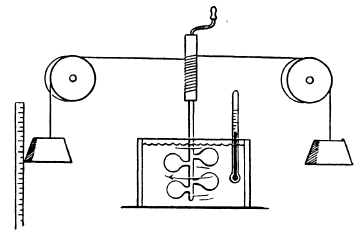
The
determination of this number was the object of Joule’s researches. The
mechanism of one of his experiments is very much like that of a weight clock.
The winding of such a clock consists of elevating two weights, thereby adding
potential energy to the system. If the clock is not further interfered with, it
may be regarded as a closed system. Gradually the weights fall and the clock
runs down. At the end of a certain time the weights will have reached their
lowest position and the clock will have stopped. What has happened to the
energy? The potential energy of the weights has changed into kinetic energy of
the mechanism, and has then gradually been dissipated as heat.
A
clever alteration in this sort of mechanism enabled Joule to measure the heat
lost and thus the rate of exchange. In his apparatus two weights caused a paddle
wheel to turn while immersed in water. The potential energy of the weights was
changed into kinetic energy of the movable parts, and thence into heat which raised
the temperature of the water. Joule measured this change of temperature and,
making use of the known specific heat of water, calculated the amount of heat
absorbed. He summarized the results of many trials as follows:
1st. That the quantity of heat produced by the friction of bodies, whether solid or liquid, is always proportional to the quantity of force [by force Joule means energy] expended.
And
2nd. That the quantity of heat capable of increasing the temperature of a pound of water (weighed in vacuo and taken at between 55° and 60°) by 1° Fahr. requires for its evolution the expenditure of a mechanical force [energy] represented by the fall of 772 Ib. through the space of one foot.
In
other words, the potential energy of 772 pounds elevated one foot above the
ground is equivalent to the quantity of heat necessary to raise the temperature
of one pound of water from 55° F. to 56°
F. Later experimenters were capable of somewhat greater accuracy, but the
mechanical equivalent of heat is essentially what Joule found in his pioneer
work.
Joule determined that a given quantity of mechanical energy was changed into a definite amount of heat.
Once
this important work was done, further progress was rapid. It was soon
recognized that these kinds of energy, mechanical and heat, are only two of its
many forms. Everything which can be converted into either of them is also a
form of energy. The radiation given off by the sun is energy, for part of it is
transformed into heat on the earth. An electric current possesses energy, for
it heats a wire or turns the wheels of a motor. Coal represents chemical
energy, liberated as heat when the coal burns. In every event in nature one form
of energy is being converted into another, always at some well-defined rate of
exchange. In a closed system, one isolated from external influences, the energy
is conserved and thus behaves like a substance. The sum of all possible forms
of energy in such a system is constant, although the amount of any one kind may
be changing. If we regard the whole universe as a closed system, we can proudly
announce with the physicists of the nineteenth century that the energy of the
universe is invariant, that no part of it can ever be created or destroyed.
It was determined further that in every event in nature one form
of energy is being converted into another, always at some well-defined rate of
exchange.
Our
two concepts of substance are, then, matter
and energy. Both obey conservation
laws: An isolated system cannot change either in mass or in total energy. Matter
has weight but energy is weightless. We have therefore two different concepts
and two conservation laws. Are these ideas still to be taken seriously? Or has this
apparently well-founded picture been changed in the light of newer
developments? It has! Further changes in the two concepts are connected with
the theory of relativity. We shall return to this point later.
Our two concepts of substance are, then, matter and energy. Both
obey conservation laws: An isolated system cannot change either in mass or in
total energy.
.
Final Comment
Energy is looked upon as “weightless substance.” It is considered substance because it is conserved in the same way as mass. It is a dynamic form of substance. Energy comes in many different forms. There are well-defined rates of exchange between different forms of energy.
Energy tracks changes and interactions. When change is occurring at some place in a closed system, a compensating change is always occurring elsewhere in that system. When there are no changes occurring, there is conservation in terms of momentum.