Einstein 1938: What is a Wave?

Reference: Evolution of Physics

This paper presents Chapter II, section 7 from the book THE EVOLUTION OF PHYSICS by A. EINSTEIN and L. INFELD. The contents are from the original publication of this book by Simon and Schuster, New York (1942).

The paragraphs of the original material (in black) are accompanied by brief comments (in color) based on the present understanding.  Feedback on these comments is appreciated.

The heading below is linked to the original materials.

.

What is a Wave?

A bit of gossip starting in London reaches Edinburgh very quickly, even though not a single individual who takes part in spreading it travels between these two cities. There are two quite different motions involved, that of the rumour, London to Edinburgh, and that of the persons who spread the rumour. The wind, passing over a field of grain, sets up a wave which spreads out across the whole field. Here again we must distinguish between the motion of the wave and the motion of the separate plants, which undergo only small oscillations. We have all seen the waves that spread in wider and wider circles when a stone is thrown into a pool of water. The motion of the wave is very different from that of the particles of water. The particles merely go up and down. The observed motion of the wave is that of a state of matter and not of matter itself. A cork floating on the wave shows this clearly, for it moves up and down in imitation of the actual motion of the water, instead of being carried along by the wave.

The observed motion of the wave is that of a state of matter and not of matter itself. A cork floating on the wave shows this clearly, for it moves up and down in imitation of the actual motion of the water, instead of being carried along by the wave.

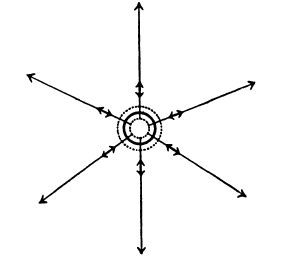
In order to understand better the mechanism of the wave let us again consider an idealized experiment. Suppose that a large space is filled quite uniformly with water, or air, or some other “medium”. Somewhere in the centre there is a sphere. At the beginning of the experiment there is no motion at all. Suddenly the sphere begins to “breathe” rhythmically, expanding and contracting in volume, although retaining its spherical shape. What will happen in the medium? Let us begin our examination at the moment the sphere begins to expand. The particles of the medium in the immediate vicinity of the sphere are pushed out, so that the density of a spherical shell of water, or air, as the case may be, is increased above its normal value. Similarly, when the sphere contracts, the density of that part of the medium immediately surrounding it will be decreased. These changes of density are propagated throughout the entire medium. The particles constituting the medium perform only small vibrations, but the whole motion is that of a progressive wave. The essentially new thing here is that for the first time we consider the motion of something which is not matter, but energy propagated through matter.

The particles constituting the medium perform only small vibrations, but the whole motion is that of a progressive wave. The essentially new thing here is that for the first time we consider the motion of something which is not matter, but energy propagated through matter.

Using the example of the pulsating sphere, we may introduce two general physical concepts, important for the characterization of waves. The first is the velocity with which the wave spreads. This will depend on the medium, being different for water and air, for example. The second concept is that of wave-length. In the case of waves on a sea or river it is the distance from the trough of one wave to that of the next, or from the crest of one wave to that of the next. Thus sea waves have greater wave-length than river waves. In the case of our waves set up by a pulsating sphere the wave-length is the distance, at some definite time, between two neighbouring spherical shells showing maxima or minima of density. It is evident that this distance will not depend on the medium alone. The rate of pulsation of the sphere will certainly have a great effect, making the wave-length shorter if the pulsation becomes more rapid, longer if the pulsation becomes slower.

A wave is characterized by its velocity and wavelength. The velocity depends on the medium; but wavelength shall also depend on the frequency of disturbance.

This concept of a wave proved very successful in physics. It is definitely a mechanical concept. The phenomenon is reduced to the motion of particles which, according to the kinetic theory, are constituents of matter. Thus every theory which uses the concept of wave can, in general, be regarded as a mechanical theory. For example, the explanation of acoustical phenomena is based essentially on this concept. Vibrating bodies, such as vocal cords and violin strings, are sources of sound waves which are propagated through the air in the manner explained for the pulsating sphere. It is thus possible to reduce all acoustical phenomena to mechanics by means of the wave concept.
This concept of a wave is definitely a mechanical concept. Vibrating bodies are sources of sound waves propagated through the air. It is thus possible to reduce all acoustical phenomena to mechanics by means of the wave concept.

It has been emphasized that we must distinguish between the motion of the particles and that of the wave itself, which is a state of the medium. The two are very different, but it is apparent that in our example of the pulsating sphere both motions take place in the same straight line. The particles of the medium oscillate along short line segments, and the density increases and decreases periodically in accordance with this motion. The direction in which the wave spreads and the line on which the oscillations lie are the same. This type of wave is called longitudinal. But is this the only kind of wave? It is important for our further considerations to realize the possibility of a different kind of wave, called transverse.

Let us change our previous example. We still have the sphere, but it is immersed in a medium of a different kind, a sort of jelly instead of air or water. Furthermore, the sphere no longer pulsates but rotates in one direction through a small angle and then back again, always in the same rhythmical way and about a definite axis. The jelly adheres to the sphere and thus the adhering portions are forced to imitate the motion. These portions force those situated a little farther away to imitate the same motion, and so on, so that a wave is set up in the medium. If we keep in mind the distinction between the motion of the medium and the motion of the wave, we see that here they do not lie on the same line. The wave is propagated in the direction of the radius of the sphere, while the parts of the medium move perpendicularly to this direction. We have thus created a transverse wave.

The longitudinal wave is created by a pulsating sphere; but a transverse wave is created when the sphere oscillates rotationally.

Waves spreading on the surface of water are transverse. A floating cork only bobs up and down, but the wave spreads along a horizontal plane. Sound waves, on the other hand, furnish the most familiar example of longitudinal waves.

One more remark: the wave produced by a pulsating or oscillating sphere in a homogeneous medium is a spherical wave. It is called so because at any given moment all points on any sphere surrounding the source behave in the same way. Let us consider a portion of such a sphere at a great distance from the source. The farther away the portion is, and the smaller we choose to take it, the more it resembles a plane. We can say, without trying to be too rigorous, that there is no essential difference between a part of a plane and a part of a sphere whose radius is sufficiently large. We very often speak of small portions of a spherical wave far removed from the source as plane waves. The farther we place the shaded portion of our drawing from the centre of the spheres and the smaller the angle between the two radii, the better our representation of a plane wave. The concept of a plane wave, like many other physical concepts, is no more than a fiction which can be realized with only a certain degree of accuracy. It is, however, a useful concept which we shall need later.

A spherical wave is generated around the a pulsating or oscillating sphere, which may be approxmated as a plane wave far from the sphere.

.

Final Comment

A pulsating sphere is more likely to produce a uniform spherical wave consisting of a change in density. Such change in density would be longitudinal. The higher is the frequency of pulsation, the greater would be the change in density. Such a change in density shall decrease as the surface area of the pulse increases with distance from the sphere.

Both spinning and pulsating models seem to apply to an atom; but this needs to be explained. Besides, the sudden and sharp change in density from the nucleus to the electronic region needs explanation.

.
Einstein 1938: The Riddle of Colour

Reference: Evolution of Physics

This paper presents Chapter II, section 6 from the book THE EVOLUTION OF PHYSICS by A. EINSTEIN and L. INFELD. The contents are from the original publication of this book by Simon and Schuster, New York (1942).

The paragraphs of the original material (in black) are accompanied by brief comments (in color) based on the present understanding.  Feedback on these comments is appreciated.

The heading below is linked to the original materials.

.

The Riddle of Colour

It was again Newton’s genius which explained for the first time the wealth of colour in the world. Here is a description of one of Newton’s experiments in his own words:

In the year 1666 (at which time I applied myself to the grinding of optick glasses of other figures than spherical) I procured me a triangular glass prism, to try therewith the celebrated phenomena of colours. And in order thereto, having darkened my chamber, and made a small hole in my window-shuts, to let in a convenient quantity of the sun’s light, I placed my prism at its entrance, that it might thereby be refracted to the opposite wall. It was at first a very pleasing divertisement, to view the vivid and intense colours produced thereby.

The light from the sun is “white”. After passing through a prism it shows all the colours which exist in the visible world. Nature herself reproduces the same result in the beautiful colour scheme of the rainbow. Attempts to explain this phenomenon are very old. The Biblical story that a rainbow is God’s signature to a covenant with man is, in a sense, a “theory”. But it does not satisfactorily explain why the rainbow is repeated from time to time, and why always in connection with rain. The whole puzzle of colour was first scientifically attacked and the solution pointed out in the great work of Newton.

Newton used a triangular glass prism to produce from sunlight all the colors which exist in the visible world. This phenomenon is similar to the rainbow which is produced when sunlight passes through the water droplets of the rain.

One edge of the rainbow is always red and the other violet. Between them all other colours are arranged. Here is Newton’s explanation of this phenomenon: every colour is already present in white light. They all traverse interplanetary space and the atmosphere in unison and give the effect of white light. White light is, so to speak, a mixture of corpuscles of different kinds, belonging to different colours. In the case of Newton’s experiment the prism separates them in space. According to the mechanical theory, refraction is due to forces acting on the particles of light and originating from the particles of glass. These forces are different for corpuscles belonging to different colours, being strongest for the violet and weakest for the red. Each of the colours will therefore be refracted along a different path and be separated from the others when the light leaves the prism. In the case of a rainbow, drops of water play the role of the prism.

The substance theory of light is now more complicated than before. We have not one light substance but many, each belonging to a different colour. If, however, there is some truth in the theory, its consequences must agree with observation.

The series of colours in the white light of the sun, as revealed by Newton’s experiment, is called the spectrum of the sun, or more precisely, its visible spectrum. The decomposition of white light into its components, as described here, is called the dispersion of light. The separated colours of the spectrum could be mixed together again by a second prism properly adjusted, unless the explanation given is wrong. The process should be just the reverse of the previous one. We should obtain white light from the previously separated colours. Newton showed by experiment that it is indeed possible to obtain white light from its spectrum and the spectrum from white light in this simple way as many times as one pleases. These experiments formed a strong support for the theory in which corpuscles belonging to each colour behave as unchangeable substances. Newton wrote thus:

. . .which colours are not new generated, but only made apparent by being parted; for if they be again entirely mixt and blended together, they will again compose that colour, which they did before separation. And for the same reason, transmutations made by the convening of divers colours are not real; for when the difform rays are again severed, they will exhibit the very same colours which they did before they entered the composition; as you see blue and yellow powders, when finely mixed, appear to the naked eye, green, and yet the colours of the component corpuscles are not thereby really transmuted, but only blended. For when viewed with a good microscope they still appear blue and yellow interspersedly.

Newton showed by experiment that it is indeed possible to obtain white light from its spectrum and the spectrum from white light in this simple way as many times as one pleases. The colours of the component corpuscles are not thereby really transmuted, but only blended. We have not one light substance but many, each belonging to a different color.

Suppose that we have isolated a very narrow strip of the spectrum. This means that of all the many colours we allow only one to pass through the slit, the others being stopped by a screen. The beam which comes through will consist of homogeneous light, that is, light which cannot be split into further components. This is a consequence of the theory and can be easily confirmed by experiment. In no way can such a beam of single colour be divided further. There are simple means of obtaining sources of homogeneous light. For example, sodium, when incandescent, emits homogeneous yellow light. It is very often convenient to perform certain optical experiments with homogeneous light, since, as we can well understand, the result will be much simpler.

The consequence of the theory is the possibility of homogenous light, which cannot be split into further components. The existence of such light can easily be demonstrated by experiments.

Let us imagine that suddenly a very strange thing happens: our sun begins to emit only homogeneous light of some definite colour, say yellow. The great variety of colours on the earth would immediately vanish. Everything would be either yellow or black! This prediction is a consequence of the substance theory of light, for new colours cannot be created. Its validity can be confirmed by experiment: in a room where the only source of light is incandescent sodium everything is either yellow or black. The wealth of colour in the world reflects the variety of colour of which white light is composed.

The substance theory of light predicts that if sun emitted only homogeneous light of some definite color, such as yellow; the great variety of colors on the earth would immediately vanish. This can be demonstrated experimentally.

The substance theory of light seems to work splendidly in all these cases, although the necessity for introducing as many substances as colours may make us somewhat uneasy. The assumption that all the corpuscles of light have exactly the same velocity in empty space also seems very artificial.

It is imaginable that another set of suppositions, a theory of entirely different character, would work just as well and give all the required explanations. Indeed, we shall soon witness the rise of another theory, based on entirely different concepts, yet explaining the same domain of optical phenomena. Before formulating the underlying assumptions of this new theory, however, we must answer a question in no way connected with these optical considerations. We must go back to mechanics and ask: WHAT IS A WAVE?

The substance theory of light seems to work splendidly, but there can be an entirely different theory that can explain the same phenomena and more.

.

Final Comment

Light is also a weightless substance like heat, electricity and magnetism. But different colors make this substance theory of light very complex. There could be a greater simplicity underneath this complexity of different weightless light substances.

.

Einstein 1938: Light as Substance

Reference: Evolution of Physics

This paper presents Chapter II, section 5 from the book THE EVOLUTION OF PHYSICS by A. EINSTEIN and L. INFELD. The contents are from the original publication of this book by Simon and Schuster, New York (1942).

The paragraphs of the original material (in black) are accompanied by brief comments (in color) based on the present understanding.  Feedback on these comments is appreciated.

The heading below is linked to the original materials.

.

Light as Substance

Again we start with a few experimental facts. The number just quoted concerns the velocity of light in vacuo. Undisturbed, light travels with this speed through empty space. We can see through an empty glass vessel if we extract the air from it. We see planets, stars, nebulae, although the light travels from them to our eyes through empty space. The simple fact that we can see through a vessel whether or not there is air inside shows us that the presence of air matters very little. For this reason we can perform optical experiments in an ordinary room with the same effect as if there were no air.

The presence of air matters very little to the propagation of light in space.

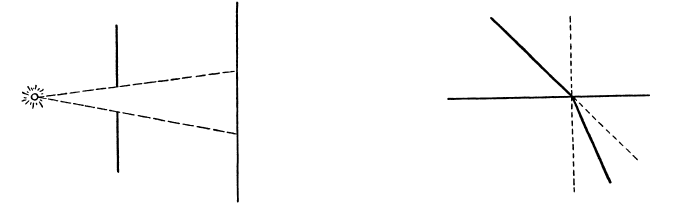
One of the simplest optical facts is that the propagation of light is rectilinear. We shall describe a primitive and naive experiment showing this. In front of a point source is placed a screen with a hole in it. A point source is a very small source of light, say, a small opening in a closed lantern. On a distant wall the hole in the screen will be represented as light on a dark background. The next drawing shows how this phenomenon is connected with the rectilinear propagation of light. All such phenomena, even the more complicated cases in which light, shadow, and half-shadows appear, can be explained by the assumption that light, in vacuo or in air, travels along straight lines.

The propagation of light is rectilinear. Light, in vacuo or in air, travels along straight lines.

Let us take another example, a case in which light passes through matter. We have a light beam travelling through a vacuum and falling on a glass plate. What happens? If the law of rectilinear motion were still valid, the path would be that shown by the dotted line. But actually it is not. There is a break in the path, such as is shown in the drawing. What we observe here is the phenomenon known as refraction. The familiar appearance of a stick which seems to be bent in the middle if half-immersed in water is one of the many manifestations of refraction.

Light bends down as it enters denser medium. This is a phenomenon known as refraction.

These facts are sufficient to indicate how a simple mechanical theory of light could be devised. Our aim here is to show how the ideas of substances, particles, and forces penetrated the field of optics, and how finally the old philosophical point of view broke down.

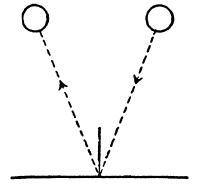
The theory here suggests itself in its simplest and most primitive form. Let us assume that all lighted bodies emit particles of light, or corpuscles, which, falling on our eyes, create the sensation of light. We are already so accustomed to introduce new substances, if necessary for a mechanical explanation, that we can do it once more without any great hesitation. These corpuscles must travel along straight lines through empty space with a known speed, bringing to our eyes messages from the bodies emitting light. All phenomena exhibiting the rectilinear propagation of light support the corpuscular theory, for just this kind of motion was prescribed for the corpuscles. The theory also explains very simply the reflection of light by mirrors as the same kind of reflection as that shown in the mechanical experiment of elastic balls thrown against a wall, as the next drawing indicates.

Light can be assumed to be a weightless substance made of particles or corpuscles. Light travels along straight lines through empty space with a known speed, as any particle would. The theory also explains very simply the reflection of light by mirrors.

The explanation of refraction is a little more difficult. Without going into details, we can see the possibility of a mechanical explanation. If corpuscles fall on the surface of glass, for example, it may be that a force is exerted on them by the particles of the matter, a force which strangely enough acts only in the immediate neighbourhood of matter. Any force acting on a moving particle changes the velocity, as we already know. If the net force on the light-corpuscles is an attraction perpendicular to the surface of the glass, the new motion will lie somewhere between the line of the original path and the perpendicular. This simple explanation seems to promise success for the corpuscular theory of light. To determine the usefulness and range of validity of the theory, however, we must investigate new and more complicated facts.

.

Final Comment

.

Einstein 1938: The Velocity of Light

Reference: Evolution of Physics

This paper presents Chapter II, section 4 from the book THE EVOLUTION OF PHYSICS by A. EINSTEIN and L. INFELD. The contents are from the original publication of this book by Simon and Schuster, New York (1942).

The paragraphs of the original material (in black) are accompanied by brief comments (in color) based on the present understanding.  Feedback on these comments is appreciated.

The heading below is linked to the original materials.

.

The Velocity of Light

In Galileo’s Two New Sciences we listen to a conversation of the master and his pupils about the velocity of light:

SAGREDO: But of what kind and how great must we consider this speed of light to be? Is it instantaneous or momentary or does it, like other motion, require time? Can we not decide this by experiment?

SIMPLICIO: Everyday experience shows that the propagation of light is instantaneous; for when we see a piece of artillery fired, at great distance, the flash reaches our eyes without lapse of time; but the sound reaches the ear only after a noticeable interval.

SAGREDO: Well, Simplicio, the only thing I am able to infer from this familiar bit of experience is that sound, in reaching our ears, travels more slowly than light; it does not inform me whether the coming of the light is instantaneous or whether, although extremely rapid, it still occupies time ….

SALVIATI: The small conclusiveness of these and other similar observations once led me to devise a method by which one might accurately ascertain whether illumination, i.e., propagation of light, is really instantaneous ….

Salviati goes on to explain the method of his experiment. In order to understand his idea let us imagine that the velocity of light is not only finite, but also small, that the motion of light is slowed down, like that in a slow-motion film. Two men, A and B, have covered lanterns and stand, say, at a distance of one mile from each other. The first man, A, opens his lantern. The two have made an agreement that B will open his the moment he sees A’s light. Let us assume that in our “slow motion” the light travels one mile in a second. A sends a signal by uncovering his lantern. B sees it after one second and sends an answering signal. This is received by A two seconds after he had sent his own. That is to say, if light travels with a speed of one mile per second, then two seconds will elapse between A’s sending and receiving a signal, assuming that B is a mile away. Conversely, if A does not know the velocity of light but assumes that his companion kept the agreement, and he notices the opening of B’s lantern two seconds after he opened his, he can conclude that the speed of light is one mile per second.

With the experimental technique available at that time Galileo had little chance of determining the velocity of light in this way. If the distance were a mile, he would have had to detect time intervals of the order of one hundred-thousandth of a second!

Galileo formulated the problem of determining the velocity of light, but did not solve it. The formulation of a problem is often more essential than its solution, which may be merely a matter of mathematical or experimental skill. To raise new questions, new possibilities, to regard old problems from a new angle, requires creative imagination and marks real advance in science. The principle of inertia, the law of conservation of energy were gained only by new and original thoughts about already well-known experiments and phenomena. Many instances of this kind will be found in the following pages of this book, where the importance of seeing known facts in a new light will be stressed and new theories described.

To raise new questions, new possibilities, to regard old problems from a new angle, requires creative imagination and marks real advance in science.

Returning to the comparatively simple question of determining the velocity of light, we may remark that it is surprising that Galileo did not realize that his experiment could be performed much more simply and accurately by one man. Instead of stationing his companion at a distance he could have mounted there a mirror, which would automatically send back the signal immediately after receiving it.

About two hundred and fifty years later this very principle was used by Fizeau, who was the first to determine the velocity of light by terrestrial experiments. It had been determined by Roemer much earlier, though less accurately, by astronomical observation.

It is quite clear that in view of its enormous magnitude, the velocity of light could be measured only by taking distances comparable to that between the earth and another planet of the solar system or by a great refinement of experimental technique. The first method was that of Roemer, the second that of Fizeau. Since the days of these first experiments the very important number representing the velocity of light has been determined many times, with increasing accuracy. In our own century a highly refined technique was devised for this purpose by Michelson. The result of these experiments can be expressed simply: The velocity of light in vacuo is approximately 186,000 miles per second, or 300,000 kilometres per second.

The velocity of light in vacuo is approximately 186,000 miles per second, or 300,000 kilometres per second.

.

Final Comment

It was quite a discovery that the velocity of light was finite and very large, and not instantaneous. The velocity is determined with experiments with visible light. Therefore, this value may vary in the range of electromagnetic spectrum. But this variation is very small compared to the velocity of light.

.

Einstein 1938: The First Serious Difficulty

Reference: Evolution of Physics

This paper presents Chapter II, section 3 from the book THE EVOLUTION OF PHYSICS by A. EINSTEIN and L. INFELD. The contents are from the original publication of this book by Simon and Schuster, New York (1942).

The paragraphs of the original material (in black) are accompanied by brief comments (in color) based on the present understanding.  Feedback on these comments is appreciated.

The heading below is linked to the original materials.

.

The First Serious Difficulty

We are now ready to note the first grave difficulty in the application of our general philosophical point of view. It will be shown later that this difficulty, together with another even more serious, caused a complete breakdown of the belief that all phenomena can be explained mechanically.

The mechanical view is to describe all phenomena by means of attractive and repulsive forces depending only on distance and acting between unchangeable particles. This view has serious flaws.

The tremendous development of electricity as a branch of science and technique began with the discovery of the electric current. Here we find in the history of science one of the very few instances in which accident seemed to play an essential role. The story of the convulsion of a frog’s leg is told in many different ways. Regardless of the truth concerning details, there is no doubt that Galvani’s accidental discovery led Volta at the end of the eighteenth century to the construction of what is known as a voltaic battery. This is no longer of any practical use, but it still furnishes a very simple example of a source of current in school demonstrations and in textbook descriptions.

Galvani’s observation of the convulsion of a frog’s leg led Volta to construct a voltaic battery as a source of electric current. This accidental discovery of the electric current led to the tremendous development of electricity as a branch of science.

The principle of its construction is simple. There are several glass tumblers, each containing water with a little sulphuric acid. In each glass two metal plates, one copper and the other zinc, are immersed in the solution. The copper plate of one glass is connected to the zinc of the next, so that only the zinc plate of the first and the copper plate of the last glass remain unconnected. We can detect a difference in electric potential between the copper in the first glass and the zinc in the last by means of a fairly sensitive electroscope if the number of the “elements”, that is, glasses with plates, constituting the battery, is sufficiently large.

The voltaic battery, constructed with two different metals in a solution of acid, produces enough electric potential difference between those metals to be detected by an electroscope.

It was only for the purpose of obtaining something easily measurable with apparatus already described that we introduced a battery consisting of several elements. For further discussion, a single element will serve just as well. The potential of the copper turns out to be higher than that of the zinc. “Higher” is used here in the sense in which +2 is greater than -2. If one conductor is connected to the free copper plate and another to the zinc, both will become charged, the first positively and the other negatively. Up to this point nothing particularly new or striking has appeared, and we may try to apply our previous ideas about potential differences. We have seen that a potential difference between two conductors can be quickly nullified by connecting them with a wire, so that there is a flow of electric fluid from one conductor to the other. This process was similar to the equalization of temperatures by heat flow. But does this work in the case of a voltaic battery? Volta wrote in his report that the plates behave like conductors:

. . . feebly charged, which act unceasingly or so that their charge after each discharge re-establishes itself; which, in a word, provides an unlimited charge or imposes a perpetual action or impulsion of the electric fluid.

The electric potential difference was expected to discharge when the two metals were connected, but, instead, there was an unceasing flow of charge.

The astonishing result of his experiment is that the potential difference between the copper and zinc plates does not vanish as in the case of two charged conductors connected by a wire. The difference persists, and according to the fluids theory it must cause a constant flow of electric fluid from the higher potential level (copper plate) to the lower (zinc plate). In an attempt to save the fluid theory, we may assume that some constant force acts to regenerate the potential difference and cause a flow of electric fluid. But the whole phenomenon is astonishing from the standpoint of energy. A noticeable quantity of heat is generated in the wire carrying the current, even enough to melt the wire if it is a thin one. Therefore, heat-energy is created in the wire. But the whole voltaic battery forms an isolated system, since no external energy is being supplied. If we want to save the law of conservation of energy we must find where the transformations take place, and at what expense the heat is created. It is not difficult to realize that complicated chemical processes are taking place in the battery, processes in which the immersed copper and zinc, as well as the liquid itself, take active parts. From the standpoint of energy this is the chain of transformations which are taking place: chemical energy energy of the flowing electric fluid, i.e., the current heat. A voltaic battery does not last for ever; the chemical changes associated with the flow of electricity make the battery useless after a time.

From the standpoint of conservation of energy this is the chain of transformations which are taking place: chemical energy → energy of the flowing electric fluid, i.e., the current → heat.

The experiment which actually revealed the great difficulties in applying the mechanical ideas must sound strange to anyone hearing about it for the first time. It was performed by Oersted about a hundred and twenty years ago. He reports:

By these experiments it seems to be shown that the magnetic needle was moved from its position by help of a galvanic apparatus, and that, when the galvanic circuit was closed, but not when open, as certain very celebrated physicists in vain attempted several years ago.

Suppose we have a voltaic battery and a conducting wire. If the wire is connected to the copper plate but not to the zinc, there will exist a potential difference but no current can flow. Let us assume that the wire is bent to form a circle, in the centre of which a magnetic needle is placed, both wire and needle lying in the same plane. Nothing happens so long as the wire does not touch the zinc plate. There are no forces acting, the existing potential difference having no influence whatever on the position of the needle. It seems difficult to understand why the “very celebrated physicists”, as Oersted called them, expected such an influence.

But now let us join the wire to the zinc plate. Immediately a strange thing happens. The magnetic needle turns from its previous position. One of its poles now points to the reader if the page of this book represents the plane of the circle. The effect is that of a force, perpendicular to the plane, acting on the magnetic pole. Faced with the facts of the experiment, we can hardly avoid drawing such a conclusion about the direction of the force acting.

The moment the circular wire is joined to the zinc plate, the magnetic needle turns, as if there is a force acting on the magnetic pole, perpendicular to the plane of the wire.

This experiment is interesting, in the first place, because it shows a relation between two apparently quite different phenomena, magnetism and electric current. There is another aspect even more important. The force between the magnetic pole and the small portions of the wire through which the current flows cannot lie along lines connecting the wire and needle, or the particles of flowing electric fluid and the elementary magnetic dipoles. The force is perpendicular to these lines! For the first time there appears a force quite different from that to which, according to our mechanical point of view, we intended to reduce all actions in the external world. We remember that the forces of gravitation, electrostatics, and magnetism, obeying the laws of Newton and Coulomb, act along the line adjoining the two attracting or repelling bodies.

Here we see a relation between two apparently quite different phenomena, magnetism and electric current. Furthermore, the force is perpendicular to the lines connecting the wire and the needle, unlike the mechanical forces.

This difficulty was stressed even more by an experiment performed with great skill by Rowland nearly sixty years ago. Leaving out technical details, this experiment could be described as follows. Imagine a small charged sphere. Imagine further that this sphere moves very fast in a circle at the centre of which is a magnetic needle. This is, in principle, the same experiment as Oersted’s, the only difference being that instead of an ordinary current we have a mechanically effected motion of the electric charge. Rowland found that the result is indeed similar to that observed when a current flows in a circular wire. The magnet is deflected by a perpendicular force.

Let us now move the charge faster. The force acting on the magnetic pole is, as a result, increased; the deflection from its initial position becomes more distinct. This observation presents another grave complication. Not only does the force fail to lie on the line connecting charge and magnet, but the intensity of the force depends on the velocity of the charge. The whole mechanical point of view was based on the belief that all phenomena can be explained in terms of forces depending only on the distance and not on the velocity. The result of Rowland’s experiment certainly shakes this belief. Yet we may choose to be conservative and seek a solution within the frame of old ideas.

Not only does the force fail to lie on the line connecting charge and magnet, but the intensity of the force depends on the velocity of the charge, and not on the distance as is the case with mechanical forces.

Difficulties of this kind, sudden and unexpected obstacles in the triumphant development of a theory, arise frequently in science. Sometimes a simple generalization of the old ideas seems, at least temporarily, to be a good way out. It would seem sufficient in the present case, for example, to broaden the previous point of view and introduce more general forces between the elementary particles. Very often, however, it is impossible to patch up an old theory, and the difficulties result in its downfall and the rise of a new one. Here it was not only the behaviour of a tiny magnetic needle which broke the apparently well-founded and successful mechanical theories. Another attack, even more vigorous, came from an entirely different angle. But this is another story, and we shall tell it later.

.

Final Comment

.