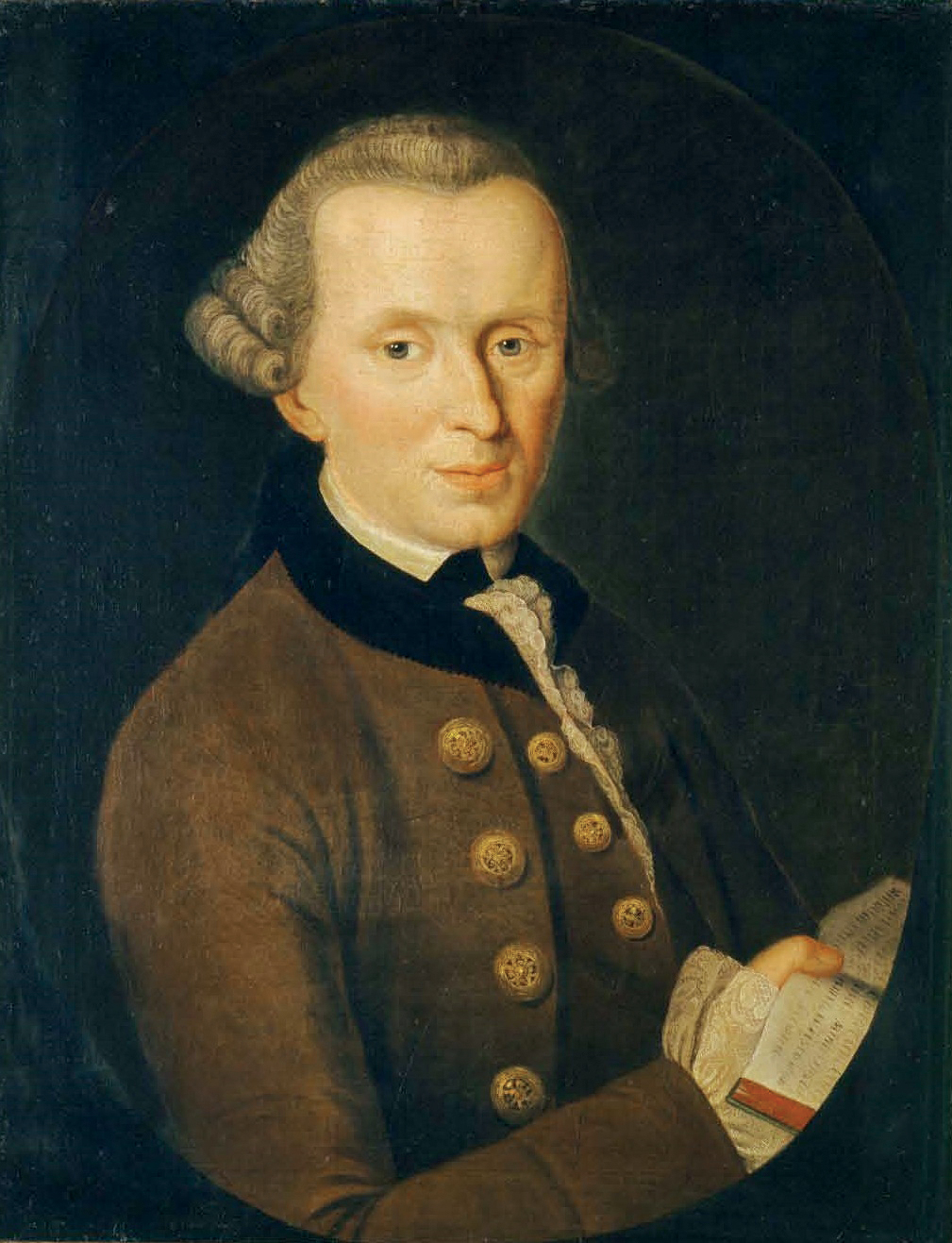
Reference: The Story of Philosophy
This paper presents Chapter VI, Section 1 (Immanuel Kant and German Idealism) from the book THE STORY OF PHILOSOPHY by WILL DURANT. The contents are from the 1933 reprint of this book by TIME INCORPORATED by arrangement with Simon and Schuster, Inc.
The paragraphs of the original material (in black) are accompanied
by brief comments (in color) based on the present understanding. Feedback
on these comments is appreciated.
The heading below is linked to the original materials.
.
Never has a system of thought so dominated an epoch as the philosophy of Immanuel Kant dominated the thought of the nineteenth century. After almost three-score years of quiet and secluded development, the uncanny Scot of Konigsberg roused the world from its “dogmatic slumber,” in 1781, with his famous Critique of Pure Reason; and from that year to our own the “critical philosophy” has ruled the speculative roost of Europe. The philosophy of Schopenhauer rose to brief power on the romantic wave that broke in 1848; the theory of evolution swept everything before it after 1859; and the exhilarating iconoclasm of Nietzsche won the center of the philosophic stage as the century came to a close. But these were secondary and surface developments; underneath them the strong and steady current of the Kantian movement flowed on, always wider and deeper; until today its essential theorems are the axioms of all mature philosophy. Nietzsche takes Kant for granted, and passes on; [The Will to Power, vol. ii, part I.] Schopenhauer calls the Critique “the most important work in German literature,” and considers any man a child until he has understood Kant; [The World as Will and Idea, London, 1883; vol. ii, p. 30.] Spencer could not understand Kant, and for precisely that reason, perhaps, fell a little short of the fullest philosophic stature. To adapt Hegel’s phrase about Spinoza: to be a philosopher, one must first have been a Kantian.
Kant wrote his Critique of Pure Reason in 1781.
Therefore let us become Kantians at once. But it cannot be done at once, apparently; for in philosophy, as in politics, the longest distance between two points is a straight line. Kant is the last person in the world whom we should read on Kant. Our philosopher is like and unlike Jehovah; he speaks through clouds, but without the illumination of the lightning-flash. He disdains examples and the concrete; they would have made his book too long, he argued. [The Critique of Pure Reason, London, 1881; vol. ii, p. xxvii. All subsequent references are to volume two.] (So abbreviated, it contains some 800 pages). Only professional philosophers were expected to read him; and these would not need illustrations. Yet when Kant gave the MS. of the Critique to his friend Herz, a man much versed in speculation, Herz returned it half read, saying he feared insanity if he went on with it. What shall we do with such a philosopher?
Kant is quite difficult to understand.
Let us approach him deviously and cautiously, beginning at a safe and respectful distance from him; let us start at various points on the circumference of the subject, and then grope our way towards that subtle centre where the most difficult of all philosophies has its secret and its treasure.
.
1. FROM VOLTAIRE TO KANT
The road here is from theoretical reason without religious faith, to religious faith without theoretical reason. Voltaire means the Enlightenment, the Encyclopedia, the Age of Reason. The warm enthusiasm of Francis Bacon had inspired all Europe (except Rousseau) with unquestioning confidence in the power of science and logic to solve at last all problems, and illustrate the “infinite perfectibility” of man. Condorcet, in prison, wrote his Historical Tableau of the Progress of the Human Spirit (1793), which spoke the sublime trust of the eighteenth century in knowledge and reason, and asked no other key to Utopia than universal education. Even the steady Germans had their Aufklarung, their rationalist, Christian Wolff, and their hopeful Lessing. And the excitable Parisians of the Revolution dramatized this apotheosis of the intellect by worshipping the “Goddess of Reason’ impersonated by a charming lady of the streets.
Voltaire’s was the age of reason and enlightenment. In this age a transformation took place from religious faith to scientific reasoning.
In Spinoza this faith in reason had begotten a magnificent structure of geometry and logic: the universe was a mathematical system, and could be described a priori, by pure deduction from accepted axioms. In Hobbes the rationalism of Bacon had become an uncompromising atheism and materialism; again nothing was to exist but “atoms and the void.” From Spinoza to Diderot the wrecks of faith lay in the wake of advancing reason: one by one the old dogmas disappeared; the Gothic cathedral of medieval belief, with its delightful details and grotesques, collapsed; the ancient God fell from his throne along with the Bourbons, heaven faded into mere sky, and hell became only an emotional expression. Helvetius and Holbach made atheism so fashionable in the salons of France that even the clergy took it up; and La Mettrie went to peddle it in Germany, under the auspices of Prussia’s king. When, in 1784, Lessing shocked Jacobi by announcing himself a follower of Spinoza, it was a sign that faith had reached its nadir, and that Reason was triumphant.
From Spinoza to Diderot, the wrecks of faith lay in the wake of advancing reason.
David Hume, who played so vigorous a role in the Enlightenment assault on supernatural belief, said that when reason is against a man, he will soon turn against reason. Religious faith and hope, voiced in a hundred thousand steeples rising out of the soil of Europe everywhere, were too deeply rooted in the institutions of society and in the heart of man, to permit their ready surrender to the hostile verdict of reason; it was inevitable that this faith and this hope, so condemned, would question the competence of the judge, and would ‘call for an examination of reason as well as of religion. What was this intellect that proposed to destroy with a syllogism the beliefs of thousands of years and millions of men? Was it infallible? Or was it one human organ like any other, with strictest limits to its functions and its powers? The time had come to judge this judge, to examine this ruthless Revolutionary Tribunal that was dealing out death so lavishly to every ancient hope. The time had come for a critique of reason.
Then it was the turn of reason itself to be examined closely.
.
2. FROM LOCKE TO KANT
The way had been prepared for such an examination by the work of Locke, Berkeley and Hume; and yet, apparently, their results too were hostile to religion.
John Locke (1632-1704) had proposed to apply to psychology the inductive tests and methods of Francis Bacon; in his great Essay on Human Understanding (1689) reason, for the first time in modern thought, had turned in upon itself, and philosophy had begun to scrutinize the instrument which it so long had trusted. This introspective movement in philosophy grew step by step with the introspective novel as developed by Richardson and Rousseau; just as the sentimental and emotional color of Clarissa Harlowe and La Nouvelle Heloise had its counterpart in the philosophic exaltation of instinct and feeling above intellect and reason.
Instinct and feeling were examined side by side with intellect and reason.
How does knowledge arise? Have we, as some good people suppose, innate ideas, as, for example, of right and wrong, and God, ideas inherent in the mind from birth, prior to all experience? Anxious theologians worried lest belief in the Deity should disappear because God had not yet been seen in any telescope, had thought that faith and morals might be strengthened if their central and basic ideas were shown to be inborn in every normal soul. But Locke, good Christian though he was, ready to argue most eloquently for “The Reasonableness of Christianity,” could not accept these suppositions; he announced, quietly, that all our knowledge comes from experience and through our senses that “there is nothing in the mind except what was first in the senses.” The mind is at birth a clean sheet, a tabula rasa; and sense-experience writes upon it in a thousand ways, until sensation begets memory and memory begets ideas. All of which seemed to lead to the startling conclusion that since only material things can affect our sense, we know nothing but matter, and must accept a materialistic philosophy. If sensations are the stuff of thought, the hasty argued, matter must be the material of mind.
It was argued that all our knowledge comes from experience and through our senses.
Not at all, said Bishop George Berkeley (1684-1753); this Lockian analysis of knowledge proves rather that matter does not exist except as a form of mind. It was a brilliant idea to refute materialism by the simple expedient of showing that we know of no such thing as matter; in all Europe only a Gaelic imagination could have conceived this metaphysical magic. But see how obvious it is, said the Bishop: has not Locke told us that all our knowledge is derived from sensation? Therefore all our knowledge of anything is merely our sensations of it, and the ideas derived from these sensations. A “thing” is merely a bundle of perceptions i.e., classified and interpreted sensations. You protest that your breakfast is much more substantial than a bundle of perceptions; and that a hammer that teaches you carpentry through your thumb has a most magnificent materiality. But your breakfast is at first nothing but a congeries of sensations of sight and smell and touch; and then of taste; and then of internal comfort and warmth. Likewise, the hammer is a bundle of sensations of color, size, shape, weight, touch, etc.; its reality for you is not in its materiality, but in the sensations that come from your thumb. If you had no senses, the hammer would not exist for you at all; it might strike your dead thumb forever and yet win from you not the slightest attention. It is only a bundle of sensations, or a bundle of memories; it is a condition of the mind. All matter, so far as we know it, is a mental condition; and the only reality that we know directly is mind. So much for materialism.
Therefore all our knowledge of anything is merely our sensations of it, and the ideas derived from these sensations. A “thing” is merely a bundle of perceptions i.e., classified and interpreted sensations.
But the Irish Bishop had reckoned without the Scotch sceptic. David Hume (1711-1776) at the age of twenty-six shocked all Christendom with his highly heretical Treatise on Human Nature, one of the classics and marvels of modern philosophy. We know the mind, said Hume, only as we know matter: by perception, though it be in this case internal. Never do we perceive any such entity as the “mind”; we perceive merely separate ideas, memories, feelings, etc. The mind is not a substance, an organ that has ideas; it is only an abstract name for the series of ideas; the perceptions, memories and feelings are the mind; there is no observable “soul” behind the processes of thought. The result appeared to be that Hume had as effectually destroyed mind as Berkeley had destroyed matter. Nothing was left; and philosophy found itself in the midst of ruins of its own making. No wonder that a wit advised the abandonment of the controversy, saying: “No matter, never mind.”
It was then argued that we know the mind only as we know matter: by perception of separate ideas, memories, feelings, etc. There is no observable “soul” behind the processes of thought. There is neither matter nor mind—just perceptions.
But Hume was not content to destroy orthodox religion by dissipating the concept of soul; he proposed also to destroy science by dissolving the concept of law. Science and philosophy alike, since Bruno and Galileo, had been making much of natural law, of “necessity” in the sequence of effect upon cause; Spinoza had reared his majestic metaphysics upon this proud conception. But observe, said Hume, that we never perceive causes, or laws; we perceive events and sequences, and infer causation and necessity; a law is not an eternal and necessary decree to which events are subjected, but merely a mental summary and shorthand of our kaleidoscopic experience; we have no guarantee that the sequences hitherto observed will re-appear unaltered in future experience. “Law” is an observed custom in the sequence of events; but there is no “necessity” in custom.
Furthermore, we never perceive causes, or laws; we perceive events and sequences, and infer causation and necessity. “Law” is an observed custom in the sequence of events; but there is no “necessity” in custom.
Only mathematical formulas have necessity they alone are inherently and unchangeably true; and this merely because such formulae are tautological the predicate is already contained in the subject; “3X3=9” is an eternal and necessary truth only because “3X3” and “9” are one and the same thing differently expressed; the predicate adds nothing to the subject. Science, then, must limit itself strictly to mathematics and direct experiment; it cannot trust to unverified deduction from “laws.” “When we run though libraries, persuaded of these principles” writes our uncanny sceptic, “what havoc must we make! If we take in our hands any volume of school metaphysics, for instance, let us ask, ‘Does it contain any abstract reasoning concerning quantity or number?’ No. ‘Does it contain any experimental reasoning concerning matter of fact and existence?’ No. Commit it then to the flames, for it can contain nothing but sophistry and illusion.” [Quoted in Royce, The Spirit of Modern Philosophy, Boston, 1892; p. 98.]
Only tautologies are true. The predicate is already contained in the subject. Science must limit itself strictly to mathematics and direct experiment; it cannot trust to unverified deduction from “laws.”
Imagine how the ears of the orthodox tingled at these words. Here the epistemological tradition the inquiry into the nature, sources, and validity of knowledge had ceased to be a support to religion; the sword with which Bishop Berkeley had slain the dragon of materialism had turned against the immaterial mind and the immortal soul; and in the turmoil science itself had suffered severe injury. No wonder that when Immanuel Kant, in 1775, read a German translation of the works of David Hume, he was shocked by these results, and was roused, as he said, from the “dogmatic slumber” in which he had assumed without question the essentials of religion and the bases of science. Were both science and faith to be surrendered to the sceptic? What could be done to save them?
Both science and faith were surrendered to the sceptic
.
3. FROM ROUSSEAU TO KANT
To the argument of the Enlightenment, the reason makes for materialism, Berkeley had essayed the answer that matter does not exist. But this had led, in Hume, to the retort that by the same token mind does not exist either. Another answer was possible that reason is no final test. There are some theoretical conclusions against which our whole being rebels; we have no right to presume that these demands of our nature must be stifled at the dictates of a logic which is after all but the recent construction of a frail and deceptive part of us. How often our instincts and feelings push aside the little syllogisms which would like us to behave like geometrical figures, and make love with mathematical precision! Sometimes, no doubt, and particularly in the novel complexities and artificialities of urban life, reason is the better guide; but in the great crises of life, and in the great problems of conduct and belief, we trust to our feelings rather than to our diagrams. If reason is against religion, so much the worse for reason!
It was then argued that that reason is no final test. Sometimes, no doubt, and particularly in the novel complexities and artificialities of urban life, reason is the better guide; but in the great crises of life, and in the great problems of conduct and belief, we trust to our feelings rather than to our diagrams.
Such, in effect, was the argument of Jean Jacques Rousseau (1712-1778), who almost alone, in France, fought the materialism and atheism of the Enlightenment. What a fate for a delicate and neurotic nature, to have been cast amidst the robust rationalism and the almost brutal hedonism [The doctrine that all behavior is motivated by the pursuit of pleasure.] of the Encyclopedists! Rousseau had been a sickly youth, driven into brooding and introversion by his physical weakness and the unsympathetic attitude of his parents and teachers; he had escaped from the stings of reality into a hothouse world of dreams, where the victories denied him in life and love could be had for the imagining. His Confessions reveal an unreconciled complex of the most refined sentimentality with an obtuse sense of decency and honor; and through it all an unsullied conviction of his moral superiority. [CF. Confessions, bk. X; vol. ii, p. 184.]
In 1749 the Academy of Dijon offered a prize for an essay on the question, “Has the Progress of the Sciences and the Arts Contributed to Corrupt, or to Purify, Morals?” Rousseau’s essay won the prize. Culture is much more of an evil than a good, he argued with all the intensity and sincerity of one who, finding culture out of his reach, proposed to prove it worthless. Consider the frightful disorders which printing has produced in Europe. Wherever philosophy arises, the moral health of the nation decays. “It was even a saying among the philosophers themselves that since learned men had appeared, honest men were nowhere to be found.” “I venture to declare that a state of reflection is contrary to nature; and that a thinking man” (an “intellectual,” as we would now say) “is a depraved animal.” It would be better to abandon our over-rapid development of the intellect, and to aim rather at training the heart and the affections. Education does not make a man good, it only makes him clever usually for mischief. Instinct and feeling are more trustworthy than reason.
A tirade against reason arose. It would be better to abandon our over-rapid development of the intellect, and to aim rather at training the heart and the affections. Instinct and feeling are more trustworthy than reason.
In his famous novel, La Nouvelle Heloise (1761), Rousseau illustrated at great length the superiority of feeling to intellect; sentimentality became the fashion among the ladies of the aristocracy, and among some of the men; France was for a century watered with literary, and then with actual, tears; and the great movement of the European intellect in the eighteenth century gave way to the romantic emotional literature of 1789-1848. The current carried with it a strong revival of religious feeling; the ecstasies of Chateaubriand’s Genie du Christianisme (1802) were merely an echo of the “Confession of Faith of the Savoyard Vicar” which Rousseau included in his epochal essay on education Emile (1762). The argument of the “Confession” was briefly this: that though reason might be against belief in God and immortality, feeling was overwhelmingly in their favor; why should we not trust in instinct here, rather than yield to the despair of an arid scepticism?
The great movement of the European intellect in the eighteenth century gave way to the romantic emotional literature of 1789-1848. The current carried with it a strong revival of religious feeling. The argument became: that though reason might be against belief in God and immortality, feeling was overwhelmingly in their favor; why should we not trust in instinct here, rather than yield to the despair of an arid scepticism?
When Kant read Emile he omitted his daily walk under the linden trees, in order to finish the book at once. It was an event in his life to find here another man who was groping his way out of the darkness of atheism, and who boldly affirmed the priority of feeling over theoretical reason in these supra-sensual concerns. Here at last was the second half of the answer to irreligion; now finally all the scoffers and doubters would be scattered. To put these threads of argument together, to unite the ideas of Berkeley and Hume with the feelings of Rousseau, to save religion from reason, and yet at the same time to save science from scepticism this was the mission of Immanuel Kant.
Kant was handed over the mission to save religion from reason, and yet at the same time to save science from scepticism.
But who was Immanuel Kant?
.
Final Comments
Only things we know directly are the sensations. Perceptions come about when sensations are assimilated in the mental matrix. The rest of the sensations that are not assimilated get speculated upon and lead to inferences.
All such inferences came under intense examination in 18th century Europe. The first to be examined were inferences related to religious faith. Most of those were found to be without reason. Then matter was found to be something inferred and so was the mind.
It was argued that all our knowledge comes from experience and through our senses, and all the ideas and “laws” are inferred, and so is the “soul” behind the processes of thought. To the skeptic anything inferred did not really exist. Only tautologies were considered to be true.
But the truth is more than just simple tautologies. There are elements of reality that are connected to each other according to the Principle of Oneness, which do not appear in themselves as tautologies, but are, nevertheless true. They are true because the principle of Oneness, a tautology in itself, acts as the criterion for truth.
The instinctual criterion of Rousseau could, very well, have been the Principle of Oneness, which was acknowledged in religion, but not explicitly by reason.
.
Note: Here is a list of people mentioned in the above section:
Giordano Bruno (1548 – 1600) died at age 52… Laws of nature
Francis Bacon (1561 – 1626) 65… Power of Science and Logic
Galileo (1564 – 1642) 77… Laws of nature
Thomas Hobbes (1588 – 1679) 91… uncompromising atheism and materialism
Baruch Spinoza (1632 – 1677) 44… magnificent structure of geometry and logic
John Locke (1632 – 1704) 72… Sensation begets memory and memory begets ideas
Christian Wolff (1679 – 1754) 75
George Berkeley (1685 – 1753) 67… Matter does not exist except as a form of mind
Voltaire (1694 – 1778) 83
La Mettrie (1709 – 1751) 42… peddled atheism
David Hume (1711 – 1776) 65… We know the mind only as we know matter, no observable “soul” behind thought
Rousseau (1712 – 1778) 66… exception
Denis Diderot (1713 – 1784) 70
Helvétius (1715 – 1771) 56… made atheism fashionable
Holbach (1723 – 1789) 65… made atheism fashionable
Immanuel Kant (1724 – 1804) 79
Gotthold Lessing (1729 – 1781) 52
Condorcet (1743 – 1794) 50
Jacobi (1804 – 1851) 46
Kant was responding to David Hume. He showed how God was the Unknowable that expressed itself as the law of thought, which actively ordered the universe. This law of thought is identified in the KHTK philosophy as the Principle of Oneness.
.