Subject Clearing Overwhelm

Reference: Course on Subject Clearing

Do this exercise whenever you feel overwhelmed by a sense of responsibility.

Preparation

  1. Be well-fed and well-rested as much as possible.
  2. Get your attention as much extroverted as possible by taking a walk and examining your environment.
  3. Select a peaceful environment for meditation where you would not be disturbed.
  4. Sit in a cross-legged position, or in a chair with feet flat on the ground.

The Meditation

  1. Close your eyes. Inhale and exhale gently, slowly.
  2. With each inhalation, mentally say to yourself: “I am responsible for the body,” The inhalation should last the whole duration of that thought.
  3. With each exhalation, mentally say to yourself: “I am responsible for the mind.” The exhalation should last the whole duration of that thought.
  4. As you do the above:
    • Face the the situation and the feeling of overwhelm. Do not resist.
    • Face any regret about having done (or not done) something. Do not resist.
    • Face whatever is difficult to look at. Do not resist.
    • Look again at the problem that you have been trying to solve.
    • Do not avoid, suppress or deny any feelings and/or sensations.
    • Decide what you need to do in the present to fulfill your responsibility.
    • Visualize yourself doing it.
  5. Repeat this for as long as the feeling of overwhelm last.
  6. Do not end this exercise until you are on top of the feeling of overwhelm.

.

Subject Clearing Fear and Anxiety

Reference: Course on Subject Clearing

Do this exercise whenever fear and anxiety are dominant. Please take all medical precautions.

Preparation

  1. Be well-fed and well-rested as much as possible.
  2. Get your attention as much extroverted as possible by taking a walk and examining your environment.
  3. Select a peaceful environment for meditation where you would not be disturbed.
  4. Sit in a cross-legged position, or in a straight-backed chair with feet flat on the ground.

The Meditation

  1. Close your eyes. Inhale and exhale gently, slowly.
  2. With each inhalation, mentally say to yourself: “I am not the body,”  while facing the sensations of fear and anxiety in the body, without resisting them. The inhalation should last the whole duration of that thought.
  3. With each exhalation, mentally say to yourself: “I am not even the mind,” while facing the feeling of fear and anxiety without resisting it. The exhalation should last the whole duration of that thought.
  4. Do not avoid, suppress or deny any sensations and feelings. Face them fully.
  5. Repeat this for as long as the fear and anxiety last.
  6. Do not end this exercise until you are on top of the fear, or anxiety, bothering you.

.

Subject Clearing Detachment

Reference: Course on Subject Clearing

Do this meditation exercise whenever you feel too attached to things.

Preparation

  1. Be well-fed and well-rested as much as possible.
  2. Get your attention as much extroverted as possible by taking a walk and examining your environment.
  3. Select a peaceful environment for meditation where you would not be disturbed.
  4. Sit in a cross-legged position, or in a straight-backed chair with feet flat on the ground.

The Meditation

  1. Close your eyes. Inhale and exhale gently, slowly.
  2. With each inhalation, mentally say to yourself: “I am not the body.” The inhalation should last the whole duration of that thought.
  3. With each exhalation, mentally say to yourself: “I am not even the mind.” The exhalation should last the whole duration of that thought.
  4. Repeat this for 7 to 11 minutes.
  5. Do this exercise at least twice a day for a week.
  6. You can remind yourself that “I am not the body. I am not even the mind. anytime during the day.

NOTE: You may do this as a walking meditation on a treadmill at a slow, comfortable pace.

.

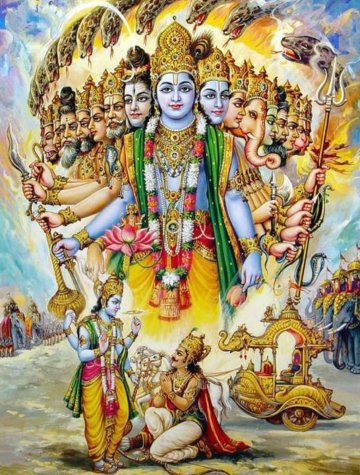
THE BHAGAVAD GITA: Chapter 11

Reference: Course on The Bhagavad Gita
English Translation By Shri Purohit Swami

.

Chapter 11

अर्जुनउवाच
मदनुग्रहायपरमंगुह्यमध्यात्मसंज्ञितम्।
यत्त्वयोक्तंवचस्तेनमोहोऽयंविगतोमम।।11.1।।

11.1 “Arjuna said: My Lord! Thy words concerning the Supreme Secret of Self, given for my blessing, have dispelled the illusions which surrounded me.

भवाप्ययौहिभूतानांश्रुतौविस्तरशोमया।
त्वत्तःकमलपत्राक्षमाहात्म्यमपिचाव्ययम्।।11.2।।

11.2 O Lord, whose eyes are like the lotus petal! Thou hast described in detail the origin and the dissolution of being, and Thine own Eternal Majesty.

एवमेतद्यथात्थत्वमात्मानंपरमेश्वर।
द्रष्टुमिच्छामितेरूपमैश्वरंपुरुषोत्तम।।11.3।।

11.3 I believe all as Thou hast declared it. I long now to have a vision of thy Divine Form, O Thou Most High!

मन्यसेयदितच्छक्यंमयाद्रष्टुमितिप्रभो।
योगेश्वरततोमेत्वंदर्शयाऽत्मानमव्ययम्।।11.4।।

11.4 If Thou thinkest that it can be made possible for me to see it, show me, O Lord of Lords, Thine own Eternal Self.

श्रीभगवानुवाच
पश्यमेपार्थरूपाणिशतशोऽथसहस्रशः।
नानाविधानिदिव्यानिनानावर्णाकृतीनिच।।11.5।।

11.5 Lord Shri Krishna replied: Behold, O Arjuna! My celestial forms, by hundred and thousands, various in kind, in colour and in shape.

पश्यादित्यान्वसून्रुद्रानश्िवनौमरुतस्तथा।
बहून्यदृष्टपूर्वाणिपश्याऽश्चर्याणिभारत।।11.6।।

11.6 Behold thou the Powers of Nature: fire, earth, wind and sky; the sun, the heavens, the moon, the stars; all forces of vitality and of healing; and the roving winds. See the myriad wonders revealed to none but thee.

इहैकस्थंजगत्कृत्स्नंपश्याद्यसचराचरम्।
ममदेहेगुडाकेशयच्चान्यद्द्रष्टुमिच्छसि।।11.7।।

11.7 Here in Me living as one, O Arjuna, behold the whole universe, movable and immovable, and anything else that thou wouldst see!

नतुमांशक्यसेद्रष्टुमनेनैवस्वचक्षुषा।
दिव्यंददामितेचक्षुःपश्यमेयोगमैश्वरम्।।11.8।।

11.8 Yet since with mortal eyes thou canst not see Me, lo! I give thee the Divine Sight. See now the glory of My Sovereignty.”

सञ्जयउवाच
एवमुक्त्वाततोराजन्महायोगेश्वरोहरिः।
दर्शयामासपार्थायपरमंरूपमैश्वरम्।।11.9।।

11.9 Sanjaya continued: “Having thus spoken, O King, the Lord Shri Krishna, the Almighty Prince of Wisdom, showed to Arjuna the Supreme Form of the Great God.

अनेकवक्त्रनयनमनेकाद्भुतदर्शनम्।
अनेकदिव्याभरणंदिव्यानेकोद्यतायुधम्।।11.10।।

11.10 There were countless eyes and mouths, and mystic forms innumerable, with shining ornaments and flaming celestial weapons.

दिव्यमाल्याम्बरधरंदिव्यगन्धानुलेपनम्।
सर्वाश्चर्यमयंदेवमनन्तंविश्वतोमुखम्।।11.11।।

11.11 Crowned with heavenly garlands, clothed in shining garments, anointed with divine unctions, He showed Himself as the Resplendent One, Marvellous, Boundless, Omnipresent.

दिविसूर्यसहस्रस्यभवेद्युगपदुत्थिता।
यदिभाःसदृशीसास्याद्भासस्तस्यमहात्मनः।।11.12।।

11.12 Could a thousand suns blaze forth together it would be but a faint reflection of the radiance of the Lord God.

तत्रैकस्थंजगत्कृत्स्नंप्रविभक्तमनेकधा।
अपश्यद्देवदेवस्यशरीरेपाण्डवस्तदा।।11.13।।

11.13 In that vision Arjuna saw the universe, with its manifold shapes, all embraced in One, its Supreme Lord.

ततःसविस्मयाविष्टोहृष्टरोमाधनञ्जयः।
प्रणम्यशिरसादेवंकृताञ्जलिरभाषत।।11.14।।

11.14 Thereupon Arjuna, dumb with awe, his hair on end, his head bowed, his hands clasped in salutation, addressed the Lord thus:

अर्जुनउवाच
पश्यामिदेवांस्तवदेवदेहेसर्वांस्तथाभूतविशेषसङ्घान्।
ब्रह्माणमीशंकमलासनस्थमृषींश्चसर्वानुरगांश्चदिव्यान्।।11.15।।

11.15 Arjuna said: O almighty God! I see in Thee the powers of Nature, the various creatures of the world, the Progenitor on his lotus throne, the Sages and the shining angels.

अनेकबाहूदरवक्त्रनेत्रंपश्यामित्वांसर्वतोऽनन्तरूपम्।
नान्तंनमध्यंनपुनस्तवादिंपश्यामिविश्वेश्वरविश्वरूप।।11.16।।

11.16 I see Thee, infinite in form, with, as it were, faces, eyes and limbs everywhere; no beginning, no middle, no end; O Thou Lord of the Universe, Whose Form is universal!

किरीटिनंगदिनंचक्रिणंचतेजोराशिंसर्वतोदीप्तिमन्तम्।
पश्यामित्वांदुर्निरीक्ष्यंसमन्ताद्दीप्तानलार्कद्युतिमप्रमेयम्।।11.17।।

11.17 I see thee with the crown, the sceptre and the discus; a blaze of splendour. Scarce can I gaze on thee, so radiant thou art, glowing like the blazing fire, brilliant as the sun, immeasurable.

त्वमक्षरंपरमंवेदितव्यंत्वमस्यविश्वस्यपरंनिधानम्।
त्वमव्ययःशाश्वतधर्मगोप्तासनातनस्त्वंपुरुषोमतोमे।।11.18।।

11.18 Imperishable art Thou, the Sole One worthy to be known, the priceless Treasure-house of the universe, the immortal Guardian of the Life Eternal, the Spirit Everlasting.

अनादिमध्यान्तमनन्तवीर्यमनन्तबाहुंशशिसूर्यनेत्रम्।
पश्यामित्वांदीप्तहुताशवक्त्रम्स्वतेजसाविश्वमिदंतपन्तम्।।11.19।।

11.19 Without beginning, without middle and without end, infinite in power, Thine arms all-embracing, the sun and moon Thine eyes, Thy face beaming with the fire of sacrifice, flooding the whole universe with light.

द्यावापृथिव्योरिदमन्तरंहिव्याप्तंत्वयैकेनदिशश्चसर्वाः।
दृष्ट्वाऽद्भुतंरूपमुग्रंतवेदंलोकत्रयंप्रव्यथितंमहात्मन्।।11.20।।

11.20 Alone thou fillest all the quarters of the sky, earth and heaven, and the regions between. O Almighty Lord! Seeing Thy marvellous and awe-inspiring Form, the spheres tremble with fear.

अमीहित्वांसुरसङ्घाःविशन्तिकेचिद्भीताःप्राञ्जलयोगृणन्ति।
स्वस्तीत्युक्त्वामहर्षिसिद्धसङ्घाःस्तुवन्तित्वांस्तुतिभिःपुष्कलाभिः।।11.21।।

11.21 The troops of celestial beings enter into Thee, some invoking Thee in fear, with folded palms; the Great Seers and Adepts sing hymns to Thy Glory, saying All Hail.’

रुद्रादित्यावसवोयेचसाध्याविश्वेऽश्िवनौमरुतश्चोष्मपाश्च।
गन्धर्वयक्षासुरसिद्धसङ्घावीक्षन्तेत्वांविस्मिताश्चैवसर्वे।।11.22।।

11.22 The Vital Forces, the Major stars, Fire, Earth, Air, Sky, Sun, Heaven, Moon and Planets; the Angels, the Guardians of the Universe, the divine Healers, the Winds, the Fathers, the Heavenly Singers; and hosts of Mammon-worshippers, demons as well as saints, are amazed.

रूपंमहत्तेबहुवक्त्रनेत्रंमहाबाहोबहुबाहूरुपादम्।
बहूदरंबहुदंष्ट्राकरालंदृष्ट्वालोकाःप्रव्यथितास्तथाऽहम्।।11.23।।

11.23 Seeing Thy stupendous Form, O Most Mighty, with its myriad faces, its innumerable eyes and limbs and terrible jaws, I myself and all the worlds are overwhelmed with awe.

नभःस्पृशंदीप्तमनेकवर्णंव्यात्ताननंदीप्तविशालनेत्रम्।
दृष्ट्वाहित्वांप्रव्यथितान्तरात्माधृतिंनविन्दामिशमंचविष्णो।।11.24।।

11.24 When I see Thee, touching the Heavens, glowing with colour, with open mouth and wide open fiery eyes, I am terrified. O My Lord! My courage and peace of mind desert me.

दंष्ट्राकरालानिचतेमुखानिदृष्ट्वैवकालानलसन्निभानि।
दिशोनजानेनलभेचशर्मप्रसीददेवेशजगन्निवास।।11.25।।

11.25 When I see Thy mouths with their fearful jaws like glowing fires at the dissolution of creation, I lose all sense of place; I find no rest. Be merciful, O Lord in whom this universe abides!

अमीचत्वांधृतराष्ट्रस्यपुत्राःसर्वेसहैवावनिपालसङ्घैः।
भीष्मोद्रोणःसूतपुत्रस्तथाऽसौसहास्मदीयैरपियोधमुख्यैः।।11.26।।

11.26 All these sons of Dhritarashtra, with the hosts of princes, Bheeshma, Drona and Karna, as well as the other warrior chiefs belonging to our side;

वक्त्राणितेत्वरमाणाविशन्तिदंष्ट्राकरालानिभयानकानि।
केचिद्विलग्नादशनान्तरेषुसंदृश्यन्तेचूर्णितैरुत्तमाङ्गैः।।11.27।।

11.27 I see them all rushing headlong into Thy mouths, with terrible tusks, horrible to behold. Some are mangled between thy jaws, with their heads crushed to atoms.

यथानदीनांबहवोऽम्बुवेगाःसमुद्रमेवाभिमुखाःद्रवन्ति।
तथातवामीनरलोकवीराविशन्तिवक्त्राण्यभिविज्वलन्ति।।11.28।।

11.28 As rivers in flood surge furiously to the ocean, so these heroes, the greatest among men, fling themselves into Thy flaming mouths.

यथाप्रदीप्तंज्वलनंपतङ्गाविशन्तिनाशायसमृद्धवेगाः।
तथैवनाशायविशन्तिलोकास्तवापिवक्त्राणिसमृद्धवेगाः।।11.29।।

11.29 As moths fly impetuously to the flame only to be killed, so these men rush into Thy mouths to court their own destruction.

लेलिह्यसेग्रसमानःसमन्ताल्लोकान्समग्रान्वदनैर्ज्वलद्भिः।
तेजोभिरापूर्यजगत्समग्रंभासस्तवोग्राःप्रतपन्तिविष्णो।।11.30।।

11.30 Thou seemest to swallow up the worlds, to lap them in flame. Thy glory fills the universe. Thy fierce rays beat down upon it irresistibly.

आख्याहिमेकोभवानुग्ररूपोनमोऽस्तुतेदेववरप्रसीद।
विज्ञातुमिच्छामिभवन्तमाद्यंनहिप्रजानामितवप्रवृत्तिम्।।11.31।।

11.31 Tell me then who Thou art, that wearest this dreadful Form? I bow before Thee, O Mighty One! Have mercy, I pray, and let me see Thee as Thou wert at first. I do not know what Thou intendest.

श्रीभगवानुवाच
कालोऽस्मिलोकक्षयकृत्प्रवृद्धोलोकान्समाहर्तुमिहप्रवृत्तः।
ऋतेऽपित्वांनभविष्यन्तिसर्वेयेऽवस्थिताःप्रत्यनीकेषुयोधाः।।11.32।।

11.32 Lord Shri Krishna replied: I have shown myself to thee as the Destroyer who lays waste the world and whose purpose is destruction. In spite of thy efforts, all these warriors gathered for battle shall not escape death.

तस्मात्त्वमुत्तिष्ठयशोलभस्वजित्वाशत्रून्भुङ्क्ष्वराज्यंसमृद्धम्।
मयैवैतेनिहताःपूर्वमेवनिमित्तमात्रंभवसव्यसाचिन्।।11.33।।

11.33 Then gird up thy loins and conquer. Subdue thy foes and enjoy the kingdom in prosperity. I have already doomed them. Be thou my instrument, Arjuna!

द्रोणंचभीष्मंचजयद्रथंचकर्णंतथाऽन्यानपियोधवीरान्।
मयाहतांस्त्वंजहिमाव्यथिष्ठायुध्यस्वजेतासिरणेसपत्नान्।।11.34।।

11.34 Drona and Bheeshma, Jayadratha and Karna, and other brave warriors – I have condemned them all. Destroy them; fight and fear not. Thy foes shall be crushed.”

सञ्जयउवाच
एतच्छ्रुत्वावचनंकेशवस्यकृताञ्जलिर्वेपमानःकिरीटी।
नमस्कृत्वाभूयएवाहकृष्णंसगद्गदंभीतभीतःप्रणम्य।।11.35।।

11.35 Sanjaya continued: “Having heard these words from the Lord Shri Krishna, the Prince Arjuna, with folded hands trembling, prostrated himself and with choking voice, bowing down again and again, and overwhelmed with awe, once more addressed the Lord.

अर्जुनउवाच
स्थानेहृषीकेशतवप्रकीर्त्याजगत्प्रहृष्यत्यनुरज्यतेच
रक्षांसिभीतानिदिशोद्रवन्तिसर्वेनमस्यन्तिचसिद्धसङ्घाः।।11.36।।

11.36 Arjuna said: My Lord! It is natural that the world revels and rejoices when it sings the praises of Thy glory; the demons fly in fear and the saints offer Thee their salutations.

कस्माच्चतेननमेरन्महात्मन्गरीयसेब्रह्मणोऽप्यादिकर्त्रे।
अनन्तदेवेशजगन्निवासत्वमक्षरंसदसत्तत्परंयत्।।11.37।।

11.37 How should they do otherwise? O Thou Supremest Self, greater than the Powers of creation, the First Cause, Infinite, the Lord of Lords, the Home of the universe, Imperishable, Being and Not-Being, yet transcending both.

त्वमादिदेवःपुरुषःपुराणस्त्वमस्यविश्वस्यपरंनिधानम्।
वेत्तासिवेद्यंचपरंचधामत्वयाततंविश्वमनन्तरूप।।11.38।।

11.38 Thou art the Primal God, the Ancient, the Supreme Abode of this universe, the Knower, the Knowledge and the Final Home. Thou fillest everything. Thy form is infinite.

वायुर्यमोऽग्निर्वरुणःशशाङ्कःप्रजापतिस्त्वंप्रपितामहश्च।
नमोनमस्तेऽस्तुसहस्रकृत्वःपुनश्चभूयोऽपिनमोनमस्ते।।11.39।।

11.39 Thou art the Wind, Thou art Death, Thou art the Fire, the Water, the Moon, the Father and the Grandfather. Honour and glory to Thee a thousand and a thousand times! Again and again, salutation be to Thee, O my Lord!

नमःपुरस्तादथपृष्ठतस्तेनमोऽस्तुतेसर्वतएवसर्व।
अनन्तवीर्यामितविक्रमस्त्वंसर्वंसमाप्नोषिततोऽसिसर्वः।।11.40।।

11.40 Salutations to Thee in front and on every side, Thou who encompasseth me round about. Thy power is infinite; Thy majesty immeasurable; thou upholdest all things; yea,Thou Thyself art All.

सखेतिमत्वाप्रसभंयदुक्तंहेकृष्णहेयादवहेसखेति।
अजानतामहिमानंतवेदंमयाप्रमादात्प्रणयेनवापि।।11.41।।

11.41 Whatever I have said unto Thee in rashness, taking Thee only for a friend and addressing Thee as O Krishna! O Yadava! O Friend!’ in thoughtless familiarity, no understanding Thy greatness;

यच्चावहासार्थमसत्कृतोऽसिविहारशय्यासनभोजनेषु।
एकोऽथवाप्यच्युततत्समक्षंतत्क्षामयेत्वामहमप्रमेयम्।।11.42।।

11.42 Whatever insult I have offered to Thee in jest, in sport or in repose, in conversation or at the banquet, alone or in a multitude, I ask Thy forgiveness for them all, O Thou Who art without an equal!

पितासिलोकस्यचराचरस्यत्वमस्यपूज्यश्चगुरुर्गरीयान्।
नत्वत्समोऽस्त्यभ्यधिकःकुतोऽन्योलोकत्रयेऽप्यप्रतिमप्रभाव।।11.43।।

11.43 For Thou art the Father of all things movable and immovable, the Worshipful, the Master of Masters! In all the worlds there is none equal to Thee, how then superior, O Thou who standeth alone, Supreme.

तस्मात्प्रणम्यप्रणिधायकायंप्रसादयेत्वामहमीशमीड्यम्।
पितेवपुत्रस्यसखेवसख्युःप्रियःप्रियायार्हसिदेवसोढुम्।।11.44।।

11.44 Therefore I prostrate myself before Thee, O Lord! Most Adorable! I salute Thee, I ask Thy blessing. Only Thou canst be trusted to bear with me, as father to son, as friend to friend, as lover to his beloved.

अदृष्टपूर्वंहृषितोऽस्मिदृष्ट्वाभयेनचप्रव्यथितंमनोमे।
तदेवमेदर्शयदेवरूपंप्रसीददेवेशजगन्निवास।।11.45।।

11.45 I rejoice that I have seen what never man saw before; yet, O Lord! I am overwhelmed with fear. Please take again the Form I know. Be merciful, O Lord! thou Who are the Home of the whole universe.

किरीटिनंगदिनंचक्रहस्तमिच्छामित्वांद्रष्टुमहंतथैव।
तेनैवरूपेणचतुर्भुजेनसहस्रबाहोभवविश्वमूर्ते।।11.46।।

11.46 I long to see Thee as thou wert before, with the crown, the sceptre and the discus in Thy hands; in Thy other Form, with Thy four hands, O Thou Whose arms are countless and Whose forms are infinite.

श्रीभगवानुवाच
मयाप्रसन्नेनतवार्जुनेदंरूपंपरंदर्शितमात्मयोगात्।
तेजोमयंविश्वमनन्तमाद्यंयन्मेत्वदन्येननदृष्टपूर्वम्।।11.47।।

11.47 Lord Shri Krishna replied: My beloved friend! It is only through My grace and power that thou hast been able to see this vision of splendour, the Universal, the Infinite, the Original. Never has it been seen by any but thee.

नवेदयज्ञाध्ययनैर्नदानैर्नचक्रियाभिर्नतपोभिरुग्रैः।
एवंरूपःशक्यअहंनृलोकेद्रष्टुंत्वदन्येनकुरुप्रवीर।।11.48।।

11.48 Not by study of the scriptures, not by sacrifice or gift, not by ritual or rigorous austerity, is it possible for man on earth to see what thou hast seen, O thou foremost hero of the Kuru-clan!

मातेव्यथामाचविमूढभावोदृष्ट्वारूपंघोरमीदृङ्ममेदम्।
व्यपेतभीःप्रीतमनाःपुनस्त्वंतदेवमेरूपमिदंप्रपश्य।।11.49।।

11.49 Be not afraid or bewildered by the terrible vision. Put away thy fear and, with joyful mind, see Me once again in My usual Form.”

सञ्जयउवाच
इत्यर्जुनंवासुदेवस्तथोक्त्वास्वकंरूपंदर्शयामासभूयः।
आश्वासयामासचभीतमेनंभूत्वापुनःसौम्यवपुर्महात्मा।।11.50।।

11.50 Sanjaya continued: “Having thus spoken to Arjuna, Lord Shri Krishna showed Himself again in His accustomed form; and the Mighty Lord, in gentle tones, softly consoled him who lately trembled with fear.

अर्जुनउवाच
दृष्ट्वेदंमानुषंरूपंतवसौम्यंजनार्दन।
इदानीमस्मिसंवृत्तःसचेताःप्रकृतिंगतः।।11.51।।

11.51 Arjuna said: Seeing Thee in Thy gentle human form, my Lord, I am myself again, calm once more.

श्रीभगवानुवाच
सुदुर्दर्शमिदंरूपंदृष्टवानसियन्मम।
देवाअप्यस्यरूपस्यनित्यंदर्शनकाङ्क्षिणः।।11.52।।

11.52 Lord Shri Krishna replied: It is hard to see this vision of Me that thou hast seen. Even the most powerful have longed for it in vain.

नाहंवेदैर्नतपसानदानेननचेज्यया।
शक्यएवंविधोद्रष्टुंदृष्टवानसिमांयथा।।11.53।।

11.53 Not by study of the scriptures, or by austerities, not by gifts or sacrifices, is it possible to see Me as thou hast done.

भक्त्यात्वनन्ययाशक्यमहमेवंविधोऽर्जुन।
ज्ञातुंदृष्टुंचतत्त्वेनप्रवेष्टुंचपरंतप।।11.54।।

11.54 Only by tireless devotion can I be seen and known; only thus can a man become one with Me, O Arjuna!

मत्कर्मकृन्मत्परमोमद्भक्तःसङ्गवर्जितः।
निर्वैरःसर्वभूतेषुयःसमामेतिपाण्डव।।11.55।।

11.55 He whose every action is done for My sake, to whom I am the final goal, who loves Me only and hates no one – O My dearest son, only he can realize Me!”

.

Subject Clearing

Verses 11:1-11:4
The origin and dissolution of being is going on all the time. The illusion is that the being is considered permanent at some level. It is amazing to truly witness the origin and dissolution of being.

Verses 11:5-11:8
Look at all the uncountable galaxies, stars, suns, planets and the elements. Look at the powers in nature—the constructive forces of vitality and the destructive forces of violent storms—all of them living together as one.

Verses 11:9-11:14
Visualize as if you are surrounded by all these powerful forms and forces. Visualize them in the front and back, left and right, and even above and below. Stay there and behold them all. Whether constructive or destructive—they are all living together as one. It is an awesome sight.

Verses 11:15-11:17
Everything knowable—the powers of Nature, the gods, creatures, beings, forms, sages, divinities, the brilliance and splendor—is present in this Cosmic vision. It is infinite. This is a comprehensive concept of the universe consisting of everything knowable.

Verses 11:18-11:20
The universe is one. It is infinite both in space and time. It is worthy to be known. All life is part of this universe. It has no beginning or end. It is infinite in power. It is simply awesome.

Verses 11:21-11:23
All beings, powerful and wise, bow down to this universe. Demons and the saints alike are amazed by it. The universe is overwhelming with its awe.

Verses 11.24-11.27
The intimate view of the overall universe takes you by surprise beyond all that is familiar. All of a sudden you become aware of the destruction that is inevitable. It is so real and terrifying.

Verses 11.28-11.31
Looking at the battle field, Arjuna realizes that all these warriors were rushing toward their deaths and their destruction was inevitable. This included his own destruction as well. Arjuna feels totally helplessness and horrified about it. He starts to question the very purpose of life.

Verses 11.32-11.34
Krishna tells Arjuna that Time is the all devouring reality. There is constant change. Nothing survives forever. But the overall universe evolves as greater continuity, consistency and harmony comes about.

Verses 11.35-11.46
Arjuna realizes the nature of the Universe and Time. No wonder the universe is awesome and praiseworthy at the same time. How can it be otherwise! The Unknowable transcends both being and non-being. It is the basis of everything. This view of ultimate reality is beyond any other experience. It makes everything else appear so trivial. This ultimate reality stands supreme. But Maya is so enchanting.

Verses 11.47-11.55
This ultimate reality is rare to behold. You do not see it through the study of scriptures, or through the performance of rituals. Do not be afraid of it. It takes a lot of courage to view the universe as it is. One has to let go of everything–all attachments and prejudices. Just be there and confront.

.

Final Comment

God refers to the core of the universe from which all natural laws spring forth and form the universe. Extreme devotion of Yoga may take the Yogi to this rare experience of God, but that experience is totally different from any intellectual projection.

It takes a lot of courage to view the universe as it is. It may feel like the ground slipping away from underneath one’s feet. There is no way that the yogi can be prepared for this experience. It can be so real that it is terrifying and utterly overwhelming.

There is simply a feeling of great awe at the immensity of this experience. Here is something senior to all the different gods that Aryans ever had over the centuries. Time is the all devouring reality. Destruction is inevitable. There is constant change. You are graced only when you flow with nature.

PLATO: The Political Solution

Reference: The Story of Philosophy

Note: The original Text is provided below.
Previous / Next

.

Summary

.

Comments

.

Original Text

Automatically—without any hypocrisy of voting. Democracy means perfect equality of opportunity, especially in education; not the rotation of every Tom, Dick and Harry in public office. Every man shall have an equal chance to make himself fit for the complex tasks of administration; but only those who have proved their mettle (or, in our myth, their metal), and have emerged from all tests with the insignia of skill, shall be eligible to rule. Public officials shall be chosen not by votes, nor by secret cliques pulling the unseen wires of democratic pretense, but by their own ability as demonstrated in the fundamental democracy of an equal race. Nor shall any man hold office without specific training, nor hold high office till he has first filled a lower office well (Gorgias, 514-5). 

Democracy depends on equal opportunity in education. Democratic elections should depend on ability rather than on votes. 

Is this aristocracy? Well, we need not be afraid of the word, if the reality is good which it betokens: words are wise men’s counters, without value of their own; they are the money only of fools and politicians. We want to be ruled by the best, which is what aristocracy means; have we not, Carlyle-like; yearned and prayed to be ruled by the best? But we have come to think of aristocracies as hereditary: let it be carefully noted that this Platonic aristocracy is not of that kind; one would rather call it a democratic aristocracy. For the people, instead of blindly electing the lesser of two evils presented to them as candidates by nominating cliques, will here be themselves, everyone of them, the candidates; and will receive an equal chance of educational election to public office. There is no caste here; no inheritance of position or privilege; no stoppage of talent impecuniously born; the son of a ruler begins on the same level, and receives the same treatment and opportunity, as the son of a boot-black; if the ruler’s son is a dolt he falls at the first shearing; if the boot-black’s son is a man of ability the way is clear for him to become a guardian of the state (423). Career will be open to talent wherever it is born. This is a democracy of the schools—a hundredfold more honest and more effective than a democracy of the polls. 

It will be a huge problem if education is politicized. 

And so, “setting aside every other business, the guardians will dedicate themselves wholly to the maintenance of freedom in the state, making this their craft and engaging in no work which does not bear upon this end” (395). They shall be legislature and executive and court in one; even the laws shall not bind them to a dogma in the face of altered circumstance; the rule of the guardians shall be a flexible intelligence unbound by precedent. 

The primary task of education should be to develop the ability to think critically that can be trusted by others. But the trust from others requires that they themselves must be able to think critically to some degree.

But how can men of fifty have a flexible intelligence? Will they not be mentally plaster-casted by routine? Adeimantus (echoing, no doubt, some hot brotherly debate in Plato’s home) objects that philosophers are dolts or rogues, who would rule either foolishly, or selfishly, or both. “The votaries of philosophy who carry on the study not only in youth with a view to education, but as the pursuit of their maturer years—these men for the most part grow into very strange beings, not to say utter scoundrels; and the result with those who may be considered the best of them is, that they are made useless to the world by the very study which you extol” (487). This is a fair enough description of some be-spectacled modern philosophers; but Plato answers that he has guarded against this difficulty by giving his philosophers the training of life as well as the erudition of the schools; that they will in consequence be men of action rather than merely men of thought—men seasoned to high purposes and noble temper by long experience and trial. By philosophy Plato means an active culture, wisdom that mixes with the concrete busy-ness of life; he does not mean a closeted and impractical metaphysician; Plato “is the man who least resembles Kant, which is (with all respect) a considerable merit.” 

The ability to think critically and wisely must be supported by practical experience that comes from active living.

So much for incompetence; as for rascality we may provide against that by establishing among the guardians a system of communism: 

In the first place none of them should have any property beyond what is absolutely necessary; neither should they have a private house, with bars and bolts, closed against any one who has a mind to enter; their provisions should be only such as are required by trained warriors, who are men of temperance and courage; their agreement is to receive from the citizens a fixed rate of pay, enough to meet the expenses of the year, and no more; and they will have common meals and live together, like soldiers in a camp. Gold and silver we will tell them that they have from God; the diviner metal is within them, and they have therefore no need of that earthly dross which passes under the name of gold, and ought not to pollute the divine by earthly admixture, for that commoner metal has been the source of many unholy deeds; but their own is undefiled. And they alone of all the citizens may not touch or handle silver or gold, or be under the same roof with them, or wear them, or drink from them. And this will be their salvation, and the salvation of the State. But should they ever acquire homes or lands or moneys of their own, they will become housekeepers and husbandmen instead of guardians; enemies and tyrants instead of allies of the other citizens; hating and being hated, plotting and being plotted against, they will pass through life in much greater terror of internal than of external enemies; and the hour of ruin, both to themselves and to the rest of the State, will be at hand (416-17), 

To develop character during training, greed should curbed as much as possible. It is interesting to note that much of Capitalism has been guided by greed.

This arrangement will make it unprofitable, as well as dangerous, for the guardians to rule as a clique seeking the good of their class rather than that of the community as a whole. For they will be protected from want; the necessities and modest luxuries of a noble life will be theirs in regular provision, without the searing and wrinkling care of economic worry. But by the same token they will be precluded from cupidity and sordid ambitions; they will always have just so much of the world’s goods, and no more; they will be like physicians establishing, and themselves accepting, a dietary for a nation. They will eat together, like consecrated men; they will sleep together in single barracks, like soldiers sworn to simplicity. “Friends should have all things in common,” as Pythagoras used to say (Law 807). So the authority of the guardians will be sterilized, and their power made poisonless; their sole reward will be honor and the sense of service to the group. And they will be such men as from the beginning have deliberately consented to so materially limited a career; and such men as at the end of their stern training will have learned to value the high repute of the statesman above the crass emoluments of the office-seeking politicians or the “economic man.” At their coming the battles of party politics will be no more. 

The guardians will be trained to have a simple life and just enough wants that will be amply fulfilled by the state. Their sole reward will be honor and the sense of service to the group.

But what will their wives say to all this? Will they be content to forego the luxuries of life and the conspicuous consumption of goods? The guardians will have no wives. Their communism is to be of women as well as of goods. They are to be freed not only from the egoism of self, but from the egoism of family; they are not to be narrowed to the anxious acquisitiveness of the prodded husband; they are to be devoted not to a woman. but to the community. Even their children shall not be specifically or distinguishably theirs; all children of guardians shall be taken from their mothers at birth and brought up in common; their particular parentage will be lost in the scuffle (460). All the guardian-mothers will care for all the guardian-children; the brother-hood of man, within these limits, will graduate from phrase to fact; every boy will be a brother to every other boy, every girl a sister, every man a father, and every woman a mother. 

The guardians will have a common family. This is a controversial point.

But whence will these women come? Some, no doubt, the guardians will woo out of the industrial or military classes; others will have become, by their own right, members of the guardian class. For there is to be no sex barrier of any kind in this community; least of all in education—the girl shall have the same intellectual opportunities as the boy, the same chance to rise to the highest positions in the state. When Glaucon objects (458 f) that this admission of woman to any office, provided she has passed the tests, violates the principle of the division of labor, he receives the sharp reply that division of labor must be by aptitude and ability, not by sex; if a woman shows herself capable of political administration, let her rule; if a man shows himself to be capable only of washing dishes, let him fulfill the function to which Providence has assigned him.

There is no discrimination for the duties of the guardians based on sex.

Community of wives does not mean indiscriminate mating; rather there is to be strict eugenic supervision of all reproductive relations. The argument from the breeding of animals here starts its wandering career: if we get such good results in breeding cattle selectively for qualities desired, and from breeding only from the best in each generation, why should we not apply similar principles to the matings of mankind? (459). For it is not enough to educate the child properly; he must be properly born, of select and healthy ancestry; “education should begin before birth” (Laws, 789). Therefore no man or woman shall procreate unless in perfect health; a health certificate is to be required of every bride and groom (Laws; 772). Men may reproduce only when they are above thirty and under forty-five; women only when they are above twenty and under forty. Men unmarried by thirty-five are to be taxed into felicity (Laws, 771). Off-spring born of unlicensed matings, or deformed, are to be exposed and left to die. Before and after the ages specified for procreation, mating is to be free, on condition that the fetus be aborted. “We grant this permission with strict orders to the parties to do all in their power to prevent any embryo from seeing the light; and if any should force its way to birth, they must understand that the offspring of such a union cannot be maintained, and they must make their arrangements accordingly” (461). The marriage of relatives is prohibited, as inducing degeneration (310). “The best of either sex should be united with the best as often as possible, and the inferior with the inferior; and they are to rear the off-spring of the one sort but not that of the other; for this is the only way of keeping the flock in prime condition. … Our braver and better youth, beside their other honors and rewards, are to be permitted a greater variety of mates; for such fathers ought to have as many sons as possible” (459-60). 

Children must be properly born, of select and healthy ancestry requiring strict eugenic supervision of all reproductive relations. This point happens to be very controversial.

But our eugenic society must be protected not only from disease and deterioration within, but from enemies without. It must be ready, if need be, to wage successful war. Our model community would of course be pacific, for it would restrict population within the means of subsistence; but neighboring states not so managed might well look upon the orderly prosperity of our Utopia as an invitation to raid and rapine. Hence, while deploring the necessity, we shall have, in our intermediate class, a sufficient number of well-trained soldiers, living a hard and simple life like the guardians, on a stated modicum of goods supplied by their “maintainers and fore-fathers,” the people. At the same time every precaution must be taken to avoid the occasions of war. The primary occasion is overpopulation (373); the second is foreign trade, with the inevitable disputes that interrupt it. Indeed, competitive trade is really a form of war; “peace is only a name” (Laws, 622). It will be well then to situate our ideal state considerably inland, so that it shall be shut out from any high development of foreign commerce. “The sea fills a country with merchandise and money-making and bargaining; it breeds in men’s minds habits of financial greed and faithlessness, alike in its internal and in its foreign relations” (Laws, 704-7). Foreign trade requires a large navy to protect it; and navalism is as bad as militarism. “In every case the guilt of war is confined to a few persons, and the many are friends” (471). The most frequent wars are precisely the vilest—civil wars, wars of Greek against Greek; let the Greeks form a pan-Hellenic league of nations, uniting lest “the whole Greek race some day fall under the yoke of barbarian peoples” (469). 

It is best to have the capacity to defend one’s state, while avoiding the occasions of war.  But increase in population causes war and war serves to control population. Maybe broad education can help control population better. Foreign trade has the overtones of the greed of Capitalism that may lead to war.

So our political structure will be topped with a small class of guardians; it will be protected by a large class of soldiers and “auxiliaries”; and it will rest on the broad base of a commercial, industrial, and agricultural population. This last or economic class will retain private property, private mates, and private families. But trade and industry will “be regulated by the guardians to prevent excessive individual wealth or poverty; anyone acquiring more than four times the average possession of the citizens must relinquish the excess to the state (Laws, 714 f). Perhaps interest will be forbidden, and profits limited (Laws, 920). The communism of the guardians is impracticable for the economic class; the distinguishing characteristics of this class are powerful instincts of acquisition and competition; some noble souls among them will be free from this fever of combative possession, but the majority of men are consumed with it; they hunger and thirst not after righteousness, nor after honor, but after possessions endlessly multiplied. Now men engrossed in the pursuit of money are unfit to rule a state; and our entire plan rests on the hope that if the guardians rule well and live simply, the economic man will be willing to let them monopolize administration if they permit him to monopolize luxury. In short, the perfect society would be that in which each class and each unit would be doing the work to which its nature and aptitude best adapted it; in which no class or individual would interfere with others, but all would co-operate in difference to produce an efficient and harmonious whole (433-4). That would be a just state. 

There should be a small ruler class of guardians, a larger class of warriors, and a very broad class of a commercial, industrial, and agricultural population. There should not be too much disparity of wealth among population. Excess wealth should go to state to be used for improving the infrastructure of the society.

In short, the perfect society would be that in which each class and each unit would be doing the work to which its nature and aptitude best adapted it; in which no class or individual would interfere with others, but all would co-operate in difference to produce an efficient and harmonious whole.

.