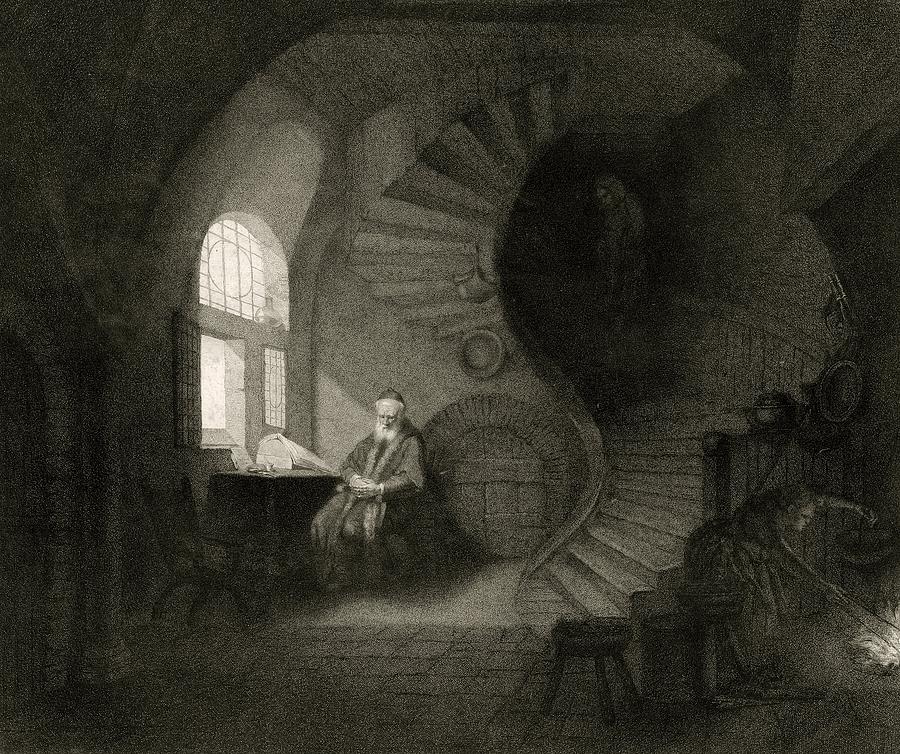
SPINOZA: The Treatise on Religion and the State

Reference: The Story of Philosophy

This paper presents Chapter IV Section 2 from the book THE STORY OF PHILOSOPHY by WILL DURANT. The contents are from the 1933 reprint of this book by TIME INCORPORATED by arrangement with Simon and Schuster, Inc.

The paragraphs of the original material (in black) are accompanied by brief comments (in color) based on the present understanding.  Feedback on these comments is appreciated.

The heading below is linked to the original materials.

.

II. The Treatise on Religion and the State

Let us study his four books in the order in which he wrote them. The Tractatus Theologico-Politicus is perhaps the least interesting of them to us today, because the movement of higher criticism which Spinoza initiated has made into platitudes the propositions for which Spinoza risked his life. It is unwise of an author to prove his point too thoroughly; his conclusions pass into the currency of all educated minds, and his works no longer have that mystery about them which draws us ever on. So it has been with Voltaire; and so with Spinoza’s treatise on religion and the state. 

The conclusions reached by Spinoza in his first book has now become quite common place.

The essential principle of the book is that the language of the Bible is deliberately metaphorical or allegorical; not only because it partakes of the Oriental tendency to high literary color and ornament, and exaggerated descriptive expressions; but because, too, the prophets and the apostles, to convey their doctrine by arousing the imagination, were compelled to adapt themselves to the capacities and predispositions of the popular mind. “All Scripture was written primarily foran entire people, and secondarily for the whole human race; consequently its contents must necessarily be adapted, as far as possible, to the understanding of the masses.” “Scripture does not explain things by their secondary causes, but only narrates them in the order and style which has most power to move men, and especially uneducated men, to devotion. … Its object is not to convince the reason, but to attract and lay hold of the imagination.” Hence the abundant miracles and the repeated appearances of God. “The masses think that the power and providence of God are most clearly displayed by events that are extraordinary, and contrary to the conception which they have formed of nature. … They suppose, indeed, that God is inactive so long as nature works in her accustomed order; and vice versa, that the power of nature, and natural causes, are idle so long as God is acting; thus they imagine two powers distinct from one another, the power of God and the power of nature.”

(Here enters the basic idea of Spinoza’s philosophy—that God and the processes of nature are one.) Men love to believe that God breaks the natural order of events for them; so the Jews gave a miraculous interpretation of the lengthening of the day in order to impress others (and perhaps themselves) with the conviction that the Jews were the favorites of God; and similar incidents abound in the early history of every people. Sober and literal statements do not move the soul; if Moses had said that it was merely the East wind (as we gather from a later passage) that cleared a path for them through the Red Sea, it would have made little impression on the minds of the masses he was leading. Again, the apostles resorted to miracle stories for the same reason that they resorted to parables; it was anecessary adaptation to the public mind. The greater influence of such men as compared with philosophers and scientists is largely attributable to the vivid and metaphorical forms of speech which the founders of religion by the nature of their mission and their own emotional intensity, are driven to adopt. 

The basic idea of Spinoza’s philosophy is that God and the processes of nature are one. Prophets used miraculous interpretations of events because that move the soul of man, sober and literal statements do not.

Interpreted on this principle, the Bible, says Spinoza, contains nothing contrary to reason. But interpreted literally, it is full of errors, contradictions, and obvious impossibilities—as that the Pentateuch was written by Moses. The more Philosophical interpretation reveals, through the mist of allegory and poetry; the profound thought of great thinkers and leaders, and makes intelligible the persistence of the Bible and its immeasurable influence upon men. Both interpretations have a proper place and function: the people will always demand a religion phrased in imagery and haloed with the supernatural; if one such form of faith is destroyed they will create another. But the philosopher knows that God and nature are one being, acting by necessity and according to invariable law; it is this majestic Law which he will reverence and obey. He knows that in the Scriptures “God is described as a law-giver or prince, and styled just, merciful, etc., merely in concession to the understanding of the people and their imperfect knowledge; that in reality God acts … by the necessity of his nature, and his decrees … are eternal truths.”

The more Philosophical interpretation reveals, through the mist of allegory and poetry, the profound thought of great thinkers and leaders, and makes intelligible the persistence of the Bible and its immeasurable influence upon men.

Spinoza makes no separation between Old and New Testament, and looks upon the Jewish and the Christian religion as one, when popular hatred and misunderstandings are laid aside, and philosophical interpretation finds the hidden core and essence of the rival faiths. “I have often wondered that persons who make boast of professing the Christian religion—namely, love, joy, peace, temperance, and charity to all men—should quarrel with such rancorous animosity, and display daily toward one another such bitter hatred, that this, rather than the virtues which they profess, is the readiest criterion of their faith.” The Jews have survived chiefly because of Christian hatred of them; persecution gave them the unity and solidarity necessary for continued racial existence; without persecution they might have mingled and married with the peoples of Europe, and been engulfed in the majorities with which they were everywhere surrounded. But there is no reason why the philosophic Jew and the philosophic Christian, when all nonsense is discarded, should not agree sufficiently in creed to live in peace and cooperation. 

Spinoza looks upon the Jewish and the Christian religion as one. He sees no reason why the philosophic Jew and the philosophic Christian, when all nonsense is discarded, should not agree sufficiently in creed to live in peace and cooperation. 

The first step toward this consummation, Spinoza thinks, would be a mutual understanding about Jesus. Let improbable dogmas be withdrawn, and the Jews would soon recognize in Jesus the greatest and noblest of the prophets. Spinoza does not accept the divinity of Christ, but he puts him first among men. “The eternal wisdom of God … has shown itself forth in all things, but chiefly in the mind of man, and most of all in Jesus Christ.” “Christ was sent to teach not only the Jews, but the whole human race” ; hence “he accommodated himself to the comprehension of the people … and most often taught by parables.” He considers that the ethics of Jesus are almost synonymous with wisdom; in reverencing him one rises to “the intellectual love of God.” So noble a figure, freed from the impediment of dogmas that lead only to divisions and disputes, would draw an men to him; and perhaps in his name a world torn with suicidal wars of tongue and sword might find a unity of faith and a possibility of brotherhood at last. 

The first step toward this consummation, Spinoza thinks, would be a mutual understanding about Jesus.

.
DIANETICS: Analyzer Schematic

Reference: Hubbard 1950: Dianetics TMSMH

These are some comments on Appendix III (B), “Analyzer Schematic” from DIANETICS: THE MODERN SCIENCE OF MENTAL HEALTH.

.

Appendix III (B)
Analyzer Schematic

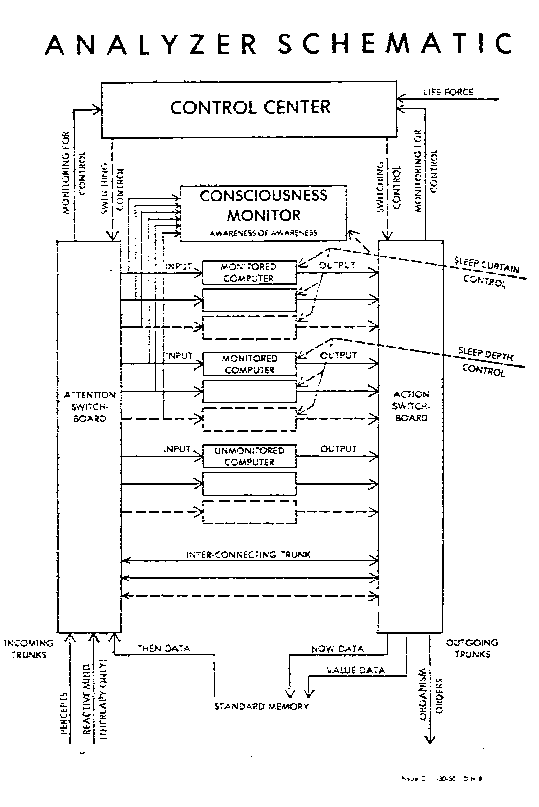
This analyzer schematic deals with the idea of multiple attention. This is pretty much like having multiple windows open on a computer. Each window is set up to do a task. One may switch one window to another depending on the need of the moment. The output from one task may be used in another task. Many tasks may be coordinated in this manner.

In the matrix model of the mind, many different circuits can be activated simultaneously, and started and paused as necessary. An operating system is necessary for this purpose, and that is the function of the C-point, or the “I”. Note that once the circuits for the tasks are defined, these tasks proceed at lightening speed in the assimilated matrix. When a musician is playing the piano, and also singing, listening to the orchestra, aware of audience reaction, etc., we have the “I” coordinating all these different tasks effortlessly. In this example, a lot of practice is needed to define or set up the different circuits. The better the circuits are set up, the easier it becomes to multi-task.

This schematic highlights the function of the operating system, which is spreading its attention over many different tasks and doing them efficiently. The operating system is the “I”, which represents a certain level of consciousness. The life force that energizes this operating system is the same life force that energizes the universe.

.

DIANETICS: Mind Schematic

Reference: Hubbard 1950: Dianetics TMSMH

These are some comments on Appendix III (A), “Mind Schematic” from DIANETICS: THE MODERN SCIENCE OF MENTAL HEALTH.

.

Appendix III (A)
Mind Schematic

This Appendix summarizes how that traditional theory of Dianetics has been updated. According to traditional Dianetics, this block diagram represents three separate behavior patterns as follows:

  1. The basic cycle of automatic physical adjustment
  2. The cycle of reasoned behavior
  3. The cycle of reactive behavior

Dianetics identifies a self-determined “I” with the analyzer and some automatic programming with the reactive behavior. The commands that come out of the analytical and reactive portions of the mind, subsequently, influence the system of the body. This diagram is now updated as follows.

The current view, however, is much simpler. According to this view, the “I”, the mind and the body are three different aspects of the same tightly integrated system. This system is best represented as a matrix of elements that interact with each other in infinitely different permutations and combinations.

The assimilated part of this matrix is streamlined from perception, through computations to action in a smooth flow. The “perceptions” enter through the sense organs of the body. They immediately break down into “perceptual elements”. The finer are these elements the greater consciousness results from them. For example, the perceptions break down into much finer elements in humans than in the animals.

The perceptual elements are assimilated into the matrix in the most efficient way to eliminate all duplicates. The original pattern of “perceptions” is maintained among the elements in the matrix with a time stamp, such that, the memory is reconstructed in the background as and when needed for computations. The computations simply flow through the infinity of circuits of the matrix almost instantaneously. They take time only in identifying and resolving anomalies. The anomalies consist of discontinuities (missing sequences), inconsistencies (contradictions) and disharmonies (arbitrarily added sequences). Most of the time the anomalies are resolved by modifying the flow through the matrix. This produces realizations. However, when the modification requires interaction with the environment to procure more “perceptions”, the circuits of the body are activated. The body then carries out the required action to procure the needed “perceptions”. This cycle repeats and continues.

The matrix may be viewed as a spectrum of activity. In the middle of the spectrum, is the activity of the mental matrix. This activity spurs the activity of the body and its interaction with the environment at one end of the spectrum. At the other end is the state of consciousness that reflects the overall fineness of the matrix elements. This consciousness is increasing with continuous evolution. We may recognize this state of consciousness as the “I” which appears as self-awareness. This “I” has certain position on the consciousness scale, which spans from Mystery to Knowingness. With experience, this “I” is evolving out of a fog of mystery and moving toward a state of knowingness.

The above is the description, in a nutshell, of the consciousness-mind-body system, and its reasoned behavior. The environment present anomalies. The resolution of anomalies provides the path to the evolution of “I”.

The reasoned behavior depends on the degree of breakdown of “perceptions” into perceptual elements of the matrix. The finer is the breakdown, the higher is the consciousness and the more reasoned is the behavior. But, when there is little or no breakdown of the “perception,” as in the case of the traumatic experience, we have a deviation from reasoned behavior into the domain of reactive behavior. 

The trauma exists in the matrix like an encysted tumor. When it is part of circuits in the matrix, the tumor acts like a “black box.” The awareness of the “perceptions” inside the tumor does not exist because they not assimilated into rest of the matrix. This tumor represents the engram and the unconsciousness associated with it. Restimulation is simply the activation of a circuit that passes through this tumor. The tumor is an encysted recording of the trauma that is interpreted literally by the rest of the matrix. Thus, all circuits that flow through this tumor become aberrated or “infected.” This tumor then starts to infect the circuits connected to it. This infection then starts to spread through the matrix. This leads to aberrated behavior and psychosomatic illnesses.

We may call this tumor and all the infected circuits as the unassimilated parts of the matrix. This is the “reactive mind” of Dianetics. There are no separate “analytical mind,” “reactive mind,” and “memory banks.” There is simply a mental matrix. The assimilated portions of this matrix behave analytically. The unassimilated portions of this matrix behave reactively. 

The above is the description of what makes the consciousness-mind-body system deviate from its proper functioning so that it becomes aberrated and ill.

The solution is to break down the “perceptions” encysted as a tumor in the matrix and assimilate them into the rest of the matrix. There doesn’t appear to be that many tumors and the only route to resolving these tumors appears to be the resolution of the anomalies that emanate from them.

This simplification of the Dianetics model now presents us with a more widely applicable solution like Subject Clearing.

.

DIANETICS: The Scientific Method

Reference: Hubbard 1950: Dianetics TMSMH

These are some comments on “The Scientific Method” from Appendix II of Dianetics: The Modern Science of Mental Health.

.

Appendix II
The Scientific Method

The following is a summary of the article by John W. Campbell, Jr.:

The Scientific Method is, while based on certain readily cited rules, far more than those rules. It must be lived up to to be fully understood. It implies that a scientist’s best friend will review his work starting with the premise that it’s all wrong and do his best to prove it’s wrong. The triumph comes from producing a new theory that stands up, and is useful, even when the most knowing make deliberate attempts to find a flaw. The critical rules are

  1. Argument by appeal to authority is of no value whatever.
  2. The observation, not the observer’s report, are the important data.
  3. No theory, however well-established or long-held, can stand in the face of one relevant, contradictory fact.

Appeal to authority can be hidden  under phrases like “Everybody knows,” “of course,” “naturally”. Saying a thing is “theoretically impossible” is, actually, appeal to the authority of present theories. So far as the Great Name argument goes, those are easy to spot, and their value comes into focus very quickly if you simply substitute an arbitrary name for the Great Name. It is the scientist— who operates on the principle that he doesn’t already know all the answers—who is out looking for new and better answers.

Ideally, the scientific method follows seven steps:

  1. Make a series of careful observations.
  2. Combining all relevant data, from all relevant experiments, formulate a hypothesis.
  3. Using the hypothesis, predict new facts.
  4. Perform an experiment and make observations on these predictions.
  5. As a result of the experiment, discard the hypothesis, or advance it now to the status of “Theory.”
  6. Make further predictions, further experiments, and collect more observational evidence until a contradictory relevant fact is found.
  7. Discard the old theory, take the new total of observational data, and form a new hypothesis.
  8. Go back to step 3.

Notice that each time round that cycle the new hypothesis shows how to get new data, new experimental evidence, new information. The process is not circular; it’s an expanding spiral, and each sweep around it covers a broader and broader field of understanding.

But the most important step of all is Step Seven. It’s so easy and comfortable to believe that the old theory is Truth, and doesn’t and won’t ever need changing, even if it doesn’t work all the time. The true scientist starts off with any theory and finds it useful only so long as it works. If it no longer works, it should be discarded, and a new, better one fashioned.

.

DIANETICS: The Philosophic Method

Reference: Hubbard 1950: Dianetics TMSMH

These are some comments on Appendix I, “The Philosophic Method” from DIANETICS: THE MODERN SCIENCE OF MENTAL HEALTH.

.

Appendix I
The Philosophic Method

The following is excerpted from the writings of Will Durant:

Science seems always to advance, while philosophy seems always to lose ground. Yet this is only because philosophy accepts the hard and hazardous task of dealing with problems not yet open to the methods of science—problems like good and evil, beauty and ugliness, order and freedom, life and death; so soon as a field of inquiry yields knowledge susceptible of exact formulation it is called science. 

Philosophy is dealing with very complex problems, with lot of variables. Science enters when precise relationships among variables start to develop.

Every science begins as philosophy and ends as art; it arises in hypothesis and flows into achievement. Philosophy is a hypothetical interpretation of the unknown, … or of the inexactly known … it is the front trench in the siege of truth. Science is the captured territory; and behind it are those secure regions in which knowledge and art build our imperfect and marvelous world. Philosophy seems to stand still, perplexed; but only because she leaves the fruits of victory to her daughters the sciences, and herself passes on, divinely discontent, to the uncertain and the unexplored. 

Philosophy moves forward always dealing with the uncertain and the unexplored.

Shall we be more technical? Science is analytical description, philosophy is synthetic interpretation. Science wishes to resolve the whole into parts, the organism into organs, the obscure into the known. It does not inquire into the values and ideal possibilities of things, nor into their total and final significance; it is content to show their present actuality and operation, it narrows its gaze resolutely to the nature and process of things as they are. 

Science examines in a very objective fashion isolating anomalies and resolving them with least bit of assumptions.

The scientist is as impartial as Nature in Turgenev’s poem: he is as interested in the leg of a flea as in the creative throes of a genius. But the philosopher is not content to describe the fact; he wishes to ascertain its relation to experience in general, and thereby to get at its meaning and its worth; he combines things in interpretive synthesis; he tries to put together, better than before, that great universe-watch which the inquisitive scientist has analytically taken apart. 

Philosophy looks beyond into the realms only faintly visible and into the possibilities that may exist.

Science tells us how to heal and how to kill; it reduces the death rate in retail and then kills us wholesale in war; but only wisdom—desire coordinated in the light of all experience—can tell us when to heal and when to kill. To observe processes and to construct means is science; to criticize and coordinate ends is philosophy: and because in these days our means and instruments have multiplied beyond our interpretation and synthesis of ideals and ends, our life is full of sound and fury, signifying nothing. For a fact is nothing except in relation to desire; it is not complete except in relation to a purpose and a whole. Science without philosophy, facts without perspective and valuation, cannot save us from havoc and despair. Science gives us knowledge, but only philosophy can give us wisdom. 

Today we have neither science nor philosophy at its best. Science has not grappled with the complex structure of man. So many anomalies are unresolved. And philosophy has not moved forward.

.