SPINOZA: Nature and God

Reference: The Story of Philosophy

This paper presents Chapter IV Section 4.1 from the book THE STORY OF PHILOSOPHY by WILL DURANT. The contents are from the 1933 reprint of this book by TIME INCORPORATED by arrangement with Simon and Schuster, Inc.

The paragraphs of the original material (in black) are accompanied by brief comments (in color) based on the present understanding.  Feedback on these comments is appreciated.

The heading below is linked to the original materials.

.

IV.1 Nature and God

Page one plunges us at once into the maelstrom of metaphysics. Our modern hard-headed (or is it soft-headed?) abhorrence of metaphysics captures us, and for a moment we wish we were anywhere except in Spinoza. But then metaphysics, as William James said, is nothing but an attempt to think things out clearly to their ultimate significance, to find their substantial essence in the scheme of reality,— or, as Spinoza puts it, their essential substance; and thereby to unify all truth and reach that “highest of all generalizations” which, even to the practical Englishman, constitutes philosophy. Science itself, which so superciliously scorns metaphysics, assumes a metaphysic in its every thought. It happens that the metaphysic which it assumes is the metaphysic of Spinoza. 

Metaphysics is nothing but an attempt to think things out clearly to their ultimate significance, and thereby to unify all truth.

There are three pivotal terms in Spinoza’s system: substance, attribute, and mode. Attribute we put aside temporarily, for simplicity’s sake. A mode is any individual thing or event, any particular form or shape, which reality transiently assumes; you, your body, your thoughts, your groups your species, your planet, are modes; all these are forms, modes, almost literally fashions, of some eternal and invariable reality lying behind and beneath them. 

Spinoza’s substance means “underlying reality,”  and mode means “any particular form or shape, which reality transiently assumes.”

What is this underlying reality? Spinoza calls it substance, as literally that which stands beneath. Eight generations have fought voluminous battles over the meaning of this term; we must not be discouraged if we fail to resolve the matter in a paragraph. One error we should guard against: substance does not mean the constituent material of anything, as when we speak of wood as the substance of a chair. We approach Spinoza’s use of the word when we speak of “the substance of his remarks.” If we go back to the Scholastic philosophers from whom Spinoza took the term, we find that they used it as a translation of the Greek ousia, which is the present participle of einai, to be, and indicates the inner being or essence. Substance then is that which is (Spinoza had not forgotten the impressive “I am who am” of Genesis); that which eternally and unchangeably is, and of which everything else must be a transient form or mode. If now we compare this division of the world into substance and modes with its division, in The Improvement of the Intellect, into the eternal order of laws and invariable relations on the one hand, and the temporal order of time-begotten and death-destined things on the other, we are impelled to the conclusion that Spinoza means by substance here very nearly what he meant by the eternal order there. Let us provisionally take it as one element in the term substance, then, that it betokens the very structure of existence, underlying all events and things, and constituting the essence of the world. 

Substance is that which stands beneath (the beingness). It does not mean the constituent material.

But further Spinoza identifies substance with nature and God. After the manner of the Scholastics, he conceives nature under a double aspect: as active and vital process, which Spinoza calls natura naturans—nature begetting, the élan vītal and creative evolution of Bergson; and as the passive product of this process, natura naturata—nature begotten, the material and contents of nature, its woods and winds and waters, its hills and fields and myriad external forms. It is in the latter sense that he denies, and in the former sense that he affirms, the identity of nature and substance and God. Substance and modes, the eternal order and the temporal order, active nature and passive nature, God and the world,—all these are for Spinoza coincident and synonymous dichotomies; each divides the universe into essence and incident. That substance is insubstantial, that it is form and not matter, that it has nothing to do with that mongrel and neuter composite of matter and thought which some interpreters have supposed it to be, stands out dearly enough from this identification of substance with creative but not with passive or material nature. A passage from Spinoza’s correspondence may help us: 

I take a totally different view of God and Nature from that which the later Christians usually entertain, for I hold that God is the immanent, and not the extraneous, cause of all things. I say, All is in God; all lives and moves in God. And this I maintain with the Apostle Paul, and perhaps with every one of the philosophers of antiquity, although in a way other than theirs. I might even venture to say that my view is the same as that entertained by the Hebrews of old, if so much may be inferred from certain traditions, greatly altered or falsified though they be. lt is however a complete mistake on the part of those who say that my purpose … is to show that God and Nature, under which last term they understand a certain mass of corporeal matter, are one and the same. I had no such intention.

God is the active aspect of nature; the world is the passive aspect of nature.

Again, in the Treatise on Religion and the State, he writes: “By the help of God I mean the fixed and unchangeable order of nature, or the chain of natural events”; the universal laws of nature and the eternal decrees of God are one and the same thing. “From the infinite nature of God all things … follow by the same necessity, and in the same way, as it follows from the nature of a triangle, from eternity to eternity, that its three angles are equal to two right angles.” What the laws of the circle are to all circles, God is to the world. Like substance, God is the causal chain or process, the underlying condition of all things, the law and structure of the world. This concrete universe of modes and things is to God as a bridge is to its design, its structure, and the laws of mathematics and mechanics according to which it is built; these are the sustaining basis, the underlying condition, the substance, of the bridge; without them it would fall. And like the bridge, the world itself is sustained by its structure and its laws; it is upheld in the hand of God. 

God is the Laws of Nature that sustain all the modes of Nature.

The will of God and the laws of nature being one and the same reality diversely phrased, it follows that all events are the mechanical operation of invariable laws, and not the whim of an irresponsible autocrat seated in the stars. The mechanism which Descartes saw in matter and body alone, Spinoza sees in God and mind as well. It is a world of determinism, not of design. Because we act for conscious ends, we suppose that all processes have such ends in view; and because we are human we suppose that all events lead up to man and are designed to subserve his needs. But this is an anthropocentric delusion, like so much of our thinking. The root of the greatest errors in philosophy lies in projecting our human purposes, criteria and preferences into the objective universe. Hence our “problem of evil”: we strive to reconcile the ills of life with the goodness of God, forgetting the lesson taught to Job, that God is beyond our little good and eviL Good and bad are relative to human and often individual tastes and ends, and have no validity for a universe in which individuals are ephemera, and in which the Moving Finger writes even the history of the race in water. 

Whenever, then, anything in nature seems to us ridiculous, absurd or evil, it is because we have but a partial knowledge of things, and are in the main ignorant of the order and coherence of nature as a whole, and because we want everything to be arranged according to the dictates of our own reason; although in fact, what our reason pronounces bad is not bad as regards the order and laws of universal nature, but only as regards the laws of our own nature taken separately. … As for the terms good and bad, they indicate nothing positive considered in themselves. … For one and the same thing can at the same time be good, bad, and indifferent. For example, music is good to the melancholy, bad to mourners, and indifferent to the dead.

We project our ephemeral issues on the eternal laws of nature.

Bad and good are prejudices which the eternal reality cannot recognize; “it is right that the world should illustrate the full nature of the infinite, and not merely the particular ideals of man.” And as with good and bad, so with the ugly and the beautiful; these too are subjective and personal terms, which, flung at the universe, will be returned to the sender unhonored. “I would warn you that I do not attribute to nature either beauty or deformity, order or confusion. Only in relation to our imagination can things be called beautiful or ugly, well-ordered or confused.” “For example, if motion which the nerves receive by means of the eyes from objects before us is conducive of health, those objects are called beautiful; if it is not, those objects are called ugly.” In such passages Spinoza passes beyond Plato, who thought that his esthetic judgments must be the laws of creation and the eternal decrees of God. 

It is not the universe that is evolving from confusion to order, but our understanding of it.

Is God a person? Not in any human sense of this word. Spinoza notices “the popular belief which still pictures God as of the male, not of the female sex”; and he is gallant enough to reject a conception which mirrored the earthly subordination of woman to man. To a correspondent who objected to his impersonal conception of Deity, Spinoza writes in terms reminiscent of the old Greek sceptic Xenophanes: 

When you say that if I allow not in God the operations of seeing, hearing, observing, willing, and the like … you know not what sort of God mine is, I thence conjecture that you believe there is no greater perfection than such as can be explained by the attributes aforesaid. I do not wonder at it; for I believe that a triangle, if it could speak, would in like manner say that God is eminently triangular, and a circle that the divine nature is eminently circular; and thus would everyone ascribe his own attributes to God.

People ascribe their own attributes to God. But God is not a person in the human sense of the word.

Finally, “neither intellect nor will pertains to the nature of God,” in the usual sense in which these human qualities are attributed to the Deity; but rather the will of God is the sum of all causes and all laws, and the intellect of God is the sum of all mind. “The mind of God,” as Spinoza conceives it, “is all the mentality that is scattered over space and time, the diffused consciousness that animates the world.” “All things, in however diverse degree, are animated.” Life or mind is one phase or aspect of everything that we know, as material extension or body is another; these are the two phases or attributes (as Spinoza calls them) through which we perceive the operation of substance or God; in this sense God—the universal process and eternal reality behind the flux of things—may be said to have both a mind and a body. Neither mind nor matter is God; but the mental processes and the molecular processes which constitute the double history of the world—these, and their causes and their laws, are God. 

God is the universal process and eternal reality behind the flux of things. The mind of God is the mental matrix of the universe. The body of God is the whole visible universe.

.
SPINOZA: The Ethics

Reference: The Story of Philosophy

This paper presents Chapter IV Section 4 from the book THE STORY OF PHILOSOPHY by WILL DURANT. The contents are from the 1933 reprint of this book by TIME INCORPORATED by arrangement with Simon and Schuster, Inc.

The paragraphs of the original material (in black) are accompanied by brief comments (in color) based on the present understanding.  Feedback on these comments is appreciated.

The heading below is linked to the original materials.

.

IV. The Ethics

The most precious production in modern philosophy is cast into geometrical form, to make the thought Euclideanly clear; but the result is a laconic obscurity in which every line requires a Talmud of commentary. The Scholastics had formulated their thought so, but never so pithily; and they had been helped to clarity by their fore-ordained conclusions. Descartes had suggested that philosophy could not be exact until it expressed itself in the, forms of mathematics; but he had never grappled with his own ideal. Spinoza came to the suggestion with a mind trained in mathematics as the very basis of all rigorous scientific procedure, and impressed with the achievements of Copernicus, Kepler and Galileo. To our more loosely textured minds the result is an exhausting concentration of both matter and form; and we are tempted to console ourselves by denouncing this philosophic geometry as an artificial chess-game of thought in which axioms, definitions, theorems and proofs are manipulated like kings and bishops, knights and pawns; a logical solitaire invented to solace Spinoza’s loneliness. Order is against the grain of our minds; we prefer to follow the straggling lines of fantasy, and to weave our philosophy precariously out of our dreams. But Spinoza had but one compelling desire—to reduce the intolerable chaos of the world to unity and order. He had the northern hunger for truth rather than the southern lust for beauty; the artist, in him was purely an architect, building a system of thought to perfect symmetry and form. 

Spinoza’s effort was to reduce the intolerable chaos of the world to unity and order using precise mathematical form.

Again, the modem student will stumble and grumble over the terminology of Spinoza. Writing in Latin, he was compelled to express his essentially modern thought in medieval and scholastic terms; there was no other language of philosophy which would then have been understood. So he uses the term substance where we should write reality or essence; perfect where we should write complete; ideal for our object; objectively for subjectively, and formally for objectively. These are hurdles in the race, which will deter the weakling but will stimulate the strong. 

Spinoza was compelled to express his essentially modern thought in medieval and scholastic terms.

In short, Spinoza is not to be read, he is to be studied; you must approach him as you would approach Euclid, recognizing that in these brief two hundred pages a man has written down his lifetime’s thought with stoic sculptury of everything superfluous. Do not think to find its core by running over it rapidly; never in a work of philosophy was there so little that could be skipped without loss. Every part depends upon preceding parts; some obvious and apparently needless proposition turns out to be the cornerstone of an imposing development of logic. You will not understand any important section thoroughly till you have read and pondered the whole; though one need not say, with Jacobi’s enthusiastic exaggeration, that “no one has understood Spinoza to whom a single line of the Ethics remains obscure.” “Here, doubtless,” says Spinoza, in the second part of his book, “the reader will become confused, and will recollect many things which will bring him to a standstill; and therefore I pray him to proceed gently with me and form no judgment concerning these things until he shall have read all.” Read the book not all at once, but in small portions at many sittings. And having finished it, consider that you have but begun to understand it. Read then some commentary, like Pollock’s Spinoza, or Martineau’s Study of Spinoza; or, better, both. Finally, read the Ethic, again; it will be a new book to you. When you have finished it a second time you will remain forever a lover of philosophy. 

Spinoza is not to be read, he is to be studied. You will not understand any important section thoroughly till you have read and pondered the whole.

.

The Evolution of Dianetics

Reference: Course on Subject Clearing

Dianetics (from Greek dia, “through”, and nous, “mind”) is a subject that addresses psychosomatic causes of illnesses and aberrations afflicting the human self. In Dianetics therapy, impressions from the periods of unconsciousness (facsimiles) were found to exist in the mind. According to Hubbard’s Dianetics theory, these facsimiles are the source of all psychosomatic illnesses and aberrations. The Dianetics theory was published in 1950 in DIANETICS: The Modern Science of Mental Health.

The actual discovery of Dianetics is that the mind is capable of recording the details of events, such as, severe injury, delirium, or surgical anesthesia, while the person appears to be unconscious. Such recordings normally stay below the level of consciousness, but can be retrieved back into consciousness with some effort.

The existence of facsimiles has been known since ancient times. For example, the facsimile were identified as “samskāra” in Buddha’s time (500 BC). Buddha taught “mindfulness meditation” as the method for dissolving samskāras. He presented it as the route to spiritual progress.

The Dianetic method for the recovery of the contents of facsimiles has been the “repeater technique.” It first established the state of “reverie,” which is like daydreaming. It is similar to a meditative state in which one is not avoiding, resisting, denying or suppressing any thoughts, and allowing free association to take place. A person, however, cannot apply this technique to himself because the mind tends to go “unconscious” as it approaches the facsimile in recall. An “auditor” has to be trained to apply this technique to the person. The drawback is that dianetic reverie acts as a mild form of hypnosis. Though a person in reverie retains enough analytical awareness, any untoward comments from the auditor can penetrate deep in his psyche and affect his later thinking.

The “repeater technique” of Dianetics proved to be quite difficult to apply as it requires great observation and skill, and a misapplication could affect the mind adversely when forced on a person. Hubbard subsequently came up with a more gradient auditing approach under the heading of Scientology. This approach was presented as a series of auditing steps called Scientology Grade Chart. It ended up with a person auditing himself on OT Levels, under the discipline of auditing.

These OT Levels have remained open ended since Hubbard passed away in 1986. The results have not been as spectacular and broad as were hoped. A summary and criticism of these OT Levels is presented at Scientology OT Levels.

Even at OT Levels, where a person is auditing himself, the auditing procedure is fraught with errors. The insertion of an “auditor” has presented its own set of new difficulties, which makes a broader application very expensive and practically unfeasible. The development of Subject Clearing based on Mindfulness approach of Buddha eliminates the need for an auditor, while retaining the workable aspects of Dianetics and Scientology methods. The Subject Clearing is currently under development and can be freely and safely applied on oneself by anybody in its current form.

.

SPINOZA: The Improvement of the Intellect

Reference: The Story of Philosophy

This paper presents Chapter IV Section 3 from the book THE STORY OF PHILOSOPHY by WILL DURANT. The contents are from the 1933 reprint of this book by TIME INCORPORATED by arrangement with Simon and Schuster, Inc.

The paragraphs of the original material (in black) are accompanied by brief comments (in color) based on the present understanding.  Feedback on these comments is appreciated.

The heading below is linked to the original materials.

.

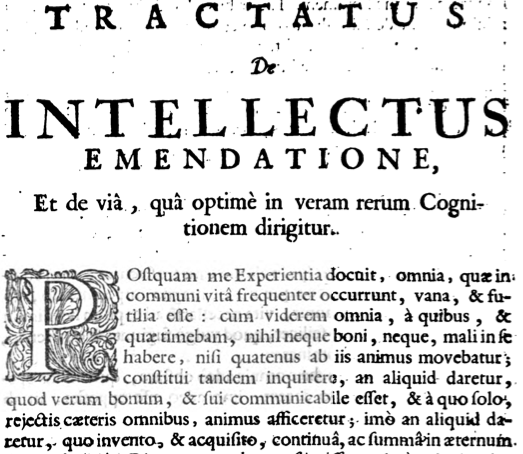
III. The Improvement of the Intellect

Opening Spinoza’s next book, we come at the outset upon mile of the gems of philosophic literature. Spinoza tells why he gave up everything for philosophy:

After experience had taught me that all things which frequently take place in ordinary life are vain and futile, and when I saw.that all the things I feared, and which feared me, had nothing good or bad in them save in so far as the mind was affected by them; I determined at last to inquire whether there was anything which might be truly good, and able to communicate its goodness, and by which the mind might be affected, to the exclusion of all other things; I determined, I say, to inquire whether I might discover and attain the faculty of enjoying throughout eternity continual supreme happiness. … I could see the many advantages acquired from honor and riches, and that I should be debarred from acquiring these things if I wished seriously to investigate a new matter. But the more one possesses of either of them, the more the pleasure is increased, and the more one is in consequence, encouraged to increase them; whereas if at any time our hope is frustrated, there arises in us the deepest pain. Fame has also this great drawback, that if we pursue it we must direct our lives in such a way as to please the fancy of men, avoiding what they dislike and seeking what pleases them. … But the love towards a thing eternal and infinite alone feeds the mind with a pleasure secure from all pain. … The greatest good is the knowledge of the union which the mind has with the whole of nature. … The more the mind knows, the better it understands its forces and the order of nature; the more it understands its forces or strength, the better it will be able to direct itself and lay down the rules for itself; and the more it understands the order of nature, the more easily it will be able to liberate itself from useless things; this is the whole method. 

The greatest good is the knowledge of the union which the mind has with the whole of nature. This sounds like the goal of Indian Yoga.

Only knowledge, then, is power and freedom; and the only permanent happiness is the pursuit of knowledge and the joy of understanding. Meanwhile, however, the philosopher must remain a man and a citizen; what shall be his mode of life during his pursuit of truth? Spinoza lays down a simple rule of conduct to which, so far as we know, his actual behavior thoroughly conformed: 

  1. To speak in a manner comprehensible to the people, and to do for them all things that do not prevent us from attaining our ends…. 
  2. To enjoy only such pleasures as are necessary for the preservation of health.
  3. Finally, to seek only enough money … as is necessary for the maintenance of our life and health, and to comply with such customs as are not opposed to what we seek.

Spinoza opts for very simple living in his pursuit of knowledge.

But in setting out upon such a quest, the honest and clear-headed philosopher comes at once upon the problem: How do I know that my knowledge is knowledge, that my senses can be trusted in the material which they bring to my reason, and that my reason can be trusted with the conclusions which it derives from the material of sensation? Should we not examine the vehicle before abandoning ourselves to its directions? Should we not do all that we can to perfect it? “Before all things,” says Spinoza, Baconianly, “a means must be devised for improving and clarifying the intellect.” We must distinguish carefully the various forms of knowledge, and trust only the best. 

Spinoza first concern is to find the criterion that could be applied to test the trustworthiness of knowledge.

First, then, there is hearsay knowledge, by which, for example, I know the day of my birth. Second, vague experience, “empirical” knowledge in the derogatory sense, as when a physician knows a cure not by any scientific formulation of experimental tests, but by a “general impression” that it has “usually” worked. Third, immediate deduction, or knowledge reached by reasoning, as when I conclude to the immensity of the sun from seeing that in the case of other objects distance decreases the apparent size. This kind of knowledge is superior to the other two, but is yet precariously subject to sudden refutation by direct experience; so science for a hundred years reasoned its way to an “ether” which is now in high disfavor with the physicist élite. Hence the highest kind of knowledge is the fourth form, which comes by immediate deduction and direct perception, as when we see at once that 6 is the missing number in the proportion, 2:4::3:x; or as when we perceive that the whole is greater than the part. Spinoza believes that men versed in mathematics know most of Euclid in this intuitive way; but he admits ruefully that “the things which I have been able to know by this knowledge so far have been very few.”

Spinoza concludes that the highest kind of knowledge comes by immediate deduction and direct perception. Compare this to Buddha’s insistence on seeing things as they are.

In the Ethics Spinoza reduces the first two forms of knowledge to one; and calls intuitive knowledge a perception of things sub specie eternitatis—in their eternal aspects and relations,—which gives in a phrase a definition of philosophy. Scientia intuitiva, therefore, tries to find behind things and events their laws and eternal relations. Hence Spinoza’s very fundamental distinction (the basis of his entire system) between the “temporal order”—the “world” of things and incidents—and the “eternal order”—the world of laws and structure. Let us study this distinction carefully: 

It must be noted that I do not understand here by the series of causes and real entities a series of individual mutable things, but rather the series of fixed and eternal things. For it would be impossible for human weakness to follow up the series of individual mutable things, not only because their number surpasses all count, but because of the many circumstances, in one and the same thing, each of which may be the cause of the thing’s existence. For indeed, the existence of particular things has no connection with their essence, and is not an eternal truth. However, there is no need that we should understand the series of individual mutable things, for their essence … is only to be found in fixed and eternal things, and from the laws inscribed in those things as their true codes, according to which all individual things are made and arranged; nay, these individual and mutable things depend so intimately and essentially on these fixed ones that without them they can neither exist nor be conceived.*

*”For although nothing exists In nature except Individual bodies, exhibiting clear individual effects according to particular laws; yet, in each branch of learning, those very laws—their investigation, discovery and development—are the foundation both of theory and of practice.” Fundamentally, all philosophers agree.

Underlying the infinite variables of the universe there are fixed relations in the form of natural laws.

If we will keep this passage in mind as we study Spinoza’s masterpiece, it will itself be clarified, and much in the Ethics that is discouragingly complex will unravel itself into simplicity and understanding. 

.

DIANETICS: Advice to the Pre-clear 

Reference: Hubbard 1950: Dianetics TMSMH

These are some comments on Appendix IV, “Advice to the Pre-clear” from DIANETICS: THE MODERN SCIENCE OF MENTAL HEALTH.

.

Appendix IV
Advice to the Pre-clear 

Many of the advices given in this appendix are not applicable when working with the subject clearing approach. The following is noted based on these advices:

The subject clearing approach is quite safe. Take ten to twenty milligrams of vitamin B1 a day while focusing intensely on resolving anomalies.  B1 is intimately connected with the generation of mental energy.

A complete recall of one’s life is not necessary. Take up the memories that keep coming up and examine them for anomalies. Examine the unwanted feelings, emotions and condition. They all are coming from deeply buried impressions (facsimiles), which have not been fully assimilated. Understand that these facsimiles exert hypnotic influence on your thinking. If something about your thinking does not make sense then it is originating from some facsimile yet to be discovered. Realize that you can always raise your necessity level to counter the effects of these facsimiles while you work on discovering them.

You know that you are improving as you are becoming less “push button” in your behavior. Make sure you are totally honest with yourself. Even when you are told things about yourself from your relatives and others, beware of anomalies in that data that may be coming from them. Anybody discouraging you from resolving an anomaly is very likely a part of that anomaly.

The purpose of Subject Clearing is to evolve as a conscious being. No drugs, and only good nutrition is needed to facilitate your effort. Use of drugs would actually be an anomaly.

You may go through some rough spots as you work through your facsimiles, but there are all of passing duration. The progress continues with occasional fantastic gains in between as you keep on resolving anomalies. Don’t put your life on hold while you make this effort. But do make the effort and always thank yourself for the effort you are making in improving yourself.

Do not ignore any anomaly no matter how big or small. Drill that anomaly down to its fundamental aspect that does not make sense. Always follow the discipline of Subject Clearing. The only way out of it is through it! The solution is there within you. You just have to find it. Just follow the process.

Remember the process is to consolidate all your knowledge by drilling all anomalies down to their fundamental level and then keep researching that fundamental level. The key word is ASSIMILATION!

.