PM: The Mind

Reference: Postulate Mechanics

The following key words and definitions act as stable data that help understand the basics of the mind. The key words appearing in earlier chapters (words in square brackets) are not defined again. For all key words, please see PM: Glossary.

NOTE: “PM” is the abbreviation for Postulate Mechanics. The content of this subject is open to further refinement and update as long as they comply with the postulate of ONENESS. 

[SENSATION]

[POSTULATE]

DATA
Anything sensed is data. A datum is basically an element of sensation. This datum exists because it is defined by a postulate. The postulate exists as an inherent part of the datum. Thus, data is a collection of elements of sensation/postulates. As data gets refined its forms changes from sensation to perception to memory to experience to knowledge to wisdom. Refinement of data consists of spotting and resolution of anomalies. This data is symbolized as graphics and language.

THOUGHT
A postulate is made up of the finest substance called thought. Thought forms the upper end of the spectrum of substance. As thoughts condense they gradually take on the characteristics of radiation and matter. Any object that we observe must have a thought component to have a form. Thoughts also appear as ideas, beliefs, opinions, speculations, etc., that can be sensed and dealt with mentally only. From the viewpoint of assimilation thoughts are very adaptable; but, they can become very rigid and difficult to assimilate when they form structures, such as, fixed ideas, rigid beliefs, etc. Thoughts are considered to occupy the spiritual domain but they also interact with the physical domain. This is observed in the body, where thoughts generate phenomenon, such as, emotions and efforts.

MIND
The complex capabilities expressed through the body are seen as the workings of a mind. The purpose of the mind is to be aware and to observe, spot and resolve anomalies. The anomalies may be found in the environment, or in the operation of the mind itself. It computes and directs the actions of the body. At the core of the mind lies the mental matrix.

MENTAL MATRIX
By definition, a matrix is a surrounding environment in which something develops. The mental matrix consists of a thought environment, and at the core of this environment are postulates. As soon as the mind senses something, the thought environment interacts with the sensations. It assimilates the sensations in real-time so they can be perceived clearly. Subsequently, perceptions are assimilated and stored as memories. Over time, memories are assimilated resulting in experience, knowledge and wisdom. The layers from sensations to wisdom become part of the mental matrix. This enables the mind to recall, imagine, reason and have consciousness.

[ASSIMILATION]

[ONENESS]

[ANOMALY]

INTELLIGENCE
Intelligence is the ability to spot anomalies and trace them all the way until resolved.

[PERCEPTION]

MEMORY
A memory comes up as a vivid picture when it is either recent or it has some charge (tension) on it. Usually any mild charge evaporates over time and the memory gets assimilated as experience and knowledge. After that, from such experience and knowledge, particulars can be visualized but their feel is different. Happy moments may be visualized relatively easily and accurately. The memory of those part of trauma that contain shock, pain and unconsciousness may at first appear as blanks; but they can be recalled over time when concentrated effort is applied. A person’s memory, and his ability to visualize, gets better as his ability to confront improves.

EXPERIENCE
Experience consists of sensations encountered directly in a subject. There is also second hand information that may be assimilated with direct experience. In general, the total content of the mental matrix may be referred to as experience.

[KNOWLEDGE]

WISDOM
Wisdom arises in the mind with the assimilation of experience. Wisdom provides one with the power to discern the actual situation quickly and find its optimum solution. 

INTUITION
An intuition is the dawning of awareness of the postulate that underlies what the person has been looking at. All of a sudden a lot of things in that area start to make sense.

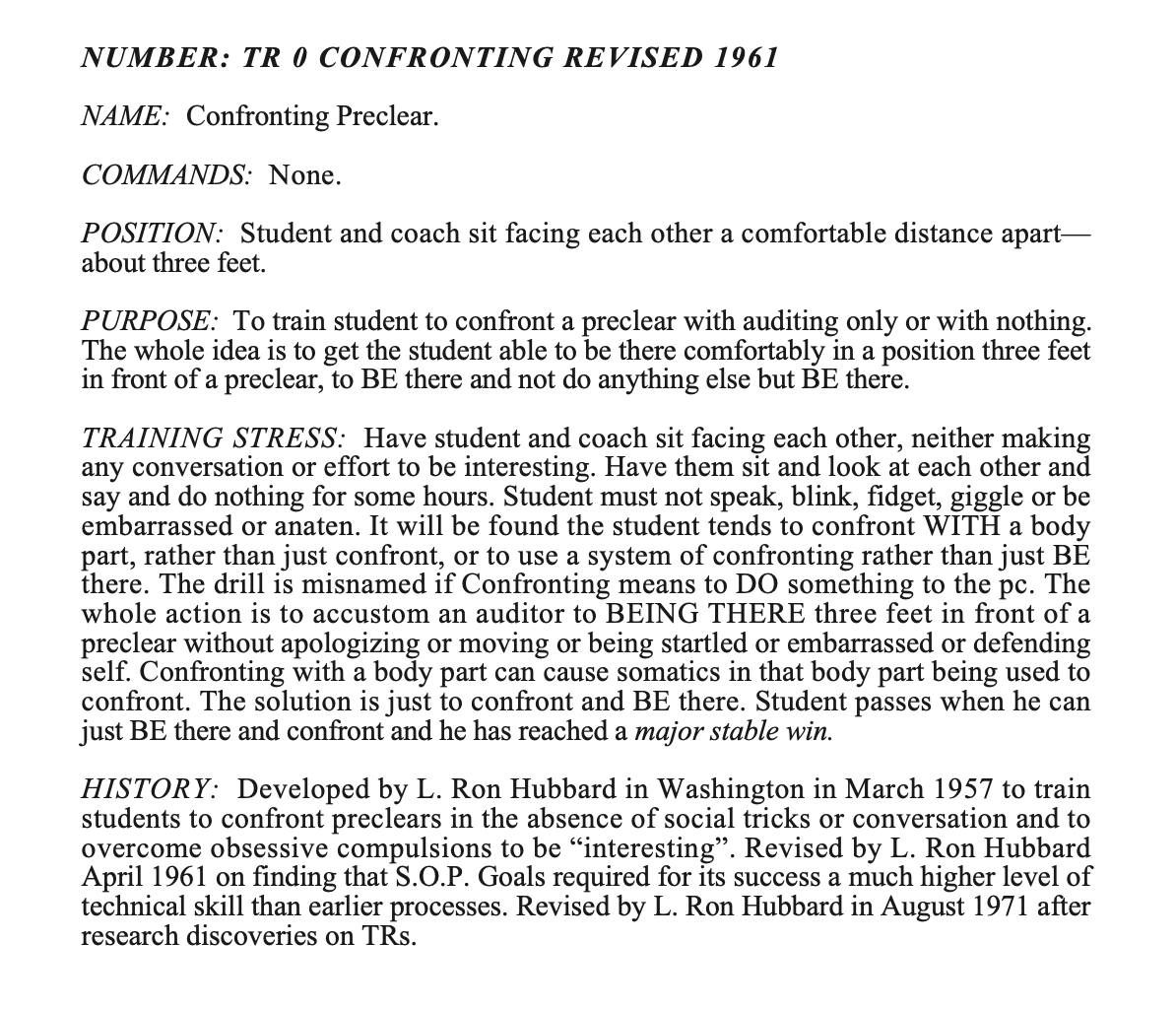
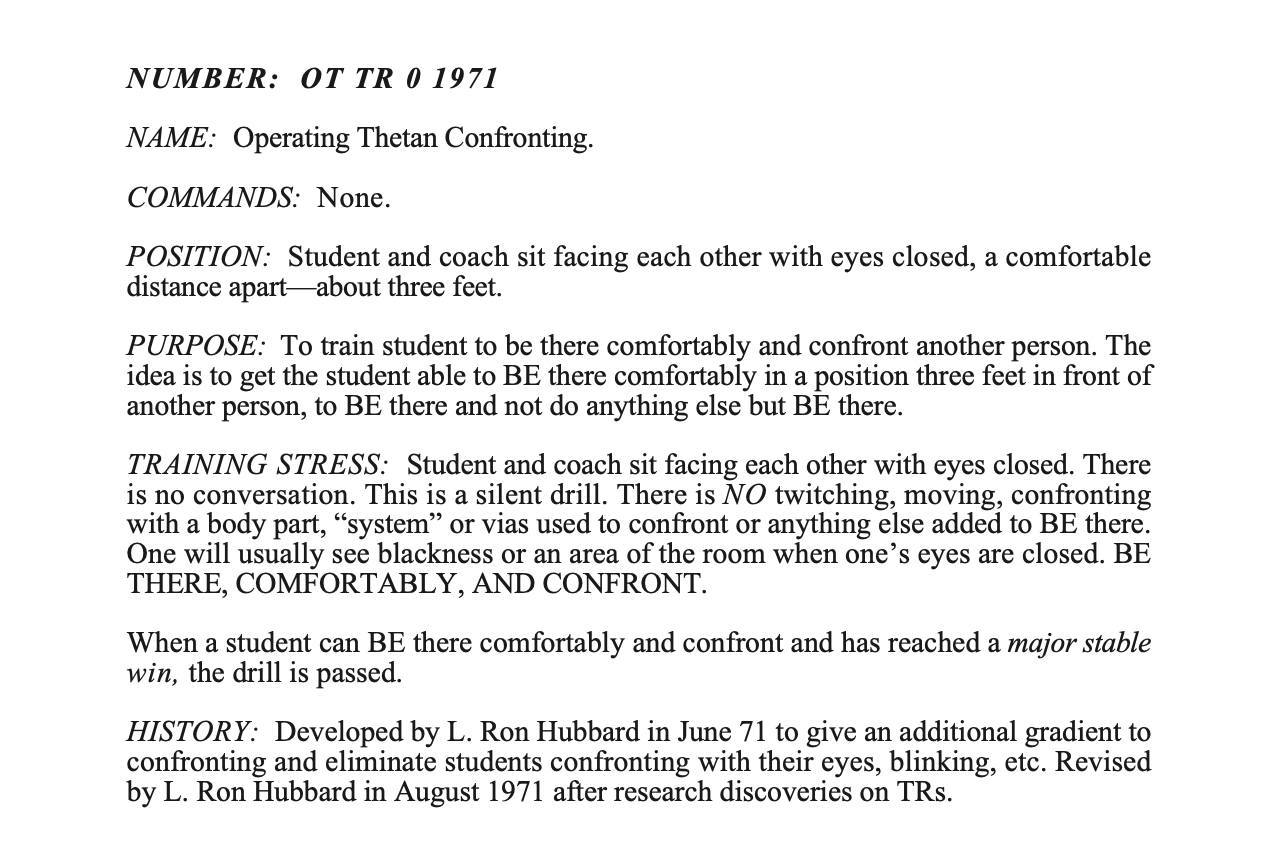
CONFRONT
To confront is to face without flinching or avoiding. Confront helps the person penetrate the suppositions and see the reality for what it is. When a person confronts he  sees the anomaly clearly, and he is able to trace it all the way until it is resolved.

REASONING
Reasoning is looking more closely to determine where to look next to narrow the target. Sometimes, a situation is very complex with a  large scope and many trails to follow. One follows each trail as far as one can. This may require postulating to fill gaps for the moment; but such postulates must be verified, or refined, as more observations become available. Resolution occurs when oneness (continuity, consistency and harmony) is attained for the whole situation.

[SUBJECT CLEARING]

.

IMAGINATION
Imagination is the visualization of possible scenarios not actually presented to the physical senses. Imagination makes sense only to the degree it does not violate reality. Imagination can help resolve anomalies.

CONSCIOUSNESS
To be conscious is “to know together.” Consciousness is the level of awareness of the mind. It depends on the fineness and sophistication of assimilation. Sensations, perceptions, memories, experience, knowledge and wisdom—all contribute to consciousness.

ATTENTION

Attention is the ability to focus on any one part of the universe. But to efficiently do so, the attention should neither be fixed nor dispersed. 

EMOTION
Emotion is the response of a life organism to a situation based on its general state of consciousness. 

EFFORT
Effort is the exertion of physical or mental power to resolve a situation.

SANITY
Sanity is the soundness of the mind.

.

Glossary: Postulate Mechanics

Reference: Postulate Mechanics

This glossary is a compilation of definitions that are used in the subject of POSTULATE MECHANICS.

.

Glossary

—A—

ABRAHAMIC RELIGIONS [Chapter 1]
In Abrahamic religions (Judaism, Christianity and Islam) God is considered to be the source of all creation. God is then assigned the attribute of omniscient (all-knowing) among others. But God itself is presented as a mystery. In Postulate Mechanics, God’s original meaning of “that which is invoked” is acknowledged. God is seen as the power that enables a person to know the inherent oneness of the universe.

ANOMALY [Chapter 5]
Anything that lacks clarity and bring up wrong emotions contains anomalies. Anomalies take the form of disharmony (arbitrary data), inconsistency (contradictory data), or discontinuity (missing data). For example, a dichotomy, such as, “physical-spiritual” is an anomaly of discontinuity because it is not recognized as a dimension. Physical and spiritual are the two ends of the dimension of reality just like hot and cold are the two ends of the dimension of temperature. In general, all unrealities, confusions and sufferings in life contain anomalies.

ASSIMILATION [Chapter 4]
To assimilate is to “make similar.” An example of assimilation occurs when you pour water having different temperatures in the same container. The cold water in the mixture gains heat and the hot water loses heat such that the water in that container, after some time, arrives at an equilibrium temperature. In the mind, the equilibrium may be defined as oneness (harmony, consistency and continuity). When a person spots an anomaly and looks at it more closely, all ideas and emotions in that anomaly tend to assimilate and arrive at oneness. When sensations are assimilated they provide clearer perceptions. When perceptions are assimilated they provide clearer memory. When memories are assimilated they provide clearer experience. When experiences are assimilated they provide clearer knowledge. When knowledge is assimilated it results in knowingness. 

ATOM [Chapter 7]
An atom is the fundamental building block of all matter, defining the chemical properties of elements. 

ATONEMENT [Chapter 6]
The practice of atonement is the deliberate work of seeing one’s wrongdoing clearly, taking responsibility, and actively repairing the rupture—in oneself, with others, and with the divine—so that genuine reconciliation can occur.

ATTENTION
When awareness is focused on any part of the universe we have ATTENTION. Attention is optimum when it is neither fixed nor sweeping at random. [Mind] 

AWARENESS [Chapter 2]
Awareness is the ability to sense the substantiality of the universe. The awareness first appears in the form of sensations. Superficial awareness is called identification. Deep awareness is called knowingness. There is a continuum of awareness from from identification to knowingness.

—B—


BEING
Please see SELF.

BEINGNESS
Beingness is the essence of whole person. It is the whole genetic programming that consists of Thetan and Genetic Entity. [Life]

—C—

CONCEPTUAL LOGIC
Conceptual logic involves starting with broader but fewer concepts; and continuing with narrower but more numerous concepts, while ensuring consistency. This logic may be used to explore any subject—even a subject as large as the universe, and life within it. [Introduction]

CONCEPTUAL TRUTH
Conceptual truth involves oneness (continuity, consistency and harmony) among concepts. A single concept is neither true nor false in itself. The degree of continuity, consistency and harmony may also serve as ‘evidence’ of truth of a concept within a given context. [Introduction]

CONFRONT
To confront is to face without flinching or avoiding. Confront helps the person penetrate the suppositions and see the reality for what it is. When a person confronts he  sees the anomaly clearly, and he is able to trace it all the way until it is resolved. [Mind]

CONSCIOUSNESS
To be conscious is “to know together.” Consciousness is the level of awareness of the mind. It depends on the fineness and sophistication of assimilation. Sensations, perceptions, memories, experience, knowledge and wisdom—all contribute to consciousness. [Mind]

CONSIDERATION [Introduction]
We come to know because we have considered something. Considerations are formed out of reasoning that follows from some postulate. In that sense, a consideration is a continuation of some postulate.

CREATION [Chapter 1]
Creation refers to the act of bringing the universe and all within it into existence. The Western theology defines it as the divine act of God shaping the world. It encompasses the origins of life, humanity, and the cosmos. The Eastern philosophies see the universe as either beginningless or cyclic, arising from an ultimate principle rather than a one‑time creation out of nothing by a separate God. According to Postulate Mechanics, Creation requires ingredients from which to create. Such ingredients are ever present in the form of basic postulates. These postulates generate sensations, which are then interpreted as the universe.

CRITERION OF TRUTH
The criterion of truth is absence of anomalies. The lesser are the anomalies present, the greater is the truth in a subject. [Introduction]

—D—

DATA
Anything sensed is data. A datum is basically an element of sensation. This datum exists because it is defined by a postulate. The postulate exists as an inherent part of the datum. Thus, data is a collection of elements of sensation/postulates. As data gets refined its forms changes from sensation to perception to memory to experience to knowledge to wisdom. Refinement of data consists of spotting and resolution of anomalies. This data is symbolized as graphics and language. [Mind]

DEATH
Death is the total and permanent cessation of all vital functions of the life organism. Death and birth are natural events that are necessary for the evolution of life. When death occurs, the whole spirit-mind-body system disintegrates together as one. The “I” is the configuration of body, mind and spirit. This configuration is lost upon death. Therefore, the “I” does not pass through death, only knowledge and karma does. Knowledge is the assimilated content of the mind. It gets stored in the society, humanity and the universe. It is accessed through meditation. Karma is the unassimilated content of the mind. It passes from one life to the next as DNA “programming” that is waiting to be fully assimilated. [Life]

DEVOTION [Chapter 6]
Devotion in prayer expresses self-offering, a way of cultivating an intimate bond of love and surrender to the Divine through words, chants, and ritual gestures.

DICHOTOMY [Introduction]
A dichotomy is the division of a concept, idea, or entity into two sharply distinguished, mutually exclusive, or contradictory parts. A false dichotomy occurs when only two options are presented, ignoring intermediate possibilities. It is observed that all dichotomies that are knowable, may be presented as two ends of a continuous scale. For example, the dichotomy “hot-cold” may be presented as two ends of a continuous temperature scale. This is the case with dichotomies stated in religion and philosophy, such as, “physical-spiritual,” “good-evil,” “cause-effect,” etc. Only true dichotomy is “Unknowable-knowable,” where nothing can be said about Unknowable, because it is unknowable.

DIMENSION
Origin: ‘a measuring’. A dimension represents the measure of a continuously varying characteristic of substance. The basic dimensions are thickness (existence), space (extent) and time (duration). Any characteristic that can be measured exists in a dimension. A dimension may be plotted mathematically on a scale that extends to infinity in either direction.

DUALITY
Duality means a dual state or quality, such as, hot-cold, good-evil, physical-spiritual, etc. A duality is formed when one looks at the two opposite directions of a dimension; for example, the dimension of temperature extends to increasingly hot in one direction and increasingly cold in the other. These two “opposites” represent a duality. But one should not forget that duality, in reality, are just two different values on a continuous dimension.

—E—

EFFORT
Effort is the exertion of physical or mental power to resolve a situation. [Mind]

EGO
The ego is the awareness of oneself. It is the sense of “I”. The negative aspects of Ego are manifested when self gets fixated on its individuality. [Life]

ELECTRON [Chapter 7]
An electron is a subatomic particle generated during atomic interactions. Inside the atom, it forms a field of very thin matter that surrounds the nucleus. The electronic field fills most of the atom. Electrons do not exist as particles within the atom.

EMOTION
Emotion is the response of a life organism to a situation based on its general state of consciousness.  [Mind]

ENERGY
Energy is the measure of substance (mass or thickness) along with its inherent motion. Matter has energy. Radiation has anergy. Thought has energy. Usually, energy is confused with radiation, such as light. [Universe]

EVOLUTION
Evolution of life occurs from inanimate to animate, minerals to cells, unicellular to multicellular, and from plants to animals to humans. The form becomes more complex as it evolves, and the inherent motion becomes more sophisticated. [Life]

EXPERIENCE
Experience consists of sensations encountered directly in a subject. There is also second hand information that may be assimilated with direct experience. In general, the total content of the mental matrix may be referred to as experience. [Mind]

—F—


FAITH [Chapter 6]
The practice of faith is the ongoing, lived act of entrusting yourself to the Ultimate—God, Truth, or Reality—and embodying that trust in concrete attitudes and actions, day by day.

FIELD [Chapter 7]
A field is an expanse of something. Matter spread continuously in space forms a field of matter.

FORM
Forms are what we sense and perceive. Light, electron and atoms are elementary forms. These elementary forms evolve into more complex forms, such as, molecules, organic molecules, minerals, virus, cells, organisms, etc.

FREE WILL
A person’s free will is his ability to make decisions voluntarily. In other words, he can postulate, but subject to the laws of Postulate Mechanics. Free will does not mean that the person can arbitrarily do anything he wants. [Life]

—G—

GENETIC ENTITY
Genetic Entity is a term borrowed from Scientology. It is a programming that keeps the blueprint of the body. It is carried forward over the genetic line. It is hard-wired into the body through DNA molecules. It develops the body and monitors all its functions. It is very sophisticated, but it has limited capacity to update itself. [Life]

GOD [Chapter 1]
In mainstream Western (especially Jewish, Christian, and Islamic) theology, God is defined as the unique, personal, absolute reality who is the necessary, self‑existent creator and sustainer of everything other than himself, possessing perfect power, knowledge, and goodness.

—H—

—I—

IDENTIFICATION [Chapter 4]
Identification is superficial awareness that is limited to labels and symbolisms. Therefore, identification is memory intensive and lacks depth. As identification of sensations is assimilated there comes about increasing knowingness.

IDENTITY [Chapter 4]
The self acquires an identity when identification of sensations occurs. The self cannot differentiate itself from the identity. A self can have many identities and not be aware of them. It just acts out according to the identity that gets activated in a situation. Such identities dissolve as assimilation occurs and knowingness comes about.

IMAGINATION
Imagination is the visualization of possible scenarios not actually presented to the physical senses. Imagination makes sense only to the degree it does not violate reality. Imagination can help resolve anomalies. [Mind]

INDIVIDUAL
An individual is a life organism that has the sense of being coordinated from a single control point, and which considers itself to be separate and unique. 

INDIVIDUALITY
The self has a sense of individuality in that it considers itself to be unique. An identified self can also claim individuality. Therefore, individuality and identity are not exclusive of each other. [Life]

INTELLECT
Intellect refers to the mind’s capacity for rational thought, understanding, and acquiring knowledge, enabling reasoning, judgment, and abstract thinking, distinct from mere feeling or willing. The intellect rises up to self-evident postulates, which act as the starting point of reasoning. The postulates and reasoning are naturally constrained by the continuity, consistency and harmony of oneness. There are no other natural constraints—logical or otherwise.

INTELLIGENCE
Intelligence is the ability to spot anomalies and trace them all the way until resolved. [Mind]

INTUITION
An intuition is the dawning of awareness of the postulate that underlies what the person has been looking at. All of a sudden a lot of things in that area start to make sense. [Mind]

—J—

—K—

KNOWABLE [Introduction]
The knowable is anything that can be sensed physically or mentally. The physical universe is sensed and perceived to be made up of matter and radiation. The spiritual universe is sensed and perceived to be made up of thought. All religious and philosophical concepts are knowable simply because they can be sensed as considerations. This knowable Universe is differentiated only from the Unknowable.

KNOWINGNESS [Chapter 4]
Knowingness comes about as all sensations get assimilated and evolve into deep understanding. In knowingness there is complete harmony, consistency and continuity of all that is being sensed. 

KNOWLEDGE
As sensations are assimilated, they, ultimately, lead to knowledge of the phenomena one is looking at. Knowledge thus obtained is applied to improve the conditions in life. Knowledge was, at first, conceived through philosophy, and applied through religion. Over time knowledge has been made more precise through the systematic approach of science. The knowledge that is needed today is about the understanding of the mind, so the potential of a person can be maximized. [Introduction]

—L—

LAWS OF POSTULATE MECHANICS

  1. Beyond what we know, there is much that we do not know. 
  2. We know only what we can sense and perceive. 
  3. We can perceive only that which is substantial enough to be sensed.
  4. We perceive sensations only when they acquire meaning in association with postulates.
  5. The accuracy of perception depends on the consistency among the underlying postulates.
  6. We know only what we have sensed, postulated and perceived.
  7. The knowable universe is the outcome of what we have sensed, postulated and perceived.
  8. All our spiritual and physical knowledge is part of this knowable universe. Nothing lies beyond it.
  9. The spiritual elements are perceived as thought. This includes postulates.
  10. The physical elements are perceived as radiation and matter.
  11. The knowable universe consists of an integration of both spiritual and physical elements.
  12. The knowable universe is a single Universe.
  13. This knowable Universe is differentiated only from the Unknowable.
  14. All experience is knowable. This includes experience that is supposedly difficult to describe.
  15. The “experience of void” is a sense of emptiness. It is a sensation that is knowable.
  16. Space may not contain matter or radiation, but it will always contain thought.
  17. Time is a duration relative to the infinite duration (eternity, or no change) of a “black hole.”

[The Laws]

LIFE
The life appears as a form made of substance that has inherent motion. We observe that thought has a form and inherent motion, so does radiation, such as light; and so does matter, such as the particles of atom. These are evolving forms. As life evolves, its form and inherent motion become increasingly complex. And so we have objects, minerals, chemicals, cells, plants, animals and humans. This evolution has led to self-animation and intelligence. New abilities may emerge in future as life has the potential to postulate and become aware within the constraints of oneness. [Introduction] [Life]

LOGIC
The purpose of Logic is to assimilate things so they form a consistent whole. Logic associates observations, thoughts, concepts and other elements of the universe, to make them continuous, consistent and harmonious. When things are not logical we have anomalies. These anomalies may be described as discontinuity (missing data), inconsistency (contradictory data), and disharmony (arbitrary data). [Universe]

—M—

MAN
Man is a life organism at the top of the evolutionary chain. A life organism has a form made of substance, which displays inherent motion. The form made of substance is seen as a body. The complex capabilities expressed through the body are seen as the workings of a mind. And, the inherent motion, which makes these capabilities possible, is seen as the spirit. [Life]

MASS [Chapter 7]
Mass is the extremely high thickness of matter. [See THICKNESS]

MATTER [Chapter 3]
Matter is substance with highest thickness called mass. A gradient of mass appears within the atom of matter. The nucleus of atom consists of “solid mass”. The surrounded field of electrons consists of “liquid mass.” And the enveloping field of radiation consists of “gaseous mass.” Therefore, from the center of atom to its periphery, we have a gradient of decreasing mass. While the mass decreases the volume increases.

MEDITATION [Chapter 6]
In meditation, there is a curiosity to know but no judgment. There is a soft perseverance but no resistance. One maintains a focused attention, open monitoring and effortless presence. 

MEMORY
A memory comes up as a vivid picture when it is either recent or it has some charge (tension) on it. Usually any mild charge evaporates over time and the memory gets assimilated as experience and knowledge. After that, from such experience and knowledge, particulars can be visualized but their feel is different. Happy moments may be visualized relatively easily and accurately. The memory of those part of trauma that contain shock, pain and unconsciousness may at first appear as blanks; but they can be recalled over time when concentrated effort is applied. A person’s memory, and his ability to visualize, gets better as his ability to confront improves. [Mind]

MENTAL MATRIX
By definition, a matrix is a surrounding environment in which something develops. The mental matrix consists of a thought environment, and at the core of this environment are postulates. As soon as the mind senses something, the thought environment interacts with the sensations. It assimilates the sensations in real-time so they can be perceived clearly. Subsequently, perceptions are assimilated and stored as memories. Over time, memories are assimilated resulting in experience, knowledge and wisdom. The layers from sensations to wisdom become part of the mental matrix. This enables the mind to recall, imagine, reason and have consciousness. [Mind]

MEST
In Scientology, MEST stands for the all-substance universe, that we see as matter, energy, space, and time. Scientology makes the error of limiting the designation of “MEST” to the material universe only. In Postulate Mechanics, the universe is defined as all that is knowable, and made up of matter, radiation and thought as its substance. Space and time are properties of substance. [Universe]

MIND
The complex capabilities expressed through the body are seen as the workings of a mind. The purpose of the mind is to be aware and to observe, spot and resolve anomalies. The anomalies may be found in the environment, or in the operation of the mind itself. It computes and directs the actions of the body. At the core of the mind lies the mental matrix. [Mind]

MINDFULNESS [Chapter 6]
The practice of mindfulness is the training of attention to stay with present-moment experience, on purpose and without judgment, in both formal meditation and everyday life. More specifically, mindfulness is sustained, awareness of thoughts, emotions, bodily sensations, and surroundings as they unfold right now, rather than being lost in past or future. It includes two key elements: focused attention on present experience and an attitude of curiosity, openness, and acceptance toward whatever appears.

MISCONCEPTION [Chapter 5]
A misconception is an erroneous idea, or a mistaken notion, such as, “the sun goes around the earth.” The deeper is a misconception the greater is its influence on the individual. The widely spread is the misconception in the society, the more natural it appears because everybody agrees with it. As an individual becomes aware of his misconceptions he starts to resolve his anomalies also.

MOTION [Chapter 3]
Motion is an inherent characteristic of substance. Both light and electrons have observable inherent motion. On a cosmic scale, matter has the least motion; The motion of radiation) is many orders of magnitude faster than that of matter. And the motion of thought appears to be instantaneous. Motion appears to be opposite of thickness. For example, in an atom, as thickness decreases, motion increases from the center to periphery. The same thing we observe in a galaxy—where the bodies rotate around the highly dense black hole at the center at greater distances as their thickness decreases. In short, the inherent motion of substance increases as its inherent thickness decreases.

—N—

NUCLEUS [Chapter 7]
The atomic nucleus is the tiny, dense region at the center of an atom, containing nearly all its mass. It is a field of matter and not a particle.

—O—

ONENESS [Chapter 2]
Oneness comes about as substantiality is assimilated in awareness. With assimilation comes about harmony of awareness. With increasing harmony comes about consistency. And, with increasing consistency comes about continuity. Oneness lies in the harmony of relations, consistency of realities, and continuity of dimensions. Oneness underlies the very concept of the Universe. It is the key to Scientific Method. Oneness is not a monotone canvas; but it is a beautiful painting full of colors and forms that are harmonious, consistent and continuous. 

—P—

PARTICLE [Chapter 7]
A particle is a minute portion of matter that is separate from other particles by intervening space.

PERCEPTION
Perception becomes clearer as the sensations get assimilated after deriving their meaning from postulates. The sensations routinely get assimilated into perceptions, such as, visual (sight), auditory (hearing), olfactory (smell), gustatory (taste), tactile (touch) and mental (internal). [Universe]

POSTULATE [Introduction]
A postulate is a statement assumed to be true without proof, serving as a foundational premise for further reasoning. It acts as a self-evident starting point—such as “God” or “Self”—used to build logical reasoning in religions and philosophies. Einstein postulated, “The speed of light in a vacuum is constant for all moving observers, regardless of their speed” to build up his theory of relativity.

POSTULATE MECHANICS [Introduction]
For the “matter” we have Classical Mechanics. For the “radiation” we have Quantum Mechanics. For the “thought” we now have Postulate Mechanics. The purpose of Postulate Mechanics is to investigate, in a scientific manner, the postulates underlying this universe. 

PRAYER [Chapter 6]
One prays to God in an effort to reach the power that will alleviate his suffering. There is an inward movement of communication, submission, and loving attention to the Divine.

—Q—

—R—

RADIATION [Chapter 3]
Radiation is a category of substance, which radiates out in a continuous stream at great speeds. The thickness of radiation is so small that it cannot be measured as mass. So, it is measured in terms of “frequency.” The electromagnetic spectrum of radiation is based on frequency. On this spectrum gamma rays have the highest frequency; and, radio waves have the lowest frequency. According to Postulate Mechanics, the inherent motion increases as thickness decreases. Therefore, the radio waves may travel faster than the gamma radiation in space.

REALITY
Reality is the is-ness of things. Reality is based on the postulates that we are in agreement with knowingly or unknowingly. The ultimate reality is unknowable; because no matter how much we postulate to know, there will always be more to postulate. Reality is based on the postulates that we are in agreement with knowingly or unknowingly. The reality of the universe depends on the oneness (continuity, consistency and harmony) of all things. Unreality consists of discontinuity, inconsistency or disharmony. […]

REASONING
Reasoning is looking more closely to determine where to look next to narrow the target. Sometimes, a situation is very complex with a  large scope and many trails to follow. One follows each trail as far as one can. This may require postulating to fill gaps for the moment; but such postulates must be verified, or refined, as more observations become available. Resolution occurs when oneness (continuity, consistency and harmony) is attained for the whole situation. [Mind]

RELATIVE MOTION
The spread/motion of concentrated matter particles is near zero within this vast space, which is very likely the spread/motion of thought. But the relative spread/motion of two matter particles relative to each other can still be significant. All of physics is based on this relative motion of matter particles. [Universe]

—S—

SANITY
Sanity is the soundness of the mind. [Mind]

SELF [Chapter 2]
Self is core of the Universe. It consists of the postulates of substantiality, awareness and oneness (harmony, consistency and continuity). It is the starting point of considerations that evolve into phenomena, identities, affinity, reality and communication. These considerations form the universe.

SELF-ANIMATION
Self animation is inherent to a living form, such as, virus, cells and higher organisms. Since extremely small changes in thickness may produce significantly large and visible changes in motion, life can manage self-animation by controlling the thickness of its parts. The required changes in thickness are so small that they can easily be controlled by thought. Therefore, a thought-motion interface may be postulated for living organisms. [Life]

SELF-DETERMINATION
Self-determination is a person’s ability to determine something without outside influence, and based entirely on his viewpoint. [Life]

SENSATION [Chapter 4]
When we sense something we call it a sensation. Sensations are both physical and mental. Sensations take the form of perceptions, feelings, emotions, pain, memories, experience, knowledge, etc. Sensations are identified and assimilated towards knowingness.

SOUL
The SOUL refers to the animating, non-physical essence of life. In philosophy, this term has been used to refer to the mind. In religion, it is theorized to be that eternal aspect of the person, which separates from the body upon death, and goes to heaven or hell. [Life]

SPACE [Chapter 7]
Space is the boundless, three-dimensional continuum containing all substance, extending beyond Earth’s atmosphere and encompassing the entire universe. 

SPIRIT
Spirit lies at the upper end of the spectrum of self. At the bottom end of this spectrum lies the ego. Spirit represents a self that is completely integrated and contains no anomalies. All aspects of the spirit are totally assimilated. [Life]

SPIRITUALITY
Spirituality deals with the matters of life. It means becoming aware of the situations in life and resolving them. [Life]

STILLNESS [Chapter 6]
The practice of stillness is the ongoing training of body and mind to become quiet, open, and undefended, so that what is deeper than thought—God, the heart, or pure awareness—can be known more directly and allowed to reshape one’s way of being.

SUBJECT CLEARING
Subject Clearing is a method of reasoning, in which elements/concepts in a subject are collected and arranged in a sequence. Please note that there can be many different levels in a subject, and a person may address one level at a time. The elements of a level are collected until all of them are accounted for. These elements are then stacked up in the sequence of most significant to the least. Mindfulness is the key to arrive at the correct sequence. Please note that an element is more significant than another that is derived from it. This sequential arrangement facilitates the detection of missing, contradictory or arbitrary elements. These are anomalies by definition. The most significant anomaly is then taken up and traced further in a similar manner, until that trail leads to a discovery and a resolution. This whole process is then repeated again and again, until the problem or confusion in that subject is resolved. This includes the subject of life. The Subject Clearing process helps revise or redefine concepts in a subject and update their definitions. It also detects and corrects misconceptions prevalent in the society. [Introduction]

SUBSTANCE [Chapter 3]
Substance is that which is substantial enough to be sensed. Postulate Mechanics categorizes substance as follows: (1) matter, (2) radiation, and (3) thought. The two inherent characteristics of substance are thickness and motion. As thickness decreases, motion increases from matter to radiation to thought. This is obvious on cosmic scale; but can be postulated to exist on smaller scales. For example, invisible thought may generates visible motions of body parts by simply controlling changes in its thickness.

SUBSTANTIALITY [Chapter 2]
Substantiality means something exists and it can be sensed. Substantiality refers not only to something physical made of matter, but also to something spiritual made of thought. A perception of rose is substantial; but a mental image picture of rose created by imagination is substantial too, because both exist and can be sensed.

SUFFERING
The problem has always been that our receptivity is limited. So, the question has always been, “How do we expand our receptivity and get to the deeper reality?” This is done by resolving anomalies (discontinuities, inconsistencies or disharmonies) in what is observed. This is called assimilation. To assimilate one looks at the anomaly more closely until its exact nature is recognized. When sensations are assimilated they provide clearer perceptions. When perceptions are assimilated they provide clearer memory. When memories are assimilated they provide clearer experience. When experiences are assimilated they provide clearer knowledge. When knowledge is assimilated it results in wisdom.

—T—

THETAN
Thetan is a term borrowed from Scientology that describes the mind and its functions. It is the upper end of the programming carried forward over the genetic line, the lower end of which is Genetic Entity that describes the body and its functions. Thetan (Mind) and Genetic Entity (body) are integrated as one single system of beingness. Thetan is not something that can be detached from the body as believed in Scientology. That detachment occurs only in the form of attention no longer being fixated on the body. Thetan is also not something immortal as believed in Scientology. That sense of immortality applies only to the property of universal awareness.

THICKNESS [Chapter 3]
Thickness means a degree of density, firmness, viscosity, etc. It is an inherent characteristic of substance. Matter has extremely high thickness called mass. The thickness of radiation is so small that it cannot be measured as mass. So, it is measured in terms of “frequency.” Thought has so small a thickness that it cannot be measured even as frequency. It can only be sensed mentally as “weightiness.” The thickness decreases from matter to radiation to thought. Matter and radiation are considered to be physical substances. Thought is considered to be a mental, or spiritual, substance because it can be sensed mentally only.

THOUGHT [Chapter 3]
Thought is a category of substance, whose thickness is infinitesimal even with respect to the frequency of radiation. We may refer to the thickness of thought in terms of its “weightiness.” There may be fixed, serious thought at one end of the spectrum of thought; and free flowing, buoyant thought at the other. The inherent motion of thought is considered to be literally instantaneous. it is expected to be many orders of magnitude faster than the speed of radiation. The free flowing, buoyant thought may travel faster than the fixed, serious ideas. Thoughts are easy to assimilate when they are free-flowing; but they become difficult as they form structures, such as, fixed ideas. 

TIME
Time refers to the duration of substance. Matter has near infinite duration. Any duration, which is less than infinite, appears as motion. In the absence of substance there is neither duration, nor motion nor time. [Universe]

TRUTH
The truth of a datum is established by the demonstration of its consistency within the given context. Presence of even a single anomaly degrades the truth.  [Universe]

—U—

UNCONSCIOUSNESS (OCCLUSION)
When sensations do not get assimilated enough to be perceived clearly, a person remains unconscious of them. This is the case with traumatic sensations that do not get assimilated in a routine manner. They are kept in the mind waiting to be assimilated. When unassimilated sensations of a past trauma get assimilated later, their perceptions come flooding back as “missing memory”.

UNIVERSE [Introduction]
The word UNIVERSE literally means “combined into one.” The characteristic common to all things, whether physical or spiritual, is that they are knowable. It is the assimilation of all things knowable as a single whole, which we sense as this universe. Every aspect of this universe can be sensed. This sensation forms the basic substance of the universe. 

UNKNOWABLE [Introduction]
The unknowable is beyond consideration, because the moment you consider it, it becomes knowable as that consideration. It is like Kant’s “thing-in-itself” that is beyond sensory experience. It may be compared to the Nirākār Brahman of the Vedas that has no attributes. We try to know the unknowable by assigning it a symbol and/or an attribute, such as, the omniscient God; but we end up knowing only that symbol and/or attribute. The unknowable remains unknowable. The idea of unknowable serves only as a reference against which knowable may be contrasted.

—V—

VEDIC RELIGIONS [Chapter 1]
In the ancient Vedic religions, such as, Hinduism, the Nirākār Brahman uses Māyā to arise as Sākār Brahman. The Nirākār Brahman is considered to be a reality without attributes. Māyā is considered to be the process that generates attributes. And Sākār Brahman is considered to be the reality with attributes. In Postulate Mechanics, the Nirākār Brahman is viewed as “unknowable,” Maya is viewed as the basic “postulates.” And, Sākār Brahman is viewed as the knowable “universe.”

VIEWPOINT
Viewpoint is the frame of reference the beingness is using to view from. It is closely tied with individuality. The viewpoint determines a person’s reality, which includes the sense of his location in space, and what he thinks of himself. The viewpoint can become fixed, but a person can always unfix and change it. [Life]

—W—

WISDOM
Wisdom arises in the mind with the assimilation of experience. Wisdom provides one with the power to discern the actual situation quickly and find its optimum solution. [Mind]

—X—

—Y—

—Z—

.

Postulate Mechanics (PM)

Reference: The Book of Subject Clearing

This is an outline of Postulate Mechanics (PM), which is a new, upcoming subject. This outline is continually being extended and updated.

Note: This is a work in progress.

Postulate Mechanics (PM)

  1. PM Preface … … … … … Glossary: Postulate Mechanics
  2. PM Introduction
  3. PM Chapter 1: The Knowable Universe
  4. PM Chapter 2: Universe & Self
  5. PM Chapter 3: Substantiality (Substance)
  6. PM Chapter 4: Awareness (Ability to Sense)
  7. PM Chapter 5: Oneness (Assimilation)
  8. PM Chapter 6: Piercing the Veil
  9. PM Chapter 7: Atom & Space
  10. PM Chapter 8: Intrinsic Motion

Under Review

  1. PM: The Laws
  2. PM: The Universe
  3. PM: The Life
  4. PM: The Mind
  5. PM: The Logic
  6. PM: The Factors
  7. Holding: Postulate Mechanics

Subject Clearing (SC)

  1. The Book of Subject Clearing
  2. SC: Hinduism … … … … … Glossary: Hinduism
  3. SC: Buddhism … … … … … Glossary: Buddhism
  4. SC: Scientology … … … … … Glossary: Scientology
  5. SC: Psychology
  6. The Book of Physics

References

  1. PM: Introduction (old)
  2. Grassroots Scientology
  3. Holding Data: Blank Glossary

.

PM: The Universe

Reference: Postulate Mechanics

The following key words and definitions act as stable data that help understand the basics of the universe. The key words appearing in earlier chapters (words in square brackets) are not defined again. For all key words, please see PM: Glossary.

NOTE: “PM” is the abbreviation for Postulate Mechanics. The content of this subject is open to further refinement and update as long as they comply with the postulate of ONENESS.

[UNIVERSE]

SENSATION
When we sense something we call it a sensation. The awareness of sensation is determined by postulates. Postulates give meaning to sensations so they can be perceived. 

SUBSTANCE
Substance is that which is substantial enough to be sensed and perceived. We may divide the substance of this universe into three categories: (1) matter, (2) radiation, and (3) thought. The two fundamental aspects of substance are consistency and motion. As consistency decreases from matter to radiation to thought, the motion increases simultaneously on a greatly magnified scale. Thus, extremely small changes in  consistency may produce significantly large and visible changes in motion.

CONSISTENCY
Consistency is a fundamental aspect of substance, which means “a degree of density, firmness, viscosity, etc.” Matter has extremely high consistency called mass. Radiation has a such small consistency that it is considered to have no mass. Thought has still less consistency that cannot be sensed physically. It can only be sensed mentally. We have decreasing consistency from matter to radiation to thought. Matter and radiation are considered to be physical substances. Thought is considered to be a mental (metaphysical) substance.

MOTION
Motion, as observed in the properties of light and the electrons, is a fundamental aspect of substance. When the substance is extremely concentrated, as at the center of a galaxy, its consistency is near infinite, and its motion is near zero. When the substance is extremely diffused, as in the intergalactic space, its consistency is near zero, and its motion is near infinite. Motion reflects the relative SPREAD of substance. Matter has hardly any spread/motion. Radiation has respectable spread/motion. And thought has extreme spread/motion.

RELATIVE MOTION
The spread/motion of concentrated matter particles is near zero within this vast space, which is very likely the spread/motion of thought. But the relative spread/motion of two matter particles relative to each other can still be significant. All of physics is based on this relative motion of matter particles.

MEST
In Scientology, MEST stands for the all-substance universe, that we see as matter, energy, space, and time. Scientology makes the error of limiting the designation of “MEST” to the material universe only. In Postulate Mechanics, the universe is defined as all that is knowable, and made up of matter, radiation and thought as its substance. Space and time are properties of substance.

SPACE
Space refers to the spread of substance. There is no space in the absence of substance. The “empty space” is empty of matter only; but it defines the spread of radiation and thought. The “space” studied in geometry is actually the abstraction of the spread of matter.

TIME
Time refers to the duration of substance. Matter has near infinite duration. Any duration, which is less than infinite, appears as motion. In the absence of substance there is neither duration, nor motion nor time.

ENERGY
Energy is the measure of substance (mass or consistency) along with its inherent motion. Matter has energy. Radiation has anergy. Thought has energy. Usually, energy is confused with radiation, such as light.

MATTER
Matter is the substance with highest consistency, which is called mass. However, matter does contain radiation and thought as part of its structure.

REALITY
Reality is the is-ness of things. It is how we perceive the forms and their inherent motion. Reality is based on the postulates that we are in agreement with knowingly or unknowingly. The reality of the universe, however, comes from the oneness (continuity, consistency and harmony) of all things. Unreality has the elements of discontinuity, inconsistency or disharmony.

PERCEPTION
Perception becomes clearer as the sensations get assimilated after deriving their meaning from postulates. The sensations routinely get assimilated into perceptions, such as, visual (sight), auditory (hearing), olfactory (smell), gustatory (taste), tactile (touch) and mental (internal). 

ASSIMILATION
To assimilate is to “make similar” by establishing consistency among elements under consideration. Any discontinuity, inconsistency or disharmony is an anomaly that needs to be assimilated. To assimilate one looks at the anomaly more closely until its exact nature is recognized. When sensations are assimilated they provide clearer perceptions. When perceptions are assimilated they provide clearer memory. When memories are assimilated they provide clearer experience. When experiences are assimilated they provide clearer knowledge. When knowledge is assimilated it results in wisdom.

ONENESS
In Postulate Mechanics, Oneness is understood as CONSISTENCY among parts. This consistency appears as CONTINUITY at very small scales, and as HARMONY at very large scales. Oneness does not imply sameness. Oneness means that all that is known is continuous, consistent and harmonious. Oneness lies in the continuity of dimensions, consistency of realities, and harmony of relations. Oneness underlies the very concept of the Universe, and also the concept of Scientific Method. Oneness is not a monotone canvas; but it is a beautiful painting full of colors and forms that are continuous, consistent and harmonious. 

[ANOMALY]

LOGIC
The purpose of Logic is to assimilate things so they form a consistent whole. Logic associates observations, thoughts, concepts and other elements of the universe, to make them continuous, consistent and harmonious. When things are not logical we have anomalies. These anomalies may be described as discontinuity (missing data), inconsistency (contradictory data), and disharmony (arbitrary data). 

TRUTH
The truth of a datum is established by the demonstration of its consistency within the given context. Presence of even a single anomaly degrades the truth. 

KNOWABLE
The knowable universe is the outcome of postulates. It consists of all that can be sensed and perceived. The spiritual elements are sensed and perceived as thought. The physical elements are sensed and perceived as matter and radiation. As knowable, both spiritual and physical elements are integrated into a single Universe. This knowable Universe is differentiated only from the Unknowable.

[KNOWLEDGE]

.

Dianetics Axioms 181 – 194

Reference: The Dianetics Axioms

L. Ron Hubbard found that man is obeying very definite laws and rules which could be set forward in axioms. The very first and most fundamental of these is: The dynamic principle of existence is survive. That is the basic axiom of Dianetics.

The original Dianetic axioms are referenced below in black.

.

Executive Summary 2025

.

Axioms 181-194

DN AXIOM 181: Pain is stored as plus or minus randomity

.

DN AXIOM 182: Pain, as an area of plus or minus randomity, can reinflict itself upon the organism.

.

DN AXIOM 183: Past pain becomes ineffective upon the organism when the randomity of its area is addressed and aligned.

.

DN AXIOM 184: The earlier the area of plus or minus randomity, the greater self-produced effort existed to repel it.

.

DN AXIOM 185: Later areas of plus or minus randomity cannot be realigned easily until earlier areas are realigned.

.

DN AXIOM 186: Areas of plus or minus randomity become increased in activity when perceptions of similarity are introduced into them.

.

DN AXIOM 187: Past areas of plus or minus randomity can be reduced and aligned by address to them in present time.

.

DN AXIOM 188: Absolute good and absolute evil do not exist in the mest universe.

.

DN AXIOM 189: That which is good for an organism may be defined as that which promotes the survival of that organism. 

COROLLARY: Evil may be defined as that which inhibits or brings plus or minus randomity into the organism, which is contrary to the survival motives of the organism.

.

DN AXIOM 190: Happiness consists in the act of bringing alignment into hitherto resisting plus or minus randomity. Neither the act or action of attaining survival, nor the accomplishment of this act itself, brings about happiness.

.

DN AXIOM 191: Construction is an alignment of data. 

COROLLARY: Destruction is a plus or minus randomity of data. The effort of constructing is the alignment toward the survival of the aligning organism. Destruction is the effort of bringing randomity into an area.

.

DN AXIOM 192: Optimum survival behavior consists of effort in the maximum survival interest in everything concerned in the dynamics.

.

DN AXIOM 193: The optimum survival solution of any problem would consist of the highest attainable survival for every dynamic concerned.

.

DN AXIOM 194: The worth of any organism consists of its value to the survival of its own THETA along any dynamic.

.