INERTIA is the resistance that is felt when something is pushed. If something offers no resistance then there can be no push either. Therefore, for force to be manifested there must be inertia opposing it. Both force and inertia are the manifestation of the consistency of substance.
When the force upon an object and its inertia are in exact balance, there exists a uniform state of motion, or rest, in which there is no acceleration. The fact that the speed of light is constant means that it has inertia that is balancing any electromagnetic force acting upon it. If there is no inertia, the speed shall be infinite.
A body with infinite consistency shall have infinite inertia and it would not be displaceable from its location. We may assign it zero absolute motion. As the consistency reduces, the inertia also reduces and some displacement would become possible. This shall bring about a configuration similar to that of a rotating galaxy. We can thus show an inverse relationship between consistency and absolute motion.
When an object is accelerated to a higher speed with the application of an external force, and the external force is removed; then the inertia of the object will start acting to bring the object back to its original balanced speed. If the inertia is also reduced in the process, then the higher speed shall be maintained.
Both Force and Inertia are manifestations of consistency.
Wikipedia defines dark matter and dark energy as follows:
In astronomy, dark matter is matter of unknown composition that does not emit or reflect enough electromagnetic radiation to be observed directly, but whose presence can be inferred from gravitational effects on visible matter. And, dark energy is an unknown form of energy that affects the universe on the largest scales. Its primary effect is to drive the accelerating expansion of the universe. Of the universe, about 26.8% is dark matter, and about 68.3% is dark energy.
According to the definition of SUBSTANCE, both matter and energy are forms of substance because they can be sensed and/or known. Matter is made visible to the eye by energy; but energy itself is invisible. This definition tells us that “thought” is the third form of substance, which is yet to be recognized.
According to the definition of CONSISTENCY, the substance is recognized by the fact that it is manifested and, therefore, it must have consistency in order to be sensed and/or known. The consistency of matter is known as mass.
According to the definition of SPACE, the sense of space means presence of substance. If that substance is neither matter nor energy, then it must be thought.
It is likely that dark matter/energy has something to do with what has been ignored all this time—the “thought” substance.
On planet earth, the combined weight of all ants is greater than the combined weight of all humans. It may not come as a surprise that, in this universe, the combined weight of all “thought” substance could be greater than the combined weight of all visible matter and energy.
According to the definition of THOUGHT, the laws that apply to thought would be very different from the laws that apply to energy, just like the laws that apply to energy are quite different from the laws that apply to matter. We need to explore the laws for thought scientifically. A law discovered so far is the Principle of Oneness.
Since there are no known categories of substance other than matter, energy and thought, we may adopt as a working hypothesis that,
Dark Matter is thought substance; and, Dark Energy represents the characteristic motion and interactions of that thought substance.
Chapter 18: ATOMIC, NUCLEAR AND SOLID-STATE PHYSICS
.
KEY WORD LIST
Atom, Bohr Atom, Energy Level Diagram, Quantized Energy Levels, Bohr’s Theory, Quantum Theory of Atom, Principal Quantum Number (n), Electron Shells, Second Quantum Number (l), Third Quantum Number (ml), Fourth Quantum Number (ms), Bohr Radius, Electron Probability Cloud, Pauli Exclusion Principle, Bremsstrahlung radiation, X-Ray Lines, Ground State, Excited State, Spontaneous Emission, Stimulated Emission, Laser, Binding Energy, Mass Defect, Maximum Binding Energy, Radioactivity, Half-Life, Dating, Conservation Laws, Natural Decay Processes, Neutrino, Positron, γ-Decay, Induced Reactions, Fission Reaction, Nuclear Energy, Chain Reaction, Cross-Section, Enrichment, Breeder Reactors, Moderator, Critical Reaction, Control Rods, Fusion Reactions, Elementary Particles, Baryons, Leptons, Anti-Particle, Photon, Virtual Photons, Electrodynamics, Muon, Strong Interaction, Weak Interaction, Tau Particle, Meson, Hadron, Quarks, Strangeness, Gluons, “Color” Charge, Chromodynamics, Standard Model, Solid-State Physics, Crystal, Energy “Band”, Energy Gap And Overlap, Energy Gap And Overlap, Conduction Band, Insulator, Semiconductor, Holes, N-Type Semiconductor, P-Type Semiconductor, Photodetectors.
(From KHTK) Atomic Structure, Electron Shells, Charge, Nuclear Shells, Fundamental Particles
.
GLOSSARY
For details on the following concepts, please consult Chapter 18.
ATOM An atom is composed of a positively charged nucleus consisting of protons and neutrons and a surrounding shell of negatively charged electrons which have about 2000 times less mass than the protons and neutrons of the nuclei.
BOHR ATOM Bohr assumed that a wave drawn around the circle representing the path of the electron is an integral multiple of the wavelength. Thus, he asserted that the angular momentum is quantized in multiples of h, and that the only possible allowed orbits for the electron were ones with such an angular momentum. Niels Bohr showed that if one makes certain ad hoc assumptions about quantization, like those suggested by Planck for the black-body radiation, he could indeed explain some detailed phenomena associated with atoms containing a single electron
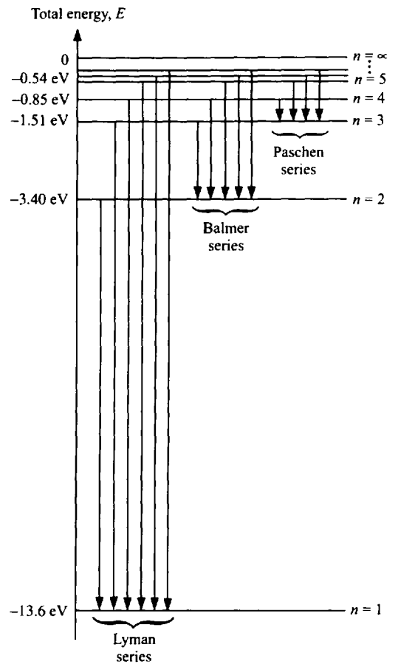
ENERGY LEVEL DIAGRAM We usually picture the allowed states for the atom in an energy level diagram. Here, the energy is zero if the nucleus and the electrons are not bound to each other (Ionized atom). The ground state is the lowest allowed energy (E1) bound state, and it is negative. The atom can make a transition by moving from one allowed level to another.
QUANTIZED ENERGY LEVELS The Bohr theory of the atom thus predicts the existence of quantized energy levels, each associated with a distinct label, n, which is called the quantum number of that level. In those levels the atom cannot radiate away any energy unless, after losing an amount of radiant energy, the atom finds itself in another allowed energy level. Thus, only specific frequencies of radiation (and correspondingly, only specific wavelengths) can be radiated by an atom. Some of these transitions are shown in the diagram below.
BOHR’S THEORY The Bohr theory was successful in giving a rationale for the stability of atoms, and it correctly predicted the wavelengths of radiation from single electron atoms. The theory further showed that the radiation from atoms in general was determined by differences in energy levels of the atoms. However, his theory was unable to be generalized to atoms with more than one electron and was unable to explain why the energy levels of atoms should be quantized in the first place.
QUANTUM THEORY OF ATOM In the quantum theory, the behavior of electrons is determined by the wavefunction solutions of Schrödinger’s equation, which yield the probability that a particle is at a given point in space at a given time. There are stationary solutions of this equation only for certain energies that can be found for bound states. These solutions require labels n, l, and m in three dimensions. It was experimentally determined from the details of the radiation emitted by these atoms, that a fourth label was required as well. These labels are called “quantum numbers” and the accepted notation for these quantum numbers in a one electron atom are n, 1, ml and ms. This fourth quantum number arises from a purely quantum mechanical concept, the intrinsic spin of the electron.
PRINCIPAL QUANTUM NUMBER (n) The quantum number n is called the principal quantum number. It corresponds to the energy quantum number in Bohr’s theory. This number takes on integral values beginning with 1 with no upper bound. It is associated with the distance, r, between the nucleus and the electron; but the concept of a circulating electron in an orbit as prescribed by the Bohr theory, has no validity in quantum mechanics and angular momentum cannot be given a simple visual picture as in the Bohr theory.
ELECTRON SHELLS In the case of multi electron atoms, all electrons with a common principal quantum number n are said to be in the same shell, approximating a single electron atom. All electrons with n = 1 are said to be in the K shell, and all have essentially the same energy. All electrons with the n = 2 are said to be in the L shell, with n = 3 they are in the M shell, with n = 4 in the N shell, etc
SECOND QUANTUM NUMBER (l) The quantum number l is related to one of the angular coordinates. It is called the angular momentum quantum number, since it determines the magnitude of the orbital angular momentum of the electron about the nucleus. In multi electron atoms, the energy levels of an electron are dependent somewhat on 1 as well. For a given n, the allowed values of l are restricted to integers in the range from zero to (n – 1). All electrons with the same quantum number 1 have the same angular momentum.
Any electron with 1 = 0 is called an s electron and has no angular momentum. When 1 = 1, the electron has certain angular momentum and is called a p electron. When 1 = 2, the electron has a different value of angular momentum and is called a d electron. An electron with 1 = 3 is called an f electron, with 1 = 4 is called a g electron, etc.
THIRD QUANTUM NUMBER (ml) The third quantum number ml is related to the second angular coordinate. It indicates the allowed directions for the angular momentum. This is called space quantization. For a given l the values of ml are restricted to integer values ranging from -l to +l. If 1 = 1, there are three possible values for ml: -1, 0, and + 1. This quantum number is often called the magnetic quantum number because the energy of an electron depends on ml in the presence of a magnetic field. The magnetic quantum number has only a very small effect on the energy of the quantum state, except when a magnetic field is existent. It is again important to reiterate that although angular momentum remains an important physical quantity in quantum mechanics, one cannot identify this quantity with the concept of a circulating electron! NOTE: See KHTK explanation below.
FOURTH QUANTUM NUMBER (ms) We need an additional quantum number msto get agreement between the theory and experiment. This additional quantum number does not arise from the motion of an electron in three dimensions, but rather arises from the intrinsic properties of the electron itself. If one assumes that the electron has an intrinsic spin (an internal spin about its own axis) which is quantized, then the atom has additional angular momentum due to the intrinsic spin. This assumption was an ad hoc assumption until quantum mechanics was made to conform to the theory of relativity and the Schrödinger equation was replaced by the Dirac equation. The relativistic equation predicted the correct value for the electron spin. This spin angular momentum is intrinsic to the electron just as its charge and its mass are. These intrinsic values cannot be increased or decreased.
As in the case of the orbital angular momentum, the spin angular momentum is also quantized in space, with its component restricted to two possible states. We assign two possible spins of ±1/2 to quantum number ms. We now must designate each energy level by four quantum numbers, n, 1, ml and ms. Because the electron is charged, the spinning electron produces a magnetic field which in turn impacts slightly on the energy levels of the electrons. With the addition of this spin, the theory agrees with experiment to a remarkable degree.
BOHR RADIUS Bohr radius a0 = 5.29 x 10-l1 m, which is the radius of the lowest level orbit in the Bohr atom.
ELECTRON PROBABILITY CLOUD We see that the electron cannot be located at any specific position in space, but rather there is an “electron probability cloud” in which the electron is concentrated. For n = 1, the maximum probability location for the electron is r = a0, while the average position of the electron is 1.5a0. The total probability of finding the electron at any radial distance is the area under the curve between r = 0 and r = ∞, and must equal 1 since the electron is definitely somewhere in this range.
PAULI EXCLUSION PRINCIPLE This principle states that no more than one electron in an atom can have the same quantum numbers n, 1, ml and ms. We now know that this principle applies to any particle that has a spin of 1/2 (or 3/2, 5/2, etc.). In that case, only one electron can have the quantum numbers for the lowest energy level. The next electron will have to go into the next level, and subsequent electrons into ever higher levels.
BREMSSTRAHLUNG RADIATION X-rays can be produced by taking energetic electrons and letting them strike a metal plate. The energy from a decelerating electron is converted directly to a photon. This is called Bremsstrahlung or braking radiation.
X-RAY LINES X-ray lines are produced when the incident electron loses energy by a “collision” to one of the bound electrons in the material, resulting in the removal of that electron from the atom. If that removed electron is one of the inner electrons, then one of the outer electrons could transfer to this state. By dropping into the inner state, the electron loses energy, and that energy is radiated away by a photon with a wavelength corresponding to the difference in energy between the two states. These wavelengths are often in the X-ray region, especially for materials with many electrons. These characteristic wavelengths then appear in the X-ray spectrum in addition to the continuous spectrum of the Bremsstrahlung radiation.
GROUND STATE The electrons in all the atoms would tend to be found in the “ground state”, in which the electrons fill the various levels from the bottom up, and thus has the lowest overall energy.
EXCITED STATE If the electrons were somehow removed to a higher state, we say that the atom is in an “excited state,” and have a higher overall energy.
SPONTANEOUS EMISSION In spontaneous emission, an excited state electron rapidly transitions downward emitting a photon of a definite frequency f.
STIMULATED EMISSION When the atom can stay in the excited state for a relatively long time, and a photon at that definite frequency f, passes by, it can stimulate the electron to make the transition back to the ground state, by emitting a second photon at frequency f, that is in phase with the first photon. Such a process is called “stimulated emission”. The new photon also travels in the same direction as the initial photon.
LASER When there are many atoms in the excited metastable state then each of the photons can stimulate other emissions which then stimulate even more emissions causing a cascade of photons at the same frequency. This radiation would be especially intense since the radiation from all the independent atoms are in phase with each other. This is the basic concept needed for understanding the operation of the laser.
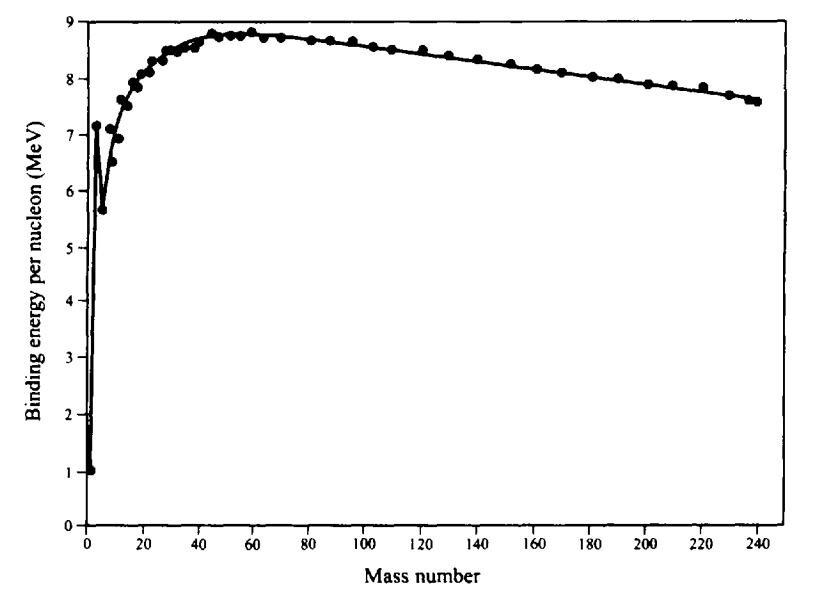
BINDING ENERGY Binding energy is the energy required to remove a nucleon from the nucleus. The energy required to separate all the nucleons from each other is the total binding energy (B.E.) of the nucleus. For a nucleus with A nucleons the average energy needed to remove one nucleon is (B.E.)/A, or the binding energy per nucleon. When one separates all the nucleons, one must supply this amount of energy per nucleon. The total binding energy, B.E., is also the amount of energy released when one forms the nucleus from individual nucleons.
MASS DEFECT The binding energy released when one forms the nucleus from individual nucleons is equivalent to the mass lost. The nucleus will have less mass than the sum of the masses of its constituents. This “lost” mass is called the “mass defect”, and must be equal to the (B.E.)/c2. If we measure the mass of the nucleus, we can calculate the mass defect by comparing this mass to the sum of the masses of its constituents. This will then give us the binding energy of the nucleus.
MAXIMUM BINDING ENERGY We note that a maximum (B.E.)/A of 8.77 MeV/nucleon occurs for Fe57. This nucleus has nucleons which are more tightly bound than in any other nucleus. If the nucleons in other nuclei would be able to rearrange themselves into Fe57, they would each release more energy until their new binding energy increases to 8.77 MeV/nucleon. This can occur if the light elements (A < 57) fuse together to form nuclei with larger A. One can also release energy by converting very heavy nuclei (such as uranium) into lighter nuclei which have a larger (B.E.)/A, thus releasing energy.
RADIOACTIVITY Many nuclei, including those occurring naturally, are unstable, and they decay to another nucleus in a characteristic manner. Radioactivity is the emission of ionizing radiation or particles caused by the spontaneous disintegration of atomic nuclei. Highly radioactive means short half-life, weakly radioactive means long half-life.
HALF-LIFE Each nuclear decay is characterized by a “half-life”, which is the average time that it takes for half of the nuclei to decay. Although one cannot predict which individual atom will have its nucleus decay at any time, only half the original nuclei remain after “half-life.”
DATING One of the applications of naturally occurring radioactivity is in dating of geological or archeological samples. If one assumes that one knows the initial composition of a material in terms of the nuclei present, then, if some of the nuclei are radioactive, we can determine the age of the sample by measuring the composition at the present time.
This technique would allow us to date organic materials on the basis of the following assumptions: (1) The ratio of C12/C14 in the atmosphere has remained essentially stable over geologic time; (2) As an organic substance grows and absorbs carbon, the ratio absorbed is the same as the ratio in the sea of air above; (3) Once the organic material (e.g. a tree) dies there is no more carbon absorbed or emitted chemically, so that the only change in composition comes from the radioactive decay of the carbon 14. We can usually compensate for uncertainties in these assumptions, and in many cases, we can check the accuracy of age determinations by using additional radioactive decays of other isotopes. This has become a standard technique, although it requires careful measurements as well as thorough analysis to be sure that it is legitimately applied in each case.
CONSERVATION LAWS From mechanics, we have the laws of conservation of energy, of linear momentum and of angular momentum. From electricity, we have the law of conservation of charge. All of these conservation laws must be satisfied in any decay that occurs in nature. In addition, we find in the naturally occurring decays that the total number of protons and neutrons (nucleons) must be the same before and after a decay.
NATURAL DECAY PROCESSES There are three naturally occurring decays, which are called α, β and γ. In α -decay the particle emitted from a larger nucleus is the nucleus of a helium atom, in β-decay the particle emitted is an electron and in γ-decay the particle emitted is a photon. A particle will decay by itself only if the decay products have less rest mass than the original particle. The excess mass of the original particle is given as kinetic energy to the decay products.
NEUTRINO Neutrino is a neutral subatomic particle with a mass close to zero and half-integral spin, rarely reacting with normal matter.
POSITRON The positron or antielectron is the particle with an electric charge of +1e, a spin of 1/2, and the same mass as an electron. It is the antiparticle of the electron. When a positron collides with an electron, annihilation occurs.
γ-DECAY Inγ-decay the effect of the emission of a y-ray is merely to carry away energy from the nucleus. We view this in the same manner as for atomic physics where a photon carries away energy as the electrons make transitions between different levels. Similarly, the nucleus has energy levels, and a photon is emitted when the nucleus makes a transition to a lower level.
INDUCED REACTIONS In addition to the naturally occurring nuclear transformations via radioactivity, it is possible to induce nuclear transformations by bombarding the nucleus with another particle or nucleus. For instance, one can strike the nucleus with a proton, or a neutron, or an α -particle, or a γ -ray, etc. The result of such a collision could be a new nucleus plus the emission of a different particle or particles. In all such collisions, called nuclear reactions, the outcomes are restricted by all the conservation laws.
FISSION REACTION If a uranium nucleus would “fission”, i.e. break apart into two smaller nuclei, then each nucleon on average would gain binding energy and this additional binding energy would be released in the form of kinetic energy given to the fission products. To help the uranium nucleus to fission, we can send in additional energy via a photon (photofission) or a neutron. Then the nucleus has enough energy to surmount the barrier and it will immediately break apart. Often, the products of fission include, in addition to massive nuclei, other more elemental particles such as neutrons.
NUCLEAR ENERGY The energy released in a nuclear reaction is huge compared to the energy released in a chemical reaction of two atoms or two molecules, such as the explosion of TNT. In chemical reactions the energy released per molecular interaction is typically a few eV, which is 108 times smaller than the above fission reaction. This is why nuclear energy is much more potent than chemical energy.
CHAIN REACTION We must arrange to have many nuclei fission to produce a large total amount of energy. This is made possible by using the extra neutrons that are released in each fission to initiate a new fission. The process is known as a “chain reaction”. If the chain is not controlled it could produce a large, nearly instantaneous release of energy as in a bomb. If it is controlled, the energy release can be gradual, as in a reactor.
CROSS-SECTION The cross-section is the likelihood of fission occurring in a material. Only U235 (and a new nucleus, produced in reactions, plutonium, Pu239) has a sufficiently large cross-section for use in a reactor.
ENRICHMENT Natural uranium contains mainly U238 (99.3%), with only 0.7% of U235. The cross-section of U238 is too small to use as a practical material. It is very difficult to separate U235 from U238 since both isotopes have the same chemical properties and they differ only slightly in mass. When one has “enriched” the uranium so that it contains about 3% of U235, one can use this mixture as the fuel for a reactor.
BREEDER REACTORS One can build a reactor that produces more fuel (in the form of Pu239) than it consumes (in the form of U235). These reactors are called “breeder” reactors. The plutonium produced in these reactors can be chemically separated from the uranium and used as fuel for a fission reactor.
MODERATOR The fission reaction that is induced by the incoming neutron produces extra neutrons, with a large amount of kinetic energy, which we want to use to induce further fissions in a chain reaction. However, only slow neutrons are efficient in inducing fission, so we first must slow down the neutrons. This is done by a “moderator”, which is a material with which the neutrons collide, and to which they transfer their energy. Energy transfer is most efficient if an energetic object collides with another body of roughly the same mass. The closest material in mass to neutron would be hydrogen (a proton), which is plentiful in water. However, water tends to absorb the neutron and form a deuteron (1H2), which removes the neutron from play instead of slowing it down, thus inhibiting the chain reaction tremendously. Therefore, “heavy” water, already made from deuterium is a much better alternative moderator.
CRITICAL REACTION If the excess neutrons that are produced in a fission induce, on average, less than one new fission, then the reactor is “sub-critical” and will not produce a chain reaction. If more than one fission is induced, on average, then the reaction will increase rapidly in number, possibly leading to an explosion. If the average number of fissions induced by the extra neutrons is just one, the reactor is critical, and a chain reaction will be sustained.
CONTROL RODS The number of induced fissions produced is controlled using “control rods” made of material that absorbs neutrons. These are automatically adjusted to keep the energy production at the intended level. Another control mechanism that prevents a properly constructed reactor from getting out of control is the fact that as the reactor core overheats, the moderator will boil away, and this will automatically reduce the number of slow neutrons and hence the fission reaction.
FUSION REACTIONS The binding energy per nucleon of light nuclei is smaller than that of nuclei with mass numbers near 70, and fusing those light nuclei together increases the average binding energy per nucleon, thus releasing energy. This process is known as fusion, and it is the source of energy of the sun and other stars. In the sun, the process used to generate energy fuses four protons. The conservation of charge requires that electrons be emitted in this process. If one could build a controlled fusion reactor, we would be able to generate energy by combining the very abundant hydrogen and/or deuterium found in water, and create helium, a very useful, yet environmentally harmless inert gas. No radioactive byproducts would be produced.
ELEMENTARY PARTICLES These are the new sub-atomic particles that we have been considering, such as, baryons, leptons and photons.
BARYONS This is the class of particles that contain protons and neutrons.
KHTK NOTE: Baryons represent the very condensed substance in the nuclear region.
LEPTONS This is the class of particles that contain the electron, positron and neutrino.
KHTK NOTE: Leptons represent the much less condensed substance in the electronic region.
ANTI-PARTICLE Positrons were predicted by Dirac after he showed that the correct set of quantum wave equations that are consistent with relativity predicted the existence of an “antiparticle” for each particle. These antiparticles are nearly identical with their particles and have either the same or the opposite properties of their particle. Thus, a positron has the same mass as the electron, but the opposite charge. The properties of particles and antiparticles are always such that they can annihilate each other if they meet, with their entire rest masses being converted into energy (usually γ-rays), without violating any conservation law. Similarly, pairs of particle-antiparticle can be produced directly from the conversion of γ-ray energy into the pair (usually in the presence of some heavy object such as a nucleus) without violating any conservation laws. The γ-ray must, of course, have at least an energy equal to the combined rest mass energy of the created particles.
PHOTON The photon is a particle that turns out to be its own antiparticle. This means that there is no distinction between particle and antiparticle photons, since both have the same charge (zero), rest mass (zero), baryon number (zero), spin (one), etc.
VIRTUAL PHOTONS See ELECTROMAGNETIC INTERACTION. Since these photons are not free to travel away, they are called virtual photons to distinguish them from photons that carry energy through space. Thus, virtual photon can be considered the carrier of the electric and magnetic force between charged particles.
KHTK NOTE: Particles of very near consistencies maybe considered to be exchanging virtual photons because charge represents the gradient of consistency (degree of condensation) of the substance.
ELECTROMAGNETIC INTERACTIONElectromagnetic interaction is the interaction between the electrons and nucleus in an atom. These interactions can be described in terms of the “virtual” exchange of photons. By this we mean that the electromagnetic interaction between charged particles can be considered a consequence of a possible continuous creation of photons by one charge and absorption by the other charge.
ELECTRODYNAMICS The full theory of these interactions with virtual photons is called quantum electrodynamics. The idea that one type of particle is the carrier of the force between other particles can be carried over to other forces as well. The electromagnetic force allows charged particles to exist in both bound states (electrons in an atom) or free states (electrons or protons moving through space).
MUON Muons make up much of the cosmic radiation reaching the earth’s surface. A muon is an unstable subatomic particle that has spin ½, and a negative charge e, but with a mass around 200 times greater. But in other respects, it behaves essentially the same as an electron. It is sometimes called a heavy electron.
KHTK NOTE: The charge of “-1” means that the particle exists at the electron-nucleus interface. It represents the steep change in the consistency of substance.
STRONG INTERACTION Strong interaction is the force that that holds nucleons together in the nucleus. In Strong interactions the decay proceeds very fast and they require the conservation of strangeness quantum number. The strong interaction can be considered as arising from the interchange of particles, called “gluons,” among quarks.
KHTK NOTE: Strong interaction represents the gradient of consistency of substance within the nucleus.
WEAK INTERACTION Weak interaction is the interaction at short distances between subatomic particles called leptons mediated by the weak force. The weak interaction can be considered as arising from the virtual interchange of particles, called “vector bosons.” The weak interaction and the electromagnetic interaction have now been shown to be two aspects of the common “electroweak” interaction.
KHTK NOTE: Weak interaction represents the gradient of consistency of substance within the electron region.
TAU PARTICLE The tau particle is similar to the electron and muon with a rest mass of 3490 times that of electron. The muons and the tau particle are unstable, and decay to electrons of smaller rest mass.
KHTK NOTE: The electron-muon-tau represent the suddenly increasing consistency of substance at the interface between the electronic and nuclear regions.
MESON Meson is a subatomic particle which is intermediate in mass between an electron and a proton and transmits the strong interaction that binds nucleons together in the atomic nucleus. The least massive meson is a pion, which is 270 times heavier than the electron. The next massive meson is the kaon, which is 970 times heavier than the electron.
KHTK NOTE: Mesons glue together the baryons just like photons glue together the Leptons.
HADRON Hadron is a subatomic particle of a type including the baryons and mesons, which can take part in the strong interaction.
QUARKS The mesons and the baryons are viewed as composites of more fundamental particles, called quarks. We know of six different quarks, and all six have been detected indirectly by identifying the properties of mesons containing these quarks. All mesons are composed of one quark and one antiquark, and all baryons are composed of three quarks. The quarks interact by means of the strong interaction.
STRANGENESS It is hard to understand why some particles, like the kaon, should have such a long half-life. After all, the kaon participates in the strong interaction, and can decay into pions that also participate in the strong interaction. There is a similar problem with the decay of a massive baryon called the lambda-particle, which is often created together with the kaon. The solution that was conceived is that these particles (as well as some other new particles) have a new quantum number, called “strangeness”, which must be conserved in an interaction involving nuclear forces (strong interaction). Strangeness is a new property that, like electric charge, baryon number and lepton number, can be both positive and negative. Strangeness is conserved in strong interactions but not in weak interactions. Decay through weak interactions have a relatively longer half-life. Conservation of strangeness introduces a new concept insofar as it is not an absolute conservation law. It is required for the strong interaction (and the electromagnetic interaction), but not for the weak interaction.
GLUONS The particles that are being interchanged among quarks in strong interaction are called “gluons” since they are responsible for “gluing together” the quarks.
“COLOR” CHARGE Each quark has a three valued index called “color” charge. The color charge is a quantity comparable to electric charge in electrodynamics, except that there are two types of electric charges and three types of color charges.
CHROMODYNAMICS The theory of the strong interaction is called “chromodynamics” because the label “color” has been commonly used for this index. Neither quarks nor gluons have ever been seen alone. It is now believed that quarks can only exist in bound states so that one will never see a free quark. This is a consequence of the nature of the strong force provided by the gluons to the quarks.
STANDARD MODEL Much of our present understanding of elementary particles and the world built out of them is explained by a comprehensive theory called the “Standard Model”. Even so, much more needs to be understood, such as the reason the fundamental particles have the rest masses that they do, and whether all the forces of nature can be understood to be different aspects of the same interaction.
KHTK NOTE: The rest masses are a measure of the consistency (degree of condensation) of energy particles. The interactions provide the continuity of substance that is condensing.
SOLID-STATE PHYSICS Solid-state physics studies how the large-scale properties of solid materials result from their atomic-scale properties. Thus, solid-state physics forms a theoretical basis of materials science. Along with solid-state chemistry, it also has direct applications in the technology of transistors and semiconductors.
CRYSTAL The simplest case of solid is the situation when the atoms are arranged in a fixed symmetric pattern which is repeated throughout the solid. Such a system is called a crystal. The results of analyzing this special case can be generalized to more complicated cases of solids with varying degrees of disorder (amorphous solids) and even to liquids. Together all the classes of material are called “condensed matter”.
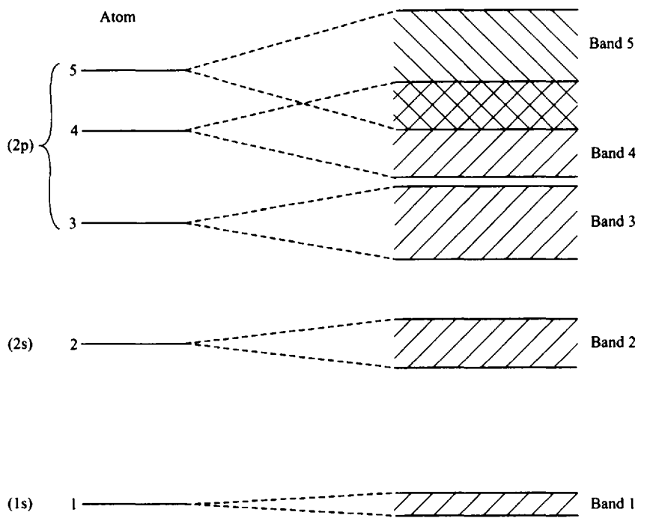
ENERGY “BAND” Two or more atoms that are far apart, have their own identical energy level structure. The electrons can be specified as being in a particular level of a particular atom. As one brings two atoms closer together, the wave functions begin to overlap, and the electron can no longer be considered as confined to only one atom. The result is that the individual levels of each of the two overlapping atoms become two closely spaced shared levels in each of which the electron is shared by the two atoms. As one adds more and more atoms, the electrons are shared by more atoms and the energy levels are best described as energy “bands.” Each band will have twice the number of electrons because of the overlapping of the two individual energy levels. Each energy level of the individual atoms become converted to a band able to accommodate two electrons per atom.
ENERGY GAP AND OVERLAP There is an “energy gap” between some of the bands (see the figure above). This gap is large between bands 1 and 2 and is small between bands 3 and 4. At the energies within these gaps, there cannot be any electrons in the solid.
If there are an even number of electrons per atom, then one expects the highest band to be filled. However, if the bands overlap, as do bands 4 and 5 in the figure above, then the highest band containing electrons may not be filled even for an even number of electrons per atom.
This basic idea permits us to understand why certain solids act as insulators, while others act as conductors, and still others act as “semiconductors”.
ENERGY GAP AND OVERLAP When one imposes a voltage between the ends of a wire, an electric field tries to accelerate the electrons in the material. The electrons that can move because of the imposed voltage are called “free” electrons.
CONDUCTION BAND The energy band in which the “free” electrons move is called the conduction band. This is the case if the highest band containing electrons is not filled. The lower bands are called valence bands.
INSULATOR If the upper valence band is filled, then there are no energy levels available for the highest energy electrons, and they will be unable to accelerate. We will then have an insulator.
SEMICONDUCTOR If one can excite electrons from this filled valence band to the empty next higher band, that band would constitute a conduction band, and these excited electrons can move in an electric field. This type of excitation can occur if the temperature is sufficiently high that the thermal energy of the electrons allows them to jump to the conduction band. Materials such as these, with small energy gaps, are called semiconductors. They can change from insulators to conductors as the temperature increases.
HOLES When an electron excites into the conduction band, we say that there is a positive “hole” created in the valence band and that the positive holes act just like positively charged particles and provide conduction in this band.
N-TYPE SEMICONDUCTOR If one inserts atoms in the base semiconductor material, which have one extra electron, then there will be one more electron per impurity atom than is needed to fill the valence band. These added electrons can partially fill the conduction band and provides conduction appropriate to negative electrons. We call this material an n-type semiconductor.
P-TYPE SEMICONDUCTOR If one inserts atoms in the base semiconductor material, which have one less electron, then there will be one state in the valence band that may be unfilled. This “hole” acts to provide conduction appropriate to a positive charge, and this material is called p-type semiconductor.
PHOTODETECTORS It is also possible to excite electrons in an insulator or semiconductor to the conduction band by absorbing a photon. The incident photon that is absorbed will make it possible for the material to conduct electricity. This process is the basis for constructing photodetectors since the absorption of a photon is signaled by a change in the conductivity of the material.
.
The following definitions are from the philosophy of KHTK:
ATOMIC STRUCTURE An electron cannot be treated as a point particle. The electron has a volume, and, within that volume, the energy substance of electron has the same consistency (degree of condensation) throughout. Multiple electrons come about due to different consistencies. The consistency of the electrons decreases with increasing distance from the nucleus. Therefore, multiple electrons appear as multiple shells around the nucleus of an atom. The quantum numbers simply specify the shells, and a fine structure of sub-shells within those shells.
ELECTRON SHELLS Each energy level of the atom is associated with the consistency of electrons. The four quantum numbers seem to determine the shape of the electron shells within the atom. This shape is almost spherical close to the nucleus, but it flattens out to a disk-like shape away from the nucleus. This makes the shape of the atom look like the shape of a galaxy as it appears from its side.
CHARGE The electron charge seems to be due to the sudden change in energy consistency at the electron-nucleus interface. The “attraction” is due to the CONTINUITY of the substance. Strong attraction corresponds to high gradient of continuity. Light attraction corresponds to light gradient of continuity. The “repulsion” occurs when the gradient of this consistency does not match. The electrons inside an atom are arranged by the gradient of their consistency and so they do not repel each other. Two negatively charged surfaces repel each other because there is a complete mismatch of the gradients of energy levels between them.
NUCLEAR SHELLS Protons and neutrons are bound together in the nucleus because of the continuity of substance. They simply make different layers of the nucleus. These layers get more condensed as they get closer to the center. Protons have charge so they must form the surface of the nucleus to interface with the electrons. Neutrons fill the inside of the nucleus and are more condensed; so, they have slightly greater mass. As the nucleus grows, the number of neutrons get larger more rapidly than the number of protons because they fill the inside of the nucleus.
FUNDAMENTAL PARTICLES There is a seemingly inexhaustible array of oddball particles, and the conservation laws begin to seem arbitrary and capricious. Most of these particles lie in the high gradient of consistency between the electron and proton at the electronic-nuclear interface. Such particles are unstable and decay into other particles. This indicates dynamic migration of substance across this interface.
Chapter 17: PARTICLES OF LIGHT AND WAVES OF MATTER
.
KEY WORD LIST
Localization, Interference, Energy Flow, Quantization, Light, Black Body Radiation, Photo-Electric Effect, Production of X-rays, Compton Scattering, Matter Waves, Probability Distribution, Maxwell’s Wave Equation, Schrödinger’s Equation, Dirac’s Equation, Wave Function, Wave Packet, Uncertainty Principle, Zero Point Energy, Tunnelling.
(From KHTK) Particle, Quantum, Motion.
.
GLOSSARY
For details on the following concepts, please consult Chapter 17.
LOCALIZATION A particle is defined as a “point”. The properties of velocity and acceleration are attributed to the whole particle. There is certainly no possibility of considering any one particle as being simultaneously at many different positions in space. A wave is defined as a disturbance that is spread over a fairly sizable area. A pure sinusoidal wave is spread out from plus to minus infinity. A pulse wave has a definite extent in space at any instance. One generally thinks of a wave as being a disturbance located simultaneously at many points of space. Therefore, the particle and wave picture differ on the question of localization.
INTERFERENCE The interference or diffraction phenomenon is observed with waves but not with particles.
ENERGY FLOW Both waves and particles carry energy and momentum. But there is a big difference in the mechanism of that energy flow. A wave carries this energy in a continuous fashion without discontinuous jumps in energy flow, even if the energy is greatly decreased. However, in case of particles, the energy comes in discontinuous pulses, with each pulse bringing a discrete amount of energy. The flow of energy is not uniform or continuous. This difference leads to the idea of quantization.
QUANTIZATION In case of light, a continuously flowing wave seems to transport quantized units of energy.
LIGHT Although the experiments on interference show that light behaves as a wave, the photo-electric effect provides the most convincing evidence that light must be considered to consist of particles. This apparent anomaly between wave and particle nature is resolved in the definitions from KHTK provided below.
BLACK BODY RADIATION This radiation is emitted over a continuous spectrum of frequencies. It increases rapidly at lower frequencies reaching a maximum and then starts to decline. Maxwell equations explain the distribution only at lower frequencies when it is increasing rapidly. They are unable to explain the rest of the distribution. But the whole distribution can be explained when energy is seen to be radiating in quanta that are proportional to frequency.
PHOTO-ELECTRIC EFFECT In the photo-electric effect, a beam of light is shone on a metal, with the result that electrons are emitted from the metal. However, the maximum kinetic energy of the electrons emitted is found to depend on the frequency of the incident light and not on its intensity. This means that light energy has to be absorbed in quanta in the interaction that frees the electrons.
PRODUCTION OF X-RAYS X-rays can be produced by taking energetic electrons and letting them strike a metal plate. When these electrons stop in the metal, they emit electromagnetic radiation over a large range of wavelengths. The surprising experimental fact is that there is a minimum wavelength that can be emitted for each V (energy of the electrons). This minimum wavelength varies inversely with V but is not affected by the electron current density. These results cannot be explained by a wave theory of light.
COMPTON SCATTERING The X-ray beam, after it is scattered by electrons, suffers a definite reduction in frequency. Compton showed that energy of the photon, as given by its frequency, is reduced by the same amount that the kinetic energy of the recoil electron is increased. Thus, the photon is a momentum carrying corpuscle that can transfer its momentum in a given direction to the atom. The Compton effect also implies that the electron must be treated as a wave and not as a particle.
MATTER WAVES To conform with the case of electromagnetic waves, De Broglie hypothesized that the frequency and wavelength for electrons should be determined by the same basic relations used for photons. If De Broglie’s hypothesis is true, then the electrons represented by these waves should exhibit interference and diffraction appropriate to the wavelengths associated with the electron. When experiments were performed using crystals as diffraction gratings, this diffraction was indeed seen. Similar predictions for the wavelengths of more massive particles, such as protons and neutrons, have also been experimentally verified. Thus, at small scales, there is dualism in nature between waves and particles. The velocity of the particles is equal to the group velocity of its associated wave. Planck showed that energy is connected to frequency, E = hf. De Broglie then showed that momentum is connected to wavelength, p = h/λ. This is a fundamental relation of the Quantum Theory.
PROBABILITY DISTRIBUTION The interference of waves in the double slit experiment creates a distribution of the intensity of light. Quantum mechanics interprets this as a probability distribution of “point” particles called photons. This concept, that the only thing that we can predict is the probability of a photon’s location, is a basic concept of quantum mechanics.
MAXWELL’S WAVE EQUATION Thus in the case of a photon, Maxwell’s wave equation gives the probability amplitude for finding a photon. This equation has to be solved to predict the behavior of the photon.
SCHRÖDINGER’S EQUATION This is a similar equation that provides the probability amplitude for finding a non-relativistic electron.
DIRAC’S EQUATION This equation provides the probability amplitude for finding a relativistic electron.
WAVE FUNCTION The central idea is that there is some wave equation which has to be solved to predict the behavior of a particle. When this equation is solved for a particular case, the resulting wave (called a wave function) gives an amplitude which, when squared, is proportional to the probability distribution of the particles.
WAVE PACKET Pulses of waves can be obtained by superposing a large number of regular traveling waves of different wavelengths. Such a pulse is called a “wave packet.” Such a packet traveling through space indeed resembles a localized particle.
UNCERTAINTY PRINCIPLE The uncertainty principle states that if one wants to describe a particle (at a given time) as being localized in a region ∆x (i.e. have a spatial uncertainty ∆x), then that particle must have an uncertainty in its x direction momentum, ∆p, which is at least as large as h/∆x. Similarly, if one wants the x direction momentum to be known to within ∆p, then there must be an uncertainty in the position of the particle which is at least as large as ∆x = h/∆p. Of course, if p is uncertain, so is v and the kinetic energy.
ZERO POINT ENERGY This means that particles of matter, even if the temperature is at absolute zero where there is no thermal energy, must still have an average kinetic energy related to this range of momenta. This kinetic energy at a temperature of absolute zero, is called the “zero-point energy”, and there is no way to avoid having this minimum amount of energy.
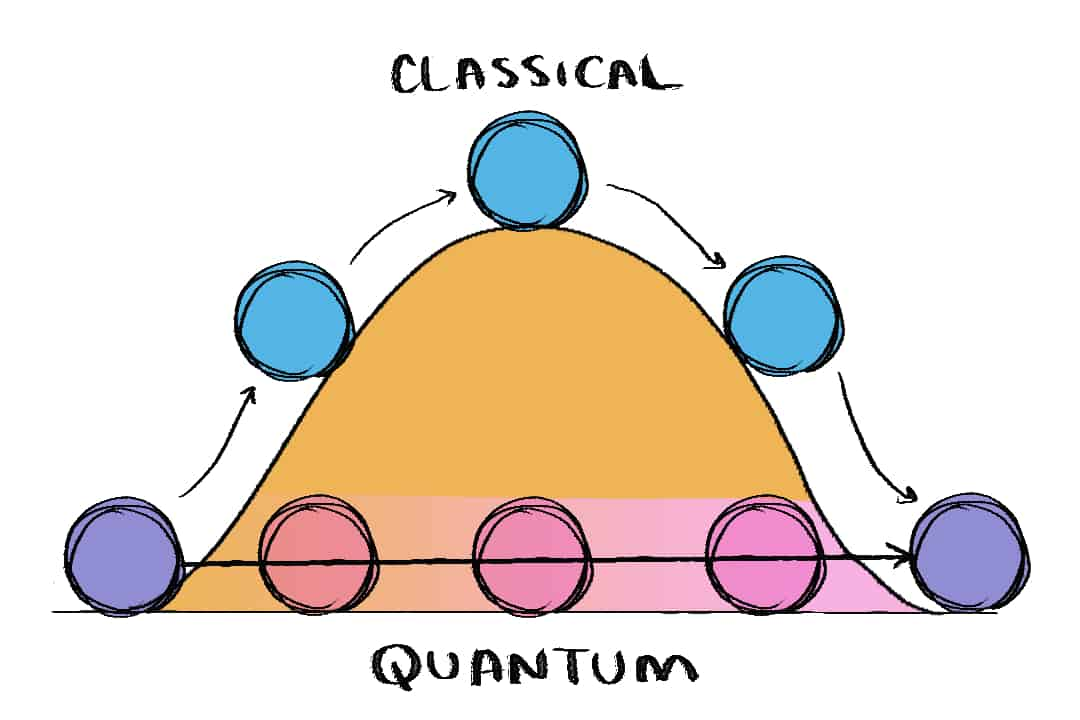
TUNNELLING Energy uncertainty of a particle allows it to surmount the barrier from the inside to the outside of the well for the short time needed to travel and escape from the well. This process is called tunneling, since the particle appears to have dug a hole through the wall of the well and emerged on the outside. This process actually occurs in the radioactive decay of nuclei.
.
The following definitions are from the philosophy of KHTK:
PARTICLE A particle is not a “point,” but it has a volume that is filled with substance. The substance within a particle has uniform consistency throughout. The more condensed is the substance, the smaller is the size of the particle. This predicts the relative sizes of a proton and an electron in a hydrogen atom. The size of the electron is equivalent to the size of the hydrogen atom. On the other hand, the size of the proton is roughly 2000 times smaller because its substance is that much condensed. This provides a proper visualization of the hydrogen atom, where an extremely small proton exists at the center of the only electron there is. A very condensed particle, like proton, may appear to be spherical in shape; but as the consistency of substance decreases, as in the electron, the particle is likely to expand in size and flatten into the shape of a disk.
QUANTUM This quantum is the amount of energy involved in the process of radiating and getting absorbed. It does not necessarily mean that this energy exists in space in a pulse form. In space it may simply appear as a certain consistency (a degree of condensation) of energy.
MOTION When the difference in condensations is very large, the condensed substance may appear as a particle next to the uncondensed substance. But if the difference in condensation is comparable, the two substances may appear as waves when set next to each other. Therefore, ‘wave’ and ‘particle’ is a matter of looking at substance at different scale of condensation. If you greatly magnify a particle, you may see waves inside it as a disturbance. The wave inside a particle may have a ‘motion’ commensurate with the condensation of its substance. This may appear to give the particle its relative speed compared to another particle.
We find that a slight change in the condensation of substance creates a huge change in the relative speed of its particle. This may be the leverage that thought has over physical movement. All animation in the body is most likely produced by infinitesimal shifts in condensations of substance. This principle may also underlie in controlling the speed and direction of the UFOs. The change in condensation must apply equally to the occupants of the UFO for intense accelerations not to be felt by them.
Relativity, Observer, Ether, Ether vs. Field, Michelson’s Experiment, Einstein’s Postulates, Simultaneity, Time Dilation, Length Contraction, Lorentz Transformation, Mass, Relativistic Mass, Energy, Total Energy,Spacetime, Spacetime Framework, Size of a Light Particle,
.
GLOSSARY
For details on the following concepts, please consult Chapter 16.
RELATIVITY The velocity of a planet made of rock (v) is so small compared to the velocity of ephemeral light (c) that c appears not to vary at all even when compared with the largest variations in v. This fact underlies the theory of relativity. The final clarification by Einstein was that light is a physical wave and not a wave in some physical medium other than light. That was a great confusion that had dominated physics for over a century.
OBSERVER The “observer” of Einstein may best be compared to a viewpoint that stands beyond the whole scale of motion. That is a scientific notion that lies at the interface of physics and metaphysics. Please see The Static Viewpoint.
ETHER If there is anything like “ether” as the “medium of light,” then it would be a medium that underlies all physical substance and not just light. In other words, ether does not represent a definite inertial reference frame that lies somewhere on the scale of motion. In fact, ether represents the whole scale of motion. The ether has been incorporated in the concept of “observer” in Einstein’s theory of relativity. It is free to attach itself to any particle—either matter or light.
ETHER VS. FIELD These two concepts are very different. Ether was postulated as the medium in which a wave of light was formed according to the wave theory. On the other hand, Field is conceived as the energy substance of light itself according to the quantum theory.
MICHELSON’S EXPERIMENT Michelson and Morley tried to find changes in the velocity of light traveling along perpendicular paths at different times of the year and found no differences. They concluded that the velocity of light was always c for an observer on earth, no matter in which direction the observer was moving, or, in other words, all observers measure the same speed of light, c.
EINSTEIN’S POSTULATES Einstein made two postulates: first, that the laws of nature were identical for all inertial observers, as with Newton’s laws of mechanics; second, that there was no special medium, or “ether”, and that light waves traveled with the same speed in any direction in empty space as measured by all inertial observers. These included observers moving relative to each other while measuring the same light wave!
Here the observers are attached to Earth. So, we are measuring the speed of light relative to the speed of Earth. There is no way of knowing the speed of Earth in space. All we have is the speed of Earth relative to the Sun, which is something very different. It appears that the speed of “Earth in space” is infinitesimal compared to the speed of “light in space.” That is why Einstein’s postulates work.
SIMULTANEITY Einstein argued that if all inertial observers measure the same light beam as traveling with velocity c, irrespective of their motion relative to each other, the simultaneity assumption does not prove out to be true. But this is only true because the speed of light is finite. An unattached observer, who is looking at the whole scale of motion simultaneously, will be able to see the differences in speeds, and explain simultaneity accordingly depending on distances. In other words, our perception is affected by the finite speed of light, but not intuition.
TIME DILATION in Einstein’s theory, moving clocks run at a slower rate than stationary clocks, even if the clocks are identical. The time interval between successive “ticks” on the clock (its period) will be longer when observed by an observer, A, that sees the clock moving, than by an observer, B, at rest with respect to the clock. Thus, observer A will say that the moving clock runs slow compared with an identical clock that is not moving. In this case, V is much smaller than c.
Since c = wavelength/period, as wavelength increases the period shall increase too. This is time dilation. Therefore, increased speed is equivalent to increased wavelength of “energy substance in space.” When that substance is mass, we may say that increased speed “softens” the mass. This is like proton mass softening into electron mass in an atom.
Here the increased speed is not an increase in “relative speed.” It is an increase of speed “in space.” In other words, when we are looking at wavelengths, we are looking from the framework of spacetime, and not in some inertial frame.
The confusion comes from considering the time dilation in an inertial framework. No such confusion arises when one thinks in the spacetime framework.
LENGTH CONTRACTION In Einstein’s theory length contracts in the direction of motion. Therefore, two observers approaching each other will each see lengths contract in the other’s framework. This is confusing because here one is dealing with relative velocities. Actual length contraction will depend on velocity in the spacetime framework and not due to relative speeds in the inertial framework.
In the spacetime framework length contraction appears as the condensation of energy substance, meaning the reduction in the wavelength. This condensation is accompanied by reduction in velocity in the spacetime framework.
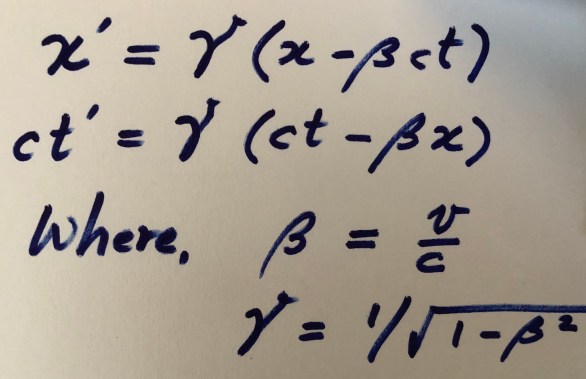
LORENTZ TRANSFORMATION The equations that relate space-time points in one inertial system to the other are called transformation equations. For Newtonian physics those transformation equations are called Galilean, while for Einstein’s relativity theory they must be different and are called Lorentz transformations. The Lorentz transformation equations are:
The inertial systems are limited to material domain only, which forms an extremely small window on the whole electromagnetic spectrum at the extreme upper end of it. In this window the velocity is an extremely small fraction of the speed of light. In other words, the Lorentz Transformations apply only when v << c, and not otherwise.
MASS Non-relativistic mass, or the “rest mass” is inherent to the particle. This mass “softens up” (its wavelength increases) as the velocity of the particle increases in the Spacetime Framework. The rest mass of an electron is not as hard as the rest mass of a proton. It is “softened mass.”
RELATIVISTIC MASS The “relativistic mass” is a representation of total energy of a particle. It includes the large kinetic energy of the particle. It also includes the potential, nuclear energy, etc., but they are relatively small. In measuring the very large kinetic energy, confusion arises when velocity measured in the inertial framework is more than the velocity of light. The actual velocities of particles are never greater than the velocity of light when measured in the spacetime framework. The relativistic mass (m) is related to actual mass (m0) as follows: m = γm0.
ENERGY Energy has two different definitions: (a) Energy as motion of mass = kinetic energy (b) Energy as “softened mass” = the EM spectrum
TOTAL ENERGY The total energy of a particle is essentially given by its relativistic mass. This is known as Einstein’s famous equation for the equivalence of mass and energy, E = mc2. All energy, including kinetic energy, is equivalent to mass. Therefore, whenever the energy of a particle is increased, its mass increases.
SPACETIME Einstein gives us a mathematical definition of spacetime. However, we may form a tangible definition of spacetime as follows: Spacetime is not nothing. Space implies extents and time implies duration. Therefore, spacetime implies “something” with extents and duration. We call that “something” to be the fundamental substance that produces the whole electromagnetic spectrum as it condenses. At the upper end of this spectrum, we have matter.
SPACETIME FRAMEWORK Spacetime framework views the whole scale of motion from a detached viewpoint, whereas the inertial framework looks at motion from the upper end of the electromagnetic spectrum, which represents the viewpoint of matter.
SIZE OF A LIGHT PARTICLE The size of a light particle is roughly given by its wavelength. The size of a material particle may be measured by its de Broglie wavelength. The size of a light particle is very, very large compared to the size of a material particle. A light particle is at least c times bigger than the material particle.