.
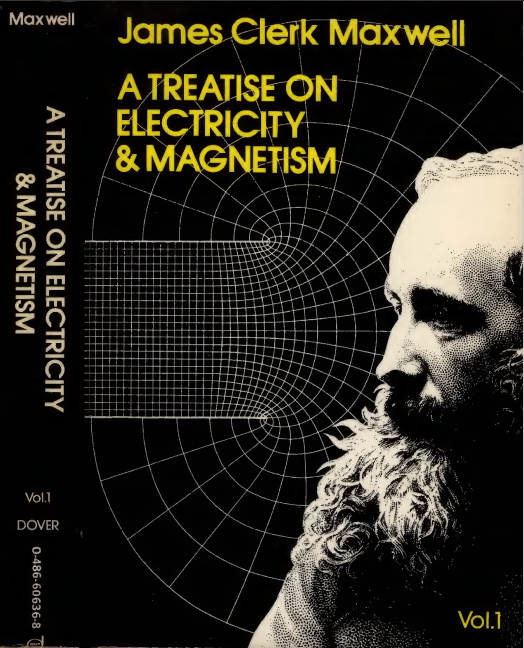
This is the preface from Maxwell’s book A Treatise on Electricity & Magnetism – Volume 1. It highlights Maxwell’s view of Faraday’s work.
Here is my summary of these views:
It is true that any mathematical work must have its basis in actual experimental data. I am glad that Maxwell decided to consult Faraday’s work first. Faraday’s way of conceiving phenomena was very different from other mathematicians. The main difference was in their basic postulates.
Maxwell observes that Faraday considered space to be a dimension of force, whereas the mathematicians took space for granted as something standalone. Thus, Faraday saw force as the medium, which the mathematicians didn’t. Faraday sought the seat of the phenomena in real actions going on in the medium; whereas, the mathematicians were satisfied with the idea of action at a distance.
Faraday’s approach was analytical as it was based on experiments; whereas, the approach of mathematicians was a synthesis that started out with certain assumptions. Faraday’s ideas clarified observed phenomena much better than “most fertile methods of research discovered by the mathematicians.”
According to Maxwell, the whole theory of potential as a quantity was more compatible with the ideas of Faraday and with the mathematical discoveries of Laplace, Poisson, Green and Gauss, than with the various speculations of “mathematicians”.
Maxwell decided to take the Faraday’s approach to develop a theory of electromagnetism, hoping that someone else might take up the “action at a distance” approach.
.
The contents of this preface follow. My comments follow the quoted paragraphs in bold italics.
The fact that certain bodies, after being rubbed, appear to attract other bodies, was known to the ancients. In modern times, a great variety of other phenomena have been observed, and have been found to be related to these phenomena of attraction. They have been classed under the name of Electric phenomena, amber, having been the substance in which they were first described.
Other bodies, particularly the loadstone, and pieces of iron and steel which have been subjected to certain processes, have also been long known to exhibit phenomena of action at a distance. These phenomena, with others related to them, were found to differ from the electric phenomena, and have been classed under the name of Magnetic phenomena, the loadstone, being found in the Thessalian Magnesia.
The electromagnetic attraction seems to come about because of the separation of the two sides of the particle-void interface. There is more nuclei and less motion on one side and more void and motion on the other. Void does contain substance but it is not concentrated like mass in the nucleus. Thus, there is contact with continuity of substance that passes action across a distance.
These two classes of phenomena have since been found to be related to each other, and the relations between the various phenomena of both classes, so far as they are known, constitute the science of Electromagnetism.
Electricity and magnetism are two aspects of the same phenomenon to be studied here.
In the following Treatise I propose to describe the most important of these phenomena, to shew how they may be subjected to measurement, and to trace the mathematical connexions of the quantities measured. Having thus obtained the data for a mathematical theory of electromagnetism, and having shewn how this theory may be applied to the calculation of phenomena, I shall endeavour to place in as clear a light as I can the relations between the mathematical form of this theory and that of the fundamental science of Dynamics, in order that we may be in some degree prepared to determine the kind of dynamical phenomena among which we are to look for illustrations or explanations of the electromagnetic phenomena.
Maxwell intends to keep his mathematical analysis of the electromagnetic phenomenon consistent with Newtonian mechanics, such that all effects are measurable in a consistent fashion.
In describing the phenomena, I shall select those which most clearly illustrate the fundamental ideas of the theory, omitting others, or reserving them till the reader is more advanced.
The most important aspect of any phenomenon from a mathematical point of view is that of a measurable quantity. I shall therefore consider electrical phenomena chiefly with a view to their measurement, describing the methods of measurement, and defining the standards on which they depend.
In the application of mathematics to the calculation of electrical quantities, I shall endeavour in the first place to deduce the most general conclusions from the data at our disposal, and in the next place to apply the results to the simplest cases that can be chosen. I shall avoid, as much as I can, those questions which, though they have elicited the skill of mathematicians, have not enlarged our knowledge of science.
In working out his theory, Maxwell decides to focus on electrical phenomena chiefly with a view to their measurement, describing the methods of measurement, and defining the standards on which they depend.
The internal relations of the different branches of the science which we have to study are more numerous and complex than those of any other science hitherto developed. Its external relations, on the one hand to dynamics, and on the other to heat, light, chemical action, and the constitution of bodies, seem to indicate the special importance of electrical science as an aid to the interpretation of nature.
It appears to me, therefore, that the study of electromagnetism in all its extent has now become of the first importance as a means of promoting the progress of science.
The mathematical laws of the different classes of phenomena have been to a great extent satisfactorily made out.
The connexions between the different classes of phenomena have also been investigated, and the probability of the rigorous exactness of the experimental laws have been greatly strengthened by a more extended knowledge of their relations to each other.
Finally, some progress has been made in the reduction of electromagnetism to a dynamical science, by shewing that no electromagnetic phenomenon is contradictory to the supposition that it depends on purely dynamical action.
Maxwell is looking at the resolution of electromagnetic phenomena according to Newtonian dynamics to be central to the progress of science.
What has been hitherto done, however, has by no means exhausted the field of electrical research. It has rather opened up that field, by pointing out subjects of enquiry, and furnishing us with means of investigation.
It is hardly necessary to enlarge upon the beneficial results of magnetic research on navigation, and the importance of a knowledge of the true direction of the compass, and of the effect of the iron in a ship. But the labours of those who have endeavoured to render navigation more secure by means of magnetic observations have at the same time greatly advanced the progress of pure science.
Gauss, as a member of the German Magnetic Union, brought his powerful intellect to bear on the theory of magnetism, and on the methods of observing it, and he not only added greatly to our knowledge of the theory of attractions, but reconstructed the whole of magnetic science as regards the instruments used, the methods of observation, and the calculation of the results, so that his memoirs on Terrestrial Magnetism may be taken as models of physical research by all those who are engaged in the measurement of any of the forces in nature.
The important applications of electromagnetism to telegraphy have also reacted on pure science by giving a commercial value to accurate electrical measurements, and by affording to electricians the use of apparatus on a scale which greatly transcends that of any ordinary laboratory. The consequences of this demand for electrical knowledge, and of these experimental opportunities for acquiring it, have been already very great, both in stimulating the energies of advanced electricians, and in diffusing among practical men a degree of accurate knowledge which is likely to conduce to the general scientific progress of the whole engineering profession.
Maxwell is acknowledging the work done in the field of electromagnetism so far.
There are several treatises in which electrical and magnetic phenomena are described in a popular way. These, however, are not what is wanted by those who have been brought face to face with quantities to be measured, and whose minds do not rest satisfied with lecture-room experiments.
There is also a considerable mass of mathematical memoirs which are of great importance in electrical science, but they lie concealed in the bulky Transactions of learned societies; they do not form a connected system; they are of very unequal merit, and they are for the most part beyond the comprehension of any but professed mathematicians.
I have therefore thought that a treatise would be useful which should have for its principal object to take up the whole subject in a methodical manner, and which should also indicate how each part of the subject is brought within the reach of methods of verification by actual measurement.
Maxwell feels that there is a need for a treatise that examines the subject of electromagnetism quantitatively in a methodical manner.
The general complexion of the treatise differs considerably from that of several excellent electrical works, published, most of them, in Germany, and it may appear that scant justice is done to the speculations of several eminent electricians and mathematicians. One reason of this is that before I began the study of electricity I resolved to read no mathematics on the subject till I had first read through Faraday’s Experimental Researches in Electricity. I was aware that there was supposed to be a difference between Faraday’s way of conceiving phenomena and that of the mathematicians, so that neither he nor they were satisfied with each other’s language. I had also the conviction that this discrepancy did not arise from either party being wrong. I was first convinced of this by Sir William Thomson *, to whose advice and assistance, as well as to his published papers, I owe most of what I have learned on the subject.
* I take this opportunity of acknowledging my obligations to Sir W. Thomson and to Professor Tait for many valuable suggestions made during the printing of this work.
Maxwell decides to base his mathematical research on Faraday’s experimental work, because it is quite different from the theoretical approach of other mathematicians as regards their basic postulates.
As I proceeded with the study of Faraday, I perceived that his method of conceiving the phenomena was also a mathematical one, though not exhibited in the conventional form of mathematical symbols. I also found that these methods were capable of being expressed in the ordinary mathematical forms, and thus compared with those of the professed mathematicians.
For instance, Faraday, in his mind’s eye, saw lines of force traversing all space where the mathematicians saw centres of force attracting at a distance: Faraday saw a medium where they saw nothing but distance: Faraday sought the seat of the phenomena in real actions going on in the medium, they were satisfied that they had found it in a power of action at a distance impressed on the electric fluids.
Maxwell found that Faraday’s work could easily be treated mathematically. It was more practical and corresponded to reality closely.
When I had translated what I considered to be Faraday’s ideas into a mathematical form, I found that in general the results of the two methods coincided, so that the same phenomena were accounted for, and the same laws of action deduced by both methods, but that Faraday’s methods resembled those in which we begin with the whole and arrive at the parts by analysis, while the ordinary mathematical methods were founded on the principle of beginning with the parts and building up the whole by synthesis.
Faraday’s approach was analytical as it was based on experiments; whereas, the approach of mathematicians was a synthesis that started out with certain assumptions.
I also found that several of the most fertile methods of research discovered by the mathematicians could be expressed much better in terms of ideas derived from Faraday than in their original form.
Faraday’s ideas clarified observed phenomena much better.
The whole theory, for instance, of the potential, considered as a quantity which satisfies a certain partial differential equation, belongs essentially to the method which I have called that of Faraday. According to the other method, the potential, if it is to be considered at all, must be regarded as the result of a summation of the electrified particles divided each by its distance from a given point. Hence many of the mathematical discoveries of Laplace, Poisson, Green and Gauss find their proper place in this treatise, and their appropriate expressions in terms of conceptions mainly derived from Faraday.
Faraday’s ideas are very compatible with the mathematical discoveries of Laplace, Poisson, Green and Gauss, and with the theory of potential that satisfies a certain partial differential equation.
Great progress has been made in electrical science, chiefly in Germany, by cultivators of the theory of action at a distance. The valuable electrical measurements of W. Weber are interpreted by him according to this theory, and the electromagnetic speculation which was originated by Gauss, and carried on by Weber, Eiemann, J. and C. Neumann, Lorenz, &c., is founded on the theory of action at a distance, but depending either directly on the relative velocity of the particles, or on the gradual propagation of something, whether potential or force, from the one particle to the other. The great success which these eminent men have attained in the application of mathematics to electrical phenomena, gives, as is natural, additional weight to their theoretical speculations, so that those who, as students of electricity, turn to them as the greatest authorities in mathematical electricity, would probably imbibe, along with their mathematical methods, their physical hypotheses.
Maxwell acknowledges that mathematics based on the action at a distance approach has been quite successful, but it doesn’t resolve the question of how force propagates through the void.
These physical hypotheses, however, are entirely alien from the way of looking at things which I adopt, and one object which I have in view is that some of those who wish to study electricity may, by reading this treatise, come to see that there is another way of treating the subject, which is no less fitted to explain the phenomena, and which, though in some parts it may appear less definite, corresponds, as I think, more faithfully with our actual knowledge, both in what it affirms and in what it leaves undecided.
Maxwell, however, believes that there is another way of looking at the phenomena that corresponds more faithfully with our actual knowledge.
In a philosophical point of view, moreover, it is exceedingly important that two methods should be compared, both of which have succeeded in explaining the principal electromagnetic phenomena, and both of which have attempted to explain the propagation of light as an electromagnetic phenomenon and have actually calculated its velocity, while at the same time the fundamental conceptions of what actually takes place, as well as most of the secondary conceptions of the quantities concerned, are radically different.
Both approaches have succeeded in explaining the principal electromagnetic phenomena but their fundamental conceptions of what actually takes place are radically different.
I have therefore taken the part of an advocate rather than that of a judge, and have rather exemplified one method than attempted to give an impartial description of both. I have no doubt that the method which I have called the German one will also find its supporters, and will be expounded with a skill worthy of its ingenuity.
I have not attempted an exhaustive account of electrical phenomena, experiments, and apparatus. The student who desires to read all that is known on these subjects will find great assistance from the Traite d’ Electricite of Professor A. de la Rive, and from several German treatises, such as Wiedemann’s Galvanismus, Riess’ Reibungselektricitat, Beer’s Einleitung in die Elektrostatik, &c.
Maxwell decides to take the Faraday’s approach to develop a theory of electromagnetism, and focuses primarily on the theoretical aspects of the phenomena.
I have confined myself almost entirely to the mathematical treatment of the subject, but I would recommend the student, after he has learned, experimentally if possible, what are the phenomena to be observed, to read carefully Faraday’s Experimental Researches in Electricity. He will there find a strictly contemporary historical account of some of the greatest electrical discoveries and investigations, carried on in an order and succession which could hardly have been improved if the results had been known from the first, and expressed in the language of a man who devoted much of his attention to the methods of accurately describing scientific operations and their results*.
* Life and Letters of Faraday, vol. i. p. 395.
Maxwell is very approving of Faraday’s long and arduous experimental research for its accuracy and attention to detail.
It is of great advantage to the student of any subject to read the original memoirs on that subject, for science is always most completely assimilated when it is in the nascent state, and in the case of Faraday’s Researches this is comparatively easy, as they are published in a separate form, and may be read consecutively. If by anything I have here written I may assist any student in understanding Faraday’s modes of thought and expression, I shall regard it as the accomplishment of one of my principal aims–to communicate to others the same delight which I have found myself in reading Faraday’s Researches.
Maxwell heartily recommends the study of Faraday’s research work.
The description of the phenomena, and the elementary parts of the theory of each subject, will be found in the earlier chapters of each of the four Parts into which this treatise is divided. The student will find in these chapters enough to give him an elementary acquaintance with the whole science.
The remaining chapters of each Part are occupied with the higher parts of the theory, the processes of numerical calculation, and the instruments and methods of experimental research.
The relations between electromagnetic phenomena and those of radiation, the theory of molecular electric currents, and the results of speculation on the nature of action at a distance, are treated of in the last four chapters of the second volume.
James Clerk Maxwell
Feb. 1, 1873.
.