Category Archives: Physics Book

The Physics Book.

Eddington 1927: The Velocity of Light

abstract-speed-of-light

Reference: The Book of Physics

Note: The original text is provided below.
Previous / Next

.

Summary

.

Comments

.

Original Text

A feature of the relativity theory which seems to have aroused special interest among philosophers is the absoluteness of the velocity of light. In general velocity is relative. If I speak of a velocity of 40 kilometres a second, I must add “relative to the earth”, “relative to Arcturus”, or whatever reference body I have in mind. No one will understand anything from my statement unless this is added or implied. But it is a curious fact that if I speak of a velocity of 299,796 kilometres a second it is unnecessary to add the explanatory phrase. Relative to what? Relative to any and every star or particle of matter in the universe.

It is no use trying to overtake a flash of light; however fast you go it is always travelling away from you at 186,000 miles a second. Now from one point of view this is a rather unworthy deception that Nature has practiced upon us. Let us take our favourite observer who travels at 161,000 miles a second and send him in pursuit of the flash of light. It is going 25,000 miles a second faster than he is; but that is not what he will report. Owing to the contraction of his standard scale his miles are only half-miles; owing to the slowing down of his clocks his seconds are double-seconds. His measurements would therefore make the speed 100,000 miles a second (really half-miles per double-second). He makes a further mistake in synchronizing the clocks with which he records the velocity. (You will remember that he uses a different Now line from ours.). This brings the speed up to 186,000 miles a second. From his own point of view the traveler is lagging hopelessly behind the light; he does not realise what a close race he is making of it, because his measuring appliances have been upset. You will note that the evasiveness of the light-flash is not in the least analogous to the evasiveness of the rainbow.

But although this explanation may help to reconcile us to what at first seems a blank impossibility, it is not really the most penetrating. You will remember that a Seen-Now line, or track of a flash of light, represents the grain of the world-structure. Thus the peculiarity of a velocity of 299,796 kilometres a second is that it coincides with the grain of the world. The four-dimensional worms representing material bodies must necessarily run across the grain into the future cone, and we have to introduce some kind of reference frame to describe their course. But the flash of light is exactly along the grain, and there is no need of any artificial system of partitions to describe this fact.

The number 299,796 (kilometres per second) is, so to speak, a code-number for the grain of the wood. Other code-numbers correspond to the various wormholes which may casually cross the grain. We have different codes corresponding to different frames of space and time; the code-number of the grain of the wood is the only one which is the same in all codes. This is no accident; but I do not know that any deep inference is to be drawn from it, other than that our measure-codes have been planned rationally so as to turn on the essential and not on the casual features of world-structure.

The speed of 299,796 kilometres per second which occupies a unique position in every measure-system is commonly referred to as the speed of light. But it is much more than that; it is the speed at which the mass of matter becomes infinite, lengths contract to zero, clocks stand still. Therefore it crops up in all kinds of problems whether light is concerned or not.

The scientist’s interest in the absoluteness of this velocity is very great; the philosopher’s interest has been, I think, largely a mistaken interest. In asserting its absoluteness scientists mean that they have assigned the same number to it in every measure-system; but that is a private arrangement of their own—an unwitting compliment to its universal importance. (In the general relativity theory, chapter VI, measure-systems are employed in which the velocity of light is no longer assigned the same constant value, but it continues to correspond to the grain of absolute world-structure.) Turning from the measure-numbers to the thing described by them, the “grain” is certainly an absolute feature of the wood, but so also are the “worm-holes” (material particles). The difference is that the grain is essential and universal, the worm-holes casual. Science and philosophy have often been at cross-purposes in discussing the Absolute—a misunderstanding which is I am afraid chiefly the fault of the scientists. In science we are chiefly concerned with the absoluteness or relativity of the descriptive terms we employ; but when the term absolute is used with reference to that which is being described it has generally the loose meaning of “universal” as opposed to “casual”.

Another point on which there has sometimes been a misunderstanding is the existence of a superior limit to velocity. It is not permissible to say that no velocity can exceed 299,796 kilometres per second. For example, imagine a search-light capable of sending an accurately parallel beam as far as Neptune. If the search-light is made to revolve once a minute, Neptune’s end of the beam will move round a circle with velocity far greater than the above limit. This is an example of our habit of creating velocities by a mental association of states which are not themselves in direct causal connection. The assertion made by the relativity theory is more restricted, viz.—

Neither matter, nor energy, nor anything capable of being used as a signal can travel faster than 299,796 kilometres per second, provided that the velocity is referred to one of the frames of space and time considered in this chapter. (Some proviso of this kind is clearly necessary. We often employ for special purposes a frame of reference rotating with the earth; in this frame the stars describe circles once a day, and are therefore ascribed enormous velocities.)

The velocity of light in matter can under certain circumstances (in the phenomenon of anomalous dispersion) exceed this value. But the higher velocity is only attained after the light has been passing through the matter for some moments so as to set the molecules in sympathetic vibration. An unheralded light-flash travels more slowly. The speed, exceeding 299,796 kilometres a second, is, so to speak, achieved by prearrangement, and has no application in signaling.

We are bound to insist on this limitation of the speed of signaling. It has the effect that it is only possible to signal into the Absolute Future. The consequences of being able to transmit messages concerning events Here-Now into the neutral wedge are too bizarre to contemplate. Either the part of the neutral wedge that can be reached by the signals must be restricted in a way which violates the principle of relativity; or it will be possible to arrange for a confederate to receive the messages which we shall send him to-morrow, and to retransmit them to us so that we receive them to-day. The limit to the velocity of signals is our bulwark against that topsy-turvydom of past and future, of which Einstein’s theory is sometimes wrongfully accused.

Expressed in the conventional way this limitation of the speed of signaling to 299,796 kilometres a second seems a rather arbitrary decree of Nature. We almost feel it as a challenge to find something that goes faster. But if we state it in the absolute form that signaling is only possible along a track of temporal relation and not along a track of spatial relation the restriction seems rational. To violate it we have not merely to find something which goes just 1 kilometer per second better, but something which overleaps that distinction of time and space—which, we are all convinced, ought to be maintained in any sensible theory.

.

Eddington 1927: The Four-Dimensional World

1. BQ_space_gazing_480x320

Reference: The Book of Physics

Note: The original text is provided below.
Previous / Next

.

Summary

.

Comments

.

Original Text

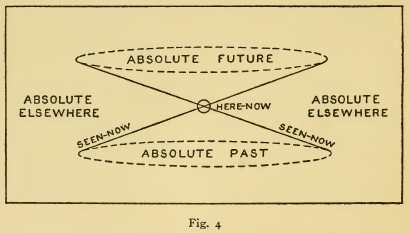
I do not know whether you have been keenly alive to the fact that for some time now we have been immersed in a four-dimensional world. The fourth dimension required no introduction; as soon as we began to consider events it was there. Events obviously have a fourfold order which we can dissect into right or left, behind or in front, above or below, sooner or later—or into many alternative sets of fourfold specification. The fourth dimension is not a difficult conception. It is not difficult to conceive of events as ordered in four dimensions; it is impossible to conceive them otherwise. The trouble begins when we continue farther along this line of thought, because by long custom we have divided the world of events into three-dimensional sections or instants, and regarded the piling of the instants as something distinct from a dimension. That gives us the usual conception of a three-dimensional world floating in the stream of time. This pampering of a particular dimension is not entirely without foundation; it is our crude appreciation of the absolute separation of space-relations and time-relations by the hour-glass figures. But the crude discrimination has to be replaced by a more accurate discrimination. The supposed planes of structure represented by Now lines separated one dimension from the other three; but the cones of structure given by the hourglass figures keep the four dimensions firmly pinned together. (In Fig. 4 the scale is such that a second of time corresponds to 70,000 miles of space. If we take a more ordinary scale of experience, say a second to a yard, the Seen-Now lines become almost horizontal; and it will easily be understood why the cones which pin the four dimensions together have generally been mistaken for sections separating them.)

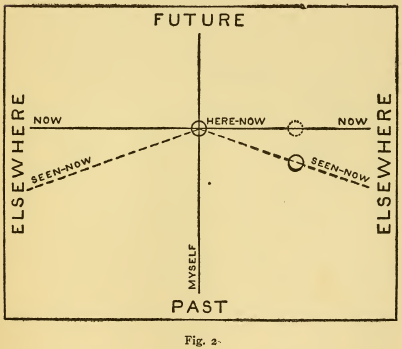
We are accustomed to think of a man apart from his duration. When I portrayed “Myself” in Fig. 2, you were for the moment surprised that I should include my boyhood and old age. But to think of a man without his duration is just as abstract as to think of a man without his inside. Abstractions are useful, and a man without his inside (that is to say, a surface) is a well-known geometrical conception. But we ought to realise what is an abstraction and what is not. The “four-dimensional worms” introduced in this chapter seem to many people terribly abstract. Not at all; they are unfamiliar conceptions but not abstract conceptions. It is the section of the worm (the man Now) which is an abstraction. And as sections may be taken in somewhat different directions, the abstraction is made differently by different observers who accordingly attribute different FitzGerald contractions to it. The non-abstract man enduring through time is the common source from which the different abstractions are made.

The appearance of a four-dimensional world in this subject is due to Minkowski. Einstein showed the relativity of the familiar quantities of physics; Minkowski showed how to recover the absolute by going back to their four-dimensional origin and searching more deeply.

.

Eddinton 1927: Absolute Distinction of Space and Time

space-time

Reference: The Book of Physics

Note: The original text is provided below.
Previous / Next

.

Summary

.

Comments

.

Original Text

By dividing the world into Absolute Past and Future on the one hand and Absolute Elsewhere on the other hand, our hour-glasses have restored a fundamental differentiation between time and space. It is not a distinction between time and space as they appear in a space-time frame, but a distinction between temporal and spatial relations. Events can stand to us in a temporal relation (absolutely past or future) or a spatial relation (absolutely elsewhere), but not in both. The temporal relations radiate into the past and future cones and the spatial relations into the neutral wedge; they are kept absolutely separated by the Seen-Now lines which we have identified with the grain of absolute structure in the world. We have recovered the distinction which the Astronomer Royal confused when he associated time with the merely artificial Now lines.

I would direct your attention to an important difference in our apprehension of time-extension and space-extension. As already explained our course through the world is into the absolute future, i.e. along a sequence of time-relations. We can never have a similar experience of a sequence of space-relations because that would involve travelling with velocity greater than light. Thus we have immediate experience of the time-relation but not of the space-relation. Our knowledge of space-relations is indirect, like nearly all our knowledge of the external world—a matter of inference and interpretation of the impressions which reach us through our senseorgans. We have similar indirect knowledge of the time-relations existing between the events in the world outside us; but in addition we have direct experience of the time-relations that we ourselves are traversing— a knowledge of time not coming through external sense-organs, but taking a short cut into our consciousness. When I close my eyes and retreat into my inner mind, I feel myself enduring, I do not feel myself extensive. It is this feeling of time as affecting ourselves and not merely as existing in the relations of external events which is so peculiarly characteristic of it; space on the other hand is always appreciated as something external.

That is why time seems to us so much more mysterious than space. We know nothing about the intrinsic nature of space, and so it is quite easy to conceive it satisfactorily. We have intimate acquaintance with the nature of time and so it baffles our comprehension. It is the same paradox which makes us believe we understand the nature of an ordinary table whereas the nature of human personality is altogether mysterious. We never have that intimate contact with space and tables which would make us realise how mysterious they are; we have direct knowledge of time and of the human spirit which makes us reject as inadequate that merely symbolic conception of the world which is so often mistaken for an insight into its nature.

.

Eddington 1927: Absolute Past and Future

Fig 4

Reference: The Book of Physics

Note: The original text is provided below.
Previous / Next

.

Summary

.

Comments

.

Original Text

Let us now try to attain this absolute view. We rub out all the Now lines. We rub out Yourself and Myself, since we are no longer essential to the world. But the Seen-Now lines are left. They are absolute, since all observers from Here-Now agree about them. The flat picture is a section; you must imagine it rotated (twice rotated in fact, since there are two more dimensions outside the picture). The Seen-Now locus is thus really a cone; or by taking account of the prolongation of the lines into the future a double cone or hour-glass figure (Fig. 4). These hour-glasses (drawn through each point of the world considered in turn as a Here-Now) embody what we know of the absolute structure of the world so far as space and time are concerned. They show how the “grain” of the world runs.

Fig 4

Father Time has been pictured as an old man with a scythe and an hour-glass. We no longer permit him to mow instants through the world with his scythe; but we leave him his hour-glass.

Since the hour-glass is absolute its two cones provide respectively an Absolute Future and an Absolute Past for the event Here-Now. They are separated by a wedge-shaped neutral zone which (absolutely) is neither past nor future. The common impression that relativity turns past and future altogether topsy-turvy is quite false. But, unlike the relative past and future, the absolute past and future are not separated by an infinitely narrow present. It suggests itself that the neutral wedge might be called the Absolute Present; but I do not think that is a good nomenclature. It is much better described as Absolute Elsewhere. We have abolished the Now lines, and in the absolute world the present (Now) is restricted to Here-Now.

Perhaps I may illustrate the peculiar conditions arising from the wedge-shaped neutral zone by a rather hypothetical example. Suppose that you are in love with a lady on Neptune and that she returns the sentiment. It will be some consolation for the melancholy separation if you can say to yourself at some—possibly prearranged —moment, “She is thinking of me now”. Unfortunately a difficulty has arisen because we have had to abolish Now. There is no absolute Now, but only the various relative Nows differing according to the reckoning of different observers and covering the whole neutral wedge which at the distance of Neptune is about eight hours thick. She will have to think of you continuously for eight hours on end in order to circumvent the ambiguity of “Now”.

At the greatest possible separation on the earth the thickness of the neutral wedge is no more than a tenth of a second; so that terrestrial synchronism is not seriously interfered with. This suggests a qualification of our previous conclusion that the absolute present is confined to HereNow. It is true as regards instantaneous events (point-events). But in practice the events we notice are of more than infinitesimal duration. If the duration is sufficient to cover the width of the neutral zone, then the event taken as a whole may fairly be considered to be Now absolutely. From this point of view the “nowness” of an event is like a shadow cast by it into space, and the longer the event the farther will the umbra of the shadow extend.

As the speed of matter approaches the speed of light its mass increases to infinity, and therefore it is impossible to make matter travel faster than light. This conclusion is deduced from the classical laws of physics, and the increase of mass has been verified by experiment up to very high velocities. In the absolute world this means that a particle of matter can only proceed from Here-Now into the absolute future—which, you will agree, is a reasonable and proper restriction. It cannot travel into the neutral zone; the limiting cone is the track of light or of anything moving with the speed of light. We ourselves are attached to material bodies, and therefore we can only go on into the absolute future.

Events in the absolute future are not absolutely Elsewhere. It would be possible for an observer to travel from Here-Now to the event in question in time to experience it, since the required velocity is less than that of light; relative to the frame of such an observer the event would be Here. No observer can reach an event in the neutral zone, since the required speed is too great. The event is not Here for any observer (from Here-Now); therefore, it is absolutely Elsewhere.

.

Eddington 1927: Location of Events

Fig 1

Reference: The Book of Physics

Note: The original text is provided below.
Previous / Next

.

Summary

.

Comments

.

Original Text

In Fig. 1 you see a collection of events, indicated by circles. They are not at present in their right places; that is the job before me–to put them into proper locations in my frame of space and time. Among them I can immediately recognize and label the event Here-Now, viz. that which is happening in this room at the moment. The other events are at varying degrees of remoteness from Here-Now, and it is obvious to me that the remoteness is not only of different degrees but of different kinds. Some events spread away towards what in a general way I call the Past; I can contemplate others which are distant in the Future; others are remote in another kind of way towards China or Peru, or in general terms Elsewhere. In this picture I have only room for one dimension of Elsewhere; another dimension sticks out at right angles to the paper; and you must imagine the third dimension as best you can.

Now we must pass from this vague scheme of location to a precise scheme. The first and most important thing is to put Myself into the picture. It sounds egotistical; but, you see, it is my frame of space that will be used, so it all hangs round me. Here I am—a kind of four-dimensional worm (Fig. 2). It is a correct portrait; I have considerable extension towards the Past and presumably towards the Future, and only a moderate extension towards Elsewhere. The “instantaneous me”, i.e. myself at this instant, coincides with the event Here- Now. Surveying the world from HereNow, I can see many other events happening now. That puts it into my head that the instant of which I am conscious here must be extended to include them; and I jump to the conclusion that Now is not confined to Here-Now. I therefore draw the instant Now, running as a clean section across the world of events, in order to accommodate all the distant events which are happening now. I select the events which I see happening now and place them on this section, which I call a moment of time or an “instantaneous state of the world”. I locate them on Now because they seem to be Now.

Fig 2

This method of location lasted until the year 1667, when it was found impossible to make it work consistently. It was then discovered by the astronomer Roemer that what is seen now cannot be placed on the instant Now. (In ordinary parlance—light takes time to travel.) That was really a blow to the whole system of worldwide instants, which were specially invented to accommodate these events. We had been mixing up two distinct events; there was the original event somewhere out in the external world and there was a second event, viz. the seeing by us of the first event. The second event was in our bodies Here-Now; the first event was neither Here nor Now. The experience accordingly gives no indication of a Now which is not Here; and we might well have abandoned the idea that we have intuitive recognition of a Now other than Here-Now, which was the original reason for postulating world-wide instants Now.

However, having become accustomed to world-wide instants, physicists were not ready to abandon them. And, indeed, they have considerable usefulness provided that we do not take them too seriously. They were left in as a feature of the picture, and two Seen-Now lines were drawn, sloping backwards from the Now line, on which events seen now could be consistently placed.

The cotangent of the angle between the Seen-Now lines and the Now line was interpreted as the velocity of light.

Accordingly, when I see an event in a distant part of the universe, e.g. the outbreak of a new star, I locate it (quite properly) on the Seen-Now line. Then I make a certain calculation from the measured parallax of the star and draw my Now line to pass, say, 300 years in front of the event, and my Now line of 300 years ago to pass through the event. By this method I trace the course of my Now lines or world-wide instants among the events, and obtain a frame of time-location for external events. The auxiliary Seen-Now lines, having served their purpose, are rubbed out of the picture.

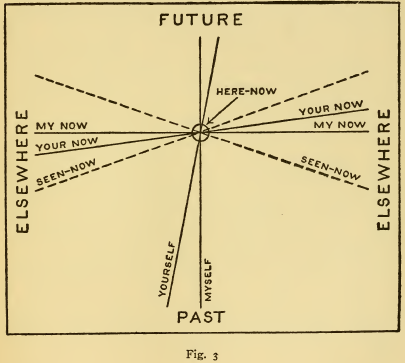
Fig 3

That is how I locate events; how about you? We must first put You into the picture (Fig. 3). We shall suppose that you are on another star moving with different velocity but passing close to the earth at the present moment. You and I were far apart in the past and will be again in the future, but we are both Here- Now. That is duly shown in the picture. We survey the world from HereNow, and of course we both see the same events simultaneously. We may receive rather different impressions of them; our different motions will cause different Doppler effects, FitzGerald  contractions, etc. There may be slight misunderstandings until we realise that what you describe as a red square is what I would describe as a green oblong, and so on. But, allowing for this kind of difference of description, it will soon become clear that we are looking at the same events, and we shall agree entirely as to how the Seen-Now lines lie with respect to the events. Starting from our common Seen-Now lines, you have next to make the calculations for drawing your Now line among the events, and you trace it as shown in Fig. 3.

How is it that, starting from the same Seen-Now lines, you do not reproduce my Now line? It is because a certain measured quantity, viz. the velocity of light, has to be employed in the calculations; and naturally you trust to your measures of it as I trust to mine. Since our instruments are affected by different FitzGerald contractions, etc., there is plenty of room for divergence. Most surprisingly we both find the same velocity of light, 299,796 kilometres per second. But this apparent agreement is really a disagreement; because you take this to be the velocity relative to your planet and I take it to be the velocity relative to mine. (The measured velocity of light is the average to-and-fro velocity. The velocity in one direction singly cannot be measured until after the Now lines have been laid down and therefore cannot be used in laying down the Now lines. Thus, there is a deadlock in drawing the Now lines which can only be removed by an arbitrary assumption or convention. The convention actually adopted is that (relative to the observer) the velocities of light in the two opposite directions are equal. The resulting Now lines must therefore be regarded as equally conventional.)  Therefore, our calculations are not in accord, and your Now line differs from mine.

If we believe our world-wide instants or Now lines to be something inherent in the world outside us, we shall quarrel frightfully. To my mind it is ridiculous that you should take events on the right of the picture which have not -happened yet and events on the left which are already past and call the combination an instantaneous condition of the universe. You are equally scornful of my grouping. We can never agree. Certainly, it looks from the picture as though my instants were more natural than yours; but that is because I drew the picture. You, of course, would redraw it with your Now lines at right angles to yourself.

But we need not quarrel if the Now lines are merely reference lines drawn across the world for convenience in locating events—like the lines of latitude and longitude on the earth. There is then no question of a right way and a wrong way of drawing the lines; we draw them as best suits our convenience. World-wide instants are not natural cleavage planes of time; there is nothing equivalent to them in the absolute structure of the world; they are imaginary partitions which we find it convenient to adopt.

We have been accustomed to regard the world—the enduring world—as stratified into a succession of instantaneous states. But an observer on another star would make the strata run in a different direction from ours. We shall see more clearly the real mechanism of the physical world if we can rid our minds of this illusion of stratification. The world that then stands revealed, though strangely unfamiliar, is actually much simpler. There is a difference between simplicity and familiarity. A pig may be most familiar to us in the form of rashers, but the unstratified pig is a simpler object to the biologist who wishes to understand how the animal functions.

.