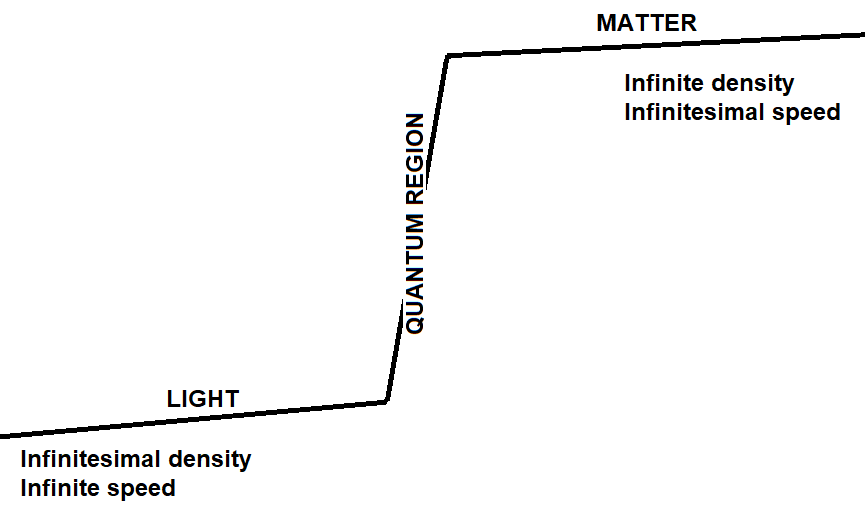
As explained in the preface, the very fact that the fundamental theories of physics cannot be reconciled indicates that there are basic assumptions underlying physics that are inconsistent with reality.
Physics starts with the concepts of matter and void. These two concepts are then expanded upon throughout the development of physics. Therefore, our search for assumptions should start with how matter and void have been conceived and expanded upon.
The starting concept in classical physics is matter as the basic substance, and the void as the absence of substance. All other concepts are then derived from the idea of matter as substance. For example, mass is the “density” of matter, kinetic energy is the “motion” of matter; potential energy is the “tension” in matter; momentum is the “impact” of matter.
Classical physics deals with matter up till the concept of atom. Beyond atom we encounter the constituents of atom and their characteristics. These are dealt by quantum physics. A sharp break in reality occurs at this transition from classical to quantum physics because the characteristics of matter do not seem to continue beyond atom. Beyond matter, atom and quantum particles, there is electromagnetic radiation and, of course, void.
We need to investigate the concept of matter as a substance beyond the atom, where classical physics is replaced by quantum physics.
.
Objectivity
Physics takes pride in being objective. The word objective is derived from object that has the sense of “something perceived”. Objectivity requires consistency among what is observed and not just agreement on what is postulated to explain those observations.
Objective reality is not only made tangible through physical perceptions of sight, touch, hearing, taste and smell, but it is also made logical by the mental perceptions of continuity, consistency, and harmony. The objective reality is that which has been tested and verified and cannot be argued with. It is the same for all people because all known inconsistencies have been resolved.
When we say that physics is objective, we mean that there is a natural continuity, consistency, and harmony among all its observations, interpretations and conclusions.
.
Subjectivity
Physics tries to resolve subjectivity. The word subjective is derived from subject that has the sense of “open to inspection”. It is characterized by inconsistencies that still need to be resolved. As inconsistencies are resolved the subjective reality becomes increasingly objective.
Subjectivity exists when there is difficulty in obtaining direct observations, so gaps are filled with educated guesses and, sometimes, with outright assumptions. Such guesses and assumption must always be open to inspection. Trouble comes when things that are subjective are closed to inspection, mainly by agreement among physicists.
The route from subjectivity to objectivity in physics is a closer inspection of anomalies (discontinuity, inconsistency, and disharmony) concerning matter and void, and resolving them.
To find the assumptions that are hidden behind the mathematical symbolism for matter and void, we need to inspect the matter-void interface first.
The survey of Physics in Part I shows that we have a gradient of substance from matter to void.
.