Category Archives: Science

Space, Field & Matter

cern

  1. We may view Space as “undisturbed field” with zero frequency. As space is disturbed a field of finite frequency is generated.

  2. The field has electrical and magnetic aspects to it. As these aspects change, they reinforce each other through generation of force.

  3. Thus field conveys force, which brings about changes elsewhere.

  4. Inertia is expressed as “mass” in classical mechanics of matter. The equivalent expression of inertia would be as “frequency” in the field.

  5. Inertia in a field shall increase with frequency. Higher frequency regions in a field shall have higher inertia, and more force shall be conveyed through such regions.

  6. In very high frequency regions in a field, the frequency may condense and precipitate as mass.

  7. Field has properties of interference and diffraction.

.

Location in Space

Stars-fixed

In Quantum Physics, we are looking at an area where observation without bias means more than any education. We should be willing to question earlier assumptions, when they become obvious.

Our concept of space comes from dimensions of matter. Does the same concept of dimension apply to field? Suppose there is no matter but only field. How will we conceive of dimensions then?

Does an electromagnetic disturbance travel in space? Or is it a varying condition of space itself. Is “c” really the “speed” of light in “space”, or is it a constant relationship between space and time as represented by constant ratio of wavelength to period of electromagnetic disturbance?

If the frequency associated with electromagnetic disturbance is that of space itself vibrating, then we cannot look at the amplitude as some “distance”. With this kind of questioning I have upset people with traditional thinking who have accused me of keeping company of crackpots. But I do not believe traditional thinking is so sacred that it cannot be questioned.

I believe that truth lies in logical consistency. The Heisenberg Principle to me presents a logical inconsistency as it did to Einstein. It assumes that a location in a field could be approximated by a Euclidean point. I believe that to be logically inconsistent.

A location in a field has dimension of the “wavelength” of the disturbance that makes up that field.

.

What is Quantum Field Theory?

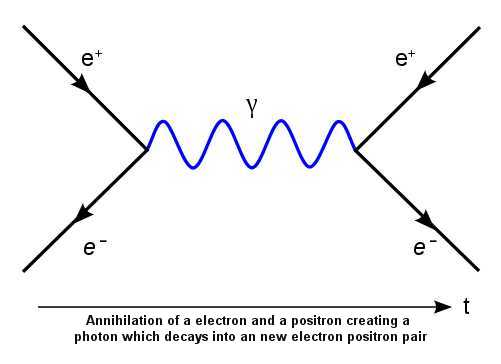
simple-feynman-diagram
Reference: Answer from Barak Shoshany at What is quantum field theory?

I loved the answer from Barak Shoshany. My understanding of Quantum Field Theory is developing as follows.

(1)    A “particle” is a high frequency pulse in a low-frequency background field. We may refer to the low-frequency field as the corresponding “space”.

(2)    Movement of a “particle” within the “space” is like movement of a pulse relative to other pulses within a field.

(3)    A pulse is seen as continuous with the surrounding field. Thus a “quantum particle” is always continuous with the surrounding “field space”.

(4)    The steep gradient of frequency change from “field space” to “quantum particle” appears as gravity around a particle. The high frequency of the particle appears as mass.

(5)    The “quantum particle” may be wide enough to contain a still higher “frequency spike” within it. The frequency spike shall appear as “condensed particle” within the particle. The particle shall now be perceived relatively as space.

(6)    Thus there can be more condensed particle within a particle; and more condensed space within a space. It is just how you look at it. At higher frequencies the “particle – space” shall appear more condensed.

(7)    Thus all particles shall be related to each other. They will maintain continuity among themselves.

(8)   The “wave-particle” duality is now adequately explained by this iterative “particle – space” model.

(9)   The nucleus of an atom is a particle within the electronic field of the atom. And the electronic field of the atom is a particle within the field we call space. So the nucleus of an atom is a “particle within a particle”. This makes atom a “compound particle”.

(10)  The particle is a high frequency pulse within a pulsating field. Its motion shall be measured relative to similar pulses in the field. It may appear either motionless or in motion.

(11)  The Higgs field is more like the theoretical field of zero frequency or “undisturbed space”. It is the basis of all other “disturbed spaces” or fields.

(12)  Any spike in Higgs field will appear as “creation of mass” because one is going from zero to a finite frequency. To go from zero to the mass of atomic nucleus is a big jump in frequency and will require a large amount of energy.

(13)  Fields interact with each other. A field converts energy from interaction into a particle. Energy is conserved but not the number of particles.

(14) The location of a particle shall be the “footprint” of the particle in its relative space. This “footprint” is a finite dimension of the order of the wavelength of the surrounding space. This location may be approximated by a Euclidean point only when the particle is highly condensed, such as, the nucleus of an atom.

(15) Heisenburg’s Uncertainty principle assumes that all locations may be approximated by a Euclidean point. This assumption is questionable.
.

What is a Quantum in Physics?

electrical-manipulation-qub
Reference: Relativity and the Problem of Space
  • Newtonian mechanics seem to cover the area where mass is concerned.

  • Einsteinian relativity seems to cover the area where field is concerned.

  • But the interface between mass and field is not fully resolved.

This is the area of Quantum Mechanics that needs to be resolved fully.

.
Reference: https://en.wikipedia.org/wiki/Quantum
  1. In the attempt to bring theory into agreement with experiment, Max Planck postulated that electromagnetic energy is absorbed or emitted in discrete packets, or quanta.

  2. In 1905 Albert Einstein suggested that radiation existed in spatially localized packets which he called “quanta of light”. A photon is a single quantum of electromagnetic radiation. It is proportional in magnitude to the frequency of the radiation it represents.

  3. While quantization was first discovered in electromagnetic radiation, it describes a fundamental aspect of energy not just restricted to photons.

  4. Quantum is the minimum amount of any physical entity involved in an interaction. The magnitude can take on only certain discrete values. The energy of an electron bound to an atom is quantized, which results in the stability of atoms, and hence of matter in general.

  5. Quantum is part of the fundamental framework for understanding and describing nature.

Quantum seems to have replaced the “material point” of the old.

.

Quantum Mechanics and Space

black-hole-space-time-gas

The idea of space comes from dimensions of solids or matter. But matter is not the most basic physical substance. Underlying matter we have the field. How does this change the concept of space?

It is interesting to study the interface between matter and field. That is the area Quantum Mechanics is looking at. Quantum Mechanics have had lots of successes, so Quantum Mechanics is mostly right. But its math is very complicated. Can that math be simplified without rendering QM wrong, because QM is not wrong! If we can simplify the math of QM then I am sure we can get further mileage out of it.

Where is the limitation on QM coming from? I think it is the uncertainty in our concept of space. Our feel for space is based on matter. We do not have a feel for field. Our concept of space is tied to physical substance. Our understanding of the basic physical substance has moved from matter to field, but not the understanding of space.

What is field compared to matter? When particles collide in atomic and nuclear reactions, we see emission of radiation. It seems that matter cannot be divided indefinitely as matter. Somewhere along the way matter seems to divide into field.

What is wave function? A wave function is trying to define the field. What does probability in a wave function mean? I don’t think it provides the chance of locating a particle in space because the concept of particle and space is in question here. A particle seems to be a “peak in probability”, and the background is not space but the adjacent valley. These “peaks and valleys” are relative, which are mimicking “particles and space”.

The atom exists as a “particle” in the relative “space” of outside low-frequency field. The nucleus of an atom exists as a “particle” in the relative “space” of the electronic region. This idea is not very different from the idea of a “quantum” in QM.

Different particles are different “peaks” in the space provided by the “valleys” of the field. The “peak” is a sudden jump in frequency (energy) from the frequency that is characteristic of the field. The characteristic frequency of a field gives a character to “space”.

There seems to be a spike in frequency at the surface of the atom, and another huge spike at the surface of the nucleus. “Particles”, such as, electrons, atoms, and nuclei are stable configurations. The “particles” of Standard Model are also relatively stable configurations. This explains how there are particles within particles.

What does the zero mass of a photon means? Mass seems to come about when there is sharp spike in frequency. That means there is no sharp spike in frequency within a photon. The photon is the “space” part of a field. The photon then stands out as a “particle” in a “space” of lowest frequency possible. That would be a field approaching zero frequency. That would be “pure space”.

.