Category Archives: Science

Einstein 1938: The Reality of the Field

Reference: Evolution of Physics

This paper presents Chapter III, section 3 from the book THE EVOLUTION OF PHYSICS by A. EINSTEIN and L. INFELD. The contents are from the original publication of this book by Simon and Schuster, New York (1942).

The paragraphs of the original material (in black) are accompanied by brief comments (in color) based on the present understanding.  Feedback on these comments is appreciated.

The heading below is linked to the original materials.

.

The Reality of the Field

The quantitative, mathematical description of the laws of the field is summed up in what are called Maxwell’s equations. The facts mentioned so far led to the formulation of these equations, but their content is much richer than we have been able to indicate. Their simple form conceals a depth revealed only by careful study.

The formulation of these equations is the most important event in physics since Newton’s time, not only because of their wealth of content, but also because they form a pattern for a new type of law.

The characteristic features of Maxwell’s equations, appearing in all other equations of modern physics, are summarized in one sentence. Maxwell’s equations are laws representing the structure of the field.

Maxwell’s equations are laws representing the structure of the field.

Why do Maxwell’s equations differ in form and character from the equations of classical mechanics? What does it mean that these equations describe the structure of the field? How is it possible that, from the results of Oersted’s and Faraday’s experiments, we can form a new type of law, which proves so important for the further development of physics?
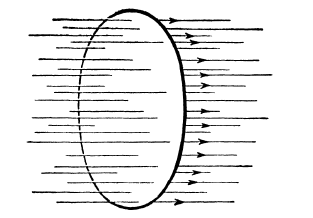
We have already seen, from Oersted’s experiment, how a magnetic field coils itself around a changing electric field. We have seen, from Faraday’s experiment, how an electric field coils itself around a changing magnetic field. To outline some of the characteristic features of Maxwell’s theory, let us, for the moment, focus all our attention on one of these experiments, say, on that of Faraday. We repeat the drawing in which an electric current is induced by a changing magnetic field. We already know that an induced current appears if the number of lines of force, passing the surface bounded by the wire, changes. Then the current will appear if the magnetic field changes or the circuit is deformed or moved: if the number of magnetic lines passing through the surface is changed, no matter how this change is caused. To take into account all these various possibilities, to discuss their particular influences, would necessarily lead to a very complicated theory. But can we not simplify our problem? Let us try to eliminate from our considerations everything which refers to the shape of the circuit, to its length, to the surface enclosed by the wire. Let us imagine that the circuit in our last drawing becomes smaller and smaller, shrinking gradually to a very small circuit enclosing a certain point in space. Then everything concerning shape and size is quite irrelevant. In this limiting process where the closed curve shrinks to a point, size and shape automatically vanish from our considerations and we obtain laws connecting changes of magnetic and electric field at an arbitrary point in space at an arbitrary instant.

Thus, this is one of the principal steps leading to Maxwell’s equations. It is again an idealized experiment performed in imagination by repeating Faraday’s experiment with a circuit shrinking to a point.

We should really call it half a step rather than a whole one. So far our attention has been focused on Faraday’s experiment. But the other pillar of the field theory, based on Oersted’s experiment, must be considered just as carefully and in a similar manner. In this experiment the magnetic lines of force coil themselves around the current. By shrinking the circular magnetic lines of force to a point, the second half-step is performed and the whole step yields a connection between the changes of the magnetic and electric fields at an arbitrary point in space and at an arbitrary instant.

The Maxwell equations are obtained by shrinking Oersted’s and Faraday’s circuits to an idealized point, such that everything concerning shape and size of the circuits become quite irrelevant.  We then obtain laws connecting the changes of the magnetic and electric fields at an arbitrary point in space and at an arbitrary instant.

But still another essential step is necessary. According to Faraday’s experiment, there must be a wire testing the existence of the electric field, just as there must be a magnetic pole, or needle, testing the existence of a magnetic field in Oersted’s experiment. But Maxwell’s new theoretical idea goes beyond these experimental facts. The electric and magnetic field or, in short, the electromagnetic field is, in Maxwell’s theory, something real. The electric field is produced by a changing magnetic field, quite independently, whether or not there is a wire to test its existence; a magnetic field is produced by a changing electric field, whether or not there is a magnetic pole to test its existence.

Maxwell’s theoretical ideas goes beyond the experimental fact that there must be a wire testing the existence of the electric field, just as there must be a magnetic pole, or needle, testing the existence of a magnetic field. The electromagnetic field is something quite independently real.

Thus two essential steps led to Maxwell’s equations. The first: in considering Oersted’s and Rowland’s experiments, the circular line of the magnetic field coiling itself around the current and the changing electric field had to be shrunk to a point; in considering Faraday’s experiment, the circular line of the electric field coiling itself around the changing magnetic field had to be shrunk to a point. The second step consists of the realization of the field as something real; the electromagnetic field once created exists, acts, and changes according to Maxwell’s laws.

Maxwell’s equations describe the structure of the electromagnetic field. All space is the scene of these laws and not, as for mechanical laws, only points in which matter or charges are present.

According to Maxwell, all space is the scene of these laws and not only the points in which matter or charges are present. Therefore, the duality of matter and void, as in the mechanical view, is eliminated.

We remember how it was in mechanics. By knowing the position and velocity of a particle at one single instant, by knowing the acting forces, the whole future path of the particle could be foreseen. In Maxwell’s theory, if we know the field at one instant only, we can deduce from the equations of the theory how the whole field will change in space and time. Maxwell’s equations enable us to follow the history of the field, just as the mechanical equations enabled us to follow the history of material particles.

Maxwell’s equations enable us to follow the history of the field, just as the mechanical equations enabled us to follow the history of material particles.

But there is still one essential difference between mechanical laws and Maxwell’s laws. A comparison of Newton’s gravitational laws and Maxwell’s field laws will emphasize some of the characteristic features expressed by these equations.

With the help of Newton’s laws we can deduce the motion of the earth from the force acting between the sun and the earth. The laws connect the motion of the earth with the action of the far-off sun. The earth and the sun, though so far apart, are both actors in the play of forces.

In Maxwell’s theory there are no material actors. The mathematical equations of this theory express the laws governing the electromagnetic field. They do not, as in Newton’s laws, connect two widely separated events; they do not connect the happenings here with the conditions there. The field here and now depends on the field in the immediate neighbourhood at a time just past. The equations allow us to predict what will happen a little farther in space and a little later in time, if we know what happens here and now. They allow us to increase our knowledge of the field by small steps. We can deduce what happens here from that which happened far away by the summation of these very small steps. In Newton’s theory, on the contrary, only big steps connecting distant events are permissible. The experiments of Oersted and Faraday can be regained from Maxwell’s theory, but only by the summation of small steps each of which is governed by Maxwell’s equations.

In Newton’s theory only big steps connecting distant events are permissible. In Maxwell’s theory, the field here and now depends on the field in the immediate neighborhood at a time just past. We can deduce what happens here from that which happened far away by the summation of these very small steps.

A more thorough mathematical study of Maxwell’s equations shows that new and really unexpected conclusions can be drawn and the whole theory submitted to a test on a much higher level, because the theoretical consequences are now of a quantitative character and are revealed by a whole chain of logical arguments.

Let us again imagine an idealized experiment. A small sphere with an electric charge is forced, by some external influence, to oscillate rapidly and in a rhythmical way, like a pendulum. With the knowledge we already have of the changes of the field, how shall we describe everything that is going on here, in the field language?

The oscillation of the charge produces a changing electric field. This is always accompanied by a changing magnetic field. If a wire forming a closed circuit is placed in the vicinity, then again the changing magnetic field will be accompanied by an electric current in the circuit. All this is merely a repetition of known facts, but the study of Maxwell’s equations gives a much deeper insight into the problem of the oscillating electric charge. By mathematical deduction from Maxwell’s equations we can detect the character of the field surrounding an oscillating charge, its structure near and far from the source and its change with time. The outcome of such deduction is the electromagnetic wave. Energy radiates from the oscillating charge travelling with a definite speed through space; but a transference of energy, the motion of a state, is characteristic of all wave phenomena.

The Maxwell’s equations provide the insight that energy radiates from the oscillating charge, traveling with a definite speed through space; but a transference of energy, the motion of a state, is characteristic of all wave phenomena.

Different types of waves have already been considered. There was the longitudinal wave caused by the pulsating sphere, where the changes of density were propagated through the medium. There was the jellylike medium in which the transverse wave spread. A deformation of the jelly, caused by the rotation of the sphere, moved through the medium. What kind of changes are now spreading in the case of an electromagnetic wave? Just the changes of an electromagnetic field! Every change of an electric field produces a magnetic field; every change of this magnetic field produces an electric field; every change of…, and so on. As field represents energy, all these changes spreading out in space, with a definite velocity, produce a wave. The electric and magnetic lines of force always lie, as deduced from the theory, on planes perpendicular to the direction of propagation. The wave produced is, therefore, transverse. The original features of the picture of the field we formed from Oersted’s and Faraday’s experiments are still preserved, but we now recognize that it has a deeper meaning.

Energy is diluted substance—force that is spread out in space. This is field, which is maintaining a balance between motion and inertia dynamically at every point. This balance gives it a certain density and velocity.

The electromagnetic wave spreads in empty space. This, again, is a consequence of the theory. If the oscillating charge suddenly ceases to move, then its field becomes electrostatic. But the series of waves created by the oscillation continues to spread. The waves lead an independent existence and the history of their changes can be followed just as that of any other material object.

There are electromagnetic waves of different densities (frequencies). Those densities are maintained. Therefore, we have many different densities spreading through the same region independent of each other. But they may mix in some manner without losing individual identities.

We understand that our picture of an electromagnetic wave, spreading with a certain velocity in space and changing in time, follows from Maxwell’s equations only because they describe the structure of the electromagnetic field at any point in space and for any instant.

There is another very important question. With what speed does the electromagnetic wave spread in empty space? The theory, with the support of some data from simple experiments having nothing to do with the actual propagation of waves, gives a clear answer: the velocity of an electromagnetic wave is equal to the velocity of light.

There are two distinct velocities: The velocity in material domain, and the velocity in radiation domain. The inertia of these two domains is very far apart, and so are their velocities. All the velocities in the radiation domain appear to be the same from the perspective of material domain. So, it is no surprise that the velocity of electromagnetic wave is same as the velocity of light.

Oersted’s and Faraday’s experiments formed the basis on which Maxwell’s laws were built. All our results so far have come from a careful study of these laws, expressed in the field language. The theoretical discovery of an electromagnetic wave spreading with the speed of light is one of the greatest achievements in the history of science.

Experiment has confirmed the prediction of theory. Fifty years ago, Hertz proved, for the first time, the existence of electromagnetic waves and confirmed experimentally that their velocity is equal to that of light. Nowadays, millions of people demonstrate that electromagnetic waves are sent and received. Their apparatus is far more complicated than that used by Hertz and detects the presence of waves thousands of miles from their sources instead of only a few yards.

The electromagnetic wave produced by an oscillating charge is of a different substantiality then that of the electromagnetic field existing among the nuclei of the atoms.

.

Final Comment

.

Einstein 1938: The Two Pillars of the Field Theory

Reference: Evolution of Physics

This paper presents Chapter III, section 2 from the book THE EVOLUTION OF PHYSICS by A. EINSTEIN and L. INFELD. The contents are from the original publication of this book by Simon and Schuster, New York (1942).

The paragraphs of the original material (in black) are accompanied by brief comments (in color) based on the present understanding.  Feedback on these comments is appreciated.

The heading below is linked to the original materials.

.

The Two Pillars of the Field Theory

“The change of an electric field is accompanied by a magnetic field.” If we interchange the words “magnetic” and “electric”, our sentence reads: “The change of a magnetic field is accompanied by an electric field.” Only an experiment can decide whether or not this statement is true. But the idea of formulating this problem is suggested by the use of the field language.

Just over a hundred years ago, Faraday performed an experiment which led to the great discovery of induced currents.

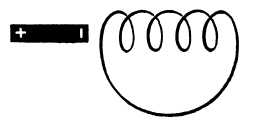
The demonstration is very simple. We need only a solenoid or some other circuit, a bar magnet, and one of the many types of apparatus for detecting the existence of an electric current. To begin with, a bar magnet is kept at rest near a solenoid which forms a closed circuit. No current flows through the wire, for no source is present. There is only the magnetostatic field of the bar magnet which does not change with time. Now, we quickly change the position of the magnet either by removing it or by bringing it nearer the solenoid, whichever we prefer. At this moment, a current will appear for a very short time and then vanish. Whenever the position of the magnet is changed, the current reappears, and can be detected by a sufficiently sensitive apparatus. But a current—from the point of view of the field theory—means the existence of an electric field forcing the flow of the electric fluids through the wire. The current, and therefore the electric field, too, vanishes when the magnet is again at rest.

Not only the change of an electric field is accompanied by a magnetic field; but the change of a magnetic field is also accompanied by an electric field.

Imagine for a moment that the field language is unknown and the results of this experiment have to be described, qualitatively and quantitatively, in the language of old mechanical concepts. Our experiment then shows: by the motion of a magnetic dipole a new force was created, moving the electric fluid in the wire. The next question would be: upon what does this force depend? This would be very difficult to answer. We should have to investigate the dependence of the force upon the velocity of the magnet, upon its shape, and upon the shape of the circuit. Furthermore, this experiment, if interpreted in the old language, gives us no hint at all as to whether an induced current can be excited by the motion of another circuit carrying a current, instead of by motion of a bar magnet.

The field language describes the phenomenon of induced current much more clearly by including what is going on in the space around a magnet. 

It is quite a different matter if we use the field language and again trust our principle that the action is determined by the field. We see at once that a solenoid through which a current flows would serve as well as a bar magnet. The drawing shows two solenoids: one, small, through which a current flows, and the other, in which the induced current is detected, larger. We could move the small solenoid, as we previously moved the bar magnet, creating an induced current in the larger solenoid. Furthermore, instead of moving the small solenoid, we could create and destroy a magnetic field by creating and destroying the current, that is, by opening and closing the circuit. Once again, new facts suggested by the field theory are confirmed by experiment!

The key Principle is that the action is determined by the field. The bar magnet can be replaced by a solenoid through which a current flows, without changing the results.

Let us take a simpler example. We have a closed wire without any source of current. Somewhere in the vicinity is a magnetic field. It means nothing to us whether the source of this magnetic field is another circuit through which an electric current flows, or a bar magnet. Our drawing shows the closed circuit and the magnetic lines of force. The qualitative and quantitative description of the induction phenomena is very simple in terms of the field language. As marked on the drawing, some lines of force go through the surface bounded by the wire. We have to consider the lines of force cutting that part of the plane which has the wire for a rim. No electric current is present so long as the field does not change, no matter how great its strength. But a current begins to flow through the rim-wire as soon as the number of lines passing through the surface surrounded by wire changes. The current is determined by the change, however it may be caused, of the number of lines passing the surface. “The number of lines changes” means that the density of the lines changes and this, we remember, means that the field strength changes.

A current begins to flow through the rim-wire as soon as the number of lines passing through the surface surrounded by wire changes. This means that the field strength changes.

These then are the essential points in our chain of reasoning: change of magnetic field induced current motion of charge existence of an electric field.

Therefore: a changing magnetic field is accompanied by an electric field.

Thus we have found the two most important pillars of support for the theory of the electric and magnetic field. The first is the connection between the changing electric field and the magnetic field. It arose from Oersted’s experiment on the deflection of a magnetic needle and led to the conclusion: a changing electric field is accompanied by a magnetic field.

The second connects the changing magnetic field with the induced current and arose from Faraday’s experiment. Both formed a basis for quantitative description.

Again the electric field accompanying the changing magnetic field appears as something real. We had to imagine, previously, the magnetic field of a current existing without the testing pole. Similarly, we must claim here that the electric field exists without the wire testing the presence of an induced current.

In fact, our two-pillar structure could be reduced to only one, namely, to that based on Oersted’s experiment. The result of Faraday’s experiment could be deduced from this with the law of conservation of energy. We used the two-pillared structure only for the sake of clearness and economy.

The result of Faraday’s experiment could be deduced from Oersted’s experiment, with the law of conservation of energy.

One more consequence of the field description should be mentioned. There is a circuit through which a current flows, with, for instance, a voltaic battery as the source of the current. The connection between the wire and the source of the current is suddenly broken. There is, of course, no current now! But during this short interruption an intricate process takes place, a process which could again have been foreseen by the field theory. Before the interruption of the current, there was a magnetic field surrounding the wire. This ceased to exist the moment the current was interrupted. Therefore, through the interruption of a current, a magnetic field disappeared. The number of lines of force passing through the surface surrounded by the wire changed very rapidly. But such a rapid change, however it is produced, must create an induced current. What really matters is the change of the magnetic field making the induced current stronger if the change is greater. This consequence is another test for the theory. The disconnection of a current must be accompanied by the appearance of a strong, momentary induced current. Experiment again confirms the prediction. Anyone who has ever disconnected a current must have noticed that a spark appears. This spark reveals the strong potential differences caused by the rapid change of the magnetic field.

The same process can be looked at from a different point of view, that of energy. A magnetic field disappeared and a spark was created. A spark represents energy, therefore so also must the magnetic field. To use the field concept and its language consistently, we must regard the magnetic field as a store of energy. Only in this way shall we be able to describe the electric and magnetic phenomena in accordance with the law of conservation of energy.

To use the field concept and its language consistently, we must regard the magnetic field as a store of energy, in order to be consistent with the law of conservation of energy.

Starting as a helpful model, the field became more and more real. It helped us to understand old facts and led us to new ones. The attribution of energy to the field is one step farther in the development in which the field concept was stressed more and more, and the concepts of substances, so essential to the mechanical point of view, were more and more suppressed.

The development of the field view stresses the concept of energy more; whereas, the mechanical view stressed the concept of substance.

.

Final Comment

The Two Pillars of the Field Theory are: A changing electric field is accompanied by a magnetic field. A changing magnetic field is accompanied by an electric field.

The core characteristic of matter is force. As matter is diluted it becomes more dynamic. We may refer to this more dynamic form as energy. Thus, we may describe force and energy as the static and dynamic forms of substance respectively. Within a field the concepts of force and distance become inseparable.

This may help clear up the use of the terms force and energy in the field view, as compared to their use in the mechanical view.

.

Einstein 1938: The Field as Representation

Reference: Evolution of Physics

This paper presents Chapter III, section 1 from the book THE EVOLUTION OF PHYSICS by A. EINSTEIN and L. INFELD. The contents are from the original publication of this book by Simon and Schuster, New York (1942).

The paragraphs of the original material (in black) are accompanied by brief comments (in color) based on the present understanding.  Feedback on these comments is appreciated.

The heading below is linked to the original materials.

.

The Field as Representation

DURING the second half of the nineteenth century new and revolutionary ideas were introduced into physics; they opened the way to a new philosophical view, differing from the mechanical one. The results of the work of Faraday, Maxwell, and Hertz led to the development of modern physics, to the creation of new concepts, forming a new picture of reality.

Our task now is to describe the break brought about in science by these new concepts and to show how they gradually gained clarity and strength. We shall try to reconstruct the line of progress logically, without bothering too much about chronological order.

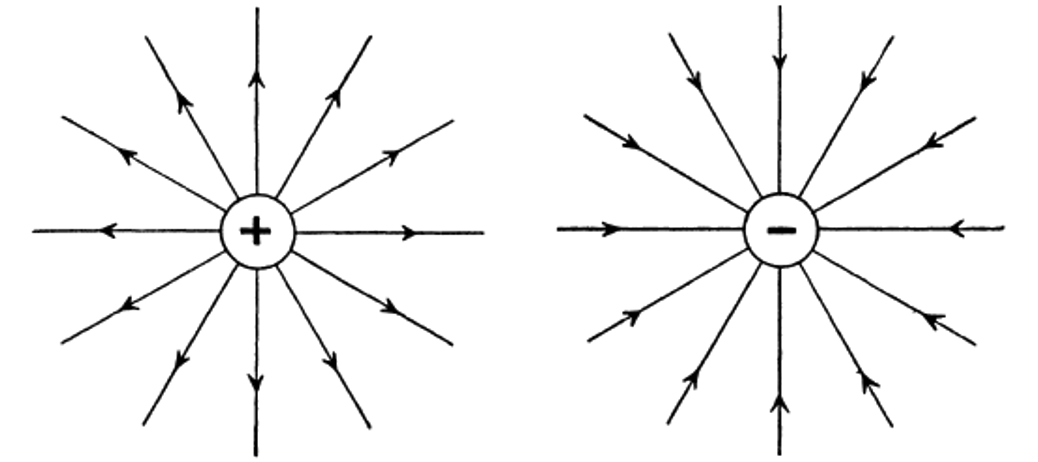
The new concepts originated in connection with the phenomena of electricity, but it is simpler to introduce them, for the first time, through mechanics. We know that two particles attract each other and that this force of attraction decreases with the square of the distance. We can represent this fact in a new way, and shall do so even though it is difficult to understand the advantage of this. The small circle in our drawing represents an attracting body, say, the sun. Actually, our diagram should be imagined as a model in space and not as a drawing on a plane. Our small circle, then, stands for a sphere in space, say, the sun. A body, the so-called test body, brought somewhere within the vicinity of the sun will be attracted along the line connecting the centres of the two bodies. Thus the lines in our drawing indicate the direction of the attracting force of the sun for different positions of the test body. The arrow on each line shows that the force is directed toward the sun; this means the force is an attraction. These are the lines of force of the gravitational field. For the moment, this is merely a name and there is no reason for stressing it further. There is one characteristic feature of our drawing which will be emphasized later. The lines of force are constructed in space, where no matter is present. For the moment, all the lines of force, or briefly speaking, the field, indicate only how a test body would behave if brought into the vicinity of the sphere for which the field is constructed.

Faraday’s lines of force are the earliest representation of field. They exist in space where there is no matter. They indicate only how a test body would behave if brought into the vicinity of the sphere for which the field is constructed.

The lines in our space model are always perpendicular to the surface of the sphere. Since they diverge from one point, they are dense near the sphere and become less and less so farther away. If we increase the distance from the sphere twice or three times, then the density of the lines, in our space model, though not in the drawing, will be four or nine times less. Thus the lines serve a double purpose. On the one hand, they show the direction of the force acting on a body brought into the neighbourhood of the sphere-sun. On the other hand, the density of the lines of force in space shows how the force varies with the distance. The drawing of the field, correctly interpreted, represents the direction of the gravitational force and its dependence on distance. One can read the law of gravitation from such a drawing just as well as from a description of the action in words, or in the precise and economical language of mathematics. This field representation, as we shall call it, may appear clear and interesting, but there is no reason to believe that it marks any real advance. It would be quite difficult to prove its usefulness in the case of gravitation. Some may, perhaps, find it helpful to regard these lines as something more than drawings, and to imagine the real actions of force passing through them. This may be done, but then the speed of the actions along the lines of force must be assumed as infinitely great! The force between two bodies, according to Newton’s law, depends only on distance; time does not enter the picture. The force has to pass from one body to another in no time! But, as motion with infinite speed cannot mean much to any reasonable person, an attempt to make our drawing something more than a model leads nowhere.

The lines of force indicate the direction of the force. The density of the lines of force in space shows how the force varies with the distance. This field cannot be looked upon as if force passes from one body to another in no time.

We do not intend, however, to discuss the gravitational problem just now. It served only as an introduction, simplifying the explanation of similar methods of reasoning in the theory of electricity.

We shall begin with a discussion of the experiment which created serious difficulties in our mechanical interpretation. We had a current flowing through a wire circuit in the form of a circle. In the middle of the circuit was a magnetic needle. The moment the current began to flow a new force appeared, acting on the magnetic pole, and perpendicular to any line connecting the wire and the pole. This force, if caused by a circulating charge, depended, as shown by Rowland’s experiment, on the velocity of the charge. These experimental facts contradicted the philosophical view that all forces must act on the line connecting the particles and can depend only upon distance.

The field is helpful in sketching out much more complex lines of force, such as those around a wire carrying a current. It contradicts the philosophical view that all forces must act on the line connecting the particles and can depend only upon distance.

The exact expression for the force of a current acting on a magnetic pole is quite complicated, much more so, indeed, than the expression for gravitational forces. We can, however, attempt to visualize the actions just as we did in the case of a gravitational force. Our question is: with what force does the current act upon a magnetic pole placed somewhere in its vicinity? It would be rather difficult to describe this force in words. Even a mathematical formula would be complicated and awkward. It is best to represent all we know about the acting forces by a drawing, or rather by a spatial model, with lines of force. Some difficulty is caused by the fact that a magnetic pole exists only in connection with another magnetic pole, forming a dipole. We can, however, always imagine the magnetic needle of such length that only the force acting upon the pole nearer the current has to be taken into account. The other pole is far enough away for the force acting upon it to be negligible. To avoid ambiguity we shall say that the magnetic pole brought nearer to the wire is the positive one.

The character of the force acting upon the positive magnetic pole can be read from our drawing.

First we notice an arrow near the wire indicating the direction of the current, from higher to lower potential. All other lines are just lines of force belonging to this current and lying on a certain plane. If drawn properly, they tell us the direction of the force vector representing the action of the current on a given positive magnetic pole as well as something about the length of this vector. Force, as we know, is a vector, and to determine it we must know its direction as well as its length. We are chiefly concerned with the problem of the direction of the force acting upon a pole. Our question is: how can we find, from the drawing, the direction of the force, at any point in space?

It is best to represent complicated forces by a drawing, or rather by a spatial model, with lines of force.

The rule for reading the direction of a force from such a model is not as simple as in our previous example, where the lines of force were straight. In our next diagram only one line of force is drawn in order to clarify the procedure. The force vector lies on the tangent to the line of force, as indicated. The arrow of the force vector and the arrows on the line of force point in the same direction. Thus this is the direction in which the force acts on a magnetic pole at this point. A good drawing, or rather a good model, also tells us something about the length of the force vector at any point. This vector has to be longer where the lines are denser, i.e., near the wire, shorter where the lines are less dense, i.e., far from the wire.

The force vector lies on the tangent to the line of force. A good drawing, or rather a good model, also tells us something about the length of the force vector at any point. This vector has to be longer where the lines are denser.

In this way, the lines of force, or in other words, the field, enable us to determine the forces acting on a magnetic pole at any point in space. This, for the time being, is the only justification for our elaborate construction of the field. Knowing what the field expresses, we shall examine with a far deeper interest the lines of force corresponding to the current. These lines are circles surrounding the wire and lying on the plane perpendicular to that in which the wire is situated. Reading the character of the force from the drawing, we come once more to the conclusion that the force acts in a direction perpendicular to any line connecting the wire and the pole, for the tangent to a circle is always perpendicular to its radius. Our entire knowledge of the acting forces can be summarized in the construction of the field. We sandwich the concept of the field between that of the current and that of the magnetic pole in order to represent the acting forces in a simple way.

The lines of force, or the field, enable us to determine the forces acting on a magnetic pole at any point in space. For a wire carrying current, these lines are circles surrounding the wire and lying on the plane perpendicular to that in which the wire is situated.

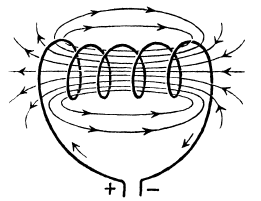
Every current is associated with a magnetic field, i.e., a force always acts on a magnetic pole brought near the wire through which a current flows. We may remark in passing that this property enables us to construct sensitive apparatus for detecting the existence of a current. Once having learned how to read the character of the magnetic forces from the field model of a current, we shall always draw the field surrounding the wire through which the current flows, in order to represent the action of the magnetic forces at any point in space. Our first example is the so-called solenoid. This is, in fact , a coil of wire as shown in the drawing. Our aim is to learn, by experiment, all we can about the magnetic field associated with the current flowing through a solenoid and to incorporate this knowledge in the construction of a field. A drawing represents our result. The curved lines of force are closed, and surround the solenoid in a way characteristic of the magnetic field of a current.

Every current is associated with a magnetic field, i.e., a force always acts on a magnetic pole brought near the wire through which a current flows. The curved lines of force are closed, and surround the solenoid in a way characteristic of the magnetic field of a current.

The field of a bar magnet can be represented in the same way as that of a current. Another drawing shows this. The lines of force are directed from the positive to the negative pole. The force vector always lies on the tangent to the line of force and is longest near the poles because the density of the lines is greatest at these points. The force vector represents the action of the magnet on a positive magnetic pole. In this case the magnet and not the current is the “source” of the field.

The field of a bar magnet can be represented in the same way as that of a current. The lines of force are directed from the positive to the negative pole.

Our last two drawings should be carefully compared. In the first, we have the magnetic field of a current flowing through a solenoid; in the second, the field of a bar magnet. Let us ignore both the solenoid and the bar and observe only the two outside fields. We immediately notice that they are of exactly the same character; in each case the lines of force lead from one end of the solenoid or bar to the other.

The field representation yields its first fruit! It would be rather difficult to see any strong similarity between the current flowing through a solenoid and a bar magnet if this were not revealed by our construction of the field.

We notice that the magnetic field of a current flowing through a solenoid is of exactly the same character as the field of a bar magnet.

The concept of field can now be put to a much more severe test. We shall soon see whether it is anything more than a new representation of the acting forces. We could reason: assume, for a moment, that the field characterizes all actions determined by its sources in a unique way. This is only a guess. It would mean that if a solenoid and a bar magnet have the same field, then all their influences must also be the same. It would mean that two solenoids, carrying electric currents, behave like two bar magnets, that they attract or repel each other, depending exactly as in the case of bars, on their relative positions. It would also mean that a solenoid and a bar attract or repel each other in the same way as two bars. Briefly speaking, it would mean that all actions of a solenoid through which a current flows and of a corresponding bar magnet are the same, since the field alone is responsible for them, and the field in both cases is of the same character. Experiment fully confirms our guess!

All actions of a solenoid through which a current flows and of a corresponding bar magnet are the same, since the field alone is responsible for them, and the field in both cases is of the same character.

How difficult it would be to find those facts without the concept of field! The expression for a force acting between a wire through which a current flows and a magnetic pole is very complicated. In the case of two solenoids, we should have to investigate the forces with which two currents act upon each other. But if we do this, with the help of the field, we immediately notice the character of all those actions at the moment when the similarity between the field of a solenoid and that of a bar magnet is seen.

We have the right to regard the field as something much more than we did at first. The properties of the field alone appear to be essential for the description of phenomena; the differences in source do not matter. The concept of field reveals its importance by leading to new experimental facts.

The properties of the field alone appear to be essential for the description of phenomena; the differences in source do not matter. The concept of field reveals its importance by leading to new experimental facts.

The field proved a very helpful concept. It began as something placed between the source and the magnetic needle in order to describe the acting force. It was thought of as an “agent” of the current, through which all action of the current was performed. But now the agent also acts as an interpreter, one who translates the laws into a simple, clear language, easily understood.

The first success of the field description suggests that it may be convenient to consider all actions of currents, magnets and charges indirectly, i.e., with the help of the field as an interpreter. A field may be regarded as something always associated with a current. It is there even in the absence of a magnetic pole to test its existence. Let us try to follow this new clue consistently.

The field also acts as an interpreter, one who translates the laws into a simple, clear language, easily understood.

The field of a charged conductor can be introduced in much the same way as the gravitational field, or the field of a current or magnet. Again only the simplest example! To design the field of a positively charged sphere, we must ask what kind of forces are acting on a small positively charged test body brought near the source of the field, the charged sphere. The fact that we use a positively and not a negatively charged test body is merely a convention, indicating in which direction the arrows on the line of force should be drawn. The model is analogous to that of a gravitational field (p. 130) because of the similarity between Coulomb’s law and Newton’s. The only difference between the two models is that the arrows point in opposite directions. Indeed, we have repulsion of two positive charges and attraction of two masses. However, the field of a sphere with a negative charge will be identical with a gravitational field since the small positive testing charge will be attracted by the source of the field.

If both electric and magnetic poles are at rest, there is no action between them, neither attraction nor repulsion. Expressing the same fact in the field language, we can say: an electrostatic field does not influence a magnetostatic one and vice versa. The words “static field” mean a field that does not change with time. The magnets and charges would rest near one another for an eternity if no external forces disturbed them. Electrostatic, magnetostatic and gravitational fields are all of different character. They do not mix; each preserves its individuality regardless of the others.

Electrostatic, magnetostatic and gravitational fields are all of different character. They do not mix; each preserves its individuality regardless of the others.

Let us return to the electric sphere which was, until now, at rest, and assume that it begins to move owing to the action of some external force. The charged sphere moves. In the field language this sentence reads: the field of the electric charge changes with time. But the motion of this charged sphere is, as we already know from Rowland’s experiment, equivalent to a current. Further, every current is accompanied by a magnetic field. Thus the chain of our argument is:

We, therefore, conclude: The change of an electric field produced by the motion of a charge is always accompanied by a magnetic field.

The change of an electric field produced by the motion of a charge is always accompanied by a magnetic field.

Our conclusion is based on Oersted’s experiment, but it covers much more. It contains the recognition that the association of an electric field, changing in time, with a magnetic field is essential for our further argument.

As long as a charge is at rest there is only an electrostatic field. But a magnetic field appears as soon as the charge begins to move. We can say more. The magnetic field created by the motion of the charge will be stronger if the charge is greater and if it moves faster. This also is a consequence of Rowland’s experiment. Once again using the field language, we can say: the faster the electric field changes, the stronger the accompanying magnetic field.

The faster the electric field changes, the stronger the accompanying magnetic field.

We have tried here to translate familiar facts from the language of fluids, constructed according to the old mechanical view, into the new language of fields. We shall see later how clear, instructive, and far-reaching our new language is.

The new language of fields is much more clear, instructive, and far-reaching than the old mechanical view provided by the language of fluids.

.

Final Comment

A field represents lines of force in space. Electrostatic, electromagnetic and gravitational fields are different character. Their lines of force do not mix; each preserves its individuality regardless of the others.

The direction and density of force may vary in the field, but it maintains continuity. The field provides the connection between source and its effect. It explains the mystery of “action at a distance.”

.

Einstein 1938: Ether and the Mechanical View

Reference: Evolution of Physics

This paper presents Chapter II, section 10 from the book THE EVOLUTION OF PHYSICS by A. EINSTEIN and L. INFELD. The contents are from the original publication of this book by Simon and Schuster, New York (1942).

The paragraphs of the original material (in black) are accompanied by brief comments (in color) based on the present understanding.  Feedback on these comments is appreciated.

The heading below is linked to the original materials.

.

Ether and the Mechanical View

The discussion of all the various attempts to understand the mechanical nature of the ether as a medium for transmitting light would make a long story. A mechanical construction means, as we know, that the substance is built up of particles with forces acting along lines connecting them and depending only on the distance. In order to construct the ether as a jelly-like mechanical substance physicists had to make some highly artificial and unnatural assumptions. We shall not quote them here; they belong to the almost forgotten past. But the result was significant and important. The artificial character of all these assumptions, the necessity for introducing so many of them all quite independent of each other, was enough to shatter the belief in the mechanical point of view.

A mechanical construction means that the substance is built up of particles with forces acting along lines connecting them and depending only on the distance. But this view declines as the thickness of substance decreases.

But there are other and simpler objections to ether than the difficulty of constructing it. Ether must be assumed to exist everywhere, if we wish to explain optical phenomena mechanically. There can be no empty space if light travels only in a medium.

Yet we know from mechanics that interstellar space does not resist the motion of material bodies. The planets, for example, travel through the ether-jelly without encountering any resistance such as a material medium would offer to their motion. If ether does not disturb matter in its motion, there can be no interaction between particles of ether and particles of matter. Light passes through ether and also through glass and water, but its velocity is changed in the latter substances. How can this fact be explained mechanically? Apparently only by assuming some interaction between ether particles and matter particles. We have just seen that in the case of freely moving bodies such interactions must be assumed not to exist. In other words, there is interaction between ether and matter in optical phenomena, but none in mechanical phenomena! This is certainly a very paradoxical conclusion!

The thicker is the substance the slower is its velocity. Matter particles are extremely condensed ether particles. For them to move as a wave, ether must constantly condense as the matter particle passes, and then decondense.

There seems to be only one way out of all these difficulties. In the attempt to understand the phenomena of nature from the mechanical point of view, throughout the whole development of science up to the twentieth century, it was necessary to introduce artificial substances like electric and magnetic fluids, light corpuscles, or ether. The result was merely the concentration of all the difficulties in a few essential points, such as ether in the case of optical phenomena. Here all the fruitless attempts to construct an ether in some simple way, as well as the other objections, seem to indicate that the fault lies in the fundamental assumption that it is possible to explain all events in nature from a mechanical point of view. Science did not succeed in carrying out the mechanical programme convincingly, and today no physicist believes in the possibility of its fulfilment.

The inconsistencies seem to indicate that the fault lies in the fundamental assumption that it is possible to explain all events in nature from a limited mechanical point of view.

In our short review of the principal physical ideas we have met some unsolved problems, have come upon difficulties and obstacles which discouraged the attempts to formulate a uniform and consistent view of all the phenomena of the external world. There was the unnoticed clue in classical mechanics of the equality of gravitational and inertial mass. There was the artificial character of the electric and magnetic fluids. There was, in the interaction between electric current and magnetic needle, an unsolved difficulty. It will be remembered that this force did not act in the line connecting the wire and the magnetic pole, and depended on the velocity of the moving charge. The law expressing its direction and magnitude was extremely complicated. And finally, there was the great difficulty with the ether.

The mechanical view does not fully explain gravitation, electrical charge, magnetic force of the moving current, and the nature of aether.

Modern physics has attacked all these problems and solved them. But in the struggle for these solutions new and deeper problems have been created. Our knowledge is now wider and more profound than that of the physicist of the nineteenth century, but so are our doubts and difficulties.

The effort to resolve these problems with limited mechanical view has led to new problems. Therefore, the mechanical view itself needs to be examined and expanded.

WE SUMMARIZE:

In the old theories of electric fluids, in the corpuscular and wave theories of light, we witness the further attempts to apply the mechanical view. But in the realm of electric and optical phenomena we meet grave difficulties in this application.

A moving charge acts upon a magnetic needle. But the force, instead of depending only upon distance, depends also upon the velocity of the charge. The force neither repels not attracts but acts perpendicular to the line connecting the needle and the charge.

In optics we have to decide in favour of the wave theory against the corpuscular theory of light. Waves spreading in a medium consisting of particles, with mechanical forces acting between them, are certainly a mechanical concept. But what is the medium through which light spreads and what are its mechanical properties? There is no hope of reducing the optical phenomena to the mechanical ones before this question is answered. But the difficulties in solving this problem are so great that we have to give it up and thus give up the mechanical views as well.

The observations of electrical and optical phenomena are inconsistent with mechanical explanations. For example, the force generated by moving charge does not depend on distance. In optics, we need to explain the very nature of substance.

.

Final Comment

Aether appears to be the most fundamental fabric, the increasing condensation of which produces light and the spectrum of radiation; the electrical fluids and an array of quantum particles; and matter and its properties of inertia and gravitation.

Spinning of matter particle produces centeredness of inertia along its axis. Circular motion of electrical charges produces magnetic lines of force along its axis. Rotating fields of light produce polarization along its axis.

.

Einstein 1938: Longitudinal or Transverse Light Waves?

Reference: Evolution of Physics

This paper presents Chapter II, section 9 from the book THE EVOLUTION OF PHYSICS by A. EINSTEIN and L. INFELD. The contents are from the original publication of this book by Simon and Schuster, New York (1942).

The paragraphs of the original material (in black) are accompanied by brief comments (in color) based on the present understanding.  Feedback on these comments is appreciated.

The heading below is linked to the original materials.

.

Longitudinal or Transverse Light Waves?

All the optical phenomena we have considered speak for the wave theory. The bending of light around small obstacles and the explanation of refraction are the strongest arguments in its favour. Guided by the mechanical point of view we realize that there is still one question to be answered: the determination of the mechanical properties of the ether. It is essential for the solution of this problem to know whether light waves in the ether are longitudinal or transverse. In other words: is light propagated like sound? Is the wave due to changes in the density of the medium, so that the oscillations of the particles are in the direction of the propagation? Or does the ether resemble an elastic jelly, a medium in which only transverse waves can be set up and whose particles move in a direction perpendicular to that in which the wave itself travels?

Guided by the mechanical point of view we realize that there is still one question to be answered: the determination of the mechanical properties of the ether. 

Before solving this problem, let us try to decide which answer should be preferred. Obviously, we should be fortunate if light waves were longitudinal. The difficulties in designing a mechanical ether would be much simpler in this case. Our picture of ether might very probably be something like the mechanical picture of a gas that explains the propagation of sound waves. It would be much more difficult to form a picture of ether carrying transverse waves. To imagine a jelly as a medium made up of particles in such a way that transverse waves are propagated by means of it is no easy task. Huygens believed that the ether would turn out to be “air-like” rather than “jelly-like”. But nature cares very little for our limitations. Was nature, in this case, merciful to the physicists attempting to understand all events from a mechanical point of view? In order to answer this question we must discuss some new experiments.

Longitudinal waves have varying density of medium in the direction of propagation. Transverse waves have no such variation of density; instead they have displacement in a direction perpendicular to the direction of propagation.

We shall consider in detail only one of many experiments which are able to supply us with an answer. Suppose we have a very thin plate of tourmaline crystal, cut in a particular way which we need not describe here. The crystal plate must be thin so that we are able to see a source of light through it. But now let us take two such plates and place both of them between our eyes and the light. What do we expect to see? Again a point of light, if the plates are sufficiently thin. The chances are very good that the experiment will confirm our expectation. Without worrying about the statement that it may be chance, let us assume we do see the light point through the two crystals. Now let us gradually change the position of one of the crystals by rotating it. This statement makes sense only if the position of the axis about which the rotation takes place is fixed. We shall take as an axis the line determined by the incoming ray. This means that we displace all the points of the one crystal except those on the axis. A strange thing happens! The light gets weaker and weaker until it vanishes completely. It reappears as the rotation continues and we regain the initial view when the initial position is reached.

Without going into the details of this and similar experiments we can ask the following question: can these phenomena be explained if the light waves are longitudinal? In the case of longitudinal waves the particles of the ether would move along the axis, as the beam does. If the crystal rotates, nothing along the axis changes. The points on the axis do not move, and only a very small displacement takes place nearby. No such distinct change as the vanishing and appearance of a new picture could possibly occur for a longitudinal wave. This and many other similar phenomena can be explained only by the assumption that light waves are transverse and not longitudinal! Or, in other words, the “jelly-like” character of the ether must be assumed.

This is very sad! We must be prepared to face tremendous difficulties in the attempt to describe the ether mechanically.

Light displaying transverse wave characteristics shall only mean that its density does not vary in the direction of propagation; instead it shifts sideways.

.

Final Comment

Monochromatic light has a certain thickness or frequency. That has been the result of a longitudinal compression of substance. Polarization of monochromatic light simply adds a rotational shifting on top of the longitudinal compression. The longitudinal compression provides particle characteristics. The rotational shifting provides the wave characteristics.

.