Category Archives: Science

Disagreement with Einstein

einsteintongue

References:

Mindful Subject Clearing – Physics

The Disturbance Hypothesis of Light

KHTK Postulates for Physics

.

From Evolution of Physics by Einstein

III. FIELD, RELATIVITY – Ether and motion (page 185)

Let us now write down the facts which have been sufficiently confirmed by experiment without bothering any more about the “e___r” problem.

(1) The velocity of light in empty space always has its standard value, independent of the motion of the source or receiver of light.

(2) In two c.s. moving uniformly, relative to each other, all laws of nature are exactly identical and there is no way of distinguishing absolute uniform motion.

There are many experiments to confirm these two statements and not a single one to contradict either of them. The first statement expresses the constant character of the velocity of light, the second generalizes the Galilean relativity principle, formulated for mechanical phenomena, to all happenings in nature.

In mechanics, we have seen: If the velocity of a material point is so and so, relative to one c.s., then it will be different in another c.s. moving uniformly, relative to the first. This follows from the simple mechanical transformation principles. They are immediately given by our intuition (man moving relative to ship and shore) and apparently nothing can be wrong here! But this transformation law is in contradiction to the constant character of the velocity of light. Or, in other words, we add a third principle:

(3) Positions and velocities are transformed from one inertial system to another according to the classical transformation.

The contradiction is then evident. We cannot combine (1), (2), and (3).

The classical transformation seems too obvious and simple for any attempt to change it. We have already tried to change (1) and (2) and came to a disagreement with experiment. All theories concerning the motion of “e___r” required an alteration of (1) and (2). This was no good. Once more we realize the serious character of our difficulties. A new clue is needed. It is supplied by accepting the fundamental assumptions (1) and (2), and, strange though it seems, giving up (3). The new clue starts from an analysis of the most fundamental and primitive concepts; we shall show how this analysis forces us to change our old views and removes all our difficulties.

.

Einstein’s conclusion in (1) is incorrect.

The velocity of light in empty space is not constant. The velocity of light is so much greater than the velocity of a material source of light that it appears to be constant.

Per Disturbance hypothesis, the velocity of electromagnetic radiation shall depend on its frequency. No experiment so far has been accurate enough to detect the difference in velocities of the colors in the visible spectrum. No experiments have been conducted to compare the velocity of light to the velocity of radio waves to the far left of the electromagnetic spectrum; or to the velocity of cosmic rays to the far right of the electromagnetic spectrum. The velocity of light cannot be considered an absolute constant.

.

Einstein’s conclusion in (2) is correct.

There is no way of distinguishing absolute uniform motion.

When considering the laws of nature one must also take into account the effect of inherent inertia on natural phenomena. The inherent inertia of light is very different from the inherent inertia of a moving body. This was not taken into account when comparing the velocity of light to the velocity of a material source of light in experiments that formed Einstein’s conclusion in (1).

.

Einstein’s decision to give up (3) is correct.

The classical transformation is “matter-centric” rather than “ether-centric.”

The “ether-centric” transformation shall take into account the effect of inherent inertia on natural phenomena as considered in Disturbance hypothesis. Please note that the Disturbance hypothesis still needs to be worked out in mathematical detail.

.

The Mystery of Ether

folding_space_by_ether

References:

Mindful Subject Clearing – Physics

The Disturbance Hypothesis of Light

KHTK Postulates for Physics

.

From Evolution of Physics by Einstein

III. FIELD, RELATIVITY – Ether and motion

Thus arose one of the most dramatic situations in the history of science. All assumptions concerning ether led nowhere! The experimental verdict was always negative. Looking back over the development of physics we see that the ether, soon after its birth, became the enfant terrible of the family of physical substances. First, the construction of a simple mechanical picture of the ether proved to be impossible and was discarded. This caused, to a great extent, the breakdown of the mechanical point of view. Second, we had to give up hope that through the presence of the ether-sea one c.s. would be distinguished and lead to the recognition of absolute, and not only relative, motion. This would have been the only way, besides carrying the waves, in which ether could mark and justify its existence. All our attempts to make ether real failed. It revealed neither its mechanical construction nor absolute motion. Nothing remained of all the properties of the ether except that for which it was invented, i.e. its ability to transmit electromagnetic waves. Our attempts to discover the properties of the ether led to difficulties and contradictions. After such bad experiences, this is the moment to forget the ether completely and to try never to mention its name. We shall say: our space has the physical property of transmitting waves, and so omit the use of a word we have decided to avoid.

.

All these difficulties resolve when we postulate ether to be a field with no inertia, but which has the ability to transmit electromagnetic waves that have inertia. Ether became “enfant terrible of the family of physical substances” because, to be real, it had to be a substance with inertia, just like anything else.

Ether cannot be described mechanically because the mechanical view assumes mass in all substances, where mass is an expression of inertia. The principles of mechanics apply only to substances with mass, and energy is assumed to be something exchanged among such substances. Mechanics has no concept of energy that is not associated with mass.

Electricity and Magnetism were first assumed to be fluids following the mechanical view. But this caused some fundamental difficulties. These difficulties were finally resolved with the formation of Maxwell’s equations. These equations made the existence of electrical and magnetic fields real without associating them with the concept of mass.

Einstein first viewed ether as a massless substance in the form of a “field”. This was the ether-sea of Einstein. It was expected to provide a coordinate system in which motion could be measured in some absolute sense. But this was found not to be the case.

Einstein writes, “All our attempts to make ether real failed.” This is because reality in the physical universe is viewed as substance with inertia. It is hard for a physicist to conceive of “substance” devoid of inertia.

Einstein then writes, “Nothing remained of all the properties of the ether except that for which it was invented, i.e. its ability to transmit electromagnetic waves.” And that is the reality, and also the truth.

Ether is a “substance” with no inertia, which has the ability to transmit electromagnetic waves that have the property of inertia.

In the final analysis there is no absolute motion.

This is the Disturbance Hypothesis.

.

Michelson-Morley experiment

mminterfclean

From Evolution of Physics by Einstein

III. FIELD, RELATIVITY – Ether and motion

The situation grows more and more serious. Two assumptions have been tried. The first, that moving bodies carry ether along. The fact that the velocity of light does not depend on the motion of the source contradicts this assumption. The second, that there exists one distinguished c.s. and that moving bodies do not carry the ether but travel through an ever calm ether-sea. If this is so, then the Galilean relativity principle is not valid and the speed of light cannot be the same in every c.s. Again we are in contradiction with experiment.

.

I do not think that moving bodies carry ether along. When a disturbance moves through a medium it does not carry the medium along. According to the wave theory, light would be a disturbance in ether. Therefore, the motion of light would not carry ether along. Light has no mass, but it has some inertia that is proportional to its frequency. This inertia manifests as momentum. So light moves through ether at a great but finite speed.

Please note that we are viewing ether as a “field” with zero inertia. It does not have motion, or lack of motion, in some absolute sense.

According to the Disturbance hypothesis, matter is also a disturbance moving through ether. The inertia of a body, such as earth, manifests as mass because it is several orders of magnitude greater than the inertia of light. So a body is expected to move through ether at a speed several orders of magnitude slower than the speed of light.

Current estimates put the speed of earth to be about 104 times slower than the speed of light, but it assumes the inertial basis for light to be the same as that for earth. When we use the inertial basis to be ether, the speed of earth is estimated to be 250 or 1015 times slower than the speed of light. This is a very rough estimate but it is enough to show that the motion of earth relative to ether would be virtually undetectable. Experiments, even more accurate than Michelson-Morley experiment, shall be incapable of detecting earth’s motion relative to ether. It is then no surprise that the motion of source will have no effect on the velocity of light.

Einstein’s conclusion that moving bodies do not carry ether along is correct because even solid bodies move as disturbance in ether per the Disturbance Hypothesis. But to Einstein this meant that the Galilean relativity principle was not valid and the speed of light could not be the same in every coordinate system.

But this contradiction can be explained by the Disturbance Hypothesis. Experimentally, the speed of light appears to be same in every coordinate system because any difference is virtually impossible to detect. Furthermore, Galilean relativity principle needs to be expanded to account for the differences in inertia per the disturbance levels.

The famous Michelson-Morley experiment is fully understandable, without contradiction, in the light of Disturbance Hypothesis.

.

Galilean Relativity

galileantennis

Einstein says in The Evolution of Physics:

We really have no choice. We tried to save the Galilean relativity principle by assuming that systems carry the ether along in their motion, but this led to a contradiction with experiment. The only way out is to abandon the Galilean relativity principle and try out the assumption that all bodies move through the calm ether-sea.

 .

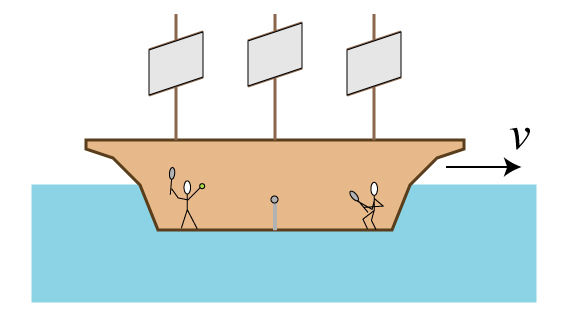
Galilean relativity states that the laws of motion are the same in all inertial frames. Galileo Galilei first described this principle in 1632 using the example of a ship traveling at constant velocity, without rocking, on a smooth sea; any observer doing experiments below the deck would not be able to tell whether the ship was moving or stationary.

It is assumed that the medium should move with the motion of inertial frame along with the disturbance, as in the case of sound waves, for Galilean relativity to work. Thus, ether as the medium of light is expected to move with the inertial frame, but there is no experimental evidence found for that.

This can be explained by observing that the inertia associated with the medium of light is several orders of magnitude smaller than the inertia associated with the medium of sound. An object cannot move through a “medium” having the same order of inertia. But such restriction need not apply when the “medium” has a level of inertia several orders of magnitude smaller.

Galilean relativity applies only to objects and medium that has the same order of inertia. We simply have to be aware of this limitation. We need not abandon the Galilean relativity principle.

The error has been in viewing everything physical from the inertial frame of matter.

.

Addition (September 27, 2019)

Lorentz transformation of relativity reduces to Galilean transformation when ‘c’ is infinite. That means that Galilean transformation applies to motion that is absolute. Newton looked the background of stars as the basis that was at absolute rest.

Therefore, Galilean transformation applies to absolute motion, which is the inverse of the density of substance (see The Universal Frame of Reference). Galilean transformation does not apply to relative motion except when density is constant.

Therefore, Galilean transformation applies in the material domain as long as the density of objects is comparable. This is not the case with Mercury, which 4 times as dense as the Earth and 12 times as dense as the Sun. That is why we get an error when we use Newton’s laws, that support Galilean transformation, to calculate the precession of the perihelion of Mercury’s orbit.

We get better results when we use Lorentz transformation because we are using light as the basis. This does not rectify the error completely because ‘c’ is very large but not infinite. We may be able to rectify the error completely if we can determine the absolute motions of all the bodies involved using their density and then use Galilean transformation.

.

Comment (Apr 13, 2026)

.

Relativity and the Coordinate System

viewing

Einstein says in THE EVOLUTION OF PHYSICS:

We must, therefore, give up the analogy between sound and light waves and turn to the second possibility: that all matter moves through the ether, which takes no part whatever in the motion. This means that we assume the existence of a sea of ether with all c.s. resting in it, or moving relative to it. 

.

I think that the analogy between sound and light waves is valid once we view the phenomena with some understanding of the differences in their Disturbance Levels.

Matter appears to move through ether because the two exist at entirely different Disturbance Levels.

Forward motion of the disturbance is many orders of magnitude higher at the level of ether (DL50), than at the level of matter (DL100). On the other hand, internal agitation is many orders of magnitude higher at DL100, than at DL50. These two levels hardly contribute  to each other in terms of either motion or agitation.

Ether is simply there in the background of matter.

The actual background is formed by space at DL0. We may then view all phenomena  as follows.

  1. Light wave or Ether at DL50.

  2. Sound wave or Matter at DL100

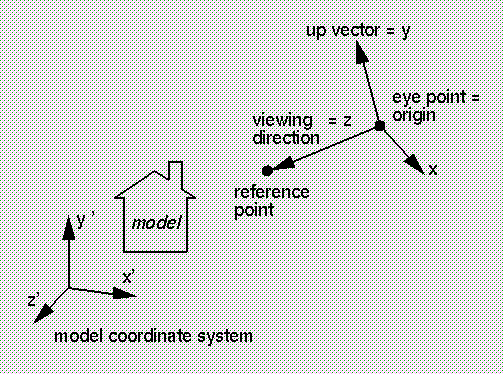
There is confusion because we are assuming our Coordinate System at DL100. From this coordinate system we assume the speed of light to be a constant at 3 x 10⁸ m/s. It makes better sense to use DL0 as the basis of the Coordinate System. Then we can properly evaluate the relationship between the disturbance levels of ether and matter.

The present Coordinate System is “matter-centric” because it is based on our perception at the level of matter. This is similar to the pre-Galileo “earth-centric” view of the universe.

.

Comment (Apr 13, 2026)

.