Category Archives: Religion

Glossary of Spiritual Terms

The purpose of this Glossary is to express ancient Vedic knowledge using modern scientific language. The “translation” may not be exactly right at first, but, hopefully, it shall improve as better input is received.

.

AGNI
The Vedas start with homage to Agni. Agni implies energy in all its forms. It is animated by an innate impulse. Energy is the basic substance of the universe. Everything physical, spiritual, real, imaginary, postulated or considered, is made of energy.

BECOMING ONE
To “become one” is to know something so intimately that there is no distance left. For example, when you are expert in riding a bicycle, you have become one with that bicycle. You push pedals and apply brakes without putting attention on them. But you are fully aware of those actions, and you can change them whenever you want. To “become one with God” is to know the universal laws so well that you operate according to them without having attention on them. When one says, “the seer and scenery has become one,” it implies knowingness. See KNOWINGNESS.

BEING
A being is an energy form animated by an innate impulse.

BHAGAVĀN
Bhagavān literally means “fortunate”, “blessed”, and hence “illustrious”, “divine”, “venerable”, “holy”, etc. Please see Etymology and meaning.
“He who understands the creation and dissolution, the appearance and disappearance of beings, the wisdom and ignorance, should be called Bhagavān.” — Vishnu Purana, VI.5.78

BRAHMA
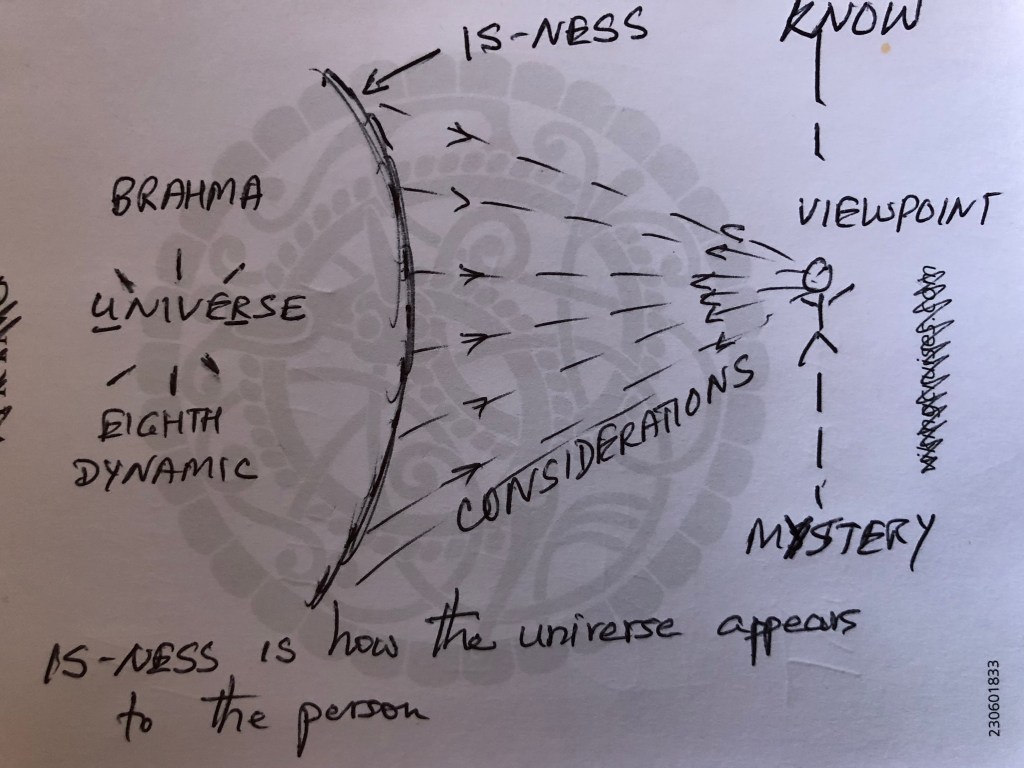
Brahma is the innate impulse manifested as energy in the form of the whole universe.

In modern language one would say that the highest metaphysical reality is the innate impulse, which is the characteristic of all energy. This impulse, on a universal scale, is understood as Brahma (the universal viewpoint). But, on the scale of an entity, it is understood as Atman (the individual viewpoint). There is quite a distance from Atman (or Paramatman) to Brahma in terms of broadness of the viewpoint.
CONSCIOUSNESS
Consciousness is the level of awareness of the mind. The greater is the refinement of the data elements (and the relationships among them) from perception, the higher is the consciousness. Human consciousness is much higher than the consciousness in animals, because the data elements are much more refined with greater number of relationships among them. See MIND.

DHARMA
Dharma means, literally, “the Law of Being.”  It refers to the natural purpose of something. For example, the “Dharma” of the sun is to shine and give warmth.

ISHVARA (ईश्वर)
The composite word, Ishvara literally means “owner of best, beautiful”, “ruler of choices, blessings, boons”, or “chief of suitor, lover”. As a concept, Ishvara in ancient and medieval Sanskrit texts, variously means God, Supreme Being, Supreme Soul, lord, king or ruler, rich or wealthy man, god of love, deity Vishnu… [in Vedas,] the contextual meaning, however as the ancient Indian grammarian Pāṇini explains, is neither god nor supreme being. Please see Etymology.

IS-NESS
It is how the universe appears to a person

IMMORTALITY
State of freedom from all samskaras (karmic impressions)

KALPA
One day of Brahma equal to 1000 Yugas, equal to 4320 million years. See Hindu units of time.

KNOWINGNESS
Knowingness is to know something so intimately that it has become part of you. For example, an expert has knowingness in his area of expertise. He knows his area so well that he can skillfully carry out the actions in that area without thinking. We associate absolute knowingness with God, but that is an ideal one holds. In reality, there is no absolute knowingness.

MAYA
Maya consists of filters generated by karmic impressions that cloud one’s vision.

MIND
The mind is the organ of mental sense. In a normal functioning mind, the perceptions are received through the senses of touch, sight, hearing, taste and smell. These perceptions break down into fine data elements, which are then arranged in a matrix type structure. Experience is stored as patterns of relationships among these data elements. The duplication of data elements is minimized. New perception is assimilated by arranging them in existing patterns with the correct time stamp and removing duplicate data elements. The existing patterns are modified and extended as necessary. Also see ASSIMILATION.

MINDFULNESS
A presence, which is free of assumptions, bias and fixed ideas

REALITY
Reality and unreality are the opposite ends of the scale of Is-ness, where is-ness is the sense of reality of the person. His is-ness on this scale improves as his viewpoint broadens.

SACRIFICE
Sacrifice is surrendering one’s self-interests and devotedly working for the sake of the welfare of the world.

SAMĀDHI (समाधि)
Samādhi means concentration of the thoughts, profound or abstract meditation, intense contemplation of any particular object (so as to identify the contemplator with the object meditated upon); this is the eighth and last stage of yoga; with Buddhists samādhi is the fourth and last stage of dhyāna or intense abstract meditation. The deep sleep like state of samadhi is the period of assimilation in which you completely reset your system. But you don’t live in that state. Samadhi leads you toward the universal viewpoint. Being “established in God” would means being established in the universal viewpoint.

SAMSKARAS
Karmic impressions brought about by one’s actions and their consequences

SAT-CHIT-ANAND
The bliss of pure thought energy

SURRENDER (in yoga)
Surrendering is “not avoiding, not denying, not resisting, and not suppressing.” It is experiencing fully what is there. You free yourself from an unwanted condition only by becoming fully aware of it. Suppressing is not the same thing as surrendering. If a person is suppressing bad habits to become good, he has not surrendered yet. After you have surrendered, only your basic nature is left. The basic nature operates according to the universal laws

THOUGHT ENERGY
Thought energy is the fundamental energy on which the spectrum of radiative energy and matter rest. The thought energy resides in the mind, which then transitions into physical energy of the body.

TRAUMA
The traumas are like “tumors” in the data matrix of the mind. They are made up of painful perceptions that did not get assimilated. They have only a few connection with the data matrix. They get reactivated when perception comes through these few connections. These “traumas” have their own unhealthy patterns that are backed up by the force of mental pain. The continual reactivation of traumatic experiences then gradually infects and conditions the healthy parts of the mental matrix by forcefully imposing unhealthy patterns. These unhealthy patterns contain all the emotional baggage, phobias, fixed ideas, prejudices, biases, etc., that you encounter. The traumas are not easy to access because they are not assimilated into the mental matrix. Repairing infected circuits in the mental matrix may allow, ultimately, to uncover these traumas and blow them; at which point many deep rooted problems also resolve. See ASSIMILATION, MIND.

UNREALITY
Unreality manifests itself in the form of inconsistencies, disharmonies and discontinuities. You resolve these things and the unreality disappears. It does not continue. Only the reality continues.

VIDHATA
Vidhata means “inherent principles of existence.” Duality is a natural consequence of these principles. Any imbalance straightens out by itself.

YAJNA
Yajna means selfless action done for the welfare of the world. For example, Jnana yajna is performed to spread jnana for larger benefit of community. The ritual of yajna is a symbol for such action. See SACRIFICE.

.
Atman & Paramatman

Does the spider have an atman? There is some energy that is animating the spider. It is not as sophisticated as the energy which is animating the human body. But, in both cases, it is some kind of energy, which we may call atman. So, atman is not the same thing as some human identity, or any other identity.

The concept of atman is not the same as the idea of “soul” in Christianity or in other Semitic religions. All those ideas are based on the human identity one has been attached to while living. So he wants the same identity to continue after death as “soul”.

Two ideas are psychologically deep-rooted in man: self-protection and self-preservation. For self-protection man has created God, on whom he depends for his own protection, safety and security, just as a child depends on its parent. For self-preservation man has conceived the idea of an immortal Soul, which will live eternally. In his ignorance, weakness, fear, and desire, man needs these two things to console himself. Hence he clings to them deeply and fanatically.

The objective view of PARAMATMAN and ATMAN is very different from the subjective view of God and Soul as described above because the psychological factors of self-protection and self-preservation are not there.

Bhakti Yoga starts out with the subjective view of God and Soul. On the other hand, Jnana Yoga seeks to obtain the objective view of PARAMATMAN and ATMAN directly.

The Law of Evolution

A person represents that part of the universe that is trying to evolve. We may think that an individual may not succeed in making a change beyond the conditioned change. But, by the grace of God, he may very well make a breakthrough.

You cannot just make an arbitrary change. Any change you make must continue the evolution that has taken place; it must be in harmony with what exists; and it must not generate an inconsistency. That is the law of evolution.

In other words, to reflect sanity, any postulate you make must be continuous, harmonious and consistent with the universe that exists.

You may postulate anything, but it may not necessarily be consistent with the environment around you. To make it consistent you’ll have to change the environment too, otherwise, you are simply conditioning your mind. It would be self-hypnotism, or MAYA as called in Hinduism.

.

Time

Time represents what is persisting. And that, which is persisting, is either an actual evolution of knowledge or just a conditioned mind. In other words, you are either going up the Know-to-Mystery scale, or you are going down.

But Time is the simply the abstract notion of PERSISTENCE.

.

God & Universe

VEDAS say that everything has evolved from God, because God is not separate from the universe.

But Christianity gives God a human like beingness and says that God created this universe. In other words, Christianity postulates a separation between God and the universe. But that is an inconsistent postulate. God is not just an image or reflection of humanity. God is the entire universe.

God has always been the universe–then and now. God has been the evolving universe all along. We are part of God and spearheading this evolution.

.

The Law of Spirituality

The main lesson that I have learned about meditation is to be non-judgmental and non-resistive in perceiving what is there. The mind does its own thing, and that is a phenomenon worthy of observation too.

Regulation of what one says to others is part of being thoughtful. But I see no reason why one must regulate or suppress one’s own thoughts from oneself in meditation.

In fact, in my view, such a suppression of thoughts brings about a lack of clarity in one’s consideration of what is there.

When you suppress your undesirable thoughts they stay with you. They don’t go away. You are simply not-is-ing them (telling yourself it is not there) using your idea of morality.

But as you closely examine your thoughts you suddenly realize why the undesirable thoughts are there. The moment you know this underlying truth, the undesirable thoughts vanish forever.

You may get rid of your undesirable thoughts only by as-is-ing them (seeing them as they are). This is mindfulness meditation.

This is the basic Law of spirituality. Religions get derailed and get a bad name when the followers do not follow this Law of Spirituality.

.

Morality

People are often conditioned by social morality enforced by the Church. This gets into conflict with their natural sense of ethics. A person who has fixed beliefs about morality is heavily denying that he has any undesirable thoughts, while he is full of them.

A person who is regulating his thought by suppressing them from himself is not being honest with himself. Therefore, he will not be able to resolve his undesirable thoughts and make spiritual progress.

In short, morality is imposed on a person by the society. The sense of ethics is natural to the person. An imposition of morality suppresses the natural sense of ethics of the person and conditions his thinking.

.

Grace

The mechanical element is the predictability of things and associations according to existing conditioning.

The true spiritual element is the unpredictability of the appearance and disappearance of things and associations. It is this unpredictability of the spiritual element that is interpreted by humans as the “grace of god”.

But, like any dichotomy, “spiritual and mechanical” form the two ends of the same graduated scale. In other words, these concepts are relative to each other.

.

BIBLE: MATTHEW (Chapter 2)

Reference: Religion

[NOTE: I present here my interpretation and understanding of some of the religious texts.  I apologize ahead of time if my presentation does not quite agree with the traditional interpretation. I welcome any discussion and consequent correction.]

.

BIBLE: MATTHEW (Chapter 2)

Verses 1 to 12 narrate the renown of Jesus right from his birth as the king of Jews. This summoned wise men from the East (by means of a new star) to worship him. It also alarmed King Herod of Judea.

Verses 13 to 18 narrate that Joseph, the father of Jesus, realized that Jesus was in danger. So, he, with his family, moved to Egypt. When King Herod heard of this escape, he ordered all boys in Bethlehem and its vicinity, who were two years old and under, to be killed.

Verses 19 to 21 narrate that when Joseph found out that King Herod had died, he returned to the district of Galilee, and settled in a town called Nazareth.         

A close up of a map

Description automatically generated
Judea and the district of Galilee

This account emphasizes magical events, stark portrayal of evil, and fulfilling of earlier prophecies. Believers may take this story to be factual, which in their mind, adds to the mystique and, therefore, divinity of Jesus. Here we are seeing a viewpoint that is operating in mystery. It has a tendency to equate mystery with divinity.

From Wikipedia:

“Most modern biographers of Herod, and probably a majority of biblical scholars, dismiss Matthew’s story as an invention. Contemporary non-biblical sources, including Herod’s friend and personal historian, Nicolas of Damascus, provide no corroboration for Matthew’s account of the massacre, and it is not mentioned in the Gospel of Luke. Classical historian Michael Grant states “[t]he tale is not history but myth or folk-lore”, while Peter Richardson notes that the story’s absence from the Gospel of Luke and the accounts of Josephus “work[s] against the account’s accuracy”. Richardson suggests that the event in Matthew’s gospel was inspired by Herod’s murder of his own sons.”

As an overview, the wisdom taught by Jesus is wonderful and it speaks for itself. The question arises, “Why must such mystique be attached to Jesus?”

In my opinion, it may have been difficult for the Church to convey the wisdom of Jesus to illiterate people. So, mystique was added to attract attention. This seems to be the case with all religions in general.

.