Category Archives: Buddhism

BUDDHISM: The Secret of the Flower

Reference: Buddhism

[NOTE: In color are Vinaire’s comments.]

Zen refuses to lock itself into a verbal casing; it is not founded on written words, and is outside the established teachings. Zen is not interested in theories about enlightenment; it wants the real thing. 

After Buddhism split into Theravada and Mahayana, Theravada continued as a fairly unified tradition, whereas Mahayana divided into a number of denominations or schools. The most popular of these, the Pure Land Sect, resembles the Pauline strand in Christianity in relying on faith—in its case faith in the “other power” of one of the Buddhas—to carry devotees to the Pure Land of the Western Paradise. In its popular reading this paradise bears many resemblances to the Christian heaven, though both admit of subtler interpretations in which paradise is regarded as an experiential state rather than a geographical place. Another important Mahayana school (Ti’en Tai in Chinese; Tendai in Japanese) introduced into Buddhism the Confucian predilections for learning and social harmony. It sought to find a place for all the Buddhist schools in a culminating treatise, The Lotus Sutra. We shall not go into these and smaller sects of Mahayana Buddhism; we shall reserve our space for, first, the Buddhism that Taoism profoundly influenced, namely Ch’an (Zen in Japanese), and second, the Buddhism that evolved in Tibet. The selection is partly determined by the fact that these are the branches of Buddhism that have attracted the most attention in the West, but there is the added advantage that they will take us to two quite different lands in which Buddhism has flourished. 

After Buddhism split into Theravada and Mahayana, Theravada continued as a fairly unified tradition, whereas Mahayana divided into a number of denominations or schools. 

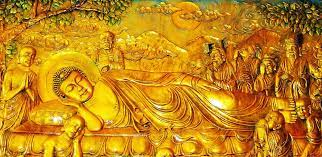
Because the Communist takeover of China disrupted its religious life, we shall pursue the Ch’an/Zen sect in its Japanese guise. Like other Mahayanist sects, this one claims to trace its perspective back to Gautama himself. His teachings that found their way into the Pali Canon, it holds, were those the masses seized upon. His more perceptive followers heard in his message a higher, subtler teaching. The classic instance of this is reported in the Buddha’s Flower Sermon. Standing on a mountain with his disciples around him, the Buddha did not on this occasion resort to words. He simply held aloft a golden lotus. No one understood the meaning of this eloquent gesture save Mahakasyapa, whose quiet smile, indicating that he had gotten the point, caused the Buddha to designate him as his successor. The insight that prompted the smile was transmitted in India through twenty-eight patriarchs and carried to China in A.D. 520 by Bodhidharma. Spreading from there to Japan in the twelfth century, it contains the secret of Zen.

The Zen sect of Mahayana Buddhism claims to trace its perspective back to Buddha’s Flower Sermon. The Buddha did not on this occasion resort to words. He simply held aloft a golden lotus. 

Entering Zen is like stepping through Alice’s looking glass. One finds oneself in a topsy-turvy wonderland where everything seems quite mad—charmingly mad for the most part, but mad all the same. It is a world of bewildering dialogues, obscure conundrums, stunning paradoxes, flagrant contradictions, and abrupt non sequiturs, all carried off in the most urbane, cheerful, and innocent style imaginable. Here are some examples: 

A master, Gutei, whenever he was asked the meaning of Zen, lifted his index finger. That was all. Another kicked a ball. Still another slapped the inquirer. 

A novice who makes a respectful allusion to the Buddha is ordered to rinse his mouth out and never utter that dirty word again. 

Someone claiming to understand Buddhism writes the following stanza:

The body is the Bodhi-Tree;
The mind is like the mirror bright.
Take heed to keep it always clean,
And let no dust collect upon it.

He is at once corrected by an opposite quatrain, which becomes accepted as the true Zen position:

Bodhi (True Wisdom) is not a tree;
The mind is not a mirror shining.
As there is nothing from the first,
Why talk of wiping off the dust?

A monk approaches a master saying, “I have just come to this monastery. Would you kindly give me some instruction?” The master asks, “Have you eaten your breakfast yet?” “I have.” “Then go wash your bowls.” The inquirer acquired the understanding he was seeking through this exchange. 

A group of Zen masters, gathered for conversation, have a great time declaring that there is no such thing as Buddhism, or Enlightenment, or anything even remotely resembling nirvana. They set traps for one another, trying to trick someone into an assertion that might imply the contrary. Practiced as they are, they always artfully elude traps and pitfalls, whereupon the entire company bursts into glorious, room-shaking laughter.

What goes on here? Is it possible to make any sense out of what at first blush looks like Olympian horseplay, if not a direct put-on? Can they possibly be serious in this kind of spiritual doubletalk, or are they simply pulling our legs? 

The answer is that they are completely serious, though it is true that they are rarely solemn. And though we cannot hope to convey their perspective completely, it being of Zen’s essence that it cannot be impounded in words, we can give some hint as to what they are up to. 

Zen’s essence is that it cannot be impounded in words. It is simply a presentation of anomalies to be resolved.

Let us admit at the outset that even this is going to be difficult, for we shall have to use words to talk about a position that is acutely aware of their limitations. Words occupy an ambiguous place in life. They are indispensable to our humanity, for without them we would be but howling yahoos. But they can also deceive, or at least mislead, fabricating a virtual reality that fronts for the one that actually exists. A parent can be fooled into thinking it loves its child because it addresses the child in endearing terms. A nation can assume that the phrase “under God” in its Pledge of Allegiance shows that its citizens believe in God when all it really shows is that they believe in believing in God. With all their admitted uses, words have three limitations. At worst they construct an artificial world wherein our actual feelings are camouflaged and people are reduced to stereotypes. Second, even when their descriptions are reasonably accurate, descriptions are not the things described—menus are not the meal. Finally, as mystics emphasize, our highest experiences elude words almost entirely. 

Words have limitations in describing the reality. Zen’s anomalies serve to keep the attention focused while unrestrained mindfulness meditation occurs in the mind leading to realizations.

Every religion that has developed even a modicum of semantic sophistication recognizes to some extent the way words and reason fall short of reality when they do not actually distort it. However much the rationalist may begrudge the fact, paradox and the transrational are religion’s life blood, and that of art as well. Mystics in every faith report contacts with a world that startles and transforms them with its dazzling darkness. Zen stands squarely in this camp, its only uniqueness being that it makes breaking the language barrier its central concern. 

Zen makes breaking the language barrier its central concern. 

Only if we keep this fact in mind have we a chance of understanding this outlook, which in ways is the strangest expression of mature religion. It was the Buddha himself, according to Zen tradition, who first made the point by refusing (in the Flower Sermon we have already alluded to) to equate his experiential discovery with any verbal expression. Bodhidharma continued in this tradition by defining the treasure he was bringing to China as “a special transmission outside the scriptures.” This seems so out of keeping with religion as usually understood as to sound heretical. Think of Hinduism with its Vedas, Confucianism with its Classics, Judaism with its Torah, Christianity with its Bible, Islam with its Koran. All would happily define themselves as special transmissions through their scriptures. Zen, too, has its texts; they are intoned in its monasteries morning and evening. In addition to the Sutras, which it shares with other branches of Buddhism, it has its own texts: the Hekigan Roku, the Mumonkan, and others. But one glance at these distinctive texts will reveal how unlike other scriptures they are. Almost entirely they are given to pressing home the fact that Zen cannot be equated with any verbal formula whatsoever. Account after account will depict disciples interrogating their masters about Zen, only to receive a roared “Ho!” for answer. For the master sees that through such questions, seekers are trying to fill the lack in their lives with words and concepts instead of realizations. Indeed, students will be lucky if they get off with verbal rebuffs. Often a rain of blows will be the retort as the master, utterly uninterested in the disciples’ physical comfort, resorts to the most forceful way he can think of to pry the questioner out of his mental rut.

Zen has its own texts, in addition to the sutras, which are almost entirely given to pressing home the fact that Zen cannot be equated with any verbal formula whatsoever. 

As we might expect, this unique stance toward scripture is duplicated in Zen’s attitude toward creeds. In contrast to most religions, which pivot around a creed of some sort, Zen refuses to lock itself into a verbal casing; it is “not founded on written words, and [is] outside the established teachings,” to return to Bodhidharma’s putting of the point. Signposts are not the destination, maps are not the terrain. Life is too rich and textured to be fitted into pigeonholes, let alone equated with them. No affirmation is more than a finger pointing to the moon. And, lest attention turn to the finger, Zen will point, only to withdraw its finger at once. Other faiths regard blasphemy and disrespect for God’s word as sins, but Zen masters may order their disciples to rip their scriptures to shreds and avoid words like Buddha or nirvana as if they were smut. They intend no disrespect. What they are doing is straining by every means they can think of to blast their novices out of solutions that are only verbal. “Not everyone who says to me, ‘Lord, Lord,’ will enter the kingdom of heaven” (Matthew 7:21). Zen is not interested in theories about enlightenment; it wants the real thing. So it shouts, and buffets, and reprimands, without ill-will entering in the slightest. All it wants to do is force the student to crash the wordbarrier. Minds must be sprung from their verbal bonds into a new mode of apprehending. 

Zen refuses to lock itself into a verbal casing; it is not founded on written words, and is outside the established teachings. Zen is not interested in theories about enlightenment; it wants the real thing. 

Every point can be overstated, so we should not infer from what has been said that Zen forgoes reason and words entirely. To be sure, it is no more impressed with the mind’s attempts to mirror ultimate reality than was Kierkegaard with Hegel’s metaphysics; no amount of polishing can enable a brick to reflect the sun. But it does not follow that reason is worthless. Obviously, it helps us make our way in the everyday world, a fact that leads Zennists in the main to be staunch advocates of education. But more. Working in special ways, reason can actually help awareness toward its goal. If the way that it is employed to do this seems at times like using a thorn to remove a thorn, we should add that reason can also play an interpretive role, serving as a bridge to join a newly discovered world to the world of common sense. For there is not a Zen problem whose answer, once discovered, does not make good sense within its own frame of reference; there is no experience that the masters are unwilling to try to describe or explain, given the proper circumstance. The point regarding Zen’s relation to reason is simply a double one. First, Zen logic and description make sense only from an experiential perspective radically different from the ordinary. Second, Zen masters are determined that their students attain the experience itself, not allow talk to take its place.

But it does not follow that reason is worthless. Working in special ways, reason can actually help awareness toward its goal. 

Nowhere is Zen’s determination on this latter point more evident than in the method it adopted for its own perpetuation. Whereas on the tricky matter of succession other religions turned to institutionalized mandates, papal succession, or creedal dicta, Zen trusted its future to a specific state of consciousness that was to be transmitted directly from one mind to another, like flame passed from candle to candle, or water poured from cup to cup. It is this “transmission of Buddha-mind to Buddha-mind” that constitutes the “special transmission” Bodhidharma cited as Zen’s essence. For a number of centuries this inward transmission was symbolized by the handing down of the Buddha’s robe and bowl from patriarch to patriarch, but in the Eighth Century the Sixth Patriarch in China concluded that even this simple gesture was a step toward confounding form with essence and ordered it discontinued. So here is a tradition that centers in a succession of teachers, each of whom has in principle inherited from his master a mindstate analogous to the one Gautama awakened in Mahakasyapa. Practice falls short of this principle, but the following figures suggest the steps that are taken to keep it in place. The master of the teacher under whom the author of this book studied estimated that he had given personal instruction to some nine hundred probationers. Of these, thirteen completed their Zen training, and four were given the inka—which is to say, they were confirmed as roshis (Zen masters) and authorized to teach.

It is this “transmission of Buddha-mind to Buddha-mind” that constitutes the “special transmission” Bodhidharma cited as Zen’s essence. 

And what is the training by which aspirants are brought toward the Buddha-mind that has been thus preserved? We can approach it by way of three key terms: zazen, koan, and sanzen

Zazen literally means “seated meditation.” The bulk of Zen training takes place in a large meditation hall. Visitors to these are struck by the seemingly endless hours the monks devote to sitting silently on two long, raised platforms that extend the length of the hall on either side, their faces toward the center (or to the walls, depending on which of the two main lineages of Zen the monastery is attached to). Their position is the lotus posture, adopted from India. Their eyes are half closed as their gaze falls unfocused on the tawny straw mats they are sitting on. 

Zazen literally means “seated meditation.” The bulk of Zen training takes place in a large meditation hall. 

Thus they sit, hour after hour, day after day, year after year, seeking to waken the Buddha-mind so they may later relate it to their daily lives. The most intriguing feature of the process is the use they make of one of the strangest devices for spiritual training anywhere to be encountered—the koan

In a general way koan means problem, but the problems Zen devises are fantastic. At first glance they look like nothing so much as a cross between a riddle and a shaggy dog story. For example:

A master, Wu Tsu, says, “Let me take an illustration from a fable. A cow passes by a window. Its head, horns, and the four legs all pass by. Why did not the tail pass by?” 

Or again: What was the appearance of your face before your ancestors were born? 

Another: We are all familiar with the sound of two hands clapping. What is the sound of one hand clapping? (If you protest that one hand can’t clap, you go to the foot of the class.) 

One more: Li-ku, a high-ranking officer in the Tang dynasty, asked a famous Ch’an master: “A long time ago a man kept a goose in a bottle. It grew larger and larger until it could not get out of the bottle any more. He did not want to break the bottle, nor did he wish to harm the goose. How would you get it out? 

The master was silent for a few moments, then shouted, “O Officer!” 
“Yes.” 
“It’s out!”

In a general way koan means problem, but the problems Zen devises are fantastic. Anyway, Zen is a direct practice of how to resolve anomalies. You let the answer form itself from deep inside you.

Our impulse is to dismiss these puzzles as absurd, but the Zen practitioner is not permitted to do this. He or she is ordered to direct the full force of the mind upon them, sometimes locking logic with them, sometimes dropping them into the mind’s deep interior to wait till an acceptable answer erupts, a project that on a single koan may take as long as a doctoral dissertation. 

During this time the mind is intently at work, but it is working in a very special way. We in the West rely on reason so fully that we must remind ourselves that in Zen we are dealing with a perspective that is convinced that reason is limited and must be supplemented by another mode of knowing. 

Beyond reason is letting the answer to deep questions simply bubble up.

For Zen, if reason is not a ball and chain, anchoring mind to earth, it is at least a ladder too short to reach to truth’s full heights. It must, therefore, be surpassed, and it is just this surpassing that koans are designed to assist. If they look scandalous to reason, we must remember that Zen is not trying to placate the mundane mind. It intends the opposite: to upset the mind—unbalance it and eventually provoke revolt against the canons that imprison it. But this puts the matter too mildly. By forcing reason to wrestle with what from its normal point of view is flat absurdity; by compelling it to conjoin things that are ordinarily incompatible, Zen tries to drive the mind to a state of agitation wherein it hurls itself against its logical cage with the desperation of a cornered rat. By paradox and non sequitur Zen provokes, excites, exasperates, and eventually exhausts the mind until it sees that thinking is never more than thinking about, or feeling more than feeling for. Then, having gotten the rational mind where it wants it—reduced to an impasse—it counts on a flash of sudden insight to bridge the gap between secondhand and firsthand life.

Light breaks on secret lots….
Where logics die
The secret grows through the eye.

Zen is not trying to placate the mundane mind. It intends the opposite: to upset the mind—unbalance it and eventually provoke revolt against the canons that imprison it. 

Before we dismiss this strange method as completely foreign, it is well to remember that Kierkegaard regarded meditation on the paradox of the Incarnation—the logical absurdity of the Infinite becoming finite, God becoming man—as the most rewarding of all Christian exercises. The koan appears illogical because reason proceeds within structured perimeters. Outside those perimeters the koan is not inconsistent; it has its own logic, a “Riemannian” logic we might say. Once the mental barrier has been broken, it becomes intelligible. Like an alarm clock, it is set to awaken the mind from its dream of rationality. A higher lucidity is at hand. 

There is a higher lucidity than rationality.

Struggling with his koan, the Zen monk is not alone. Books will not avail, and koans that are being worked on are not discussed with fellow monks, for this could only produce secondhand answers. Twice a day, though, on average, the monk confronts the master in private “consultation concerning meditation”—sanzen in Rinzai and dokusan in the Soto sect. These meetings are invariably brief. The trainee states the koan in question and follows it with his or her answer to date. The role of the master is then threefold. In the happy event that the answer is correct, he validates it, but this is his least important role, for a right answer usually comes with a force that is self-validating. A greater service is rendered in rejecting inadequate answers, for nothing so helps the student to put these permanently to one side as the master’s categorical rejection of them. This aspect of sanzen is fittingly described in the ninth-century Rules of Hyakujo as affording “the opportunity for the teacher to make a close personal examination of the student, to arouse him from his immaturity, to beat down his false conceptions and to rid him of his prejudices, just as the smelter removes the lead and quicksilver from the gold in the smelting-pot, and as the jade-cutter, in polishing the jade, discards every possible flaw.” The master’s other service is, like that of any exacting examiner, to keep the student energized and determined during the long years the training requires.

A right answer usually comes with a force that is self-validating. 

And to what does this zazen, koan training, and sanzen lead? The first important breakthrough is an intuitive experience called kensho or satori. Though its preparation may take years, the experience itself comes in a flash, exploding like a silent rocket deep within the subject and throwing everything into a new perspective. Fearful of being seduced by words, Zennists waste little breath in describing satoris, but occasionally accounts appear.

Ztt! I entered. I lost the boundary of my physical body. I had my skin, of course, but I felt I was standing in the center of the cosmos. I saw people coming toward me, but all were the same man. All were myself. I had never known this world before. I had believed that I was created, but now I must change my opinion: I was never created; I was the cosmos. No individual existed.

This explanation is beautiful.

From this and similar descriptions we can infer that satori is Zen’s version of the mystical experience, which, wherever it appears, brings joy, at-one-ment, and a sense of reality that defies ordinary language. But whereas the tendency is to relate such experiences to the zenith of the religious quest, Zen places them close to the point of departure. In a very real sense Zen training begins with satori. For one thing, there must be further satoris as the trainee learns to move with greater freedom in this realm. But the important point is that Zen, drawing half its inspiration from the practical, common-sense, this-worldly orientation of the Chinese to balance the mystical other-worldly half it derived from India, refuses to permit the human spirit to withdraw—shall we say retreat?—into the mystical state completely. Once we achieve satori, we must

get out of the sticky morass in which we have been floundering, and return to the unfettered freedom of the open fields. Some people may say: “If I have [achieved satori] that is enough. Why should I go further?” The old masters lashed out at such persons, calling them “earthworms living in the slime of self-accredited enlightenment.”

A Satori is not the end-all of enlightenment. There are many satoris ahead.

The genius of Zen lies in the fact that it neither leaves the world in the less-than-ideal state in which it finds it, nor withdraws from the world in aloofness or indifference. Zen’s object is to infuse the temporal with the eternal—to widen the doors of perception so that the wonder of the satori experience can flood the everyday world.

Zen’s object is to infuse the temporal with the eternal.

“What,” asks the student, “is the meaning of Bodhidharma’s coming from the West?” The master answers, “The cypress tree standing in the garden.” Being’s amazingness must be directly realized, and satori is its first discernment. But until—through recognizing the interpenetration and convertibility of all phenomena—its wonder spreads to objects as common as the tree in your backyard and you can perform your daily duties with the understanding that each is equally a manifestation of the infinite, Zen’s business has not been completed. 

But until you can perform your daily duties with the understanding that each is equally a manifestation of the infinite, Zen’s business has not been completed. 

With the possible exception of the Buddha himself, in no one is that business ever completely finished. Yet by extrapolating hints in the Zen corpus we can form some idea of what the condition of “the man who has nothing further to do” would be like. 

First, it is a condition in which life seems distinctly good. Asked what Zen training leads to, a Western student who had been practicing for seven years in Kyoto answered, “No paranormal experiences that I can detect. But you wake up in the morning and the world seems so beautiful you can hardly stand it.” 

There is a continuing sense of world’s beauty and life’s goodness.

Along with this sense of life’s goodness there comes, secondly, an objective outlook on one’s relation to others; their welfare impresses one as being as important as one’s own. Looking at a dollar bill, one’s gaze may be possessive; looking at a sunset, it cannot be. Zen attainment is like looking at the sunset. Requiring (as it does) awareness to the full, issues like “whose awareness?” or “awareness of what?” do not arise. Dualisms dissolve. As they do there comes over one a feeling of gratitude to the past and responsibility to things present and future. 

Zen attainment is like looking at the sunset. Requiring (as it does) awareness to the full, issues like “whose awareness?” or “awareness of what?” do not arise. 

Third, the life of Zen (as we have sought to emphasize) does not draw one away from the world; it returns one to the world—the world robed in new light. We are not called to worldly indifference, as if life’s object were to spring soul from body as piston from syringe. The call is to discover the satisfaction of full awareness even in its bodily setting. “What is the most miraculous of all miracles?” “That I sit quietly by myself.” Simply to see things as they are, as they truly are in themselves, is life enough. It is true that Zen values unity, but it is a unity that is simultaneously empty (because it erases lines that divide) and full (because it replaces those lines with ones that connect). Stated in the form of a Zen algorithm, “All is one, one is none, none is all.” Zen wears the air of divine ordinariness: “Have you eaten? Then wash your bowls.” If you cannot find the meaning of life in an act as simple as that of doing the dishes, you will not find it anywhere.

My daily activities are not different,
Only I am naturally in harmony with them.
Taking nothing, renouncing nothing,
In every circumstance no hindrance, no conflict…
Drawing water, carrying firewood,
This is supernatural power, this the marvelous activity.

The life of Zen does not draw one away from the world; it returns one to the world—the world robed in new light. 

With this perception of the infinite in the finite there comes, finally, an attitude of generalized agreeableness. “Yesterday was fair, today it is raining”; the experiencer has passed beyond the opposites of preference and rejection. As both pulls are needed to keep the relative world turning, each is welcomed in its proper turn. 

There is a poem by Seng Ts’an on “Trust in the Heart,” that stands as the purest expression of this ideal of total acceptance.

The perfect way knows no difficulties
Except that it refuses to make preferences;
Only when freed from hate and love
Does it reveal itself fully and without disguise;
A tenth of an inch’s difference,
And heaven and earth are set apart.
If you wish to see it before your own eyes
Have no fixed thoughts either for or against it.
To set up what you like against what you dislike—
That is the disease of the mind.
The Way is perfect like unto vast space,
With nothing wanting, nothing superfluous.
It is due to making choices
That its Suchness is lost sight of.
The One is none other than the All, the All none other than the One.
Take your stand on this, and the rest will follow of its own accord;
I have spoken, but in vain, for what can words tell
Of things that have no yesterday, tomorrow, or today?

Even truth and falsity look different. “Do not seek after truth. Merely cease to hold opinions.” 

Fifth, as the dichotomies between self and other, finite and infinite, acceptance and rejection are transcended, even the dichotomy between life and death disappears.

When this realization is completely achieved, never again can one feel that one’s individual death brings an end to life. One has lived from an endless past and will live into an endless future. At this very moment one partakes of Eternal Life—blissful, luminous, pure. 

The dichotomies between self and other, finite and infinite, acceptance and rejection are transcended. Even the dichotomy between life and death disappears.

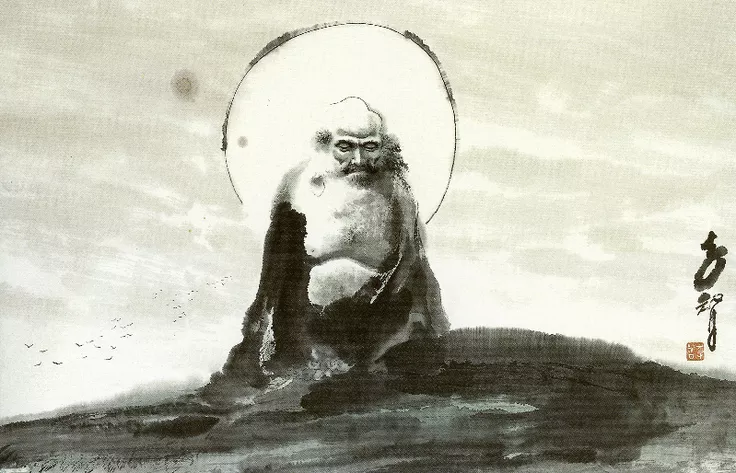
As we leave Zen to its future we may note that its influence on the cultural life of Japan has been enormous. Though its greatest influence has been on pervasive life attitudes, four ingredients of Japanese culture carry its imprint indelibly. In sumie or black ink landscape painting, Zen monks, living their simple lives close to the earth, have rivaled the skill and depth of feeling of their Chinese masters. In landscape gardening Zen temples surpassed their Chinese counterparts and raised the art to unrivaled perfection. Flower arrangement began in floral offerings to the Buddha, but developed into an art that until recently was a part of the training of every refined Japanese girl. Finally, there is the celebrated tea ceremony, in which an austere but beautiful setting, a few fine pieces of old pottery, a slow, graceful ritual, and a spirit of utter tranquility combine to epitomize the harmony, respect, clarity, and calm that characterize Zen at its best.

There is the celebrated tea ceremony, in which an austere but beautiful setting, a few fine pieces of old pottery, a slow, graceful ritual, and a spirit of utter tranquility combine to epitomize the harmony, respect, clarity, and calm that characterize Zen at its best.

.

BUDDHISM: Big Raft and Little

Reference: Buddhism

[NOTE: In color are Vinaire’s comments.]

In Theravada Buddhism the prime attribute of enlightenment is wisdom (bodhi), from which flow automatically the compassion for others. From the Mahayana perspective compassion must be given priority over wisdom from the beginning.

Thus far we have been looking at Buddhism as it appears from its earliest records. We turn now to Buddhist history and the record it provides of the variations that can enter a tradition as it seeks to minister to the needs of masses of people and multiple personality types. 

When we approach Buddhist history with this interest, what strikes us immediately is that it splits. Religions invariably split. In the West the twelve Hebrew tribes split into Israel and Judah. Christendom split into the Eastern and Western churches, the Western church split into Roman Catholicism and Protestantism, and Protestantism splinters. The same happens in Buddhism. The Buddha dies, and before the century is out the seeds of schism have been sown. One approach to the question of why Buddhism split would be through analyzing the events, personalities, and environments the religion became implicated with in its early centuries. We can cut through all that, however, by saying, simply, that Buddhism divided over the questions that have always divided people. 

Buddhism split just like most religions have split as they seeks to minister to the needs of masses of people and multiple personality types. 

How many such questions are there? How many questions will divide almost every assemblage of people whether in India, New York, or Madrid? Three come to mind. 

First, there is the question of whether people are independent or interdependent. Some people are most aware of their individuality; for them, their freedom and initiative is more important than their bondings. The obvious corollary is that they see people as making their own ways through life; what each achieves will be largely of his or her own doing. “I was born in the slums, my father was an alcoholic, all of my siblings went to the dogs—don’t talk to me about heredity or environment. I got to where I am by myself!” This is one attitude. On the other side of the fence are those for whom life’s inter-connectedness prevails. To them the separateness of people seems tenuous; they see themselves as supported and vectored by social fields that are as strong as those of physics. Human bodies are of course separate, but on a deeper level we are joined like icebergs in a common floe. “Send not to ask for whom the bell tolls, it tolls for thee.” 

There is the question of whether people are independent or interdependent, which will divide almost every assemblage of people. There is that strong feeling of individuality that contributes to it.

A second question concerns the relation in which human beings stand, not this time to their fellows, but to the universe. Is the universe friendly—helpful on the whole toward creatures? Or is it indifferent, if not hostile? Opinions differ. On bookstore shelves we find volumes with titles like Man Stands Alone, and next to them Man Does not Stand Alone and Man Is Not Alone. Some people see history as a thoroughly human project in which humanity raises itself by its own bootstraps or progress doesn’t happen. For others it is powered by “a higher power that makes for good.” 

A second question concerns the relation in which human beings stand, not this time to their fellows, but to the universe.

A third dividing question is: What is the best part of the human self, its head or its heart? A popular parlor game used to revolve around the question, “If you had to choose, would you rather be loved or respected?” It is the same point with a different twist. Classicists rank thoughts above feelings; romantics do the opposite. The first seek wisdom; the second, if they had to choose, prefer compassion. The distinction probably also relates to William James’s contrast between the tough-minded and the tender-minded. 

A third dividing question is: What is the best part of the human self, its head or its heart?

Here are three questions that have probably divided people as long as they have been human and continue to divide them today. They divided the early Buddhists. One group took as its motto the Buddha’s valedictory, “Be lamps unto yourselves; work out your salvation with diligence.” Whatever progress those in this group make will be the fruit of wisdom—insight into the cause of suffering as gained through meditation. The other group held that compassion is the more important feature of enlightenment, arguing that to seek enlightenment by oneself and for oneself is a contradiction in terms. For them, human beings are more social than individual, and love is the greatest thing in the world. 

One Buddhist group focused on the insight into the cause of suffering as gained through meditation. The other group held that compassion is the more important feature of enlightenment.

Other differences gathered around these fundamental ones. The first group insisted that Buddhism was a full-time job; those who made nirvana their central object would have to give up the world and become monks. The second group, perhaps because it did not rest all its hopes on self-effort, was less demanding. It held that its outlook was as relevant for the layperson as for the professional; that in its own way it was as applicable in the world as in the monastery. This difference left its imprint on the names of the two outlooks. Both called themselves yanas, rafts or ferries, for both claimed to carry people across life’s sea to the shores of enlightenment. The second group, however, pointing to its doctrine of cosmic help (grace) and its ampler regard for laypeople, claimed to be “Buddhism for the people” and thereby the larger of the two vehicles. Accordingly it preempted the name Mahayana, the Big Raft, maha meaning “great,” as in Mahatma (the Great Souled) Gandhi. As this name caught on, the other group came to be known, by default, as Hinayana, or the Little Raft. 

The second group, pointing to its doctrine of cosmic help (grace) and its ampler regard for laypeople, claimed to be Mahayana (Big Raft). As this name caught on, the other group came to be known, by default, as Hinayana, or the Little Raft.

Not exactly pleased with this invidious designation, the Hinayanists have preferred to call their Buddhism Theravada, the Way ofthe Elders. In doing so they regained the initiative by claiming to represent original Buddhism, the Buddhism taught by Gautama himself. The claim is justified if we confine ourselves to the explicit teachings of the Buddha as they are recorded in the earliest texts, the Pali Canon, for on the whole those texts do support the Theravada position. But this fact has not discouraged the Mahayanists from their counterclaim that it is they who represent the true line of succession. For, they argue, the Buddha taught more eloquently and profoundly by his life and example than by the words the Pali Canon records. The decisive fact about his life is that he did not remain in nirvana after his enlightenment but returned to devote his life to others. Because he did not belabor this fact, Theravadins (attending too narrowly to his initial spoken words, the Mahayanists contend) overlook the importance of his “great renunciation,” and this causes them to read his mission too narrowly.

Not exactly pleased with this invidious designation, the Hinayanists have preferred to call their Buddhism Theravada, the Way of the Elders. In doing so they regained the initiative by claiming to represent original Buddhism, the Buddhism taught by Gautama himself.

We can leave to the two schools their dispute over apostolic succession; our concern is not to judge but to understand the positions they embody. The differences that have come out thus far may be summarized by the following pairs of contrasts, if we keep in mind that they are not absolute but denote differences in emphasis. 

Our concern is not to judge but to understand the positions they embody. 

1. For Theravada Buddhism progress is up to the individual; it depends on his or her understanding and resolute application of the will. For Mahayanists the fate of the individual is linked to that of all life, and they are ultimately undivided. Two lines from John Whittier’s “The Meeting” summarize the latter outlook:

He findeth not who seeks his own
The soul is lost that’s saved alone.

Theravada Buddhism focuses on individual effort; whereas, for Mahayana Buddhism the fate of the individual is linked to that of all life.

2. Theravada holds that humanity is on its own in the universe. No gods exist to help us over the humps, so self-reliance is our only recourse.

By ourselves is evil done,
By ourselves we pain endure,
By ourselves we cease from wrong,
By ourselves become we pure.
No one saves us but ourselves,
No one can and no one may;
We ourselves must tread the Path:
Buddhas only show the way.

For Mahayana, in contrast, grace is a fact. We can be at peace because a boundless power draws—or if you prefer, propels—everything to its appointed goal. In the words of a famous Mahayana text, “There is a Buddha in every grain of sand.”

Theravada holds that humanity is on its own in the universe. For Mahayana, in contrast, grace is a fact.

3. In Theravada Buddhism the prime attribute of enlightenment is wisdom (bodhi), meaning profound insight into the nature of reality, the causes of anxiety and suffering, and the absence of a separate core of selfhood. From these realizations flow automatically the Four Noble Virtues: loving-kindness, compassion, equanimity, and joy in the happiness and wellbeing of others. From the Mahayana perspective karuna (compassion) cannot be counted on to be an automatic fruit. From the beginning compassion must be given priority over wisdom. Meditation yields a personal power that can be destructive if a person has not deliberately cultivated compassionate concern for others as the motive for arduous discipline. “A guard I would be to them who have no protection,” runs a typical Mahayana invocation; “a guide to the voyager, a ship, a well, a spring, a bridge for the seeker of the other shore.” The theme has been beautifully elaborated by Shantideva, a poet-saint who has been called the Thomas à Kempis of Buddhism:

May I be a balm to the sick, their healer and servitor until sickness come never again;
May I quench with rains of food and drink the anguish of hunger and thirst;
May I be in the famine of the age’s end their drink and meat;
May I become an unfailing store for the poor, and serve them with manifold things for their need.
My own being and my pleasures, all my righteousness in the past, present and future, I surrender indifferently,
That all creatures may win through to their end.

In Theravada Buddhism the prime attribute of enlightenment is wisdom (bodhi), from which flow automatically the compassion for others. From the Mahayana perspective compassion must be given priority over wisdom from the beginning.

4. The sangha (Buddhist monastic order) is at the heart of Theravada Buddhism. Monasteries (and to a lesser extent nunneries) are the spiritual dynamos in lands where it predominates, reminding everyone of a higher truth behind visible reality. Monks and nuns—only partially isolated from society because they are dependent on local people to put into their begging bowls their one daily meal—are accorded great respect. This veneration is extended to people who assume monastic vows for limited periods (a not uncommon practice) in order to practice mindfulness meditation intensively. In Burma “taking the robe” for a three-month monastic retreat has virtually marked the passage into male adulthood. Mahayana Buddhism, on the contrary, is primarily a religion for laypeople. Even its priests usually marry, and they are expected to make service to the laity their primary concern. 

The sangha (Buddhist monastic order) is at the heart of Theravada Buddhism. Mahayana Buddhism, on the contrary, is primarily a religion for laypeople.

5. It follows from these differences that the ideal type as projected by the two schools will differ appreciably. For the Theravadins the ideal was the Arhat, the perfected disciple who, wandering like the lone rhinoceros, strikes out alone for nirvana and, with prodigious concentration, proceeds unswervingly toward that goal. The Mahayana ideal, on the contrary, was the boddhisattva, “one whose essence (sattva) is perfected wisdom (bodhi)”—a being who, having reached the brink of nirvana, voluntarily renounces that prize and returns to the world to make nirvana available to others. The boddhisattva deliberately sentences himself—or herself: the best loved of all boddhisattvas is the Goddess of Mercy, Kwan Yin, in China—to agelong servitude in order that others, drawing vicariously on the merit thus accumulated, may enter nirvana first. 

The difference between the two types is illustrated in the story of four men who, journeying across an immense desert, come upon a compound surrounded with high walls. One of the four determines to find out what is inside. He scales the wall, and on reaching the top gives a whoop of delight and jumps over. The second and third do likewise. When the fourth man gets to the top of the wall, he sees below him an enchanted garden with sparkling streams, pleasant groves, and luscious fruit. Though longing to jump over, he resists the temptation. Remembering other wayfarers who are trudging the burning deserts, he climbs back down and devotes himself to directing them to the oasis. The first three men were Arhats; the last was a boddhisattva, one who vows not to desert this world “until the grass itself be enlightened”. 

For the Theravadins the ideal is the Arhat, the perfected disciple. The Mahayana ideal, on the contrary, is the boddhisattva, who, having reached the brink of nirvana, voluntarily renounces that prize and returns to the world to make nirvana available to others. 

6. This difference in ideal naturally floods back to color the two schools’ estimates of the Buddha himself. For one he was essentially a saint, for the other a savior. Theravadins revere him as a supreme sage, who through his own efforts awakened to the truth and became an incomparable teacher who laid out a path for them to follow. A man among men, his very humanness is the basis for the Theravadins’ faith that they, too, have the potential for enlightenment. But the Buddha’s direct personal influence ceased with his paranirvana (entrance into nirvana at death). He knows nothing more of this world of becoming and is at perfect peace. The reverence felt by the Mahayanists could not be satisfied with this humanness—extraordinary, to be sure, but human nonetheless. For them the Buddha was a world savior who continues to draw all creatures toward him “by the rays of his jewel hands.” The bound, the shackled, the suffering on every plane of existence, galaxy beyond galaxy, worlds beyond worlds, all are drawn toward liberation by the glorious “gift rays” of the Lord.

Theravadins revere Buddha as a supreme sage, who through his own efforts awakened to the truth and became an incomparable teacher. For Mahayanists the Buddha was a world savior who continues to draw all creatures toward him “by the rays of his jewel hands.”

These differences are the central ones, but several others may be mentioned to piece out the picture. Whereas the Theravadins followed their founder in considering speculation a useless diversion, Mahayana spawned elaborate cosmologies replete with many-leveled heavens and hells. The only kind of prayer the Theravadins countenanced was meditation and invocations to deepen faith and loving-kindness, whereas the Mahayanists added supplication, petition, and calling on the name of the Buddha for spiritual strength. Finally, whereas Theravada remained conservative to the point of an almost fundamentalistic adherence to the early Pali texts, Mahayana was liberal in almost every respect. It accepted later texts as equally authoritative, was less strict in interpreting disciplinary rules, and had a higher opinion of the spiritual possibilities of women and the laity in general. 

Whereas the Theravadins followed their founder in considering speculation a useless diversion, Mahayana spawned elaborate cosmologies replete with many-leveled heavens and hells. 

Thus, in the end, the wheel comes full circle. The religion that began as a revolt against rites, speculation, grace, and the supernatural, ends with all of them back in full force and its founder (who was an atheist as far as a personal God was concerned) transformed into such a God himself. We can schematize the differences that divide the two great branches of Buddhism as follows, if we bear in mind that the differences are not absolute:

Which one wins? Inwardly, there is no measure (or better, no such thing as winning); but outwardly (in terms of numbers), the answer is Mahayana. Part of the reason may lie in the fact that it converted one of the greatest kings the world has known. In the history of ancient royalty the figure of Asoka (c. 272–232 B.C.) stands out like a Himalayan peak, clear and resplendent against a sunlit sky. If we are not all Buddhists—Mahayana Buddhists—today it was not Asoka’s fault. Not content to board the Big Raft himself and commend it to his subjects—his Buddhist wheel of the law waves on India’s flag today—he strove to extend it over three continents. Finding Buddhism an Indian sect, he left it a world religion. 

In my opinion, one should become an Arhat and then take on the mantle of Bodhisattva. Buddha was both. 

It would be going too far, however, to suppose that a single historical personage made Buddhism cosmopolitan, and the different ways Asia heard the Buddha’s message and took it to heart provides a final touchstone for distinguishing Theravada from Mahayana. The differences that have occupied us thus far have been doctrinal, but there is an important socio-political difference between them as well.

There is a socio-political difference beyond the doctrinal difference.

Theravada sought to incarnate a feature of the Buddha’s teachings that has not thus far been mentioned: his vision of an entiresociety—a civilization if you will—that was founded like a tripod on monarchy, the monastic community (sangha), and the laity, each with responsibilities to the other two and meriting services from them in return. South Asian countries that remain to this day Theravadin—Sri Lanka, Burma, Thailand, and Cambodia—took this political side of the Buddha’s message seriously, and remnants of his model are discernible in those lands right down to today. China’s interest in Buddhism (which she transmitted to the other lands that were to become Mahayanist: Korea, Japan, and Tibet) bypassed its social dimensions, which included education as well as politics. In East Asian lands Buddhism appears as something of a graft. Buddhist missionaries persuaded the Chinese that they possessed psychological and metaphysical profundities the Chinese sages had not sounded, but Confucius had thought a lot about the social order, and the Chinese were not about to be lectured to on that subject by aliens. So China discounted the political proposals of the Buddha and took from his corpus its psycho-spiritual components with their cosmic overtones. The world still awaits a history of Buddhism that tells the story of the Theravada/Mahayana divide in terms of the way in which (for geographical and historical reasons) Theravada remained faithful to its founder’s vision of a Buddhist civilization, whereas Mahayana becomes Buddhism trimmed to its religious core: a module that could be grafted onto civilizations whose social foundations were securely in place. 

Theravada remained faithful to its founder’s vision of a Buddhist civilization, whereas Mahayana becomes Buddhism trimmed to its religious core: a module that could be grafted onto civilizations whose social foundations were securely in place. 

The doctrinal differences between Theravada and Mahayana appear to have softened as the centuries have gone by. Following World War II two young Germans who were disillusioned with Europe went to Sri Lanka to dedicate their lives to the Buddha’s peaceable way. Both became Theravada monks. One, his name changed to Nyanaponika Thera, continued on that path; but the other, while on a sightseeing trip to north India, met some Tibetans and switched to their tradition, becoming known in the West as Lama Govinda. Toward the close of Nyanaponika’s life a visitor asked him about the different Buddhisms the two friends had espoused. With great serenity and sweetness the aging Theravadin replied: “My friend cited the Bodhisattva Vow as the reason for his switch to Mahayana, but I could not see the force of his argument. For if one were to transcend self-centeredness completely, as the Arhat seeks to do, what would be left but compassion?”

Being an Arhat is the foundation of Bodhisattva.

.

BUDDHISM: Basic Buddhist Concepts

Reference: Buddhism

[NOTE: In color are Vinaire’s comments.]

The Buddha listed his Three Marks of Existence  as impermanence (anicca), suffering (dukkha) and the absence of permanent identity or a soul (anatta). We are freed from the pain of clutching for permanence only if the acceptance of continual change is driven into our very marrow.

The Buddha’s total outlook on life is as difficult to be certain of as that of any personage in history. Part of the problem stems from the fact that, like most ancient teachers, he wrote nothing. There is a gap of almost a century and a half between his spoken words and the first written records, and though memory in those times appears to have been incredibly faithful, a gap of that length is certain to raise questions. A second problem arises from the wealth of material in the texts themselves. Buddha taught for forty-five years, and a staggering corpus has come down to us in one form or another. While the net result is doubtless a blessing, the sheer quantity of materials is bewildering; for though his teachings remained remarkably consistent over the years, it was impossible to say things for many minds and in many ways without creating problems of interpretation. These interpretations constitute the third barrier. By the time texts began to appear, partisan schools had sprung up, some intent on minimizing the Buddha’s break with Brahmanic Hinduism, others intent on sharpening it. This makes scholars wonder how much in what they are reading is the Buddha’s actual thought and how much is partisan interpolation.

We are not certain how much we are reading is the Buddha’s actual thought and how much is partisan interpolation.

Undoubtedly, the most serious obstacle to the recovery of the Buddha’s rounded philosophy, however, is his own silence at crucial points. We have seen that his burning concerns were practical and therapeutic, not speculative and theoretical. Instead of debating cosmologies, he wanted to introduce people to a different kind of life. It would be wrong to say that theory did not interest him. His dialogues show that he analyzed certain abstract problems meticulously; that he possessed, indeed, a brilliant metaphysical mind. It was on principle that he resisted philosophy, as someone with a sense of mission might shun hobbies as a waste of time. 

Buddha’s burning concerns were practical and therapeutic, not speculative and theoretical. But his silence at crucial points is puzzling.

His decision makes so much sense that it may seem a betrayal to insert a section like this one, which tries forthrightly to identify—and to some extent define—certain key notions in the Buddha’s outlook. In the end, however, the task is unavoidable for the simple reason that metaphysics is unavoidable. Everyone harbors some notions about ultimate questions, and these notions affect interpretations of subsidiary issues. The Buddha was no exception. He refused to initiate philosophical discussions, and only occasionally did he let himself be pried from his “noble silence” to engage in them, but certainly he had views. No one who wishes to understand him can escape the hazardous task of trying to discover what they were. 

Buddha refused to initiate philosophical discussions, and only occasionally did he let himself be pried from his “noble silence” to engage in them, but certainly he had views.

We may begin with nirvana, the word the Buddha used to name life’s goal as he saw it. Etymologically it means “to blow out,” or “to extinguish,” not transitively, but as a fire ceases to draw. Deprived of fuel, the fire goes out, and this is nirvana. From such imagery it has been widely supposed that the extinction to which Buddhism points is complete, total annihilation. If this were so there would be grounds for the accusation that Buddhism is life-denying and pessimistic. As it is, scholars of the last half-century have exploded this view. Nirvana is the highest destiny of the human spirit and its literal meaning is extinction, but we must be precise as to what is to be extinguished. It is the boundaries of the finite self. It does not follow that what is left will be nothing. Negatively, nirvana is the state in which the faggots of private desire have been completely consumed and everything that restricts the boundless life has died. Affirmatively, it is that boundless life itself. Buddha parried every request for a positive description of the unconditioned, insisting that it was “incomprehensible, indescribable, inconceivable, unutterable”; for after we eliminate every aspect of the only consciousness we have known, how can we speak of what is left? One of Buddha’s heirs, Nagasena, preserves this point in the following dialogue. Asked what nirvana is like, Nagasena countered with a question of his own: 

“Is there such a thing as wind?”
“Yes, revered sir.”
“Please, sir, show the wind by its color or configuration or as thin or thick or long or short.”
“But it is not possible, revered Nagasena, for the wind to be shown; for the wind cannot be grasped in the hand or touched; yet wind exists.”
“If, sir, it is not possible for the wind to be shown, well then, there is no wind.”
“I, revered Nagasena, know that there is wind; I am convinced of it, but I am not able to show the wind.”
“Even so, sir, nirvana exists; but it is not possible to show nirvana.”

Buddha maintained that Nirvana is incomprehensible, indescribable, inconceivable, unutterable. [NOTE: Etymologically nirvana means “to blow out,” or “to extinguish.” This could refer to the “blowing out of all prior considerations or preconceived notions.”]

Our final ignorance is to imagine that our final destiny is conceivable. All we can know is that it is a condition that is beyond—beyond the limitations of mind, thoughts, feelings, and will, all these (not to mention bodily things) being confinements. The Buddha would venture only one affirmative characterization. “Bliss, yes bliss, my friends, is nirvana.” 

The Buddha would venture only one affirmative characterization. “Bliss, yes bliss, my friends, is nirvana.” 

Is nirvana God? When answered in the negative, this question has led to opposite conclusions. Some conclude that since Buddhism professes no God, it cannot be a religion; others, that since Buddhism obviously is a religion, religion doesn’t require God. The dispute requires that we take a quick look at what the word “God” means. 

Buddhism forces one to look carefully at the meaning of “God”.

Its meaning is not single, much less simple. Two meanings must be distinguished for its place in Buddhism to be understood. 

One meaning of God is that of a personal being who created the universe by deliberate design. Defined in this sense, nirvana is not God. The Buddha did not consider it personal because personality requires definition, which nirvana excludes. And while he did not expressly deny creation, he clearly exempted nirvana from responsibility for it. If absence of a personal Creator God is atheism, Buddhism is atheistic. 

If God is defined as a “personal creator” then Buddhism is atheistic. 

There is a second meaning of God, however, which (to distinguish it from the first) has been called the Godhead. The idea of personality is not part of this concept, which appears in mystical traditions throughout the world. When the Buddha declared, “There is, O monks, an Unborn, neither become nor created nor formed…. Were there not, there would be no deliverance from the formed, the made, the compounded,” he seemed to be speaking in this tradition. Impressed by similarities between nirvana and the Godhead, Edward Conze has compiled from Buddhist texts a series of attributes that apply to both. We are told

that Nirvana is permanent, stable, imperishable, immovable, ageless, deathless, unborn, and unbecome, that it is power, bliss and happiness, the secure refuge, the shelter, and the place of unassailable safety; that it is the real Truth and the supreme Reality; that it is the Good, the supreme goal and the one and only consummation of our life, the eternal, hidden and incomprehensible Peace.

We may conclude with Conze that nirvana is not God defined as personal creator, but that it stands sufficiently close to the concept of God as Godhead to warrant the name in that sense.

If God is defined as “Godhead” (the idea of personality is not part of this concept) that is unborn, uncreated and without form, then Buddhism is the truest religion.

The most startling thing the Buddha said about the human self is that it has no soul. This anatta (no soul) doctrine has again caused Buddhism to seem religiously peculiar. But again the word must be examined. What was the atta (Pali for the Sanskrit Atman or soul) that the Buddha denied? At the time it had come to signify (a) a spiritual substance that, in keeping with the dualistic position in Hinduism, (b) retains its separate identity forever. 

Buddha denied the existence of soul—that aspect of self, which retains its separate identity forever.

Buddha denied both these features. His denial of spiritual substance—the soul as homunculus, a ghostly wraith within the body that animates the body and outlasts it—appears to have been the chief point that distinguished his concept of transmigration from prevailing Hindu interpretations. Authentic child of India, the Buddha did not doubt that reincarnation was in some sense a fact, but he was openly critical of the way his Brahmanic contemporaries interpreted the concept. The crux of his criticism may be gathered from the clearest description he gave of his own view on the subject. He used the image of a flame being passed from candle to candle. As it is difficult to think of the flame on the final candle as being the original flame, the connection would seem to be a causal one, in which influence was transmitted by chain reaction but without a perduring substance. 

The Buddha did not doubt that reincarnation was in some sense a fact, but to him it was like a flame being passed from candle to candle. Here influence was transmitted by chain reaction but without a perduring substance, much like the DNA passing various characteristics from one generation to the next.

When to this image of the flame we add the Buddha’s acceptance of karma, we have the gist of what he said about transmigration. A summary of his position would run something like this: (1) There is a chain of causation threading each life to those that have led up to it, and to those that will follow. Each life is in its present condition because of the way the lives that led up to it were lived. (2) Throughout this causal sequence the will remains free. The lawfulness of things makes the present state the product of prior acts, but within the present the will is influenced but not controlled. People remain at liberty to shape their destinies. (3) The two preceding points affirm the causal connectedness of life, but they do not entail that a substance of some sort be transmitted. Ideas, impressions, feelings, streams of consciousness, present moments—these are all that we find, no spiritual substrate. Hume and James were right: If there is an enduring self, subject always, never object, it never shows itself.

Buddha’s acceptance of karma is consistent with the transmission of influence from one life to the next, as in the sense of the transmission of DNA programming.

An analogy can suggest the Buddha’s views of karma and reincarnation in a supporting way. (1) The desires and dislikes that influence the contents of my mind—what I pay attention to and what I ignore—have not appeared by accident; they have definite lineages. In addition to attitudes that I have taken over from my culture, I have formed mental habits. These include cravings of various sorts, tendencies to compare myself with others in pride or envy, and dispositions toward contentment and its opposite, aversion. (2) Although habitual reactions tend to become fixed, I am not bound by my personal history; I can have new ideas and changes of heart. (3) Neither the continuity nor the freedom these two points affirm requires that thoughts or feelings be considered entities—things, or mental substances that are transported from mind to mind, or from moment to moment. Acquiring a concern for justice from my parents did not mean that a substance, however ethereal and ghostlike, leapt from their heads into mine. 

Our tendencies, attitudes and mental habits have lineages, but these are not permanent substances that are transported from mind to mind. We are not bound by them.

This denial of spiritual substance was only an aspect of Buddha’s wider denial of substance of every sort. Substance carries both a general and a specific connotation. Generally, it refers to something relatively permanent that underlies surface changes in the thing in question; specifically, this more basic something is thought to be matter. The psychologist in Buddha rebelled against the latter notion, for to him mind was more basic than matter. The empiricist in him, for its part, challenged the implications of a generalized notion of substance. It is impossible to read much Buddhist literature without catching its sense of the transitoriness (anicca) of everything finite, its recognition of the perpetual perishing of every natural object. It is this that gives Buddhist descriptions of the natural world their poignancy. “The waves follow one after another in an eternal pursuit.” Or,

Life is a journey.
Death is a return to the earth.
The universe is like an inn.
The passing years are like dust.

Substance refers to something relatively permanent that underlies surface changes in the thing in question, but there is no substance that may be considered absolutely permanent or everlasting. The only thing that comes closest to being permanent is the impulse to evolve.

The Buddha listed impermanence (anicca) as the first of his Three Marks of Existence—characteristics that apply to everything in the natural order—the other two being suffering (dukkha) and the absence of permanent identity or a soul (anatta). Nothing in nature is identical with what it was the moment before; in this the Buddha was close to modern science, which has discovered that the relatively stable objects of the macro-world derive from particles that barely exist. To underscore life’s fleetingness the Buddha called the components of the human self skandas—skeins that hang together as loosely as yarn—and the body a “heap,” its elements no more solidly assembled than grains in a sandpile. But why did the Buddha belabor a point that may seem obvious? Because, he believed, we are freed from the pain of clutching for permanence only if the acceptance of continual change is driven into our very marrow. Followers of the Buddha know well his advice:

Regard this phantom world
As a star at dawn, a bubble in a stream,
A flash of lightning in a summer cloud,
A flickering lamp—a phantom—and a dream.

The Buddha listed his Three Marks of Existence  as impermanence (anicca), suffering (dukkha) and the absence of permanent identity or a soul (anatta). We are freed from the pain of clutching for permanence only if the acceptance of continual change is driven into our very marrow.

Given this sense of the radical impermanence of all things finite, we might expect the Buddha’s answer to the question “Do human beings survive bodily death?” to be a flat no, but actually his answer was equivocal. Ordinary people when they die leave strands of finite desire that can only be realized in other incarnations; in this sense at least these persons live on. But what about the Arhat, the holy one who has extinguished all such desires; does such a one continue to exist? When a wandering ascetic put this question, the Buddha said:

“The word reborn does not apply to him.”
“Then he is not reborn?”
“The term not-reborn does not apply to him.”
“To each and all of my questions, Gotama, you have replied in the negative. I am at a loss and bewildered.”
“You ought to be at a loss and bewildered, Vaccha. For this doctrine is profound, recondite, hard to comprehend, rare, excellent, beyond dialectic, subtle, only to be understood by the wise. Let me therefore question you. If there were a fire blazing in front of you, would you know it?”
“Yes, Gotama.”
“If the fire went out, would you know it had gone out?”
“Yes.”
“If now you were asked in what direction the fire had gone, whether to east, west, north, or south, could you give an answer?”
“The question is not rightly put, Gotama.”

Whereupon Buddha brought the discussion to a close by pointing out that “in just the same way” the ascetic had not rightly put his question. “Feelings, perceptions, forces, consciousness—everything by which the Arhat might be denoted has passed away for him. Profound, measureless, unfathomable, is the Arhat even as the mighty ocean; reborn does not apply to him nor not-reborn, nor any combination of such terms.”

Born and not-reborn are the two ends of a dimension that applies to the average person. This dimension simply does not apply to an Arhat, who has extinguished all desires, feelings, perceptions, forces, and consciousness.

It contributes to the understanding of this conversation to know that the Indians of that day thought that expiring flames do not really go out but return to the pure, invisible condition of fire they shared before they visibly appeared. But the real force of the dialogue lies elsewhere. In asking where the fire, conceded to have gone out, had gone, the Buddha was calling attention to the fact that some problems are posed so clumsily by our language as to preclude solution by their very formulation. The question of the illumined soul’s existence after death is such a case. If the Buddha had said, “Yes, it does live on,” his listeners would have assumed the persistence of our present mode of experiencing, which the Buddha did not intend. On the other hand, if he had said, “The enlightened soul ceases to exist,” his hearers would have assumed that he was consigning it to total extinction, which too he did not intend. On the basis of this rejection of extremes we cannot say much with certainty, but we can venture something. The ultimate destiny of the human spirit is a condition in which all identification with the historical experience of the finite self will disappear, while experience as such not only remains but is heightened beyond recognition. As an inconsequential dream vanishes completely on awakening, as the stars go out in deference to the morning sun, so individual awareness will be eclipsed in the blazing light of total awareness. Some say, “The dewdrop slips into the shining sea.” Others prefer to think of the dewdrop as opening to receive the sea itself. 

The ultimate destiny of the human spirit is a condition in which all identification with the historical experience of the finite self will disappear, while experience as such not only remains but is heightened beyond recognition.

If we try to form a more detailed picture of the state of nirvana, we shall have to proceed without the Buddha’s help, not only because he realized almost to despair how far the condition transcends the power of words, but also because he refused to wheedle his hearers with previews of coming attractions. Even so, it is possible to form some notion of the logical goal toward which his Path points. We have seen that the Buddha regarded the world as one of lawful order in which events are governed by the pervading law of cause and effect. The life of the Arhat, however, is one of increasing independence from the causal order of nature. It does not violate that order, but the Arhat’s spirit grows in autonomy as the world’s hold decreases. In this sense the Arhat is increasingly free not only from the passions and worries of the world but also from its happenings in general. With every growth of inwardness, peace and freedom replace the turbulent bondage of those whose lives are prey to circumstance. As long as spirit remains tied to body, its freedom from the particular, the temporal, and the changing cannot be complete. But sever this connection with the Arhat’s final death, and freedom from the finite will be complete. We cannot imagine what the state would be like, but the trajectory toward it is discernible. 

We cannot imagine what the state would be like, but the trajectory toward it is discernible. The Arhat’s spirit grows in autonomy as the world’s hold decreases.

Spiritual freedom brings largeness of life. The Buddha’s disciples sensed that he embodied immeasurably more of reality—and in that sense was more real—than anyone else they knew; and they testified from their own experience that advance along his path enlarged their lives as well. Their worlds seemed to expand, and with each step they felt themselves more alive than they had been before. As long as they were limited by their bodies, there were limits beyond which they could not go; but if all ties were loosed, might not they be completely free? Once more, we cannot concretely imagine such a state, but the logic of the progression seems clear. If increased freedom brings increased being, total freedom should be being itself.

A thousand questions remain, but the Buddha is silent.
Others abide our questions. Thou are free.
We ask and ask; thou smilest and art still.

If increased freedom brings increased being, total freedom should be being itself.

.

BUDDHISM: The Eightfold Path

Reference: Buddhism

[NOTE: In color are Vinaire’s comments.]

The result of right concentration is not simply a new philosophy of life; but a regeneration: change into a different kind of creature, who experienced the world in a new way.

The Buddha’s approach to the problem of life in the Four Noble Truths was essentially that of a physician. He began by examining carefully the symptoms that provoke concern. If everything were going smoothly, so smoothly that we noticed ourselves as little as we normally notice our digestion, there would be nothing to worry about and we would have to attend no further to our way of life. But this is not the case. There is less creativity, more conflict, and more pain than we feel there should be. These symptoms the Buddha summarized in the First Noble Truth, with the declaration that life is dukkha, or out of joint. The next step was diagnosis. Throwing rites and faith to the winds, he asked, practically, what is causing these abnormal symptoms? Where is the seat of the infection? What is always present when suffering is present, and absent when suffering is absent? The answer was given in the Second Noble Truth: the cause of life’s dislocation is tanha, or the drive for private fulfillment. What, then, of the prognosis? The Third Noble Truth is hopeful: the disease can be cured by overcoming the egoistic drive for separate existence. This brings us to prescription; how is this overcoming to be accomplished? The Fourth Noble Truth provides the answer. The way to the overcoming of self-seeking is through the Eightfold Path.

The Fourth Noble Truth provides the prescription to the overcoming the egoistic drive for separate existence, which throws life out of joint.

The Eightfold Path, then, is a course of treatment. But it is not an external treatment, to be accepted passively by the patient as coming from without. It is not treatment by pills, or rituals, or grace. Instead, it is treatment by training. People routinely train for sports and their professions, but with notable exceptions like Benjamin Franklin, they are inclined to assume that one cannot train for life itself. The Buddha disagreed. He distinguished two ways of living. One—a random, unreflective way, in which the subject is pushed and pulled by impulse and circumstance like a twig in a storm drain—he called “wandering about.” The second, the way of intentional living, he called the Path. What he proposed was a series of changes designed to release the individual from ignorance, unwitting impulse, and tanha. It maps a complete course; steep grades and dangerous curves are posted, and rest spots indicated. By long and patient discipline, the Eightfold Path intends nothing less than to pick one up where one is and set one down as a different human being, one who has been cured of crippling disabilities. “Happiness he who seeks may win,” the Buddha said, “if he practice.”

The cure comes about when the Eightfold Path is practiced.

What is this practice the Buddha is talking about? He breaks it down into eight steps. They are preceded, however, by a preliminary he does not include in his list, but refers to so often elsewhere that we may assume that he was presupposing it here. This preliminary step is right association. No one has recognized more clearly than the Buddha the extent to which we are social animals, influenced at every turn by the “companioned example” of our associates, whose attitudes and values affect us profoundly. Asked how one attains illumination, the Buddha began: “An arouser of faith appears in the world. One associates oneself with such a person.” Other injunctions follow, but right association is so basic that it warrants another paragraph.

The preliminary step is right association.

When a wild elephant is to be tamed and trained, the best way to begin is by yoking it to one that has already been through the process. By contact, the wild one comes to see that the condition it is being led toward is not wholly incompatible with being an elephant—that what is expected of it does not contradict its nature categorically and heralds a condition that, though startlingly different, is viable. The constant, immediate, and contagious example of its yoke-fellow can teach it as nothing else can. Training for the life of the spirit is not different. The transformation facing the untrained is neither smaller than the elephant’s nor less demanding. Without visible evidence that success is possible, without a continuous transfusion of courage, discouragement is bound to set in. If (as scientific studies have now shown) anxieties are absorbed from one’s associates, may not persistence be assimilated equally? Robert Ingersoll once remarked that had he been God he would have made health contagious instead of disease; to which an Indian contemporary responded: “When shall we come to recognize that health is as contagious as disease, virtue as contagious as vice, cheerfulness as contagious as moroseness?” One of the three things for which we should give thanks every day, according to Shankara, is the company of the holy; for as bees cannot make honey unless together, human beings cannot make progress on the Way unless they are supported by a field of confidence and concern that Truthwinners generate. The Buddha agrees. We should associate with Truthwinners, converse with them, serve them, observe their ways, and imbibe by osmosis their spirit of love and compassion. 

We should associate with Truthwinners, converse with them, serve them, observe their ways, and imbibe by osmosis their spirit of love and compassion. 

With this preliminary step in place we may proceed to the Path’s eight steps proper. 

1. Right Views. A way of life always involves more than beliefs, but it can never bypass them completely, for in addition to being social animals, as was just noted, human beings are also rational animals. Not entirely, to be sure—the Buddha would have been quick to acknowledge this. But life needs some blueprint, some map the mind can trust if we are to direct our energies purposively. To return to the elephant for illustration, however great the danger in which it finds itself, it will make no move to escape until it has first assured itself that the track it must tread will bear its weight. Without this conviction it will remain trumpeting in agony in a burning wagon rather than risk a fall. Reason’s most vociferous detractors must admit that it plays at least this much of a role in human life. Whether or not it has the power to lure, it clearly holds power of veto. Until reason is satisfied, an individual cannot proceed in any direction wholeheartedly. 

Until reason is satisfied, an individual cannot proceed in any direction wholeheartedly. 

Some intellectual orientation, therefore, is needed if one is to set out other than haphazardly. The Four Noble Truths provide this orientation. Suffering abounds, it is occasioned by the drive for private fulfillment, that drive can be tempered, and the way to temper it is by traveling the Eightfold Path.

The Four Noble Truths provide this orientation.

2. Right Intent. Whereas the first step summoned us to make up our minds as to what life’s problem basically is, the second advises us to make up our hearts as to what we really want. Is it really enlightenment, or do our affections swing this way and that, dipping like kites with every current of distraction? If we are to make appreciable headway, persistence is indispensable. People who achieve greatness are almost invariably passionately invested in some one thing. They do a thousand things each day, but behind these stands the one thing they count supreme. When people seek liberation with single-mindedness of this order, they may expect their steps to turn from sliding sandbank scrambles into ground-gripping strides. 

People who achieve greatness are almost invariably passionately invested in some one thing. 

3. Right Speech. In the next three steps we take hold of the switches that control our lives, beginning with attention to language. Our first task is to become aware of our speech and what it reveals about our character. Instead of starting with a resolve to speak nothing but the truth—one that is likely to prove ineffective at the outset because it is too advanced—we will do well to start further back, with a resolve to notice how many times during the day we deviate from the truth, and to follow this up by asking why we did so. Similarly with uncharitable speech. Begin not by resolving never to speak an unkind word, but by watching one’s speech to become aware of the motives that prompt unkindness.

Begin not by resolving never to speak an unkind word, but by watching one’s speech to become aware of the motives that prompt unkindness. Same with untruth.

After this first step has been reasonably mastered, we will be ready to try some changes. The ground will have been prepared, for once we become aware of how we do talk, the need for changes will become evident. In what directions should the changes proceed? First, toward veracity. The Buddha approached truth more ontologically than morally; he considered deceit more foolish than evil. It is foolish because it reduces one’s being. For why do we deceive? Behind the rationalizations, the motive is almost always fear of revealing to others or to ourselves what we really are. Each time we give in to this “protective tariff,” the walls of our egos thicken to further imprison us. To expect that we can dispense with our defenses at a stroke would be unrealistic, but it is possible to become progressively aware of them and recognize the ways in which they hem us in. 

Once we become aware of how we do talk, the need for changes will become evident. Be what you truly are.

The second direction in which our speech should move is toward charity. False witness, idle chatter, gossip, slander, and abuse are to be avoided, not only in their obvious forms but also in their covert ones. The covert forms—subtle belittling, “accidental” tactlessness, barbed wit—are often more vicious because their animus is veiled.

The second direction in which our speech should move is toward charity.

4. Right Conduct. Here, too, the admonition (as the Buddha detailed it in his later discourses) involves a call to understand one’s behavior more objectively before trying to improve it. The trainee is to reflect on actions with an eye to the motives that prompted them. How much generosity was involved, and how much self-seeking? As for the direction in which change should proceed, the counsel is again toward selflessness and charity. These general directives are detailed in the Five Precepts, the Buddhist version of the second or ethical half of the Ten Commandments:

Understand your behavior more objectively before trying to improve it. Any change should proceed toward selflessness and charity as spelled out in the Five Precepts below.

Do not kill. Strict Buddhists extend this proscription to animals and are vegetarians.
Do not steal.
Do not lie.
Do not be unchaste. For monks and the unmarried, this means continence. For the married it means restraint in proportion to one’s interests in, and distance along, the Path.
Do not drink intoxicants. It is reported that an early Russian Czar, faced with the decision as to whether to choose Christianity, Islam, or Buddhism for his people, rejected the latter two because both included this fifth proscription.

5. Right Livelihood. The word “occupation” is well devised, for our work does indeed occupy most of our waking attention. Buddha considered spiritual progress to be impossible if the bulk of one’s doings pull against it: “The hand of the dyer is subdued by the dye in which it works.” Christianity has agreed. While explicitly including the hangman as a role society regrettably requires, Martin Luther disallowed usurers and speculators. 

One’s occupation should not pull against one’s spiritual progress.

For those who are intent enough on liberation to give their entire lives to the project, right livelihood requires joining the monastic order and subscribing to its discipline. For the layperson it calls for engaging in occupations that promote life instead of destroying it. Again the Buddha was not content with generalizing. He named names—the professions of his day he considered incompatible with spiritual seriousness. Some of these are obvious: poison peddler, slave trader, prostitute. Others if adopted worldwide would be revolutionary: butcher, brewer, arms maker, tax collector (profiteering was then routine). One of the number continues to be puzzling. Why did the Buddha condemn the occupation of caravan trader? 

Engage in occupations that promote life instead of destroying it. 

While the Buddha’s explicit teachings about work were aimed at helping his contemporaries decide between occupations that were conducive to spiritual progress and ones that impeded it, there are Buddhists who suggest that if he were teaching today he would be less concerned with specifics than with the danger that people forget that earning a living is life’s means, not life’s end.

Earning a living is life’s means, not life’s end.

6. Right Effort. The Buddha laid tremendous stress on the will. Reaching the goal requires immense exertion; there are virtues to be developed, passions to be curbed, and destructive mind states to be expunged so compassion and detachment can have a chance. “‘He robbed me, he beat me, he abused me’—in the minds of those who think like this, hatred will never cease.” But the only way such crippling sentiments can be dispelled, indeed the only way to shake off fetters of any sort, is by what William James called “the slow dull heave of the will.” “Those who follow the Way,” said Buddha, “might well follow the example of an ox that marches through the deep mire carrying a heavy load. He is tired, but his steady gaze, looking forward, will never relax until he comes out of the mire, and it is only then he takes a respite. O monks, remember that passion and sin are more than the filthy mire, and that you can escape misery only by earnestly and steadily thinking of the Way.” Velleity—a low level of volition, a mere wish not accompanied by effort or action to obtain it—won’t do.

Reaching the goal requires immense exertion; there are virtues to be developed, passions to be curbed, and destructive mind states to be expunged so compassion and detachment can have a chance.

In discussing right effort, the Buddha later added some after-thoughts about timing. Inexperienced climbers, out to conquer their first major peak, are often impatient with the seemingly absurd saunter at which their veteran guide sets out, but before the day is over his staying pace is vindicated. The Buddha had more confidence in the steady pull than in the quick spurt. Stretched too taut, a string will snap; a plane that ascends too sharply will crash. In China the author of the Tao Te Ching made the point with a different image: “He who takes the longest strides does not walk farthest.”

The Buddha had more confidence in the steady pull than in the quick spurt. 

Because the West has found the last two steps in the Eightfold Path of special importance for the understanding of the human mind and its workings—there are several meditation centers in the United States, catering disproportionately to mental health professionals, that are dedicated exclusively to their practice—these will be discussed at greater length. 

7. Right Mindfulness. No teacher has credited the mind with more influence over life than did the Buddha. The best loved of all Buddhist texts, the Dhammapada, opens with the words, “All we are is the result of what we have thought.” And respecting the future, it assures us that “all things can be mastered by mindfulness.” 

All we are is the result of what we have thought. All things can be mastered by mindfulness.

Among Western philosophers, Spinoza stands closest to the Buddha on the mind’s potential. Spinoza’s dictum—“to understand something is to be delivered of it”—comes close to summarizing his entire ethic. The Buddha would have agreed. If we could really understand life, if we could really understand ourselves, we would find neither a problem. Humanistic psychology proceeds on the same assumption. When “awareness of experience is fully operating,” Carl Rogers writes, “human behavior is to be trusted, for in these moments the human organism becomes aware of its delicacy and tenderness towards others.” The Buddha saw ignorance, not sin, as the offender. More precisely, insofar as sin is our fault, it is prompted by a more fundamental ignorance—most specifically, the ignorance of our true nature. 

Insofar as sin is our fault, it is prompted by a more fundamental ignorance—most specifically, the ignorance of our true nature. 

To gradually overcome this ignorance, the Buddha counsels such continuous self-examination as to make us wilt (almost) at the prospect, but he thought it necessary because he believed that freedom—liberation from unconscious, robot-like existence—is achieved by self-awareness. To this end he insisted that we seek to understand ourselves in depth, seeing everything minutely, “as it really is.” If we maintain a steady attention to our thoughts and feelings, we perceive that they swim in and out of our awareness, and are in no way permanent parts of us. We should witness all things non-reactively, especially our moods and emotions, neither condemning some nor holding on to others. A miscellany of other practices are recommended, some of which are these: The aspirant is to keep the mind in control of the senses and impulses, rather than being driven by them. Fearful and disgusting sights are to be meditated on until one no longer experiences aversion toward them. The entire world should be pervaded with thoughts of loving-kindness. 

The aspirant is to keep the mind in control of the senses and impulses, rather than being driven by them. Fearful and disgusting sights are to be meditated on until one no longer experiences aversion toward them. The entire world should be pervaded with thoughts of loving-kindness. 

Out of the semi-alertness that comprises the consciousness of the average human being, this seventh step summons the seeker to steady awareness of every action that is taken, and every content that turns up in one’s stream of consciousness. The adept becomes aware of the moment when sleep takes over, and whether breath was coming in or going out at that moment. Obviously, this takes practice. In addition to working at it continuously to some extent, special times should be allotted for undistracted introspection. Periods of complete withdrawal for the purpose must also be built into one’s schedule. 

This seventh step summons the seeker to steady awareness of every action that is taken, and every content that turns up in one’s stream of consciousness.

Here is a Western observer’s description of monks in Thailand practicing this seventh step: 

One of them spends hours each day slowly walking about the grounds of the wat in absolute concentration upon the minutest fraction of every action connected with each step. The procedure is carried into every single physical act of daily life until, theoretically, the conscious mind can follow every step that goes into the generation of a feeling, perception or thought. A fifty-year-old monk meditates in a small graveyard adjoining his wat, because he’s undisturbed there. He seats himself, cross-legged and immobile but with his eyes open, for hours on end—through the driving rain at midnight or the blistering heat of noonday. His usual length of stay is two or three hours. 

Through this practice one arrives at a number of insights: (1) Every emotion, thought, or image is accompanied by a body sensation, and vice versa. (2) One discerns obsessive patterns in what arises in one’s mind and how these patterns constitute our misery (dukkha). For some it is a nursing of old grievances; others find themselves preoccupied with longings and self-pity, and still others simply feel at sea. With continuing practice the obsessive grip of these patterns loosens. (3) Every mental and physical state is in flux; none is solid and enduring. Even physical pain is a series of discrete sensations that can suddenly change. (4) The meditator realizes how little control we have over our minds and our physical sensations, and how little awareness we normally have of our reactions. (5) Most important, one begins to realize that there is nobody behind the mental/physical events, orchestrating them. When the capacity for microscopic attention is refined, it becomes apparent that consciousness itself is not continuous. Like the light from a light bulb, the on/off is so rapid that consciousness seems to be steady, whereas in fact it is not. With these insights, the belief in a separate self-existent self begins to dissolve.

With this close examination of one’s nature, one starts to realize that there is no separate self-existent self.

8. Right Concentration. This involves substantially the techniques we have already encountered in Hinduism’s raja yoga and leads to substantially the same goal. In his later years the Buddha told his disciples that his first intimations of deliverance came to him before he left home when, still a boy and sitting one day in the cool shade of an apple tree in deep thought, he found himself caught up into what he later identified as the first level of the absorptions. It was his first faint foretaste of deliverance, and he said to himself, “This is the way to enlightenment.” It was nostalgia for the return and deepening of this experience, as much as his disillusionment with the usual rewards of worldly life, that led him to his decision to devote his life completely to spiritual adventure. The result, as we have seen, was not simply a new philosophy of life. It was regeneration: change into a different kind of creature, who experienced the world in a new way. Unless we see this, we shall be unequipped to fathom the power of Buddhism in human history. Something happened to the Buddha under that Bo Tree, and something has happened to every Buddhist since who has persevered to the final step of the Eightfold Path. Like a camera, the mind had been poorly focused, but the adjustment has now been made. With the “extirpation of delusion, craving, and hostility,” the three poisons, we see that things were not as we had supposed. Indeed, suppositions of whatsoever sort have vanished, to be replaced by direct perception. The mind reposes in its true condition.

The result of right concentration is not simply a new philosophy of life; but a regeneration: change into a different kind of creature, who experienced the world in a new way. Suppositions of whatsoever sort vanish, to be replaced by direct perception. The mind reposes in its true condition.

.

BUDDHISM: The Four Noble Truths

Reference: Buddhism

[NOTE: In color are Vinaire’s comments.]

Our evolution depends on resolving the anomalies of the universe and not the fictitious “anomalies of self.”

When the Buddha finally managed to break through the spell of rapture that rooted him to the Immovable Spot for the forty-nine days of his enlightenment, he arose and began a walk of over one hundred miles toward India’s holy city of Banaras. Six miles short of that city, in a deer park at Sarnath, he stopped to preach his first sermon. The congregation was small—only five ascetics who had shared his severe austerities but had broken with him in anger when he renounced that approach, only to have now become his first disciples. His subject was the Four Noble Truths. His first formal discourse after his awakening, it was a declaration of the key discoveries that had come to him as the climax of his six-year quest. 

The first sermon of Buddha was on Four Noble Truths. It was a summarization of his key realizations of his six-year quest.

Asked to list in propositional form their four most considered convictions about life, most people would probably stammer. The Four Noble Truths constitute Buddha’s answer to that request. Together they stand as the axioms of his system, the postulates from which the rest of his teachings logically derive. 

The For Noble Truths stand as the axioms of Buddha’s system.

The First Noble Truth is that life is dukkha, usually translated “suffering.” Though far from its total meaning, suffering is an important part of that meaning and should be brought to focus before proceeding to other connotations. 

The First Noble Truth is that life is dukkha, usually translated “suffering.”

Contrary to the view of early Western interpreters, the Buddha’s philosophy was not pessimistic. A report of the human scene can be as grim as one pleases; the question of pessimism does not arise until we are told whether it can be improved. Because the Buddha was certain that it could be, his outlook falls within Heinrich Zimmer’s observation that “everything in Indian thought supports the basic insight that, fundamentally, all is well. A supreme optimism prevails everywhere.” But the Buddha saw clearly that life as typically lived is unfulfilling and filled with insecurity.

Buddha saw clearly that life as typically lived is unfulfilling and filled with insecurity.

He did not doubt that it is possible to have a good time and that having a good time is enjoyable, but two questions obtruded. First, how much of life is thus enjoyable. And second, at what level of our being does such enjoyment proceed. Buddha thought the level was superficial, sufficient perhaps for animals but leaving deep regions of the human psyche empty and wanting. By this understanding even pleasure is gilded pain. “Earth’s sweetest joy is but disguised pain,” William Drummond wrote, while Shelley speaks of “that unrest which men miscall delight.” Beneath the neon dazzle is darkness; at the core—not of reality but of unregenerated human life—is the “quiet desperation” Thoreau saw in most peoples’ lives. That is why we seek distractions, for distractions divert us from what lies beneath the surface. Some may be able to distract themselves for long periods, but the darkness is unrelieved.

Lo! as the wind is, so is mortal life:
A moan, a sigh, a sob, a storm, a strife.

By Buddha’s understanding even pleasure was gilded pain. 

That such an estimate of life’s usual condition is prompted more by realism than by morbidity is suggested by the extent to which thinkers of every stripe have shared it. Existentialists describe life as a “useless passion,” “absurd,” “too much (de trop).” Bertrand Russell, a scientific humanist, found it difficult to see why people should take unhappily to news that the universe is running down, inasmuch as “I do not see how an unpleasant process can be made less so [by being] indefinitely repeated.” Poetry, always a sensitive barometer, speaks of “the pitiful confusion of life” and “time’s slow contraction on the most hopeful heart.” The Buddha never went further than Robert Penn Warren:

Oh, it is real. It is the only real thing.
Pain. So let us name the truth, like men.
We are born to joy that joy may become pain.
We are born to hope that hope may become pain.
We are born to love that love may become pain.
We are born to pain that pain may become more
Pain, and from that inexhaustible superflux
We may give others pain as our prime definition.

Such an estimate of life’s usual condition is prompted more by realism than by morbidity.

Even Albert Schweitzer, who considered India pessimistic, echoed the Buddha’s appraisal almost to idiom when he wrote, “Only at quite rare moments have I felt really glad to be alive. I could not but feel with a sympathy full of regret all the pain that I saw around me, not only that of men, but of the whole creation.” 

In my opinion, the whole purpose of life is to evolve, and that is not easy. But with that purpose all pain becomes tolerable.

Dukkha, then, names the pain that to some degree colors all finite existence. The word’s constructive implications come to light when we discover that it was used in Pali to refer to wheels whose axles were off-center, or bones that had slipped from their sockets. (A modern metaphor might be a shopping cart we try to steer from the wrong end.) The exact meaning of the First Noble Truth is this: Life (in the condition it has got itself into) is dislocated. Something has gone wrong. It is out of joint. As its pivot is not true, friction (interpersonal conflict) is excessive, movement (creativity) is blocked, and it hurts. 

The exact meaning of the First Noble Truth is this: Life (in the condition it has got itself into) is dislocated. Something has gone wrong. It is out of joint. As its pivot is not true, friction (interpersonal conflict) is excessive, movement (creativity) is blocked, and it hurts. 

Having an analytical mind, the Buddha was not content to leave this First Truth in this generalized form. He went on to pinpoint six moments when life’s dislocation becomes glaringly apparent. Rich or poor, average or gifted, all human beings experience: 

1. The trauma of birth. Psychoanalysts have in our time made a great deal of this point. Though Freud came to deny that the birth trauma was the source of all later anxiety, to the end he considered it anxiety’s prototype. The birth experience “involves just such a concatenation of painful feelings, of discharges and excitation, and of bodily sensations, as have become a prototype for all occasions on which life is endangered, ever after to be reproduced again in us as the dread of ‘anxiety’ conditions.”

2. The pathology of sickness. 

3. The morbidity of decrepitude. In the early years sheer physical vitality joins with life’s novelty to render life almost automatically good. In later years the fears arrive: fear of financial dependence; fear of being unloved and unwanted; fear of protracted illness and pain; fear of being physically repulsive and dependent on others; fear of seeing one’s life as a failure in some important respect. 

4. The phobia of death. On the basis of years of clinical practice, Carl Jung reported that he found death to be the deepest terror in every patient he had analyzed who had passed the age of forty. Existentialists join him in calling attention to the extent to which the fear of death mars healthy living.

5. To be tied to what one dislikes. Sometimes it is possible to break away, but not always. An incurable disease, a stubborn character defect—for better or for worse there are martyrdoms to which people are chained for life. 

6. To be separated from what one loves. 

All human beings experience the trauma of birth, the pathology of sickness, the morbidity of decrepitude, the phobia of death, to be tied to what one dislikes, and to be separated from what one loves. 

No one denies that the shoe of life pinches in these six places. The First Noble Truth pulls them together by concluding that the five skandas (life components) are painful. As these skandas are body, sensations, thoughts, feelings, and consciousness—in short, the sum of what we generally consider life to be—the statement amounts to the assertion that the whole of human life (again, as usually lived) is suffering. Somehow life has become estranged from reality, and this estrangement precludes real happiness until it is overcome. 

The five components of life—body, sensations, thoughts, feelings, and consciousness—are painful. 

For the rift to be healed we need to know its cause, and the Second Noble Truth identifies it. The cause of life’s dislocation is tanha. Again imprecisions of translations—all are to some degree dishonest—make it wise to stay close to the original word. Tanha is usually translated as “desire.” There is some truth in this—the kind we encounter in Heartbreak House when George Bernard Shaw has Ellie exclaim, “I feel now as if there was nothing I could not do, because I want nothing,” which assertion moves Captain Shotover to his one enthusiasm in the play: “That’s the only real strength. That’s genius. That’s better than rum.” But if we try to make desire tanha’s equivalent, we run into difficulties. To begin with, the equivalence would make this Second Truth unhelpful, for to shut down desires, all desires, in our present state would be to die, and to die is not to solve life’s problem. But beyond being unhelpful, the claim of equivalence would be flatly wrong, for there are some desires the Buddha explicitly advocated—the desire for liberation, for example, or for the happiness of others. 

The Second Noble truth: The cause of life’s dislocation is tanha, usually translated as “thirst.”

Tanha is a specific kind of desire, the desire for private fulfillment. When we are selfless we are free, but that is precisely the difficulty—to maintain that state. Tanha is the force that ruptures it, pulling us back from the freedom of the all to seek fulfillment in our egos, which ooze like secret sores. Tanha consists of all “those inclinations which tend to continue or increase separateness, the separate existence of the subject of desire; in fact, all forms of selfishness, the essence of which is desire for self at the expense, if necessary, of all other forms of life. Life being one, all that tends to separate one aspect from another must cause suffering to the unit which even unconsciously works against the Law. Our duty to our fellows is to understand them as extensions, other aspects, of ourselves—fellow facets of the same Reality.”

Our duty to our fellows is to understand them as extensions, other aspects, of ourselves—fellow facets of the same Reality.

This is some distance from the way people normally understand their neighbors. The customary human outlook lies a good halfway toward Ibsen’s description of a lunatic asylum in which “each shuts himself in a cask of self, the cask stopped with a bung of self and seasoned in a well of self.” Given a group photograph, whose face does one scan for first? It is a small but telling symptom of the devouring cancer that causes sorrow. Where is the man who is as concerned that no one go hungry as that his own children be fed? Where is the woman who is as concerned that the standard of living for the entire world rise, as that her own salary be raised? Here, said the Buddha, is where the trouble lies; this is why we suffer. Instead of linking our faith and love and destiny to the whole, we persist in strapping these to the puny burros of our separate selves, which are certain to stumble and give out eventually. Coddling our individual identities, we lock ourselves inside “our skin-encapsulated egos” (Alan Watts), and seek fulfillment through their intensification and expanse. Fools to suppose that imprisonment can bring release! Can we not see that “tis the self by which we suffer”? Far from being the door to abundant life, the ego is a strangulated hernia. The more it swells, the tighter it shuts off the free-flowing circulation on which health depends, and the more pain increases.

Instead of linking our faith and love and destiny to the whole, we persist in strapping these to the puny burros of our separate selves, which are certain to stumble and give out eventually. 

The Third Noble Truth follows logically from the Second. If the cause of life’s dislocation is selfish craving, its cure lies in the overcoming of such craving. If we could be released from the narrow limits of self-interest into the vast expanse of universal life, we would be relieved of our torment. The Fourth Noble Truth prescribes how the cure can be accomplished. The overcoming of tanha, the way out of our captivity, is through the Eightfold Path.

The Third Noble truth: If the cause of life’s dislocation is selfish craving, its cure lies in the overcoming of such craving. 

The Fourth Noble truth: The way out of our captivity, is through the Eightfold Path.

.