Category Archives: Philosophy

HERBERT SPENCER: Sociology: The Evolution of Society

Reference: The Story of Philosophy

This paper presents Chapter VIII Section 6 from the book THE STORY OF PHILOSOPHY by WILL DURANT. The  contents are from the 1933 reprint of this book by TIME INCORPORATED by arrangement with Simon and Schuster, Inc.

The paragraphs of the original material (in black) are accompanied by brief comments (in color) based on the present understanding.

.

VI. Sociology: The Evolution of Society

With sociology the verdict is quite different. These stout volumes, whose publication ranged over twenty years, are Spencer’s masterpiece: they cover his favorite field, and show him at his best in suggestive generalization and political philosophy. From his first book, Social Statics, to the last fascicle of The Principles of Sociology, over a stretch of almost half a century, his interest is predominantly in the problems of economics and government; he begins and ends, like Plato, with discourses on moral and political justice. No man, not even Comte (founder of the science and maker of the word), has done so much for sociology. 

The volumes on Sociology cover Spencer’s favorite field, and show him at his best in suggestive generalization and political philosophy. 

In a popular introductory volume, The Study of Sociology (1873), Spencer argues eloquently for the recognition and development of the new science. If determinism is correct in psychology, there must be regularities of cause and effect in social phenomena; and a thorough student of man and society will not be content with a merely chronological history, like Livy’s, nor with a biographical history like Carlyle’s; he will look in human history for those general lines of development, those causal sequences, those illuminating correlations, which transform the wilderness of facts into the chart of science. What biography is to anthropology, history is to sociology. Of course there are a thousand obstacles that the study of society must yet overcome before it can deserve the name of science.* The young study is harassed by a multitude of prejudices—personal, educational, theological, economic, political, national, religious; and by the ready omniscience of the uninformed. “There is a story of a Frenchman who, having been three weeks here, proposed to write a book on England; who, after three months, found that he was not quite ready; and who, after three years, concluded that he knew nothing about it.” Such a man was ripe to begin the study of sociology. Men prepare themselves with life-long study before becoming authorities in physics or chemistry or biology ; but in the field of social and political affairs every grocer’s boy is an expert, knows the solution, and demands to be heard. 

*If Spencer’s critics had read this passage they would not have accused him of over-rating sociology.

If determinism is correct in psychology, there must be regularities of cause and effect in social phenomena; and a thorough student of society will look in human history for those causal sequences, which transform the wilderness of facts into the chart of science.

Spencer’s own preparation, in this case, was a model of intellectual conscience. He employed three secretaries to gather data for him, and to classify the data in parallel columns giving the domestic, ecclesiastical, professional, political, and industrial institutions of every significant people. At his own expense he published these collections in eight large; volumes, so that other students might verify or modify his conclusions; and the publication being unfinished at his death. he left part of his little savings to complete the undertaking. After seven years of such preparation, the first volume of the Sociology appeared in 1876; not until 1896 was the last one ready. When everything else of Spencer’s has become a task for the antiquarian, these three volumes will still be rich in reward for every student of society. 

Spencer employed three secretaries to gather data for him, and to classify the data in parallel columns giving the domestic, ecclesiastical, professional, political, and industrial institutions of every significant people.

Nevertheless, the initial conception of the work is typical of Spencer’s habit of rushing into generalizations. Society, he believes, is an organism, having organs of nutrition, circulation, coordination and reproduction,* very much as in the case of individuals. It is true that in the individual; consciousness is localized, while in society each of the parts retains its own, consciousness and its own will; but the centralization of government and authority tend to reduce the scope of this distinction. “A social organism is like an individual organism in these essential traits: that it grows; that while growing it becomes more complex; that while becoming more complex, its parts acquire increasing mutual dependence; that its life is immense in length compared with the lives of its component units; … that in both cases there is increasing integration accompanied by increasing heterogeneity.”  Thus the development of society liberally carries out the formula of evolution: the growing size of the political unit, from family to state and league, the growing size of the economic unit, from petty domestic industry to monopolies and cartels, the growing size of the population unit, from villages to towns, and cities—surely these show a process of integration; while the division of labor, the multiplication of professions and trades, and the growing’ economic interdependence of city with country, and of nation with nation, amply illustrate the development of coherence and differentiation. 

*Budding with colonization, and sexual reproduction with the inter-marriage of races.

Spencer believed that society is an organism, having organs of nutrition, circulation, coordination and reproduction, very much as in the case of individuals. 

The same principle of the integration of the heterogeneous applies to every field of social phenomena, from religion and government to science and art. Religion is at first the worship of a multitude of gods and spirits, more or less alike in every nation; and the development of religion comes through the notion of a central and omnipotent deity subordinating the others, and coordinating them into their hierarchy of special roles. The first gods were probably suggested by dreams and ghosts. The word spirit was, and is, applied equally to ghosts and gods. The primitive mind believed that in death, or sleep, or trance, the ghost or spirit left the body; even in a sneeze the forces of expiration might expel the spirit, so that a protective “God bless you!”—or its equivalent—became attached to this dangerous adventure. Echoes and reflections were sounds and sights of one’s ghost or double; the Basuto refuses to walk by a stream, lest a crocodile should seize his shadow and consume it. God was, at first, only “a permanently existing ghost.” Persons who had been powerful during their earthly lives were believed to keep their power in their ghostly appearance. Among the Tannese the word for god means, literally, a dead man. “Jehovah” meant “the strong one,'” “the warrior”: he had been a local potentate, perhaps, who was worshiped after his death as the “god of hosts.” Such dangerous ghosts had to be propitiated: funeral rites grew into worship, and all the modes of currying favor with the earthly chief were applied to the ceremonial of prayer and the appeasement of the gods. Ecclesiastical revenues originated in gifts to the gods, just as state revenues began as presents to the chief. Obeisances to kings became prostration and prayer at the altar of the god. The derivation of the god from the dead king shows clearly in the case of the Romans, who deified rulers before their death. In such ancestor-worship all religion seems to have its origin. The power of this custom may be illustrated by the story of the chief who refused baptism because he was not satisfied with the answer to his query as to whether he would meet his unbaptized ancestors in heaven. (Something of this belief entered into the bravery of the Japanese in the war of 1905; death was made easier for them by the thought that their ancestors were looking down upon them from the skies.) 

The same principle of the integration of the heterogeneous applies to every field of social phenomena, from religion and government to science and art. The first gods were probably suggested by dreams and ghosts. The word spirit was, and is, applied equally to ghosts and gods. 

Religion is probably the central feature in the life of primitive men; existence is so precarious and humble among them that the soul lives rather in the hope of things to come than in the reality of things seen. In some measure, supernatural religion is a concomitant of militarist societies; as war gives way to industry, thought turns from death to life, and life runs out of the grooves of reverent authority into the open road of initiative and freedom. Indeed, the most far-reaching change that has taken place in all the history of western society is the gradual replacement of a military by an industrial regime. Students of the state habitually classify societies according as their governments are monarchical, aristocratic, or democratic; but these are superficial distinctions; the great dividing line is that which separates militant from industrial societies, nations that live by war from those that live by work. 

The most far-reaching change that has taken place in all the history of western society is the gradual replacement of a military by an industrial regime, nations that live by war from those that live by work. 

The military state is always centralized in government, and almost always monarchical; the cooperation it inculcates is regimental and compulsory; it encourages authoritarian religion, worshiping a warrior god; it develops rigid class distinctions and class codes; it props up the natural domestic absolutism of the male. Because the death rate in warlike societies is high, they tend to polygamy and a low status of women. Most states have been militant because war strengthens the central power and makes for the subordination of all interests to those of the state. Hence “history is little more than the Newgate calendar of nations,” a record of robbery, treachery, murder and national suicide. Cannibalism is the shame of primitive societies; but some modern societies are sociophagous, and enslave and consume whole peoples. Until war is outlawed and overcome, civilization is a precarious interlude, between catastrophes; “the possibility of a high social … state fundamentally depends on the cessation of war.”

Until war is outlawed and overcome, civilization is a precarious interlude, between catastrophes.

The hope of such a consummation lies not so much in the spiritual conversion of the hearts of men (for men are what the environment makes them), as in the development of industrial societies. Industry makes for democracy and peace: as life ceases to be dominated by war, a thousand centers of economic development arise, and power is beneficently spread over a large portion of the members of the group. Since production can prosper only where initiative is free, an industrial society breaks down those traditions of authority, hierarchy, and caste, which flourish in military states, and under which military states flourish. The occupation of the soldier ceases to be held in high repute; and patriotism becomes a love of one’s country rather than a hatred of every other. Peace at home becomes the first need of prosperity, and as capital becomes international, and a thousand investments cross every frontier, international peace becomes a necessity as well. As foreign war diminishes, domestic brutality decreases; monogamy replaces polygamy because the life-tenure of men becomes almost equal to that of women; the status of women rises, and the “emancipation of women” becomes a matter of course. Superstitious religions give way to liberal creeds whose focus of effort is the amelioration and ennoblement of human life and character on this earth. The mechanisms of industry teach men the mechanisms of the universe, and the notion of invariable sequences in cause and effect; exact investigation of natural causes replaces the easy resort to supernatural explanations. History begins to study the people at work rather than the kings at war; it ceases to be a record of personalities and becomes the history of great inventions and new ideas. The power of government is lessened, and the power of productive groups within the state increases; there is a passage “from status to contract,” from equality in subordination to freedom in initiative, from compulsory cooperation to cooperation in liberty. The contrast between the militant and the industrial types of society is indicated by “inversion of the belief that individuals exist for the benefit of the State into the belief that the State exists for the benefit of the individuals.

The hope of such a consummation lies not so much in the spiritual conversion of the hearts of men (for men are what the environment makes them), as in the development of industrial societies. Industry makes for democracy and peace.

While protesting vigorously against the growth of an imperialistic militarism in England, Spencer chose his country as a type of approach to the industrial society, and pointed to France and Germany as instances of the militant state. 

From time to time newspapers remind us of the competition between Germany and France in their military developments. The body politic, in either case, expends most of its energies in growths of teeth and claws—every increase on the one side prompting an increase on the other. … Recently the French Minister for Foreign Affairs, referring to Tunis, Tongking, the Congo, and Madagascar, enlarged on the need there had been for competing in political burglaries with other nations; and held that, by taking forcible possession of territories owned by inferior peoples, ‘France has regained a certain portion of the glory which so many noble enterprises during previous centuries has insured her.’ … Hence we see why, in France, as in Germany, a scheme of social re-organization under which each citizen, while maintained by the community, is to labor for the community, has obtained so wide an adhesion as to create a formidable political body—why among the French, St. Simon, Fourier, Proudhon, Cabet, Louis Blanc, Pierre Leroux, now by word and now by deed, have sought to bring about some form of communistic working and living. … Verification by contrast meets us on observing that in England, where the extent of ownership by others has been less than in France and Germany, alike under its military form and under its civil form, there has been less progress in sentiment and idea towards that form of ownership by others which socialism implies.

While protesting vigorously against the growth of an imperialistic militarism in England, Spencer chose his country as a type of approach to the industrial society, and pointed to France and Germany as instances of the militant state. 

As this passage indicates, Spencer believes that socialism is a derivative of the militant, and feudal type of state, and has no natural affiliation with industry. Like militarism, socialism Involves the development of centralization, the extension of governmental power, the decay of initiative, and the subordination of the individual. “Well may Prince Bismarck display leanings towards State Socialism.” “It is the law of all organization that as it becomes complete it becomes rigid.” Socialism would be in industry what a rigid instinctive equipment is in animals; it would produce a community of human ants and bees, and would issue in a slavery far more monotonous and hopeless than the present condition of affairs. 

Under the compulsory arbitration which socialism would necessitate, … the regulators, pursuing their personal interests, … would not be met by the combined resistance of all workers; and their power, unchecked as now by refusals to work save on prescribed terms, “Would grow and ramify and consolidate until it became irresistible. … When from regulation of the workers by the bureaucracy we turn to the bureaucracy itself, and ask how it is to be regulated, there is no satisfactory answer. … Under such conditions there must arise a new aristocracy, for the support of which the masses would toil; and which, being consolidated, would wield a power far beyond that of any past aristocracy.*

*There is danger of this in Russia to-day.

Spencer believes that socialism is a derivative of the militant, and feudal type of state, and has no natural affiliation with industry. Like militarism, socialism Involves the development of centralization, the extension of governmental power, the decay of initiative, and the subordination of the individual. 

Economic relationships are so different from political relationships, and so much more complex, that, no government could regulate them all without such an enslaving bureaucracy. State interference always neglects some, factor of the intricate industrial situation, and has failed whenever tried; note the wage-fixing laws of medieval England, and the price-fixing laws of Revolutionary France. Economic relations must be left to the automatic self-adjustment (imperfect though it may be) of supply and demand. What society most wants it will pay for most heavily; and if certain men, or certain functions, receive great rewards it is because they have taken, or have involved, exceptional risks or pains. Men as now constituted will not tolerate a compulsory equality. Until an automatically-changed environment automatically changes human character, legislation enacting artificial changes will be as futile as astrology. 

Economic relationships are so different from political relationships, and so much more complex, that, no government could regulate them all without such an enslaving bureaucracy. Economic relations must be left to the automatic self-adjustment of supply and demand.

Spencer was almost made sick by the thought of a world ruled by the wage-earning class. He was not enamored of trade-union leaders so far as he could know them through the refractory medium of the London Times. He pointed out that strikes are useless unless most strikes fail; for if all workers should, at various times, strike and win, prices would presumably rise in accord with the raised wages, and the situation would be as before. ”We shall presently see the injustices  once inflicted by the employing classes paralleled by the injustices inflicted by the employed classes.”

Spencer was almost made sick by the thought of a world ruled by the wage-earning class. He pointed out that if all workers should, at various times, strike and win, prices would presumably rise in accord with the raised wages, and the situation would be as before.

Nevertheless his conclusions were not blindly conservative. He realized the chaos and brutality of the social system that surrounded him, and he looked about with evident eagerness to find a substitute. In the end he gave his sympathies to the cooperative movement; he saw in this the culmination of that passage from status to contract in which Sir Henry Maine had found the essence of economic history. “The regulation of labor becomes less coercive as society assumes a higher type. Here we reach a form in which the coerciveness has diminished to the smallest degree consistent with combined action. Each member is his own master in respect of the work he does; and is subject only to such rules, established by majority of the members, as are needful for maintaining order. The transition from the compulsory cooperation of militancy to the voluntary cooperation of industrialism is completed.” He doubts if human beings are yet honest and competent enough to make so democratic a system of industry efficient; but he is all for trying. He foresees a time when industry will no longer be directed by absolute masters, and men will no longer sacrifice their lives in the production of rubbish. “As the contrast between the militant and the industrial types is indicated by inversion of the belief that individuals exist for the benefit of the state into the belief that the state exists for the benefit of individuals; so the contrast between the industrial type and the type likely to be evolved from it is indicated by inversion of the belief that life is for work into the belief that work is for life.”

Spencer doubts if human beings are yet honest and competent enough to make so democratic a system of industry efficient; but he is all for trying. He foresees a time when industry will no longer be directed by absolute masters, and men will no longer sacrifice their lives in the production of rubbish.

.

HERBERT SPENCER: Psychology: The Evolution of Mind

Reference: The Story of Philosophy

This paper presents Chapter VIII Section 5 from the book THE STORY OF PHILOSOPHY by WILL DURANT. The  contents are from the 1933 reprint of this book by TIME INCORPORATED by arrangement with Simon and Schuster, Inc.

The paragraphs of the original material (in black) are accompanied by brief comments (in color) based on the present understanding.

.

V. Psychology: The Evolution of Mind

The two volumes on The Principles of Psychology (1873) are the weakest links in Spencer’s chain. There had been an earlier volume on the subject (1855), a youthfully vigorous defense of materialism and determinism; but age and thought revised this into a milder form, and padded it out with hundreds of pages of painstaking but unilluminating analysis. Here, even more than elsewhere, Spencer is rich in theories and poor in proofs. He has a theory of the origin of nerves out of intercellular connective tissue; and a theory of the genesis of instinct by the compounding of reflexes and the transmission of acquired characters; and a theory of the origin of mental categories out of the experience of the race; and a theory of “transfigured realism”;* and a hundred other theories that have all the obfuscating power of metaphysics rather than the clarifying virtue of a matter-of-fact psychology. In these volumes we leave realistic England and go “back to Kant.” 

*Spencer means by this that although the objects of experience may very well be transfigured by perception, and be quite other than they seem, they have an existence which does not all depend upon perceiving them.

Spencer is rich in theories and poor in proofs. The theories have all the obfuscating power of metaphysics rather than the clarifying virtue of a matter-of-fact psychology.

What strikes us at once is that for the first time in the history of psychology, we get here a resolutely evolutionist point of view, an attempt at genetic explanations, an effort to trace the bewildering complexities of thought down to the simplest of nervous operations, and finally to the motions of matter. It is true that this effort fails; but who has ever succeeded in such an attempt? Spencer sets out with a magnificent program for the unveiling of the processes whereby consciousness has been evolved; in the end he is compelled to posit consciousness everywhere, in order to evolve it. He insists that there has been one continuous evolution from nebula to mind, and at last confesses that matter is known only through mind. Perhaps the most significant paragraphs in these volumes are those in which the materialist philosophy is abandoned: 

Can the oscillation of a molecule be represented in consciousness side by side with a nervous shock, and the two be recognized as one? No effort enables us to assimilate them. That a unit of feeling has nothing in common with a unit of motion, becomes more than ever manifest when we bring the two into juxtaposition. And the immediate verdict of consciousness thus given, might be analytically justified; … for it might be shown that the conception of an oscillating molecule is built out of many units of feeling.” (I. e., our knowledge of matter is built up out of units of mind—sensations and memories and ideas). “… Were we compelled to choose between the alternatives of translating mental phenomena into physical phenomena, or of translating physical phenomena into mental phenomena, the latter alternative would seem the more acceptable of the two.

Spencer sets out with a magnificent program for the unveiling of the processes whereby consciousness has been evolved; in the end he is compelled to posit consciousness everywhere, in order to evolve it.

Nevertheless there is of course an evolution of mind; a development of modes of response from simple to compound to complex, from reflex to tropism to instinct, through memory and imagination to intellect and reason. To the reader who can pass alive through these 1400 pages of physiological and psychological analysis there will come an overwhelming sense of the continuity of life and the continuity of mind; he will see, as on a retarded cinematograph, the formation of nerves, the. development of adaptive reflexes and instincts, and the production of consciousness and thought through the clash of conflicting impulses. “Intelligence has neither distinct grades nor is it constituted by faculties that are truly independent, but its highest manifestations are the effects of a complication that has arisen by insensible steps out of the simplest elements.” There is no hiatus between instinct and reason; each is an adjustment of inner relations to outer relations, and the only difference is one of degree, in so far as the relations responded to by instinct are comparatively stereotyped and simple, while those met by reason are comparatively novel and complex. A rational action is simply an instinctive response: which has survived in a struggle with other instinctive responses; aroused by a situation; “deliberation” is merely the internecine strife of rival impulses. At bottom, reason and instinct, mind and life, are one. 

Nevertheless there is of course an evolution of mind; a development of modes of response from simple to compound to complex, from reflex to tropism to instinct, through memory and imagination to intellect and reason.

Will is an abstract term which we give to the sum of our active impulses, and a volition is the natural flow of an unimpeded idea into action. An idea is the first stage of an action, an action is the last stage of an idea. Similarly, an emotion is the first stage of an instinctive action, and the expression of the emotion is a useful prelude to the completed response; the baring of the teeth in anger. gives a substantial hint of that tearing of the enemy to pieces which used to be the natural termination of such a beginning. “Forms of thought” like the perception of space and time, or the notions of quantity and cause, which Kant supposed innate, are merely instinctive ways of thinking; and as instincts are habits acquired by the race but native to the individual, so these categories are mental habits slowly acquired in the course of evolution, and now part of our intellectual heritage. All these age-long puzzles of psychology can be explained by “the inheritance of continually-accumulating modifications.”—It is of course just this all-pervading assumption that makes so much of these laborious volumes questionable, and perhaps vain.

It is of course just this all-pervading assumption that makes so much of these laborious volumes questionable, and perhaps vain.

.

HERBERT SPENCER: Biology: The Evolution of Life

Reference: The Story of Philosophy

This paper presents Chapter VIII Section 4 from the book THE STORY OF PHILOSOPHY by WILL DURANT. The  contents are from the 1933 reprint of this book by TIME INCORPORATED by arrangement with Simon and Schuster, Inc.

The paragraphs of the original material (in black) are accompanied by brief comments (in color) based on the present understanding.

.

IV. Biology: The Evolution of Life 

The second and third volumes of the Synthetic Philosophy appeared in 1872 under the title of Principles of Biology. They revealed the natural limitations of a philosopher invading a specialist’s field; but they atoned for errors of detail by illuminating generalizations that gave a new unity and intelligibility to vast areas of biological fact. 

Spencer provided illuminating generalizations to vast areas of biological fact. 

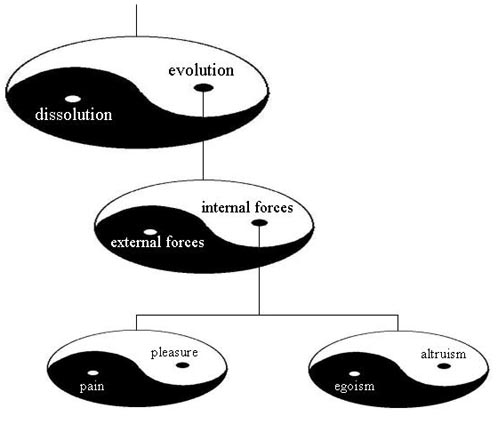
Spencer begins with a famous definition: “Life is the continuous adjustment of internal relations to external relations.” The completeness of life depends on the completeness of this correspondence; and life is perfect when the correspondence is perfect. The correspondence is not a merely passive adaptation; what distinguishes life is the adjustment of internal relations in anticipation of a change in external relations, as when an animal crouches to avoid a blow, or a man makes a fire to warm his food. The defect of the definition lies not merely in its tendency to neglect the remolding activity of the organism upon the environment, but in its failure to explain what is that subtle power whereby an organism is enabled to make these prophetic adjustments that characterize vitality. In a chapter added to later editions, Spencer was forced to discuss “The Dynamic Element in Life,” and to admit that his definition had not really revealed the nature of life. “We are obliged to confess that Life in its essence cannot be conceived in physico-chemical terms.” He did not realize how damaging such an admission was to the unity and completeness of his system. 

Spencer begins with a famous definition: “Life is the continuous adjustment of internal relations to external relations.” But his definition had not really revealed the nature of life.

As Spencer sees in the life of the individual an adjustment of internal to external relations, so he sees in the life of the species a remarkable adjustment of reproductive fertility to the conditions of its habitat. Reproduction arises originally as a re-adaptation of the nutritive surface to the nourished mass; the growth of an amoeba, for example, involves an increase of mass much more rapid than the increase in the surface through which the mass must get its nourishment, Division, budding, spore-formation, and sexual reproduction have this in common, that the ratio of mass to surface is reduced, and the nutritive balance is restored. Hence the growth of the individual organism beyond a certain point is dangerous; and normally growth gives way, after a time, to reproduction. 

Spencer sees in the life of the species a remarkable adjustment of reproductive fertility to the conditions of its habitat. The ratio of mass to surface is prone to adjustment to establish the nutritive balance.

On the average, growth varies inversely with the rate of energy-expenditure; and the rate of reproduction varies inversely with the degree of growth. “It is well known to breeders that if a filly is allowed to bear a foal, she is thereby prevented from reaching her proper size. … As a converse fact, castrated animals, as capons and notably cats, often become larger than their unmutilated associates.” The rate of reproduction tends to fall as the development and capability of the individual progress. “When, from lowness of organization, the ability to contend with external dangers is small, there must be great fertility to compensate for the consequent mortality; otherwise the race must die out. When, on the contrary, high endowments give much capacity for self-preservation, a correspondingly low degree of fertility is requisite,” lest the rate of multiplication should outrun the supply of food. In general, then, there is an opposition of individuation and genesis, or individual development and fertility. The rule holds for groups and species more regularly than for individuals: the more highly developed the species or the group, the lower will its birth-rate be. But it holds for individuals too, on the average. For example, intellectual development seems hostile to fertility. “Where exceptional fertility exists, there is sluggishness of mind, and where there has been, during education, excessive expenditure in mental action, there frequently follows a complete or partial infertility. Hence the particular kind of further evolution which Man is hereafter to undergo is one which, more than any other, may be expected to cause a decline in his power of reproduction.” Philosophers are notorious for shirking parentage. In woman, on the other hand, the arrival of motherhood normally brings a diminution of intellectual activity; and perhaps her shorter adolescence is due to her earlier sacrifice to reproduction.

The more highly developed the species or the group, the lower will its birth-rate be. On the average, the rate of reproduction varies inversely with the degree of growth.

Despite this approximate adaptation of birth-rate to the needs of group survival, the adaptation is never complete, and Malthus was right in his general principle that population tends to outrun the means of subsistence. “From the beginning this pressure of population has been the proximate cause of progress. It produced the original diffusion of the race. It compelled men to abandon predatory habits and take to agriculture. It led to the clearing of the earth’s surface. It forced men into the social state, … and developed the social sentiments. It has stimulated to progressive improvements in production, and to increased skill and intelligence.” It is the chief cause of that struggle for existence through which the fittest are enabled to survive, and through which the level of the race is raised. 

Malthus was also right in his general principle that population tends to outrun the means of subsistence. It is the chief cause of that struggle for existence through which the fittest are enabled to survive, and through which the level of the race is raised. 

Whether the arrival of the fittest is due chiefly to spontaneous favorable variations, or to the partial inheritance of characters or capacities repeatedly acquired by successive generations, is a question on which Spencer took no dogmatic stand; he accepted Darwin’s theory gladly, but felt that there were facts which it could not explain, and which compelled a modified acceptance of Lamarckian views. He defended Lamarck with fine vigor in his controversy with Weismann, and pointed out certain defects in the Darwinian theory. In those days Spencer stood almost alone on the side of Lamarck; it is of some interest to note that today the neo-Lamarckians include descendants of Darwin, while the greatest contemporary English biologist gives it as the view of present-day students of genetics that Darwin’s particular theory (not, of course the general theory) of evolution must be abandoned.

Spencer accepted Darwin’s theory gladly, but felt that there were facts which it could not explain, and which compelled a modified acceptance of Lamarckian views.

.

HERBERT SPENCER: Evolution

Reference: The Story of Philosophy

This paper presents Chapter VIII Section 3.2 from the book THE STORY OF PHILOSOPHY by WILL DURANT. The  contents are from the 1933 reprint of this book by TIME INCORPORATED by arrangement with Simon and Schuster, Inc.

The paragraphs of the original material (in black) are accompanied by brief comments (in color) based on the present understanding.

.

III. First Principles

2. Evolution

Having indicated the unknowable, philosophy surrenders it, and turns its face to what can be known. Metaphysics is a mirage: as Michelet put it, it is “the art of befuddling one’s self methodically.” The proper field and function of philosophy lies in the summation and unification of the results of science. “Knowledge of the lowest kind is un-unified knowledge; science is partially-unified knowledge; philosophy is completely-unified knowledge.” Such complete unification requires a broad and universal principle that will include all experience, and will describe the essential features of all knowledge. Is there a principle of this kind?

The function of philosophy is to completely unify all knowledge. Such complete unification requires a broad and universal principle that will include all experience, and will describe the essential features of all knowledge.

We may perhaps approach such a principle by trying to unify the highest generalizations of physics. These are the indestructibility of matter, the conservation of energy, the continuity of motion, the persistence of relations among forces .(i. e., the inviolability of natural law), the transformability and equivalence of forces (even of mental and physical forces), and the rhythm of motion. This last generalization, not usually recognized, needs only to be pointed out. All nature is rhythmical, from the pulsations of heat to the vibrations of violin strings; from the undulations of light, heat and sound to the tides of the sea; from the periodicities of sex to the periodicities of planets and comets and stars; from the alternation of night and day to the succession of the seasons, and perhaps to the rhythms of climatic change; from the oscillations of molecules to the rise and fall of nations and the birth and death of stars.

It is cyclical universe that contains cycles within cycles of birth and death, start and stop, appearance and disappearance.

All these “laws of the knowable” are reducible (by an analysis which must not here be followed in detail) to the final law of the persistence of force. But there is something static and inert about this principle; it does not so much as ‘hint at the secret of life. What is the dynamic principle of reality? What is the formula of the growth and decay of all things? It must be a formula of evolution and dissolution, for “an entire history of anything must include its appearance out of the imperceptible and its disappearance into the imperceptible.”

The dynamic principle of reality must relate to the growth and decay of all things. It must be a formula of evolution and dissolution.

So Spencer offers us his famous formula of evolution, which made the intellect of Europe gasp for breath, and required ten volumes and forty years for its explanation. “Evolution is an integration of matter and a concomitant dissipation of motion; during which the matter passes from an indefinite, incoherent homogeneity to a definite, coherent heterogeneity; and during which the retained motion undergoes a parallel transformation.” What does this mean?

Spencer’s formula of evolution: “Evolution is an integration of matter and a concomitant dissipation of motion; during which the matter passes from an indefinite, incoherent homogeneity to a definite, coherent heterogeneity; and during which the retained motion undergoes a parallel transformation.”

The growth of planets out of nebulae; the formation of oceans and mountains on the earth; the metabolism of elements by plants, and of animal tissues by men; the development of the heart in the embryo, and the fusion of bones after birth; the unification of sensations and memories into knowledge and thought, and of knowledge into science and philosophy; the development of families into clans and gentes and cities and states and alliances and the “federation of the world”: here is the integration of matter,—the aggregation of separate items into masses and groups and wholes. Such integration of course involves a lessening of motion in the parts, as the growing power of the state lessens the freedom of the individual; but at the same time it gives to the parts an inter-dependence, a protective tissue of relationships, which constitute “coherence” and promote corporate survival. The process brings, too, a greater definiteness of forms and functions: the nebula is shapeless, nebulous; and yet out of it come the elliptical regularity of the planets, the sharp lines of mountain-chains, the specific form and character of organisms and organs, the division of labor and specialization of function in physiological and political structures, etc. And the parts of this integrating whole become not merely definite but diverse, heterogeneous in nature and operation. The primeval nebula is homogeneous—i. e., it consists of parts that are alike; but soon it is differentiated into gases and liquids and solids; the earth becomes here green with grass, there white with mountain-tops, or blue with the multitudinous sea; evolving life begets, out of a relatively homogeneous protoplasm, the varied organs of nutrition, reproduction, locomotion, and perception; a simple language fills whole continents with its, multiplying dialects; a single science breeds a hundred, and the folk-lore of a nation flowers into a thousand forms of literary art; individuality grows, character stands out uniquely, and every race and people develops its peculiar genius. Integration and heterogeneity, aggregation of parts into ever larger wholes and differentiation of parts into ever more varied forms: these are the foci of the orbit of evolution. Whatever passes from diffusion to integration and unity, and from a homogeneous simplicity to a differentiated complexity (cf. America, 1600-1900), is in the flow of evolution; whatever is returning from integration to diffusion, and from complexity to simplicity (cf. Europe 200-600 A. D.), is caught in the ebb of dissolution.

Whatever passes from diffusion to integration and unity, and from a homogeneous simplicity to a differentiated complexity, is in the flow of evolution; whatever is returning from integration to diffusion, and from complexity to simplicity, is caught in the ebb of dissolution.

Not content with this synthetic formula, Spencer endeavors to show how it follows by inevitable necessity from the natural operation of mechanical forces. There is, first, a certain “Instability of the Homogeneous”: i. e., similar parts cannot long remain similar because they are unevenly subjected to external forces; outer parts, e. g., are sooner attacked, like coast-line towns in war; and the variety of occupations moulds similar men into the varied embodiments of a hundred professions and trades. There is, again, a “Multiplication of Effects”: one cause may produce a vast variety of results, and help to differentiate the world; a word amiss, like Marie Antoinette’s, or an altered telegram at Ems, or a wind at Salamis, may play an endless role in history. And there is the law of “Segregation”: the parts of a relatively homogeneous whole, being driven separate into different areas, are shaped by diverse environments into dissimilar products,—as the English become Americans; or Canadians, or Australians, according to the genius of the place. In these many ways the forces of nature build the variety of this evolving world.

Similar parts cannot long remain similar because they are unevenly subjected to external forces. The variety of occupations moulds similar men into the varied embodiments of a hundred professions and trades. In these many ways the forces of nature build the variety of this evolving world.

But finally, and inescapably, comes “Equilibration.” Every motion, being motion under resistance, must sooner or later come to an end; every rhythmic oscillation (unless externally reinforced) suffers some loss of rate and amplitude. The planets ride through a lesser orbit, or will ride, than once they rode; the sun will shine less warmly and brightly as the centuries pass away; the friction of the tides will retard the rotation of the earth. This globe, that throbs and murmurs with a million motions, and luxuriates into a million forms of riotously breeding life, will some day move more leisurely in its orbit and its parts; the blood will run cooler and more slowly in our desiccated veins; we shall not hurry any more; like dying races, we shall think of heaven in terms of rest and not of life; we shall dream of Nirvana. Gradually, and then rapidly, equilibration will become dissolution, the unhappy epilogue of evolution. Societies will disintegrate, masses will migrate, cities will fade into the dark hinterland of peasant life; no government will be strong enough to hold the loosened parts together; social order will cease to be even remembered. And in the individual too, integration will give way to disruption; and that coordination which is life will pass into that diffuse disorder which is death. The earth will be a chaotic theatre of decay, a gloomy drama of energy in irreversible degradation; and it will itself be resolved into the dust and nebula from which it came. The cycle of evolution and dissolution will be complete. The cycle will begin again, and endless times again; but always this will be the denouement. Memento mori is written upon the face of life; and every birth is a prelude to decay and death. 

But finally, and inescapably, comes “Equilibration.” Every motion, being motion under resistance, must sooner or later come to an end. Memento mori is written upon the face of life; and every birth is a prelude to decay and death. 

First Principles is a magnificent drama, telling with almost classic calm the story of the rise and fall, the evolution and dissolution, of planets and life and man; but it is a tragic drama, for which the fittest epilogue is Hamlet’s word—“The rest is silence.” Is there any wonder that men and women nurtured on faith and hope rebelled against this summary of existence? We know that we must die; but as it is a matter that will take care of itself, we prefer to think of life. There was in Spencer an almost Schopenhauerian sense of the futility of human effort. At the end of his triumphant career he expressed his feeling that life was not worth living. He had the philosopher’s disease of seeing so far ahead that all the little pleasant shapes and colors of existence passed under his nose unseen. 

At the end of his triumphant career Spencer expressed his feeling that life was not worth living. He had the philosopher’s disease of seeing so far ahead that all the little pleasant shapes and colors of existence passed under his nose unseen. 

He knew that people would not relish a philosophy whose last word was not God and heaven, but equilibration and dissolution; and in concluding this First Part he defended with unusual eloquence and fervor his right to speak the dark truths that he saw. 

Whoever hesitates to utter that which he thinks the highest truth, lest it should be too much in advance of the time, may reassure himself by looking at his acts from an impersonal point of view. Let him remember that opinion is the agency through which character adapts external arrangements to itself, and that his opinion rightly forms part of this agency—is a unit of force constituting, with other such units, the general. power which works out social changes; and he will perceive that he may properly give utterance to his innermost conviction; leaving it to produce what effect it may. It is not for nothing that he has in him these sympathies with some principles and repugnance to others. He, with all his capacities, and aspirations, and beliefs, is not an accident but a product of the time. While he is a descendant of the past he is a parent of the future; and his thoughts are as children born to him, which he may not carelessly let die. Like every other man he may properly consider himself as one of the myriad agencies through whom works the Unknown Cause; and when the Unknown Cause produces in him a certain belief, he is thereby authorized to profess and act out that belief. … Not as adventitious therefore will the wise man regard the faith that is in him. The highest truth he sees he will fearlessly utter; knowing that, let what may come of it, he is thus playing his right part in the world—knowing that if he can effect the change he aims at—well; if not—well also; though not so well.

Spencer knew that people would not relish a philosophy whose last word was not God and heaven, but equilibration and dissolution; and in concluding this First Part he defended with unusual eloquence and fervor his right to speak the dark truths that he saw. 

.

HERBERT SPENCER: The Unknowable

Reference: The Story of Philosophy

This paper presents Chapter VIII Section 3.1 from the book THE STORY OF PHILOSOPHY by WILL DURANT. The  contents are from the 1933 reprint of this book by TIME INCORPORATED by arrangement with Simon and Schuster, Inc.

The paragraphs of the original material (in black) are accompanied by brief comments (in color) based on the present understanding.

.

III. First Principles

1. The Unknowable 

“We too often forget,” says Spencer at the outset; “that not only is there ‘a soul of goodness in things evil,’ but generally also a soul of truth in things erroneous.” He proposes, therefore, to examine religious ideas, with a view to finding that core of truth which under the changing form of many faiths, has given to religion its persistent power over the human soul. 

Spencer proposes to examine religious ideas, with a view to finding that core of truth which under the changing form of many faiths, has given to religion its persistent power over the human soul. 

What he finds at once is that every theory of the origin of the universe drives us into inconceivabilities. The atheist tries to think of a self-existent world, uncaused and without beginning; but we cannot conceive of anything beginningless or uncaused. The theist merely puts back the difficulty by a step; and to the theologian who says, “God” made the, world,” the child’s unanswerable query comes, “Who made God?” All ultimate religious ideas are logically inconceivable. 

We cannot conceive of anything beginningless or uncaused, nor can we answer the question “Who made God?” All ultimate religious ideas are logically inconceivable. 

All ultimate scientific ideas are equally beyond rational conception. What is matter? We reduce it to atoms, and then find ourselves forced to divide the atom as we had divided the molecule; we are driven into the dilemma that matter is infinitely divisible,—which is inconceivable; or that there is a limit to its divisibility,—which also is inconceivable. So with the divisibility of space and time; both of these are ultimately irrational ideas. Motion is wrapped in a triple obscurity, since it involves matter changing, in time, its position in space. When we analyze matter resolutely we find nothing at last but force—a force impressed upon our organs of sense, or a force resisting our organs of action; and who, shall tell us what force is? Turn from physics to psychology, and we come upon mind and consciousness: and here are greater puzzles than before. “Ultimate scientific ideas,” then, “are all representations of realities that cannot be comprehended. … In all directions the scientist’s investigations bring him face to face with an insoluble enigma; and he ever more clearly perceives it to be an insoluble enigma. He learns at once the greatness and the littleness of the human intellect—its power in dealing with all that comes within the range of experience, its impotence in dealing with all that transcends experience. He, more than any other, truly knows that in its ultimate nature nothing can be known.” The only honest philosophy, to use Huxley’s word, is agnosticism.

All ultimate scientific ideas are equally beyond rational conception. Matter reduces to motion; and motion reduces to force. Who shall tell us what force is? The human intellect knows that in its ultimate nature nothing can be known.

The common cause of these obscurities is the relativity of all knowledge. “Thinking being relating, no thought can express more than relations. … Intellect being, framed simply by and for converse with phenomena, involves us in nonsense when we try to use it for anything beyond phenomena.”* And yet the relative and phenomenal imply by their names and natures something beyond them, something ultimate and absolute. “On watching our thoughts we see how impossible it is to get rid of the consciousness of an Actuality lying behind Appearances, and how from this impossibility results our indestructible belief in that Actuality.”  But what that Actuality is we cannot know.

*This unconsciously follows Kant, and succinctly anticipates Bergson.

The common cause of these obscurities is the relativity of all knowledge. And yet the relative and phenomenal imply something ultimate and absolute beyond them. But what that Actuality is we cannot know.

From this point of view the reconciliation of science and religions is no longer very difficult. “Truth generally lies in the coordination of antagonistic opinions.” Let science admit that its “laws” apply only to phenomena and the relative; let religion admit that its theology is a rationalizing myth for a belief that defies conception. Let religion cease to picture the Absolute as a magnified man; much worse, as a cruel and blood-thirsty and treacherous monster, afflicted with “a love of adulation such as would be despised in a human being.” Let science cease to deny deity, or to take materialism for granted. Mind and matter are, equally, relative phenomena, the double effect of an ultimate cause whose nature must remain unknown. The recognition of this Inscrutable Power is the core of truth in every religion, and the beginning of all philosophy.

Scientific “laws” apply only to phenomena and the relative. Religious theology is simply a rationalizing myth for a belief that defies conception. But there is an Inscrutable Power whose nature must remain unknown.

.

FINAL COMMENTS

.

Herbert Spencer:

  1. What core of truth, under the changing form of many faiths, has given to religion its persistent power over the human soul. 
  2. Every theory of the origin of the universe drives us into inconceivabilities.
  3. We cannot conceive of anything beginning-less or uncaused.
  4. All ultimate religious ideas are logically inconceivable. 
  5. All ultimate scientific ideas are equally beyond rational conception.
  6. Matter comes from atoms, which come from electromagnetic radiation, which comes from force, which comes from ???
  7. Man truly knows that in its ultimate nature nothing can be known.
  8. The common cause of these obscurities is the relativity of all knowledge.
  9. There is something beyond but we cannot know it.
  10. The laws in science apply only to phenomena and the relative.
  11. Theology in religion is a rationalizing myth for a belief that defies conception.
  12. There is an inscrutable Power.

.